Overview
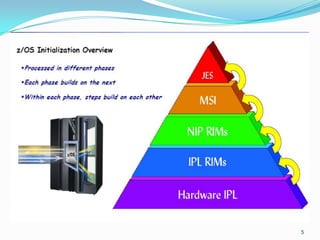
 IPL is “booting” the system
 An initial program load (IPL) is the act of loading a
copy of the operating system from disk into the
processor’s real storage and executing it..
2
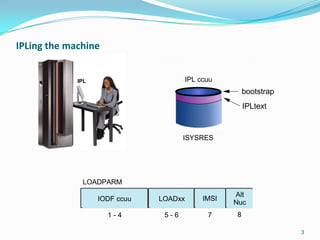
IPLing the machine
LOADPARM
bootstrap
IPL ccuu
ISYSRES
IPLtext
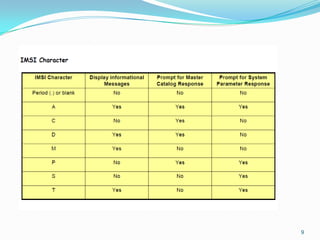
IODF ccuu LOADxx IMSI
Alt
Nuc
1 - 4 5 - 6 7 8
IPL
3
4
5
6
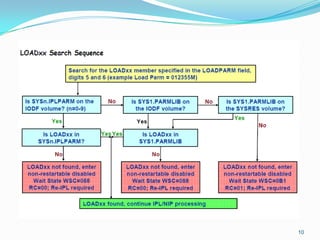
LOADxx
7
8
9
10
Initialization Process
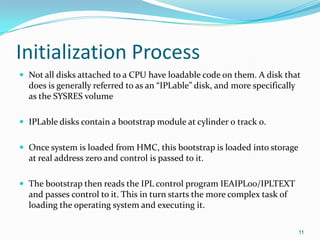
 Not all disks attached to a CPU have loadable code on them. A disk that
does is generally referred to as an “IPLable” disk, and more specifically
as the SYSRES volume
 IPLable disks contain a bootstrap module at cylinder 0 track 0.
 Once system is loaded from HMC, this bootstrap is loaded into storage
at real address zero and control is passed to it.
 The bootstrap then reads the IPL control program IEAIPL00/IPLTEXT
and passes control to it. This in turn starts the more complex task of
loading the operating system and executing it.
11
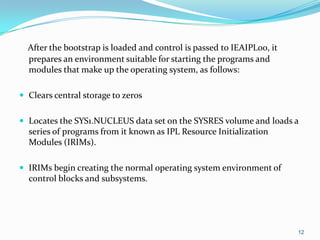
After the bootstrap is loaded and control is passed to IEAIPL00, it
prepares an environment suitable for starting the programs and
modules that make up the operating system, as follows:
 Clears central storage to zeros
 Locates the SYS1.NUCLEUS data set on the SYSRES volume and loads a
series of programs from it known as IPL Resource Initialization
Modules (IRIMs).
 IRIMs begin creating the normal operating system environment of
control blocks and subsystems.
12
IRIM Functions
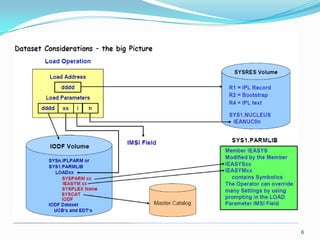
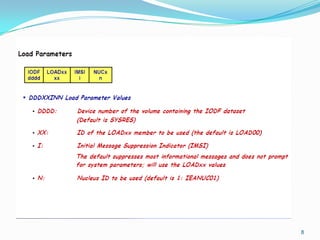
 Read the LOADPARM information entered on the hardware console at
the time the IPL command was executed.
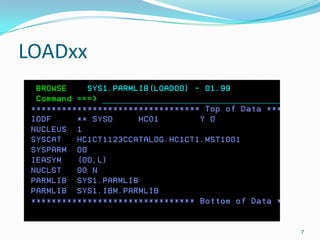
 IRIM will first attempt to locate LOADxx in SYS0.IPLPARM &
continues till SYS1.PARMLIB
 Get the information from LOADxx including the nucleus suffix, the
master catalog name, and the suffix of the IEASYSxx member to be
used, is read from it.
 Load the operating system’s nucleus & initialize virtual storage in
master scheduler address space for SQA
13
 Initialize real storage management, including the segment table for the
master scheduler, segment table entries for common storage areas, and
the page frame table.
 At last of the IRIMs then loads the first part of the Nucleus
Initialization
 Program (NIP), which invokes the Resource Initialization Modules
(RIMs), one of the earliest of which starts up communications with the
NIP console defined in the IODF.
14
NIP Functions
 Expands the SQA and the extended SQA by the amounts specified on the SQA
system parameter.
 Creates the pageable link pack area (PLPA) and the extended PLPA for a cold
start IPL
 Loads modules into the fixed link pack area (FLPA)
 Loads modules into the modified link pack area (MLPA)
 Allocates virtual storage for the common service area (CSA)
15
System address space creation
 In addition to initializing system areas, z/OS establishes
system component address spaces. It establishes an address
space for the master scheduler and other system address
spaces for various subsystems and system components.
 Some of the component address spaces are: *MASTER*,
ALLOCAS, APPC, CATALOG, and so on.
16
Master scheduler initialization
 Master scheduler initialization routines initialize system
services such as the system log and communications task,
and start the master scheduler itself. They also cause
creation of the system address space for the job entry
subsystem (JES2 or JES3), and then start the job entry
subsystem.
17
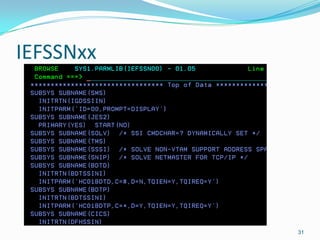
Subsystem initialization
 Subsystem initialization is the process of readying a
subsystem for use in the system.
 IEFSSNxx members of SYS1.PARMLIB contain the
definitions for the primary subsystems such as JES2 or JES3,
and the secondary subsystems such as NetView and DB2.
18
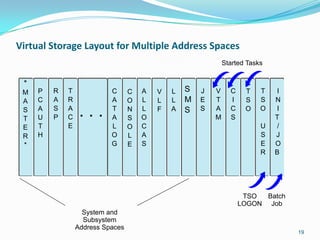
Virtual Storage Layout for Multiple Address Spaces
Started Tasks
*
M
A
S
T
E
R
*
P
C
A
U
T
H
R
A
S
P
T
R
A
C
E
. . .
C
A
T
A
L
O
G
C
O
N
S
O
L
E
A
L
L
O
C
A
S
V
L
F
L
L
A
J
E
S
V
T
A
M
C
I
C
S
T
S
O
T
S
O
U
S
E
R
I
N
I
T
/
J
O
B
Batch
Job
TSO
LOGON
System and
Subsystem
Address Spaces
S
M
S
19
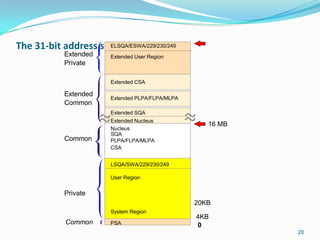
The 31-bit address space
0
16 MB
16M
Extended
Private
ELSQA/ESWA/229/230/249
Extended User Region
Extended
Common
Common
Private
Common
Extended CSA
Extended PLPA/FLPA/MLPA
Extended SQA
Extended Nucleus
Nucleus
SQA
PLPA/FLPA/MLPA
CSA
LSQA/SWA/229/230/249
User Region
System Region
PSA
20KB
4KB
20
21
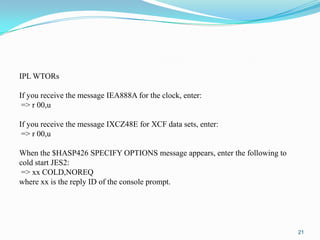
IPL WTORs
If you receive the message IEA888A for the clock, enter:
=> r 00,u
If you receive the message IXCZ48E for XCF data sets, enter:
=> r 00,u
When the $HASP426 SPECIFY OPTIONS message appears, enter the following to
cold start JES2:
=> xx COLD,NOREQ
where xx is the reply ID of the console prompt.
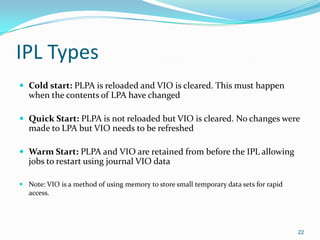
IPL Types
 Cold start: PLPA is reloaded and VIO is cleared. This must happen
when the contents of LPA have changed
 Quick Start: PLPA is not reloaded but VIO is cleared. No changes were
made to LPA but VIO needs to be refreshed
 Warm Start: PLPA and VIO are retained from before the IPL allowing
jobs to restart using journal VIO data
 Note: VIO is a method of using memory to store small temporary data sets for rapid
access.
22
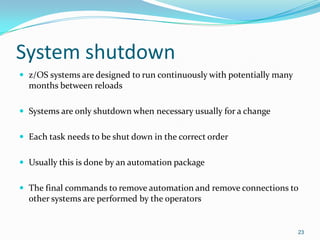
System shutdown
 z/OS systems are designed to run continuously with potentially many
months between reloads
 Systems are only shutdown when necessary usually for a change
 Each task needs to be shut down in the correct order
 Usually this is done by an automation package
 The final commands to remove automation and remove connections to
other systems are performed by the operators
23
SYSTEM PARMLIBs
24
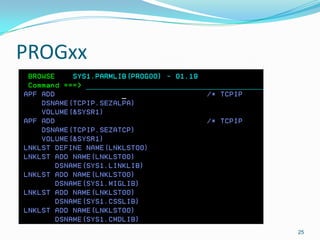
PROGxx
25
26
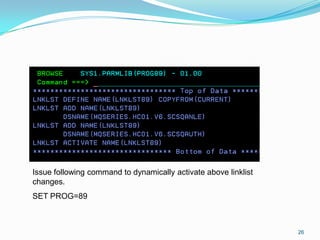
Issue following command to dynamically activate above linklist
changes.
SET PROG=89
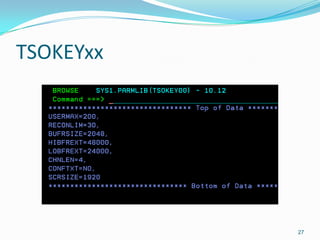
TSOKEYxx
27
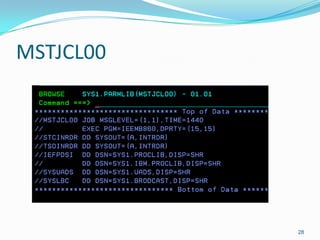
MSTJCL00
28
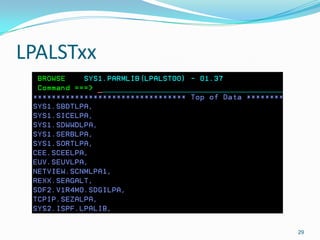
LPALSTxx
29
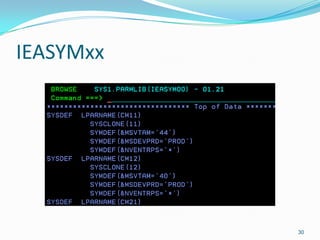
IEASYMxx
30
IEFSSNxx
31
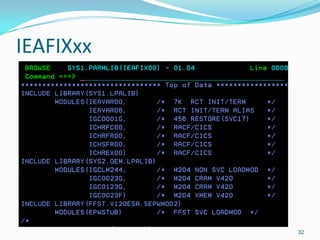
IEAFIXxx



32
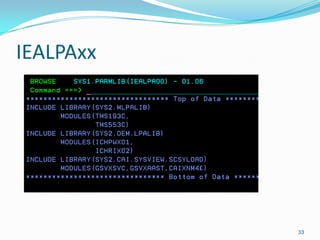
IEALPAxx
33
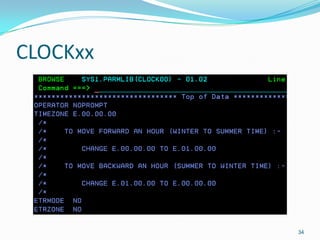
CLOCKxx
34
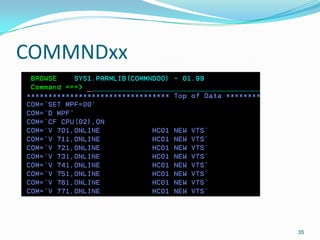
COMMNDxx
35
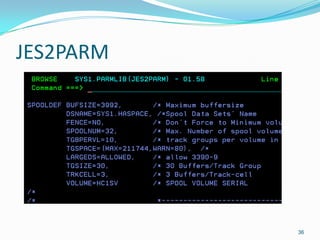
JES2PARM
36
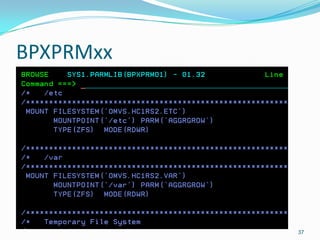
BPXPRMxx
37
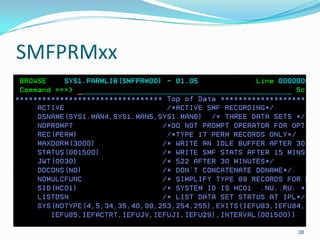
SMFPRMxx
38
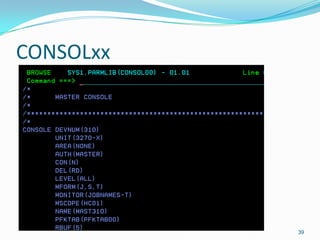
CONSOLxx
39
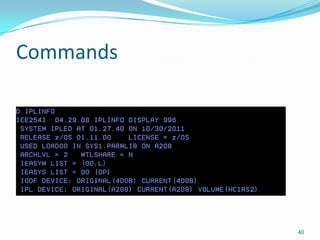
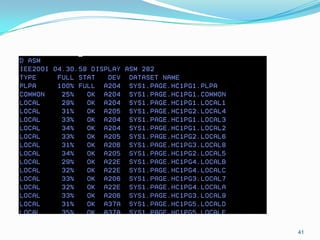
Commands
40
41
Thank You 
42

Ipl process

  • 2.
    Overview  IPL is“booting” the system  An initial program load (IPL) is the act of loading a copy of the operating system from disk into the processor’s real storage and executing it.. 2
  • 3.
    IPLing the machine LOADPARM bootstrap IPLccuu ISYSRES IPLtext IODF ccuu LOADxx IMSI Alt Nuc 1 - 4 5 - 6 7 8 IPL 3
  • 4.
  • 5.
  • 6.
  • 7.
  • 8.
  • 9.
  • 10.
  • 11.
    Initialization Process  Notall disks attached to a CPU have loadable code on them. A disk that does is generally referred to as an “IPLable” disk, and more specifically as the SYSRES volume  IPLable disks contain a bootstrap module at cylinder 0 track 0.  Once system is loaded from HMC, this bootstrap is loaded into storage at real address zero and control is passed to it.  The bootstrap then reads the IPL control program IEAIPL00/IPLTEXT and passes control to it. This in turn starts the more complex task of loading the operating system and executing it. 11
  • 12.
    After the bootstrapis loaded and control is passed to IEAIPL00, it prepares an environment suitable for starting the programs and modules that make up the operating system, as follows:  Clears central storage to zeros  Locates the SYS1.NUCLEUS data set on the SYSRES volume and loads a series of programs from it known as IPL Resource Initialization Modules (IRIMs).  IRIMs begin creating the normal operating system environment of control blocks and subsystems. 12
  • 13.
    IRIM Functions  Readthe LOADPARM information entered on the hardware console at the time the IPL command was executed.  IRIM will first attempt to locate LOADxx in SYS0.IPLPARM & continues till SYS1.PARMLIB  Get the information from LOADxx including the nucleus suffix, the master catalog name, and the suffix of the IEASYSxx member to be used, is read from it.  Load the operating system’s nucleus & initialize virtual storage in master scheduler address space for SQA 13
  • 14.
     Initialize realstorage management, including the segment table for the master scheduler, segment table entries for common storage areas, and the page frame table.  At last of the IRIMs then loads the first part of the Nucleus Initialization  Program (NIP), which invokes the Resource Initialization Modules (RIMs), one of the earliest of which starts up communications with the NIP console defined in the IODF. 14
  • 15.
    NIP Functions  Expandsthe SQA and the extended SQA by the amounts specified on the SQA system parameter.  Creates the pageable link pack area (PLPA) and the extended PLPA for a cold start IPL  Loads modules into the fixed link pack area (FLPA)  Loads modules into the modified link pack area (MLPA)  Allocates virtual storage for the common service area (CSA) 15
  • 16.
    System address spacecreation  In addition to initializing system areas, z/OS establishes system component address spaces. It establishes an address space for the master scheduler and other system address spaces for various subsystems and system components.  Some of the component address spaces are: *MASTER*, ALLOCAS, APPC, CATALOG, and so on. 16
  • 17.
    Master scheduler initialization Master scheduler initialization routines initialize system services such as the system log and communications task, and start the master scheduler itself. They also cause creation of the system address space for the job entry subsystem (JES2 or JES3), and then start the job entry subsystem. 17
  • 18.
    Subsystem initialization  Subsysteminitialization is the process of readying a subsystem for use in the system.  IEFSSNxx members of SYS1.PARMLIB contain the definitions for the primary subsystems such as JES2 or JES3, and the secondary subsystems such as NetView and DB2. 18
  • 19.
    Virtual Storage Layoutfor Multiple Address Spaces Started Tasks * M A S T E R * P C A U T H R A S P T R A C E . . . C A T A L O G C O N S O L E A L L O C A S V L F L L A J E S V T A M C I C S T S O T S O U S E R I N I T / J O B Batch Job TSO LOGON System and Subsystem Address Spaces S M S 19
  • 20.
    The 31-bit addressspace 0 16 MB 16M Extended Private ELSQA/ESWA/229/230/249 Extended User Region Extended Common Common Private Common Extended CSA Extended PLPA/FLPA/MLPA Extended SQA Extended Nucleus Nucleus SQA PLPA/FLPA/MLPA CSA LSQA/SWA/229/230/249 User Region System Region PSA 20KB 4KB 20
  • 21.
    21 IPL WTORs If youreceive the message IEA888A for the clock, enter: => r 00,u If you receive the message IXCZ48E for XCF data sets, enter: => r 00,u When the $HASP426 SPECIFY OPTIONS message appears, enter the following to cold start JES2: => xx COLD,NOREQ where xx is the reply ID of the console prompt.
  • 22.
    IPL Types  Coldstart: PLPA is reloaded and VIO is cleared. This must happen when the contents of LPA have changed  Quick Start: PLPA is not reloaded but VIO is cleared. No changes were made to LPA but VIO needs to be refreshed  Warm Start: PLPA and VIO are retained from before the IPL allowing jobs to restart using journal VIO data  Note: VIO is a method of using memory to store small temporary data sets for rapid access. 22
  • 23.
    System shutdown  z/OSsystems are designed to run continuously with potentially many months between reloads  Systems are only shutdown when necessary usually for a change  Each task needs to be shut down in the correct order  Usually this is done by an automation package  The final commands to remove automation and remove connections to other systems are performed by the operators 23
  • 24.
  • 25.
  • 26.
    26 Issue following commandto dynamically activate above linklist changes. SET PROG=89
  • 27.
  • 28.
  • 29.
  • 30.
  • 31.
  • 32.
  • 33.
  • 34.
  • 35.
  • 36.
  • 37.
  • 38.
  • 39.
  • 40.
  • 41.
  • 42.