
BRDF MODEL
Teppei Kurita
REFLECTION PROPERTIES
Bidirectional Reflectance
Distribution Function
(BRDF)
Single-wavelength
Scattering function
Texture Map
Bidirectional Scattering Surface
Reflectance Distribution Function
(BSSRDF)
Surface Light Fields
Isotropic Bidirectional
Reflectance Distribution Function
(Isotropic BRDF)
Although there is no clear
definition, the general usage is
as follows
BTF
• Contains internal scattering,
shadowing and occlusion in
the same material
SVBRDF
• Parametric BRDF expression
considering spatial changes
not considered above
Assuming
Lambert
Ignore
incident light
Same incident
and reflection
position
Ignore
spatial
changes
Ignore
surface
scattering
Ignore
anisotropy
Δx,Δy
Bidirectional Texture Function
(BTF)
Spatially Varying Bidirectional
Reflectance Distribution Function
(SVBRDF)
Ignore
spatial
changes
ASSUMPTION (1)
• Radiant flux
• Radiant energy per unit time
• Irradiance
• Radiant flux per unit area
• Radiance
• Radiant flux per unit solid angle and unit projected area
• BRDF
• Ratio of Radiance and Irradiance
• BRDF multiplied by angle cos 𝜃 between normal and light source direction is a general
reflection model
• As a general description, many Lambert reflections are multiplied by cos 𝜃 , but to be exact,
it is not a BRDF but a reflection model.
ASSUMPTION (2)
• Dichromatic Reflection
• Almost all parametric BRDF expressions assume dichroic reflection (addition of diffuse
reflection and specular reflection)
• Observed values originally include ambient light terms, omitted for the sake of simplicity to
focus on BRDF expressions
• 𝑖 = 𝑖 𝑑 + 𝑖 𝑠
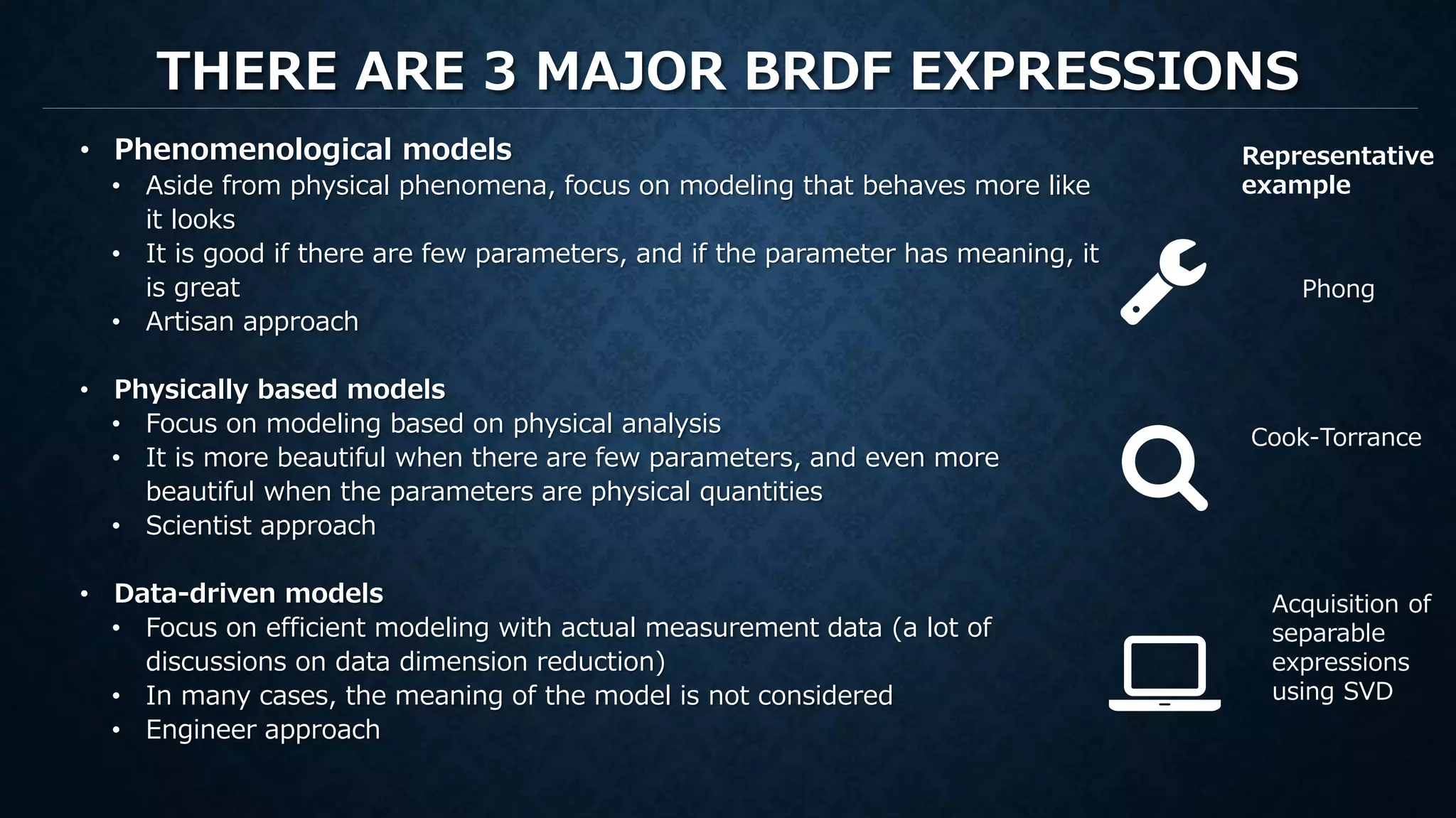
THERE ARE 3 MAJOR BRDF EXPRESSIONS
• Phenomenological models
• Aside from physical phenomena, focus on modeling that behaves more like
it looks
• It is good if there are few parameters, and if the parameter has meaning, it
is great
• Artisan approach
• Physically based models
• Focus on modeling based on physical analysis
• It is more beautiful when there are few parameters, and even more
beautiful when the parameters are physical quantities
• Scientist approach
• Data-driven models
• Focus on efficient modeling with actual measurement data (a lot of
discussions on data dimension reduction)
• In many cases, the meaning of the model is not considered
• Engineer approach
Representative
example
Phong
Cook-Torrance
Acquisition of
separable
expressions
using SVD
EVALUATION OF BRDF MODEL
• It is better to be able to express many materials and
objects (Less error is better)
• It is better to be able to describe with few parameters
• Shorter expression is better
• It is better not to have a magic number
• Almost all evaluation databases use the following:
「MERL BRDF Database https://www.merl.com/brdf/」
MERL BRDF Database [2006]
HISTORICAL TRANSITION OF THE BRDF MODEL
Phenomenologi
cal models
Physically
based models
Data-driven
models
BRDF Models
Phong
[1975]
Blinn-Phong
[1977]
Ward
[1992]
Lafortune
[1997]
Ashikhmin-Shirley
[2000]
Ashikhmin-Premoze
[2007]
Nishino and Lombardi
[2011]
Brady
[2014]
Cook-Torrance
[1982]
Walter
[2007]
He
[1991]
Oren-Nayar
[1994]
Ershov
[2001]
Rump
[2008]
Kurt
[2010]
Low
[2012]
Jakob
[2014]
Kautz and McCool
[1999]
McCool and Ahmad
[2001]
Lawrence
[2004,6]
Ozturk
[2008]
Pacanows
ki
[2012]
Ward
[2014]
Matusik
[2003]
Romeiro
[2008]
isotropic
anisotropic
isotropic
isotropic
anisotropic
anisotropic
Lambert
[1760]
In the following, we will give an overview of the rough
meaning and inventive step of an important model
Weidlich and Wilkie
[2007]
Depuy
[2015]
Burley
[2012]
PROPER EVOLUTION OF DIFFUSE REFLECTION TERMS
R
All observation brightness is the
same regardless of observation
direction
Parameter:1 𝜌 𝑑
H
Reproduces the phenomenon in which the appearance of diffuse reflection
changes depending on the observation direction and surface roughness m
When m = 0, it is equivalent to Lambert
Parameter:2 𝜌 𝑑, 𝑚
N
Phenomenologi
cal models
Physically
based models
Data-driven
models
BRDF Models
Phong
[1975]
Blinn-Phong
[1977]
Ward
[1992]
Lafortune
[1997]
Ashikhmin-Shirley
[2000]
Ashikhmin-Premoze
[2007]
Nishino and Lombardi
[2011]
Brady
[2014]
Cook-Torrance
[1982]
Walter
[2007]
He
[1991]
Oren-Nayar
[1994]
Ershov
[2001]
Rump
[2008]
Kurt
[2010]
Low
[2012]
Jakob
[2014]
Kautz and McCool
[1999]
McCool and Ahmad
[2001]
Lawrence
[2004,6]
Ozturk
[2008]
Pacanows
ki
[2012]
Ward
[2014]
Matusik
[2003]
Romeiro
[2008]
isotropic
anisotropic
isotropic
isotropic
anisotropic
anisotropic
Lambert
[1760]
Lambert [1760] Oren-Nayar [1994]
Weidlich and Wilkie
[2007]
Depuy
[2015]
Burley
[2012]
Weidlich and Wilkie
[2007]
Depuy
[2015]
Burley
[2012]
PROPER EVOLUTION OF DIFFUSE REFLECTION TERMS
R
HN
Phenomenologi
cal models
Physically
based models
Data-driven
models
BRDF Models
Phong
[1975]
Blinn-Phong
[1977]
Ward
[1992]
Lafortune
[1997]
Ashikhmin-Shirley
[2000]
Ashikhmin-Premoze
[2007]
Nishino and Lombardi
[2011]
Brady
[2014]
Cook-Torrance
[1982]
Walter
[2007]
He
[1991]
Oren-Nayar
[1994]
Ershov
[2001]
Rump
[2008]
Kurt
[2010]
Low
[2012]
Jakob
[2014]
Kautz and McCool
[1999]
McCool and Ahmad
[2001]
Lawrence
[2004,6]
Ozturk
[2008]
Pacanows
ki
[2012]
Ward
[2014]
Matusik
[2003]
Romeiro
[2008]
isotropic
anisotropic
isotropic
isotropic
anisotropic
anisotropic
Lambert
[1760]
m=0
m=50
m=100
Lambert [1760]
All observation brightness is the
same regardless of observation
direction
Parameter:1 𝜌 𝑑
Oren-Nayar [1994]
Reproduces the phenomenon in which the appearance of diffuse reflection
changes depending on the observation direction and surface roughness m
When m = 0, it is equivalent to Lambert
Parameter:2 𝜌 𝑑, 𝑚
PROPER EVOLUTION OF SPECULAR REFLECTION TERMS
R
Reflection is stronger as the angle
of reflected light R and observation
direction V matches
Spread varies depending on surface
roughness m
Parameter:3 𝜌 𝑑, 𝜌𝑠, 𝑚
H
Reflection is stronger as the angle of
normal direction N and half vector H
match
Spread varies depending on surface
roughness m
Parameter:3 𝜌 𝑑, 𝜌𝑠, 𝑚
N
Determined by D (microfacet
distribution term), G
(Shadowing/Masking term), and F
(Fresnel term)
D is important
Parameter:4 𝜌 𝑑, 𝜌𝑠, 𝑚, 𝐹0
Phenomenologi
cal models
Physically
based models
Data-driven
models
BRDF Models
Phong
[1975]
Blinn-Phong
[1977]
Ward
[1992]
Lafortune
[1997]
Ashikhmin-Shirley
[2000]
Ashikhmin-Premoze
[2007]
Nishino and Lombardi
[2011]
Brady
[2014]
Cook-Torrance
[1982]
Walter
[2007]
He
[1991]
Oren-Nayar
[1994]
Ershov
[2001]
Rump
[2008]
Kurt
[2010]
Low
[2012]
Jakob
[2014]
Kautz and McCool
[1999]
McCool and Ahmad
[2001]
Lawrence
[2004,6]
Ozturk
[2008]
Pacanows
ki
[2012]
Ward
[2014]
Matusik
[2003]
Romeiro
[2008]
isotropic
anisotropic
isotropic
isotropic
anisotropic
anisotropic
Lambert
[1760]
Phong [1975] Blinn-Phong [1977] Cook-Torrance [1982]
Weidlich and Wilkie
[2007]
Depuy
[2015]
Burley
[2012]
PROPER EVOLUTION OF SPECULAR REFLECTION TERMS
R
HN
Phenomenologi
cal models
Physically
based models
Data-driven
models
BRDF Models
Phong
[1975]
Blinn-Phong
[1977]
Ward
[1992]
Lafortune
[1997]
Ashikhmin-Shirley
[2000]
Ashikhmin-Premoze
[2007]
Nishino and Lombardi
[2011]
Brady
[2014]
Cook-Torrance
[1982]
Walter
[2007]
He
[1991]
Oren-Nayar
[1994]
Ershov
[2001]
Weidlich and Wilkie
[2007]
Depuy
[2015]
Rump
[2008]
Kurt
[2010]
Low
[2012]
Jakob
[2014]
Kautz and McCool
[1999]
McCool and Ahmad
[2001]
Lawrence
[2004,6]
Ozturk
[2008]
Pacanows
ki
[2012]
Ward
[2014]
Matusik
[2003]
Romeiro
[2008]
isotropic
anisotropic
isotropic
isotropic
anisotropic
anisotropic
Lambert
[1760]
m=10
m=50
m=200
m=10
m=50
m=200
m=0.05
f0=0.01
m=0.5
f0=0.01
m=0.05
f0=0.1
Phong [1975]
Reflection is stronger as the angle
of reflected light R and observation
direction V matches
Spread varies depending on surface
roughness m
Parameter:3 𝜌 𝑑, 𝜌𝑠, 𝑚
Blinn-Phong [1977]
Reflection is stronger as the angle of
normal direction N and half vector H
match
Spread varies depending on surface
roughness m
Parameter:3 𝜌 𝑑, 𝜌𝑠, 𝑚
Cook-Torrance [1982]
Determined by D (microfacet
distribution term), G
(Shadowing/Masking term), and F
(Fresnel term)
D is important
Parameter:4 𝜌 𝑑, 𝜌𝑠, 𝑚, 𝐹0
DETAILS OF COOK-TORRANCE [1982]
R
HN
Shadowing/Masking Term
Fresnel Term
Recent renderers almost use the Schlick approximation
This generalization is still widely
used regardless of the contents
of each term
Microfacet Distribution Term
F0 is the Fresnel response (reflectance) at an incident
angle of 0 °, which is parameterized
m is the surface roughness
(parameter), and the specular
reflection spread changes
ANISOTROPIC EXTENSION OF MICROFACET DISTRIBUTION TERMS
R
First definition of microfacet distribution
terms based on Gaussian function
(initially simpler form)
Parameter:4 𝜌 𝑑, 𝜌𝑠, 𝑚, 𝐹0
H Ward [1992]N Isotropic microfacet distribution terms
Anisotropic microfacet
distribution term
Define for the first time an extension that gives direction to the
microfacet distribution terms
Parameter:5 𝜌 𝑑, 𝜌𝑠, 𝑚 𝑥, 𝑚 𝑦, 𝐹0
Cook-Torrance [1982]
Phenomenologi
cal models
Physically
based models
Data-driven
models
BRDF Models
Phong
[1975]
Blinn-Phong
[1977]
Ward
[1992]
Lafortune
[1997]
Ashikhmin-Shirley
[2000]
Ashikhmin-Premoze
[2007]
Nishino and Lombardi
[2011]
Brady
[2014]
Cook-Torrance
[1982]
Walter
[2007]
He
[1991]
Oren-Nayar
[1994]
Ershov
[2001]
Rump
[2008]
Kurt
[2010]
Low
[2012]
Jakob
[2014]
Kautz and McCool
[1999]
McCool and Ahmad
[2001]
Lawrence
[2004,6]
Ozturk
[2008]
Pacanows
ki
[2012]
Ward
[2014]
Matusik
[2003]
Romeiro
[2008]
isotropic
anisotropic
isotropic
isotropic
anisotropic
anisotropic
Lambert
[1760]
Weidlich and Wilkie
[2007]
Depuy
[2015]
Burley
[2012]
Weidlich and Wilkie
[2007]
Depuy
[2015]
Burley
[2012]
ANISOTROPIC EXTENSION OF MICROFACET DISTRIBUTION TERMS
R
HN
Phenomenologi
cal models
Physically
based models
Data-driven
models
BRDF Models
Phong
[1975]
Blinn-Phong
[1977]
Ward
[1992]
Lafortune
[1997]
Ashikhmin-Shirley
[2000]
Ashikhmin-Premoze
[2007]
Nishino and Lombardi
[2011]
Brady
[2014]
Cook-Torrance
[1982]
Walter
[2007]
He
[1991]
Oren-Nayar
[1994]
Ershov
[2001]
Rump
[2008]
Kurt
[2010]
Low
[2012]
Jakob
[2014]
Kautz and McCool
[1999]
McCool and Ahmad
[2001]
Lawrence
[2004,6]
Ozturk
[2008]
Pacanows
ki
[2012]
Ward
[2014]
Matusik
[2003]
Romeiro
[2008]
isotropic
anisotropic
isotropic
isotropic
anisotropic
anisotropic
Lambert
[1760]
mx=0.1
my=0.1
mx=0.1
my=0.5
First definition of microfacet distribution
terms based on Gaussian function
(initially simpler form)
Parameter:4 𝜌 𝑑, 𝜌𝑠, 𝑚, 𝐹0
Ward [1992] Isotropic microfacet distribution terms
Anisotropic microfacet
distribution term
Define for the first time an extension that gives direction to the
microfacet distribution terms
Parameter:5 𝜌 𝑑, 𝜌𝑠, 𝑚 𝑥, 𝑚 𝑦, 𝐹0
Cook-Torrance [1982]
INCREASE PARAMETERS AND GENERALIZE
R
H Lafortune [1997]
Introducing the concept of generalization and specular lobes (superposition) for the first time by
increasing parameters
Parameter:Minimum 6~ 𝜌 𝑑, 𝜌𝑠, 𝑚, 𝐶 𝑥, 𝐶 𝑦, 𝐶𝑧 × 𝑙
Phenomenologi
cal models
Physically
based models
Data-driven
models
BRDF Models
Phong
[1975]
Blinn-Phong
[1977]
Ward
[1992]
Lafortune
[1997]
Ashikhmin-Shirley
[2000]
Ashikhmin-Premoze
[2007]
Nishino and Lombardi
[2011]
Brady
[2014]
Cook-Torrance
[1982]
Walter
[2007]
He
[1991]
Oren-Nayar
[1994]
Ershov
[2001]
Rump
[2008]
Kurt
[2010]
Low
[2012]
Jakob
[2014]
Kautz and McCool
[1999]
McCool and Ahmad
[2001]
Lawrence
[2004,6]
Ozturk
[2008]
Pacanows
ki
[2012]
Ward
[2014]
Matusik
[2003]
Romeiro
[2008]
isotropic
anisotropic
isotropic
isotropic
anisotropic
anisotropic
Lambert
[1760]
N
Weidlich and Wilkie
[2007]
Depuy
[2015]
Burley
[2012]
MODELING THE INDEPENDENCE OF DIFFUSE AND SPECULAR REFLECTION
R
HN
Modeled the phenomenon where diffuse reflection and specular reflection are not independent
Parameter:5 𝜌 𝑑, 𝜌𝑠, 𝑚 𝑥, 𝑚 𝑦, 𝐹0
Diffuse reflection term
Specular
reflection
term
Micro facets
Distribution term
Phenomenologi
cal models
Physically
based models
Data-driven
models
BRDF Models
Phong
[1975]
Blinn-Phong
[1977]
Ward
[1992]
Lafortune
[1997]
Ashikhmin-Shirley
[2000]
Ashikhmin-Premoze
[2007]
Nishino and Lombardi
[2011]
Brady
[2014]
Cook-Torrance
[1982]
Walter
[2007]
He
[1991]
Oren-Nayar
[1994]
Ershov
[2001]
Rump
[2008]
Kurt
[2010]
Low
[2012]
Jakob
[2014]
Kautz and McCool
[1999]
McCool and Ahmad
[2001]
Lawrence
[2004,6]
Ozturk
[2008]
Pacanows
ki
[2012]
Ward
[2014]
Matusik
[2003]
Romeiro
[2008]
isotropic
anisotropic
isotropic
isotropic
anisotropic
anisotropic
Lambert
[1760]
Ashikhmin-Shirley [2000]
Weidlich and Wilkie
[2007]
Depuy
[2015]
Burley
[2012]
MODELING THE INDEPENDENCE OF DIFFUSE AND SPECULAR REFLECTION
R
HN
Phenomenologi
cal models
Physically
based models
Data-driven
models
BRDF Models
Phong
[1975]
Blinn-Phong
[1977]
Ward
[1992]
Lafortune
[1997]
Ashikhmin-Shirley
[2000]
Ashikhmin-Premoze
[2007]
Nishino and Lombardi
[2011]
Brady
[2014]
Cook-Torrance
[1982]
Walter
[2007]
He
[1991]
Oren-Nayar
[1994]
Ershov
[2001]
Rump
[2008]
Kurt
[2010]
Low
[2012]
Jakob
[2014]
Kautz and McCool
[1999]
McCool and Ahmad
[2001]
Lawrence
[2004,6]
Ozturk
[2008]
Pacanows
ki
[2012]
Ward
[2014]
Matusik
[2003]
Romeiro
[2008]
isotropic
anisotropic
isotropic
isotropic
anisotropic
anisotropic
Lambert
[1760]
mx=100
my=100
mx=100
my=500
Ashikhmin-Shirley [2000]
Modeled the phenomenon where diffuse reflection and specular reflection are not independent
Parameter:5 𝜌 𝑑, 𝜌𝑠, 𝑚 𝑥, 𝑚 𝑦, 𝐹0
Diffuse reflection term
Specular
reflection
term
Micro facets
Distribution term
Weidlich and Wilkie
[2007]
Depuy
[2015]
Burley
[2012]
CONSIDER TRANSMISSION, MIRROR LOBE
R
H Walter [2007]N
Strengthening D and G taking into account
transmission components (GGX model)
Parameter:4 𝜌 𝑑, 𝜌𝑠, 𝑚, 𝐹0
Kurt [2010]
Specular reflection component is expressed by
superimposing lobes on the basis of Cook-Torrance
Parameter:Minimum 5~ 𝜌 𝑑, (𝜌𝑠, 𝛼, 𝑚, 𝐹0) × 𝑙
Phenomenologi
cal models
Physically
based models
Data-driven
models
BRDF Models
Phong
[1975]
Blinn-Phong
[1977]
Ward
[1992]
Lafortune
[1997]
Ashikhmin-Shirley
[2000]
Ashikhmin-Premoze
[2007]
Nishino and Lombardi
[2011]
Brady
[2014]
Cook-Torrance
[1982]
Walter
[2007]
He
[1991]
Oren-Nayar
[1994]
Ershov
[2001]
Rump
[2008]
Kurt
[2010]
Low
[2012]
Jakob
[2014]
Kautz and McCool
[1999]
McCool and Ahmad
[2001]
Lawrence
[2004,6]
Ozturk
[2008]
Pacanows
ki
[2012]
Ward
[2014]
Matusik
[2003]
Romeiro
[2008]
isotropic
anisotropic
isotropic
isotropic
anisotropic
anisotropic
Lambert
[1760]
Weidlich and Wilkie
[2007]
Depuy
[2015]
Burley
[2012]
Weidlich and Wilkie
[2007]
Depuy
[2015]
Burley
[2012]
CONSIDER TRANSMISSION, MIRROR LOBE
R
HN
Phenomenologi
cal models
Physically
based models
Data-driven
models
BRDF Models
Phong
[1975]
Blinn-Phong
[1977]
Ward
[1992]
Lafortune
[1997]
Ashikhmin-Shirley
[2000]
Ashikhmin-Premoze
[2007]
Nishino and Lombardi
[2011]
Brady
[2014]
Cook-Torrance
[1982]
Walter
[2007]
He
[1991]
Oren-Nayar
[1994]
Ershov
[2001]
Rump
[2008]
Kurt
[2010]
Low
[2012]
Jakob
[2014]
Kautz and McCool
[1999]
McCool and Ahmad
[2001]
Lawrence
[2004,6]
Ozturk
[2008]
Pacanows
ki
[2012]
Ward
[2014]
Matusik
[2003]
Romeiro
[2008]
isotropic
anisotropic
isotropic
isotropic
anisotropic
anisotropic
Lambert
[1760]
m=0.3
m=0.1
m=0.01 m=0.01
m=0.3
Walter [2007]
Strengthening D and G taking into account
transmission components (GGX model)
Parameter:4 𝜌 𝑑, 𝜌𝑠, 𝑚, 𝐹0
Kurt [2010]
Specular reflection component is expressed by
superimposing lobes on the basis of Cook-Torrance
Parameter:Minimum 5~ 𝜌 𝑑, (𝜌𝑠, 𝛼, 𝑚, 𝐹0) × 𝑙
INCREASED PARAMETERS TO IMPROVE MICROFACET DISTRIBUTION TERM
R
H Nishino and Lombardi [2011]N
Increased the parameters of the microfacet
distribution term (but with a simple formula) to
enable more precise fitting
Parameter:6 𝜌 𝑑, 𝜌𝑠, 𝑚, 𝐹0, 𝑘, 𝐶
Low [2012]
Detailed analysis of the microfacet model, and increased
parameters of the micro facet distribution term (but with
a simple formula) to enable more precise fitting
Parameter:6 𝜌 𝑑, 𝜌𝑠, 𝐹0, 𝑎. 𝑏, 𝑐
Phenomenologi
cal models
Physically
based models
Data-driven
models
BRDF Models
Phong
[1975]
Blinn-Phong
[1977]
Ward
[1992]
Lafortune
[1997]
Ashikhmin-Shirley
[2000]
Ashikhmin-Premoze
[2007]
Nishino and Lombardi
[2011]
Brady
[2014]
Cook-Torrance
[1982]
Walter
[2007]
He
[1991]
Oren-Nayar
[1994]
Ershov
[2001]
Rump
[2008]
Kurt
[2010]
Low
[2012]
Jakob
[2014]
Kautz and McCool
[1999]
McCool and Ahmad
[2001]
Lawrence
[2004,6]
Ozturk
[2008]
Pacanows
ki
[2012]
Ward
[2014]
Matusik
[2003]
Romeiro
[2008]
isotropic
anisotropic
isotropic
isotropic
anisotropic
anisotropic
Lambert
[1760]
Weidlich and Wilkie
[2007]
Depuy
[2015]
Burley
[2012]
Phenomenologi
cal models
Physically
based models
Data-driven
models
BRDF Models
Phong
[1975]
Blinn-Phong
[1977]
Ward
[1992]
Lafortune
[1997]
Ashikhmin-Shirley
[2000]
Ashikhmin-Premoze
[2007]
Brady
[2014]
Cook-Torrance
[1982]
Walter
[2007]
He
[1991]
Oren-Nayar
[1994]
Ershov
[2001]
Weidlich and Wilkie
[2007]
Depuy
[2015]
Rump
[2008]
Kurt
[2010]
Jakob
[2014]
Kautz and McCool
[1999]
McCool and Ahmad
[2001]
Lawrence
[2004,6]
Ozturk
[2008]
Pacanows
ki
[2012]
Ward
[2014]
Matusik
[2003]
Romeiro
[2008]
isotropic
anisotropic
isotropic
isotropic
anisotropic
anisotropic
Lambert
[1760]
Burley
[2012]
INCREASED PARAMETERS TO IMPROVE MICROFACET DISTRIBUTION TERM
R
HN Nishino and Lombardi [2011]
Increased the parameters of the microfacet
distribution term (but with a simple formula) to
enable more precise fitting
Parameter:6 𝜌 𝑑, 𝜌𝑠, 𝑚, 𝐹0, 𝑘, 𝐶
Low [2012]
Detailed analysis of the microfacet model, and increased
parameters of the micro facet distribution term (but with
a simple formula) to enable more precise fitting
Parameter:6 𝜌 𝑑, 𝜌𝑠, 𝐹0, 𝑎. 𝑏, 𝑐
k=1
m=100
k=1
m=500
k=5
m=100
Nishino and Lombardi
[2011]
Low
[2012]
DISNEY’S BRDF MODEL
Phenomenologi
cal models
Physically
based models
Data-driven
models
BRDF Models
Phong
[1975]
Blinn-Phong
[1977]
Ward
[1992]
Lafortune
[1997]
Ashikhmin-Shirley
[2000]
Ashikhmin-Premoze
[2007]
Nishino and Lombardi
[2011]
Brady
[2014]
Cook-Torrance
[1982]
Walter
[2007]
He
[1991]
Oren-Nayar
[1994]
Ershov
[2001]
Weidlich and Wilkie
[2007]
Depuy
[2015]
Rump
[2008]
Kurt
[2010]
Low
[2012]
Jakob
[2014]
Kautz and McCool
[1999]
McCool and Ahmad
[2001]
Lawrence
[2004,6]
Ozturk
[2008]
Pacanows
ki
[2012]
Ward
[2014]
Matusik
[2003]
Romeiro
[2008]
isotropic
anisotropic
isotropic
isotropic
anisotropic
anisotropic
Lambert
[1760]
Burley
[2012]
DETAIL OF BURLEY (DISNEY) [2012] BRDF
An anisotropic model that makes the parameters as intuitive and easy to use as possible from the creator's point of view,
starting from the physical base model of two-layer reflection
The number of parameters is larger than other BRDF models (all parameter values are easy to use from 0 to 1), and the
model is also very complex
Paramter
𝜌 𝑑 :Diffuse Albedo
𝜌𝑠 :Specular Albedo
𝑚 :Roughness
𝑚 𝑥,𝑦 :Anisotropy
𝑘1 : Subsurface condition
𝑘2 : Metal condition
𝑘3 :Mirror surface color is close to diffuse color
𝑘4 :Reflection adjustment term mainly for cloth
𝑘5 :𝑘4 make the reflection adjustment term of
the color closer to the diffuse color
𝑘6:Second layer strength
𝑘7 : Glossiness of the second layer
Specular
Reflection
Specular shadowing term
Specular microfacet distribution term
Specular Fresnel term
Second layer specular
reflection
"Clear coat" in the
paper
Specular 2nd layer surface
shadowing term
Specular 2nd layer surface
microfacet distribution term
Specular 2nd layer surface Fresnel term
Diffuse
Reflection
Diffuse Fresnel term
Subsurface term
BURLEY BRDF PARAMETER
https://disney-animation.s3.amazonaws.com/library/s2012_pbs_disney_brdf_notes_v2.pdf
Paramter
𝜌 𝑑 :Diffuse Albedo
𝜌𝑠 :Specular Albedo
𝑚 :Roughness
𝑚 𝑥,𝑦 :Anisotropy
𝑘1 : Subsurface condition
𝑘2 : Metal condition
𝑘3 :Mirror surface color is close
to diffuse color
𝑘4 :Reflection adjustment term
mainly for cloth
𝑘5 :𝑘4 make the reflection
adjustment term of the color
closer to the diffuse color
𝑘6:Second layer strength
𝑘7 : Glossiness of the second
layer
𝜌𝑠
𝑘1
𝑘2
𝑘3
𝑚
𝑚 𝑥,𝑦
𝑘4
𝑘5
𝑘6
𝑘7
Allows smooth transition to
completely different materials
← Golden metal Blue rubber →
Almost all materials of CG animation
can be edited with the same BRDF
model (except hair)
GENERATE BRDF WITH MACHINE LEARNING
R
H Brady [2014]N
Searched for a plausible model with few
parameters and short formulas using GA
Parameter:5 𝜌 𝑑, 𝜌𝑠, 𝐹0, 𝛼, 𝛽
Phenomenologi
cal models
Physically
based models
Data-driven
models
BRDF Models
Phong
[1975]
Blinn-Phong
[1977]
Ward
[1992]
Lafortune
[1997]
Ashikhmin-Shirley
[2000]
Ashikhmin-Premoze
[2007]
Nishino and Lombardi
[2011]
Brady
[2014]
Cook-Torrance
[1982]
Walter
[2007]
He
[1991]
Oren-Nayar
[1994]
Ershov
[2001]
Rump
[2008]
Kurt
[2010]
Low
[2012]
Jakob
[2014]
Kautz and McCool
[1999]
McCool and Ahmad
[2001]
Lawrence
[2004,6]
Ozturk
[2008]
Pacanows
ki
[2012]
Ward
[2014]
Matusik
[2003]
Romeiro
[2008]
isotropic
anisotropic
isotropic
isotropic
anisotropic
anisotropic
Lambert
[1760]
Weidlich and Wilkie
[2007]
Depuy
[2015]
Burley
[2012]
DETAIL OF BRADY [2014] BRDF
Using machine learning (genetic algorithm: GA), gradually evolve the BRDF formula to
find the best model
Evolution formula
Evolving pattern
Add, delete, or
change numerical
values, parameters,
operators, etc.
5 BRDFs with good final results after
100 generations of 409600 individuals
The best balance
• Small error
• Few parameters
• Expression simplicity
They call this "BRDF Model A"
MAJOR BRDF LIST
Year Model Anisotropic Parameter※ Formula
1760 Lambert 0
1975 Phong 1
1977 Blinn-Phong 1
1985 Cook-Torrance 1
1992 Ward ✔ 2
1994 Oren-Nayar 1
1997 Lafortune ✔ 4 x lobe
2000 Ashikhmin-Shirley ✔ 2
2007 Walter 1
2010 Kurt 2 x lobe
2011 Nishino and Lombardi 3
2012 Low 3
2012 Burley or Disney ✔ 9
2014 Brady 2
※ Excluding F0 and diffuse / mirror surface Albedo
Common
WHAT WE CAN SEE BY LOOKING AT THE TRANSITION
• In the BRDF expression, the specular reflection part changes depending on the parameter
• Parameters affecting specular reflection
• Specular reflection albedo (absolute value)
• (Relative) refractive index, Fresnel F at an incident angle of 0 degree (reflectance)
• Surface roughness (Although it was said in the paper that it changed with roughness in the
past, it gradually becomes a general parameterization)
• (Roughness) anisotropy
• Mystery parameter (roughness type?)
• The model of Brady [2014] is SOTA so far because of its simplicity and few parameters
• Can be interpreted as follows
Stronger as the half vector is closer to the
normal (same idea as Blinn-Phong)
Since Fresnel is established as a
physical phenomenon, it is necessary
Lambert is good for diffuse
reflection
Parameters that control the
extent of specular reflection
(same idea as Phong, in which
case it is highly correlated with
surface roughness)
The closer the half vector and incident light, the weaker
(Same as the denominator of shadowing term)
While the distribution expressed by Cook-Torrance
microfacet distribution term (Beckmann) can be
expressed, it also enables the expression of more
characteristic distributions (such as those with a
long base)
Beckmann Brady

BRDF Model (English version)

  • 1.
  • 2.
    REFLECTION PROPERTIES Bidirectional Reflectance DistributionFunction (BRDF) Single-wavelength Scattering function Texture Map Bidirectional Scattering Surface Reflectance Distribution Function (BSSRDF) Surface Light Fields Isotropic Bidirectional Reflectance Distribution Function (Isotropic BRDF) Although there is no clear definition, the general usage is as follows BTF • Contains internal scattering, shadowing and occlusion in the same material SVBRDF • Parametric BRDF expression considering spatial changes not considered above Assuming Lambert Ignore incident light Same incident and reflection position Ignore spatial changes Ignore surface scattering Ignore anisotropy Δx,Δy Bidirectional Texture Function (BTF) Spatially Varying Bidirectional Reflectance Distribution Function (SVBRDF) Ignore spatial changes
  • 3.
    ASSUMPTION (1) • Radiantflux • Radiant energy per unit time • Irradiance • Radiant flux per unit area • Radiance • Radiant flux per unit solid angle and unit projected area • BRDF • Ratio of Radiance and Irradiance • BRDF multiplied by angle cos 𝜃 between normal and light source direction is a general reflection model • As a general description, many Lambert reflections are multiplied by cos 𝜃 , but to be exact, it is not a BRDF but a reflection model.
  • 4.
    ASSUMPTION (2) • DichromaticReflection • Almost all parametric BRDF expressions assume dichroic reflection (addition of diffuse reflection and specular reflection) • Observed values originally include ambient light terms, omitted for the sake of simplicity to focus on BRDF expressions • 𝑖 = 𝑖 𝑑 + 𝑖 𝑠
  • 5.
    THERE ARE 3MAJOR BRDF EXPRESSIONS • Phenomenological models • Aside from physical phenomena, focus on modeling that behaves more like it looks • It is good if there are few parameters, and if the parameter has meaning, it is great • Artisan approach • Physically based models • Focus on modeling based on physical analysis • It is more beautiful when there are few parameters, and even more beautiful when the parameters are physical quantities • Scientist approach • Data-driven models • Focus on efficient modeling with actual measurement data (a lot of discussions on data dimension reduction) • In many cases, the meaning of the model is not considered • Engineer approach Representative example Phong Cook-Torrance Acquisition of separable expressions using SVD
  • 6.
    EVALUATION OF BRDFMODEL • It is better to be able to express many materials and objects (Less error is better) • It is better to be able to describe with few parameters • Shorter expression is better • It is better not to have a magic number • Almost all evaluation databases use the following: 「MERL BRDF Database https://www.merl.com/brdf/」 MERL BRDF Database [2006]
  • 7.
    HISTORICAL TRANSITION OFTHE BRDF MODEL Phenomenologi cal models Physically based models Data-driven models BRDF Models Phong [1975] Blinn-Phong [1977] Ward [1992] Lafortune [1997] Ashikhmin-Shirley [2000] Ashikhmin-Premoze [2007] Nishino and Lombardi [2011] Brady [2014] Cook-Torrance [1982] Walter [2007] He [1991] Oren-Nayar [1994] Ershov [2001] Rump [2008] Kurt [2010] Low [2012] Jakob [2014] Kautz and McCool [1999] McCool and Ahmad [2001] Lawrence [2004,6] Ozturk [2008] Pacanows ki [2012] Ward [2014] Matusik [2003] Romeiro [2008] isotropic anisotropic isotropic isotropic anisotropic anisotropic Lambert [1760] In the following, we will give an overview of the rough meaning and inventive step of an important model Weidlich and Wilkie [2007] Depuy [2015] Burley [2012]
  • 8.
    PROPER EVOLUTION OFDIFFUSE REFLECTION TERMS R All observation brightness is the same regardless of observation direction Parameter:1 𝜌 𝑑 H Reproduces the phenomenon in which the appearance of diffuse reflection changes depending on the observation direction and surface roughness m When m = 0, it is equivalent to Lambert Parameter:2 𝜌 𝑑, 𝑚 N Phenomenologi cal models Physically based models Data-driven models BRDF Models Phong [1975] Blinn-Phong [1977] Ward [1992] Lafortune [1997] Ashikhmin-Shirley [2000] Ashikhmin-Premoze [2007] Nishino and Lombardi [2011] Brady [2014] Cook-Torrance [1982] Walter [2007] He [1991] Oren-Nayar [1994] Ershov [2001] Rump [2008] Kurt [2010] Low [2012] Jakob [2014] Kautz and McCool [1999] McCool and Ahmad [2001] Lawrence [2004,6] Ozturk [2008] Pacanows ki [2012] Ward [2014] Matusik [2003] Romeiro [2008] isotropic anisotropic isotropic isotropic anisotropic anisotropic Lambert [1760] Lambert [1760] Oren-Nayar [1994] Weidlich and Wilkie [2007] Depuy [2015] Burley [2012]
  • 9.
    Weidlich and Wilkie [2007] Depuy [2015] Burley [2012] PROPEREVOLUTION OF DIFFUSE REFLECTION TERMS R HN Phenomenologi cal models Physically based models Data-driven models BRDF Models Phong [1975] Blinn-Phong [1977] Ward [1992] Lafortune [1997] Ashikhmin-Shirley [2000] Ashikhmin-Premoze [2007] Nishino and Lombardi [2011] Brady [2014] Cook-Torrance [1982] Walter [2007] He [1991] Oren-Nayar [1994] Ershov [2001] Rump [2008] Kurt [2010] Low [2012] Jakob [2014] Kautz and McCool [1999] McCool and Ahmad [2001] Lawrence [2004,6] Ozturk [2008] Pacanows ki [2012] Ward [2014] Matusik [2003] Romeiro [2008] isotropic anisotropic isotropic isotropic anisotropic anisotropic Lambert [1760] m=0 m=50 m=100 Lambert [1760] All observation brightness is the same regardless of observation direction Parameter:1 𝜌 𝑑 Oren-Nayar [1994] Reproduces the phenomenon in which the appearance of diffuse reflection changes depending on the observation direction and surface roughness m When m = 0, it is equivalent to Lambert Parameter:2 𝜌 𝑑, 𝑚
  • 10.
    PROPER EVOLUTION OFSPECULAR REFLECTION TERMS R Reflection is stronger as the angle of reflected light R and observation direction V matches Spread varies depending on surface roughness m Parameter:3 𝜌 𝑑, 𝜌𝑠, 𝑚 H Reflection is stronger as the angle of normal direction N and half vector H match Spread varies depending on surface roughness m Parameter:3 𝜌 𝑑, 𝜌𝑠, 𝑚 N Determined by D (microfacet distribution term), G (Shadowing/Masking term), and F (Fresnel term) D is important Parameter:4 𝜌 𝑑, 𝜌𝑠, 𝑚, 𝐹0 Phenomenologi cal models Physically based models Data-driven models BRDF Models Phong [1975] Blinn-Phong [1977] Ward [1992] Lafortune [1997] Ashikhmin-Shirley [2000] Ashikhmin-Premoze [2007] Nishino and Lombardi [2011] Brady [2014] Cook-Torrance [1982] Walter [2007] He [1991] Oren-Nayar [1994] Ershov [2001] Rump [2008] Kurt [2010] Low [2012] Jakob [2014] Kautz and McCool [1999] McCool and Ahmad [2001] Lawrence [2004,6] Ozturk [2008] Pacanows ki [2012] Ward [2014] Matusik [2003] Romeiro [2008] isotropic anisotropic isotropic isotropic anisotropic anisotropic Lambert [1760] Phong [1975] Blinn-Phong [1977] Cook-Torrance [1982] Weidlich and Wilkie [2007] Depuy [2015] Burley [2012]
  • 11.
    PROPER EVOLUTION OFSPECULAR REFLECTION TERMS R HN Phenomenologi cal models Physically based models Data-driven models BRDF Models Phong [1975] Blinn-Phong [1977] Ward [1992] Lafortune [1997] Ashikhmin-Shirley [2000] Ashikhmin-Premoze [2007] Nishino and Lombardi [2011] Brady [2014] Cook-Torrance [1982] Walter [2007] He [1991] Oren-Nayar [1994] Ershov [2001] Weidlich and Wilkie [2007] Depuy [2015] Rump [2008] Kurt [2010] Low [2012] Jakob [2014] Kautz and McCool [1999] McCool and Ahmad [2001] Lawrence [2004,6] Ozturk [2008] Pacanows ki [2012] Ward [2014] Matusik [2003] Romeiro [2008] isotropic anisotropic isotropic isotropic anisotropic anisotropic Lambert [1760] m=10 m=50 m=200 m=10 m=50 m=200 m=0.05 f0=0.01 m=0.5 f0=0.01 m=0.05 f0=0.1 Phong [1975] Reflection is stronger as the angle of reflected light R and observation direction V matches Spread varies depending on surface roughness m Parameter:3 𝜌 𝑑, 𝜌𝑠, 𝑚 Blinn-Phong [1977] Reflection is stronger as the angle of normal direction N and half vector H match Spread varies depending on surface roughness m Parameter:3 𝜌 𝑑, 𝜌𝑠, 𝑚 Cook-Torrance [1982] Determined by D (microfacet distribution term), G (Shadowing/Masking term), and F (Fresnel term) D is important Parameter:4 𝜌 𝑑, 𝜌𝑠, 𝑚, 𝐹0
  • 12.
    DETAILS OF COOK-TORRANCE[1982] R HN Shadowing/Masking Term Fresnel Term Recent renderers almost use the Schlick approximation This generalization is still widely used regardless of the contents of each term Microfacet Distribution Term F0 is the Fresnel response (reflectance) at an incident angle of 0 °, which is parameterized m is the surface roughness (parameter), and the specular reflection spread changes
  • 13.
    ANISOTROPIC EXTENSION OFMICROFACET DISTRIBUTION TERMS R First definition of microfacet distribution terms based on Gaussian function (initially simpler form) Parameter:4 𝜌 𝑑, 𝜌𝑠, 𝑚, 𝐹0 H Ward [1992]N Isotropic microfacet distribution terms Anisotropic microfacet distribution term Define for the first time an extension that gives direction to the microfacet distribution terms Parameter:5 𝜌 𝑑, 𝜌𝑠, 𝑚 𝑥, 𝑚 𝑦, 𝐹0 Cook-Torrance [1982] Phenomenologi cal models Physically based models Data-driven models BRDF Models Phong [1975] Blinn-Phong [1977] Ward [1992] Lafortune [1997] Ashikhmin-Shirley [2000] Ashikhmin-Premoze [2007] Nishino and Lombardi [2011] Brady [2014] Cook-Torrance [1982] Walter [2007] He [1991] Oren-Nayar [1994] Ershov [2001] Rump [2008] Kurt [2010] Low [2012] Jakob [2014] Kautz and McCool [1999] McCool and Ahmad [2001] Lawrence [2004,6] Ozturk [2008] Pacanows ki [2012] Ward [2014] Matusik [2003] Romeiro [2008] isotropic anisotropic isotropic isotropic anisotropic anisotropic Lambert [1760] Weidlich and Wilkie [2007] Depuy [2015] Burley [2012]
  • 14.
    Weidlich and Wilkie [2007] Depuy [2015] Burley [2012] ANISOTROPICEXTENSION OF MICROFACET DISTRIBUTION TERMS R HN Phenomenologi cal models Physically based models Data-driven models BRDF Models Phong [1975] Blinn-Phong [1977] Ward [1992] Lafortune [1997] Ashikhmin-Shirley [2000] Ashikhmin-Premoze [2007] Nishino and Lombardi [2011] Brady [2014] Cook-Torrance [1982] Walter [2007] He [1991] Oren-Nayar [1994] Ershov [2001] Rump [2008] Kurt [2010] Low [2012] Jakob [2014] Kautz and McCool [1999] McCool and Ahmad [2001] Lawrence [2004,6] Ozturk [2008] Pacanows ki [2012] Ward [2014] Matusik [2003] Romeiro [2008] isotropic anisotropic isotropic isotropic anisotropic anisotropic Lambert [1760] mx=0.1 my=0.1 mx=0.1 my=0.5 First definition of microfacet distribution terms based on Gaussian function (initially simpler form) Parameter:4 𝜌 𝑑, 𝜌𝑠, 𝑚, 𝐹0 Ward [1992] Isotropic microfacet distribution terms Anisotropic microfacet distribution term Define for the first time an extension that gives direction to the microfacet distribution terms Parameter:5 𝜌 𝑑, 𝜌𝑠, 𝑚 𝑥, 𝑚 𝑦, 𝐹0 Cook-Torrance [1982]
  • 15.
    INCREASE PARAMETERS ANDGENERALIZE R H Lafortune [1997] Introducing the concept of generalization and specular lobes (superposition) for the first time by increasing parameters Parameter:Minimum 6~ 𝜌 𝑑, 𝜌𝑠, 𝑚, 𝐶 𝑥, 𝐶 𝑦, 𝐶𝑧 × 𝑙 Phenomenologi cal models Physically based models Data-driven models BRDF Models Phong [1975] Blinn-Phong [1977] Ward [1992] Lafortune [1997] Ashikhmin-Shirley [2000] Ashikhmin-Premoze [2007] Nishino and Lombardi [2011] Brady [2014] Cook-Torrance [1982] Walter [2007] He [1991] Oren-Nayar [1994] Ershov [2001] Rump [2008] Kurt [2010] Low [2012] Jakob [2014] Kautz and McCool [1999] McCool and Ahmad [2001] Lawrence [2004,6] Ozturk [2008] Pacanows ki [2012] Ward [2014] Matusik [2003] Romeiro [2008] isotropic anisotropic isotropic isotropic anisotropic anisotropic Lambert [1760] N Weidlich and Wilkie [2007] Depuy [2015] Burley [2012]
  • 16.
    MODELING THE INDEPENDENCEOF DIFFUSE AND SPECULAR REFLECTION R HN Modeled the phenomenon where diffuse reflection and specular reflection are not independent Parameter:5 𝜌 𝑑, 𝜌𝑠, 𝑚 𝑥, 𝑚 𝑦, 𝐹0 Diffuse reflection term Specular reflection term Micro facets Distribution term Phenomenologi cal models Physically based models Data-driven models BRDF Models Phong [1975] Blinn-Phong [1977] Ward [1992] Lafortune [1997] Ashikhmin-Shirley [2000] Ashikhmin-Premoze [2007] Nishino and Lombardi [2011] Brady [2014] Cook-Torrance [1982] Walter [2007] He [1991] Oren-Nayar [1994] Ershov [2001] Rump [2008] Kurt [2010] Low [2012] Jakob [2014] Kautz and McCool [1999] McCool and Ahmad [2001] Lawrence [2004,6] Ozturk [2008] Pacanows ki [2012] Ward [2014] Matusik [2003] Romeiro [2008] isotropic anisotropic isotropic isotropic anisotropic anisotropic Lambert [1760] Ashikhmin-Shirley [2000] Weidlich and Wilkie [2007] Depuy [2015] Burley [2012]
  • 17.
    MODELING THE INDEPENDENCEOF DIFFUSE AND SPECULAR REFLECTION R HN Phenomenologi cal models Physically based models Data-driven models BRDF Models Phong [1975] Blinn-Phong [1977] Ward [1992] Lafortune [1997] Ashikhmin-Shirley [2000] Ashikhmin-Premoze [2007] Nishino and Lombardi [2011] Brady [2014] Cook-Torrance [1982] Walter [2007] He [1991] Oren-Nayar [1994] Ershov [2001] Rump [2008] Kurt [2010] Low [2012] Jakob [2014] Kautz and McCool [1999] McCool and Ahmad [2001] Lawrence [2004,6] Ozturk [2008] Pacanows ki [2012] Ward [2014] Matusik [2003] Romeiro [2008] isotropic anisotropic isotropic isotropic anisotropic anisotropic Lambert [1760] mx=100 my=100 mx=100 my=500 Ashikhmin-Shirley [2000] Modeled the phenomenon where diffuse reflection and specular reflection are not independent Parameter:5 𝜌 𝑑, 𝜌𝑠, 𝑚 𝑥, 𝑚 𝑦, 𝐹0 Diffuse reflection term Specular reflection term Micro facets Distribution term Weidlich and Wilkie [2007] Depuy [2015] Burley [2012]
  • 18.
    CONSIDER TRANSMISSION, MIRRORLOBE R H Walter [2007]N Strengthening D and G taking into account transmission components (GGX model) Parameter:4 𝜌 𝑑, 𝜌𝑠, 𝑚, 𝐹0 Kurt [2010] Specular reflection component is expressed by superimposing lobes on the basis of Cook-Torrance Parameter:Minimum 5~ 𝜌 𝑑, (𝜌𝑠, 𝛼, 𝑚, 𝐹0) × 𝑙 Phenomenologi cal models Physically based models Data-driven models BRDF Models Phong [1975] Blinn-Phong [1977] Ward [1992] Lafortune [1997] Ashikhmin-Shirley [2000] Ashikhmin-Premoze [2007] Nishino and Lombardi [2011] Brady [2014] Cook-Torrance [1982] Walter [2007] He [1991] Oren-Nayar [1994] Ershov [2001] Rump [2008] Kurt [2010] Low [2012] Jakob [2014] Kautz and McCool [1999] McCool and Ahmad [2001] Lawrence [2004,6] Ozturk [2008] Pacanows ki [2012] Ward [2014] Matusik [2003] Romeiro [2008] isotropic anisotropic isotropic isotropic anisotropic anisotropic Lambert [1760] Weidlich and Wilkie [2007] Depuy [2015] Burley [2012]
  • 19.
    Weidlich and Wilkie [2007] Depuy [2015] Burley [2012] CONSIDERTRANSMISSION, MIRROR LOBE R HN Phenomenologi cal models Physically based models Data-driven models BRDF Models Phong [1975] Blinn-Phong [1977] Ward [1992] Lafortune [1997] Ashikhmin-Shirley [2000] Ashikhmin-Premoze [2007] Nishino and Lombardi [2011] Brady [2014] Cook-Torrance [1982] Walter [2007] He [1991] Oren-Nayar [1994] Ershov [2001] Rump [2008] Kurt [2010] Low [2012] Jakob [2014] Kautz and McCool [1999] McCool and Ahmad [2001] Lawrence [2004,6] Ozturk [2008] Pacanows ki [2012] Ward [2014] Matusik [2003] Romeiro [2008] isotropic anisotropic isotropic isotropic anisotropic anisotropic Lambert [1760] m=0.3 m=0.1 m=0.01 m=0.01 m=0.3 Walter [2007] Strengthening D and G taking into account transmission components (GGX model) Parameter:4 𝜌 𝑑, 𝜌𝑠, 𝑚, 𝐹0 Kurt [2010] Specular reflection component is expressed by superimposing lobes on the basis of Cook-Torrance Parameter:Minimum 5~ 𝜌 𝑑, (𝜌𝑠, 𝛼, 𝑚, 𝐹0) × 𝑙
  • 20.
    INCREASED PARAMETERS TOIMPROVE MICROFACET DISTRIBUTION TERM R H Nishino and Lombardi [2011]N Increased the parameters of the microfacet distribution term (but with a simple formula) to enable more precise fitting Parameter:6 𝜌 𝑑, 𝜌𝑠, 𝑚, 𝐹0, 𝑘, 𝐶 Low [2012] Detailed analysis of the microfacet model, and increased parameters of the micro facet distribution term (but with a simple formula) to enable more precise fitting Parameter:6 𝜌 𝑑, 𝜌𝑠, 𝐹0, 𝑎. 𝑏, 𝑐 Phenomenologi cal models Physically based models Data-driven models BRDF Models Phong [1975] Blinn-Phong [1977] Ward [1992] Lafortune [1997] Ashikhmin-Shirley [2000] Ashikhmin-Premoze [2007] Nishino and Lombardi [2011] Brady [2014] Cook-Torrance [1982] Walter [2007] He [1991] Oren-Nayar [1994] Ershov [2001] Rump [2008] Kurt [2010] Low [2012] Jakob [2014] Kautz and McCool [1999] McCool and Ahmad [2001] Lawrence [2004,6] Ozturk [2008] Pacanows ki [2012] Ward [2014] Matusik [2003] Romeiro [2008] isotropic anisotropic isotropic isotropic anisotropic anisotropic Lambert [1760] Weidlich and Wilkie [2007] Depuy [2015] Burley [2012]
  • 21.
    Phenomenologi cal models Physically based models Data-driven models BRDFModels Phong [1975] Blinn-Phong [1977] Ward [1992] Lafortune [1997] Ashikhmin-Shirley [2000] Ashikhmin-Premoze [2007] Brady [2014] Cook-Torrance [1982] Walter [2007] He [1991] Oren-Nayar [1994] Ershov [2001] Weidlich and Wilkie [2007] Depuy [2015] Rump [2008] Kurt [2010] Jakob [2014] Kautz and McCool [1999] McCool and Ahmad [2001] Lawrence [2004,6] Ozturk [2008] Pacanows ki [2012] Ward [2014] Matusik [2003] Romeiro [2008] isotropic anisotropic isotropic isotropic anisotropic anisotropic Lambert [1760] Burley [2012] INCREASED PARAMETERS TO IMPROVE MICROFACET DISTRIBUTION TERM R HN Nishino and Lombardi [2011] Increased the parameters of the microfacet distribution term (but with a simple formula) to enable more precise fitting Parameter:6 𝜌 𝑑, 𝜌𝑠, 𝑚, 𝐹0, 𝑘, 𝐶 Low [2012] Detailed analysis of the microfacet model, and increased parameters of the micro facet distribution term (but with a simple formula) to enable more precise fitting Parameter:6 𝜌 𝑑, 𝜌𝑠, 𝐹0, 𝑎. 𝑏, 𝑐 k=1 m=100 k=1 m=500 k=5 m=100 Nishino and Lombardi [2011] Low [2012]
  • 22.
    DISNEY’S BRDF MODEL Phenomenologi calmodels Physically based models Data-driven models BRDF Models Phong [1975] Blinn-Phong [1977] Ward [1992] Lafortune [1997] Ashikhmin-Shirley [2000] Ashikhmin-Premoze [2007] Nishino and Lombardi [2011] Brady [2014] Cook-Torrance [1982] Walter [2007] He [1991] Oren-Nayar [1994] Ershov [2001] Weidlich and Wilkie [2007] Depuy [2015] Rump [2008] Kurt [2010] Low [2012] Jakob [2014] Kautz and McCool [1999] McCool and Ahmad [2001] Lawrence [2004,6] Ozturk [2008] Pacanows ki [2012] Ward [2014] Matusik [2003] Romeiro [2008] isotropic anisotropic isotropic isotropic anisotropic anisotropic Lambert [1760] Burley [2012]
  • 23.
    DETAIL OF BURLEY(DISNEY) [2012] BRDF An anisotropic model that makes the parameters as intuitive and easy to use as possible from the creator's point of view, starting from the physical base model of two-layer reflection The number of parameters is larger than other BRDF models (all parameter values are easy to use from 0 to 1), and the model is also very complex Paramter 𝜌 𝑑 :Diffuse Albedo 𝜌𝑠 :Specular Albedo 𝑚 :Roughness 𝑚 𝑥,𝑦 :Anisotropy 𝑘1 : Subsurface condition 𝑘2 : Metal condition 𝑘3 :Mirror surface color is close to diffuse color 𝑘4 :Reflection adjustment term mainly for cloth 𝑘5 :𝑘4 make the reflection adjustment term of the color closer to the diffuse color 𝑘6:Second layer strength 𝑘7 : Glossiness of the second layer Specular Reflection Specular shadowing term Specular microfacet distribution term Specular Fresnel term Second layer specular reflection "Clear coat" in the paper Specular 2nd layer surface shadowing term Specular 2nd layer surface microfacet distribution term Specular 2nd layer surface Fresnel term Diffuse Reflection Diffuse Fresnel term Subsurface term
  • 24.
    BURLEY BRDF PARAMETER https://disney-animation.s3.amazonaws.com/library/s2012_pbs_disney_brdf_notes_v2.pdf Paramter 𝜌𝑑 :Diffuse Albedo 𝜌𝑠 :Specular Albedo 𝑚 :Roughness 𝑚 𝑥,𝑦 :Anisotropy 𝑘1 : Subsurface condition 𝑘2 : Metal condition 𝑘3 :Mirror surface color is close to diffuse color 𝑘4 :Reflection adjustment term mainly for cloth 𝑘5 :𝑘4 make the reflection adjustment term of the color closer to the diffuse color 𝑘6:Second layer strength 𝑘7 : Glossiness of the second layer 𝜌𝑠 𝑘1 𝑘2 𝑘3 𝑚 𝑚 𝑥,𝑦 𝑘4 𝑘5 𝑘6 𝑘7 Allows smooth transition to completely different materials ← Golden metal Blue rubber → Almost all materials of CG animation can be edited with the same BRDF model (except hair)
  • 25.
    GENERATE BRDF WITHMACHINE LEARNING R H Brady [2014]N Searched for a plausible model with few parameters and short formulas using GA Parameter:5 𝜌 𝑑, 𝜌𝑠, 𝐹0, 𝛼, 𝛽 Phenomenologi cal models Physically based models Data-driven models BRDF Models Phong [1975] Blinn-Phong [1977] Ward [1992] Lafortune [1997] Ashikhmin-Shirley [2000] Ashikhmin-Premoze [2007] Nishino and Lombardi [2011] Brady [2014] Cook-Torrance [1982] Walter [2007] He [1991] Oren-Nayar [1994] Ershov [2001] Rump [2008] Kurt [2010] Low [2012] Jakob [2014] Kautz and McCool [1999] McCool and Ahmad [2001] Lawrence [2004,6] Ozturk [2008] Pacanows ki [2012] Ward [2014] Matusik [2003] Romeiro [2008] isotropic anisotropic isotropic isotropic anisotropic anisotropic Lambert [1760] Weidlich and Wilkie [2007] Depuy [2015] Burley [2012]
  • 26.
    DETAIL OF BRADY[2014] BRDF Using machine learning (genetic algorithm: GA), gradually evolve the BRDF formula to find the best model Evolution formula Evolving pattern Add, delete, or change numerical values, parameters, operators, etc. 5 BRDFs with good final results after 100 generations of 409600 individuals The best balance • Small error • Few parameters • Expression simplicity They call this "BRDF Model A"
  • 27.
    MAJOR BRDF LIST YearModel Anisotropic Parameter※ Formula 1760 Lambert 0 1975 Phong 1 1977 Blinn-Phong 1 1985 Cook-Torrance 1 1992 Ward ✔ 2 1994 Oren-Nayar 1 1997 Lafortune ✔ 4 x lobe 2000 Ashikhmin-Shirley ✔ 2 2007 Walter 1 2010 Kurt 2 x lobe 2011 Nishino and Lombardi 3 2012 Low 3 2012 Burley or Disney ✔ 9 2014 Brady 2 ※ Excluding F0 and diffuse / mirror surface Albedo Common
  • 28.
    WHAT WE CANSEE BY LOOKING AT THE TRANSITION • In the BRDF expression, the specular reflection part changes depending on the parameter • Parameters affecting specular reflection • Specular reflection albedo (absolute value) • (Relative) refractive index, Fresnel F at an incident angle of 0 degree (reflectance) • Surface roughness (Although it was said in the paper that it changed with roughness in the past, it gradually becomes a general parameterization) • (Roughness) anisotropy • Mystery parameter (roughness type?) • The model of Brady [2014] is SOTA so far because of its simplicity and few parameters • Can be interpreted as follows Stronger as the half vector is closer to the normal (same idea as Blinn-Phong) Since Fresnel is established as a physical phenomenon, it is necessary Lambert is good for diffuse reflection Parameters that control the extent of specular reflection (same idea as Phong, in which case it is highly correlated with surface roughness) The closer the half vector and incident light, the weaker (Same as the denominator of shadowing term) While the distribution expressed by Cook-Torrance microfacet distribution term (Beckmann) can be expressed, it also enables the expression of more characteristic distributions (such as those with a long base) Beckmann Brady