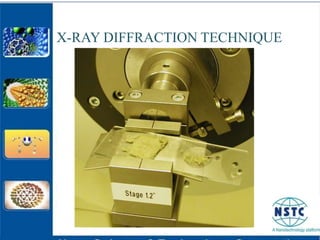
X-RAY DIFFRACTION TECHNIQUE
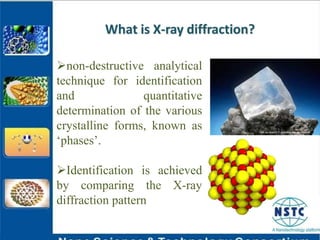
What is X-ray diffraction?
non-destructive analytical
technique for identification
and quantitative
determination of the various
crystalline forms, known as
‘phases’.
Identification is achieved
by comparing the X-ray
diffraction pattern
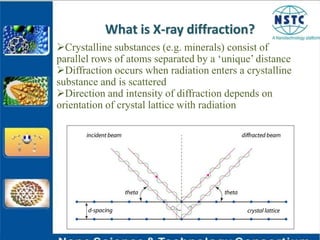
What is X-ray diffraction?
Crystalline substances (e.g. minerals) consist of
parallel rows of atoms separated by a ‘unique’ distance
Diffraction occurs when radiation enters a crystalline
substance and is scattered
Direction and intensity of diffraction depends on
orientation of crystal lattice with radiation
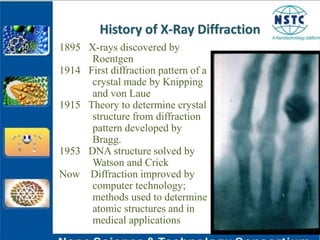
History of X-Ray Diffraction
1895 X-rays discovered by
Roentgen
1914 First diffraction pattern of a
crystal made by Knipping
and von Laue
1915 Theory to determine crystal
structure from diffraction
pattern developed by
Bragg.
1953 DNA structure solved by
Watson and Crick
Now Diffraction improved by
computer technology;
methods used to determine
atomic structures and in
medical applications
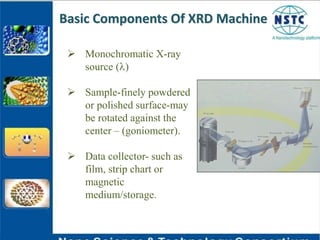
Basic Components Of XRD Machine
 Monochromatic X-ray
source ()
 Sample-finely powdered
or polished surface-may
be rotated against the
center – (goniometer).
 Data collector- such as
film, strip chart or
magnetic
medium/storage.
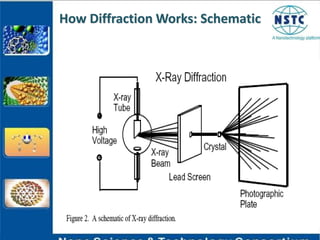
How Diffraction Works?
 Wave Interacting with a Single Particle
 Incident beams scattered uniformly in all directions
 Wave Interacting with a Solid
 Scattered beams interfere constructively in some
directions, producing diffracted beams
 Random arrangements cause beams to randomly
interfere and no distinctive pattern is produced
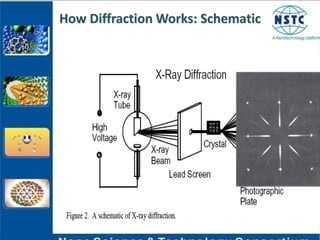
 Crystalline Material
 Regular pattern of crystalline atoms produces
regular diffraction pattern.
 Diffraction pattern gives information on crystal
structure
How Diffraction Works: Schematic
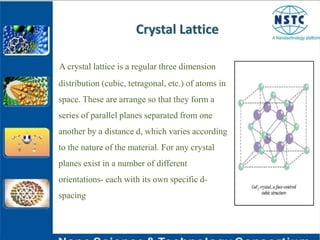
Crystal Lattice
A crystal lattice is a regular three dimension
distribution (cubic, tetragonal, etc.) of atoms in
space. These are arrange so that they form a
series of parallel planes separated from one
another by a distance d, which varies according
to the nature of the material. For any crystal
planes exist in a number of different
orientations- each with its own specific d-
spacing
Factors that affect XRD data
 Sample not powdered fine enough
 May not give all d-spacing data (not random
enough)
 Analysis too fast (degrees/minute)
 May not give accurate peak data
 Mixture of minerals??
 Not crystalline – glass!!
Applications of X-Ray Diffraction
 Find structure to determine function of
proteins
 Convenient three letter acronym: XRD
 Distinguish between different crystal
structures with identical compositions
 Study crystal deformation and stress
properties
 Study of rapid biological and chemical
processes
 Crystallographic applications
X-ray diffraction is important for:
 Solid-state physics
 Biophysics
 Medical physics
 Chemistry and Biochemistry

X-Ray Diffraction Technique

  • 1.
  • 2.
    What is X-raydiffraction? non-destructive analytical technique for identification and quantitative determination of the various crystalline forms, known as ‘phases’. Identification is achieved by comparing the X-ray diffraction pattern
  • 3.
    What is X-raydiffraction? Crystalline substances (e.g. minerals) consist of parallel rows of atoms separated by a ‘unique’ distance Diffraction occurs when radiation enters a crystalline substance and is scattered Direction and intensity of diffraction depends on orientation of crystal lattice with radiation
  • 4.
    History of X-RayDiffraction 1895 X-rays discovered by Roentgen 1914 First diffraction pattern of a crystal made by Knipping and von Laue 1915 Theory to determine crystal structure from diffraction pattern developed by Bragg. 1953 DNA structure solved by Watson and Crick Now Diffraction improved by computer technology; methods used to determine atomic structures and in medical applications
  • 5.
    Basic Components OfXRD Machine  Monochromatic X-ray source ()  Sample-finely powdered or polished surface-may be rotated against the center – (goniometer).  Data collector- such as film, strip chart or magnetic medium/storage.
  • 6.
    How Diffraction Works? Wave Interacting with a Single Particle  Incident beams scattered uniformly in all directions  Wave Interacting with a Solid  Scattered beams interfere constructively in some directions, producing diffracted beams  Random arrangements cause beams to randomly interfere and no distinctive pattern is produced  Crystalline Material  Regular pattern of crystalline atoms produces regular diffraction pattern.  Diffraction pattern gives information on crystal structure
  • 7.
  • 8.
  • 9.
    Crystal Lattice A crystallattice is a regular three dimension distribution (cubic, tetragonal, etc.) of atoms in space. These are arrange so that they form a series of parallel planes separated from one another by a distance d, which varies according to the nature of the material. For any crystal planes exist in a number of different orientations- each with its own specific d- spacing
  • 10.
    Factors that affectXRD data  Sample not powdered fine enough  May not give all d-spacing data (not random enough)  Analysis too fast (degrees/minute)  May not give accurate peak data  Mixture of minerals??  Not crystalline – glass!!
  • 11.
    Applications of X-RayDiffraction  Find structure to determine function of proteins  Convenient three letter acronym: XRD  Distinguish between different crystal structures with identical compositions  Study crystal deformation and stress properties  Study of rapid biological and chemical processes  Crystallographic applications
  • 12.
    X-ray diffraction isimportant for:  Solid-state physics  Biophysics  Medical physics  Chemistry and Biochemistry