An approach to 
ankle x-rays 
Aric Storck PGY2 
(acknowledgement to Dr. Dave Dyck for several slides) 
September 11, 2003
Objectives 
Review basic ankle fracture classification 
Review x-rays of common ankle 
fractures 
Discuss management of common ankle 
fractures
Case 1: 
25 year old female 
• Jumped off roof 
• Right ankle pain 
• Inability to weight bear on right foot 
What else do you want to know on 
history and physical examination? 
Does she need x-rays ?
Ottawa Ankle Rules: 
 Order ankle x-rays if acute trauma to ankle 
and one or more of 
• Age 55 or older 
• Inability to weight bear both immediately and in ER (4 
steps) 
• Bony tenderness over posterior distal 6 cm of lateral 
or medial malleoli 
 Sensitivity ~100% 
 Specificity ~40%
You have decided to order an 
“ankle x-ray.” The nurse entering 
your orders asks which views you 
want …
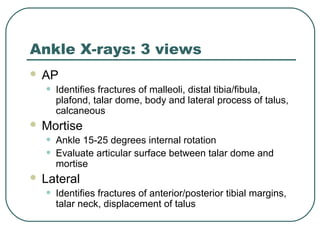
Ankle X-rays: 3 views 
 AP 
• Identifies fractures of malleoli, distal tibia/fibula, 
plafond, talar dome, body and lateral process of talus, 
calcaneous 
 Mortise 
• Ankle 15-25 degrees internal rotation 
• Evaluate articular surface between talar dome and 
mortise 
 Lateral 
• Identifies fractures of anterior/posterior tibial margins, 
talar neck, displacement of talus
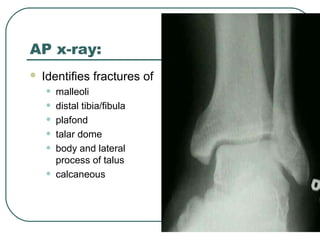
AP x-ray: 
 Identifies fractures of 
• malleoli 
• distal tibia/fibula 
• plafond 
• talar dome 
• body and lateral 
process of talus 
• calcaneous
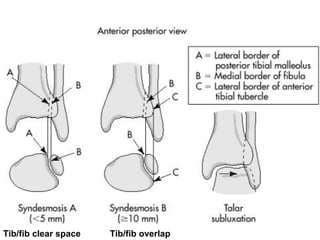
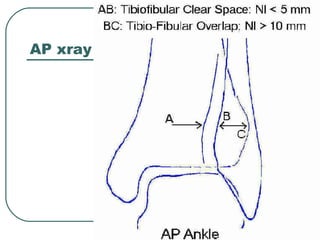
Tib/fib clear space Tib /fib overlap
AP xray
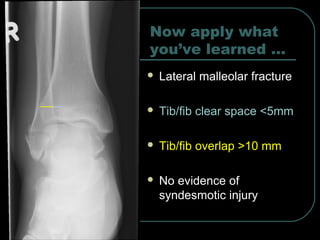
Now apply what 
you’ve learned … 
 Lateral malleolar fracture 
 Tib/fib clear space <5mm 
 Tib/fib overlap >10 mm 
 No evidence of 
syndesmotic injury
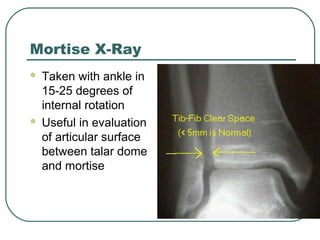
Mortise X-Ray 
 Taken with ankle in 
15-25 degrees of 
internal rotation 
 Useful in evaluation 
of articular surface 
between talar dome 
and mortise
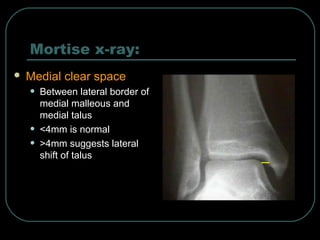
Mortise x-ray: 
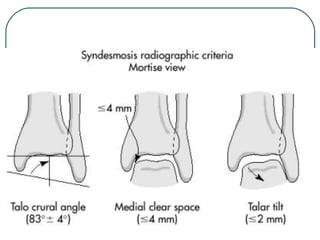
 Medial clear space 
• Between lateral border of 
medial malleous and 
medial talus 
• <4mm is normal 
• >4mm suggests lateral 
shift of talus
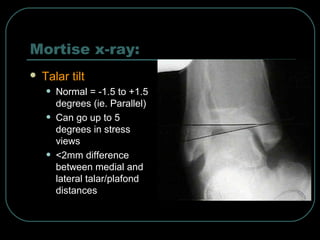
Mortise x-ray: 
 Talar tilt 
• Normal = -1.5 to +1.5 
degrees (ie. Parallel) 
• Can go up to 5 
degrees in stress 
views 
• <2mm difference 
between medial and 
lateral talar/plafond 
distances
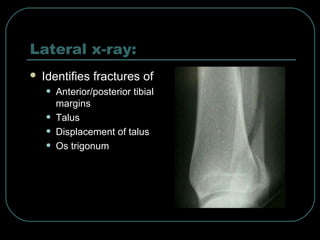
Lateral x-ray: 
 Identifies fractures of 
• Anterior/posterior tibial 
margins 
• Talus 
• Displacement of talus 
• Os trigonum
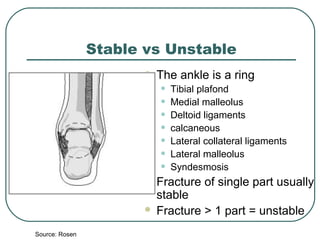
Stable vs Unstable 
 The ankle is a ring 
• Tibial plafond 
• Medial malleolus 
• Deltoid ligaments 
• calcaneous 
• Lateral collateral ligaments 
• Lateral malleolus 
• Syndesmosis 
 Fracture of single part usually 
stable 
 Fracture > 1 part = unstable 
Source: Rosen
Walking the walk …. 
Talking the talk 
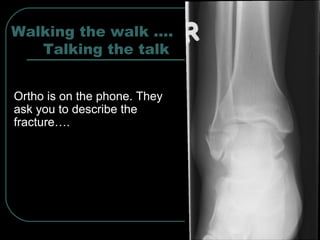
Ortho is on the phone. They 
ask you to describe the 
fracture….
Lauge-Hansen: 
 15 basic types of injury in 5 major 
categories 
• Described by two words 
1.Position of foot at time of injury 
2.Direction of talus within mortise causing fracture 
• Eg: supination-external rotation 
• Further subdivided into worsening areas of injury 
 Impossible to remember and clinically 
useless in the ED
Danis-Weber 
• Defines injury based on level of fibular fracture 
• A=below tibiotalar joint 
• No disruption of syndesmosis 
• Usually stable 
• B=at level of tibiotalar joint 
• Partial disruption of syndesmosis 
• C=above tibiotalar joint 
• Disrupts syndesmosis to level of fracture 
• unstable 
• THE MORE PROXIMAL THE FIBULAR # THE 
MORE SEVERE THE INJURY
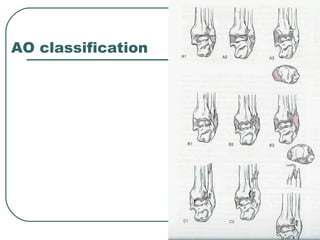
AO classification: 
 Similar to Danis-Weber scheme 
 Takes into account damage to other 
structures (usually medial malleolous) 
 ~2 pages of classifications 
• Remember them all for your exam!
AO classification
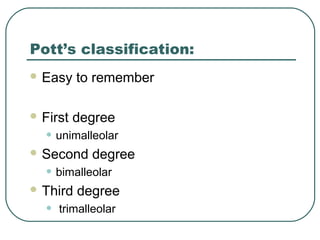
Pott’s classification: 
Easy to remember 
First degree 
• unimalleolar 
Second degree 
• bimalleolar 
Third degree 
• trimalleolar
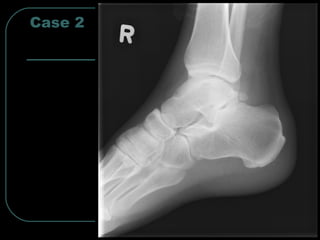
Case 2
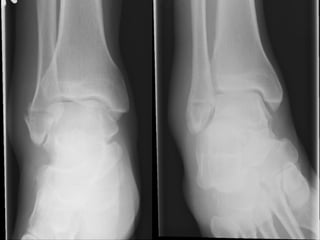
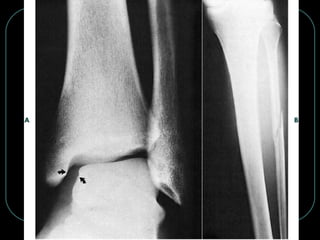
Lateral Malleolar Fracture 
Danis-Weber A 
Mechanism 
• Suppination/adduction (inversion) 
Mortise intact 
Stable fracture 
Treatment 
• Below knee cast
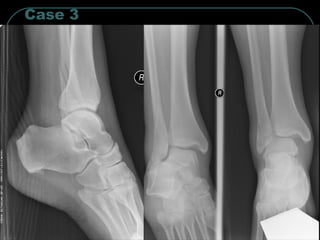
Case 3
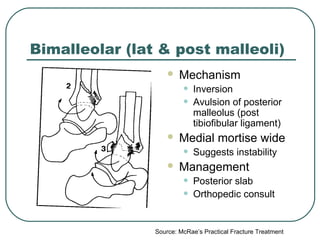
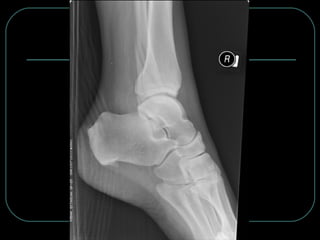
Bimalleolar (lat & post malleoli) 
 Mechanism 
• Inversion 
• Avulsion of posterior 
malleolus (post 
tibiofibular ligament) 
 Medial mortise wide 
• Suggests instability 
 Management 
• Posterior slab 
• Orthopedic consult 
Source: McRae’s Practical Fracture Treatment
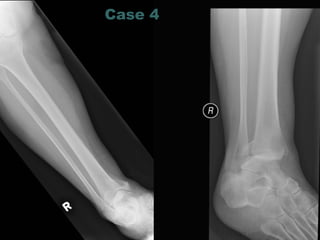
Case 4
Trimalleolar Fractures 
Unstable 
• Multiple ligamentous injuries 
• Usually involves syndesmosis 
Treatment 
• Posterior slab 
• Urgent orthopedic consultation 
• ORIF
Sour ce:Rosen 
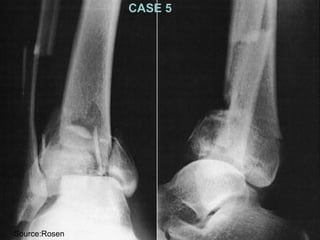
CASE 5
Pilon (tibial plafond) fractures 
 Fracture of distal tibial 
metaphysis 
• Often comminuted 
• Often significant other injuries 
 Mechanism 
• Axial load 
• Position of foot determines injury 
 Treatment 
• Unstable 
• X-ray tib/fib & ankle 
• Orthopedic consultation 
Source:Rosen
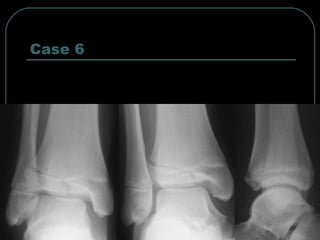
Case 6
Tillaux Fracture 
 Occurs in 12-14 year olds 
• 18 month period when epiphysis is closing 
 Salter-Harris 3 injury 
• Runs through anterolateral physis until reaches fused part, 
then extends inferiorly through epiphysis into joint 
• Visible if x-ray parallel to plane of fracture (may require 
oblique) 
 Mechanism 
• External rotation 
• Strenth of tibiofibular ligament > unfused epiphysis
Tillaux Fracture 
 Management 
• Inadequate reduction of articular surface can lead 
to early OA 
• Gap >2mm in articular surface is unacceptable 
• Advanced imaging techniques may be necessary 
• Early orthopedic consultation 
• Non-displaced 
• NWB below knee cast 
• Displaced 
• surgery
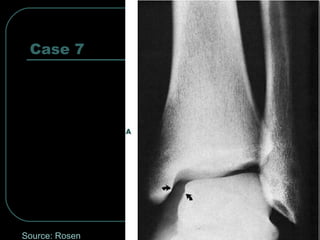
Case 7 
Source: Rosen
Maisonneuve Fracture 
Mechanism 
• Eversion + lateral rotation 
• May cause medial malleolar fracture or deltoid 
ligament disruption 
• Injury proceeds along syndesmosis and 
involves proximal fibula 
Always rule out Maisonneuve fracture in 
medial malleolar/ligamentous injury
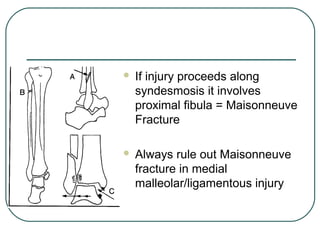
Maisonneuve Fracture 
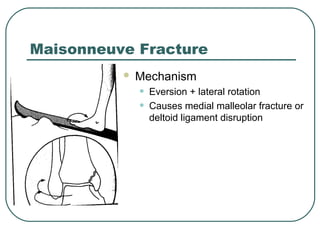
 Mechanism 
• Eversion + lateral rotation 
• Causes medial malleolar fracture or 
deltoid ligament disruption
 If injury proceeds along 
syndesmosis it involves 
proximal fibula = Maisonneuve 
Fracture 
 Always rule out Maisonneuve 
fracture in medial 
malleolar/ligamentous injury
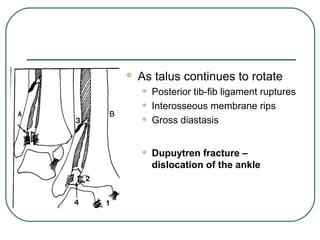
 As talus continues to rotate 
• Posterior tib-fib ligament ruptures 
• Interosseous membrane rips 
• Gross diastasis 
• Dupuytren fracture – 
dislocation of the ankle
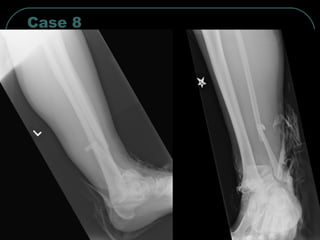
Case 8
the end

Ankle xrays

  • 1.
    An approach to ankle x-rays Aric Storck PGY2 (acknowledgement to Dr. Dave Dyck for several slides) September 11, 2003
  • 2.
    Objectives Review basicankle fracture classification Review x-rays of common ankle fractures Discuss management of common ankle fractures
  • 3.
    Case 1: 25year old female • Jumped off roof • Right ankle pain • Inability to weight bear on right foot What else do you want to know on history and physical examination? Does she need x-rays ?
  • 4.
    Ottawa Ankle Rules:  Order ankle x-rays if acute trauma to ankle and one or more of • Age 55 or older • Inability to weight bear both immediately and in ER (4 steps) • Bony tenderness over posterior distal 6 cm of lateral or medial malleoli  Sensitivity ~100%  Specificity ~40%
  • 5.
    You have decidedto order an “ankle x-ray.” The nurse entering your orders asks which views you want …
  • 6.
    Ankle X-rays: 3views  AP • Identifies fractures of malleoli, distal tibia/fibula, plafond, talar dome, body and lateral process of talus, calcaneous  Mortise • Ankle 15-25 degrees internal rotation • Evaluate articular surface between talar dome and mortise  Lateral • Identifies fractures of anterior/posterior tibial margins, talar neck, displacement of talus
  • 7.
    AP x-ray: Identifies fractures of • malleoli • distal tibia/fibula • plafond • talar dome • body and lateral process of talus • calcaneous
  • 8.
    Tib/fib clear spaceTib /fib overlap
  • 9.
  • 10.
    Now apply what you’ve learned …  Lateral malleolar fracture  Tib/fib clear space <5mm  Tib/fib overlap >10 mm  No evidence of syndesmotic injury
  • 11.
    Mortise X-Ray Taken with ankle in 15-25 degrees of internal rotation  Useful in evaluation of articular surface between talar dome and mortise
  • 13.
    Mortise x-ray: Medial clear space • Between lateral border of medial malleous and medial talus • <4mm is normal • >4mm suggests lateral shift of talus
  • 14.
    Mortise x-ray: Talar tilt • Normal = -1.5 to +1.5 degrees (ie. Parallel) • Can go up to 5 degrees in stress views • <2mm difference between medial and lateral talar/plafond distances
  • 15.
    Lateral x-ray: Identifies fractures of • Anterior/posterior tibial margins • Talus • Displacement of talus • Os trigonum
  • 16.
    Stable vs Unstable  The ankle is a ring • Tibial plafond • Medial malleolus • Deltoid ligaments • calcaneous • Lateral collateral ligaments • Lateral malleolus • Syndesmosis  Fracture of single part usually stable  Fracture > 1 part = unstable Source: Rosen
  • 17.
    Walking the walk…. Talking the talk Ortho is on the phone. They ask you to describe the fracture….
  • 18.
    Lauge-Hansen:  15basic types of injury in 5 major categories • Described by two words 1.Position of foot at time of injury 2.Direction of talus within mortise causing fracture • Eg: supination-external rotation • Further subdivided into worsening areas of injury  Impossible to remember and clinically useless in the ED
  • 19.
    Danis-Weber • Definesinjury based on level of fibular fracture • A=below tibiotalar joint • No disruption of syndesmosis • Usually stable • B=at level of tibiotalar joint • Partial disruption of syndesmosis • C=above tibiotalar joint • Disrupts syndesmosis to level of fracture • unstable • THE MORE PROXIMAL THE FIBULAR # THE MORE SEVERE THE INJURY
  • 20.
    AO classification: Similar to Danis-Weber scheme  Takes into account damage to other structures (usually medial malleolous)  ~2 pages of classifications • Remember them all for your exam!
  • 21.
  • 22.
    Pott’s classification: Easyto remember First degree • unimalleolar Second degree • bimalleolar Third degree • trimalleolar
  • 23.
  • 25.
    Lateral Malleolar Fracture Danis-Weber A Mechanism • Suppination/adduction (inversion) Mortise intact Stable fracture Treatment • Below knee cast
  • 26.
  • 27.
    Bimalleolar (lat &post malleoli)  Mechanism • Inversion • Avulsion of posterior malleolus (post tibiofibular ligament)  Medial mortise wide • Suggests instability  Management • Posterior slab • Orthopedic consult Source: McRae’s Practical Fracture Treatment
  • 28.
  • 30.
    Trimalleolar Fractures Unstable • Multiple ligamentous injuries • Usually involves syndesmosis Treatment • Posterior slab • Urgent orthopedic consultation • ORIF
  • 31.
  • 32.
    Pilon (tibial plafond)fractures  Fracture of distal tibial metaphysis • Often comminuted • Often significant other injuries  Mechanism • Axial load • Position of foot determines injury  Treatment • Unstable • X-ray tib/fib & ankle • Orthopedic consultation Source:Rosen
  • 33.
  • 34.
    Tillaux Fracture Occurs in 12-14 year olds • 18 month period when epiphysis is closing  Salter-Harris 3 injury • Runs through anterolateral physis until reaches fused part, then extends inferiorly through epiphysis into joint • Visible if x-ray parallel to plane of fracture (may require oblique)  Mechanism • External rotation • Strenth of tibiofibular ligament > unfused epiphysis
  • 35.
    Tillaux Fracture Management • Inadequate reduction of articular surface can lead to early OA • Gap >2mm in articular surface is unacceptable • Advanced imaging techniques may be necessary • Early orthopedic consultation • Non-displaced • NWB below knee cast • Displaced • surgery
  • 36.
  • 38.
    Maisonneuve Fracture Mechanism • Eversion + lateral rotation • May cause medial malleolar fracture or deltoid ligament disruption • Injury proceeds along syndesmosis and involves proximal fibula Always rule out Maisonneuve fracture in medial malleolar/ligamentous injury
  • 39.
    Maisonneuve Fracture Mechanism • Eversion + lateral rotation • Causes medial malleolar fracture or deltoid ligament disruption
  • 40.
     If injuryproceeds along syndesmosis it involves proximal fibula = Maisonneuve Fracture  Always rule out Maisonneuve fracture in medial malleolar/ligamentous injury
  • 41.
     As taluscontinues to rotate • Posterior tib-fib ligament ruptures • Interosseous membrane rips • Gross diastasis • Dupuytren fracture – dislocation of the ankle
  • 42.
  • 43.

Editor's Notes

  • #8 How do you tell AP from mortise?
  • #9 What criteria do you use to evaluate AP views?
  • #18 Danis-Weber A
  • #29 Comminuted impacted fracture of the distal tibia and fibula. Trimalleolar fracture with dislocation. Largest fragment from posterior medial malleolus – displaced 1.5 cm posteriorly.
  • #43 Fracture dislocation at level of ankle. Talus displaced laterally for three quarters of its width. Large bony fragment situated anterior to the joint space on lateral view. Comminuted fracture of distal fibula.