DWT-SVD Based Efficient Watermarking Algorithm
To Achieve
High Robustness and Perceptual Quality Image
By-
Rahul Kodali(University Roll Number:-14300111073)
Rohan Kamila(University Roll Number:-14300111079)
Sentu Paul(University Roll Number:-14300111094)
Supriya Mondal(University Roll Number:-14300111116)
Surit Datta(University Roll Number:-14300111120)
Siddhartha Kar(University Roll Number:-14300111099)
Contents
 What is digital watermarking?
 Features of watermarking
 How digital watermarking works?
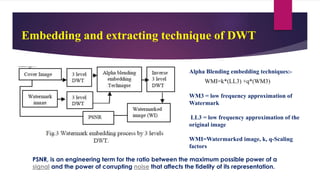
 Embedding and extracting technique of DWT
 What is SVD?
 Advantages and disadvantages of SVD
 How to overcome the disadvantages of SVD?
 Classification of watermark
 Purpose of watermarking
 What is DWT?
 Advantages and disadvantages of DWT
 Embedding and extracting technique of SVD
 How to overcome the disadvantages of DWT?
 Why it is better than other existing algorithms?
 Future work and conclusion
Digital Watermarking?
 Allows users to embed SPECIAL PATTERN or SOME DATA into
digital contents without changing its perceptual quality.
 When data is embedded, it is not written at HEADER PART but
embedded directly into digital media itself by changing media
contents data.
 Watermarking is a key process for the PROTECTION of copyright
ownership of electronic data.
Classification Of WATERMARK
 According to Human Perception
 Invisible
 Visible
 According to types of Document
 Text
 Image
 Audio
 Video
 According to Robustness
 Fragile
 Semi fragile
 Robust
Features of Watermarking
 Invisible/Inaudible
 Information is embedded without digital content degradation, because of the level of
embedding operation is too small for human to notice the change.
 Inseparable
 The embedded information can survive after some processing, compression and
format transformation.
 Unchanging data file size
 Data size of the media is not changed before and after embedding operation because
information is embedded directly into the media.
Purpose of Watermarking
 Copyright Protection
 Fingerprinting
 Copy Protection
 Broadcasting Monitoring
 Data Authentication
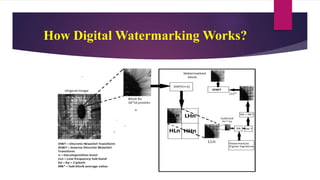
How Digital Watermarking Works?
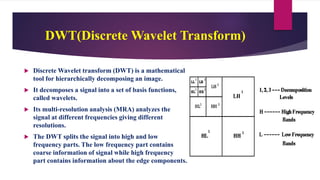
DWT(Discrete Wavelet Transform)
 Discrete Wavelet transform (DWT) is a mathematical
tool for hierarchically decomposing an image.
 It decomposes a signal into a set of basis functions,
called wavelets.
 Its multi-resolution analysis (MRA) analyzes the
signal at different frequencies giving different
resolutions.
 The DWT splits the signal into high and low
frequency parts. The low frequency part contains
coarse information of signal while high frequency
part contains information about the edge components.
Embedding and extracting technique of DWT
Alpha Blending embedding techniques:-
WMI=k*(LL3) +q*(WM3)
WM3 = low frequency approximation of
Watermark
LL3 = low frequency approximation of the
original image
WMI=Watermarked image, k, q-Scaling
factors
PSNR, is an engineering term for the ratio between the maximum possible power of a
signal and the power of corrupting noise that affects the fidelity of its representation.
Advantages and Disadvantages of DWT
 Advantages
 One of the main advantages of wavelets is that they offer a simultaneous localization in time and frequency domain.
 The use of larger DWT basis functions or wavelet filters produces blurring and ringing noise near edge regions in Images or video
frames.
 The second main advantage of wavelets is that, using fast wavelet transform, it is computationally very fast.
 Disadvantages
 Poor directional selectivity for diagonal features, because the wavelet filters are separable and real.
 Longer compression time.
 Lack of shift invariance, which means that small shifts in the input signal can cause major variations in the distribution of energy
between DWT coefficients at different scales.
 The cost of computing DWT as compared to DCT may be higher.
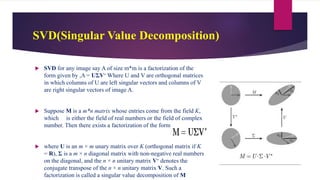
SVD(Singular Value Decomposition)
 SVD for any image say A of size m*m is a factorization of the
form given by ,A = UΣV∗ Where U and V are orthogonal matrices
in which columns of U are left singular vectors and columns of V
are right singular vectors of image A.
 Suppose M is a m*n matrix whose entries come from the field K,
which is either the field of real numbers or the field of complex
number. Then there exists a factorization of the form
 where U is an m × m unary matrix over K (orthogonal matrix if K
= R), Σ is a m × n diagonal matrix with non-negative real numbers
on the diagonal, and the n × n unitary matrix V∗ denotes the
conjugate transpose of the n × n unitary matrix V. Such a
factorization is called a singular value decomposition of M
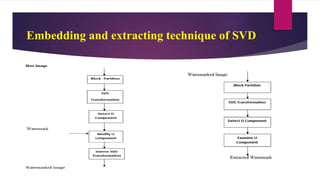
Embedding and extracting technique of SVD
Advantages and Disadvantages of SVD
 By providing an approximation to rank deficient matrices, and exposing
the geometric properties of the matrix, the singular value decomposition
of a matrix is a powerful technique in matrix decomposition.
 Despite its usefulness, however, there are number of drawbacks, for
problems that can be solved by simpler techniques, such as the Fourier
Transform, or QR decomposition, use of SVD may be unduly expensive
computationally. Secondly, the SVD operates on a fixed matrix, hence it
is not amenable to problems that require adaptive algorithms.
How To overcome the disadvantages of DWT
 Longer compression time should be shortened
 We should find ways to find to reduce cost of computing DWT
 Blurring and ringing noise near edge regions in images should be reduced
 Poor directional selectivity for diagonal features should be improved.
How To overcome the problems of SVD
 Measuring of performance of SVD should be easy.
 SVD should become fast from computational point of view .
 To find the technique to calculate the SVD easily.
 Less calculations should be made to measure the performance of SVD
 SVD characteristics which are not utilized in image processing should be utilized by
finding the techniques to utilize the unused SVD characteristics in image processing
such as image capacity for hiding information, roughness measure etc.
Why it’s better than other Algorithm
 Our proposed scheme has high degree of robustness which is validated by recovering the water-
mark against print and scan attack which is among the strongest attacks.
 Even though scheme is blind in nature it gives result better than non-blind ones.
 Many of the existing DWT and SVD based approaches do not handle the issue of authentication
and security.
 The proposed method covers this flaw by incorporating signature-based authentication
mechanism. Thus the resultant method is both robust and secure.
 Since the proposed algorithm takes the advantages of the Wavelet Transform and SVD methods
simultaneously, the extracted water-marks are more robust against all mentioned attacks (such
as cropping and rotation).
Future work and Conclusion
 In future we will try to improve our proposed algorithm, so that
disadvantages of SVD-DWT can overcome
 DWT-Based watermarking methods are fast /robust and protect against
most forms of manipulation
 Schemes based on pixel dependency are robust in most forms of image
manipulation, but fail when significant pixels are moved from their original
location
Thank You

Digital Watermarking using DWT-SVD

  • 1.
    DWT-SVD Based EfficientWatermarking Algorithm To Achieve High Robustness and Perceptual Quality Image By- Rahul Kodali(University Roll Number:-14300111073) Rohan Kamila(University Roll Number:-14300111079) Sentu Paul(University Roll Number:-14300111094) Supriya Mondal(University Roll Number:-14300111116) Surit Datta(University Roll Number:-14300111120) Siddhartha Kar(University Roll Number:-14300111099)
  • 2.
    Contents  What isdigital watermarking?  Features of watermarking  How digital watermarking works?  Embedding and extracting technique of DWT  What is SVD?  Advantages and disadvantages of SVD  How to overcome the disadvantages of SVD?  Classification of watermark  Purpose of watermarking  What is DWT?  Advantages and disadvantages of DWT  Embedding and extracting technique of SVD  How to overcome the disadvantages of DWT?  Why it is better than other existing algorithms?  Future work and conclusion
  • 3.
    Digital Watermarking?  Allowsusers to embed SPECIAL PATTERN or SOME DATA into digital contents without changing its perceptual quality.  When data is embedded, it is not written at HEADER PART but embedded directly into digital media itself by changing media contents data.  Watermarking is a key process for the PROTECTION of copyright ownership of electronic data.
  • 4.
    Classification Of WATERMARK According to Human Perception  Invisible  Visible  According to types of Document  Text  Image  Audio  Video  According to Robustness  Fragile  Semi fragile  Robust
  • 5.
    Features of Watermarking Invisible/Inaudible  Information is embedded without digital content degradation, because of the level of embedding operation is too small for human to notice the change.  Inseparable  The embedded information can survive after some processing, compression and format transformation.  Unchanging data file size  Data size of the media is not changed before and after embedding operation because information is embedded directly into the media.
  • 6.
    Purpose of Watermarking Copyright Protection  Fingerprinting  Copy Protection  Broadcasting Monitoring  Data Authentication
  • 7.
  • 8.
    DWT(Discrete Wavelet Transform) Discrete Wavelet transform (DWT) is a mathematical tool for hierarchically decomposing an image.  It decomposes a signal into a set of basis functions, called wavelets.  Its multi-resolution analysis (MRA) analyzes the signal at different frequencies giving different resolutions.  The DWT splits the signal into high and low frequency parts. The low frequency part contains coarse information of signal while high frequency part contains information about the edge components.
  • 9.
    Embedding and extractingtechnique of DWT Alpha Blending embedding techniques:- WMI=k*(LL3) +q*(WM3) WM3 = low frequency approximation of Watermark LL3 = low frequency approximation of the original image WMI=Watermarked image, k, q-Scaling factors PSNR, is an engineering term for the ratio between the maximum possible power of a signal and the power of corrupting noise that affects the fidelity of its representation.
  • 10.
    Advantages and Disadvantagesof DWT  Advantages  One of the main advantages of wavelets is that they offer a simultaneous localization in time and frequency domain.  The use of larger DWT basis functions or wavelet filters produces blurring and ringing noise near edge regions in Images or video frames.  The second main advantage of wavelets is that, using fast wavelet transform, it is computationally very fast.  Disadvantages  Poor directional selectivity for diagonal features, because the wavelet filters are separable and real.  Longer compression time.  Lack of shift invariance, which means that small shifts in the input signal can cause major variations in the distribution of energy between DWT coefficients at different scales.  The cost of computing DWT as compared to DCT may be higher.
  • 11.
    SVD(Singular Value Decomposition) SVD for any image say A of size m*m is a factorization of the form given by ,A = UΣV∗ Where U and V are orthogonal matrices in which columns of U are left singular vectors and columns of V are right singular vectors of image A.  Suppose M is a m*n matrix whose entries come from the field K, which is either the field of real numbers or the field of complex number. Then there exists a factorization of the form  where U is an m × m unary matrix over K (orthogonal matrix if K = R), Σ is a m × n diagonal matrix with non-negative real numbers on the diagonal, and the n × n unitary matrix V∗ denotes the conjugate transpose of the n × n unitary matrix V. Such a factorization is called a singular value decomposition of M
  • 12.
    Embedding and extractingtechnique of SVD
  • 13.
    Advantages and Disadvantagesof SVD  By providing an approximation to rank deficient matrices, and exposing the geometric properties of the matrix, the singular value decomposition of a matrix is a powerful technique in matrix decomposition.  Despite its usefulness, however, there are number of drawbacks, for problems that can be solved by simpler techniques, such as the Fourier Transform, or QR decomposition, use of SVD may be unduly expensive computationally. Secondly, the SVD operates on a fixed matrix, hence it is not amenable to problems that require adaptive algorithms.
  • 14.
    How To overcomethe disadvantages of DWT  Longer compression time should be shortened  We should find ways to find to reduce cost of computing DWT  Blurring and ringing noise near edge regions in images should be reduced  Poor directional selectivity for diagonal features should be improved.
  • 15.
    How To overcomethe problems of SVD  Measuring of performance of SVD should be easy.  SVD should become fast from computational point of view .  To find the technique to calculate the SVD easily.  Less calculations should be made to measure the performance of SVD  SVD characteristics which are not utilized in image processing should be utilized by finding the techniques to utilize the unused SVD characteristics in image processing such as image capacity for hiding information, roughness measure etc.
  • 16.
    Why it’s betterthan other Algorithm  Our proposed scheme has high degree of robustness which is validated by recovering the water- mark against print and scan attack which is among the strongest attacks.  Even though scheme is blind in nature it gives result better than non-blind ones.  Many of the existing DWT and SVD based approaches do not handle the issue of authentication and security.  The proposed method covers this flaw by incorporating signature-based authentication mechanism. Thus the resultant method is both robust and secure.  Since the proposed algorithm takes the advantages of the Wavelet Transform and SVD methods simultaneously, the extracted water-marks are more robust against all mentioned attacks (such as cropping and rotation).
  • 17.
    Future work andConclusion  In future we will try to improve our proposed algorithm, so that disadvantages of SVD-DWT can overcome  DWT-Based watermarking methods are fast /robust and protect against most forms of manipulation  Schemes based on pixel dependency are robust in most forms of image manipulation, but fail when significant pixels are moved from their original location
  • 18.