KIMS DENTAL DEPARTMENT
presents
CME PROGRAM
A brief insight into
ORPHAN JOINT
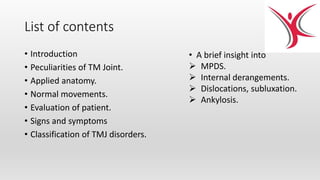
MODERATOR
DR. SRINIVAS SAKAMURI
MDS
HEAD OF THE DEPARTMENT
PRESENTER
DR G. GURU KARTHIK
MDS
ORAL AND MAXILLOFACIAL
SURGEON
List of contents
• Introduction
• Peculiarities of TM Joint.
• Applied anatomy.
• Normal movements.
• Evaluation of patient.
• Signs and symptoms
• Classification of TMJ disorders.
• A brief insight into
 MPDS.
 Internal derangements.
 Dislocations, subluxation.
 Ankylosis.
Treatment:
• Conservative management
• Surgical management
Minimally invasive
Invasive
Introduction
All the bones in the skull are attached with fibrous joint
and are immovable expect for temporomandibular joint.
• The temporomandibular joint( TMJ ) is a bilateral synovial
articulation between the mandible and temporal bone. The
name of the joint is derived from the two bones which
form the joint: the upper temporal bone which is part of
the cranium (skull), and the lower jawbone or mandible.
• The most important functions of the
temporomandibular joint (TMJ) are mastication and
speech.
1/7/2018 SEMINAR ON APPLIED ANATOMY OF TMJ, G.Guru Karthik/91 5
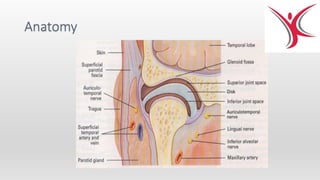
Anatomy
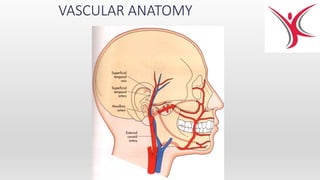
VASCULAR ANATOMY
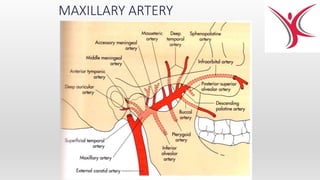
MAXILLARY ARTERY
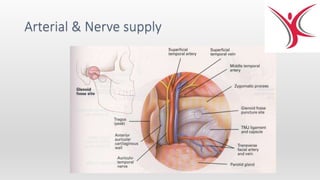
Arterial & Nerve supply
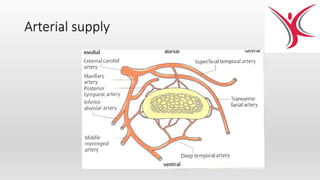
Arterial supply
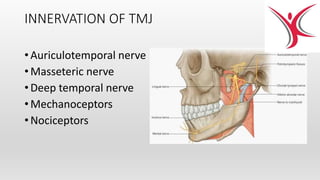
INNERVATION OF TMJ
• Auriculotemporal nerve
• Masseteric nerve
• Deep temporal nerve
• Mechanoceptors
• Nociceptors
Peculiarities of TMJ
1. Bilateral diarthrosis – right & left function together
2. Articular surface covered by fibrocartilage instead of
hyaline cartilage.
3. Only joint in human body to have a rigid endpoint of
closure i.e. occlusal contact through teeth.
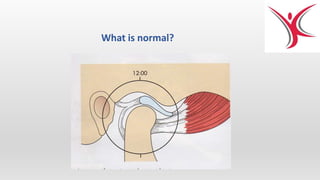
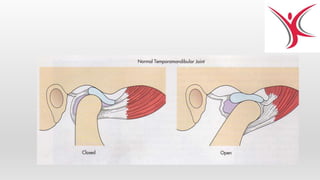
What is normal?
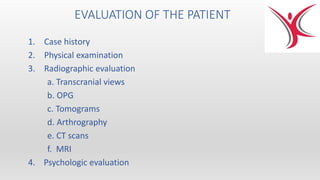
EVALUATION OF THE PATIENT
1. Case history
2. Physical examination
3. Radiographic evaluation
a. Transcranial views
b. OPG
c. Tomograms
d. Arthrography
e. CT scans
f. MRI
4. Psychologic evaluation
1. History of trauma.
2. History of rheumatoid arthiritis.
3. History of osteoarthritis.
4. History of long standing otitis
media.
5. Long standing cervical spondylitis.
6. History of extraction of posterior
teeth.
7. Bruxism.
8. History of psychological issues.
9. History of unfinished orthodontic
treatment.
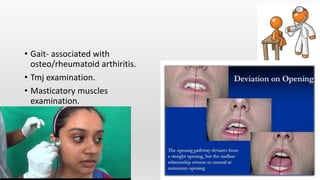
• Gait- associated with
osteo/rheumatoid arthiritis.
• Tmj examination.
• Masticatory muscles
examination.
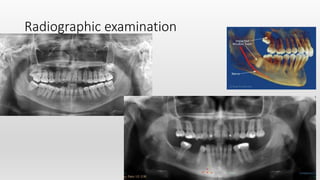
Radiographic examination
CLASSIFICATION OF TMJ DISORDERS
1. Myofascial pain and dysfunction (MPD)
2. Disk displacement disorders
3. Degenerative joint disease
4. Systemic arthritic conditions
5. Chronic recurrent dislocation
6. Ankylosis
7. Neoplasia
8. Infections
MYOFASCIAL PAIN & DYSFUNCTON
•MPD is the most common cause of
masticatory pain and limited function for
which patients seek dental consultation
and treatment.
•The source of the pain and dysfunction is
muscular, with masticatory muscles
developing tenderness and pain as a
result of abnormal muscular function or
hyperactivity.
MYOFASCIAL PAIN & DYSFUNCTON
CAUSES :
• Daytime clenching
• Bruxism
• Malocclusion
• Disk displacement disorders
• Degenerative joint disease
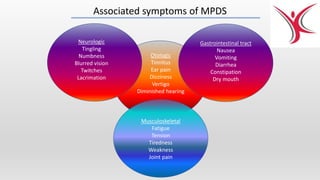
Associated symptoms of MPDS
Neurologic
Tingling
Numbness
Blurred vision
Twitches
Lacrimation
Otologic
Tinnitus
Ear pain
Dizziness
Vertigo
Diminished hearing
Gastrointestinal tract
Nausea
Vomiting
Diarrhea
Constipation
Dry mouth
Musculoskeletal
Fatigue
Tension
Tiredness
Weakness
Joint pain
MYOFASCIAL PAIN & DYSFUNCTON
SIGNS :
• Diffuse tenderness of the masticatory muscles
• The range of the mandibular movements is
decreased
• Deviation of the mandible to the affected side
• The teeth frequently have wear facets
• Joint noises may be present
• Trismus.
• Radiographs of the TMJs are usually normal
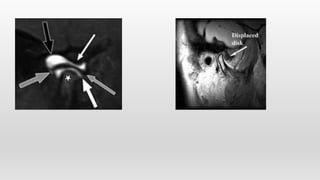
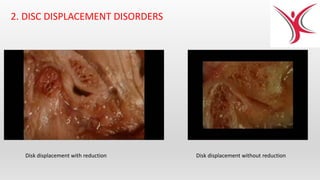
2. DISC DISPLACEMENT DISORDERS
Disk displacement with reduction Disk displacement without reduction
Treatment
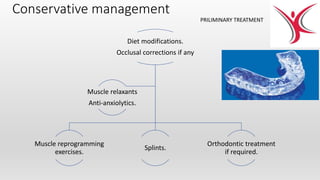
Conservative management
Diet modifications.
Occlusal corrections if any
Muscle reprogramming
exercises.
Splints.
Orthodontic treatment
if required.
Muscle relaxants
Anti-anxiolytics.
PRILIMINARY TREATMENT
NON INVASIVE TREATMENT
THERMAL APPLICATION
THERAPAUTIC ULTRASOUND
BIOSTIMULATION
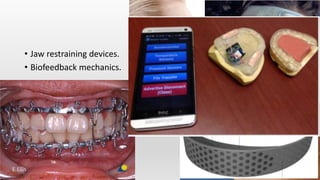
• Jaw restraining devices.
• Biofeedback mechanics.
PERMANENT OCCLUSAL MODIFICATION
• Occlusal equilibration
•Prosthetic restoration
• Orthodontics
• Orthognathic surgery
TMJ SURGERY
•Arthrocentesis
•Arthroscopy
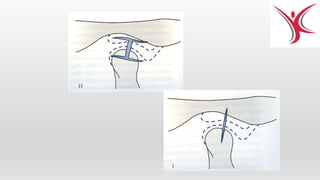
•Disk-Repositioning Surgery
•Disk Repair or Removal
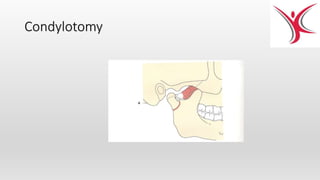
•Condylotomy
•Total Joint Replacement
•Arthroplasty for Ankylosis
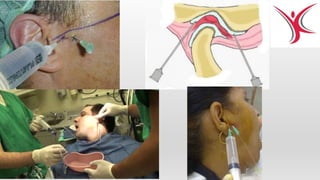
ARTHROCENTESIS
• L.A. with intravenous sedation
• Needles into the superior joint space
• Ringer’s solution
• Steroids, L.A
• NSAIDs
• Very effective in anterior disk displacement without
reduction
• Stretching of capsule, decrease in pain mediators,
release of adhesions, elimination of negative
pressure
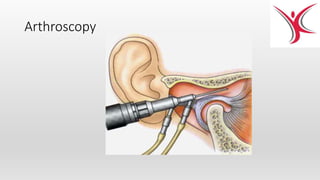
Arthroscopy
DISK REPOSITIONING SURGERY
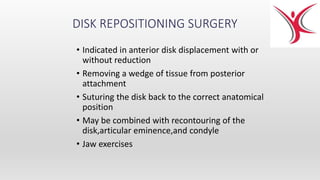
• Indicated in anterior disk displacement with or
without reduction
• Removing a wedge of tissue from posterior
attachment
• Suturing the disk back to the correct anatomical
position
• May be combined with recontouring of the
disk,articular eminence,and condyle
• Jaw exercises
DISK REPAIR OR REMOVAL
• Disk repair with dermal grafts or fascial tissue
• Diskectomy without replacement
• Disk replacement with autogenous grafts or
alloplastic implants
MANAGEMENT OF RECURRENT
DISLOCATION
1. Capsule tightening procedures
(capsulorrhaphy,reinforcement of capsule)
2. Creating mechanical obstacle
(osteotomy of eminence,placement of
graft,silastic block,Dautry’s procedure,
use of pins or screws)
3. Direct restrain of condyle
4. Creation of new muscle balance
5. Removal of mechanical obstacles
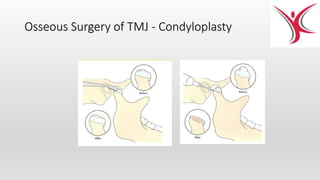
Osseous Surgery of TMJ - Condyloplasty
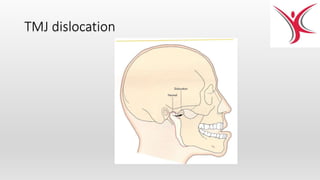
TMJ dislocation
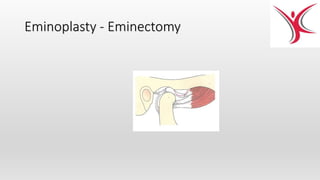
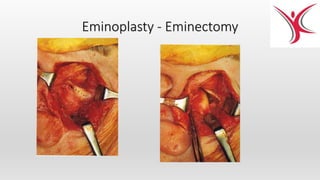
Eminoplasty - Eminectomy
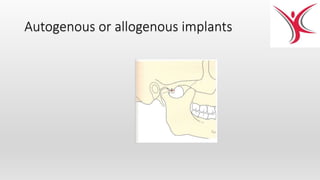
Autogenous or allogenous implants
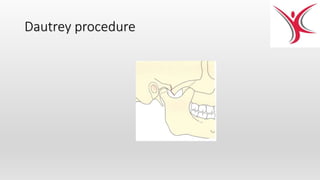
Dautrey procedure
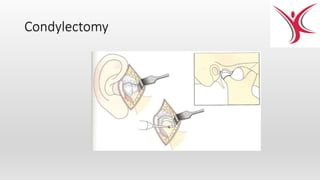
Condylectomy
Condylotomy
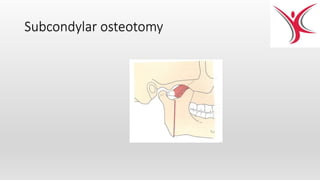
Subcondylar osteotomy
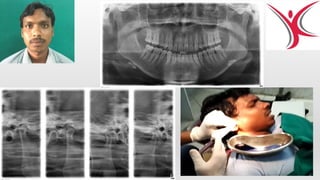
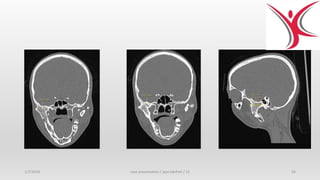
1/7/2018 case presentation / jaya lakshmi / 12 55
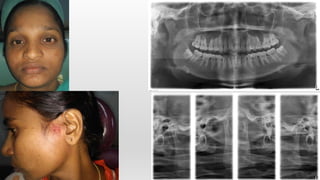
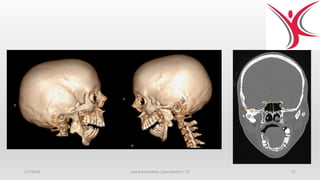
1/7/2018 case presentation / jaya lakshmi / 12 56
1/7/2018 case presentation / jaya lakshmi / 12 57
OUR TEAM
Dr. Srinivas Sakamuri MDS Endodontist
Dr Sahana Mallineni MDS Periodeontist
Dr. Venkatesh Nettam MDS Orthodontist
Dr. Kalyani Ch. BDS EHS Coordinator
Dr. Chandana BDS Budding Dentist
Dr. G. Guru Karthik MDS Oral and Maxillofacial Surgeon
TMJ overview
TMJ overview

TMJ overview

  • 1.
    KIMS DENTAL DEPARTMENT presents CMEPROGRAM A brief insight into ORPHAN JOINT
  • 2.
    MODERATOR DR. SRINIVAS SAKAMURI MDS HEADOF THE DEPARTMENT PRESENTER DR G. GURU KARTHIK MDS ORAL AND MAXILLOFACIAL SURGEON
  • 3.
    List of contents •Introduction • Peculiarities of TM Joint. • Applied anatomy. • Normal movements. • Evaluation of patient. • Signs and symptoms • Classification of TMJ disorders. • A brief insight into  MPDS.  Internal derangements.  Dislocations, subluxation.  Ankylosis.
  • 4.
    Treatment: • Conservative management •Surgical management Minimally invasive Invasive
  • 5.
    Introduction All the bonesin the skull are attached with fibrous joint and are immovable expect for temporomandibular joint. • The temporomandibular joint( TMJ ) is a bilateral synovial articulation between the mandible and temporal bone. The name of the joint is derived from the two bones which form the joint: the upper temporal bone which is part of the cranium (skull), and the lower jawbone or mandible. • The most important functions of the temporomandibular joint (TMJ) are mastication and speech. 1/7/2018 SEMINAR ON APPLIED ANATOMY OF TMJ, G.Guru Karthik/91 5
  • 6.
  • 7.
  • 8.
  • 9.
  • 10.
  • 11.
    INNERVATION OF TMJ •Auriculotemporal nerve • Masseteric nerve • Deep temporal nerve • Mechanoceptors • Nociceptors
  • 12.
    Peculiarities of TMJ 1.Bilateral diarthrosis – right & left function together 2. Articular surface covered by fibrocartilage instead of hyaline cartilage. 3. Only joint in human body to have a rigid endpoint of closure i.e. occlusal contact through teeth.
  • 13.
  • 16.
    EVALUATION OF THEPATIENT 1. Case history 2. Physical examination 3. Radiographic evaluation a. Transcranial views b. OPG c. Tomograms d. Arthrography e. CT scans f. MRI 4. Psychologic evaluation
  • 17.
    1. History oftrauma. 2. History of rheumatoid arthiritis. 3. History of osteoarthritis. 4. History of long standing otitis media. 5. Long standing cervical spondylitis. 6. History of extraction of posterior teeth. 7. Bruxism. 8. History of psychological issues. 9. History of unfinished orthodontic treatment.
  • 18.
    • Gait- associatedwith osteo/rheumatoid arthiritis. • Tmj examination. • Masticatory muscles examination.
  • 19.
  • 22.
    CLASSIFICATION OF TMJDISORDERS 1. Myofascial pain and dysfunction (MPD) 2. Disk displacement disorders 3. Degenerative joint disease 4. Systemic arthritic conditions 5. Chronic recurrent dislocation 6. Ankylosis 7. Neoplasia 8. Infections
  • 23.
    MYOFASCIAL PAIN &DYSFUNCTON •MPD is the most common cause of masticatory pain and limited function for which patients seek dental consultation and treatment. •The source of the pain and dysfunction is muscular, with masticatory muscles developing tenderness and pain as a result of abnormal muscular function or hyperactivity.
  • 24.
    MYOFASCIAL PAIN &DYSFUNCTON CAUSES : • Daytime clenching • Bruxism • Malocclusion • Disk displacement disorders • Degenerative joint disease
  • 25.
    Associated symptoms ofMPDS Neurologic Tingling Numbness Blurred vision Twitches Lacrimation Otologic Tinnitus Ear pain Dizziness Vertigo Diminished hearing Gastrointestinal tract Nausea Vomiting Diarrhea Constipation Dry mouth Musculoskeletal Fatigue Tension Tiredness Weakness Joint pain
  • 26.
    MYOFASCIAL PAIN &DYSFUNCTON SIGNS : • Diffuse tenderness of the masticatory muscles • The range of the mandibular movements is decreased • Deviation of the mandible to the affected side • The teeth frequently have wear facets • Joint noises may be present • Trismus. • Radiographs of the TMJs are usually normal
  • 27.
    2. DISC DISPLACEMENTDISORDERS Disk displacement with reduction Disk displacement without reduction
  • 28.
  • 29.
    Conservative management Diet modifications. Occlusalcorrections if any Muscle reprogramming exercises. Splints. Orthodontic treatment if required. Muscle relaxants Anti-anxiolytics. PRILIMINARY TREATMENT
  • 30.
    NON INVASIVE TREATMENT THERMALAPPLICATION THERAPAUTIC ULTRASOUND BIOSTIMULATION
  • 31.
    • Jaw restrainingdevices. • Biofeedback mechanics.
  • 32.
    PERMANENT OCCLUSAL MODIFICATION •Occlusal equilibration •Prosthetic restoration • Orthodontics • Orthognathic surgery
  • 33.
    TMJ SURGERY •Arthrocentesis •Arthroscopy •Disk-Repositioning Surgery •DiskRepair or Removal •Condylotomy •Total Joint Replacement •Arthroplasty for Ankylosis
  • 34.
    ARTHROCENTESIS • L.A. withintravenous sedation • Needles into the superior joint space • Ringer’s solution • Steroids, L.A • NSAIDs • Very effective in anterior disk displacement without reduction • Stretching of capsule, decrease in pain mediators, release of adhesions, elimination of negative pressure
  • 36.
  • 38.
    DISK REPOSITIONING SURGERY •Indicated in anterior disk displacement with or without reduction • Removing a wedge of tissue from posterior attachment • Suturing the disk back to the correct anatomical position • May be combined with recontouring of the disk,articular eminence,and condyle • Jaw exercises
  • 39.
    DISK REPAIR ORREMOVAL • Disk repair with dermal grafts or fascial tissue • Diskectomy without replacement • Disk replacement with autogenous grafts or alloplastic implants
  • 40.
    MANAGEMENT OF RECURRENT DISLOCATION 1.Capsule tightening procedures (capsulorrhaphy,reinforcement of capsule) 2. Creating mechanical obstacle (osteotomy of eminence,placement of graft,silastic block,Dautry’s procedure, use of pins or screws) 3. Direct restrain of condyle 4. Creation of new muscle balance 5. Removal of mechanical obstacles
  • 41.
    Osseous Surgery ofTMJ - Condyloplasty
  • 42.
  • 43.
  • 44.
  • 45.
  • 46.
  • 47.
  • 48.
  • 49.
  • 55.
    1/7/2018 case presentation/ jaya lakshmi / 12 55
  • 56.
    1/7/2018 case presentation/ jaya lakshmi / 12 56
  • 57.
    1/7/2018 case presentation/ jaya lakshmi / 12 57
  • 59.
    OUR TEAM Dr. SrinivasSakamuri MDS Endodontist Dr Sahana Mallineni MDS Periodeontist Dr. Venkatesh Nettam MDS Orthodontist Dr. Kalyani Ch. BDS EHS Coordinator Dr. Chandana BDS Budding Dentist Dr. G. Guru Karthik MDS Oral and Maxillofacial Surgeon