SKIN STRINGERS IN
AN AIRCRAFT
MS MS&E 06
ATTAULLAH KHAN,
MUHAMMAD SUBHAN,
WAJAHAT ALI
WHAT IS SKIN STRINGER?
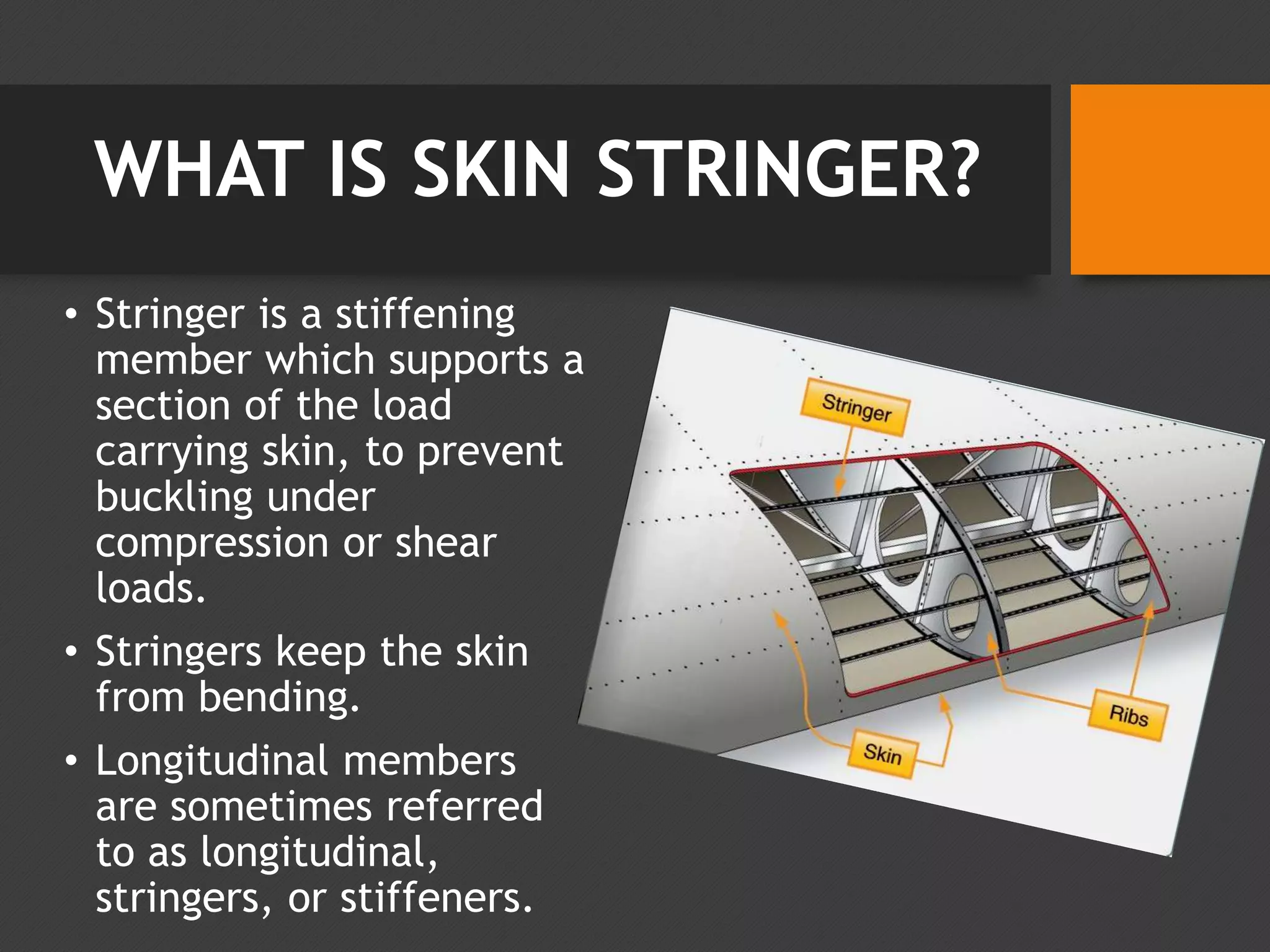
• Stringer is a stiffening
member which supports a
section of the load
carrying skin, to prevent
buckling under
compression or shear
loads.
• Stringers keep the skin
from bending.
• Longitudinal members
are sometimes referred
to as longitudinal,
stringers, or stiffeners.
ROLE OF STRINGERS IN
AIRCRAFT WINGS
• In aircraft construction, a stringer is a thin strip of
material to which the skin of the aircraft is fastened.
In the fuselage, stringers are attached to formers
(also called frames) and run in the longitudinal
direction of the aircraft.
• They are primarily responsible for transferring the
aerodynamic loads acting on the skin onto the frames
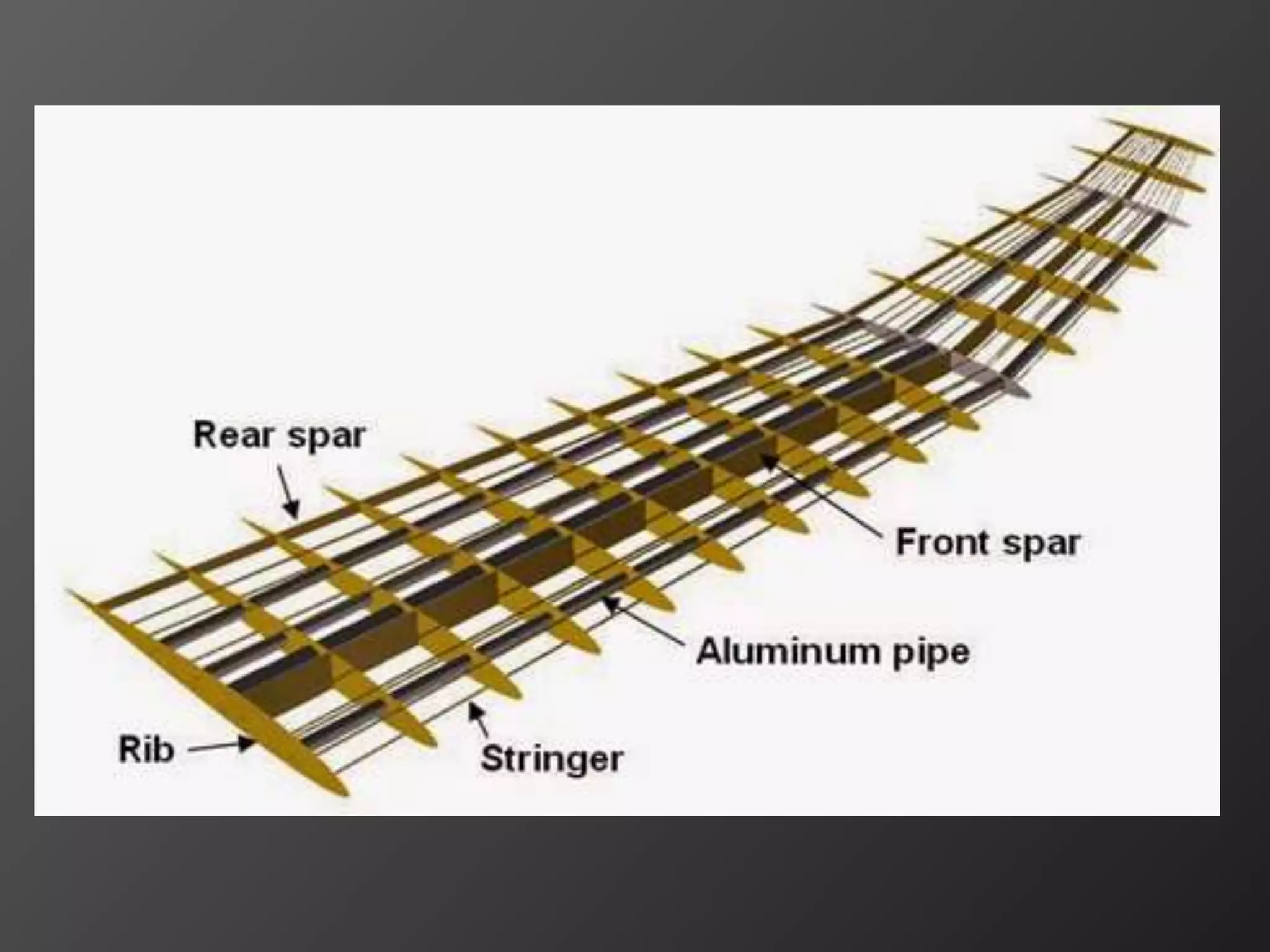
and formers. In the wings or horizontal stabilizer,
longerons run span wise and attach between the ribs.
• The primary function here also is to transfer the
bending loads acting on the wings onto the ribs and
spar.
MATERIAL SPECIFICATION
• Mostly aluminum 2024 T3 is used for skin stringers and
frames. Airframe designers still demand strong, stiff
material at an acceptable weight and cost .So alloys of
aluminum, steel and titanium will probably use for
airframe design.
• Other aluminum alloys i.e. aluminum iron molybdenum
zirconium, function well enough at high temperature to
be competitive with titanium up to near 600oF.
STRINGER AND LONGERONS
• A longeron is part of the structure of an aircraft,
designed to add rigidity and strength to the frame.
• Materials like wood, carbon fiber, and metal can be
used in longeron construction.
• Each longeron attaches directly to the frame of the
aircraft using bolts.
• In some planes, shorter longitudinal supports called
stiffeners or stringers are fastened to the longerons
• Sometimes the specifications longeron and stringer are
applied interchangeably
STRINGER VS. LONGERONS
Stringer Longeron
• If the longitudinal
participants are countless
(usually 50 to 100), they
are named stringers.
• Generally, stringers are of
smaller cross-section once
contrasted to longerons .
• Stringers frequently take
smaller stacks compared
to longerons construction.
• If the longitudinal
participants in a fuselage
are limited (usually 4 to 8),
they are named longerons.
• Generally, longerons are of
greater cross-section once
contrasted to stringers.
• Longerons frequently take
greater stacks compared to
stringers construction.
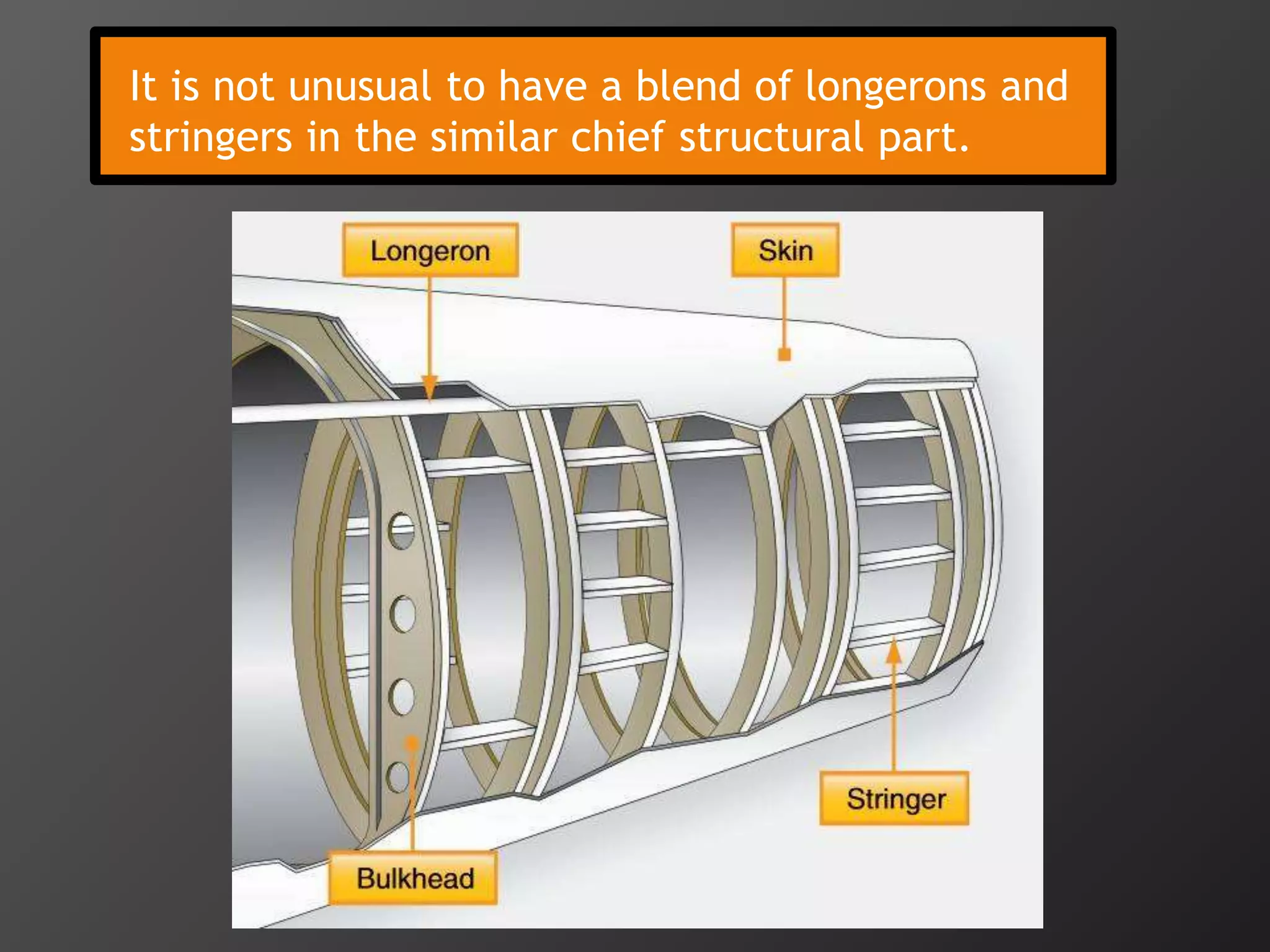
It is not unusual to have a blend of longerons and
stringers in the similar chief structural part.
DIFFERENT SHAPES OF
STRINGERS
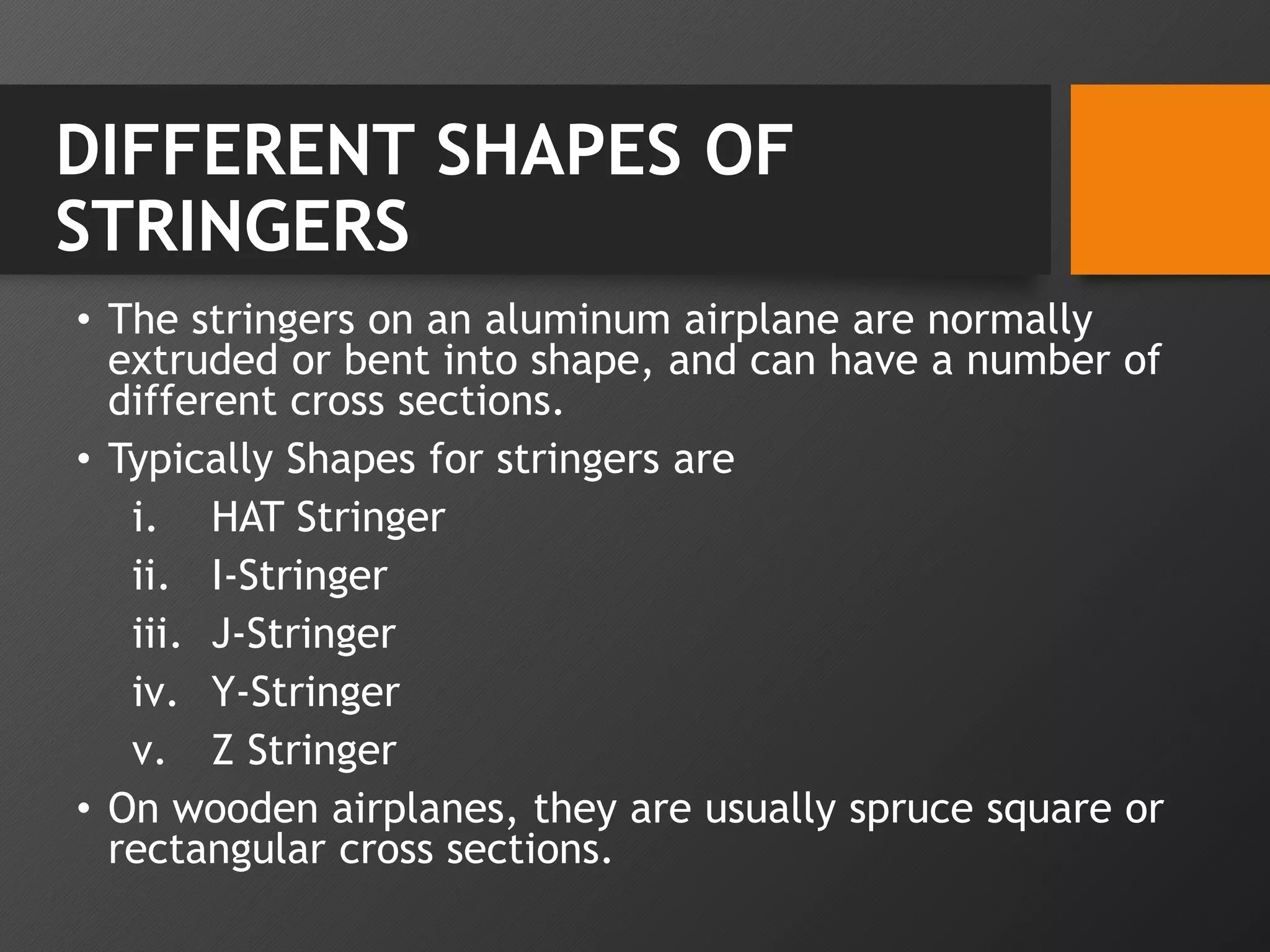
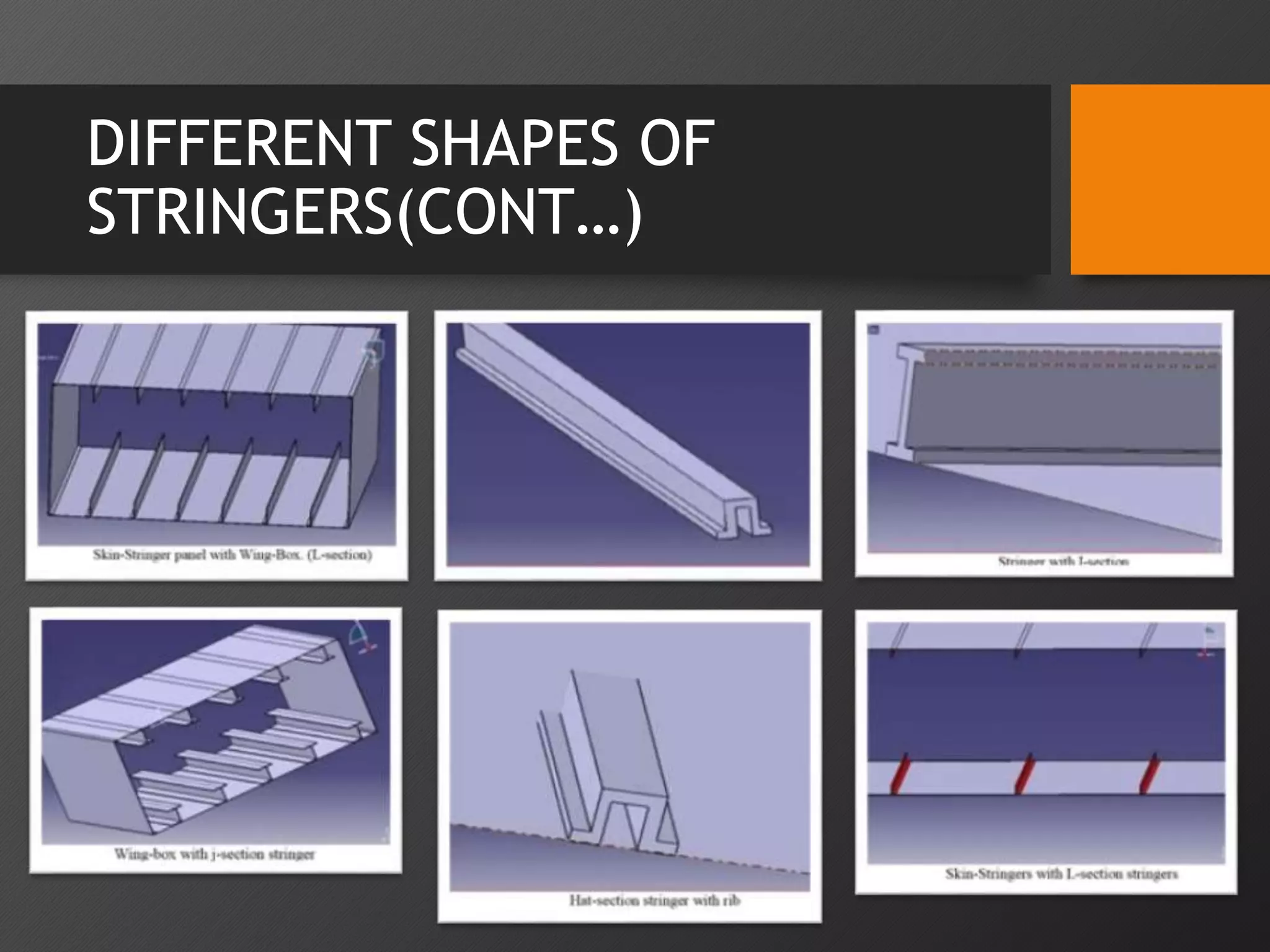
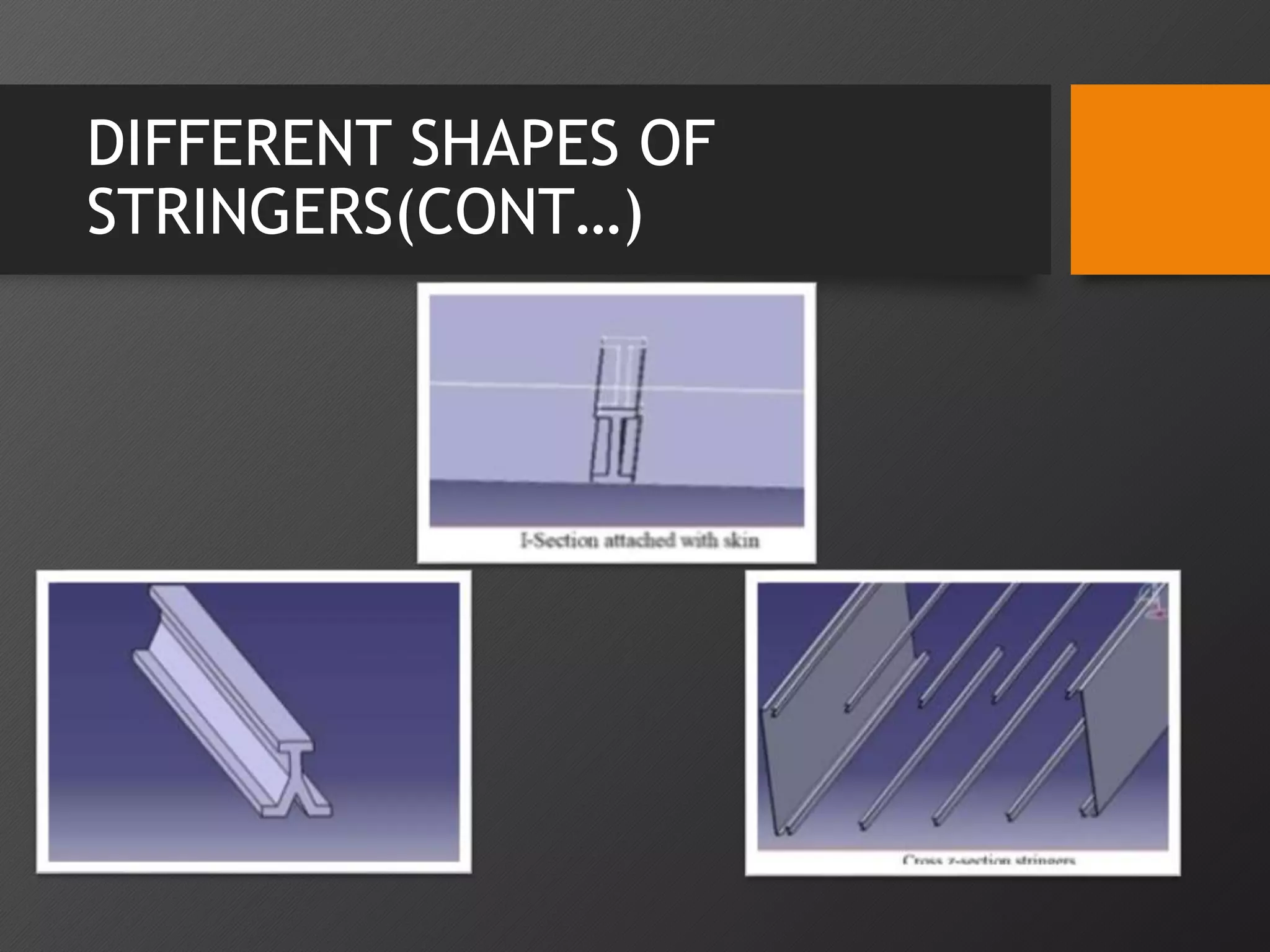
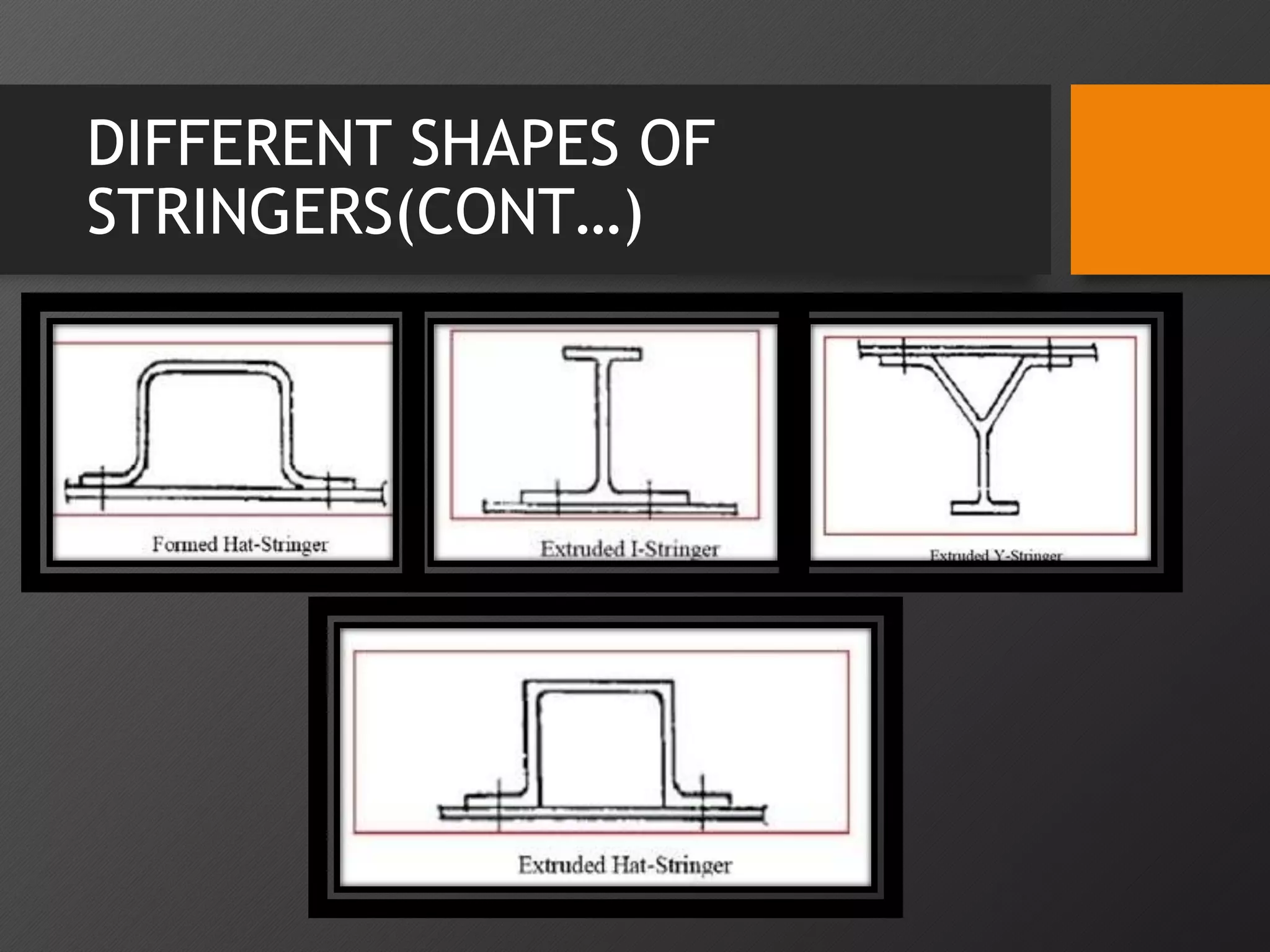
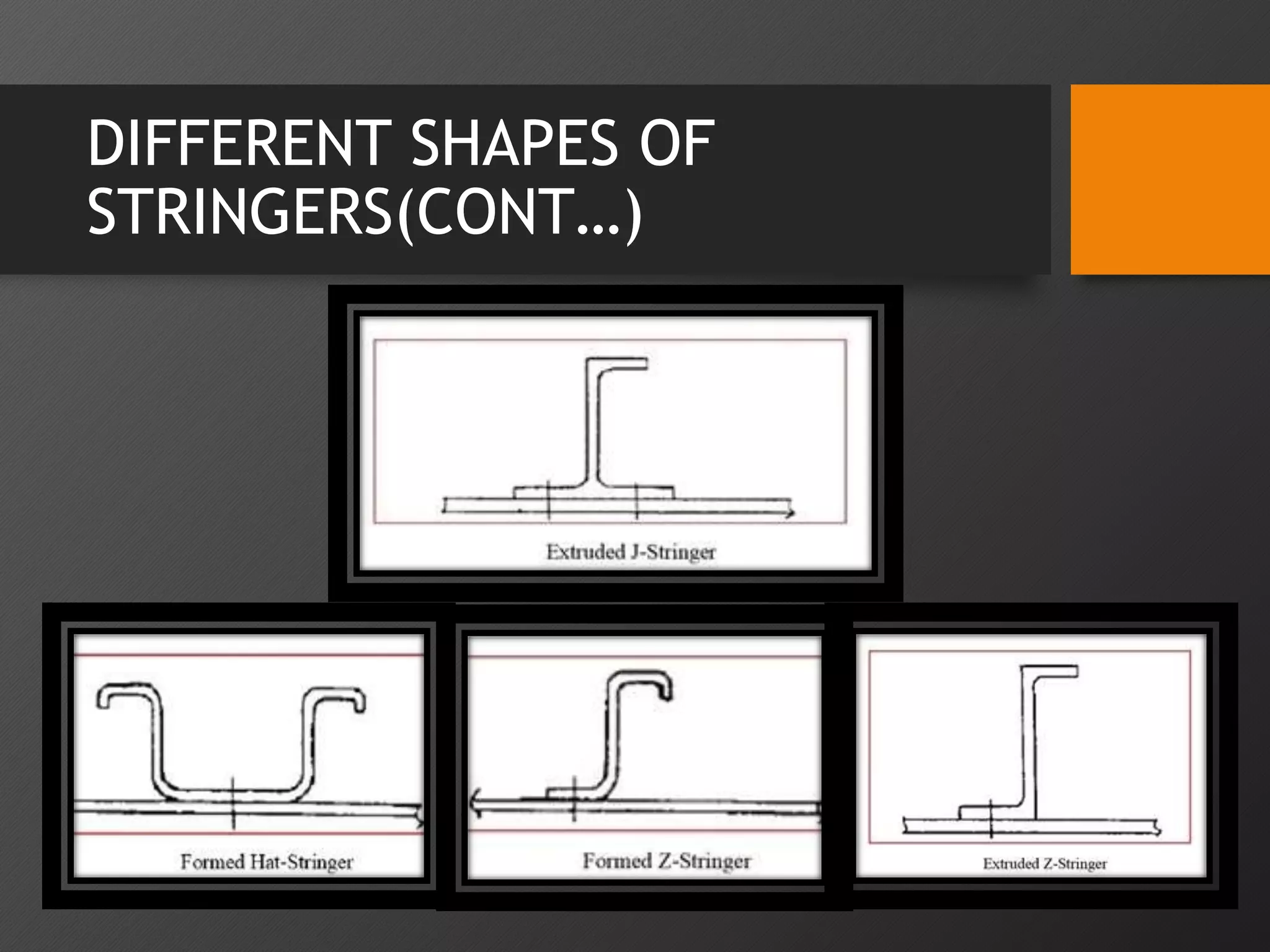
• The stringers on an aluminum airplane are normally
extruded or bent into shape, and can have a number of
different cross sections.
• Typically Shapes for stringers are
i. HAT Stringer
ii. I-Stringer
iii. J-Stringer
iv. Y-Stringer
v. Z Stringer
• On wooden airplanes, they are usually spruce square or
rectangular cross sections.
DIFFERENT SHAPES OF
STRINGERS(CONT…)
DIFFERENT SHAPES OF
STRINGERS(CONT…)
DIFFERENT SHAPES OF
STRINGERS(CONT…)
DIFFERENT SHAPES OF
STRINGERS(CONT…)
CURRENT DEVLOPMENTS
• An effective Optimization routine has been developed
to design a compressive skin stringers panel for
minimum while guarding against important failure
made such as stringer buckling, compression in
stringer outstanding and beam column eccentricity.
• The above optimization routines have been
successfully used to design Wing stringers of different
shapes by CATIA(Computer Aided Three-dimensional
Interactive Application) software.
• A good preliminary design of wing box having different
types of configuration was implemented by different
stages of design process.
RECOMMENDATION FOR
FUTURE WORK
• Although the design of a lower wing panel for simple case
of single straight crack is a good start, it can be extended
to design for a case of multiple cracks.
• Instead of using adhesive material to join stringer with
skin, it would be interesting to design by replacing
adhesive material with rivets (fasteners).
RECOMMENDATION FOR
FUTURE WORK (CONT…)
• The drag forces can also be included while generating the
design load curves.
• As the dimensions for spars and their corresponding web
caps are taken with reasonable assumption, the design
can be refined by taking actual dimensions for them.
• This design process can be repeated at different stations
along the wing semi-spar to design a complete preliminary
of wing box and stringers or skin-stringer pane
Skin stringers-in-an-aircraft

Skin stringers-in-an-aircraft

  • 1.
    SKIN STRINGERS IN ANAIRCRAFT MS MS&E 06 ATTAULLAH KHAN, MUHAMMAD SUBHAN, WAJAHAT ALI
  • 2.
    WHAT IS SKINSTRINGER? • Stringer is a stiffening member which supports a section of the load carrying skin, to prevent buckling under compression or shear loads. • Stringers keep the skin from bending. • Longitudinal members are sometimes referred to as longitudinal, stringers, or stiffeners.
  • 3.
    ROLE OF STRINGERSIN AIRCRAFT WINGS • In aircraft construction, a stringer is a thin strip of material to which the skin of the aircraft is fastened. In the fuselage, stringers are attached to formers (also called frames) and run in the longitudinal direction of the aircraft. • They are primarily responsible for transferring the aerodynamic loads acting on the skin onto the frames and formers. In the wings or horizontal stabilizer, longerons run span wise and attach between the ribs. • The primary function here also is to transfer the bending loads acting on the wings onto the ribs and spar.
  • 5.
    MATERIAL SPECIFICATION • Mostlyaluminum 2024 T3 is used for skin stringers and frames. Airframe designers still demand strong, stiff material at an acceptable weight and cost .So alloys of aluminum, steel and titanium will probably use for airframe design. • Other aluminum alloys i.e. aluminum iron molybdenum zirconium, function well enough at high temperature to be competitive with titanium up to near 600oF.
  • 6.
    STRINGER AND LONGERONS •A longeron is part of the structure of an aircraft, designed to add rigidity and strength to the frame. • Materials like wood, carbon fiber, and metal can be used in longeron construction. • Each longeron attaches directly to the frame of the aircraft using bolts. • In some planes, shorter longitudinal supports called stiffeners or stringers are fastened to the longerons • Sometimes the specifications longeron and stringer are applied interchangeably
  • 7.
    STRINGER VS. LONGERONS StringerLongeron • If the longitudinal participants are countless (usually 50 to 100), they are named stringers. • Generally, stringers are of smaller cross-section once contrasted to longerons . • Stringers frequently take smaller stacks compared to longerons construction. • If the longitudinal participants in a fuselage are limited (usually 4 to 8), they are named longerons. • Generally, longerons are of greater cross-section once contrasted to stringers. • Longerons frequently take greater stacks compared to stringers construction.
  • 8.
    It is notunusual to have a blend of longerons and stringers in the similar chief structural part.
  • 9.
    DIFFERENT SHAPES OF STRINGERS •The stringers on an aluminum airplane are normally extruded or bent into shape, and can have a number of different cross sections. • Typically Shapes for stringers are i. HAT Stringer ii. I-Stringer iii. J-Stringer iv. Y-Stringer v. Z Stringer • On wooden airplanes, they are usually spruce square or rectangular cross sections.
  • 10.
  • 11.
  • 12.
  • 13.
  • 14.
    CURRENT DEVLOPMENTS • Aneffective Optimization routine has been developed to design a compressive skin stringers panel for minimum while guarding against important failure made such as stringer buckling, compression in stringer outstanding and beam column eccentricity. • The above optimization routines have been successfully used to design Wing stringers of different shapes by CATIA(Computer Aided Three-dimensional Interactive Application) software. • A good preliminary design of wing box having different types of configuration was implemented by different stages of design process.
  • 15.
    RECOMMENDATION FOR FUTURE WORK •Although the design of a lower wing panel for simple case of single straight crack is a good start, it can be extended to design for a case of multiple cracks. • Instead of using adhesive material to join stringer with skin, it would be interesting to design by replacing adhesive material with rivets (fasteners).
  • 16.
    RECOMMENDATION FOR FUTURE WORK(CONT…) • The drag forces can also be included while generating the design load curves. • As the dimensions for spars and their corresponding web caps are taken with reasonable assumption, the design can be refined by taking actual dimensions for them. • This design process can be repeated at different stations along the wing semi-spar to design a complete preliminary of wing box and stringers or skin-stringer pane