BRIDGING
Resources and Agencies in Large-Scale Emergency Management
EU FP7 Collaborative Project
SEC-2010.4.2-1: Interoperability of data, systems, tools and equipment
www.sec-bridge.eu
Inter-organizational Collaboration Structures
during Emergency Response: A Case Study
ISCRAM 2013
Aslak Wegner Eide,
Ida Maria Haugstveit,
Ragnhild Halvorsrud,
Maria Borén
Introduction
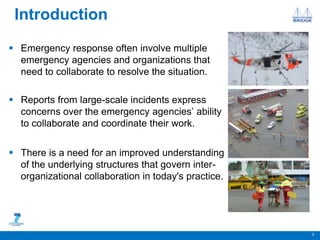
 Emergency response often involve multiple
emergency agencies and organizations that
need to collaborate to resolve the situation.
 Reports from large-scale incidents express
concerns over the emergency agencies’ ability
to collaborate and coordinate their work.
 There is a need for an improved understanding
of the underlying structures that govern inter-
organizational collaboration in today's practice.
2
Case study
 Aim: Examine the collaborative structures that could appear
between organizations and agencies that would be deployed in
response to a hypothetical, large scale incident in Norway.
- Identify and categorize the actors that would be involved.
- Clarify the capabilities and knowledge those actors would possess.
- Examine how the actors would interact and communicate.
3
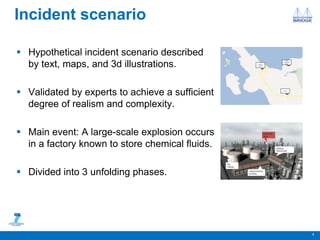
Incident scenario
 Hypothetical incident scenario described
by text, maps, and 3d illustrations.
 Validated by experts to achieve a sufficient
degree of realism and complexity.
 Main event: A large-scale explosion occurs
in a factory known to store chemical fluids.
 Divided into 3 unfolding phases.
4
Method
 The study consisted of semi-structured interviews with 11
representatives from emergency agencies and organizations.
 The hypothetical incident scenario was presented to the
participants in a sequential manner (from phase 1 to 3).
 For each phase, the interviewees were asked to explain:
- Which actors they thought likely to take part in the response effort.
- What capabilities and knowledge each actor would contribute.
- How the identified actors would interact and communicate.
 Interview guided by a predefined template that was filled in.
5
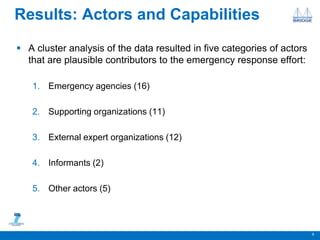
Results: Actors and Capabilities
 A cluster analysis of the data resulted in five categories of actors
that are plausible contributors to the emergency response effort:
1. Emergency agencies (16)
2. Supporting organizations (11)
3. External expert organizations (12)
4. Informants (2)
5. Other actors (5)
6
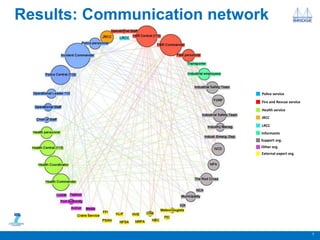
Results: Communication network
7
Support org.
External expert org.
Other org.
JRCC
LRCC
Informants
Police service
Fire and Rescue service
Health service
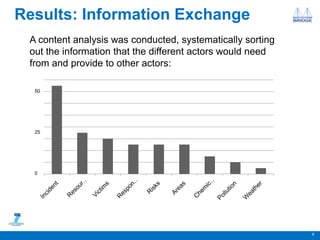
Results: Information Exchange
8
A content analysis was conducted, systematically sorting
out the information that the different actors would need
from and provide to other actors:
50
25
0
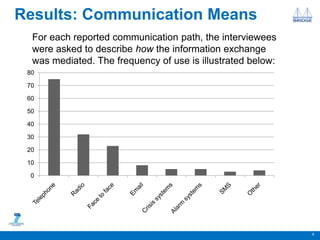
Results: Communication Means
9
0
10
20
30
40
50
60
70
80
For each reported communication path, the interviewees
were asked to describe how the information exchange
was mediated. The frequency of use is illustrated below:
Discussion and Conclusion
- The collaborative structures that emerge during emergency
response can be highly interactive and complex, and typically
involves public, private, and non-profit organizations.
- The most central actors in the communication network are
commanding personnel and emergency centrals.
- A substantial amount of the overall communication activity involves
keeping all parties up-to-date on the situation at hand.
- Verbal communication is the most frequently used means for
exchanging information (IT-based support systems are not used)
- Framework for analysis of communication networks
10
Future work
 Apply the present methodology to different scenarios and a larger
sample of actors to delineate a generic communication pattern.
 Assess the validity of the present scenario-based inquiry by
applying it to a larger sample of actors/roles.
 Investigate logs from real incidents and conduct a corresponding
analysis of the inter-organizational collaboration networks.
11
Q&A
12

Inter-organizational Collaboration Structures during Emergency Response: A Case Study

  • 1.
    BRIDGING Resources and Agenciesin Large-Scale Emergency Management EU FP7 Collaborative Project SEC-2010.4.2-1: Interoperability of data, systems, tools and equipment www.sec-bridge.eu Inter-organizational Collaboration Structures during Emergency Response: A Case Study ISCRAM 2013 Aslak Wegner Eide, Ida Maria Haugstveit, Ragnhild Halvorsrud, Maria Borén
  • 2.
    Introduction  Emergency responseoften involve multiple emergency agencies and organizations that need to collaborate to resolve the situation.  Reports from large-scale incidents express concerns over the emergency agencies’ ability to collaborate and coordinate their work.  There is a need for an improved understanding of the underlying structures that govern inter- organizational collaboration in today's practice. 2
  • 3.
    Case study  Aim:Examine the collaborative structures that could appear between organizations and agencies that would be deployed in response to a hypothetical, large scale incident in Norway. - Identify and categorize the actors that would be involved. - Clarify the capabilities and knowledge those actors would possess. - Examine how the actors would interact and communicate. 3
  • 4.
    Incident scenario  Hypotheticalincident scenario described by text, maps, and 3d illustrations.  Validated by experts to achieve a sufficient degree of realism and complexity.  Main event: A large-scale explosion occurs in a factory known to store chemical fluids.  Divided into 3 unfolding phases. 4
  • 5.
    Method  The studyconsisted of semi-structured interviews with 11 representatives from emergency agencies and organizations.  The hypothetical incident scenario was presented to the participants in a sequential manner (from phase 1 to 3).  For each phase, the interviewees were asked to explain: - Which actors they thought likely to take part in the response effort. - What capabilities and knowledge each actor would contribute. - How the identified actors would interact and communicate.  Interview guided by a predefined template that was filled in. 5
  • 6.
    Results: Actors andCapabilities  A cluster analysis of the data resulted in five categories of actors that are plausible contributors to the emergency response effort: 1. Emergency agencies (16) 2. Supporting organizations (11) 3. External expert organizations (12) 4. Informants (2) 5. Other actors (5) 6
  • 7.
    Results: Communication network 7 Supportorg. External expert org. Other org. JRCC LRCC Informants Police service Fire and Rescue service Health service
  • 8.
    Results: Information Exchange 8 Acontent analysis was conducted, systematically sorting out the information that the different actors would need from and provide to other actors: 50 25 0
  • 9.
    Results: Communication Means 9 0 10 20 30 40 50 60 70 80 Foreach reported communication path, the interviewees were asked to describe how the information exchange was mediated. The frequency of use is illustrated below:
  • 10.
    Discussion and Conclusion -The collaborative structures that emerge during emergency response can be highly interactive and complex, and typically involves public, private, and non-profit organizations. - The most central actors in the communication network are commanding personnel and emergency centrals. - A substantial amount of the overall communication activity involves keeping all parties up-to-date on the situation at hand. - Verbal communication is the most frequently used means for exchanging information (IT-based support systems are not used) - Framework for analysis of communication networks 10
  • 11.
    Future work  Applythe present methodology to different scenarios and a larger sample of actors to delineate a generic communication pattern.  Assess the validity of the present scenario-based inquiry by applying it to a larger sample of actors/roles.  Investigate logs from real incidents and conduct a corresponding analysis of the inter-organizational collaboration networks. 11
  • 12.

Editor's Notes

  • #2 Present yourself and co-authorsPresent paper that you are going to presentPresent outline for presentationPresent BRIDGE project
  • #3 This understanding is essential in order to develop solutions for improving inter-organizational collaboration in the future.
  • #5 Actors they were to identify includes themselves, actors from their own agency, and other actors that would provide them with support or critical information Mean working experience of 22.5 years.