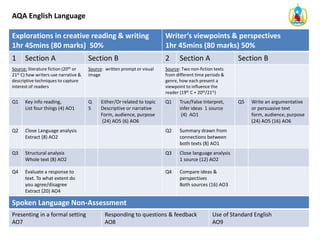
Explorations in creative reading & writing
1hr 45mins (80 marks) 50%
Writer’s viewpoints & perspectives
1hr 45mins (80 marks) 50%
1 Section A Section B 2 Section A Section B
Source: literature fiction (20th or
21st C) how writers use narrative &
descriptive techniques to capture
interest of readers
Source: written prompt or visual
image
Source: Two non-fiction texts
from different time periods &
genre, how each present a
viewpoint to influence the
reader (19th C + 20th/21st)
Q1 Key info reading,
List four things (4) AO1
Q
5
Either/Or related to topic
Descriptive or narrative
Form, audience, purpose
(24) AO5 (6) AO6
Q1 True/False Interpret,
infer ideas 1 source
(4) AO1
Q5 Write an argumentative
or persuasive text
form, audience, purpose
(24) AO5 (16) AO6
Q2 Close Language analysis
Extract (8) AO2
Q2 Summary drawn from
connections between
both texts (8) AO1
Q3 Structural analysis
Whole text (8) AO2
Q3 Close language analysis
1 source (12) AO2
Q4 Evaluate a response to
text. To what extent do
you agree/disagree
Extract (20) AO4
Q4 Compare ideas &
perspectives
Both sources (16) AO3
AQA English Language
Spoken Language Non-Assessment
Presenting in a formal setting
AO7
Responding to questions & feedback
AO8
Use of Standard English
AO9
English Language: Assessment Objectives
AO1 Identify & interpret explicit & implicit information & ideas
Select and synthesise evidence from different texts
AO2 Explain, comment on and analyse how writers use language and structure to achieve effects and
influence readers, using relevant subject terminology to support their views
AO3 Compare writers’ ideas and perspectives, as well as how these are conveyed, across two or more
texts
AO4 Evaluate texts critically and support this with appropriate textual references
AO5 Communicate clearly, effectively and imaginatively, selecting and adapting tone, style and register
for different forms, purposes and audiences. Organise information and ideas, using structural and
grammatical features to support coherence and cohesion of texts.
AO6 Candidates must use a range of vocabulary and sentence structures for clarity, purpose and effect,
with accurate spelling & punctuation.
AO7 Demonstrate presentation skills in a formal setting
AO8 Listen & respond appropriately to spoken language, including questions & feedback on presentations
AO9 Use spoken Standard English effectively in speeches and presentations
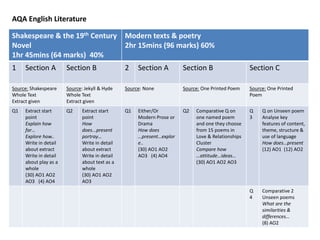
Shakespeare & the 19th Century
Novel
1hr 45mins (64 marks) 40%
Modern texts & poetry
2hr 15mins (96 marks) 60%
1 Section A Section B 2 Section A Section B Section C
Source: Shakespeare
Whole Text
Extract given
Source: Jekyll & Hyde
Whole Text
Extract given
Source: None Source: One Printed Poem Source: One Printed
Poem
Q1 Extract start
point
Explain how
far…
Explore how..
Write in detail
about extract
Write in detail
about play as a
whole
(30) AO1 AO2
AO3 (4) AO4
Q2 Extract start
point
How
does...present
portray…
Write in detail
about extract
Write in detail
about text as a
whole
(30) AO1 AO2
AO3
Q1 Either/Or
Modern Prose or
Drama
How does
…present…explor
e..
(30) AO1 AO2
AO3 (4) AO4
Q2 Comparative Q on
one named poem
and one they choose
from 15 poems in
Love & Relationships
Cluster
Compare how
…attitude…ideas…
(30) AO1 AO2 AO3
Q
3
Q on Unseen poem
Analyse key
features of content,
theme, structure &
use of language
How does…present
(12) AO1 (12) AO2
Q
4
Comparative 2
Unseen poems
What are the
similarities &
differences…
(8) AO2
AQA English Literature
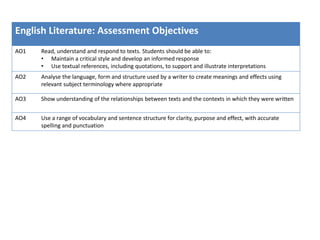
English Literature: Assessment Objectives
AO1 Read, understand and respond to texts. Students should be able to:
• Maintain a critical style and develop an informed response
• Use textual references, including quotations, to support and illustrate interpretations
AO2 Analyse the language, form and structure used by a writer to create meanings and effects using
relevant subject terminology where appropriate
AO3 Show understanding of the relationships between texts and the contexts in which they were written
AO4 Use a range of vocabulary and sentence structure for clarity, purpose and effect, with accurate
spelling and punctuation

Assessment Objectives AQA GCSE English

  • 1.
    Explorations in creativereading & writing 1hr 45mins (80 marks) 50% Writer’s viewpoints & perspectives 1hr 45mins (80 marks) 50% 1 Section A Section B 2 Section A Section B Source: literature fiction (20th or 21st C) how writers use narrative & descriptive techniques to capture interest of readers Source: written prompt or visual image Source: Two non-fiction texts from different time periods & genre, how each present a viewpoint to influence the reader (19th C + 20th/21st) Q1 Key info reading, List four things (4) AO1 Q 5 Either/Or related to topic Descriptive or narrative Form, audience, purpose (24) AO5 (6) AO6 Q1 True/False Interpret, infer ideas 1 source (4) AO1 Q5 Write an argumentative or persuasive text form, audience, purpose (24) AO5 (16) AO6 Q2 Close Language analysis Extract (8) AO2 Q2 Summary drawn from connections between both texts (8) AO1 Q3 Structural analysis Whole text (8) AO2 Q3 Close language analysis 1 source (12) AO2 Q4 Evaluate a response to text. To what extent do you agree/disagree Extract (20) AO4 Q4 Compare ideas & perspectives Both sources (16) AO3 AQA English Language Spoken Language Non-Assessment Presenting in a formal setting AO7 Responding to questions & feedback AO8 Use of Standard English AO9
  • 2.
    English Language: AssessmentObjectives AO1 Identify & interpret explicit & implicit information & ideas Select and synthesise evidence from different texts AO2 Explain, comment on and analyse how writers use language and structure to achieve effects and influence readers, using relevant subject terminology to support their views AO3 Compare writers’ ideas and perspectives, as well as how these are conveyed, across two or more texts AO4 Evaluate texts critically and support this with appropriate textual references AO5 Communicate clearly, effectively and imaginatively, selecting and adapting tone, style and register for different forms, purposes and audiences. Organise information and ideas, using structural and grammatical features to support coherence and cohesion of texts. AO6 Candidates must use a range of vocabulary and sentence structures for clarity, purpose and effect, with accurate spelling & punctuation. AO7 Demonstrate presentation skills in a formal setting AO8 Listen & respond appropriately to spoken language, including questions & feedback on presentations AO9 Use spoken Standard English effectively in speeches and presentations
  • 3.
    Shakespeare & the19th Century Novel 1hr 45mins (64 marks) 40% Modern texts & poetry 2hr 15mins (96 marks) 60% 1 Section A Section B 2 Section A Section B Section C Source: Shakespeare Whole Text Extract given Source: Jekyll & Hyde Whole Text Extract given Source: None Source: One Printed Poem Source: One Printed Poem Q1 Extract start point Explain how far… Explore how.. Write in detail about extract Write in detail about play as a whole (30) AO1 AO2 AO3 (4) AO4 Q2 Extract start point How does...present portray… Write in detail about extract Write in detail about text as a whole (30) AO1 AO2 AO3 Q1 Either/Or Modern Prose or Drama How does …present…explor e.. (30) AO1 AO2 AO3 (4) AO4 Q2 Comparative Q on one named poem and one they choose from 15 poems in Love & Relationships Cluster Compare how …attitude…ideas… (30) AO1 AO2 AO3 Q 3 Q on Unseen poem Analyse key features of content, theme, structure & use of language How does…present (12) AO1 (12) AO2 Q 4 Comparative 2 Unseen poems What are the similarities & differences… (8) AO2 AQA English Literature
  • 4.
    English Literature: AssessmentObjectives AO1 Read, understand and respond to texts. Students should be able to: • Maintain a critical style and develop an informed response • Use textual references, including quotations, to support and illustrate interpretations AO2 Analyse the language, form and structure used by a writer to create meanings and effects using relevant subject terminology where appropriate AO3 Show understanding of the relationships between texts and the contexts in which they were written AO4 Use a range of vocabulary and sentence structure for clarity, purpose and effect, with accurate spelling and punctuation