MOST IMPORTANT
INTANGIBLE ASSET:
CREDIBILITY
S T E P H A N E P R U D ’ H O M M E
A L L R I G H T S R E S E RV E D - © 2 0 1 5
STEPHANE PRUD’HOMME
• MA (Canada), MBA (China), PhD ABD (Macau)
• 21 years of experience in public relations and marcom, including:
– 8 years in China and SouthEast Asia
– 13 years of studying and working with credibility and reputation constructs
• Managing Director and Credibility Engineer at Credibility Institute
– www.credibilityinstitute.com | www.credibilityacademy.org
WHAT IS
CREDIBILITY?
3
PUBLIC RELATIONS
STRATEGY
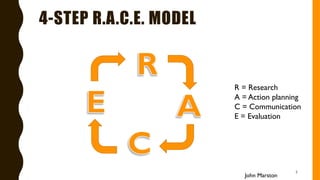
R = Research
A = Action planning
C = Communication
E = Evaluation
4-STEP R.A.C.E. MODEL
John Marston
5
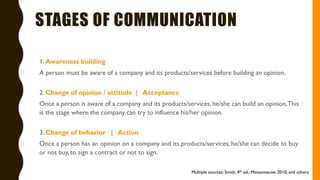
STAGES OF COMMUNICATION
1. Awareness building
A person must be aware of a company and its products/services before building an opinion.
2. Change of opinion / attitude | Acceptance
Once a person is aware of a company and its products/services, he/she can build an opinion.This
is the stage where the company can try to influence his/her opinion.
3. Change of behavior | Action
Once a person has an opinion on a company and its products/services, he/she can decide to buy
or not buy, to sign a contract or not to sign.
Multiple sources: Smith, 4th ed.; Maisonneuve, 2010; and others
FISHBEIN
MODEL
h t t p : / / b i t . l y / 2 m j B r j R
7
STAKEHOLDERS
AND PUBLICS
8
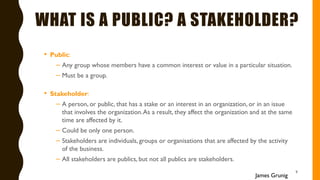
WHAT IS A PUBLIC? A STAKEHOLDER?
• Public:
– Any group whose members have a common interest or value in a particular situation.
– Must be a group.
• Stakeholder:
– A person, or public, that has a stake or an interest in an organization, or in an issue
that involves the organization.As a result, they affect the organization and at the same
time are affected by it.
– Could be only one person.
– Stakeholders are individuals, groups or organisations that are affected by the activity
of the business.
– All stakeholders are publics, but not all publics are stakeholders.
James Grunig
9
STAKEHOLDERS VS. PUBLICS
• Grunig and Repper in 1992 differentiated the terms “stakeholder” and “public” in the
following way: Organizations choose stakeholders by their marketing strategies, recruiting,
and investment plans, but “publics arise on their own and choose the organization for
attention.”
• The type of public determines how and what you communicate to the public.This theory
then, points out that an organization should communicate with its latent and aware publics
to solve any problems or issues before the situation escalates and the publics decide to
take action.
• A public is distinct from a stakeholder or a market.
10
James Grunig
PUBLICS
11
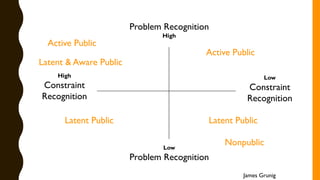
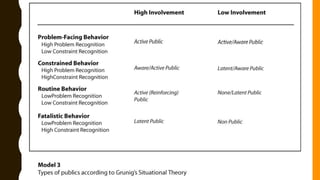
4 CATEGORIES OF PUBLICS
• Nonpublic
– No problem is recognized or exists, Low problem / Low constraint recognition
– No consequences, Communication not necessary
• Latent public
– Problem is there, but public is not aware, does not recognise it
– Low problem recognition, High or Low constraint recognition
– Communication not sought so message must be creative and attention-getting
• Aware public
– Group recognizes the problem, that a problem exists
– High problem recognition
– High constraint recognition
– Communication may or may not be processed by these publics
• Active public
– Group organizes to respond to the problem
– Group is aware of the problem and organises to respond to it
– High problem recognition, High or low constraint recognition
– Organization must actively communicate with active publics and maintain a high public profile
JamesGrunig
FACTORS DETERMINING THE TYPE
OF PUBLIC
• Problem Recognition
• Constraint Recognition
• Level of Involvement
James Grunig
Problem Recognition
High
Low
Problem Recognition
High
Constraint
Recognition
Low
Constraint
Recognition
Active Public
Active Public
Latent & Aware Public
Latent PublicLatent Public
Nonpublic
James Grunig
EVALUATION AND
MEASUREMENT
16
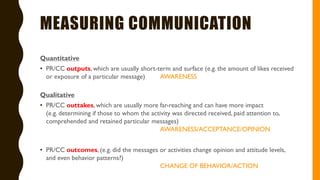
MEASURING COMMUNICATION
Quantitative
• PR/CC outputs, which are usually short-term and surface (e.g. the amount of likes received
or exposure of a particular message) AWARENESS
Qualitative
• PR/CC outtakes, which are usually more far-reaching and can have more impact
(e.g. determining if those to whom the activity was directed received, paid attention to,
comprehended and retained particular messages)
AWARENESS/ACCEPTANCE/OPINION
• PR/CC outcomes, (e.g. did the messages or activities change opinion and attitude levels,
and even behavior patterns?)
CHANGE OF BEHAVIOR/ACTION
CREDIBILITY
WHAT IS
CREDIBILITY?
19
ARISTOTLE: ETHOS, PATHOS, LOGOS
• Ethos means to convince an audience of the author’s credibility or character. An author would use
ethos to show to his audience that he is a credible source and is worth listening to. Ethos can be
developed by choosing language that is appropriate for the audience and topic (also means choosing
proper level of vocabulary), making yourself sound fair or unbiased, introducing your expertise or
pedigree, and by using correct grammar and syntax.
• Pathos means to persuade an audience by appealing to their emotions.Authors use pathos to
invoke sympathy from an audience; to make the audience feel what what the author wants them to
feel. Pathos can be developed by using meaningful language, emotional tone, emotion evoking
examples, stories of emotional events, and implied meanings.
• Logos means to convince an audience by use of logic or reason.To use logos would be to cite facts
and statistics, historical and literal analogies, and citing certain authorities on a subject. Logos can be
developed by using advanced, theoretical or abstract language, citing facts (very important), using
historical and literal analogies, and by constructing logical arguments.
20
pathosethoslogos.com
BRANDING,
IMAGE,
REPUTATION
21
BRANDING
• Brand awareness
• Brand recognition
• Brand recall
• Stage when we build an image
• Publicity
• Advertisement
• Repetition
22
BRAND IMAGE
• Publicity and Advertisement
• Repetition
• Image is what we see, what we hear
• Brand image is the current view of the customers about a brand. It can be defined as
a unique bundle of associations within the minds of target customers. It is a set of beliefs held
about a specific brand.
• It is nothing but the consumers’ perception about the product. Brand image conveys emotional
value and not just a mental image. Brand image is nothing but an organization’s character. It is
an accumulation of contact and observation by people external to an organization. It should
highlight an organization’s mission and vision to all.
• Brand image is the overall impression in consumers’ mind that is formed from all
sources. Consumers develop various associations with the brand. Based on these associations,
they form brand image.
23
www.managementstudyguide.com
BRAND/CORPORATE IMAGE
• The brand and the corporate image include:
– Brand positioning
– Brand personality
– Brand identity
– Brand legitimacy
24
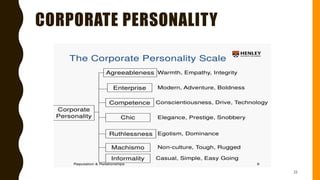
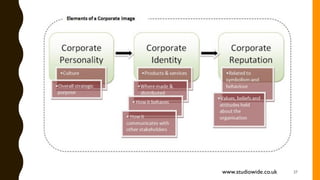
CORPORATE PERSONALITY
25
BRAND
IDENTITY VS
BRAND IMAGE
h t t p : / / b i t . l y / 2 n q k C V R
26
27www.studiowide.co.uk
TRUST
• Professor Cabral:
– Expectation to do something
– Repetition
• Trust: it’s about an action (Bohnet et al.)
• I gave you money because I trust you and I know that you will give it back to me.
28
FROM TRUST TO CREDIBILITY
29
CREDIBILITY
• Reception and perception, consistency
• Doing what has been said to be done
• Believe in a message
• Credibility: it’s about a message (Bohnet et al.)
• I believe a message:The wall is white because you told me and I believe you.
• Difference between trust and credibility is that trust is confidence in or reliance
on some person or quality while credibility is reputation impacting one's ability
to be believed. (wikidiff.com)
30
AN INTIMATE RELATIONSHIP
• The intimate relationship between a spokesperson and his/her credibility
• Credibility is not only related to influence and persuasion, but also to the act of
informing, communicating, having a dialog with an audience, receiving feedback.That is to
create and maintain a relationship of trust and sharing between a spokesperson or a
corporation and their publics and stakeholders.
• We must understand that credibility exists only in function of a reflection or a
perception, it does not exist by itself, it starts in the mind of every member of an audience.A
spokesperson is not credible because he/she thinks that he/she is credible, it is only how the
audience perceives his/her credibility.
• A credible spokesperson sincerely wishes to establish and maintain a relationship
of trust and mutual understanding with his/her publics rather than being effective. A
credible spokesperson always demonstrates a great flexibility and a mindset of openness along
with a constant authenticity.
31Prud’homme, 2004
REPUTATION
• Professor Cabral:
– Believed to be something
• Reputation is what we understand, what we remember, what we recall.
• The main point is that corporate reputation has to be earned.A company can try to
forge and carve their image, however, whether that image will lead to a favourable
reputation (which is aligned with the image, and therefore hopefully a positive reputation),
will depend on the actual activities and the tangible results, good or bad, that customers
experience. (www.studiowide.co.uk)
• “Reputation is the sum values that stakeholders attribute to a company, based on
their perception and interpretation of the image that the company communicates
over time” John Dalton, Managing Corporate Reputation.
32
REPUTATION REVISITED FRAMEWORK
33© 2015 Stephane Prud’homme
STAGES OF COMMUNICATION
• Where are located the stages of communication in this model?
1.Awareness building
2. Change of opinion / attitude | Acceptance
3. Change of behavior | Action
34
SOURCE
CREDIBILITY
THEORY
W W W. S O U R C E C R E D I B I L I T Y. O R G
35
SOURCE CREDIBILITY
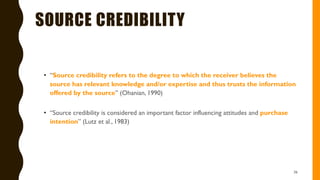
• “Source credibility refers to the degree to which the receiver believes the
source has relevant knowledge and/or expertise and thus trusts the information
offered by the source” (Ohanian, 1990)
• “Source credibility is considered an important factor influencing attitudes and purchase
intention” (Lutz et al., 1983)
36
37
Hovlandetal.,1951
SOURCECREDIBILITY
THEORY
THREE DIMENSIONS OF SOURCE
CREDIBILITY SCALE
38
SOURCE CREDIBILITY KEY FACTORS
39
CREDIBILITY CLASSIFICATION MODEL
40
Ohanian,1990andPrud’homme,2017
CREDIBILITY FACTORS
41
©2004StephanePrud’homme
CREDIBILITY AS AN OPEN SYSTEM
42
© 2004 Stephane Prud’homme
CREDIBILITY ECOSYSTEM
43
© 2004 Stephane Prud’homme
CORPORATE CREDIBILITY
44
DUAL CREDIBILITY MODEL
45
CREDIBILITY IS
A PERCEPTION
46
WE BELIEVE A
MESSAGE.
THE SPOKESPERSON
IS CREDIBLE.
47
WALK THE TALK
48
CONSISTENCY
49
BE VISIBLE
50
CREDIBILITY
EVALUATION &
MEASUREMENT
51
EVALUATION & MEASUREMENT
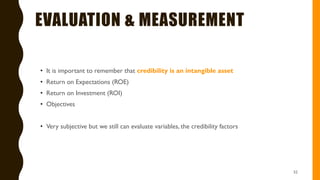
• It is important to remember that credibility is an intangible asset
• Return on Expectations (ROE)
• Return on Investment (ROI)
• Objectives
• Very subjective but we still can evaluate variables, the credibility factors
52
CREDIBILITY ROI & ROE
53
54
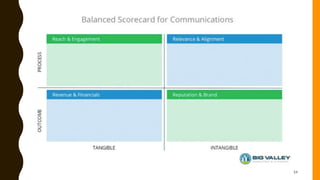
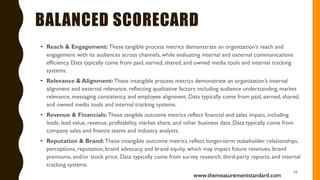
BALANCED SCORECARD
• Reach & Engagement: These tangible process metrics demonstrate an organization’s reach and
engagement with its audiences across channels, while evaluating internal and external communications
efficiency. Data typically come from paid, earned, shared, and owned media tools and internal tracking
systems.
• Relevance & Alignment: These intangible process metrics demonstrate an organization’s internal
alignment and external relevance, reflecting qualitative factors including audience understanding, market
relevance, messaging consistency, and employee alignment. Data typically come from paid, earned, shared,
and owned media tools and internal tracking systems.
• Revenue & Financials: These tangible outcome metrics reflect financial and sales impact, including
leads, lead value, revenue, profitability, market share, and other business data. Data typically come from
company sales and finance teams and industry analysts.
• Reputation & Brand: These intangible outcome metrics reflect longer-term stakeholder relationships,
perceptions, reputation, brand advocacy, and brand equity, which may impact future revenues, brand
premiums, and/or stock price. Data typically come from survey research, third-party reports, and internal
tracking systems.
55
www.themeasurementstandard.com
EVALUATION FRAMEWORK
56© Stephane Prud’homme and Guy Litalien
CONCLUSION
R E A D I N G : h t t p : / / b i t . l y / 2 m G 8 TO r
57
MERCI.
www.stepru.com
www.facebook.com/stepru
www.twitter.com/stepru
www.linkedin.com/in/stepru
www.stepru.tumblr.com
m.me/stepru
facebook.com/groups/PRStudents
AndGrads
facebook.com/credibilityinstitute

Credibility

  • 1.
    MOST IMPORTANT INTANGIBLE ASSET: CREDIBILITY ST E P H A N E P R U D ’ H O M M E A L L R I G H T S R E S E RV E D - © 2 0 1 5
  • 2.
    STEPHANE PRUD’HOMME • MA(Canada), MBA (China), PhD ABD (Macau) • 21 years of experience in public relations and marcom, including: – 8 years in China and SouthEast Asia – 13 years of studying and working with credibility and reputation constructs • Managing Director and Credibility Engineer at Credibility Institute – www.credibilityinstitute.com | www.credibilityacademy.org
  • 3.
  • 4.
  • 5.
    R = Research A= Action planning C = Communication E = Evaluation 4-STEP R.A.C.E. MODEL John Marston 5
  • 6.
    STAGES OF COMMUNICATION 1.Awareness building A person must be aware of a company and its products/services before building an opinion. 2. Change of opinion / attitude | Acceptance Once a person is aware of a company and its products/services, he/she can build an opinion.This is the stage where the company can try to influence his/her opinion. 3. Change of behavior | Action Once a person has an opinion on a company and its products/services, he/she can decide to buy or not buy, to sign a contract or not to sign. Multiple sources: Smith, 4th ed.; Maisonneuve, 2010; and others
  • 7.
    FISHBEIN MODEL h t tp : / / b i t . l y / 2 m j B r j R 7
  • 8.
  • 9.
    WHAT IS APUBLIC? A STAKEHOLDER? • Public: – Any group whose members have a common interest or value in a particular situation. – Must be a group. • Stakeholder: – A person, or public, that has a stake or an interest in an organization, or in an issue that involves the organization.As a result, they affect the organization and at the same time are affected by it. – Could be only one person. – Stakeholders are individuals, groups or organisations that are affected by the activity of the business. – All stakeholders are publics, but not all publics are stakeholders. James Grunig 9
  • 10.
    STAKEHOLDERS VS. PUBLICS •Grunig and Repper in 1992 differentiated the terms “stakeholder” and “public” in the following way: Organizations choose stakeholders by their marketing strategies, recruiting, and investment plans, but “publics arise on their own and choose the organization for attention.” • The type of public determines how and what you communicate to the public.This theory then, points out that an organization should communicate with its latent and aware publics to solve any problems or issues before the situation escalates and the publics decide to take action. • A public is distinct from a stakeholder or a market. 10 James Grunig
  • 11.
  • 12.
    4 CATEGORIES OFPUBLICS • Nonpublic – No problem is recognized or exists, Low problem / Low constraint recognition – No consequences, Communication not necessary • Latent public – Problem is there, but public is not aware, does not recognise it – Low problem recognition, High or Low constraint recognition – Communication not sought so message must be creative and attention-getting • Aware public – Group recognizes the problem, that a problem exists – High problem recognition – High constraint recognition – Communication may or may not be processed by these publics • Active public – Group organizes to respond to the problem – Group is aware of the problem and organises to respond to it – High problem recognition, High or low constraint recognition – Organization must actively communicate with active publics and maintain a high public profile JamesGrunig
  • 13.
    FACTORS DETERMINING THETYPE OF PUBLIC • Problem Recognition • Constraint Recognition • Level of Involvement James Grunig
  • 14.
    Problem Recognition High Low Problem Recognition High Constraint Recognition Low Constraint Recognition ActivePublic Active Public Latent & Aware Public Latent PublicLatent Public Nonpublic James Grunig
  • 16.
  • 17.
    MEASURING COMMUNICATION Quantitative • PR/CCoutputs, which are usually short-term and surface (e.g. the amount of likes received or exposure of a particular message) AWARENESS Qualitative • PR/CC outtakes, which are usually more far-reaching and can have more impact (e.g. determining if those to whom the activity was directed received, paid attention to, comprehended and retained particular messages) AWARENESS/ACCEPTANCE/OPINION • PR/CC outcomes, (e.g. did the messages or activities change opinion and attitude levels, and even behavior patterns?) CHANGE OF BEHAVIOR/ACTION
  • 18.
  • 19.
  • 20.
    ARISTOTLE: ETHOS, PATHOS,LOGOS • Ethos means to convince an audience of the author’s credibility or character. An author would use ethos to show to his audience that he is a credible source and is worth listening to. Ethos can be developed by choosing language that is appropriate for the audience and topic (also means choosing proper level of vocabulary), making yourself sound fair or unbiased, introducing your expertise or pedigree, and by using correct grammar and syntax. • Pathos means to persuade an audience by appealing to their emotions.Authors use pathos to invoke sympathy from an audience; to make the audience feel what what the author wants them to feel. Pathos can be developed by using meaningful language, emotional tone, emotion evoking examples, stories of emotional events, and implied meanings. • Logos means to convince an audience by use of logic or reason.To use logos would be to cite facts and statistics, historical and literal analogies, and citing certain authorities on a subject. Logos can be developed by using advanced, theoretical or abstract language, citing facts (very important), using historical and literal analogies, and by constructing logical arguments. 20 pathosethoslogos.com
  • 21.
  • 22.
    BRANDING • Brand awareness •Brand recognition • Brand recall • Stage when we build an image • Publicity • Advertisement • Repetition 22
  • 23.
    BRAND IMAGE • Publicityand Advertisement • Repetition • Image is what we see, what we hear • Brand image is the current view of the customers about a brand. It can be defined as a unique bundle of associations within the minds of target customers. It is a set of beliefs held about a specific brand. • It is nothing but the consumers’ perception about the product. Brand image conveys emotional value and not just a mental image. Brand image is nothing but an organization’s character. It is an accumulation of contact and observation by people external to an organization. It should highlight an organization’s mission and vision to all. • Brand image is the overall impression in consumers’ mind that is formed from all sources. Consumers develop various associations with the brand. Based on these associations, they form brand image. 23 www.managementstudyguide.com
  • 24.
    BRAND/CORPORATE IMAGE • Thebrand and the corporate image include: – Brand positioning – Brand personality – Brand identity – Brand legitimacy 24
  • 25.
  • 26.
    BRAND IDENTITY VS BRAND IMAGE ht t p : / / b i t . l y / 2 n q k C V R 26
  • 27.
  • 28.
    TRUST • Professor Cabral: –Expectation to do something – Repetition • Trust: it’s about an action (Bohnet et al.) • I gave you money because I trust you and I know that you will give it back to me. 28
  • 29.
    FROM TRUST TOCREDIBILITY 29
  • 30.
    CREDIBILITY • Reception andperception, consistency • Doing what has been said to be done • Believe in a message • Credibility: it’s about a message (Bohnet et al.) • I believe a message:The wall is white because you told me and I believe you. • Difference between trust and credibility is that trust is confidence in or reliance on some person or quality while credibility is reputation impacting one's ability to be believed. (wikidiff.com) 30
  • 31.
    AN INTIMATE RELATIONSHIP •The intimate relationship between a spokesperson and his/her credibility • Credibility is not only related to influence and persuasion, but also to the act of informing, communicating, having a dialog with an audience, receiving feedback.That is to create and maintain a relationship of trust and sharing between a spokesperson or a corporation and their publics and stakeholders. • We must understand that credibility exists only in function of a reflection or a perception, it does not exist by itself, it starts in the mind of every member of an audience.A spokesperson is not credible because he/she thinks that he/she is credible, it is only how the audience perceives his/her credibility. • A credible spokesperson sincerely wishes to establish and maintain a relationship of trust and mutual understanding with his/her publics rather than being effective. A credible spokesperson always demonstrates a great flexibility and a mindset of openness along with a constant authenticity. 31Prud’homme, 2004
  • 32.
    REPUTATION • Professor Cabral: –Believed to be something • Reputation is what we understand, what we remember, what we recall. • The main point is that corporate reputation has to be earned.A company can try to forge and carve their image, however, whether that image will lead to a favourable reputation (which is aligned with the image, and therefore hopefully a positive reputation), will depend on the actual activities and the tangible results, good or bad, that customers experience. (www.studiowide.co.uk) • “Reputation is the sum values that stakeholders attribute to a company, based on their perception and interpretation of the image that the company communicates over time” John Dalton, Managing Corporate Reputation. 32
  • 33.
    REPUTATION REVISITED FRAMEWORK 33©2015 Stephane Prud’homme
  • 34.
    STAGES OF COMMUNICATION •Where are located the stages of communication in this model? 1.Awareness building 2. Change of opinion / attitude | Acceptance 3. Change of behavior | Action 34
  • 35.
    SOURCE CREDIBILITY THEORY W W W.S O U R C E C R E D I B I L I T Y. O R G 35
  • 36.
    SOURCE CREDIBILITY • “Sourcecredibility refers to the degree to which the receiver believes the source has relevant knowledge and/or expertise and thus trusts the information offered by the source” (Ohanian, 1990) • “Source credibility is considered an important factor influencing attitudes and purchase intention” (Lutz et al., 1983) 36
  • 37.
  • 38.
    THREE DIMENSIONS OFSOURCE CREDIBILITY SCALE 38
  • 39.
  • 40.
  • 41.
  • 42.
    CREDIBILITY AS ANOPEN SYSTEM 42 © 2004 Stephane Prud’homme
  • 43.
    CREDIBILITY ECOSYSTEM 43 © 2004Stephane Prud’homme
  • 44.
  • 45.
  • 46.
  • 47.
    WE BELIEVE A MESSAGE. THESPOKESPERSON IS CREDIBLE. 47
  • 48.
  • 49.
  • 50.
  • 51.
  • 52.
    EVALUATION & MEASUREMENT •It is important to remember that credibility is an intangible asset • Return on Expectations (ROE) • Return on Investment (ROI) • Objectives • Very subjective but we still can evaluate variables, the credibility factors 52
  • 53.
  • 54.
  • 55.
    BALANCED SCORECARD • Reach& Engagement: These tangible process metrics demonstrate an organization’s reach and engagement with its audiences across channels, while evaluating internal and external communications efficiency. Data typically come from paid, earned, shared, and owned media tools and internal tracking systems. • Relevance & Alignment: These intangible process metrics demonstrate an organization’s internal alignment and external relevance, reflecting qualitative factors including audience understanding, market relevance, messaging consistency, and employee alignment. Data typically come from paid, earned, shared, and owned media tools and internal tracking systems. • Revenue & Financials: These tangible outcome metrics reflect financial and sales impact, including leads, lead value, revenue, profitability, market share, and other business data. Data typically come from company sales and finance teams and industry analysts. • Reputation & Brand: These intangible outcome metrics reflect longer-term stakeholder relationships, perceptions, reputation, brand advocacy, and brand equity, which may impact future revenues, brand premiums, and/or stock price. Data typically come from survey research, third-party reports, and internal tracking systems. 55 www.themeasurementstandard.com
  • 56.
    EVALUATION FRAMEWORK 56© StephanePrud’homme and Guy Litalien
  • 57.
    CONCLUSION R E AD I N G : h t t p : / / b i t . l y / 2 m G 8 TO r 57
  • 58.