
A few housekeeping notices
• Fire exits
• Toilets
• Photography
• Free Festival wifi ‘The Cloud’
• Social media
• Evaluation forms
Understanding consumer and audience psychology
Tweet us @BUFestivals #BUFest14
Facebook: Bournemouth University’s Festival of
Learning
Understanding consumer and
audience psychology
Dr Darren G. Lilleker
The Media School
About Me
• Research centres on political engagement and
participation
• Interest in where the citizen meets the consumer
– Finding this to be 80% consumer 20% citizen
• Published widely on how political communication
is designed for impact (and why it fails)
• Consultant on understanding brand meanings
• Led towards taking more psychological
perspectives
A shameless plug
“a systematic exploration of
political communication that
utilises theories from
communication psychology to
explain why some aspects of
some campaigns might be
successful or might fail”
Today’s session
• Focusing on the broad themes around what
people do with persuasive communication
• Introducing the idea of the schema
• Talking about values, beliefs and attitudes
• Introducing the lessons from a bunch of
psychological theories
• Picking out some key lessons to inform a wide
range of communicators
• Talking with you about communication (not just
at you)
Warm-Up Task
• Take a sheet of paper and write out the top
three things people will think of when they
hear your organisation’s name – put the
organisation’s name at the top
Be prepared to talk about these and have others
add their own.
Why brand meaning is hidden
• Most people talk about any organisation in
terms of its function
• Meaning is emotional – it is about
connections in the subconscious
• To uncover these is difficult but highly
rewarding for communication planning
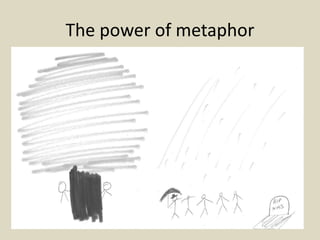
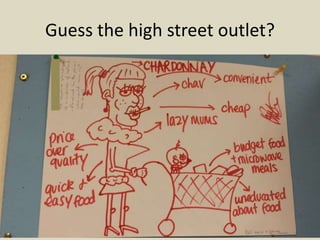
The power of metaphor
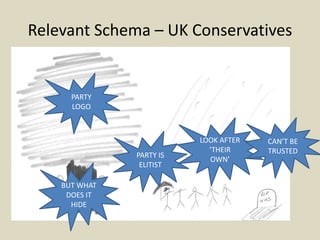
Relevant Schema – UK Conservatives
PARTY
LOGO
BUT WHAT
DOES IT
HIDE
PARTY IS
ELITIST
LOOK AFTER
‘THEIR
OWN’
CAN’T BE
TRUSTED
Guess the high street outlet?
Brands as a ‘bag of associations’
• Schema theory
– All physical associations
– All emotional associations
• A combination of symbols, images and
messages
• With related information about how these
made you feel
“I may make you feel but I can’t make you
think” (PT Grover, advertising pioneer)
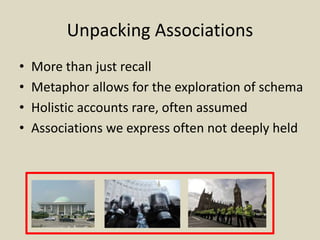
Unpacking Associations
• More than just recall
• Metaphor allows for the exploration of schema
• Holistic accounts rare, often assumed
• Associations we express often not deeply held
Evaluating Associations
• Values
– How things ought to be do you behave as I think you should
• Beliefs
– How things are do I think you behave as you should or not
• Attitudes formed from association and evaluations
– Evaluations based on experience
These decide how each of us perceive the world around
us, and judge communication
Attitudes
• Learned through direct (or 2nd hand) experience
• Range from very strong to very weak
– Weak attitudes often no more than beliefs
• Consistency of experiences shapes attitudes
– If all experiences +/- attitudes will follow
• Attitudes are hardest to change… But!
– 80% of attitudes are weak
– 20% medium to strong, 10% strongest often negative
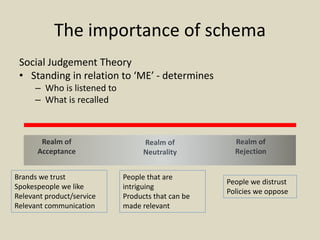
The importance of schema
Social Judgement Theory
• Standing in relation to ‘ME’ - determines
– Who is listened to
– What is recalled
Realm of
Acceptance
Realm of
Neutrality
Realm of
Rejection
Brands we trust
Spokespeople we like
Relevant product/service
Relevant communication
People we distrust
Policies we oppose
People that are
intriguing
Products that can be
made relevant
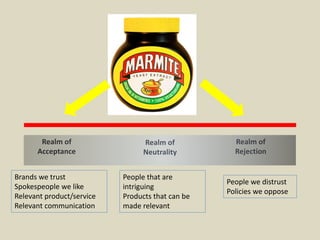
Realm of
Acceptance
Realm of
Neutrality
Realm of
Rejection
Brands we trust
Spokespeople we like
Relevant product/service
Relevant communication
People we distrust
Policies we oppose
People that are
intriguing
Products that can be
made relevant
Schema and Judgment
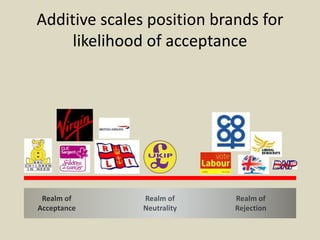
• Used a scaled measure for a number of brands
– Trust in the brand
– Proximity
– Relevance of major (known) products
– Likeability of ‘face’ of the brand
– Likelihood of purchase/donation
Realm of
Acceptance
Realm of
Neutrality
Realm of
Rejection
Additive scales position brands for
likelihood of acceptance
We accept
• Messages from people we trust
• Positions that agree with our values
• Positions that conform to beliefs and attitudes
• Messages/Symbols that have positive emotional
associations
• Individuals/Brands that have positive emotional
associations
Ethos (your purpose), Pathos (your empathy) and
Logos (your logic)
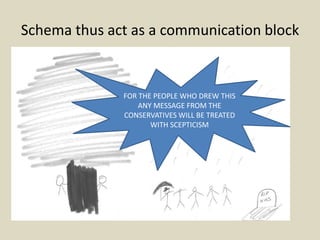
Schema thus act as a communication block
FOR THE PEOPLE WHO DREW THIS
ANY MESSAGE FROM THE
CONSERVATIVES WILL BE TREATED
WITH SCEPTICISM
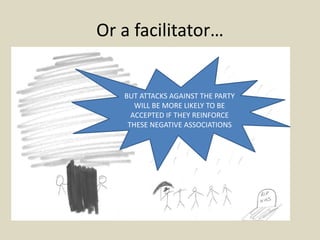
Or a facilitator…
BUT ATTACKS AGAINST THE PARTY
WILL BE MORE LIKELY TO BE
ACCEPTED IF THEY REINFORCE
THESE NEGATIVE ASSOCIATIONS
What the Conservative associations say
• Ethos
– Self-interested, out for selves, power hungry, devious
• Pathos
– Not in it together, elitist (an elite), disconnected from
society
• Logos
– Logic questioned as only working for themselves (elite
logic)
What the RNLI associations say
• Ethos
– Self-sacrifice, caring, there for people in distress
• Pathos
– Relate most to seaside/maritime communities, heroic,
emergency service
• Logos
– Emergency service (so funded), remote from non-maritime
communities
The importance of Schema
• To know what people think of your brand is to
know if they will listen to you and trust you
• To know negative associations is to consider
how to change them
• To know positive associations is to consider
how to build on them
• To know how schema are created is to design
good communication
Task 2
• Think of your last piece of communication
– Email to customers, tweet, Facebook post, ad,
article…
– What associations did it attempt to form around
your brand?
– To what extent do you think it was successful?
• Write and be prepared to share
Please
have a
break!
Task 3
• What did you want the receiver to do with
your communication
– Consider your message (argument) carefully?
– Just pick up simple associations?
– A combination?
• What was the strategic intent?
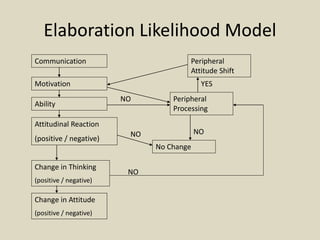
Elaboration Likelihood Model
Communication
Motivation
Ability
Attitudinal Reaction
(positive / negative)
Change in Thinking
(positive / negative)
Change in Attitude
(positive / negative)
Peripheral
Attitude Shift
Peripheral
Processing
No Change
NO
NO
NONO
YES
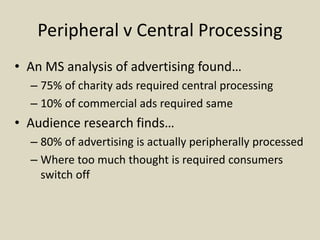
Peripheral v Central Processing
• An MS analysis of advertising found…
– 75% of charity ads required central processing
– 10% of commercial ads required same
• Audience research finds…
– 80% of advertising is actually peripherally processed
– Where too much thought is required consumers
switch off
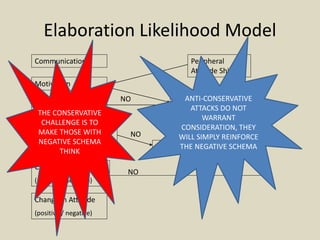
Elaboration Likelihood Model
Communication
Motivation
Ability
Attitudinal Reaction
(positive / negative)
Change in Thinking
(positive / negative)
Change in Attitude
(positive / negative)
Peripheral
Attitude Shift
Peripheral
Processing
No Change
NO
NO
NONO
YES
ANTI-CONSERVATIVE
ATTACKS DO NOT
WARRANT
CONSIDERATION, THEY
WILL SIMPLY REINFORCE
THE NEGATIVE SCHEMA
THE CONSERVATIVE
CHALLENGE IS TO
MAKE THOSE WITH
NEGATIVE SCHEMA
THINK
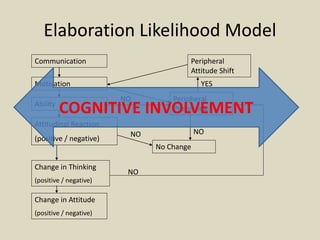
Elaboration Likelihood Model
Communication
Motivation
Ability
Attitudinal Reaction
(positive / negative)
Change in Thinking
(positive / negative)
Change in Attitude
(positive / negative)
Peripheral
Attitude Shift
Peripheral
Processing
No Change
NO
NO
NONO
YES
COGNITIVE INVOLVEMENT
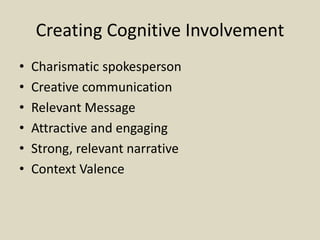
Creating Cognitive Involvement
• Charismatic spokesperson
• Creative communication
• Relevant Message
• Attractive and engaging
• Strong, relevant narrative
• Context Valence
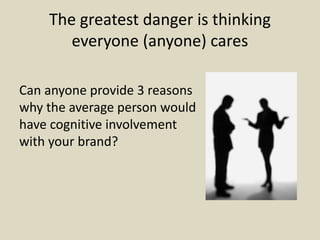
The greatest danger is thinking
everyone (anyone) cares
Can anyone provide 3 reasons
why the average person would
have cognitive involvement
with your brand?
Peripheral Cues and campaigning
• Simple messages positions that resonate with
intended audiences [ETHOS]
• Emotional communication, understanding
their context [PATHOS]
• Evocative narratives, personal and social
[ETHOS + PATHOS]
• Social context [PATHOS] linked to [ETHOS] to
limit alternative considerations [LOGOS]
Hot Cognition
• Cognitive arousal stimulated by highly
relevant communication
• Stimulation of emotions engineered to make
some think
– Form new attitudes
– Mobilisation tactics
• Importance of action stressed through
communication
Hot Cognition & Cognitive Dissonance
• Forcing individuals to question beliefs and
attitudes leads to discomfort
• Reconciliation required to reduce discomfort
– Can ignore new information
– Can cope with new information without changing
attitudes
– Can change attitudes
– Can retreat from the situation entirely
Reduction strategy based on what is possible
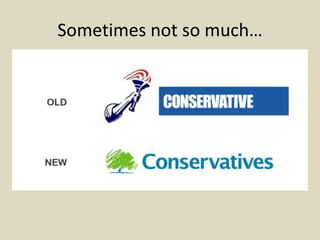
Re-branding or Re-launching
• One of the greatest challenges
– Involves creating new associations
• Involves understanding the most deep-rooted
associations
• Judging which are important to maintain
• Judging how to link to new associations
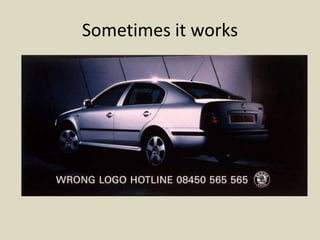
Sometimes it works
Sometimes not so much…
Mobilisation
• Getting consumers to buy
• Crowdsourcing
• Creating advocates
• Getting supporters to work for you
“we no longer have passive consumers or citizens,
they participate in myriad ways in shaping your
brand. Getting them to act with you is the
challenge but you and they win if you can”
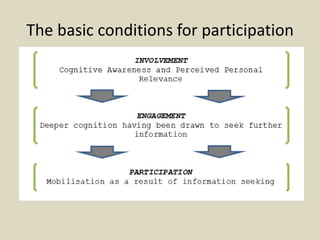
The basic conditions for participation
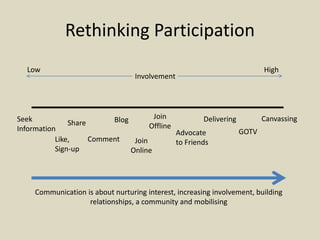
Rethinking Participation
Seek
Information
Like,
Sign-up
Share
Comment Join
Online
Blog
Advocate
to Friends
Delivering CanvassingJoin
Offline
Involvement
Low High
Communication is about nurturing interest, increasing involvement, building
relationships, a community and mobilising
GOTV
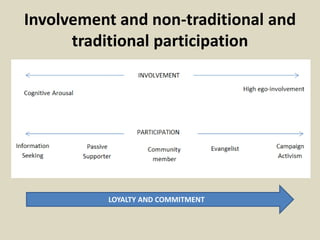
Involvement and non-traditional and
traditional participation
LOYALTY AND COMMITMENT
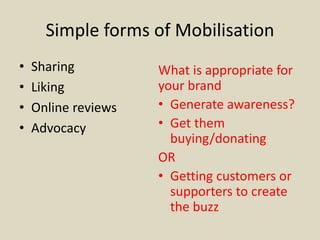
Simple forms of Mobilisation
• Sharing
• Liking
• Online reviews
• Advocacy
What is appropriate for
your brand
• Generate awareness?
• Get them
buying/donating
OR
• Getting customers or
supporters to create
the buzz
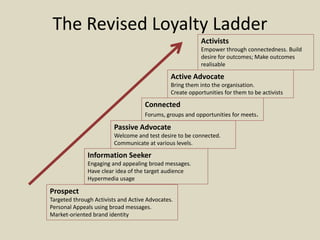
The Revised Loyalty Ladder
Information Seeker
Engaging and appealing broad messages.
Have clear idea of the target audience
Hypermedia usage
Prospect
Targeted through Activists and Active Advocates.
Personal Appeals using broad messages.
Market-oriented brand identity
Passive Advocate
Welcome and test desire to be connected.
Communicate at various levels.
Connected
Forums, groups and opportunities for meets.
Active Advocate
Bring them into the organisation.
Create opportunities for them to be activists
Activists
Empower through connectedness. Build
desire for outcomes; Make outcomes
realisable
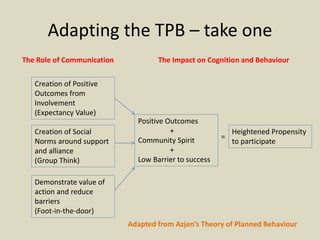
Adapting the TPB – take one
Creation of Positive
Outcomes from
Involvement
(Expectancy Value)
Creation of Social
Norms around support
and alliance
(Group Think)
Demonstrate value of
action and reduce
barriers
(Foot-in-the-door)
The Role of Communication
Positive Outcomes
+
Community Spirit
+
Low Barrier to success
Heightened Propensity
to participate
=
The Impact on Cognition and Behaviour
Adapted from Azjen’s Theory of Planned Behaviour
Apply these to your organisation
• Expectancy value
– Why should someone do what you require?
• Group think
– How to create a norm for behaviour around your
organisation
• Foot-in-the-Door
– What might the first step be (browsing, visiting,
watching, liking…)
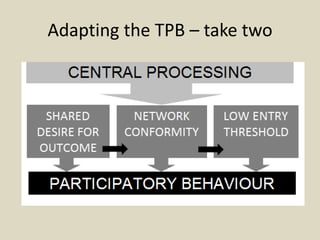
Adapting the TPB – take two
Empowering your customers?
• Participation can be inspirational
• Participation can be empowering
But
• Participation must have some impact
• Participation must be encouraged
• Participation must be nudged in a direction
Rules for mobilising
• Interest
• Desire
• Likelihood of empowerment
• Likelihood of an outcome
• A nudge to act
• Peer reinforcement of actions
• Low initial threshold
You should have
• Your own and others ideas of what your brand
represents
• The ethos communicated by the organisation
• What you expected the audience to do on receipt
• Three reasons for cognitive involvement
• A purpose for your customers/supporters
• Arguments why they should participate in your
communication
In other words you have the basics for a
communication plan
Thoughts on communication
• Traditional media gains awareness; social media
allows for activism, participation and belonging
• Participation takes many forms, and one action
may (if the request is right) lead to another
• Customers/Supporters are the best recruiters:
– personal connections create a sense of community
• A lack of a sense of community is demotivating
• Communities mobilise internally and externally
Also running today:
-The newspaper journalist:
An endangered species? 5:30pm-7pm.
-Putting pen to paper. 7pm- 9pm.
- iBU app: Interactive Festival Timetable
Tweet us @BUFestivals #BUFest14
Facebook: Bournemouth University’s Festival of
Learning
Share your feedback on this session by emailing
research@bournemouth.ac.uk

Understanding consumer and audience psychology

  • 1.
    A few housekeepingnotices • Fire exits • Toilets • Photography • Free Festival wifi ‘The Cloud’ • Social media • Evaluation forms Understanding consumer and audience psychology Tweet us @BUFestivals #BUFest14 Facebook: Bournemouth University’s Festival of Learning
  • 2.
    Understanding consumer and audiencepsychology Dr Darren G. Lilleker The Media School
  • 3.
    About Me • Researchcentres on political engagement and participation • Interest in where the citizen meets the consumer – Finding this to be 80% consumer 20% citizen • Published widely on how political communication is designed for impact (and why it fails) • Consultant on understanding brand meanings • Led towards taking more psychological perspectives
  • 4.
    A shameless plug “asystematic exploration of political communication that utilises theories from communication psychology to explain why some aspects of some campaigns might be successful or might fail”
  • 5.
    Today’s session • Focusingon the broad themes around what people do with persuasive communication • Introducing the idea of the schema • Talking about values, beliefs and attitudes • Introducing the lessons from a bunch of psychological theories • Picking out some key lessons to inform a wide range of communicators • Talking with you about communication (not just at you)
  • 6.
    Warm-Up Task • Takea sheet of paper and write out the top three things people will think of when they hear your organisation’s name – put the organisation’s name at the top Be prepared to talk about these and have others add their own.
  • 7.
    Why brand meaningis hidden • Most people talk about any organisation in terms of its function • Meaning is emotional – it is about connections in the subconscious • To uncover these is difficult but highly rewarding for communication planning
  • 8.
    The power ofmetaphor
  • 9.
    Relevant Schema –UK Conservatives PARTY LOGO BUT WHAT DOES IT HIDE PARTY IS ELITIST LOOK AFTER ‘THEIR OWN’ CAN’T BE TRUSTED
  • 10.
    Guess the highstreet outlet?
  • 11.
    Brands as a‘bag of associations’ • Schema theory – All physical associations – All emotional associations • A combination of symbols, images and messages • With related information about how these made you feel “I may make you feel but I can’t make you think” (PT Grover, advertising pioneer)
  • 12.
    Unpacking Associations • Morethan just recall • Metaphor allows for the exploration of schema • Holistic accounts rare, often assumed • Associations we express often not deeply held
  • 13.
    Evaluating Associations • Values –How things ought to be do you behave as I think you should • Beliefs – How things are do I think you behave as you should or not • Attitudes formed from association and evaluations – Evaluations based on experience These decide how each of us perceive the world around us, and judge communication
  • 14.
    Attitudes • Learned throughdirect (or 2nd hand) experience • Range from very strong to very weak – Weak attitudes often no more than beliefs • Consistency of experiences shapes attitudes – If all experiences +/- attitudes will follow • Attitudes are hardest to change… But! – 80% of attitudes are weak – 20% medium to strong, 10% strongest often negative
  • 15.
    The importance ofschema Social Judgement Theory • Standing in relation to ‘ME’ - determines – Who is listened to – What is recalled Realm of Acceptance Realm of Neutrality Realm of Rejection Brands we trust Spokespeople we like Relevant product/service Relevant communication People we distrust Policies we oppose People that are intriguing Products that can be made relevant
  • 16.
    Realm of Acceptance Realm of Neutrality Realmof Rejection Brands we trust Spokespeople we like Relevant product/service Relevant communication People we distrust Policies we oppose People that are intriguing Products that can be made relevant
  • 17.
    Schema and Judgment •Used a scaled measure for a number of brands – Trust in the brand – Proximity – Relevance of major (known) products – Likeability of ‘face’ of the brand – Likelihood of purchase/donation
  • 18.
    Realm of Acceptance Realm of Neutrality Realmof Rejection Additive scales position brands for likelihood of acceptance
  • 19.
    We accept • Messagesfrom people we trust • Positions that agree with our values • Positions that conform to beliefs and attitudes • Messages/Symbols that have positive emotional associations • Individuals/Brands that have positive emotional associations Ethos (your purpose), Pathos (your empathy) and Logos (your logic)
  • 20.
    Schema thus actas a communication block FOR THE PEOPLE WHO DREW THIS ANY MESSAGE FROM THE CONSERVATIVES WILL BE TREATED WITH SCEPTICISM
  • 21.
    Or a facilitator… BUTATTACKS AGAINST THE PARTY WILL BE MORE LIKELY TO BE ACCEPTED IF THEY REINFORCE THESE NEGATIVE ASSOCIATIONS
  • 22.
    What the Conservativeassociations say • Ethos – Self-interested, out for selves, power hungry, devious • Pathos – Not in it together, elitist (an elite), disconnected from society • Logos – Logic questioned as only working for themselves (elite logic)
  • 23.
    What the RNLIassociations say • Ethos – Self-sacrifice, caring, there for people in distress • Pathos – Relate most to seaside/maritime communities, heroic, emergency service • Logos – Emergency service (so funded), remote from non-maritime communities
  • 24.
    The importance ofSchema • To know what people think of your brand is to know if they will listen to you and trust you • To know negative associations is to consider how to change them • To know positive associations is to consider how to build on them • To know how schema are created is to design good communication
  • 25.
    Task 2 • Thinkof your last piece of communication – Email to customers, tweet, Facebook post, ad, article… – What associations did it attempt to form around your brand? – To what extent do you think it was successful? • Write and be prepared to share
  • 26.
  • 27.
    Task 3 • Whatdid you want the receiver to do with your communication – Consider your message (argument) carefully? – Just pick up simple associations? – A combination? • What was the strategic intent?
  • 28.
    Elaboration Likelihood Model Communication Motivation Ability AttitudinalReaction (positive / negative) Change in Thinking (positive / negative) Change in Attitude (positive / negative) Peripheral Attitude Shift Peripheral Processing No Change NO NO NONO YES
  • 29.
    Peripheral v CentralProcessing • An MS analysis of advertising found… – 75% of charity ads required central processing – 10% of commercial ads required same • Audience research finds… – 80% of advertising is actually peripherally processed – Where too much thought is required consumers switch off
  • 30.
    Elaboration Likelihood Model Communication Motivation Ability AttitudinalReaction (positive / negative) Change in Thinking (positive / negative) Change in Attitude (positive / negative) Peripheral Attitude Shift Peripheral Processing No Change NO NO NONO YES ANTI-CONSERVATIVE ATTACKS DO NOT WARRANT CONSIDERATION, THEY WILL SIMPLY REINFORCE THE NEGATIVE SCHEMA THE CONSERVATIVE CHALLENGE IS TO MAKE THOSE WITH NEGATIVE SCHEMA THINK
  • 31.
    Elaboration Likelihood Model Communication Motivation Ability AttitudinalReaction (positive / negative) Change in Thinking (positive / negative) Change in Attitude (positive / negative) Peripheral Attitude Shift Peripheral Processing No Change NO NO NONO YES COGNITIVE INVOLVEMENT
  • 32.
    Creating Cognitive Involvement •Charismatic spokesperson • Creative communication • Relevant Message • Attractive and engaging • Strong, relevant narrative • Context Valence
  • 33.
    The greatest dangeris thinking everyone (anyone) cares Can anyone provide 3 reasons why the average person would have cognitive involvement with your brand?
  • 34.
    Peripheral Cues andcampaigning • Simple messages positions that resonate with intended audiences [ETHOS] • Emotional communication, understanding their context [PATHOS] • Evocative narratives, personal and social [ETHOS + PATHOS] • Social context [PATHOS] linked to [ETHOS] to limit alternative considerations [LOGOS]
  • 35.
    Hot Cognition • Cognitivearousal stimulated by highly relevant communication • Stimulation of emotions engineered to make some think – Form new attitudes – Mobilisation tactics • Importance of action stressed through communication
  • 36.
    Hot Cognition &Cognitive Dissonance • Forcing individuals to question beliefs and attitudes leads to discomfort • Reconciliation required to reduce discomfort – Can ignore new information – Can cope with new information without changing attitudes – Can change attitudes – Can retreat from the situation entirely Reduction strategy based on what is possible
  • 37.
    Re-branding or Re-launching •One of the greatest challenges – Involves creating new associations • Involves understanding the most deep-rooted associations • Judging which are important to maintain • Judging how to link to new associations
  • 38.
  • 39.
  • 40.
    Mobilisation • Getting consumersto buy • Crowdsourcing • Creating advocates • Getting supporters to work for you “we no longer have passive consumers or citizens, they participate in myriad ways in shaping your brand. Getting them to act with you is the challenge but you and they win if you can”
  • 41.
    The basic conditionsfor participation
  • 42.
    Rethinking Participation Seek Information Like, Sign-up Share Comment Join Online Blog Advocate toFriends Delivering CanvassingJoin Offline Involvement Low High Communication is about nurturing interest, increasing involvement, building relationships, a community and mobilising GOTV
  • 43.
    Involvement and non-traditionaland traditional participation LOYALTY AND COMMITMENT
  • 44.
    Simple forms ofMobilisation • Sharing • Liking • Online reviews • Advocacy What is appropriate for your brand • Generate awareness? • Get them buying/donating OR • Getting customers or supporters to create the buzz
  • 45.
    The Revised LoyaltyLadder Information Seeker Engaging and appealing broad messages. Have clear idea of the target audience Hypermedia usage Prospect Targeted through Activists and Active Advocates. Personal Appeals using broad messages. Market-oriented brand identity Passive Advocate Welcome and test desire to be connected. Communicate at various levels. Connected Forums, groups and opportunities for meets. Active Advocate Bring them into the organisation. Create opportunities for them to be activists Activists Empower through connectedness. Build desire for outcomes; Make outcomes realisable
  • 46.
    Adapting the TPB– take one Creation of Positive Outcomes from Involvement (Expectancy Value) Creation of Social Norms around support and alliance (Group Think) Demonstrate value of action and reduce barriers (Foot-in-the-door) The Role of Communication Positive Outcomes + Community Spirit + Low Barrier to success Heightened Propensity to participate = The Impact on Cognition and Behaviour Adapted from Azjen’s Theory of Planned Behaviour
  • 47.
    Apply these toyour organisation • Expectancy value – Why should someone do what you require? • Group think – How to create a norm for behaviour around your organisation • Foot-in-the-Door – What might the first step be (browsing, visiting, watching, liking…)
  • 48.
    Adapting the TPB– take two
  • 49.
    Empowering your customers? •Participation can be inspirational • Participation can be empowering But • Participation must have some impact • Participation must be encouraged • Participation must be nudged in a direction
  • 50.
    Rules for mobilising •Interest • Desire • Likelihood of empowerment • Likelihood of an outcome • A nudge to act • Peer reinforcement of actions • Low initial threshold
  • 51.
    You should have •Your own and others ideas of what your brand represents • The ethos communicated by the organisation • What you expected the audience to do on receipt • Three reasons for cognitive involvement • A purpose for your customers/supporters • Arguments why they should participate in your communication In other words you have the basics for a communication plan
  • 52.
    Thoughts on communication •Traditional media gains awareness; social media allows for activism, participation and belonging • Participation takes many forms, and one action may (if the request is right) lead to another • Customers/Supporters are the best recruiters: – personal connections create a sense of community • A lack of a sense of community is demotivating • Communities mobilise internally and externally
  • 53.
    Also running today: -Thenewspaper journalist: An endangered species? 5:30pm-7pm. -Putting pen to paper. 7pm- 9pm. - iBU app: Interactive Festival Timetable Tweet us @BUFestivals #BUFest14 Facebook: Bournemouth University’s Festival of Learning Share your feedback on this session by emailing research@bournemouth.ac.uk