CELUPL
Nov. 6, 2015
FEDERATION OF ONTARIO PUBLIC
LIBRARIES RESEARCH
New Ontario Polling Data from FOPL
Market Probe 2
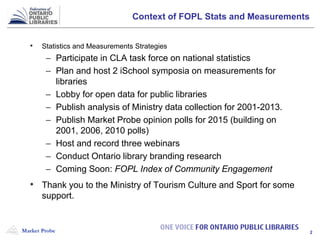
Context of FOPL Stats and Measurements
• Statistics and Measurements Strategies
– Participate in CLA task force on national statistics
– Plan and host 2 iSchool symposia on measurements for
libraries
– Lobby for open data for public libraries
– Publish analysis of Ministry data collection for 2001-2013.
– Publish Market Probe opinion polls for 2015 (building on
2001, 2006, 2010 polls)
– Host and record three webinars
– Conduct Ontario library branding research
– Coming Soon: FOPL Index of Community Engagement
• Thank you to the Ministry of Tourism Culture and Sport for some
support.
2
Market Probe 3
FOPL Reports
• Ontario Public Library Operating Data 2001-2013: Overview, Primer on
Library Statistics and Collected Tables (81 page PDF)
– Introduction by Stephen Abram, MLS, Executive Director
– A Primer on Library Data by Robert Molyneux, PhD
– Key Ratios for Ontario Public Libraries, 2013
– Population and Circulation at Ontario Public Libraries, 2001-2013, All Reporting Each
Year
– Programs Held and Program Attendance Ontario Public Libraries, 2001-2013, All
Reporting Each Year
– Selected Expenditures at Ontario Public Libraries, 2001-2013, All Reporting Each Year
– Selected Digital Materials, Held by Ontario Public Libraries, 2001-2013, All Reporting
EACH Year
– Circulations per capita and per active cardholder,2013, Ranked by Bands
– Expenditures per capita and per active cardholder, 2013, Ranked by Bands
– Total Operating Expenditures and Materials Expenditures, 2001-2013, [summary and
by bands]
– Active Cardholders as a Percentage of Population (Resident) at Ontario’s Public
Libraries, 2001-2013
– Circulation per capita and per active cardholders, Ontario Public Libraries, 2001-2013
– Sources of data used in these reports
• http://fopl.ca/news/fopl-member-benefit-performance-measures-for-ontario-
public-libraries/
• Each chapter has a separate blog posting as well for June 30-Sept 8.
Market Probe 4
FOPL Reports
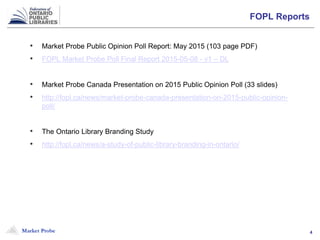
• Market Probe Public Opinion Poll Report: May 2015 (103 page PDF)
• FOPL Market Probe Poll Final Report 2015-05-08 - v1 – DL
• Market Probe Canada Presentation on 2015 Public Opinion Poll (33 slides)
• http://fopl.ca/news/market-probe-canada-presentation-on-2015-public-opinion-
poll/
• The Ontario Library Branding Study
• http://fopl.ca/news/a-study-of-public-library-branding-in-ontario/
Market Probe 5
Social Media and Ontario Public Libraries
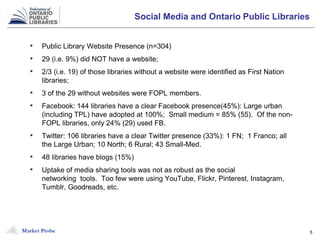
• Public Library Website Presence (n=304)
• 29 (i.e. 9%) did NOT have a website;
• 2/3 (i.e. 19) of those libraries without a website were identified as First Nation
libraries;
• 3 of the 29 without websites were FOPL members.
• Facebook: 144 libraries have a clear Facebook presence(45%): Large urban
(including TPL) have adopted at 100%; Small medium = 85% (55). Of the non-
FOPL libraries, only 24% (29) used FB.
• Twitter: 106 libraries have a clear Twitter presence (33%): 1 FN; 1 Franco; all
the Large Urban; 10 North; 6 Rural; 43 Small-Med.
• 48 libraries have blogs (15%)
• Uptake of media sharing tools was not as robust as the social
networking tools. Too few were using YouTube, Flickr, Pinterest, Instagram,
Tumblr, Goodreads, etc.
Market Probe 6
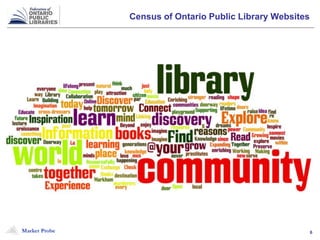
Census of Ontario Public Library Websites
Market Probe 7
Webinars in this series
• August 14, 2015: Overview of FOPL's Ontario Public Library
Statistics and Measurements Report
• Speaker: Dr. Robert Molyneux, MLIS, PhD
• http://fopl.ca/news/fopl-statistics-webinar-slides-from-august-14-
2015/
• August 17, 2015: Overview of FOPL's Market Probe Canada
Public Opinion Poll of Ontarians and Public Libraries
• Speaker: Carol French, Senior Vice President, Research &
Client Services Market Probe Canada
• http://fopl.ca/news/todays-webinar-on-the-market-probe-public-
opinion-poll/
• August 28th Noon-1 pm: Strategic Use and Insights from
FOPL's Ontario Public Library Statistics, Polls, and
Measurements (register with monica@fopl.ca)
• Speaker: Stephen Abram, MLS, executive director FOPL
7
Market Probe 8
Today I am going to focus on the results of the Public Opinion Poll
These slides will be up on the FOPL website today.
I am going to start with the conclusions / recommendations and then run through as
much of the data reports as I can.
• Background (quickly)
• Library Usage
• Accessing the Library
• Library Services
• Value of the Public Library
• Future Outlook
• Summary of Selected Conclusions
Star =
highlights
Market Probe 9
Connecting to the past: the public library continues to deliver value as
patrons’ usage patterns evolve
• Overall opinions and value perceptions of the library remain very strong.
– Its position in people’s minds relative to other tax-supported services is consistent with
previous studies, and reactions to earlier positioning statements have improved
slightly.
– The public acknowledges the library’s role in advancing literacy, equal opportunity, and
quality of life in Ontario communities.
– The value of certain services (e.g., for young children, new Canadians, and the
unemployed) has increased over the past five years.
– A majority of residents feel if their local library were to close, it would have a major
impact on the community (but not necessarily on them personally).
• Numbers of library users have remained consistent, but usage patterns
have changed.
– The number of library non-users has been extremely steady over the last 15 years.
– Library card ownership has increased; still, household usage levels may be softening
slightly.
– Reported in-person library visit frequency has remained the same over the years, but in
2015, the number of people using the library both online and in-person has surpassed
the number of in-person-only visitors.
– Usage of many services is lower than reported previously, indicating that library users
may be becoming more selective in choosing which services to use.
Market Probe 10
View to the future: the library needs to determine which investments to
make (and which to skip) in the face of technological and social change
• Regular review of strategies and tactics becomes even more important as
technology, channel, and media preferences change.
– Electronic access is complementing, not replacing, in-person usage; therefore,
duplication of hard copy and electronic materials, plus increased channel costs, will be
the norm for the foreseeable future.
– Ensuring compatibility with an ever expanding array of electronic devices will continue
to pose challenges.
• Communicating about new service offerings will be as important as
providing them.
– Traditional library services are not increasing in usage or perceived value.
– Interest in new services is fragmented, meaning trade-offs will need to made.
– Communications about new services will have to be geared to the proper segments to
create sufficient awareness, interest, and take-up.
– People’s preference for email suggests that creation of contact lists, user groups and
advisory panels may be required in order to maintain a dialogue with library users.
• How the library can best serve a future generation of users remains
uncertain.
– Older people’s respect for the heritage and social contribution of the public library
system will not necessarily be passed down to a younger generation.
– Not every library can afford to be all things to all people; there may be an increasing
need to develop centrally and deliver locally.
Market Probe 11
Other Strategy Considerations
• Clearly understand the differences between your digital and in-person
user/member
– It appears that for most libraries digital touch-points exceed in-person touch-points
– Primarily digital users have different demographics and different digital literacies.
– Your in-person user is more likely to be older, female,
• Think long and hard about target audiences
– It is important to recognize that the softening in our value proposition in kids, teens, and
18-34 year olds is major.
– We cannot rest on the love of 50+ cohort.
• New library services offer significant opportunities to re-engage with 18-34
year olds and males.
– Business, Dads and Kids, Maker, digital creation.
• Social media is an opportunity to connect with different communities but
e-mail rules.
– Urgent: Update your ILS registry files birthdays/cels, emails with anti-spam permission
Develop a 90 day campaign at check-out!
• There are a number of cautions in these data
– Softening of value proposition Young adults, homework and 18-34 year olds
– Differences between online and telephone cohort.
– The gap is widening between individual and household attachment to PL’s
Market Probe 12
2015 Survey: Connecting to the past with a view to the future…
• Fourth wave of a study that has been conducted every five years since 2000
• Objectives:
– Understand Ontario residents’ opinions about the use, role and impact of public
libraries, and how those opinions have changed over time
– Separate public opinion by level of usage of public libraries (including non-use)
– Identify areas of strength and weakness for the public library
• Results will be used to:
– Monitor status of the library
– Formulate strategy
– Identify priorities
– Provide input to a new marketing communication plan
Market Probe 13
…through the use of a dual telephone / online survey method
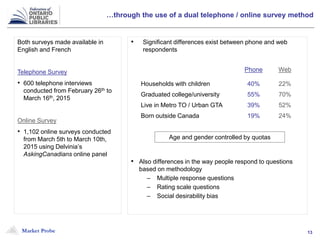
• Significant differences exist between phone and web
respondents
• Also differences in the way people respond to questions
based on methodology
– Multiple response questions
– Rating scale questions
– Social desirability bias
Both surveys made available in
English and French
Telephone Survey
• 600 telephone interviews
conducted from February 26th to
March 16th, 2015
Online Survey
• 1,102 online surveys conducted
from March 5th to March 10th,
2015 using Delvinia’s
AskingCanadians online panel
Age and gender controlled by quotas
Phone Web
Households with children 40% 22%
Graduated college/university 55% 70%
Live in Metro TO / Urban GTA 39% 52%
Born outside Canada 19% 24%
Market Probe 14
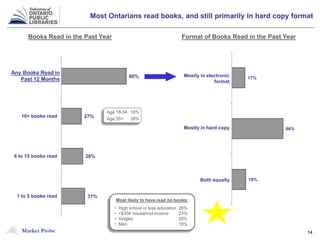
Most Ontarians read books, and still primarily in hard copy format
86%
27%
28%
31%
16+ books read
6 to 15 books read
1 to 5 books read
Any Books Read in
Past 12 Months 17%
66%
18%
Most likely to have read no books:
• High school or less education 26%
• <$35K household income 23%
• Singles 20%
• Men 19%
Mostly in electronic
format
Mostly in hard copy
Both equally
Books Read in the Past Year Format of Books Read in the Past Year
Age 18-34: 18%
Age 55+: 38%
Market Probe 15
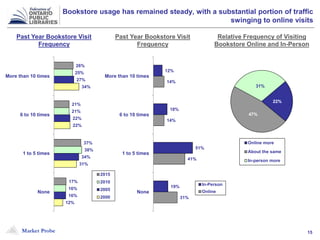
Bookstore usage has remained steady, with a substantial portion of traffic
swinging to online visits
12%
18%
51%
19%
14%
14%
41%
31%
More than 10 times
6 to 10 times
1 to 5 times
None
In-Person
Online
22%
47%
31%
Online more
About the same
In-person more
Past Year Bookstore Visit
Frequency
26%
21%
37%
17%
25%
21%
38%
16%
27%
22%
34%
16%
34%
22%
31%
12%
More than 10 times
6 to 10 times
1 to 5 times
None
2015
2010
2005
2000
Past Year Bookstore Visit
Frequency
Relative Frequency of Visiting
Bookstore Online and In-Person
Market Probe 16
87%
83%
44%
42%
41%
23%
17%
88%
83%
50%
23%
26%
21%
2015
2010
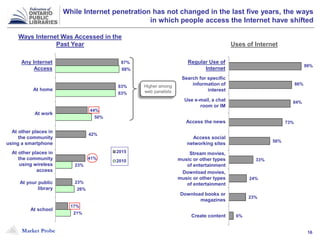
While Internet penetration has not changed in the last five years, the ways
in which people access the Internet have shifted
Higher among
web panelists
99%
86%
84%
73%
56%
33%
24%
23%
6%
Any Internet
Access
At home
At work
At other places in
the community
using a smartphone
At other places in
the community
using wireless
access
At your public
library
At school
Regular Use of
Internet
Search for specific
information of
interest
Use e-mail, a chat
room or IM
Access the news
Access social
networking sites
Stream movies,
music or other types
of entertainment
Download movies,
music or other types
of entertainment
Download books or
magazines
Create content
Ways Internet Was Accessed in the
Past Year Uses of Internet
Market Probe 17
Respondent
Only
27%
With Others in
Household
42%
Other
Household
Member(s)
Only
7%
No One
24% Respondent
Only
28%
With Others in
Household
41%
Other
Household
Member(s)
Only
10%
No One
21%
73%
68%
65%
65%
Yes
2015 2010 2005 2000
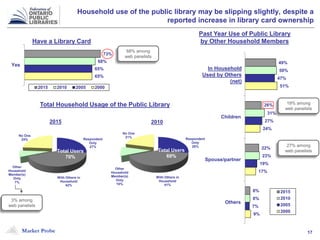
Household use of the public library may be slipping slightly, despite a
reported increase in library card ownership
Total Household Usage of the Public Library
2015 2010
49%
26%
22%
8%
50%
31%
23%
8%
47%
27%
19%
7%
51%
24%
17%
9%
Children
Spouse/partner
Others
2015
2010
2005
2000
In Household
Used by Others
(net)
19% among
web panelists
27% among
web panelistsTotal Users
70%
Total Users
69%
Past Year Use of Public Library
by Other Household Members
68% among
web panelists
3% among
web panelists
Have a Library Card
Market Probe 18
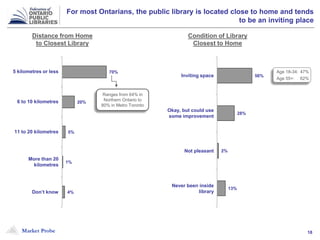
For most Ontarians, the public library is located close to home and tends
to be an inviting place
Distance from Home
to Closest Library
70%
20%
5%
1%
4%
5 kilometres or less
6 to 10 kilometres
11 to 20 kilometres
More than 20
kilometres
Don’t know
Condition of Library
Closest to Home
56%
28%
2%
13%
Inviting space
Okay, but could use
some improvement
Not pleasant
Never been inside
library
Ranges from 64% in
Northern Ontario to
80% in Metro Toronto
5 kilometres or less
6 to 10 kilometres
11 to 20 kilometres
More than 20
kilometres
Don’t know
Inviting space
Okay, but could use
some improvement
Not pleasant
Never been inside
library
Age 18-34: 47%
Age 55+: 62%
Market Probe 19
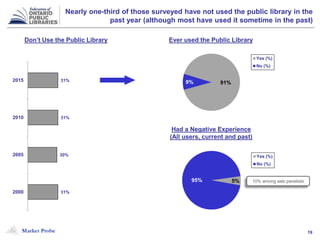
Nearly one-third of those surveyed have not used the public library in the
past year (although most have used it sometime in the past)
Don’t Use the Public Library
31%
31%
30%
31%
2015
2010
2005
2000
91%9%
Yes (%)
No (%)
Ever used the Public Library
Had a Negative Experience
(All users, current and past)
5%95%
Yes (%)
No (%)
10% among web panelists
Market Probe 20
50%
30%
21%
8%
7%
6%
40%
34%
27%
9%
10%
6%
21%
25%
26%
7%
3%
6%
22%
30%
21%
12%
8%
6%
Get information
from other sources
Not interested
Too busy
Don't read
Library isn't
accessible
Use library at
school or work
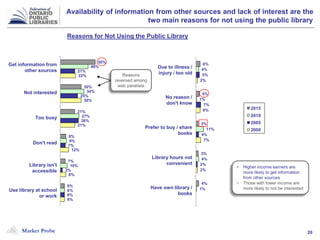
Availability of information from other sources and lack of interest are the
two main reasons for not using the public library
Reasons for Not Using the Public Library
6%
5%
3%
3%
4%
4%
1%
11%
4%
1%
5%
7%
4%
2%
2%
6%
7%
2%
Due to illness /
injury / too old
No reason /
don't know
Prefer to buy /
share books
Library hours
not convenient
Have own
library / books
Get information from
other sources
Not interested
Too busy
Don't read
Library isn't
accessible
Use library at school
or work
Due to illness /
injury / too old
No reason /
don't know
Prefer to buy / share
books
Library hours not
convenient
Have own library /
books
Reasons
reversed among
web panelists
68%
32%
65%
35%
65%
35%
0% 20% 40% 60% 80% 100%
Yes
No
2015
2010
2005
2000
• Higher income earners are
more likely to get information
from other sources
• Those with lower income are
more likely to not be interested
Market Probe 21
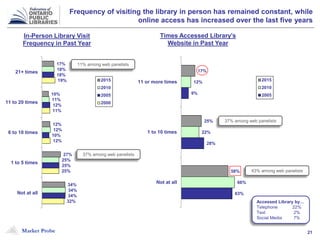
Frequency of visiting the library in person has remained constant, while
online access has increased over the last five years
In-Person Library Visit
Frequency in Past Year
Accessed Library by…
Telephone 22%
Text 2%
Social Media 7%
17%
10%
12%
27%
34%
18%
11%
12%
25%
34%
18%
12%
10%
25%
34%
19%
11%
12%
25%
32%
21+ times
11 to 20 times
6 to 10 times
1 to 5 times
Not at all
2015
2010
2005
2000
Times Accessed Library’s
Website in Past Year
17%
25%
58%
12%
22%
66%
9%
28%
63%
11 or more times
1 to 10 times
Not at all
2015
2010
2005
37% among web panelists
43% among web panelists
11% among web panelists
Market Probe 22
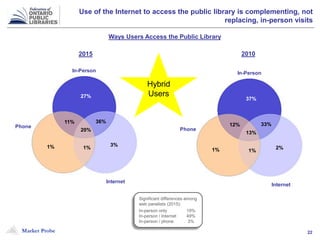
Use of the Internet to access the public library is complementing, not
replacing, in-person visits
2010
37%
1% 1%
13%
12%
In-Person
Internet
Phone
33%
2%
2015
27%
1% 1%
20%
11%
In-Person
Internet
Phone
36%
3%
Ways Users Access the Public Library
Significant differences among
web panelists (2015):
In-person only 19%
In-person / Internet 49%
In-person / phone 3%
Hybrid
Users
Market Probe 23
88%
35%
22%
11%
4%
A desktop or laptop
computer
A tablet
A smartphone
An e-reader
An iPod or MP3
player
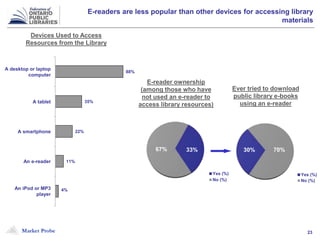
E-readers are less popular than other devices for accessing library
materials
33%67%
Yes (%)
No (%)
Devices Used to Access
Resources from the Library
E-reader ownership
(among those who have
not used an e-reader to
access library resources)
30% 70%
Yes (%)
No (%)
Ever tried to download
public library e-books
using an e-reader
A desktop or laptop
computer
A tablet
A smartphone
An e-reader
An iPod or MP3
player
Market Probe 24
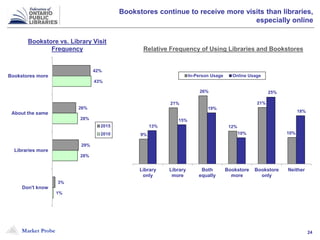
Bookstores continue to receive more visits than libraries,
especially online
Bookstore vs. Library Visit
Frequency
42%
26%
29%
3%
43%
28%
28%
1%
Bookstores more
About the same
Libraries more
Don't know
2015
2010 9%
21%
26%
12%
21%
10%
13%
15%
19%
10%
25%
18%
Library
only
Library
more
Both
equally
Bookstore
more
Bookstore
only
Neither
In-Person Usage Online Usage
Relative Frequency of Using Libraries and Bookstores
Market Probe 25
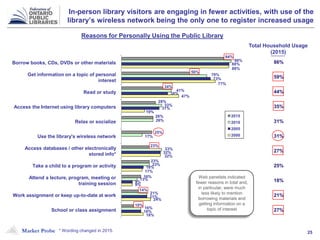
In-person library visitors are engaging in fewer activities, with use of the
library’s wireless network being the only one to register increased usage
Reasons for Personally Using the Public Library
84%
56%
34%
28%
26%
25%
23%
23%
16%
14%
10%
90%
70%
41%
33%
26%
17%
33%
23%
13%
21%
16%
88%
73%
38%
31%
32%
18%
9%
21%
16%
88%
77%
47%
19%
32%
17%
9%
24%
18%
Borrow books, CDs, DVDs or other materials
Get information on a topic of personal
interest
Read or study
Access the Internet using library computers
Relax or socialize
Use the library's wireless network
Access databases / other electronically
stored info*
Take a child to a program or activity
Attend a lecture, program, meeting or
training session
Work assignment or keep up-to-date at work
School or class assignment
86%
59%
44%
35%
31%
31%
27%
25%
18%
21%
27%
Total Household Usage
(2015)
68%
32%
65%
35%
65%
35%
0% 20% 40% 60% 80% 100%
Yes
No
2015
2010
2005
2000
Web panelists indicated
fewer reasons in total and,
in particular, were much
less likely to mention
borrowing materials and
getting information on a
topic of interest
* Wording changed in 2015.
Market Probe 26
64%
45%
36%
26%
26%
25%
19%
13%
12%
9%
7%
6%
4%
72%
55%
49%
25%
35%
28%
15%
13%
14%
12%
10%
8%
2015
2010
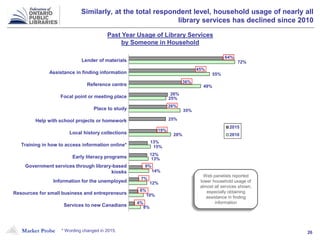
Similarly, at the total respondent level, household usage of nearly all
library services has declined since 2010
Lender of materials
Assistance in finding information
Reference centre
Focal point or meeting place
Place to study
Help with school projects or homework
Local history collections
Training in how to access information online*
Early literacy programs
Government services through library-based
kiosks
Information for the unemployed
Resources for small business and entrepreneurs
Services to new Canadians
Web panelists reported
lower household usage of
almost all services shown,
especially obtaining
assistance in finding
information
Past Year Usage of Library Services
by Someone in Household
* Wording changed in 2015.
Market Probe 27
42%
30%
24%
26%
14%
14%
10%
5%
34%
25%
21%
23%
12%
5%
4%
33%
14%
14%
13%
7%
2%
8%
5%
2%
Check catalogue
Renew an item
Reserve an item
Access other materials
via library's website
Download an item
Manage / make
changes to library account
Consult a librarian by
e-mail, chat or IM
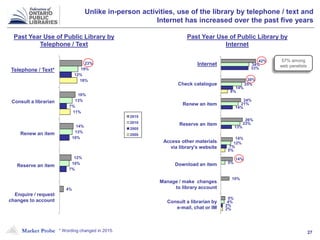
Unlike in-person activities, use of the library by telephone / text and
Internet has increased over the past five years
23%
16%
14%
12%
4%
19%
13%
13%
10%
12%
7%
10%
7%
18%
11%
Consult a librarian
Renew an item
Reserve an item
Enquire / request
changes to
account
68%
32%
65%
35%
65%
35%
0% 20% 40% 60% 80% 100%
Yes
No
2015
2010
2005
2000
Telephone / Text*
Consult a librarian
Renew an item
Reserve an item
Enquire / request
changes to account
Internet
Check catalogue
Renew an item
Reserve an item
Access other materials
via library's website
Download an item
Manage / make changes
to library account
Consult a librarian by
e-mail, chat or IM
Past Year Use of Public Library by
Telephone / Text
Past Year Use of Public Library by
Internet
57% among
web panelists
* Wording changed in 2015.
Market Probe 28
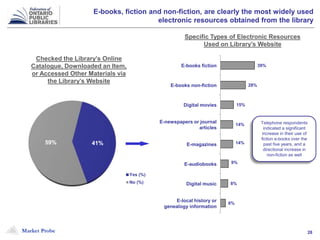
E-books, fiction and non-fiction, are clearly the most widely used
electronic resources obtained from the library
41%59%
Yes (%)
No (%)
39%
28%
15%
14%
14%
9%
8%
6%
E-books fiction
E-books non-fiction
Digital movies
E-newspapers
or journal articles
E-magazines
E-audiobooks
Digital music
E-local history or
genealogy information
Checked the Library’s Online
Catalogue, Downloaded an Item,
or Accessed Other Materials via
the Library’s Website
Telephone respondents
indicated a significant
increase in their use of
fiction e-books over the
past five years, and a
directional increase in
non-fiction as well
E-books fiction
E-books non-fiction
Digital movies
E-newspapers or journal
articles
E-magazines
E-audiobooks
Digital music
E-local history or
genealogy information
Specific Types of Electronic Resources
Used on Library’s Website
Market Probe 29
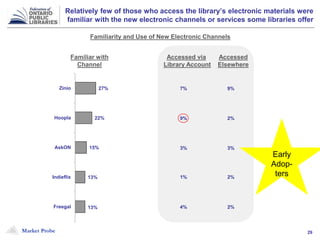
Relatively few of those who access the library’s electronic materials were
familiar with the new electronic channels or services some libraries offer
27%
22%
15%
13%
13%
Zinio
Hoopla
AskON
Indieflix
Freegal
Familiar with
Channel
Accessed via
Library Account
Accessed
Elsewhere
Familiarity and Use of New Electronic Channels
7% 9%
9% 2%
3% 3%
1% 2%
4% 2%
Early
Adop-
ters
Market Probe 30
47
39
42
36
25
24
28
33
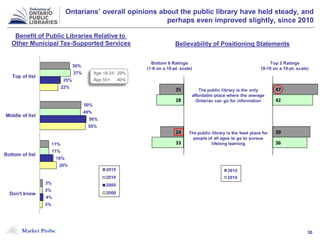
The public library is the only
affordable place where the average
Ontarian can go for information
The public library is the best place for
people of all ages to go to pursue
lifelong learning
Bottom 6 Ratings
(1-6 on a 10-pt. scale)
Top 2 Ratings
(9-10 on a 10-pt. scale)
36%
50%
11%
3%
37%
49%
11%
3%
25%
56%
16%
4%
22%
55%
20%
3%
Top of list
Middle of list
Bottom of list
Don't know
2015
2010
2005
2000
Ontarians’ overall opinions about the public library have held steady, and
perhaps even improved slightly, since 2010
68%
32%
65%
35%
65%
35%
0% 20% 40% 60% 80% 100%
Yes
No
2015
2010
2005
2000
Benefit of Public Libraries Relative to
Other Municipal Tax-Supported Services Believability of Positioning Statements
Bottom 6 Ratings
(1-6 on a 10-pt. scale)
Top 2 Ratings
(9-10 on a 10-pt. scale)
Age 18-34: 29%
Age 55+: 40%
Market Probe 31
56%
54%
50%
46%
34%
32%
31%
30%
29%
28%
26%
26%
25%
19%
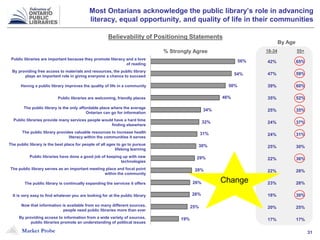
Most Ontarians acknowledge the public library’s role in advancing
literacy, equal opportunity, and quality of life in their communities
Public libraries are important because they promote literacy and a love
of reading
By providing free access to materials and resources, the public library
plays an important role in giving everyone a chance to succeed
Having a public library improves the quality of life in a community
Public libraries are welcoming, friendly places
The public library is the only affordable place where the average
Ontarian can go for information
Public libraries provide many services people would have a hard time
finding elsewhere
The public library provides valuable resources to increase health
literacy within the communities it serves
The public library is the best place for people of all ages to go to pursue
lifelong learning
Public libraries have done a good job of keeping up with new
technologies
The public library serves as an important meeting place and focal point
within the community
The public library is continually expanding the services it offers
It is very easy to find whatever you are looking for at the public library
Now that information is available from so many different sources,
people need public libraries more than ever
By providing access to information from a wide variety of sources,
public libraries promote an understanding of political issues
% Strongly Agree
Believability of Positioning Statements
42% 65%
47% 59%
39% 60%
35% 52%
25% 35%
24% 37%
24% 31%
25% 30%
22% 36%
22% 28%
23% 28%
18% 30%
20% 25%
17% 17%
By Age
18-34 55+
Change
Market Probe 32
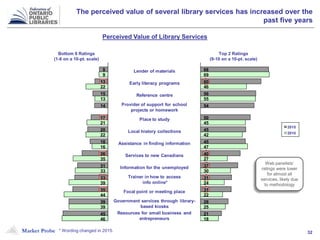
The perceived value of several library services has increased over the
past five years
68%
32%
65%
35%
65%
35%
0% 20% 40% 60% 80% 100%
Yes
No
2015
2010
2005
2000
Perceived Value of Library Services
* Wording changed in 2015.
68
60
56
54
50
45
45
40
37
31
31
28
21
69
46
55
45
42
47
27
30
24
22
25
18
9
13
15
14
17
20
18
26
31
33
35
39
45
9
22
13
21
22
16
35
33
39
44
39
46
Lender of materials
Early literacy programs
Reference centre
Provider of support for school
projects or homework
Place to study
Local history collections
Assistance in finding information
Services to new Canadians
Information for the unemployed
Trainer in how to access
info online*
Focal point or meeting place
Government services through library-
based kiosks
Resources for small business and
entrepreneurs
Bottom 6 Ratings
(1-6 on a 10-pt. scale)
Top 2 Ratings
(9-10 on a 10-pt. scale)
n/an/a
Web panelists’
ratings were lower
for almost all
services, likely due
to methodology
Bottom 6 Ratings
(1-6 on a 10-pt. scale)
Top 2 Ratings
(9-10 on a 10-pt. scale)
Market Probe 33
0
40
80
Assistance in Finding Information
Early Literacy Progams
Focal Point or Meeting Place
Government Services Kiosks
Information for the Unemployed
Lender of Materials
Local History CollectionsPlace to Study
Reference Centre
Resources for Small Business
Services to New Canadians
Support for School Projects or
Homework
Training in How to Access Info Online
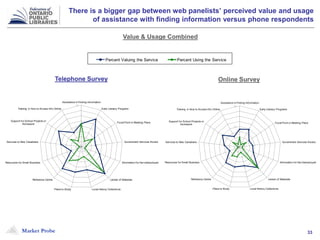
There is a bigger gap between web panelists’ perceived value and usage
of assistance with finding information versus phone respondents
0
40
80
Assistance in finding information
Early literacy programs
Focal point or meeting place
Government services through
library-based kiosks
Information for the unemployed
Lender of materials
Local history collectionsPlace to study
Provider of support for school
projects or homework
Reference centre
Resources for small business and
entrepreneurs
Services to new Canadians
Training in how to access info online
Percent Valuing the Service Percent Using the Service
Telephone Survey Online Survey
Value & Usage Combined
0
40
80
Assistance in Finding Information
Early Literacy Programs
Focal Point or Meeting Place
Government Services Kiosks
Information for the Unemployed
Lender of Materials
Local History CollectionsPlace to Study
Reference Centre
Resources for Small Business
Services to New Canadians
Support for School Projects or
Homework
Training in How to Access Info Online
Market Probe 34
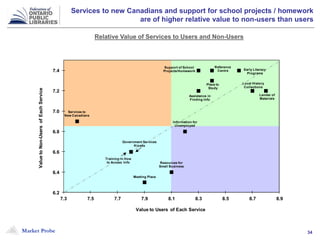
Services to new Canadians and support for school projects / homework
are of higher relative value to non-users than users
Relative Value of Services to Users and Non-Users
Lender of
Materials
Reference
Centre
Government Services
Kiosks
Meeting Place
Early Literacy
Programs
Place to
Study
Local History
Collections
Training in How
to Access Info
Information for
Unemployed
Resources for
Small Business
Assistance in
Finding Info
Services to
New Canadians
Support of School
Projects/Homework
6.2
6.4
6.6
6.8
7.0
7.2
7.4
7.3 7.5 7.7 7.9 8.1 8.3 8.5 8.7 8.9
ValuetoNon-UsersofEachService
Value to Users of Each Service
Market Probe 35
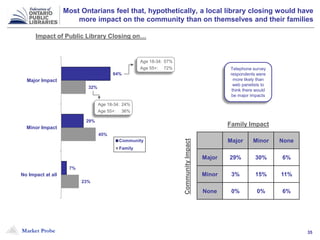
Most Ontarians feel that, hypothetically, a local library closing would have
more impact on the community than on themselves and their families
64%
29%
7%
32%
45%
23%
Major Impact
Minor Impact
No Impact at all
Community
Family
Telephone survey
respondents were
more likely than
web panelists to
think there would
be major impacts
Major Minor None
Major 29% 30% 6%
Minor 3% 15% 11%
None 0% 0% 6%
Family Impact
CommunityImpact
Impact of Public Library Closing on…
Age 18-34: 57%
Age 55+: 72%
Age 18-34: 24%
Age 55+: 36%
Market Probe 36
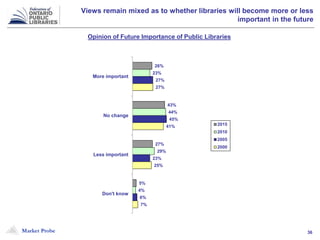
Views remain mixed as to whether libraries will become more or less
important in the future
26%
43%
27%
5%
23%
44%
29%
4%
27%
45%
23%
6%
27%
41%
25%
7%
More important
No change
Less important
Don't know
2015
2010
2005
2000
Opinion of Future Importance of Public Libraries
Market Probe 37
19%
15%
15%
16%
10%
12%
12%
9%
9%
7%
36%
35%
35%
29%
33%
27%
26%
26%
24%
24%
55%
50%
49%
44%
44%
39%
38%
35%
33%
31%
Very Likely Somewhat Likely Total
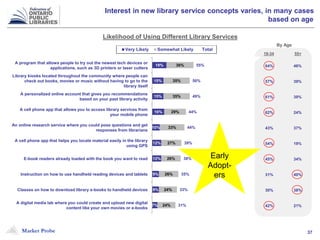
Interest in new library service concepts varies, in many cases
based on age
A program that allows people to try out the newest tech devices or
applications, such as 3D printers or laser cutters
Library kiosks located throughout the community where people can
check out books, movies or music without having to go to the
library itself
A personalized online account that gives you recommendations
based on your past library activity
A cell phone app that allows you to access library services from
your mobile phone
An online research service where you could pose questions and get
responses from librarians
A cell phone app that helps you locate material easily in the library
using GPS
E-book readers already loaded with the book you want to read
Instruction on how to use handheld reading devices and tablets
Classes on how to download library e-books to handheld devices
A digital media lab where you could create and upload new digital
content like your own movies or e-books
Likelihood of Using Different Library Services
64% 46%
57% 39%
61% 39%
62% 24%
43% 37%
54% 19%
45% 34%
31% 40%
30% 38%
42% 21%
By Age
18-34 55+
Early
Adopt-
ers
Market Probe 38
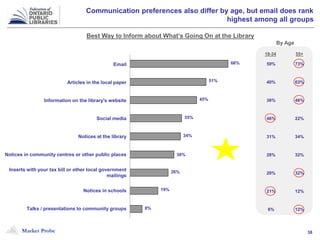
66%
51%
45%
35%
34%
30%
26%
19%
8%
Communication preferences also differ by age, but email does rank
highest among all groups
Email
Articles in the local paper
Information on the library's website
Social media
Notices at the library
Notices in community centres or other public places
Inserts with your tax bill or other local government
mailings
Notices in schools
Talks / presentations to community groups
Best Way to Inform about What’s Going On at the Library
59% 73%
40% 63%
36% 48%
46% 22%
31% 34%
28% 32%
20% 32%
21% 12%
6% 12%
By Age
18-34 55+
Market Probe 39
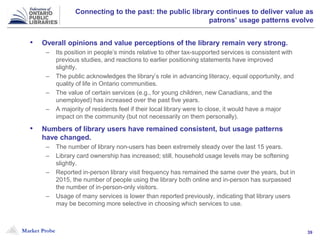
Connecting to the past: the public library continues to deliver value as
patrons’ usage patterns evolve
• Overall opinions and value perceptions of the library remain very strong.
– Its position in people’s minds relative to other tax-supported services is consistent with
previous studies, and reactions to earlier positioning statements have improved
slightly.
– The public acknowledges the library’s role in advancing literacy, equal opportunity, and
quality of life in Ontario communities.
– The value of certain services (e.g., for young children, new Canadians, and the
unemployed) has increased over the past five years.
– A majority of residents feel if their local library were to close, it would have a major
impact on the community (but not necessarily on them personally).
• Numbers of library users have remained consistent, but usage patterns
have changed.
– The number of library non-users has been extremely steady over the last 15 years.
– Library card ownership has increased; still, household usage levels may be softening
slightly.
– Reported in-person library visit frequency has remained the same over the years, but in
2015, the number of people using the library both online and in-person has surpassed
the number of in-person-only visitors.
– Usage of many services is lower than reported previously, indicating that library users
may be becoming more selective in choosing which services to use.
Market Probe 40
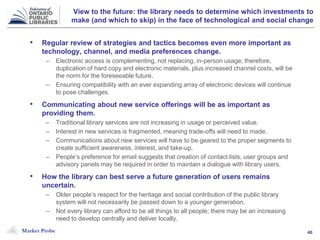
View to the future: the library needs to determine which investments to
make (and which to skip) in the face of technological and social change
• Regular review of strategies and tactics becomes even more important as
technology, channel, and media preferences change.
– Electronic access is complementing, not replacing, in-person usage; therefore,
duplication of hard copy and electronic materials, plus increased channel costs, will be
the norm for the foreseeable future.
– Ensuring compatibility with an ever expanding array of electronic devices will continue
to pose challenges.
• Communicating about new service offerings will be as important as
providing them.
– Traditional library services are not increasing in usage or perceived value.
– Interest in new services is fragmented, meaning trade-offs will need to made.
– Communications about new services will have to be geared to the proper segments to
create sufficient awareness, interest, and take-up.
– People’s preference for email suggests that creation of contact lists, user groups and
advisory panels may be required in order to maintain a dialogue with library users.
• How the library can best serve a future generation of users remains
uncertain.
– Older people’s respect for the heritage and social contribution of the public library
system will not necessarily be passed down to a younger generation.
– Not every library can afford to be all things to all people; there may be an increasing
need to develop centrally and deliver locally.
Market Probe 41
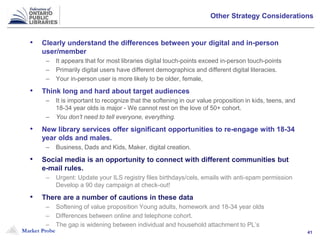
Other Strategy Considerations
• Clearly understand the differences between your digital and in-person
user/member
– It appears that for most libraries digital touch-points exceed in-person touch-points
– Primarily digital users have different demographics and different digital literacies.
– Your in-person user is more likely to be older, female,
• Think long and hard about target audiences
– It is important to recognize that the softening in our value proposition in kids, teens, and
18-34 year olds is major - We cannot rest on the love of 50+ cohort.
– You don’t need to tell everyone, everything.
• New library services offer significant opportunities to re-engage with 18-34
year olds and males.
– Business, Dads and Kids, Maker, digital creation.
• Social media is an opportunity to connect with different communities but
e-mail rules.
– Urgent: Update your ILS registry files birthdays/cels, emails with anti-spam permission
Develop a 90 day campaign at check-out!
• There are a number of cautions in these data
– Softening of value proposition Young adults, homework and 18-34 year olds
– Differences between online and telephone cohort.
– The gap is widening between individual and household attachment to PL’s
Market Probe 42
The biggest challenge of all…
All future strategies and plans should be designed with the
objective of convincing more people that the public library can be
of as much value to them personally as they think it is to others.
Discussion
www.fopl.ca
Stephen Abram,
Executive Director
416-395-0746
sabram@fopl.ca
Thank You
www.fopl.ca
Stephen Abram,
Executive Director
416-395-0746
sabram@fopl.ca

Celupl poll2015

  • 1.
    CELUPL Nov. 6, 2015 FEDERATIONOF ONTARIO PUBLIC LIBRARIES RESEARCH New Ontario Polling Data from FOPL
  • 2.
    Market Probe 2 Contextof FOPL Stats and Measurements • Statistics and Measurements Strategies – Participate in CLA task force on national statistics – Plan and host 2 iSchool symposia on measurements for libraries – Lobby for open data for public libraries – Publish analysis of Ministry data collection for 2001-2013. – Publish Market Probe opinion polls for 2015 (building on 2001, 2006, 2010 polls) – Host and record three webinars – Conduct Ontario library branding research – Coming Soon: FOPL Index of Community Engagement • Thank you to the Ministry of Tourism Culture and Sport for some support. 2
  • 3.
    Market Probe 3 FOPLReports • Ontario Public Library Operating Data 2001-2013: Overview, Primer on Library Statistics and Collected Tables (81 page PDF) – Introduction by Stephen Abram, MLS, Executive Director – A Primer on Library Data by Robert Molyneux, PhD – Key Ratios for Ontario Public Libraries, 2013 – Population and Circulation at Ontario Public Libraries, 2001-2013, All Reporting Each Year – Programs Held and Program Attendance Ontario Public Libraries, 2001-2013, All Reporting Each Year – Selected Expenditures at Ontario Public Libraries, 2001-2013, All Reporting Each Year – Selected Digital Materials, Held by Ontario Public Libraries, 2001-2013, All Reporting EACH Year – Circulations per capita and per active cardholder,2013, Ranked by Bands – Expenditures per capita and per active cardholder, 2013, Ranked by Bands – Total Operating Expenditures and Materials Expenditures, 2001-2013, [summary and by bands] – Active Cardholders as a Percentage of Population (Resident) at Ontario’s Public Libraries, 2001-2013 – Circulation per capita and per active cardholders, Ontario Public Libraries, 2001-2013 – Sources of data used in these reports • http://fopl.ca/news/fopl-member-benefit-performance-measures-for-ontario- public-libraries/ • Each chapter has a separate blog posting as well for June 30-Sept 8.
  • 4.
    Market Probe 4 FOPLReports • Market Probe Public Opinion Poll Report: May 2015 (103 page PDF) • FOPL Market Probe Poll Final Report 2015-05-08 - v1 – DL • Market Probe Canada Presentation on 2015 Public Opinion Poll (33 slides) • http://fopl.ca/news/market-probe-canada-presentation-on-2015-public-opinion- poll/ • The Ontario Library Branding Study • http://fopl.ca/news/a-study-of-public-library-branding-in-ontario/
  • 5.
    Market Probe 5 SocialMedia and Ontario Public Libraries • Public Library Website Presence (n=304) • 29 (i.e. 9%) did NOT have a website; • 2/3 (i.e. 19) of those libraries without a website were identified as First Nation libraries; • 3 of the 29 without websites were FOPL members. • Facebook: 144 libraries have a clear Facebook presence(45%): Large urban (including TPL) have adopted at 100%; Small medium = 85% (55). Of the non- FOPL libraries, only 24% (29) used FB. • Twitter: 106 libraries have a clear Twitter presence (33%): 1 FN; 1 Franco; all the Large Urban; 10 North; 6 Rural; 43 Small-Med. • 48 libraries have blogs (15%) • Uptake of media sharing tools was not as robust as the social networking tools. Too few were using YouTube, Flickr, Pinterest, Instagram, Tumblr, Goodreads, etc.
  • 6.
    Market Probe 6 Censusof Ontario Public Library Websites
  • 7.
    Market Probe 7 Webinarsin this series • August 14, 2015: Overview of FOPL's Ontario Public Library Statistics and Measurements Report • Speaker: Dr. Robert Molyneux, MLIS, PhD • http://fopl.ca/news/fopl-statistics-webinar-slides-from-august-14- 2015/ • August 17, 2015: Overview of FOPL's Market Probe Canada Public Opinion Poll of Ontarians and Public Libraries • Speaker: Carol French, Senior Vice President, Research & Client Services Market Probe Canada • http://fopl.ca/news/todays-webinar-on-the-market-probe-public- opinion-poll/ • August 28th Noon-1 pm: Strategic Use and Insights from FOPL's Ontario Public Library Statistics, Polls, and Measurements (register with monica@fopl.ca) • Speaker: Stephen Abram, MLS, executive director FOPL 7
  • 8.
    Market Probe 8 TodayI am going to focus on the results of the Public Opinion Poll These slides will be up on the FOPL website today. I am going to start with the conclusions / recommendations and then run through as much of the data reports as I can. • Background (quickly) • Library Usage • Accessing the Library • Library Services • Value of the Public Library • Future Outlook • Summary of Selected Conclusions Star = highlights
  • 9.
    Market Probe 9 Connectingto the past: the public library continues to deliver value as patrons’ usage patterns evolve • Overall opinions and value perceptions of the library remain very strong. – Its position in people’s minds relative to other tax-supported services is consistent with previous studies, and reactions to earlier positioning statements have improved slightly. – The public acknowledges the library’s role in advancing literacy, equal opportunity, and quality of life in Ontario communities. – The value of certain services (e.g., for young children, new Canadians, and the unemployed) has increased over the past five years. – A majority of residents feel if their local library were to close, it would have a major impact on the community (but not necessarily on them personally). • Numbers of library users have remained consistent, but usage patterns have changed. – The number of library non-users has been extremely steady over the last 15 years. – Library card ownership has increased; still, household usage levels may be softening slightly. – Reported in-person library visit frequency has remained the same over the years, but in 2015, the number of people using the library both online and in-person has surpassed the number of in-person-only visitors. – Usage of many services is lower than reported previously, indicating that library users may be becoming more selective in choosing which services to use.
  • 10.
    Market Probe 10 Viewto the future: the library needs to determine which investments to make (and which to skip) in the face of technological and social change • Regular review of strategies and tactics becomes even more important as technology, channel, and media preferences change. – Electronic access is complementing, not replacing, in-person usage; therefore, duplication of hard copy and electronic materials, plus increased channel costs, will be the norm for the foreseeable future. – Ensuring compatibility with an ever expanding array of electronic devices will continue to pose challenges. • Communicating about new service offerings will be as important as providing them. – Traditional library services are not increasing in usage or perceived value. – Interest in new services is fragmented, meaning trade-offs will need to made. – Communications about new services will have to be geared to the proper segments to create sufficient awareness, interest, and take-up. – People’s preference for email suggests that creation of contact lists, user groups and advisory panels may be required in order to maintain a dialogue with library users. • How the library can best serve a future generation of users remains uncertain. – Older people’s respect for the heritage and social contribution of the public library system will not necessarily be passed down to a younger generation. – Not every library can afford to be all things to all people; there may be an increasing need to develop centrally and deliver locally.
  • 11.
    Market Probe 11 OtherStrategy Considerations • Clearly understand the differences between your digital and in-person user/member – It appears that for most libraries digital touch-points exceed in-person touch-points – Primarily digital users have different demographics and different digital literacies. – Your in-person user is more likely to be older, female, • Think long and hard about target audiences – It is important to recognize that the softening in our value proposition in kids, teens, and 18-34 year olds is major. – We cannot rest on the love of 50+ cohort. • New library services offer significant opportunities to re-engage with 18-34 year olds and males. – Business, Dads and Kids, Maker, digital creation. • Social media is an opportunity to connect with different communities but e-mail rules. – Urgent: Update your ILS registry files birthdays/cels, emails with anti-spam permission Develop a 90 day campaign at check-out! • There are a number of cautions in these data – Softening of value proposition Young adults, homework and 18-34 year olds – Differences between online and telephone cohort. – The gap is widening between individual and household attachment to PL’s
  • 12.
    Market Probe 12 2015Survey: Connecting to the past with a view to the future… • Fourth wave of a study that has been conducted every five years since 2000 • Objectives: – Understand Ontario residents’ opinions about the use, role and impact of public libraries, and how those opinions have changed over time – Separate public opinion by level of usage of public libraries (including non-use) – Identify areas of strength and weakness for the public library • Results will be used to: – Monitor status of the library – Formulate strategy – Identify priorities – Provide input to a new marketing communication plan
  • 13.
    Market Probe 13 …throughthe use of a dual telephone / online survey method • Significant differences exist between phone and web respondents • Also differences in the way people respond to questions based on methodology – Multiple response questions – Rating scale questions – Social desirability bias Both surveys made available in English and French Telephone Survey • 600 telephone interviews conducted from February 26th to March 16th, 2015 Online Survey • 1,102 online surveys conducted from March 5th to March 10th, 2015 using Delvinia’s AskingCanadians online panel Age and gender controlled by quotas Phone Web Households with children 40% 22% Graduated college/university 55% 70% Live in Metro TO / Urban GTA 39% 52% Born outside Canada 19% 24%
  • 14.
    Market Probe 14 MostOntarians read books, and still primarily in hard copy format 86% 27% 28% 31% 16+ books read 6 to 15 books read 1 to 5 books read Any Books Read in Past 12 Months 17% 66% 18% Most likely to have read no books: • High school or less education 26% • <$35K household income 23% • Singles 20% • Men 19% Mostly in electronic format Mostly in hard copy Both equally Books Read in the Past Year Format of Books Read in the Past Year Age 18-34: 18% Age 55+: 38%
  • 15.
    Market Probe 15 Bookstoreusage has remained steady, with a substantial portion of traffic swinging to online visits 12% 18% 51% 19% 14% 14% 41% 31% More than 10 times 6 to 10 times 1 to 5 times None In-Person Online 22% 47% 31% Online more About the same In-person more Past Year Bookstore Visit Frequency 26% 21% 37% 17% 25% 21% 38% 16% 27% 22% 34% 16% 34% 22% 31% 12% More than 10 times 6 to 10 times 1 to 5 times None 2015 2010 2005 2000 Past Year Bookstore Visit Frequency Relative Frequency of Visiting Bookstore Online and In-Person
  • 16.
    Market Probe 16 87% 83% 44% 42% 41% 23% 17% 88% 83% 50% 23% 26% 21% 2015 2010 WhileInternet penetration has not changed in the last five years, the ways in which people access the Internet have shifted Higher among web panelists 99% 86% 84% 73% 56% 33% 24% 23% 6% Any Internet Access At home At work At other places in the community using a smartphone At other places in the community using wireless access At your public library At school Regular Use of Internet Search for specific information of interest Use e-mail, a chat room or IM Access the news Access social networking sites Stream movies, music or other types of entertainment Download movies, music or other types of entertainment Download books or magazines Create content Ways Internet Was Accessed in the Past Year Uses of Internet
  • 17.
    Market Probe 17 Respondent Only 27% WithOthers in Household 42% Other Household Member(s) Only 7% No One 24% Respondent Only 28% With Others in Household 41% Other Household Member(s) Only 10% No One 21% 73% 68% 65% 65% Yes 2015 2010 2005 2000 Household use of the public library may be slipping slightly, despite a reported increase in library card ownership Total Household Usage of the Public Library 2015 2010 49% 26% 22% 8% 50% 31% 23% 8% 47% 27% 19% 7% 51% 24% 17% 9% Children Spouse/partner Others 2015 2010 2005 2000 In Household Used by Others (net) 19% among web panelists 27% among web panelistsTotal Users 70% Total Users 69% Past Year Use of Public Library by Other Household Members 68% among web panelists 3% among web panelists Have a Library Card
  • 18.
    Market Probe 18 Formost Ontarians, the public library is located close to home and tends to be an inviting place Distance from Home to Closest Library 70% 20% 5% 1% 4% 5 kilometres or less 6 to 10 kilometres 11 to 20 kilometres More than 20 kilometres Don’t know Condition of Library Closest to Home 56% 28% 2% 13% Inviting space Okay, but could use some improvement Not pleasant Never been inside library Ranges from 64% in Northern Ontario to 80% in Metro Toronto 5 kilometres or less 6 to 10 kilometres 11 to 20 kilometres More than 20 kilometres Don’t know Inviting space Okay, but could use some improvement Not pleasant Never been inside library Age 18-34: 47% Age 55+: 62%
  • 19.
    Market Probe 19 Nearlyone-third of those surveyed have not used the public library in the past year (although most have used it sometime in the past) Don’t Use the Public Library 31% 31% 30% 31% 2015 2010 2005 2000 91%9% Yes (%) No (%) Ever used the Public Library Had a Negative Experience (All users, current and past) 5%95% Yes (%) No (%) 10% among web panelists
  • 20.
    Market Probe 20 50% 30% 21% 8% 7% 6% 40% 34% 27% 9% 10% 6% 21% 25% 26% 7% 3% 6% 22% 30% 21% 12% 8% 6% Getinformation from other sources Not interested Too busy Don't read Library isn't accessible Use library at school or work Availability of information from other sources and lack of interest are the two main reasons for not using the public library Reasons for Not Using the Public Library 6% 5% 3% 3% 4% 4% 1% 11% 4% 1% 5% 7% 4% 2% 2% 6% 7% 2% Due to illness / injury / too old No reason / don't know Prefer to buy / share books Library hours not convenient Have own library / books Get information from other sources Not interested Too busy Don't read Library isn't accessible Use library at school or work Due to illness / injury / too old No reason / don't know Prefer to buy / share books Library hours not convenient Have own library / books Reasons reversed among web panelists 68% 32% 65% 35% 65% 35% 0% 20% 40% 60% 80% 100% Yes No 2015 2010 2005 2000 • Higher income earners are more likely to get information from other sources • Those with lower income are more likely to not be interested
  • 21.
    Market Probe 21 Frequencyof visiting the library in person has remained constant, while online access has increased over the last five years In-Person Library Visit Frequency in Past Year Accessed Library by… Telephone 22% Text 2% Social Media 7% 17% 10% 12% 27% 34% 18% 11% 12% 25% 34% 18% 12% 10% 25% 34% 19% 11% 12% 25% 32% 21+ times 11 to 20 times 6 to 10 times 1 to 5 times Not at all 2015 2010 2005 2000 Times Accessed Library’s Website in Past Year 17% 25% 58% 12% 22% 66% 9% 28% 63% 11 or more times 1 to 10 times Not at all 2015 2010 2005 37% among web panelists 37% among web panelists 43% among web panelists 11% among web panelists
  • 22.
    Market Probe 22 Useof the Internet to access the public library is complementing, not replacing, in-person visits 2010 37% 1% 1% 13% 12% In-Person Internet Phone 33% 2% 2015 27% 1% 1% 20% 11% In-Person Internet Phone 36% 3% Ways Users Access the Public Library Significant differences among web panelists (2015): In-person only 19% In-person / Internet 49% In-person / phone 3% Hybrid Users
  • 23.
    Market Probe 23 88% 35% 22% 11% 4% Adesktop or laptop computer A tablet A smartphone An e-reader An iPod or MP3 player E-readers are less popular than other devices for accessing library materials 33%67% Yes (%) No (%) Devices Used to Access Resources from the Library E-reader ownership (among those who have not used an e-reader to access library resources) 30% 70% Yes (%) No (%) Ever tried to download public library e-books using an e-reader A desktop or laptop computer A tablet A smartphone An e-reader An iPod or MP3 player
  • 24.
    Market Probe 24 Bookstorescontinue to receive more visits than libraries, especially online Bookstore vs. Library Visit Frequency 42% 26% 29% 3% 43% 28% 28% 1% Bookstores more About the same Libraries more Don't know 2015 2010 9% 21% 26% 12% 21% 10% 13% 15% 19% 10% 25% 18% Library only Library more Both equally Bookstore more Bookstore only Neither In-Person Usage Online Usage Relative Frequency of Using Libraries and Bookstores
  • 25.
    Market Probe 25 In-personlibrary visitors are engaging in fewer activities, with use of the library’s wireless network being the only one to register increased usage Reasons for Personally Using the Public Library 84% 56% 34% 28% 26% 25% 23% 23% 16% 14% 10% 90% 70% 41% 33% 26% 17% 33% 23% 13% 21% 16% 88% 73% 38% 31% 32% 18% 9% 21% 16% 88% 77% 47% 19% 32% 17% 9% 24% 18% Borrow books, CDs, DVDs or other materials Get information on a topic of personal interest Read or study Access the Internet using library computers Relax or socialize Use the library's wireless network Access databases / other electronically stored info* Take a child to a program or activity Attend a lecture, program, meeting or training session Work assignment or keep up-to-date at work School or class assignment 86% 59% 44% 35% 31% 31% 27% 25% 18% 21% 27% Total Household Usage (2015) 68% 32% 65% 35% 65% 35% 0% 20% 40% 60% 80% 100% Yes No 2015 2010 2005 2000 Web panelists indicated fewer reasons in total and, in particular, were much less likely to mention borrowing materials and getting information on a topic of interest * Wording changed in 2015.
  • 26.
    Market Probe 26 64% 45% 36% 26% 26% 25% 19% 13% 12% 9% 7% 6% 4% 72% 55% 49% 25% 35% 28% 15% 13% 14% 12% 10% 8% 2015 2010 Similarly,at the total respondent level, household usage of nearly all library services has declined since 2010 Lender of materials Assistance in finding information Reference centre Focal point or meeting place Place to study Help with school projects or homework Local history collections Training in how to access information online* Early literacy programs Government services through library-based kiosks Information for the unemployed Resources for small business and entrepreneurs Services to new Canadians Web panelists reported lower household usage of almost all services shown, especially obtaining assistance in finding information Past Year Usage of Library Services by Someone in Household * Wording changed in 2015.
  • 27.
    Market Probe 27 42% 30% 24% 26% 14% 14% 10% 5% 34% 25% 21% 23% 12% 5% 4% 33% 14% 14% 13% 7% 2% 8% 5% 2% Checkcatalogue Renew an item Reserve an item Access other materials via library's website Download an item Manage / make changes to library account Consult a librarian by e-mail, chat or IM Unlike in-person activities, use of the library by telephone / text and Internet has increased over the past five years 23% 16% 14% 12% 4% 19% 13% 13% 10% 12% 7% 10% 7% 18% 11% Consult a librarian Renew an item Reserve an item Enquire / request changes to account 68% 32% 65% 35% 65% 35% 0% 20% 40% 60% 80% 100% Yes No 2015 2010 2005 2000 Telephone / Text* Consult a librarian Renew an item Reserve an item Enquire / request changes to account Internet Check catalogue Renew an item Reserve an item Access other materials via library's website Download an item Manage / make changes to library account Consult a librarian by e-mail, chat or IM Past Year Use of Public Library by Telephone / Text Past Year Use of Public Library by Internet 57% among web panelists * Wording changed in 2015.
  • 28.
    Market Probe 28 E-books,fiction and non-fiction, are clearly the most widely used electronic resources obtained from the library 41%59% Yes (%) No (%) 39% 28% 15% 14% 14% 9% 8% 6% E-books fiction E-books non-fiction Digital movies E-newspapers or journal articles E-magazines E-audiobooks Digital music E-local history or genealogy information Checked the Library’s Online Catalogue, Downloaded an Item, or Accessed Other Materials via the Library’s Website Telephone respondents indicated a significant increase in their use of fiction e-books over the past five years, and a directional increase in non-fiction as well E-books fiction E-books non-fiction Digital movies E-newspapers or journal articles E-magazines E-audiobooks Digital music E-local history or genealogy information Specific Types of Electronic Resources Used on Library’s Website
  • 29.
    Market Probe 29 Relativelyfew of those who access the library’s electronic materials were familiar with the new electronic channels or services some libraries offer 27% 22% 15% 13% 13% Zinio Hoopla AskON Indieflix Freegal Familiar with Channel Accessed via Library Account Accessed Elsewhere Familiarity and Use of New Electronic Channels 7% 9% 9% 2% 3% 3% 1% 2% 4% 2% Early Adop- ters
  • 30.
    Market Probe 30 47 39 42 36 25 24 28 33 Thepublic library is the only affordable place where the average Ontarian can go for information The public library is the best place for people of all ages to go to pursue lifelong learning Bottom 6 Ratings (1-6 on a 10-pt. scale) Top 2 Ratings (9-10 on a 10-pt. scale) 36% 50% 11% 3% 37% 49% 11% 3% 25% 56% 16% 4% 22% 55% 20% 3% Top of list Middle of list Bottom of list Don't know 2015 2010 2005 2000 Ontarians’ overall opinions about the public library have held steady, and perhaps even improved slightly, since 2010 68% 32% 65% 35% 65% 35% 0% 20% 40% 60% 80% 100% Yes No 2015 2010 2005 2000 Benefit of Public Libraries Relative to Other Municipal Tax-Supported Services Believability of Positioning Statements Bottom 6 Ratings (1-6 on a 10-pt. scale) Top 2 Ratings (9-10 on a 10-pt. scale) Age 18-34: 29% Age 55+: 40%
  • 31.
    Market Probe 31 56% 54% 50% 46% 34% 32% 31% 30% 29% 28% 26% 26% 25% 19% MostOntarians acknowledge the public library’s role in advancing literacy, equal opportunity, and quality of life in their communities Public libraries are important because they promote literacy and a love of reading By providing free access to materials and resources, the public library plays an important role in giving everyone a chance to succeed Having a public library improves the quality of life in a community Public libraries are welcoming, friendly places The public library is the only affordable place where the average Ontarian can go for information Public libraries provide many services people would have a hard time finding elsewhere The public library provides valuable resources to increase health literacy within the communities it serves The public library is the best place for people of all ages to go to pursue lifelong learning Public libraries have done a good job of keeping up with new technologies The public library serves as an important meeting place and focal point within the community The public library is continually expanding the services it offers It is very easy to find whatever you are looking for at the public library Now that information is available from so many different sources, people need public libraries more than ever By providing access to information from a wide variety of sources, public libraries promote an understanding of political issues % Strongly Agree Believability of Positioning Statements 42% 65% 47% 59% 39% 60% 35% 52% 25% 35% 24% 37% 24% 31% 25% 30% 22% 36% 22% 28% 23% 28% 18% 30% 20% 25% 17% 17% By Age 18-34 55+ Change
  • 32.
    Market Probe 32 Theperceived value of several library services has increased over the past five years 68% 32% 65% 35% 65% 35% 0% 20% 40% 60% 80% 100% Yes No 2015 2010 2005 2000 Perceived Value of Library Services * Wording changed in 2015. 68 60 56 54 50 45 45 40 37 31 31 28 21 69 46 55 45 42 47 27 30 24 22 25 18 9 13 15 14 17 20 18 26 31 33 35 39 45 9 22 13 21 22 16 35 33 39 44 39 46 Lender of materials Early literacy programs Reference centre Provider of support for school projects or homework Place to study Local history collections Assistance in finding information Services to new Canadians Information for the unemployed Trainer in how to access info online* Focal point or meeting place Government services through library- based kiosks Resources for small business and entrepreneurs Bottom 6 Ratings (1-6 on a 10-pt. scale) Top 2 Ratings (9-10 on a 10-pt. scale) n/an/a Web panelists’ ratings were lower for almost all services, likely due to methodology Bottom 6 Ratings (1-6 on a 10-pt. scale) Top 2 Ratings (9-10 on a 10-pt. scale)
  • 33.
    Market Probe 33 0 40 80 Assistancein Finding Information Early Literacy Progams Focal Point or Meeting Place Government Services Kiosks Information for the Unemployed Lender of Materials Local History CollectionsPlace to Study Reference Centre Resources for Small Business Services to New Canadians Support for School Projects or Homework Training in How to Access Info Online There is a bigger gap between web panelists’ perceived value and usage of assistance with finding information versus phone respondents 0 40 80 Assistance in finding information Early literacy programs Focal point or meeting place Government services through library-based kiosks Information for the unemployed Lender of materials Local history collectionsPlace to study Provider of support for school projects or homework Reference centre Resources for small business and entrepreneurs Services to new Canadians Training in how to access info online Percent Valuing the Service Percent Using the Service Telephone Survey Online Survey Value & Usage Combined 0 40 80 Assistance in Finding Information Early Literacy Programs Focal Point or Meeting Place Government Services Kiosks Information for the Unemployed Lender of Materials Local History CollectionsPlace to Study Reference Centre Resources for Small Business Services to New Canadians Support for School Projects or Homework Training in How to Access Info Online
  • 34.
    Market Probe 34 Servicesto new Canadians and support for school projects / homework are of higher relative value to non-users than users Relative Value of Services to Users and Non-Users Lender of Materials Reference Centre Government Services Kiosks Meeting Place Early Literacy Programs Place to Study Local History Collections Training in How to Access Info Information for Unemployed Resources for Small Business Assistance in Finding Info Services to New Canadians Support of School Projects/Homework 6.2 6.4 6.6 6.8 7.0 7.2 7.4 7.3 7.5 7.7 7.9 8.1 8.3 8.5 8.7 8.9 ValuetoNon-UsersofEachService Value to Users of Each Service
  • 35.
    Market Probe 35 MostOntarians feel that, hypothetically, a local library closing would have more impact on the community than on themselves and their families 64% 29% 7% 32% 45% 23% Major Impact Minor Impact No Impact at all Community Family Telephone survey respondents were more likely than web panelists to think there would be major impacts Major Minor None Major 29% 30% 6% Minor 3% 15% 11% None 0% 0% 6% Family Impact CommunityImpact Impact of Public Library Closing on… Age 18-34: 57% Age 55+: 72% Age 18-34: 24% Age 55+: 36%
  • 36.
    Market Probe 36 Viewsremain mixed as to whether libraries will become more or less important in the future 26% 43% 27% 5% 23% 44% 29% 4% 27% 45% 23% 6% 27% 41% 25% 7% More important No change Less important Don't know 2015 2010 2005 2000 Opinion of Future Importance of Public Libraries
  • 37.
    Market Probe 37 19% 15% 15% 16% 10% 12% 12% 9% 9% 7% 36% 35% 35% 29% 33% 27% 26% 26% 24% 24% 55% 50% 49% 44% 44% 39% 38% 35% 33% 31% VeryLikely Somewhat Likely Total Interest in new library service concepts varies, in many cases based on age A program that allows people to try out the newest tech devices or applications, such as 3D printers or laser cutters Library kiosks located throughout the community where people can check out books, movies or music without having to go to the library itself A personalized online account that gives you recommendations based on your past library activity A cell phone app that allows you to access library services from your mobile phone An online research service where you could pose questions and get responses from librarians A cell phone app that helps you locate material easily in the library using GPS E-book readers already loaded with the book you want to read Instruction on how to use handheld reading devices and tablets Classes on how to download library e-books to handheld devices A digital media lab where you could create and upload new digital content like your own movies or e-books Likelihood of Using Different Library Services 64% 46% 57% 39% 61% 39% 62% 24% 43% 37% 54% 19% 45% 34% 31% 40% 30% 38% 42% 21% By Age 18-34 55+ Early Adopt- ers
  • 38.
    Market Probe 38 66% 51% 45% 35% 34% 30% 26% 19% 8% Communicationpreferences also differ by age, but email does rank highest among all groups Email Articles in the local paper Information on the library's website Social media Notices at the library Notices in community centres or other public places Inserts with your tax bill or other local government mailings Notices in schools Talks / presentations to community groups Best Way to Inform about What’s Going On at the Library 59% 73% 40% 63% 36% 48% 46% 22% 31% 34% 28% 32% 20% 32% 21% 12% 6% 12% By Age 18-34 55+
  • 39.
    Market Probe 39 Connectingto the past: the public library continues to deliver value as patrons’ usage patterns evolve • Overall opinions and value perceptions of the library remain very strong. – Its position in people’s minds relative to other tax-supported services is consistent with previous studies, and reactions to earlier positioning statements have improved slightly. – The public acknowledges the library’s role in advancing literacy, equal opportunity, and quality of life in Ontario communities. – The value of certain services (e.g., for young children, new Canadians, and the unemployed) has increased over the past five years. – A majority of residents feel if their local library were to close, it would have a major impact on the community (but not necessarily on them personally). • Numbers of library users have remained consistent, but usage patterns have changed. – The number of library non-users has been extremely steady over the last 15 years. – Library card ownership has increased; still, household usage levels may be softening slightly. – Reported in-person library visit frequency has remained the same over the years, but in 2015, the number of people using the library both online and in-person has surpassed the number of in-person-only visitors. – Usage of many services is lower than reported previously, indicating that library users may be becoming more selective in choosing which services to use.
  • 40.
    Market Probe 40 Viewto the future: the library needs to determine which investments to make (and which to skip) in the face of technological and social change • Regular review of strategies and tactics becomes even more important as technology, channel, and media preferences change. – Electronic access is complementing, not replacing, in-person usage; therefore, duplication of hard copy and electronic materials, plus increased channel costs, will be the norm for the foreseeable future. – Ensuring compatibility with an ever expanding array of electronic devices will continue to pose challenges. • Communicating about new service offerings will be as important as providing them. – Traditional library services are not increasing in usage or perceived value. – Interest in new services is fragmented, meaning trade-offs will need to made. – Communications about new services will have to be geared to the proper segments to create sufficient awareness, interest, and take-up. – People’s preference for email suggests that creation of contact lists, user groups and advisory panels may be required in order to maintain a dialogue with library users. • How the library can best serve a future generation of users remains uncertain. – Older people’s respect for the heritage and social contribution of the public library system will not necessarily be passed down to a younger generation. – Not every library can afford to be all things to all people; there may be an increasing need to develop centrally and deliver locally.
  • 41.
    Market Probe 41 OtherStrategy Considerations • Clearly understand the differences between your digital and in-person user/member – It appears that for most libraries digital touch-points exceed in-person touch-points – Primarily digital users have different demographics and different digital literacies. – Your in-person user is more likely to be older, female, • Think long and hard about target audiences – It is important to recognize that the softening in our value proposition in kids, teens, and 18-34 year olds is major - We cannot rest on the love of 50+ cohort. – You don’t need to tell everyone, everything. • New library services offer significant opportunities to re-engage with 18-34 year olds and males. – Business, Dads and Kids, Maker, digital creation. • Social media is an opportunity to connect with different communities but e-mail rules. – Urgent: Update your ILS registry files birthdays/cels, emails with anti-spam permission Develop a 90 day campaign at check-out! • There are a number of cautions in these data – Softening of value proposition Young adults, homework and 18-34 year olds – Differences between online and telephone cohort. – The gap is widening between individual and household attachment to PL’s
  • 42.
    Market Probe 42 Thebiggest challenge of all… All future strategies and plans should be designed with the objective of convincing more people that the public library can be of as much value to them personally as they think it is to others.
  • 43.
  • 44.
    Thank You www.fopl.ca Stephen Abram, ExecutiveDirector 416-395-0746 sabram@fopl.ca