FOPL Activities

Stephen Abram, MLA , FOPL Executive Director

AMPLO Report March 7, 2014
About the Federation



Provides a single, strong voice for public libraries in Ontario to
enhance library policies and programs.



Services focus on four strategic pillars: advocacy, marketing,
research and consortia purchasing.



Over 215 members representing libraries of all sizes and
geographic regions, and serving 80% of Ontario’s population.



2

A not-for-profit membership association established in 2005.

Our Board of Directors is composed of an equal number of
library board trustees and library chief executives.
What is FOPL?


3

Simply put: Ontario’s Public Libraries. Now more than ever
before, they play a critical role in the social, educational,
cultural and economic success of the communities in our
province. Public Libraries are an essential investment in
the future of our communities and are essential drivers of
success in school preparedness, reading readiness,
economic and employment success, and social equity. As
the development of the knowledge economy progresses,
public libraries are a vital link for every resident and every
community to ensure success of all Ontarians, regardless
of location or background.
FOPL Membership
 Growing!
 Strong
 Collaboration
 Membership

ethic improving

is not a membership fee but
financial support for research, advocacy, and

4
Fundraising
 Culture

Development fund $57K approved
(with OLA) to create sustainable trustee
training over 2 years
 SOLS/OLS-N $25K approved for Phase 1
2020 branding study and campaign
 $15K stats proposal in process
 $300K Sponsorship campaign in planning
stages
5
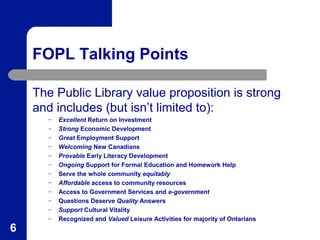
FOPL Talking Points
The Public Library value proposition is strong
and includes (but isn’t limited to):
–
–
–
–
–
–
–
–
–
–
–
–

6

Excellent Return on Investment
Strong Economic Development
Great Employment Support
Welcoming New Canadians
Provable Early Literacy Development
Ongoing Support for Formal Education and Homework Help
Serve the whole community equitably
Affordable access to community resources
Access to Government Services and e-government
Questions Deserve Quality Answers
Support Cultural Vitality
Recognized and Valued Leisure Activities for majority of Ontarians
What’s the ‘Problem”?
 We

have a very COMPLEX (not complicated)
value proposition
 We have great competencies BUT we need
to up our game on influence, advocacy, and
focus.
 We need the tools and we need to
collaborate on them nimbly and quickly.
7
Advocacy Training
 10

8

part series delivered, recorded, archived
and available (over 1000 attendees)
 iSchool MOOC: FOPL sponsored, supported
with research and videos, and planning
(5000)
 Ministry to do webinar on March 19th on Data
results for 2011 and 2012
 Copyright webinar planned for May 27 with
Wanda Noel (immediately after board and
AC hearings)
2020 Branding
 Marketing

Research (Richardson-Jalakas)
 Social Media Census

9
Project to develop a brand strategy
for Ontario public libraries

Richardson Jalakas &
associates
#1- Census – use of websites

•
•
•



11

29 (i.e. 9%) did NOT have a website;
2/3 (i.e. 19) of those libraries without a website were
identified as First Nation libraries;
3 of the 29 without websites were FOPL members.
(n = 318)
Richardson Jalakas & Associates
#1 - Census – Adoption of Social
networking
Tool

Yes

%

Notes

Social Networking:
Facebook

45%

Large urban (including TPL) have adopted
at 100%; Small medium = 85% (55). Of
the non-FOPL libraries, only 24% (29)
used FB.

Twitter

106

33%

Caucus members with T: 1 FN; 1 Franco;
all the Lg Urban (including TPL); 10 North;
6 Rural; 43 Sm-Med.

Blogs

48

15%

Google+

2

0.6%

LinkedIn

12

144

2

0.6%

MySpace

0
Richardson Jalakas & Associates
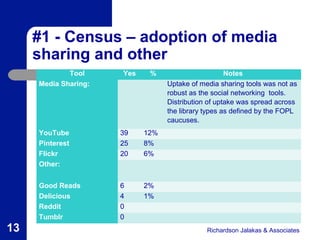
#1 - Census – adoption of media
sharing and other
Tool
Media Sharing:

Yes

%

YouTube
Pinterest
Flickr
Other:

12%
8%
6%

Good Reads
Delicious
Reddit
Tumblr

13

39
25
20

6
4
0
0

Notes
Uptake of media sharing tools was not as
robust as the social networking tools.
Distribution of uptake was spread across
the library types as defined by the FOPL
caucuses.

2%
1%

Richardson Jalakas & Associates
Wordcloud from ON Public libraries
website positioning statements

14

Richardson Jalakas & Associates
Status







15

Phase 1 – Establishing the Context:
Conduct brand and channel census of public libraries across
Ontario
Review best branding practices in public libraries in North
America
Synthesize research conducted on the impact of public
libraries
The next phase of this project will focus on communicating
some of the findings of this census and research, better
understanding the possible channels and receiving feedback
on the core value proposition.
Richardson Jalakas & Associates
OLA’s VIP
 Value
 Impact

/ Influence
 Positioning

 Member

16

Personas (D&J)
The Public Library Value Proposition
1.
2.
3.
4.
5.
6.
7.
8.
9.
10.
11.
12.
13.

17

Excellent Return on Investment
Strong Economic Development
Great Employment Support
Welcoming New Canadians
Provable Early Literacy Development
Ongoing Support for Formal Education and Homework Help
Serve the whole community equitably
Affordable access to community resources
Access to Government Services and e-government
Questions Deserve Quality Answers
Support Cultural Vitality
Recognized and Valued Leisure Activities for majority of Ontarians
Infrastructure Support (AODA and Buildings)
Activities
 Research

on Value (i.e. School Readiness
Study from OISE, Market Probe 2010 report)
 Royal Society Testimony and
Recommendations
 Webinar on Ontario Data Collection 2011-12
 iSchool Symposium: Defining New Metrics
for Library Success (April 22-23, 2014)
http://www.metricsandlibraries.org/

18

 Consulting with

Dr. Robert Molyneux
Why Measurements?

19

With nicely crafted visuals libraries could do the following:
1. Communicate effectively with their trustees to get their advice
on strategy as well as support.
2. Communicate budget 'asks' effectively that place the library in
the community value delivery context.
3. Position budget growth (or at least lessen cuts) for community
goal alignment and strategic impact.
4. Explain why technology and community room spaces are as
valuable (maybe more) than books.
5. Position hybrid collection use properly in ‘circulation’.
6. Justify restoration or extension of library hours.
7. Show that your library either performs as well as or better than
others or justify investments to perform to provincial, national or
sectoral norms.
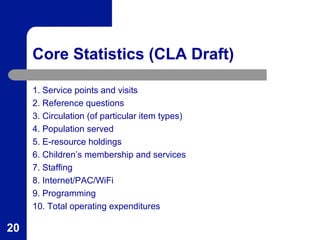
Core Statistics (CLA Draft)
1. Service points and visits
2. Reference questions
3. Circulation (of particular item types)
4. Population served
5. E-resource holdings
6. Children’s membership and services
7. Staffing
8. Internet/PAC/WiFi
9. Programming
10. Total operating expenditures

20
Core Measurements (FOPL Draft)

21

1. Overall value of a library membership (usage not cardholders)
2. Value of an 'open hour' (new metric unique to MPI TPL study that
aggregates cost + value)
3. Economic impact (vs. ROI) (Households and Population)
4. Per Capita 'Usage" comparison across systems, groups (like small,
medium. large, urban, suburban, rural, remote, FN, etc.), and jurisdictions
(province/state)
5. A 'new' usage algorithm to modernize the old circulation stat and
combine digital and print usage into a standard, comparable metric
6. A metric for technology access tied to the digital/economic divide(s)
7. A standard operational effectiveness metric (Value for Tax Dollars)
8. Average cost per household (taxes are based on household rather than
population and better reflects funding models)
9. A metric for Use of Space (meetings, study, rooms) which was new for
the MPI study and hadn't been done before
I have a dream . . .






22

Standard our sector on impact metrics that lend themselves to
the communication, influence, and financial challenges faced
by public libraries to communicate their value in the 21st
Century context.
Build a set of standardized core statistics that build up to these
measurements so we could lead most libraries to start working
with a new program to communicate value (and build on their
strengths in communicating pure 'usage').
Ultimately create a tool such as a specially designed
spreadsheet or dynamic website where you input the numbers
based on the standards and advice from some group (us?!)
that spits out decent data, information and visuals easily on the
other side.
Other
 Election

(Doh! It’s happening too fast!)
 Day at Queen’s Park (planning stages)
 AMPLO Inter-ministerial Summit at OLA
Super Conference (Thank you!) Follow Up
 Future of Libraries Summit at the Royal York
May 1-2. http://www.thefutureoflibraries.org

23
Thank You

www.fopl.ca

Stephen Abram,
Executive Director
416-395-0746
sabram@fopl.ca
Kim Silk and MPI TPL Study


TPL provided all data for the MPI study:

1.

Service points and visits – we looked at branch level and system-wide
Reference questions- we had in-person (real questions and directional), online and phone reference.
Circulation (of particular item types) – we had circulation of e-books and print broken down by age group
Population served – we used city of Toronto population for 2012; we also used a study done by Strategic
Council that found that 72% of Torontonians had used TPL in the past year (2012) which is how we
estimated membership. I was mistaken in my earlier email about gate count; many TPL branches don’t
have a gate to count entries.
E-resource holdings – we had database usage across various products
Children’s membership and services – we didn’t use child cardholders; we did count children’s materials
and programs
Staffing – we had staffing by home location, which indicated that TPL employees spend their salaries
locally
Internet/PAC/WiFi – we has PAC # of sessions and wifi # of sessions. We estimated that an average
session was 1 hour.
Programming – at branch level by program type, # of programs offered. We did not have attendance
which would have been better. Data hole here.
Total operating expenditures – provided by TPL.

2.
3.
4.

5.
6.
7.
8.
9.
10.

25

Amplo march7

  • 1.
    FOPL Activities Stephen Abram,MLA , FOPL Executive Director AMPLO Report March 7, 2014
  • 2.
    About the Federation   Providesa single, strong voice for public libraries in Ontario to enhance library policies and programs.  Services focus on four strategic pillars: advocacy, marketing, research and consortia purchasing.  Over 215 members representing libraries of all sizes and geographic regions, and serving 80% of Ontario’s population.  2 A not-for-profit membership association established in 2005. Our Board of Directors is composed of an equal number of library board trustees and library chief executives.
  • 3.
    What is FOPL?  3 Simplyput: Ontario’s Public Libraries. Now more than ever before, they play a critical role in the social, educational, cultural and economic success of the communities in our province. Public Libraries are an essential investment in the future of our communities and are essential drivers of success in school preparedness, reading readiness, economic and employment success, and social equity. As the development of the knowledge economy progresses, public libraries are a vital link for every resident and every community to ensure success of all Ontarians, regardless of location or background.
  • 4.
    FOPL Membership  Growing! Strong  Collaboration  Membership ethic improving is not a membership fee but financial support for research, advocacy, and 4
  • 5.
    Fundraising  Culture Development fund$57K approved (with OLA) to create sustainable trustee training over 2 years  SOLS/OLS-N $25K approved for Phase 1 2020 branding study and campaign  $15K stats proposal in process  $300K Sponsorship campaign in planning stages 5
  • 6.
    FOPL Talking Points ThePublic Library value proposition is strong and includes (but isn’t limited to): – – – – – – – – – – – – 6 Excellent Return on Investment Strong Economic Development Great Employment Support Welcoming New Canadians Provable Early Literacy Development Ongoing Support for Formal Education and Homework Help Serve the whole community equitably Affordable access to community resources Access to Government Services and e-government Questions Deserve Quality Answers Support Cultural Vitality Recognized and Valued Leisure Activities for majority of Ontarians
  • 7.
    What’s the ‘Problem”? We have a very COMPLEX (not complicated) value proposition  We have great competencies BUT we need to up our game on influence, advocacy, and focus.  We need the tools and we need to collaborate on them nimbly and quickly. 7
  • 8.
    Advocacy Training  10 8 partseries delivered, recorded, archived and available (over 1000 attendees)  iSchool MOOC: FOPL sponsored, supported with research and videos, and planning (5000)  Ministry to do webinar on March 19th on Data results for 2011 and 2012  Copyright webinar planned for May 27 with Wanda Noel (immediately after board and AC hearings)
  • 9.
    2020 Branding  Marketing Research(Richardson-Jalakas)  Social Media Census 9
  • 10.
    Project to developa brand strategy for Ontario public libraries Richardson Jalakas & associates
  • 11.
    #1- Census –use of websites • • •  11 29 (i.e. 9%) did NOT have a website; 2/3 (i.e. 19) of those libraries without a website were identified as First Nation libraries; 3 of the 29 without websites were FOPL members. (n = 318) Richardson Jalakas & Associates
  • 12.
    #1 - Census– Adoption of Social networking Tool Yes % Notes Social Networking: Facebook 45% Large urban (including TPL) have adopted at 100%; Small medium = 85% (55). Of the non-FOPL libraries, only 24% (29) used FB. Twitter 106 33% Caucus members with T: 1 FN; 1 Franco; all the Lg Urban (including TPL); 10 North; 6 Rural; 43 Sm-Med. Blogs 48 15% Google+ 2 0.6% LinkedIn 12 144 2 0.6% MySpace 0 Richardson Jalakas & Associates
  • 13.
    #1 - Census– adoption of media sharing and other Tool Media Sharing: Yes % YouTube Pinterest Flickr Other: 12% 8% 6% Good Reads Delicious Reddit Tumblr 13 39 25 20 6 4 0 0 Notes Uptake of media sharing tools was not as robust as the social networking tools. Distribution of uptake was spread across the library types as defined by the FOPL caucuses. 2% 1% Richardson Jalakas & Associates
  • 14.
    Wordcloud from ONPublic libraries website positioning statements 14 Richardson Jalakas & Associates
  • 15.
    Status      15 Phase 1 –Establishing the Context: Conduct brand and channel census of public libraries across Ontario Review best branding practices in public libraries in North America Synthesize research conducted on the impact of public libraries The next phase of this project will focus on communicating some of the findings of this census and research, better understanding the possible channels and receiving feedback on the core value proposition. Richardson Jalakas & Associates
  • 16.
    OLA’s VIP  Value Impact / Influence  Positioning  Member 16 Personas (D&J)
  • 17.
    The Public LibraryValue Proposition 1. 2. 3. 4. 5. 6. 7. 8. 9. 10. 11. 12. 13. 17 Excellent Return on Investment Strong Economic Development Great Employment Support Welcoming New Canadians Provable Early Literacy Development Ongoing Support for Formal Education and Homework Help Serve the whole community equitably Affordable access to community resources Access to Government Services and e-government Questions Deserve Quality Answers Support Cultural Vitality Recognized and Valued Leisure Activities for majority of Ontarians Infrastructure Support (AODA and Buildings)
  • 18.
    Activities  Research on Value(i.e. School Readiness Study from OISE, Market Probe 2010 report)  Royal Society Testimony and Recommendations  Webinar on Ontario Data Collection 2011-12  iSchool Symposium: Defining New Metrics for Library Success (April 22-23, 2014) http://www.metricsandlibraries.org/ 18  Consulting with Dr. Robert Molyneux
  • 19.
    Why Measurements? 19 With nicelycrafted visuals libraries could do the following: 1. Communicate effectively with their trustees to get their advice on strategy as well as support. 2. Communicate budget 'asks' effectively that place the library in the community value delivery context. 3. Position budget growth (or at least lessen cuts) for community goal alignment and strategic impact. 4. Explain why technology and community room spaces are as valuable (maybe more) than books. 5. Position hybrid collection use properly in ‘circulation’. 6. Justify restoration or extension of library hours. 7. Show that your library either performs as well as or better than others or justify investments to perform to provincial, national or sectoral norms.
  • 20.
    Core Statistics (CLADraft) 1. Service points and visits 2. Reference questions 3. Circulation (of particular item types) 4. Population served 5. E-resource holdings 6. Children’s membership and services 7. Staffing 8. Internet/PAC/WiFi 9. Programming 10. Total operating expenditures 20
  • 21.
    Core Measurements (FOPLDraft) 21 1. Overall value of a library membership (usage not cardholders) 2. Value of an 'open hour' (new metric unique to MPI TPL study that aggregates cost + value) 3. Economic impact (vs. ROI) (Households and Population) 4. Per Capita 'Usage" comparison across systems, groups (like small, medium. large, urban, suburban, rural, remote, FN, etc.), and jurisdictions (province/state) 5. A 'new' usage algorithm to modernize the old circulation stat and combine digital and print usage into a standard, comparable metric 6. A metric for technology access tied to the digital/economic divide(s) 7. A standard operational effectiveness metric (Value for Tax Dollars) 8. Average cost per household (taxes are based on household rather than population and better reflects funding models) 9. A metric for Use of Space (meetings, study, rooms) which was new for the MPI study and hadn't been done before
  • 22.
    I have adream . . .    22 Standard our sector on impact metrics that lend themselves to the communication, influence, and financial challenges faced by public libraries to communicate their value in the 21st Century context. Build a set of standardized core statistics that build up to these measurements so we could lead most libraries to start working with a new program to communicate value (and build on their strengths in communicating pure 'usage'). Ultimately create a tool such as a specially designed spreadsheet or dynamic website where you input the numbers based on the standards and advice from some group (us?!) that spits out decent data, information and visuals easily on the other side.
  • 23.
    Other  Election (Doh! It’shappening too fast!)  Day at Queen’s Park (planning stages)  AMPLO Inter-ministerial Summit at OLA Super Conference (Thank you!) Follow Up  Future of Libraries Summit at the Royal York May 1-2. http://www.thefutureoflibraries.org 23
  • 24.
    Thank You www.fopl.ca Stephen Abram, ExecutiveDirector 416-395-0746 sabram@fopl.ca
  • 25.
    Kim Silk andMPI TPL Study  TPL provided all data for the MPI study: 1. Service points and visits – we looked at branch level and system-wide Reference questions- we had in-person (real questions and directional), online and phone reference. Circulation (of particular item types) – we had circulation of e-books and print broken down by age group Population served – we used city of Toronto population for 2012; we also used a study done by Strategic Council that found that 72% of Torontonians had used TPL in the past year (2012) which is how we estimated membership. I was mistaken in my earlier email about gate count; many TPL branches don’t have a gate to count entries. E-resource holdings – we had database usage across various products Children’s membership and services – we didn’t use child cardholders; we did count children’s materials and programs Staffing – we had staffing by home location, which indicated that TPL employees spend their salaries locally Internet/PAC/WiFi – we has PAC # of sessions and wifi # of sessions. We estimated that an average session was 1 hour. Programming – at branch level by program type, # of programs offered. We did not have attendance which would have been better. Data hole here. Total operating expenditures – provided by TPL. 2. 3. 4. 5. 6. 7. 8. 9. 10. 25