Overview of FOPL's Ontario
Public Library Statistics and
Measurements Report
Dr. Robert Molyneux, MLIS, PhD
Stephen Abram, MLA , FOPL Executive Director
OLA Super Conference
Jan. 29, 2015
Introductions
Today’s Speakers
Dr. Robert Molyneux, MLIS, PhD
Stephen Abram, MLA , FOPL Executive
Director
2
FOPL Webinars in the Stats Series
August 14th
, 2015 Overview of FOPL's Ontario Public Library
Statistics and Measurements Report
 Speaker: Robert Molyneux, MSLS, PhD
August 17th Overview of FOPL's Market Probe Canada Public
Opinion Poll of Ontarians and Public Libraries
 Speaker: Carol French, Senior Vice President, Research &
Client Services, Market Probe Canada
August 28th Strategic Use and Insights from FOPL's Ontario
Public Library Statistics, Polls, and Measurements
 Speaker: Stephen Abram, MLS, executive director FOPL
3
Context of FOPL Stats and
Measurements
 Statistics and Measurements Strategies
– Participate in CLA task force on national statistics
– Host 2 iSchool symposia on measurements for libraries
– Lobby for open data for public libraries
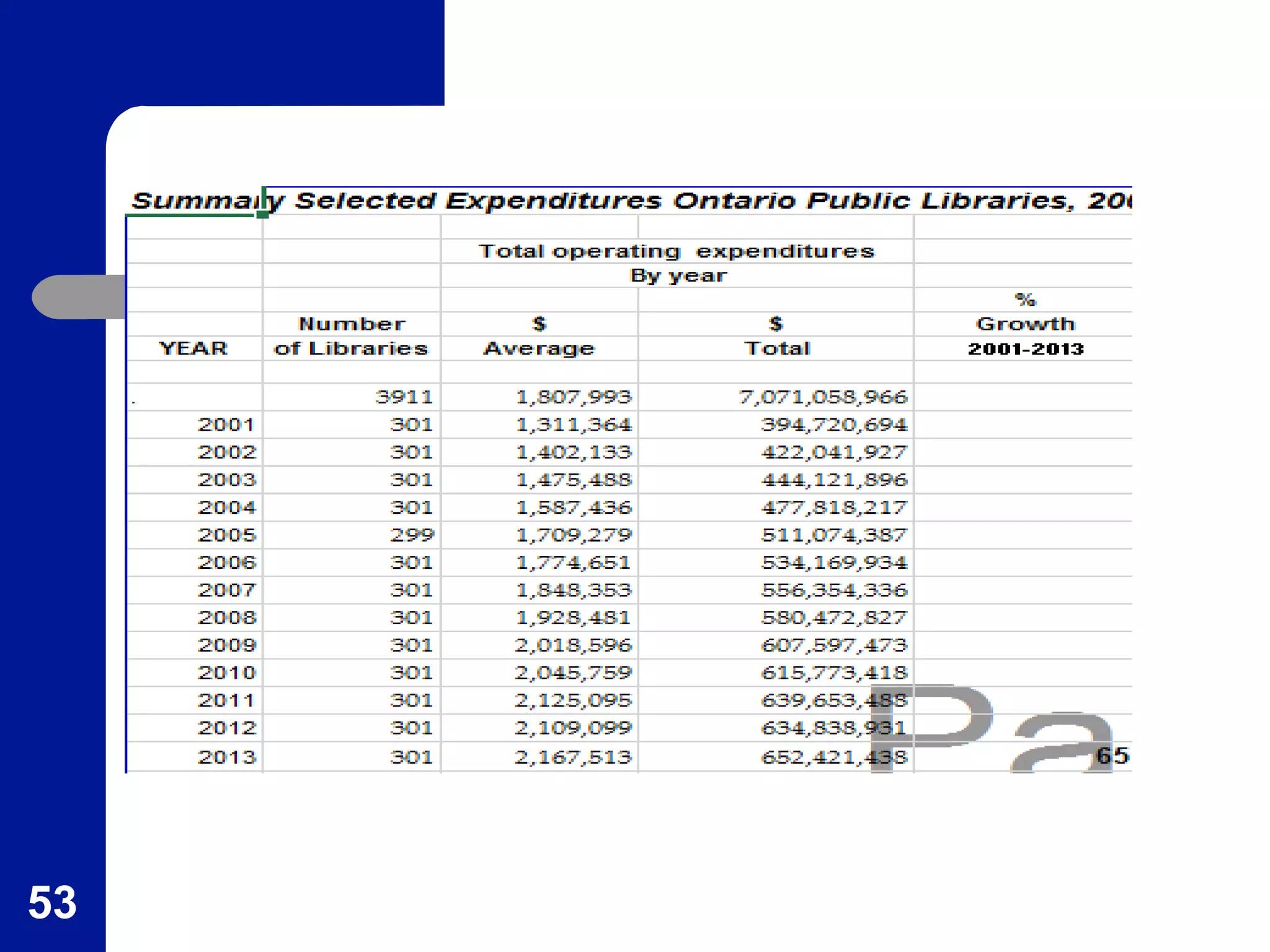
– Publish analysis of Ministry data collection for 2001-2013.
– Publish Market Probe opinion polls for 2015 (building on
2001, 2006, 2010 polls)
– Host and record webinars
– Coming Soon: FOPL Index of Community Engagement
 Thank you to the Ministry of Tourism Culture and Sport for
support
4
Limits of Library Statistics
 Library statistics are very complicated and complex.
 Most libraries do not have a strong culture of
measurement.
 What is the difference between statistics, measurements,
polls, etc.
 All numbers have inherent risk when communicated and
interpreted.
 Data - Information - Knowledge - Action/Decisions
5
Potential Comparisons
 Compare by size of population (or any other
data point (expenditures per capita, etc.)
 North – South (e.g. SOLS vs. OLS North Libraries)
 Rural, Remote, Town, County, Suburban, Urban
Libraries
 Special Groups – Francophone, First Nations, etc.
 Regional comparisons (e.g. libraries around Ajax or
libraries around Waterloo)
 Handpick a peer cohort
6
What do we normally use our data
for?
 Strategic Planning
 Program Analysis
 Budget justifications and comparisons
 Tracking success, growth, decline
 Decision support
 Finding libraries like ours to compare our experience to
theirs
– Which means they can be a directory to libraries like
mine for benchmarking and cohort analysis
– Comparing like with like is important
 And more . . .
 We will add trying to get a sense of the health of and trends
in Ontario’s public libraries
7
If you’re not collecting the
data to inform an action,
then why are you
expending the effort?
Making Decisions and Choices
Library data have a long history
9
Library data have a long history
 We have fragmentary numbers of collections
of a number of these libraries
– And like modern library numbers, we are not
always sure exactly what they mean
 Adriano Balbi, A Statistical Essay of the
Libraries of Vienna and the World [1835]
– First modern attempt at comparing libraries in
major European cities using published statistics
about them10
Balbi’s observations
 “disheartened by a disparity of opinion…”
 “only approximate data”
 “exaggerated” numbers in pursuit of prestige
Then a wonderful discussion of the problems of
comparative library data
11
Types of library data
 Balbi was dealing with reports by visitors to
various libraries at different times who
recorded estimates they heard from a variety
of people
– One-time studies done by different methods
 Episodic surveys
– Attitudinal surveys—particularly users and
non-users
– Data collection on fugitive or new subjects
12
 The data we are going to discuss are
systematically collected, annual data,
professionally compiled from surveys of
Ontario public libraries by the Ministry of
Tourism, Culture, and Sport
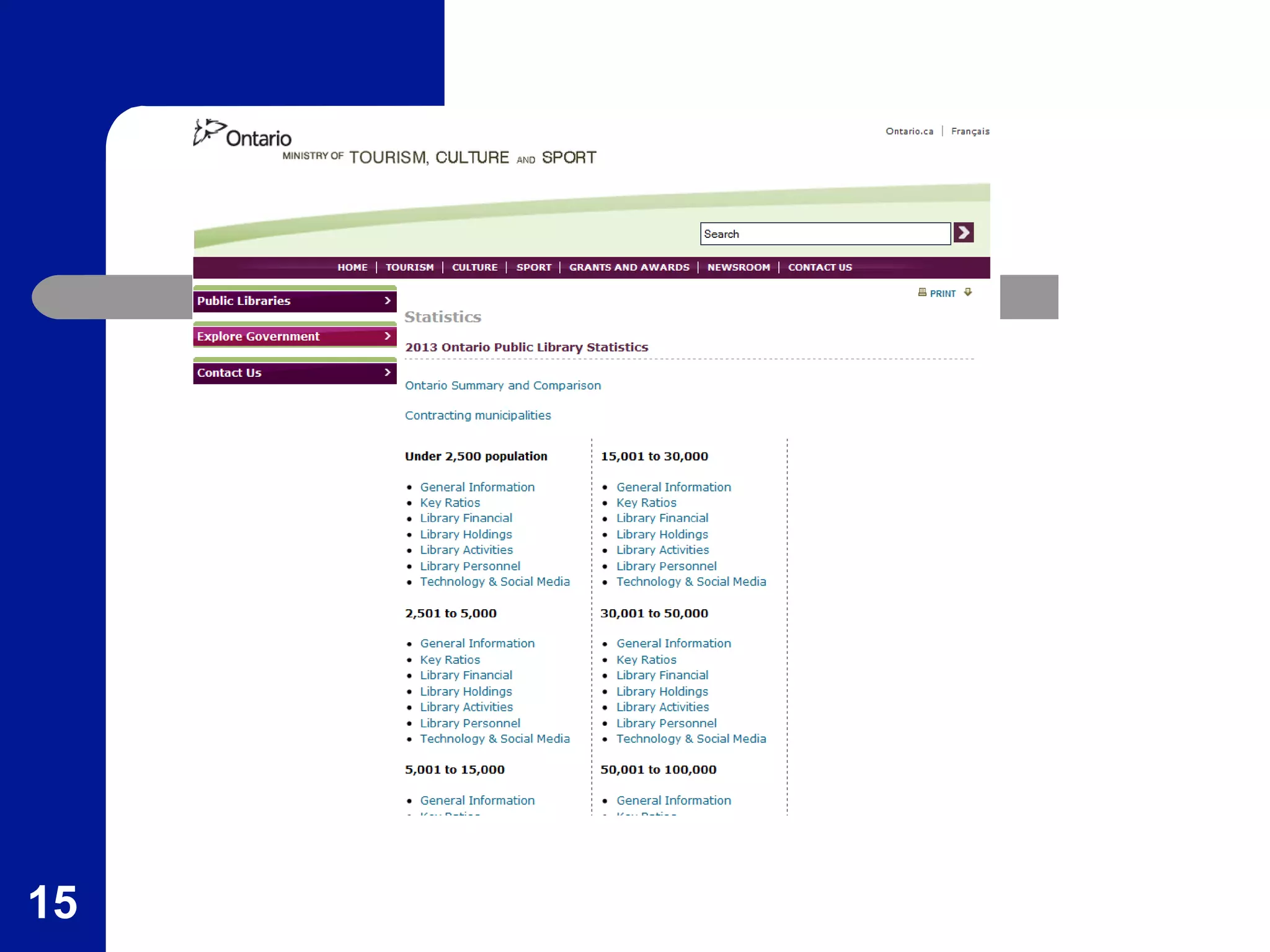
 Available from 1999-2013 in pdf
 2014 Coming Soon!
13
14
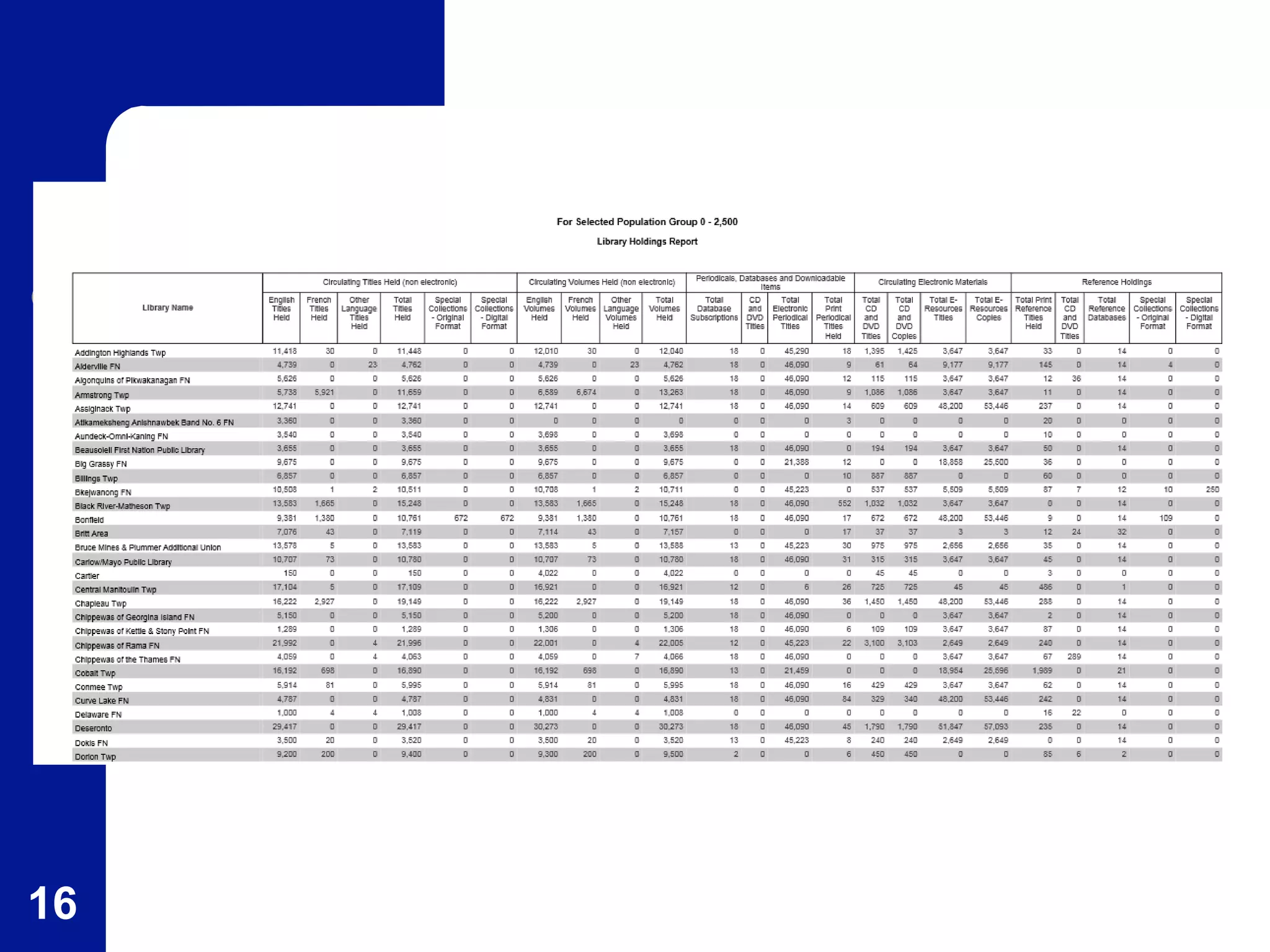
15
16
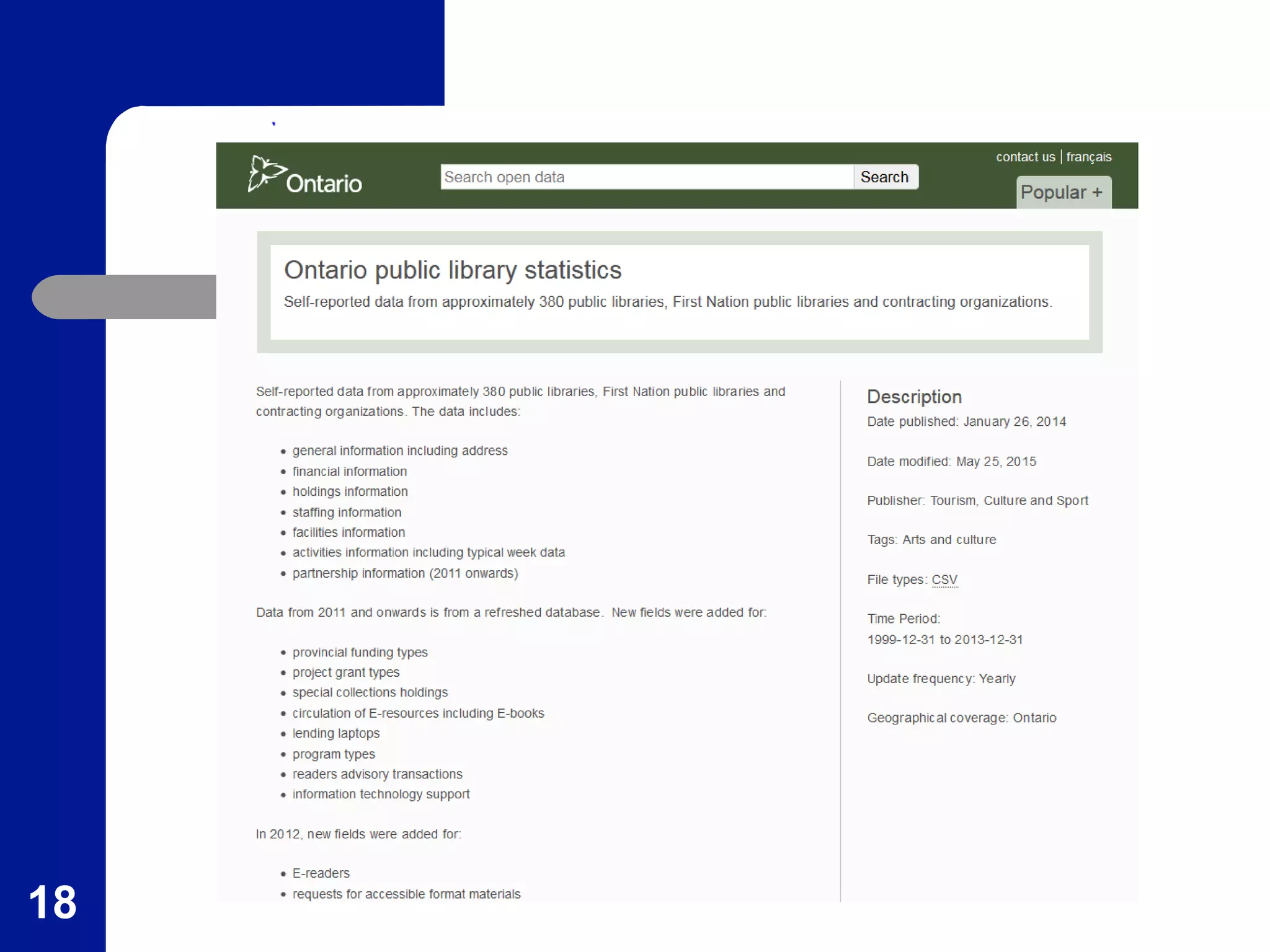
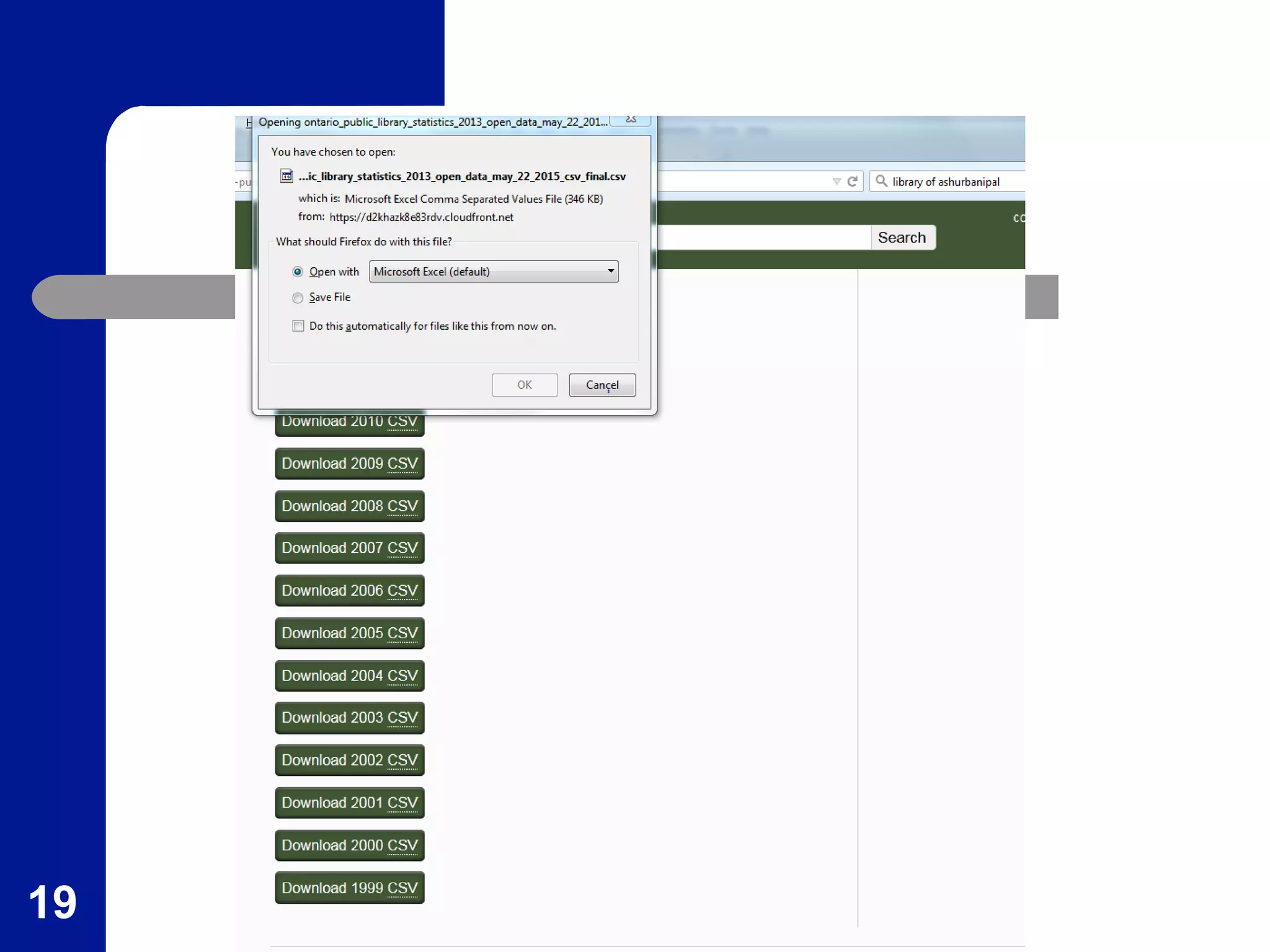
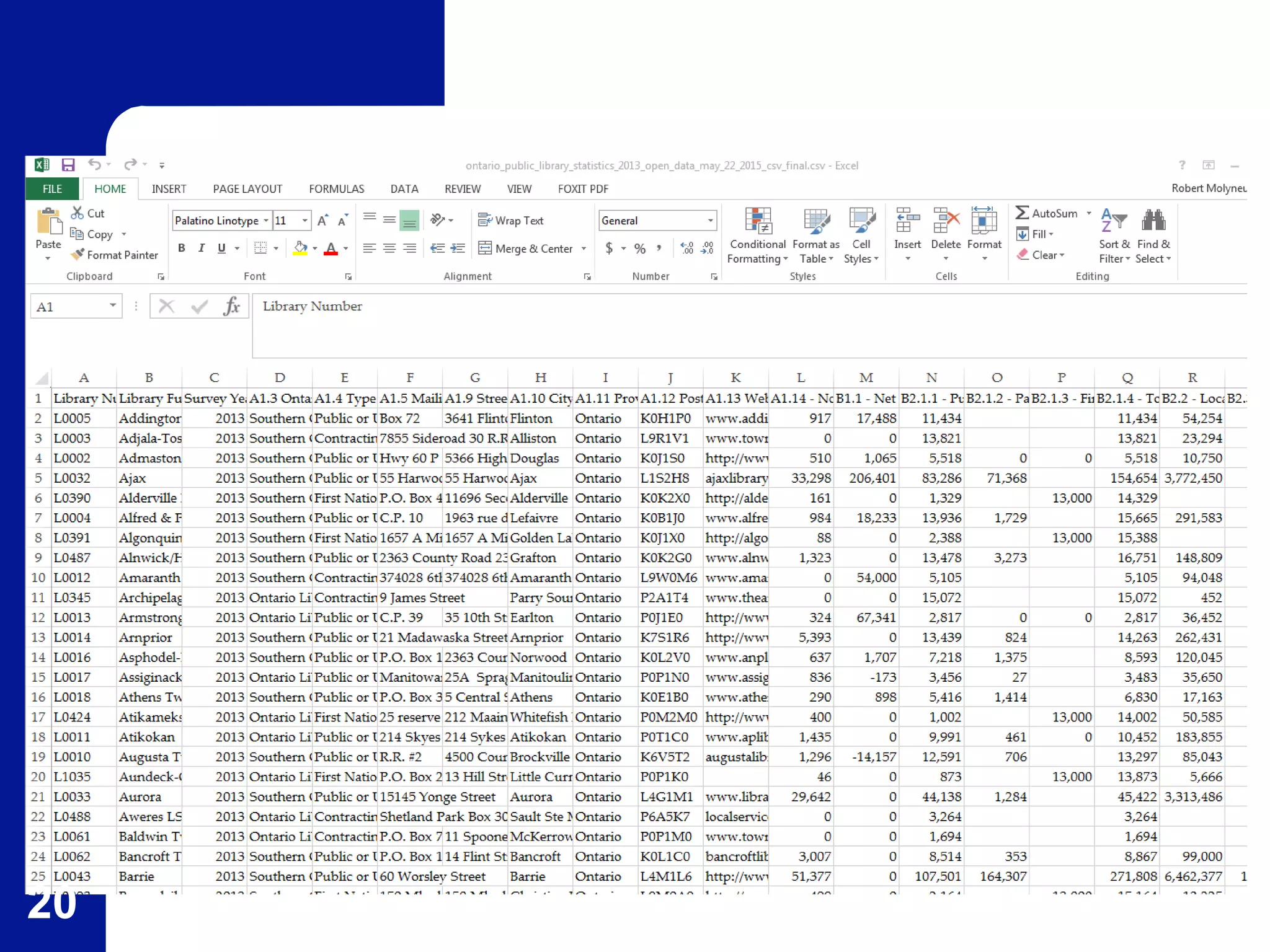
Now converted to csv files
 The Ministry has reissued these data in csv
(“comma-separated values”) which means
they can be read into a spreadsheet program
such as Excel or LibreOffice Calc readily.
 In other words, there is not a chance of
introducing error when you rekey data.
 This is a tremendous boon to studying our
libraries using these data.
17
18
19
20
21
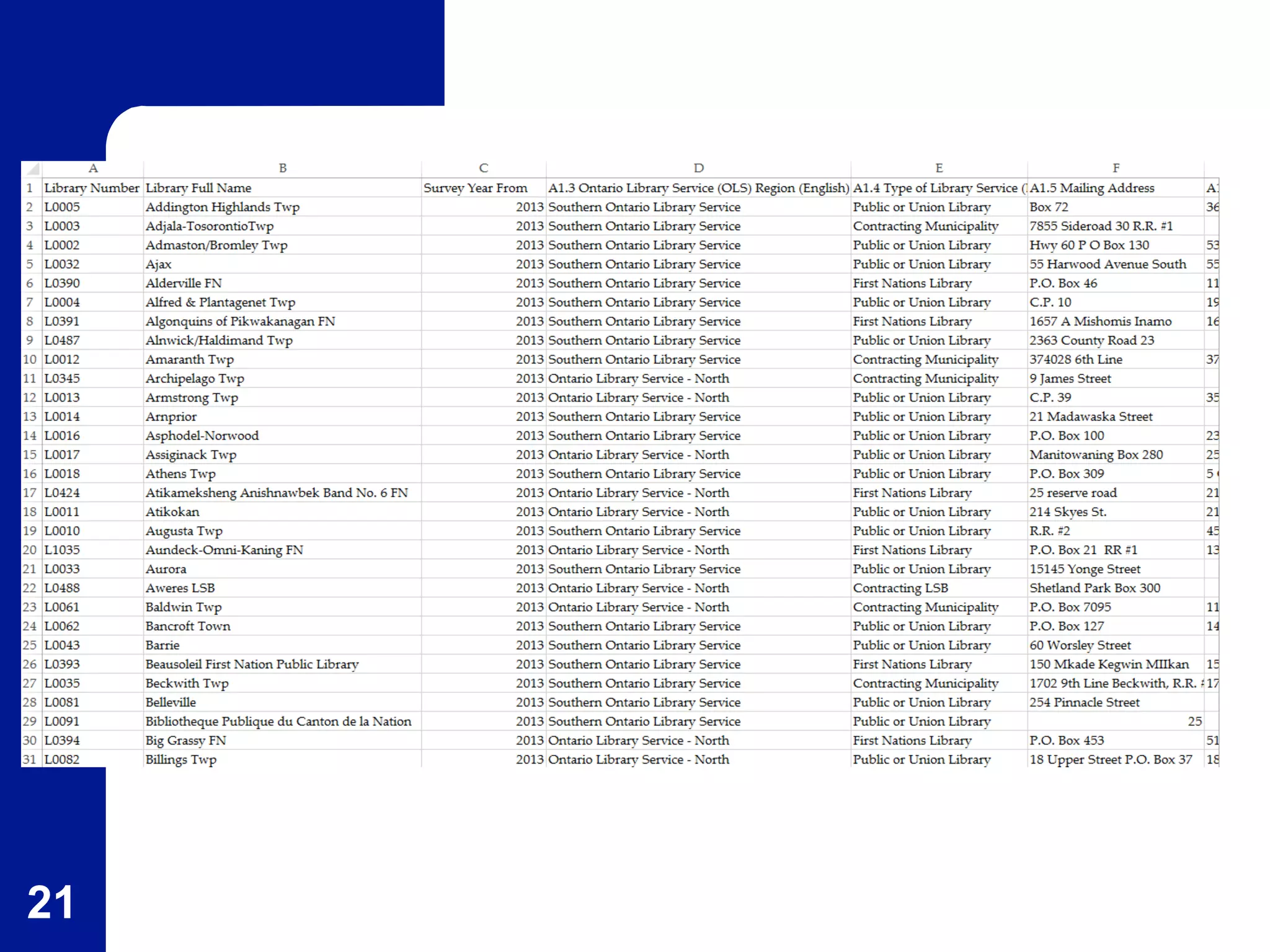
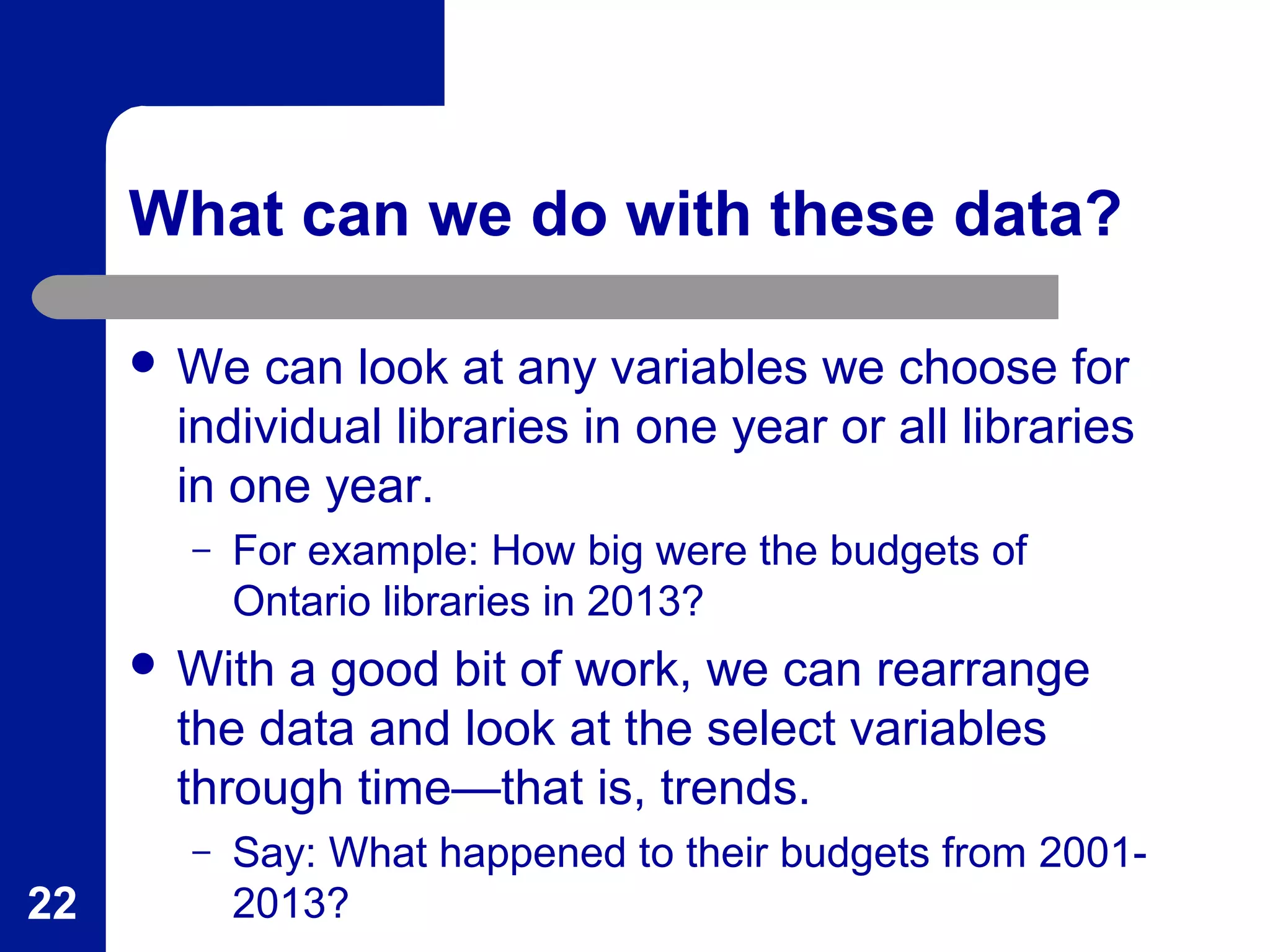
What can we do with these data?
 We can look at any variables we choose for
individual libraries in one year or all libraries
in one year.
– For example: How big were the budgets of
Ontario libraries in 2013?
 With a good bit of work, we can rearrange
the data and look at the select variables
through time—that is, trends.
– Say: What happened to their budgets from 2001-
2013?22
We did a bit of both and more
 The report is a sampler of what can be done
with these kinds of data with the focus on a
province-wide view, not individual libraries
23
We did not use all data from this series for our
report
 Small number of variables
 In order to analyze trends properly, we only used
data from libraries which reported each year. For this
study, that number is 301 libraries
 Years 2001-2013
 We separated them into 9 “Bands”—8 by size plus
the First Nations’ Libraries in a 9th
Band.
– The Ministry did the same thing
– This is common practice in this kind of analysis
24
LET’S TAKE A TOUR
THROUGH THE REPORT
25
First the Primer
 The big story is the consistent characteristic of the
library world that affects about everything:
– Skewed distribution: a few large libraries and many
small ones
 In 2013, the 10 largest libraries (of 300+) had 60% of the
total circulations and 54% of the total expenditures.
 We must take these characteristics into account in
analyzing data
– Hence, our size “Bands” which follow Ministry practice
26
The Primer, then, informs the analysis in the FOPL
Reports
 Given it is a sampler
– We segment by size of library in “Bands”
 Same as those used by the Ministry with a difference: First Nations’
Libraries are analyzed separately in those tables where we use Bands
– Another common tool is the “Rank Order Table”
 Sort libraries in order by their reported data. That, is rank their results
by the reported data or statistics calculated from these data
– Most commonly per capitas. Dividing, say, circulations, by the
resident population served by the library
 We combine this technique with analysis of Bands.
– Our focus, primarily, is the state of the provinces libraries and trends
affecting them
27
There are many other things you
could do with these data
 This is a rich series
28
ONWARD! 2013 KEY RATIOS!
29
2013 data per capita and per
cardholder
 Thirteen ratios, all libraries
 The ratios are largely those we focus on in
the rest of the report.
 As the Primer showed, per capitas allow
apples to apples comparisons of libraries of
vastly different sizes
– You may be small, but you may be doing a better
job with what you have than bigger libraries.
30
Using the Spreadsheet Versions
 You have pre-crafted tables in the report(s)
 You could take the spreadsheet and mosey
around in it a bit. Sort by this or that—it is a
very busy table and one hard to show in
slides
 FOPL can make the spreadsheet available to
the members on request.
 We are also happy to do custom analysis for
you on request for a quoted fee.
31
A bit of caution if you work with
spreadsheets
 Save a copy of the original spreadsheet
 Did I mention saving a copy of the original
and don’t change it
 Make another copy for analysis. If you make
a mistake, you always can go back to the
safe copy
 Working with spreadsheets requires caution
– You think you did something but you can’t audit
what you have done
32
Annual Population and
Circulation, 2001-2013
 Trend analysis is a bit different
 Of all libraries which reported in any year,
301 reported in each year
 These tables are complex
– We will see them again, so let’s take a look
33
34
35
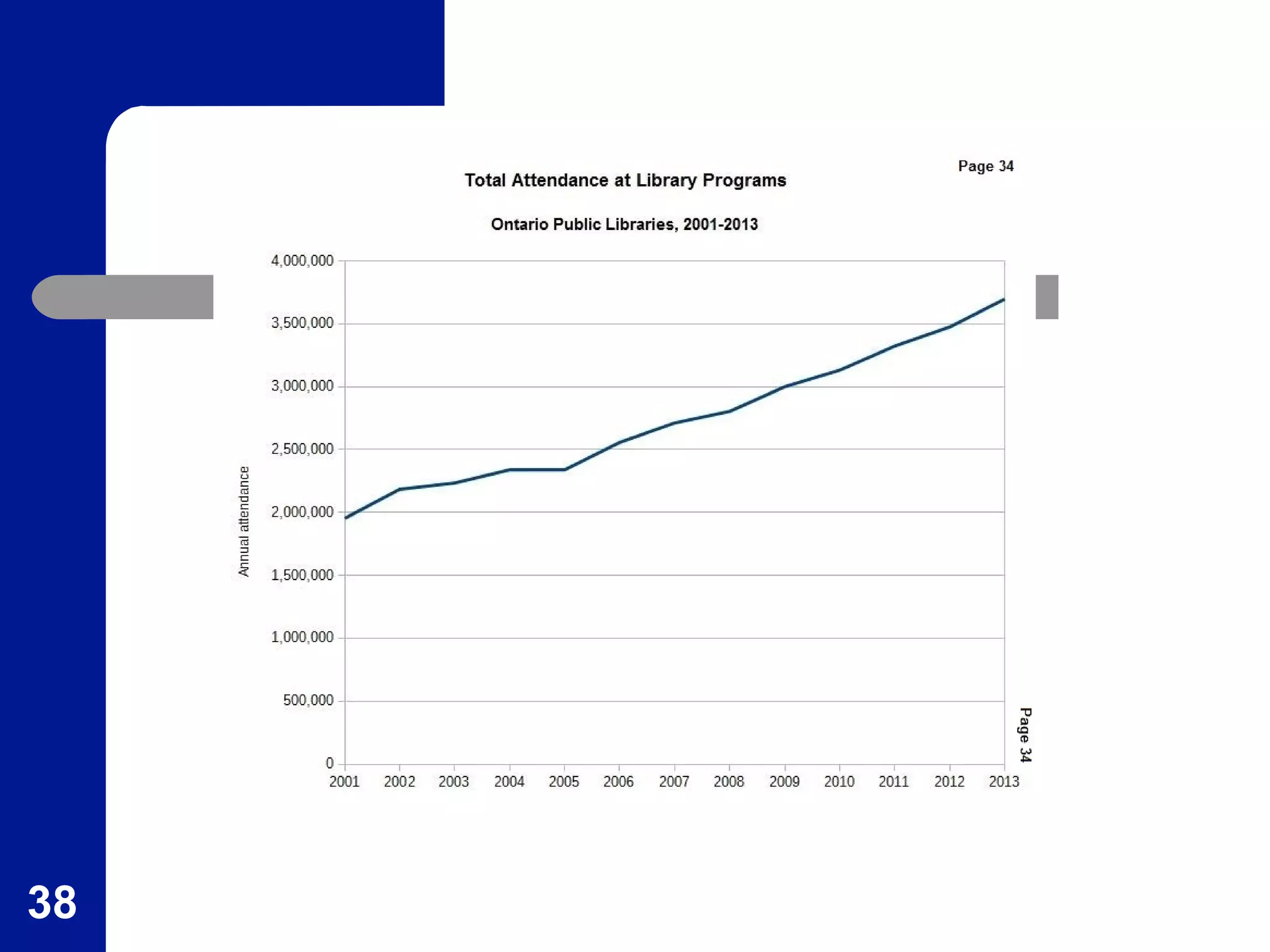
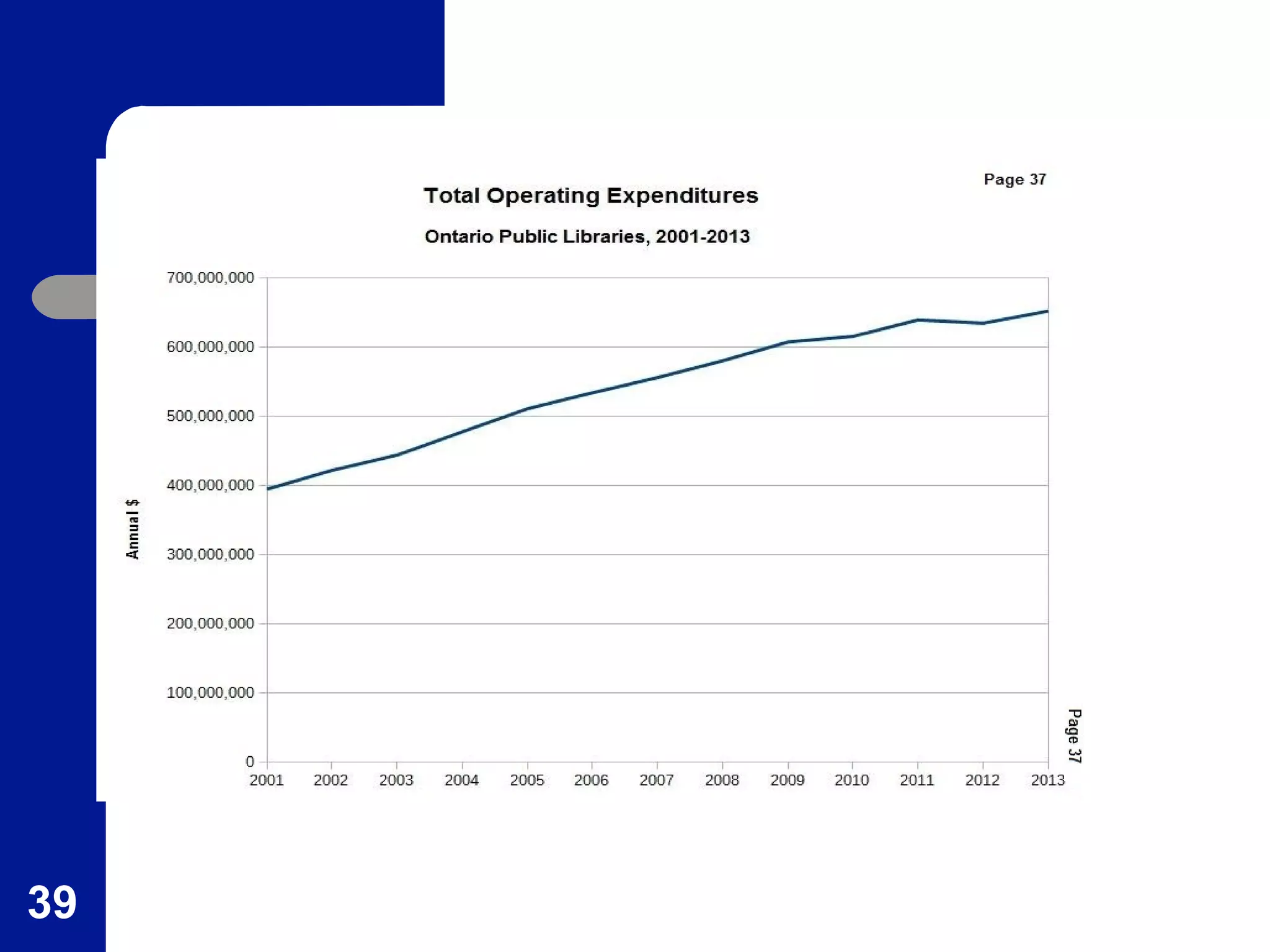
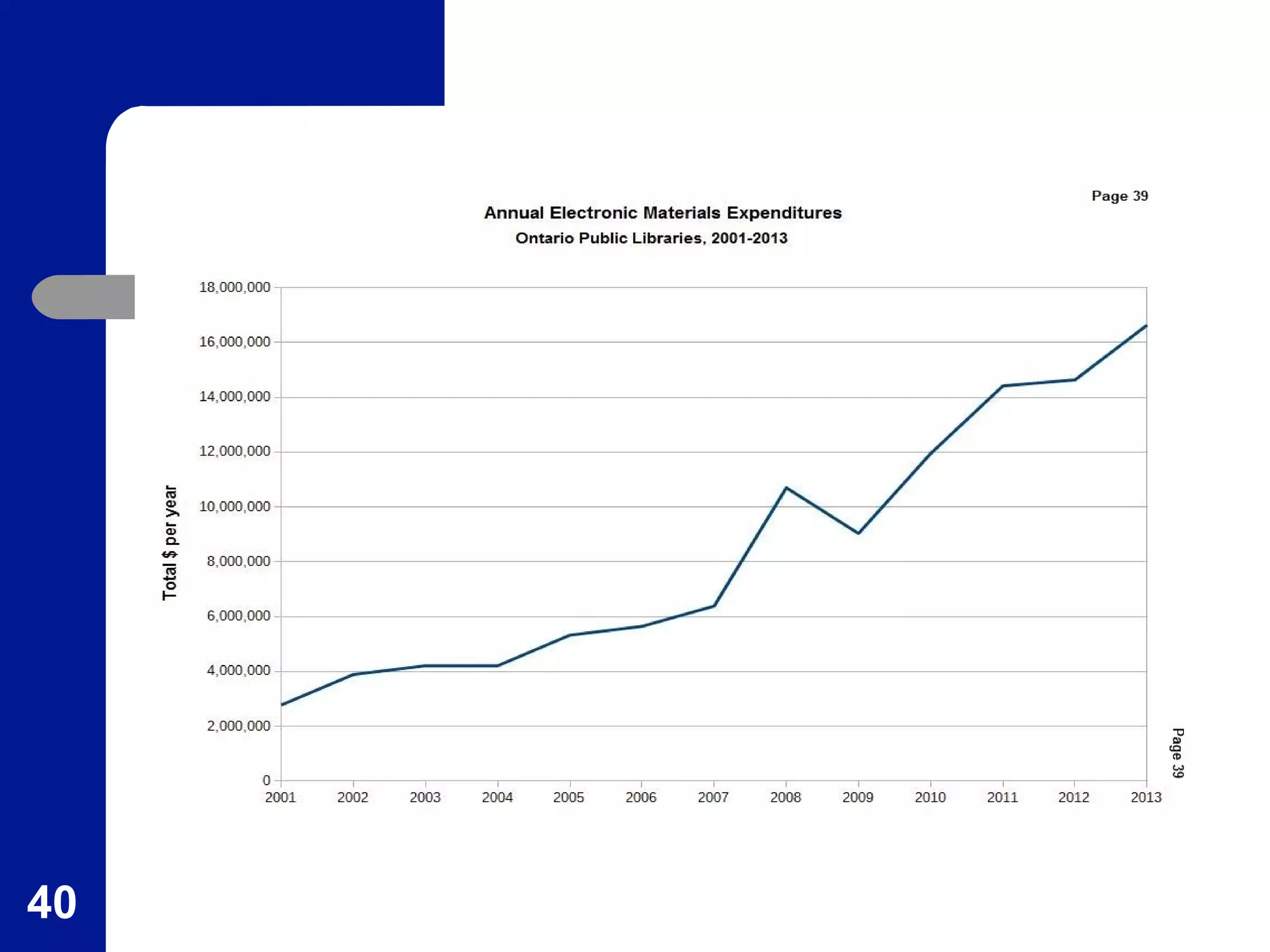
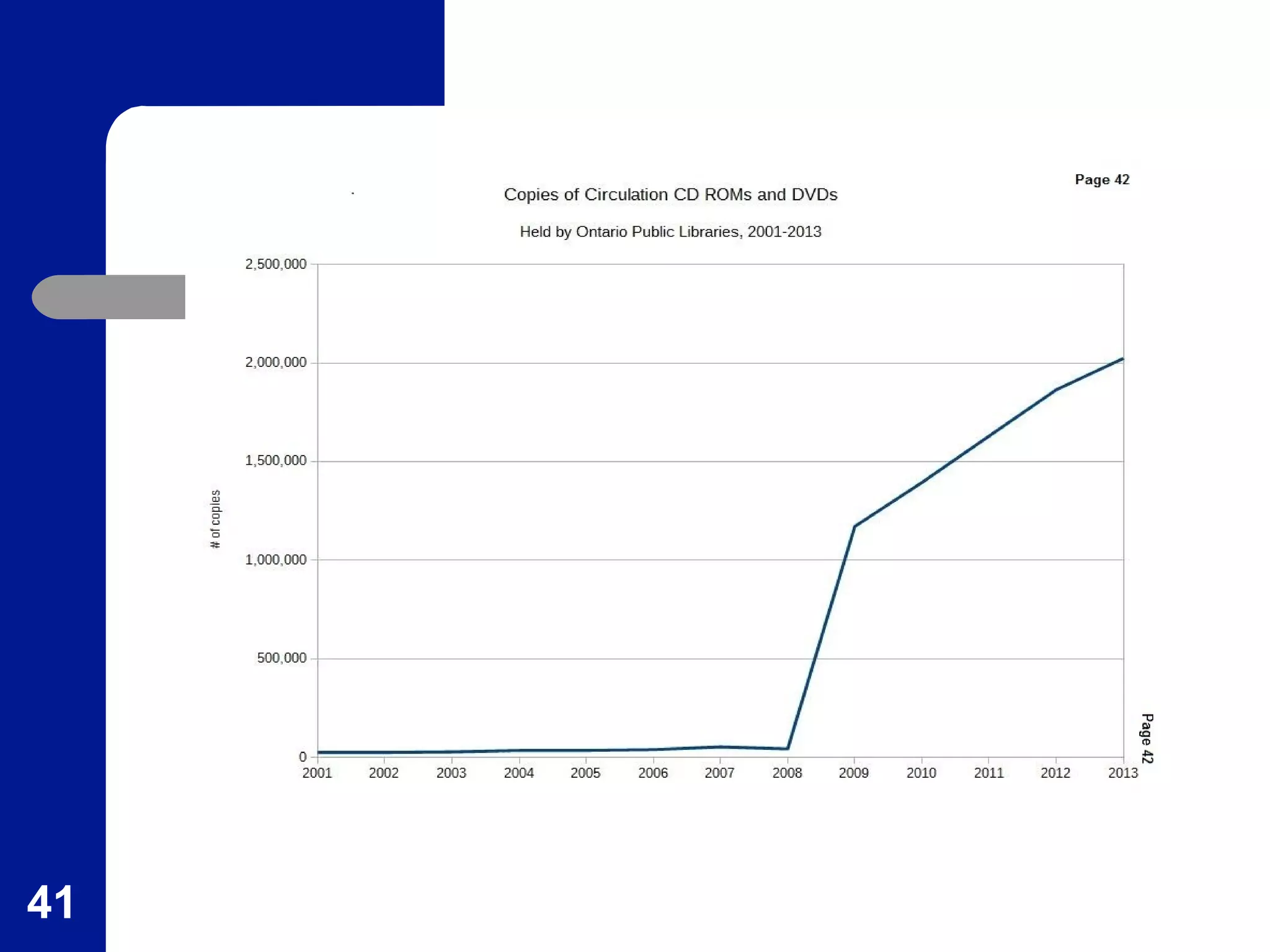
Traditional library measures are
steady
 OTOH: New things are growing
36
37
38
39
40
41
42
43
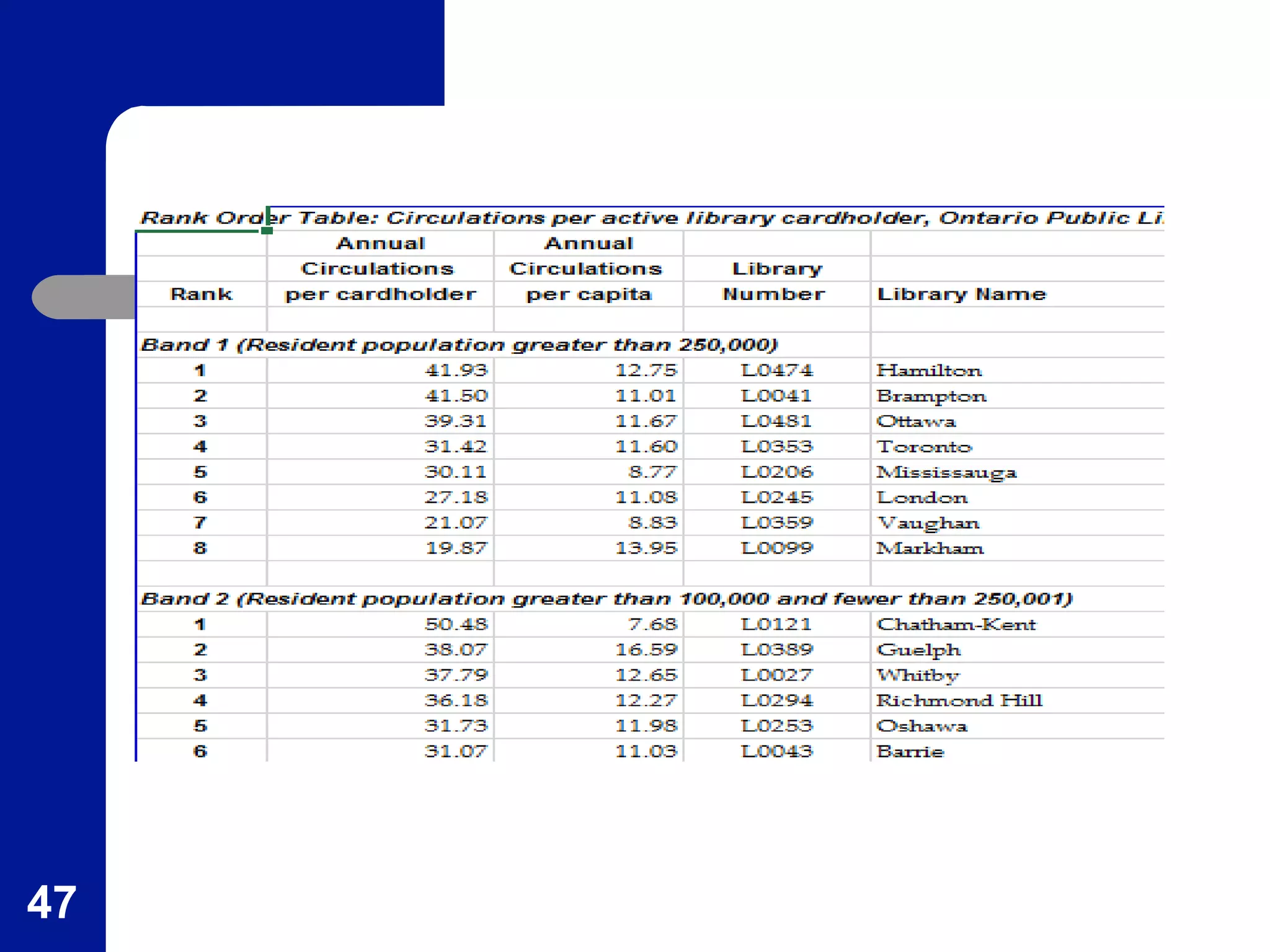
Rank Order Tables
 Circulation per capita and per active
cardholder, 2013, by Bands
44
45
46
47
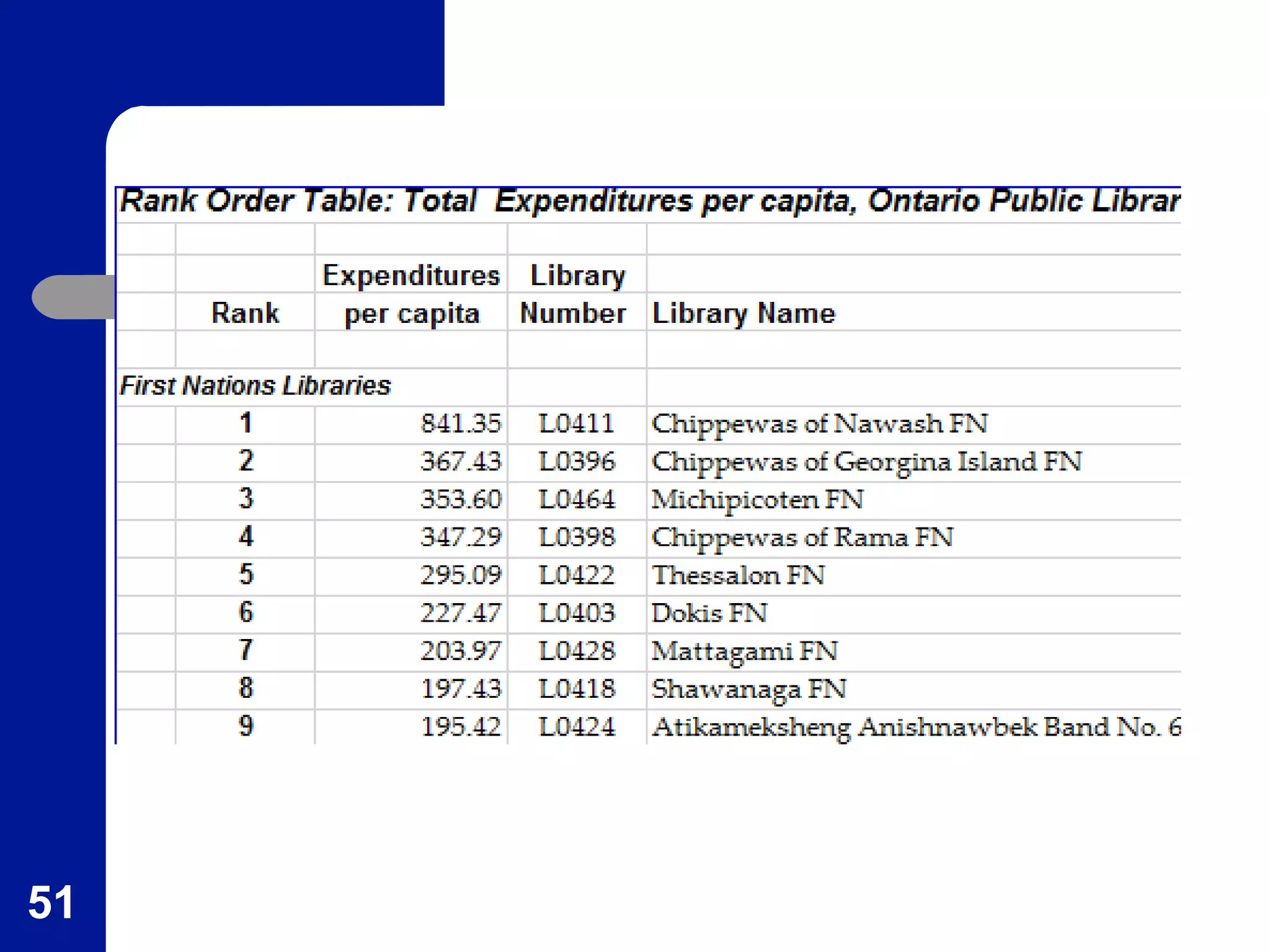
Rank Order Tables
 Expenditures per capita and per active
cardholders
48
49
50
51
52
53
54
55
Conclusions
 This is the beginning. A first shot based on
best guesses of where to look.
 There are other ways of studying libraries
such as qualitative surveys of a library’s
users and their non-users.
– Given the rapidly changing information
environment in libraries, quicker surveys likely will
be a part of the future of data gathering to support
decision making.
56
Next Step
 Develop a NEW FOPL Index of Community
Engagement for testing and discussion.
 Can we combine in various ratios the hard
copy and digital transactions and attendance
of our library members to compare libraries
on a more fulsome basis than ‘circulation’?
57
Questions?
www.fopl.ca
Stephen Abram,
Executive Director
416-395-0746
sabram@fopl.ca
Thank You
www.fopl.ca
Stephen Abram,
Executive Director
416-395-0746
sabram@fopl.ca

Fopl ola sc stats with molyneux

  • 1.
    Overview of FOPL'sOntario Public Library Statistics and Measurements Report Dr. Robert Molyneux, MLIS, PhD Stephen Abram, MLA , FOPL Executive Director OLA Super Conference Jan. 29, 2015
  • 2.
    Introductions Today’s Speakers Dr. RobertMolyneux, MLIS, PhD Stephen Abram, MLA , FOPL Executive Director 2
  • 3.
    FOPL Webinars inthe Stats Series August 14th , 2015 Overview of FOPL's Ontario Public Library Statistics and Measurements Report  Speaker: Robert Molyneux, MSLS, PhD August 17th Overview of FOPL's Market Probe Canada Public Opinion Poll of Ontarians and Public Libraries  Speaker: Carol French, Senior Vice President, Research & Client Services, Market Probe Canada August 28th Strategic Use and Insights from FOPL's Ontario Public Library Statistics, Polls, and Measurements  Speaker: Stephen Abram, MLS, executive director FOPL 3
  • 4.
    Context of FOPLStats and Measurements  Statistics and Measurements Strategies – Participate in CLA task force on national statistics – Host 2 iSchool symposia on measurements for libraries – Lobby for open data for public libraries – Publish analysis of Ministry data collection for 2001-2013. – Publish Market Probe opinion polls for 2015 (building on 2001, 2006, 2010 polls) – Host and record webinars – Coming Soon: FOPL Index of Community Engagement  Thank you to the Ministry of Tourism Culture and Sport for support 4
  • 5.
    Limits of LibraryStatistics  Library statistics are very complicated and complex.  Most libraries do not have a strong culture of measurement.  What is the difference between statistics, measurements, polls, etc.  All numbers have inherent risk when communicated and interpreted.  Data - Information - Knowledge - Action/Decisions 5
  • 6.
    Potential Comparisons  Compareby size of population (or any other data point (expenditures per capita, etc.)  North – South (e.g. SOLS vs. OLS North Libraries)  Rural, Remote, Town, County, Suburban, Urban Libraries  Special Groups – Francophone, First Nations, etc.  Regional comparisons (e.g. libraries around Ajax or libraries around Waterloo)  Handpick a peer cohort 6
  • 7.
    What do wenormally use our data for?  Strategic Planning  Program Analysis  Budget justifications and comparisons  Tracking success, growth, decline  Decision support  Finding libraries like ours to compare our experience to theirs – Which means they can be a directory to libraries like mine for benchmarking and cohort analysis – Comparing like with like is important  And more . . .  We will add trying to get a sense of the health of and trends in Ontario’s public libraries 7
  • 8.
    If you’re notcollecting the data to inform an action, then why are you expending the effort? Making Decisions and Choices
  • 9.
    Library data havea long history 9
  • 10.
    Library data havea long history  We have fragmentary numbers of collections of a number of these libraries – And like modern library numbers, we are not always sure exactly what they mean  Adriano Balbi, A Statistical Essay of the Libraries of Vienna and the World [1835] – First modern attempt at comparing libraries in major European cities using published statistics about them10
  • 11.
    Balbi’s observations  “disheartenedby a disparity of opinion…”  “only approximate data”  “exaggerated” numbers in pursuit of prestige Then a wonderful discussion of the problems of comparative library data 11
  • 12.
    Types of librarydata  Balbi was dealing with reports by visitors to various libraries at different times who recorded estimates they heard from a variety of people – One-time studies done by different methods  Episodic surveys – Attitudinal surveys—particularly users and non-users – Data collection on fugitive or new subjects 12
  • 13.
     The datawe are going to discuss are systematically collected, annual data, professionally compiled from surveys of Ontario public libraries by the Ministry of Tourism, Culture, and Sport  Available from 1999-2013 in pdf  2014 Coming Soon! 13
  • 14.
  • 15.
  • 16.
  • 17.
    Now converted tocsv files  The Ministry has reissued these data in csv (“comma-separated values”) which means they can be read into a spreadsheet program such as Excel or LibreOffice Calc readily.  In other words, there is not a chance of introducing error when you rekey data.  This is a tremendous boon to studying our libraries using these data. 17
  • 18.
  • 19.
  • 20.
  • 21.
  • 22.
    What can wedo with these data?  We can look at any variables we choose for individual libraries in one year or all libraries in one year. – For example: How big were the budgets of Ontario libraries in 2013?  With a good bit of work, we can rearrange the data and look at the select variables through time—that is, trends. – Say: What happened to their budgets from 2001- 2013?22
  • 23.
    We did abit of both and more  The report is a sampler of what can be done with these kinds of data with the focus on a province-wide view, not individual libraries 23
  • 24.
    We did notuse all data from this series for our report  Small number of variables  In order to analyze trends properly, we only used data from libraries which reported each year. For this study, that number is 301 libraries  Years 2001-2013  We separated them into 9 “Bands”—8 by size plus the First Nations’ Libraries in a 9th Band. – The Ministry did the same thing – This is common practice in this kind of analysis 24
  • 25.
    LET’S TAKE ATOUR THROUGH THE REPORT 25
  • 26.
    First the Primer The big story is the consistent characteristic of the library world that affects about everything: – Skewed distribution: a few large libraries and many small ones  In 2013, the 10 largest libraries (of 300+) had 60% of the total circulations and 54% of the total expenditures.  We must take these characteristics into account in analyzing data – Hence, our size “Bands” which follow Ministry practice 26
  • 27.
    The Primer, then,informs the analysis in the FOPL Reports  Given it is a sampler – We segment by size of library in “Bands”  Same as those used by the Ministry with a difference: First Nations’ Libraries are analyzed separately in those tables where we use Bands – Another common tool is the “Rank Order Table”  Sort libraries in order by their reported data. That, is rank their results by the reported data or statistics calculated from these data – Most commonly per capitas. Dividing, say, circulations, by the resident population served by the library  We combine this technique with analysis of Bands. – Our focus, primarily, is the state of the provinces libraries and trends affecting them 27
  • 28.
    There are manyother things you could do with these data  This is a rich series 28
  • 29.
    ONWARD! 2013 KEYRATIOS! 29
  • 30.
    2013 data percapita and per cardholder  Thirteen ratios, all libraries  The ratios are largely those we focus on in the rest of the report.  As the Primer showed, per capitas allow apples to apples comparisons of libraries of vastly different sizes – You may be small, but you may be doing a better job with what you have than bigger libraries. 30
  • 31.
    Using the SpreadsheetVersions  You have pre-crafted tables in the report(s)  You could take the spreadsheet and mosey around in it a bit. Sort by this or that—it is a very busy table and one hard to show in slides  FOPL can make the spreadsheet available to the members on request.  We are also happy to do custom analysis for you on request for a quoted fee. 31
  • 32.
    A bit ofcaution if you work with spreadsheets  Save a copy of the original spreadsheet  Did I mention saving a copy of the original and don’t change it  Make another copy for analysis. If you make a mistake, you always can go back to the safe copy  Working with spreadsheets requires caution – You think you did something but you can’t audit what you have done 32
  • 33.
    Annual Population and Circulation,2001-2013  Trend analysis is a bit different  Of all libraries which reported in any year, 301 reported in each year  These tables are complex – We will see them again, so let’s take a look 33
  • 34.
  • 35.
  • 36.
    Traditional library measuresare steady  OTOH: New things are growing 36
  • 37.
  • 38.
  • 39.
  • 40.
  • 41.
  • 42.
  • 43.
  • 44.
    Rank Order Tables Circulation per capita and per active cardholder, 2013, by Bands 44
  • 45.
  • 46.
  • 47.
  • 48.
    Rank Order Tables Expenditures per capita and per active cardholders 48
  • 49.
  • 50.
  • 51.
  • 52.
  • 53.
  • 54.
  • 55.
  • 56.
    Conclusions  This isthe beginning. A first shot based on best guesses of where to look.  There are other ways of studying libraries such as qualitative surveys of a library’s users and their non-users. – Given the rapidly changing information environment in libraries, quicker surveys likely will be a part of the future of data gathering to support decision making. 56
  • 57.
    Next Step  Developa NEW FOPL Index of Community Engagement for testing and discussion.  Can we combine in various ratios the hard copy and digital transactions and attendance of our library members to compare libraries on a more fulsome basis than ‘circulation’? 57
  • 58.
  • 59.
    Thank You www.fopl.ca Stephen Abram, ExecutiveDirector 416-395-0746 sabram@fopl.ca

Editor's Notes

  • #10 Some of the oldest numbers we know of come from libraries
  • #12 Errare humanum est
  • #15 http://www.mtc.gov.on.ca/en/libraries/statistics.shtml
  • #16 8 groups by size + County libraries and county co-operative X 7 data elements each + two summary tables = 65 tables. Earlier years had more
  • #17 If you wanted to analyze a library or library in this cohort, you would probably end up rekeying the data into a spreadsheet. Rekey = something to avoid.
  • #19 https://www.ontario.ca/data/ontario-public-library-statistics
  • #22 293 variables
  • #35 Hard to see but let’s try graphing the data
  • #55 Table modified from the distribution copy—averages removed.
  • #56 Population, circs increased, cardholders fell absolutely and as a % Detailed tables starting on page 76