Provincial Election
June 7, 2018
The Gathering May 9, 2018
Stephen Abram, MLS
Federation of Ontario Public Libraries
Lighthouse Consulting Inc.
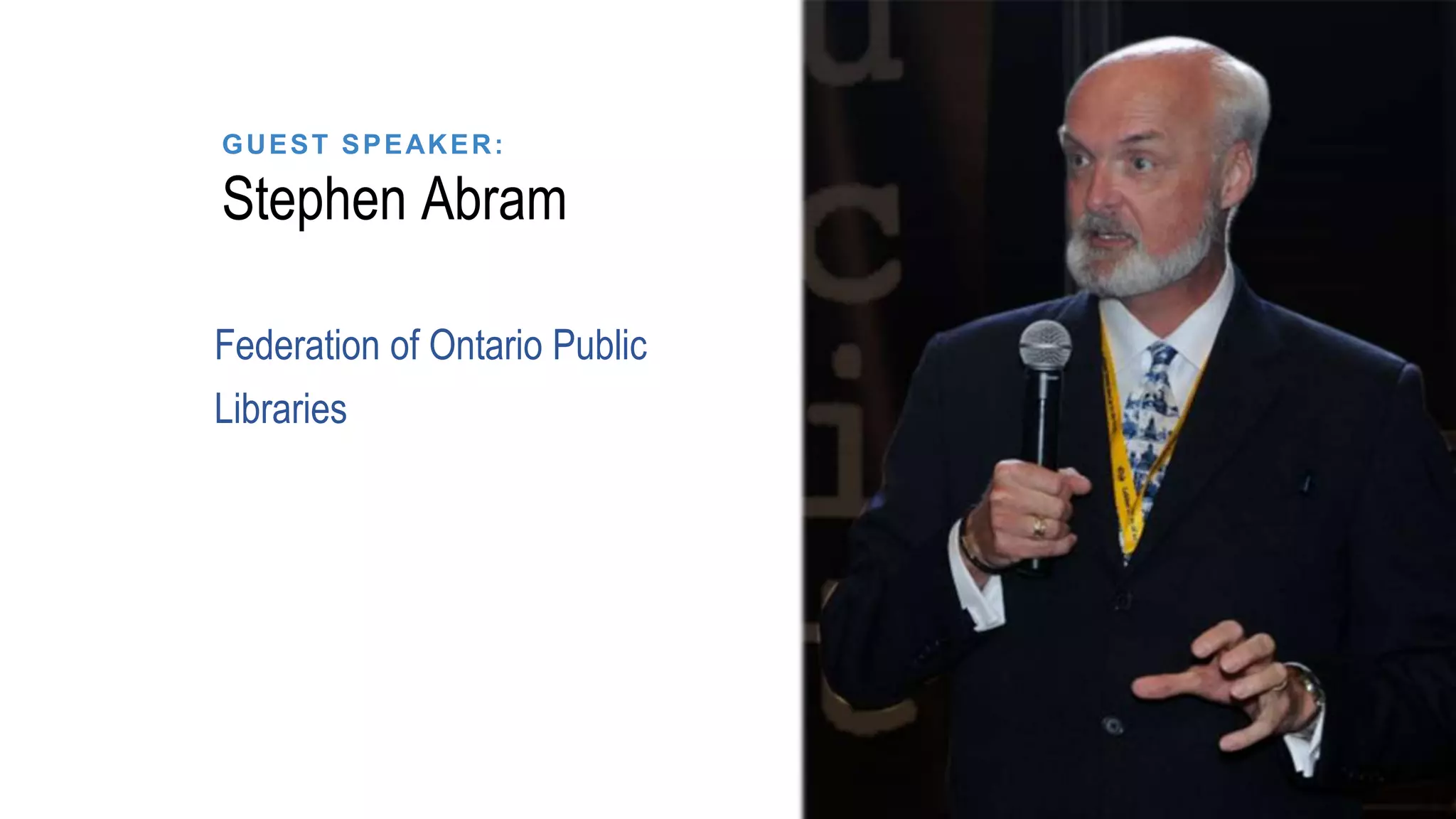
GUEST SPEAKER:
Stephen Abram
Federation of Ontario Public
Libraries
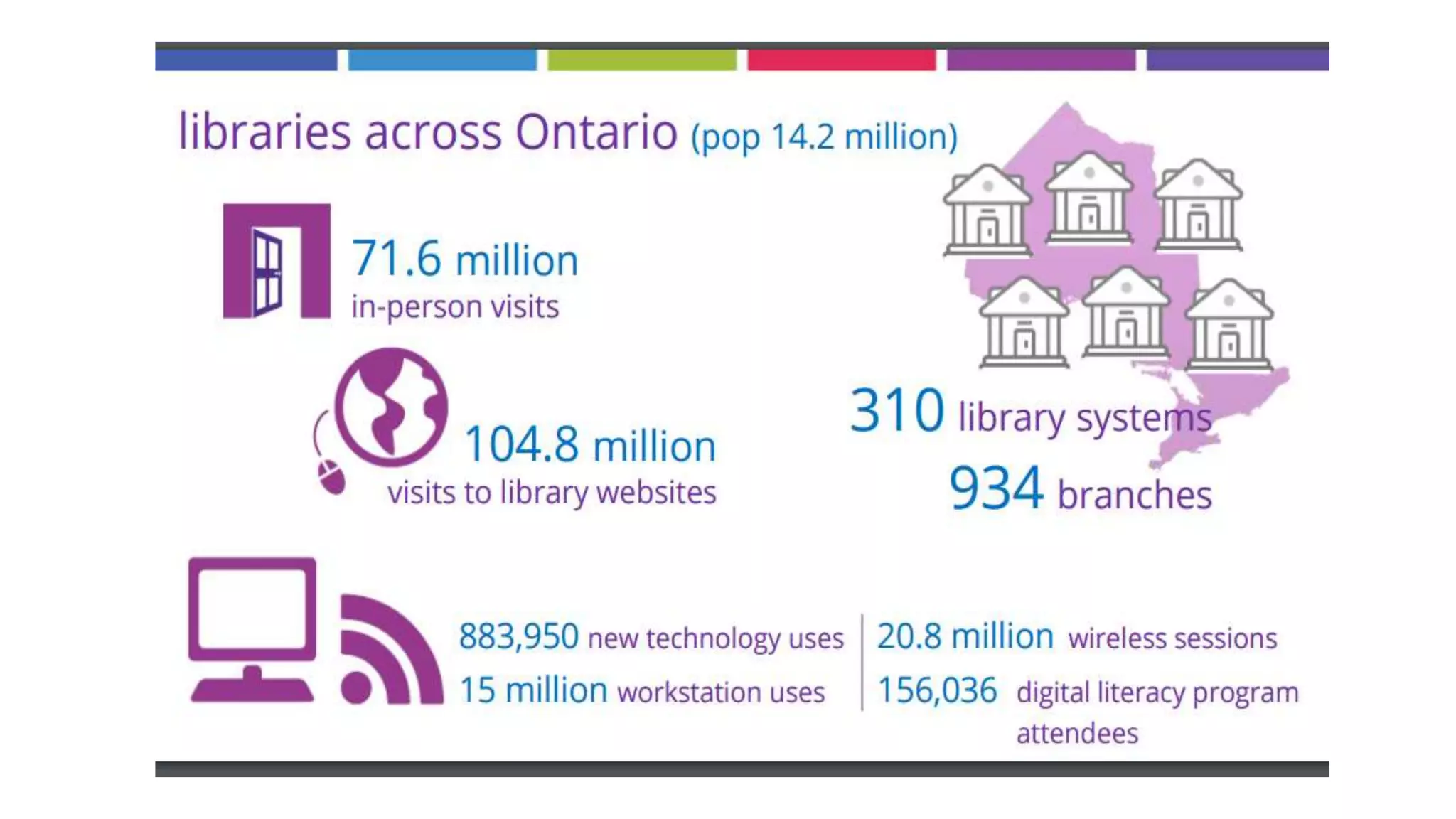
• In Ontario’s 305 public library systems there are 1157 public library
branches serving 99.34% of Ontario’s population including
indigenous communities. In person, Libraries see 137 in-person visits
per minute – over 80 million visits a year. With our 24/7/365 digital
services, that rate more than doubles!
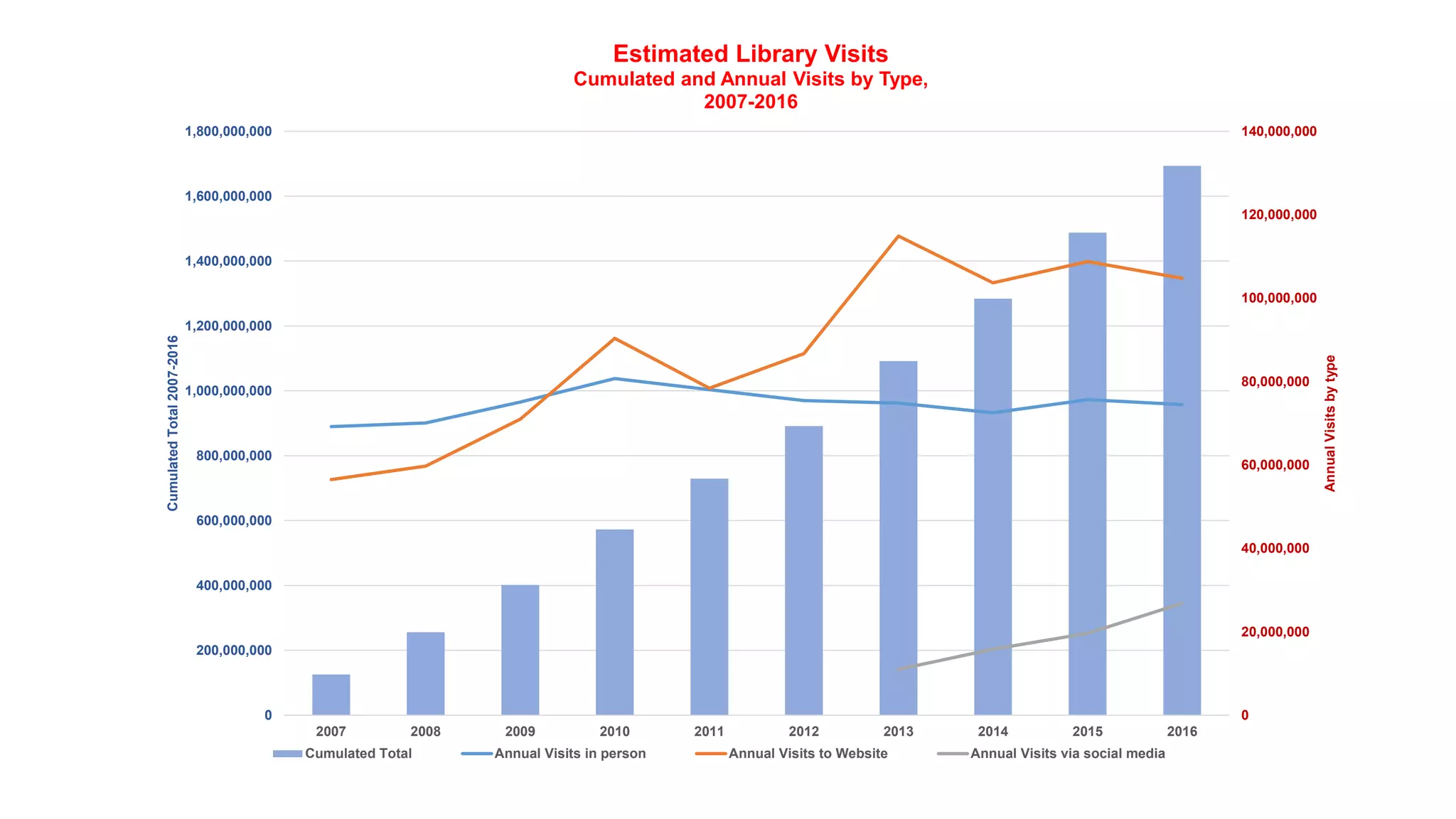
• With 155.8 Million visits per year, 426,849 Visits per day, and 17,785
Visits per hour, that comes to 296 visits per minute! There’s simply
no other public institution which gets 5 visits every second, all year
long.
• Ontario’s Public Libraries offer so many fantastic programs equitably
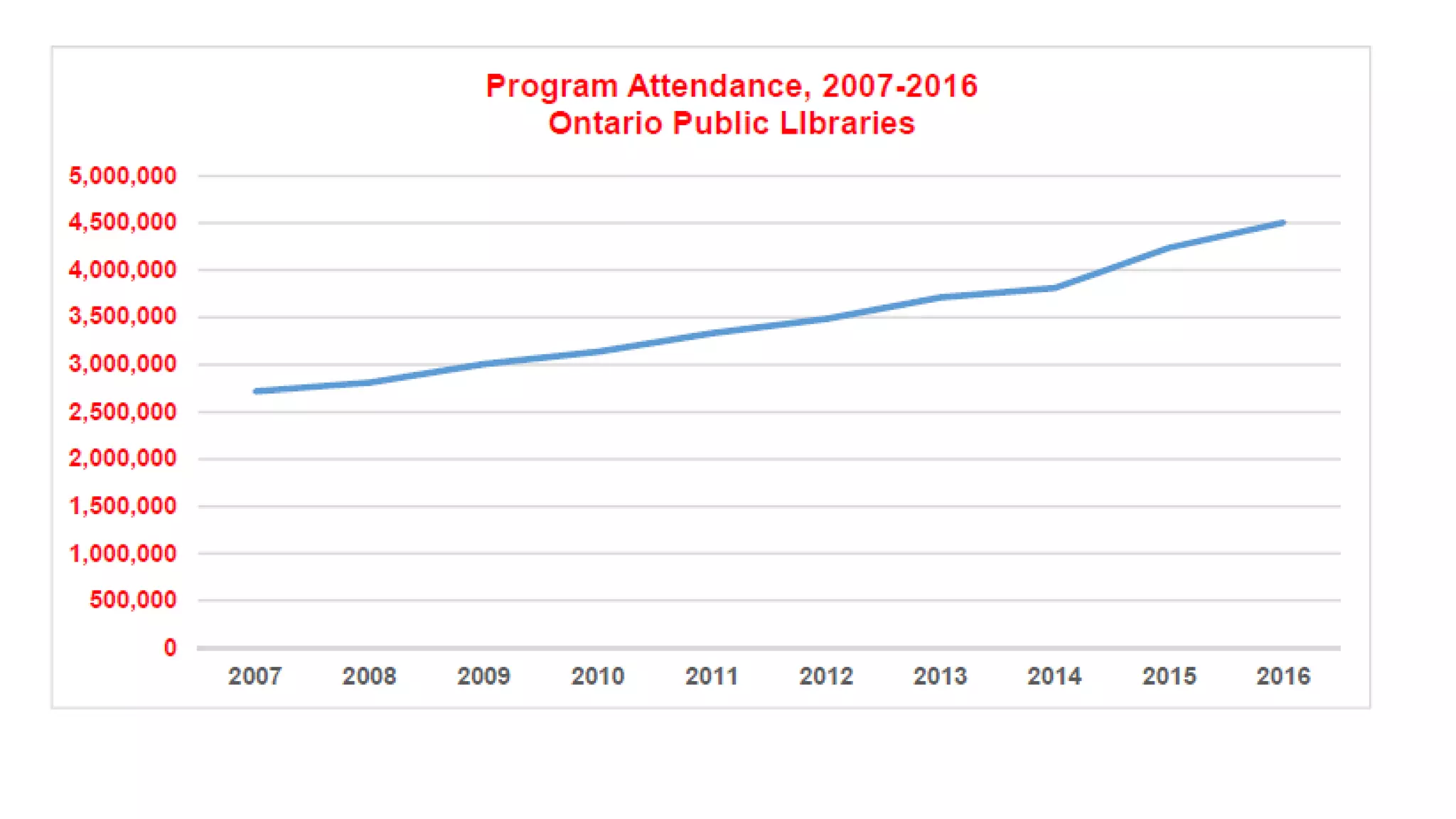
for all – over 250,000 in 2016 which attracted over 4.5 Million
residents! We’ve grown over 82% in ten years. The public value
goes on and on: Early literacy and early learning, career skills, and job
help, genealogy, business, entrepreneur and community
development, Summer Reading Club, homework help, teen programs,
newcomers to Canada, seniors programs, Book Clubs, Culture Days,
Makerspaces, and so many more! Choose to visit and learn!
The Public Library value proposition is strong and
includes (but isn’t limited to):
• Excellent Return on Investment for municipalities and the province
• Strong Economic Development and Impact (averaging $6 for every $1 invested)
• Great Employment and Business Support
• Access to all kinds of technology – with talented support
• Welcoming New Canadians & Refugees
• Provable Early and Adult Literacy Development
• Ongoing Lifelong Support for Formal Education and Homework Help
• Serving the whole community equitably
• Affordable access to community resources
• Guided access to Government Services and e-government
• Questions Deserve Quality Answers
• Support for Cultural Vitality, creativity, and innovation
• AND Recognized and Valued Leisure Activities for majority of Ontarians
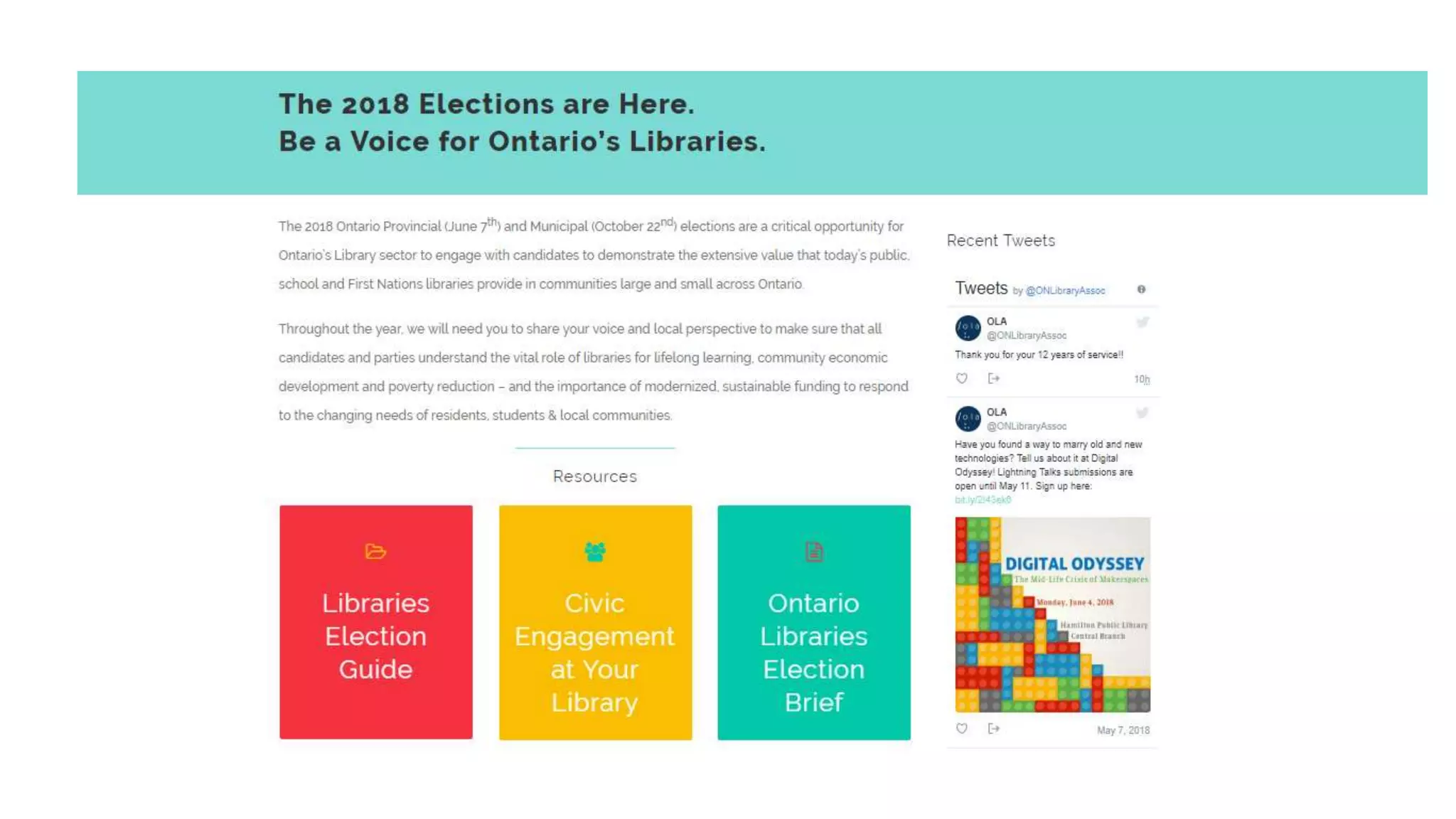
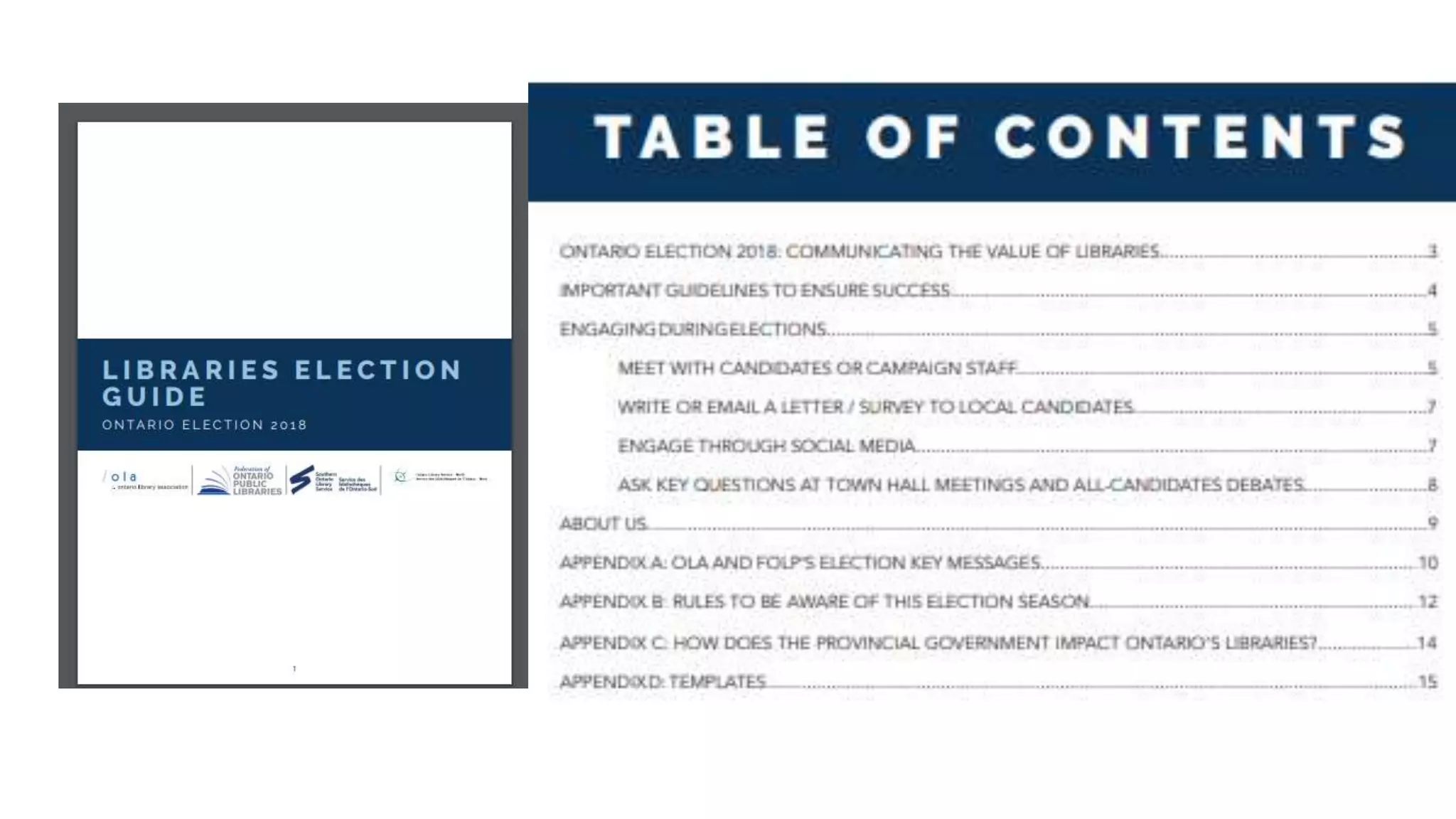
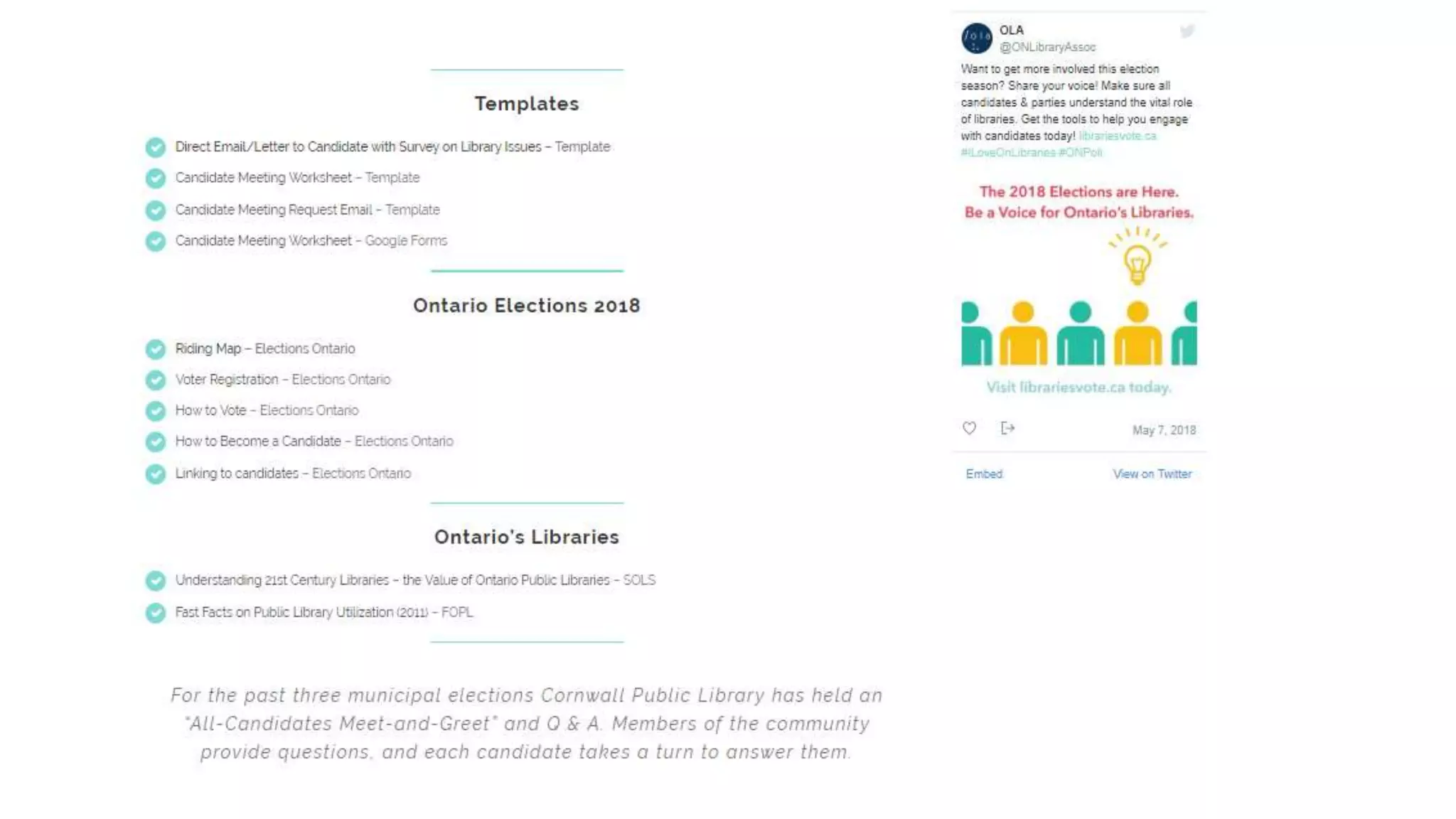
The 2018 Provincial Election
You Can Help!
https://librariesvote.ca/
There
Are
A Lot
Of Moving
Pieces!
FOPL
and
OLA
It can be confusing . . .
but all of the parts fit together
Our
ASK
Open
Media
Desk
Counsel
Public
Affairs
QP
DAY
The ED
& Board
CFLA
Stats
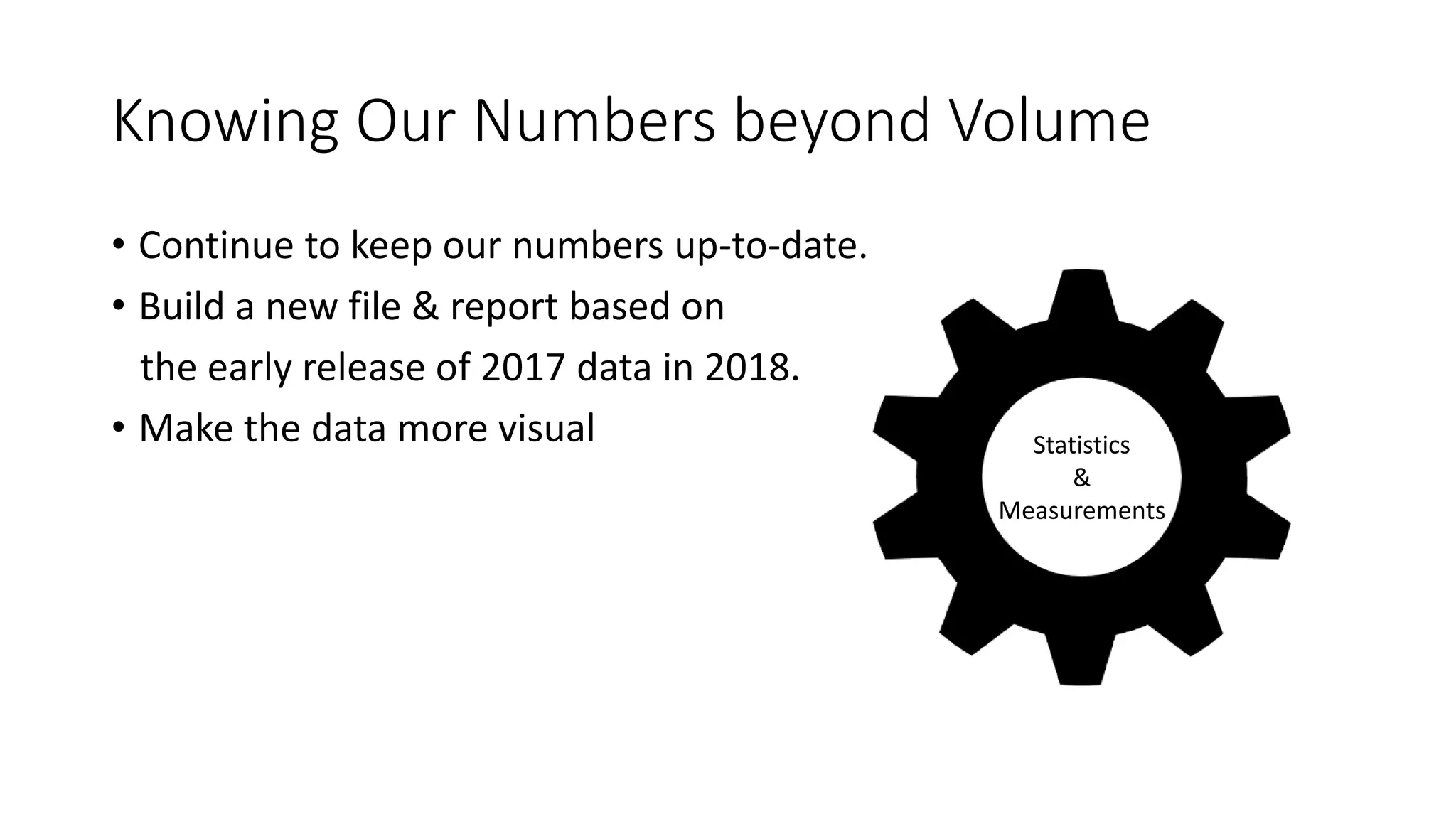
Knowing Our Numbers beyond Volume
• Continue to keep our numbers up-to-date.
• Build a new file & report based on
the early release of 2017 data in 2018.
• Make the data more visual Statistics
&
Measurements
Marketing Impact &Value of Public Libraries
• Exploit the network web we have created
• Move to Phase two
• Formalize it as a go-to tool for e-learning
• Build LDRI – measure effectiveness
Open
Media
Desk
Meetings, meetings, meetings
• Exploit CFLA membership for national issues
• Use the strengths of our Board
• Use the strengths in our members
• Evaluate whether a QP Day is needed in 2018
• Follow through with building cabinet, MPP
and municipal relationships
• Continue to expand our relationships with the civil service
• Continue to build positive and impactful relationship with our
partners (OLA, SOLS, OLS-North, CULC)
QP
DAY
The ED
& Board
CFLA
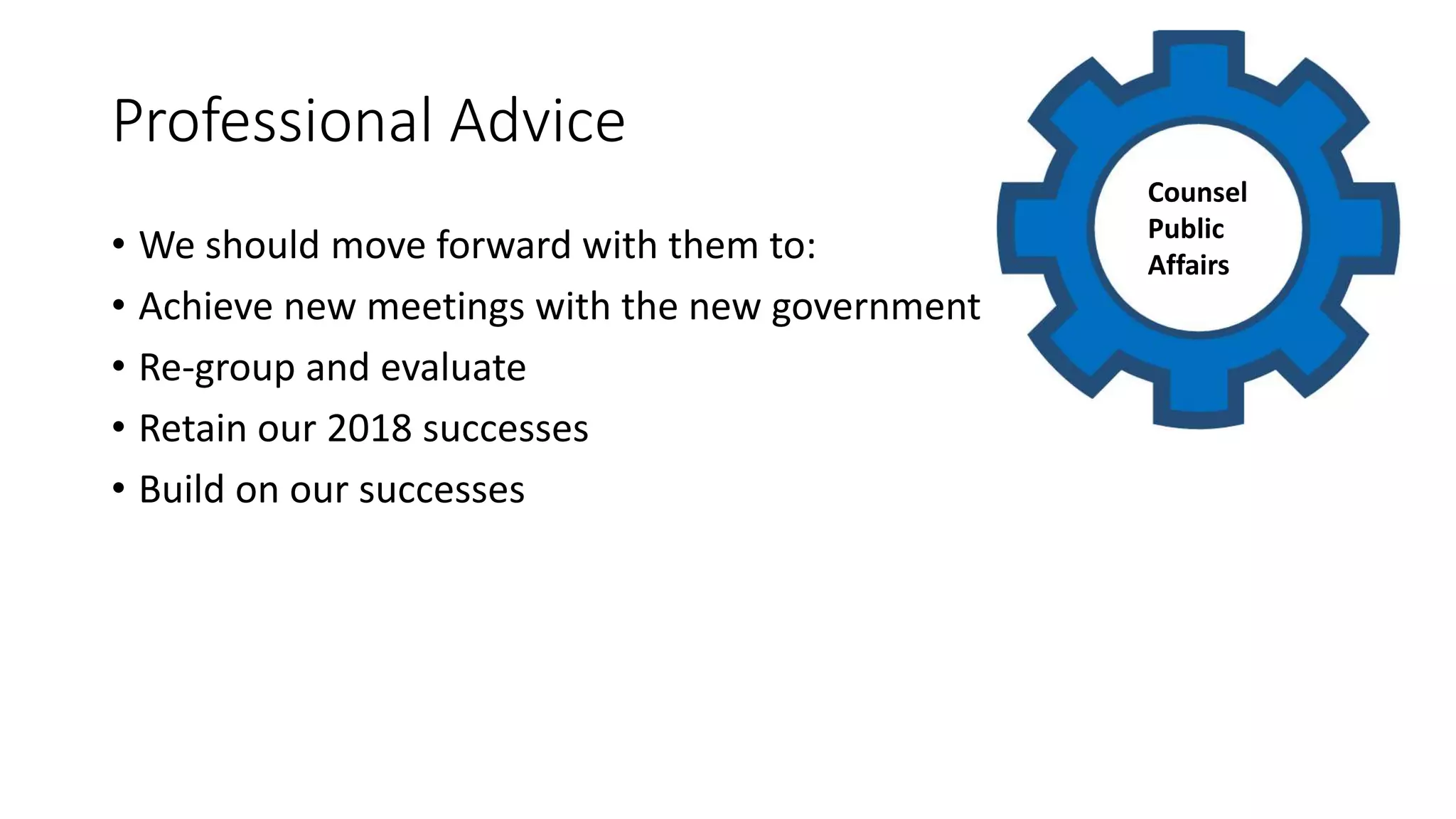
Professional Advice
• We should move forward with them to:
• Achieve new meetings with the new government
• Re-group and evaluate
• Retain our 2018 successes
• Build on our successes
Counsel
Public
Affairs
Knowing what we want
• We had three formal asks in the 2018 budget
• We will have more asks in the future
• We are working on less formal influence too
• e.g. Regulation 976, PLOG and COLA,
School library envelope, etc.
• Future consultation activities
Our
ASK
Following Through
• Municipal and Library Board Resolutions
• Provincial Budget
• Toolkits for Provincial Election
• Toolkits for Municipal Elections
• Thank you letters
• Re-group at the appropriate times (June, October, …)
• Post-election follow-through.
So now we know . . .
• All the pieces fit together
• Let’s ask ourselves if anything is missing
• We have a lot of work to do this year!
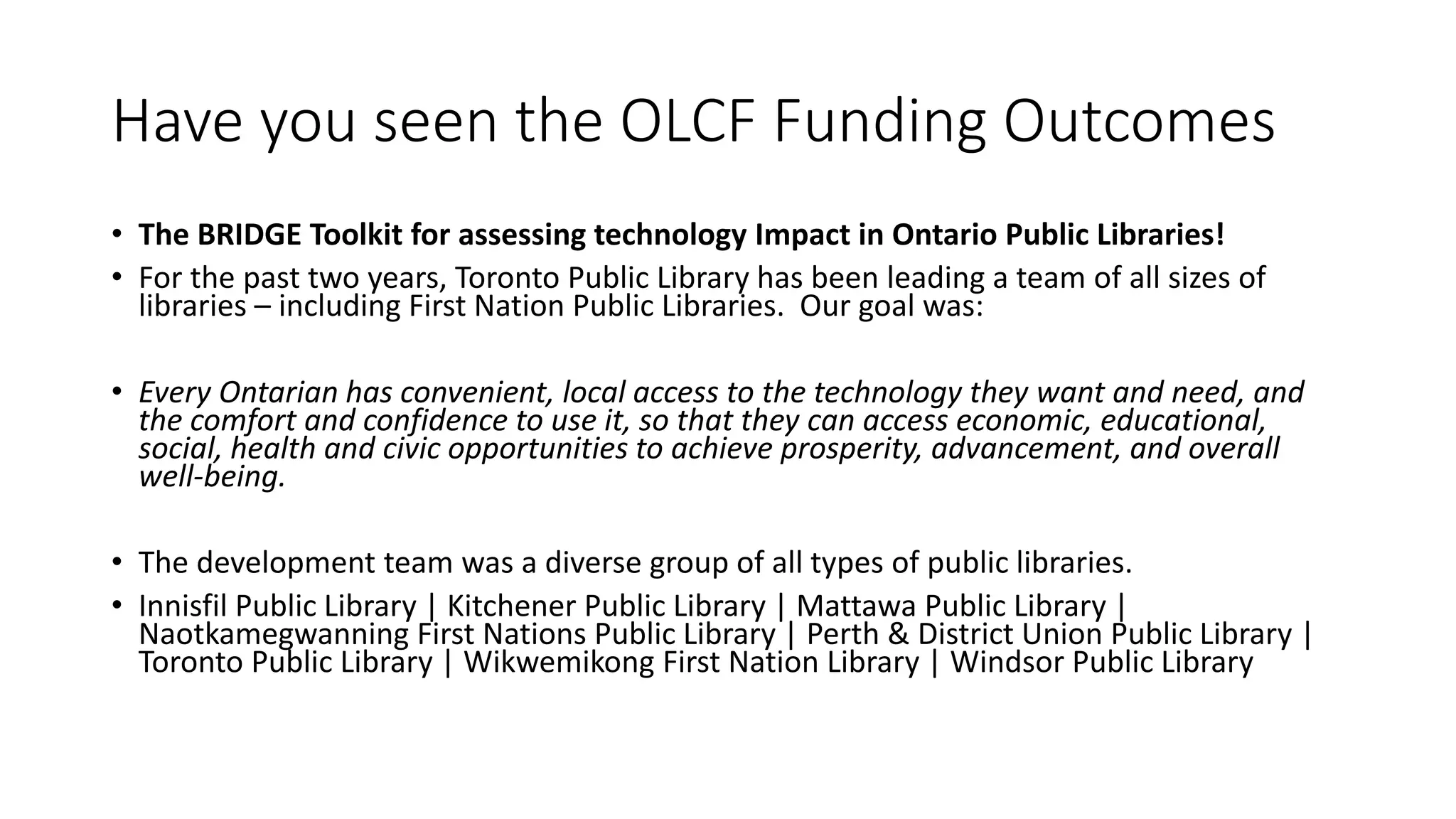
Have you seen the OLCF Funding Outcomes
• The BRIDGE Toolkit for assessing technology Impact in Ontario Public Libraries!
• For the past two years, Toronto Public Library has been leading a team of all sizes of
libraries – including First Nation Public Libraries. Our goal was:
• Every Ontarian has convenient, local access to the technology they want and need, and
the comfort and confidence to use it, so that they can access economic, educational,
social, health and civic opportunities to achieve prosperity, advancement, and overall
well-being.
• The development team was a diverse group of all types of public libraries.
• Innisfil Public Library | Kitchener Public Library | Mattawa Public Library |
Naotkamegwanning First Nations Public Library | Perth & District Union Public Library |
Toronto Public Library | Wikwemikong First Nation Library | Windsor Public Library
Of Ontarians do not have Internet access at home or work.
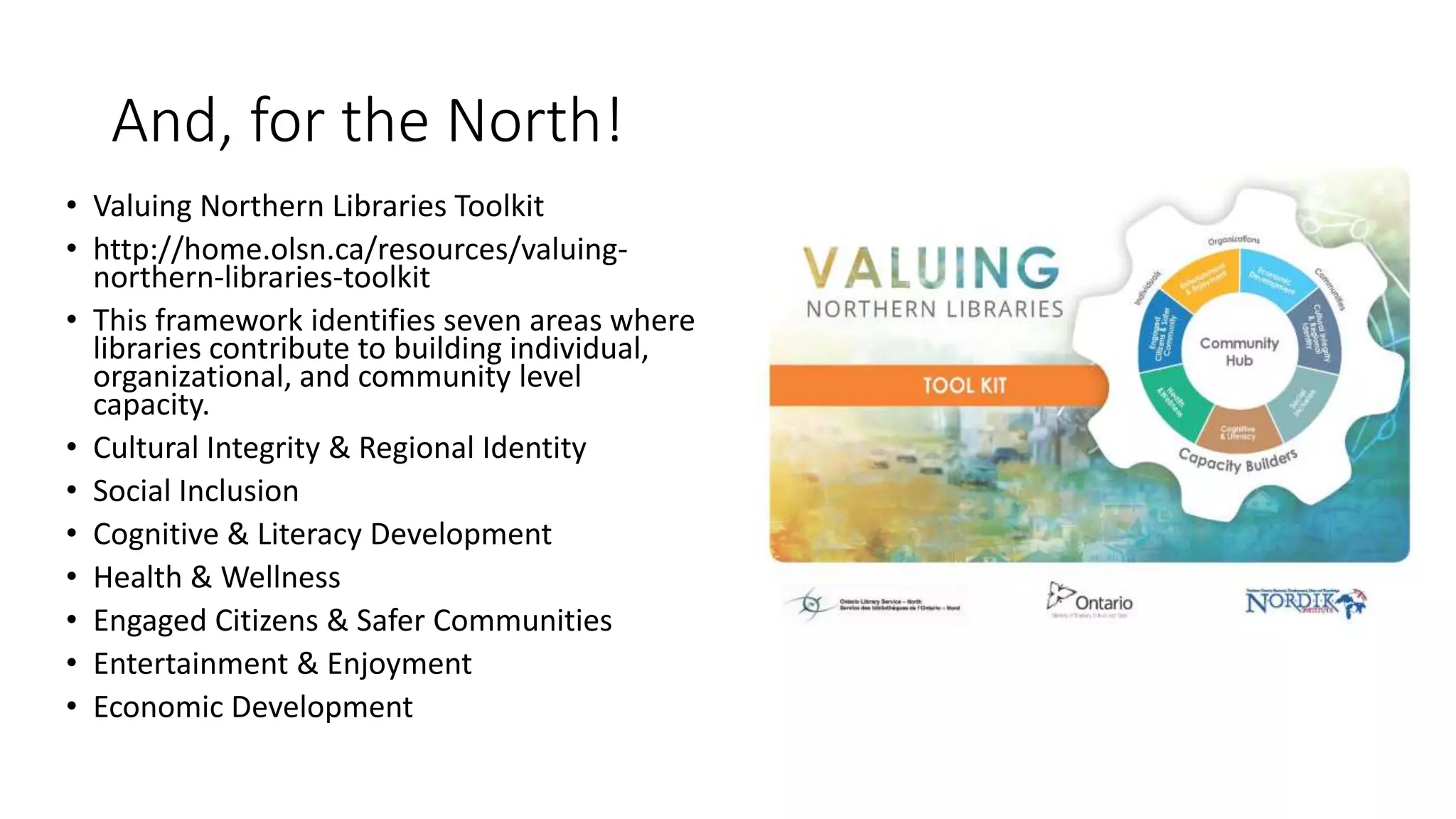
And, for the North!
• Valuing Northern Libraries Toolkit
• http://home.olsn.ca/resources/valuing-
northern-libraries-toolkit
• This framework identifies seven areas where
libraries contribute to building individual,
organizational, and community level
capacity.
• Cultural Integrity & Regional Identity
• Social Inclusion
• Cognitive & Literacy Development
• Health & Wellness
• Engaged Citizens & Safer Communities
• Entertainment & Enjoyment
• Economic Development
Ontario Public Library Operating Data 2007-2016
Overview, Primer Library Statistics, and Tables
• 2016 Ontario Public Library Data Analysis (Main Report)
• http://fopl.ca/news/2016-ontario-public-library-data-analysis/
• Preview: Ontario Public Library Data Analysis
• http://fopl.ca/news/preview-ontario-public-library-data-analysis/
• Ontario Public Library 2016 Culture Partnerships
• http://fopl.ca/news/ontario-public-library-2016-culture-partnerships/
• Highlights of Public Library Education Partnerships:
• http://fopl.ca/news/highlights-of-public-library-education-partnerships/
• 3D Printers, Maker Space Labs, and Digital Media Labs, 2015-2016
• http://fopl.ca/news/3d-printers-maker-space-labs-and-digital-media-lab-2015-
2016/
• 2016 Analysis of Public Library Partnerships
• http://fopl.ca/news/2016-analysis-of-public-library-partnerships/
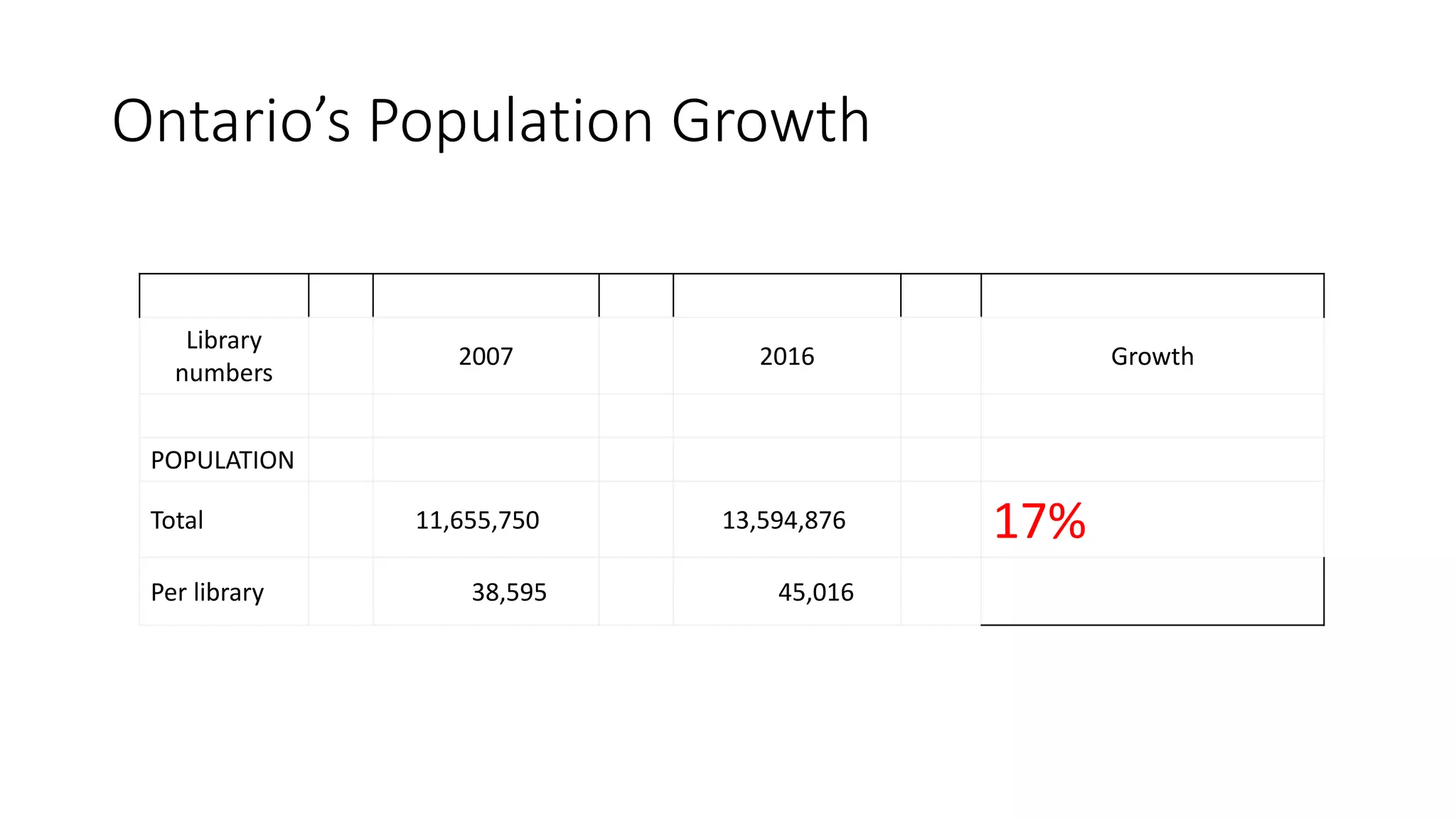
Ontario’s Population Growth
Library
numbers
2007 2016 Growth
POPULATION
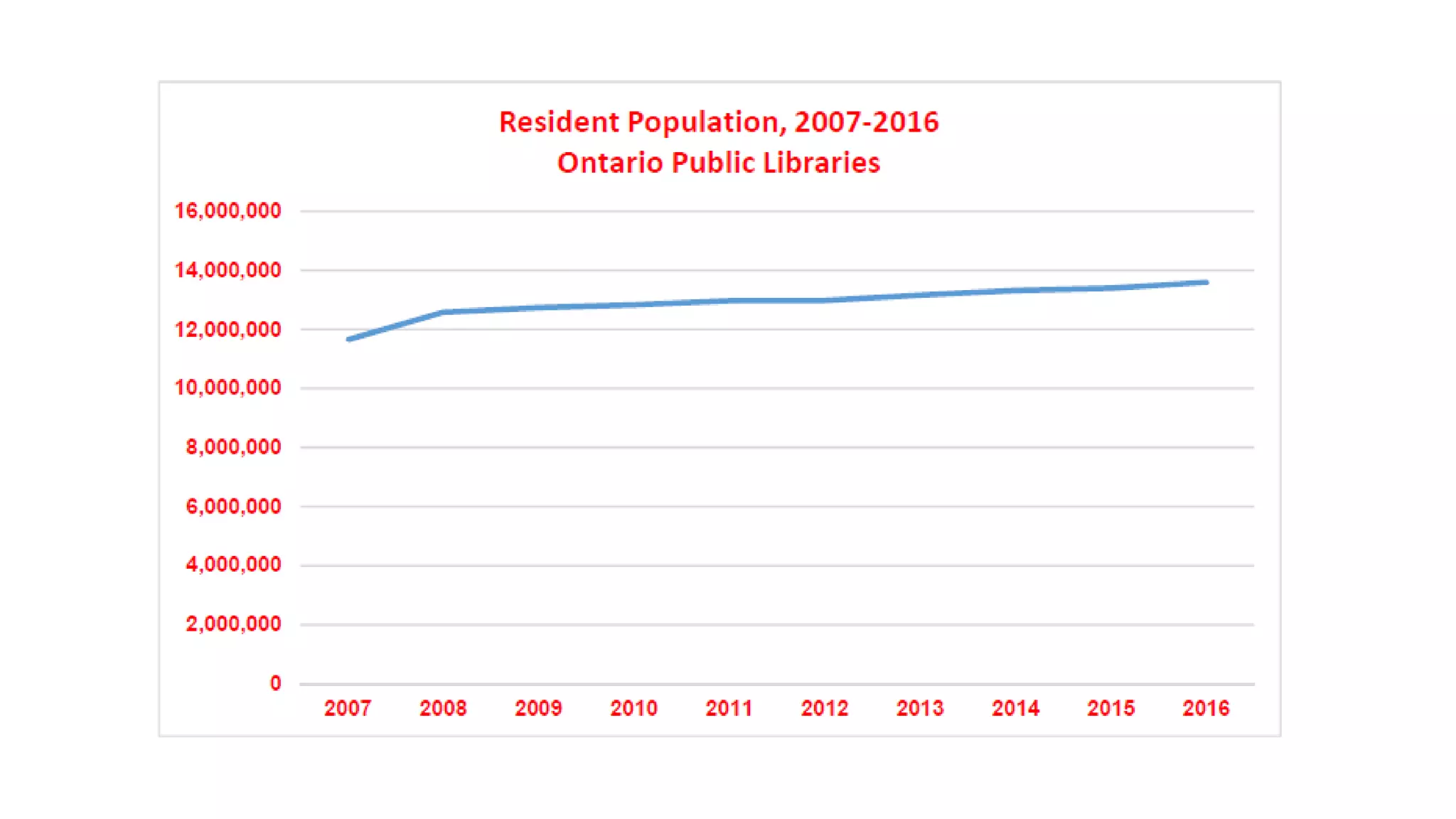
Total 11,655,750 13,594,876 17%
Per library 38,595 45,016
Circulation Growth over Ten Years
CIRCULATION
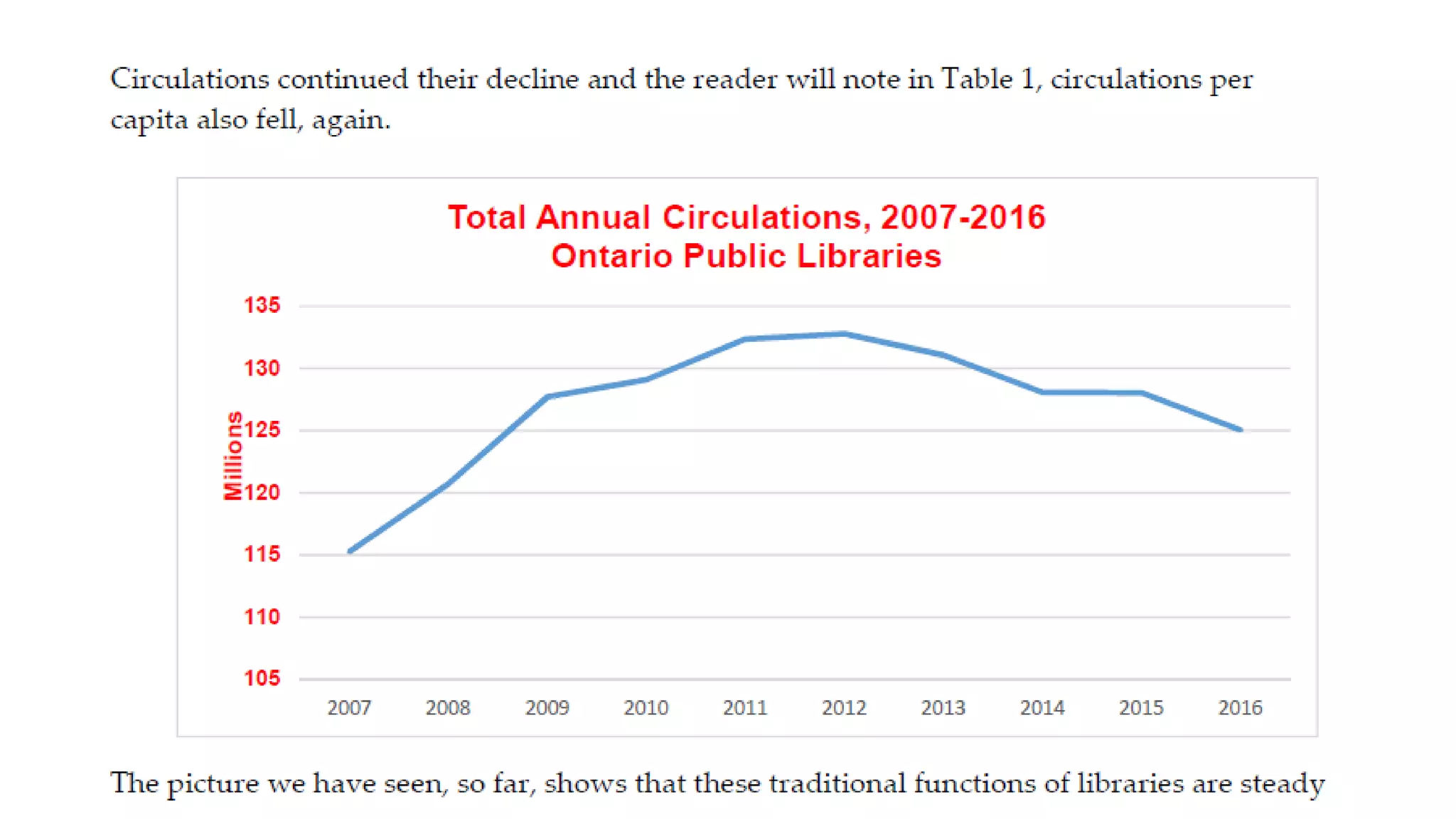
Total (excludes digital) 115,256,552 125,052,817 8%
Per library 381,644 414,082
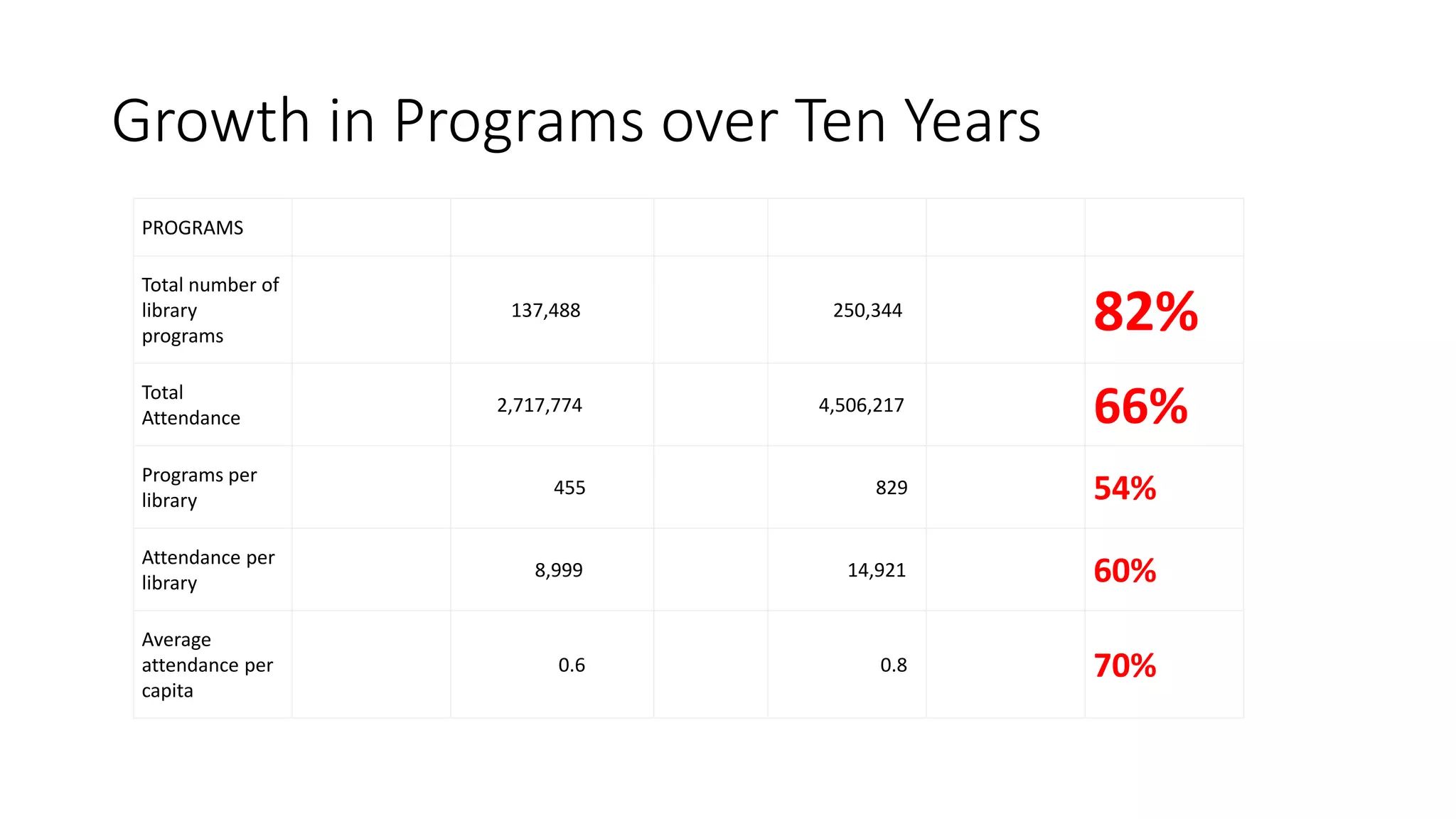
Growth in Programs over Ten Years
PROGRAMS
Total number of
library
programs
137,488 250,344
82%
Total
Attendance
2,717,774 4,506,217
66%
Programs per
library
455 829 54%
Attendance per
library
8,999 14,921 60%
Average
attendance per
capita
0.6 0.8 70%
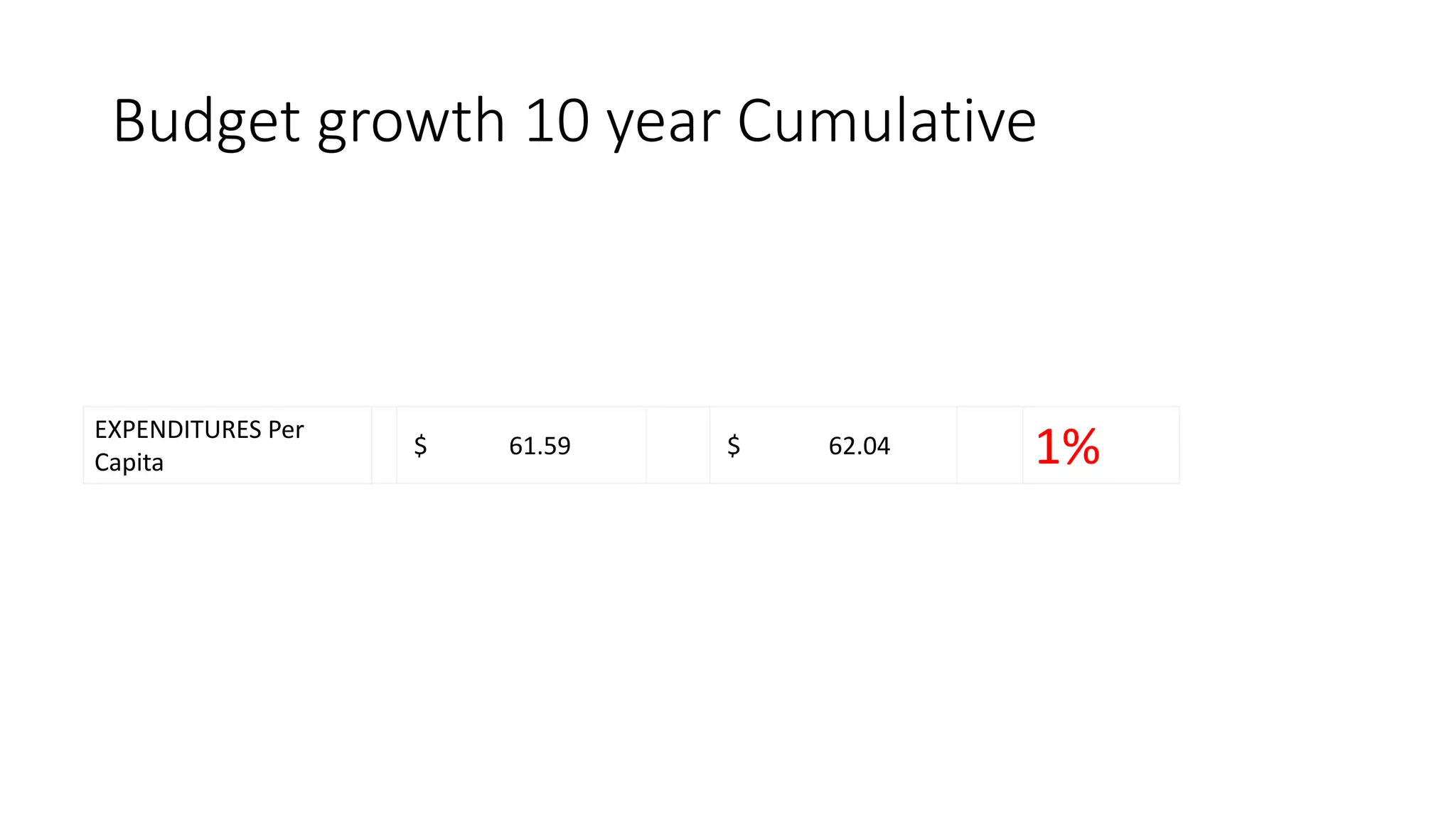
Budget growth 10 year Cumulative
EXPENDITURES Per
Capita
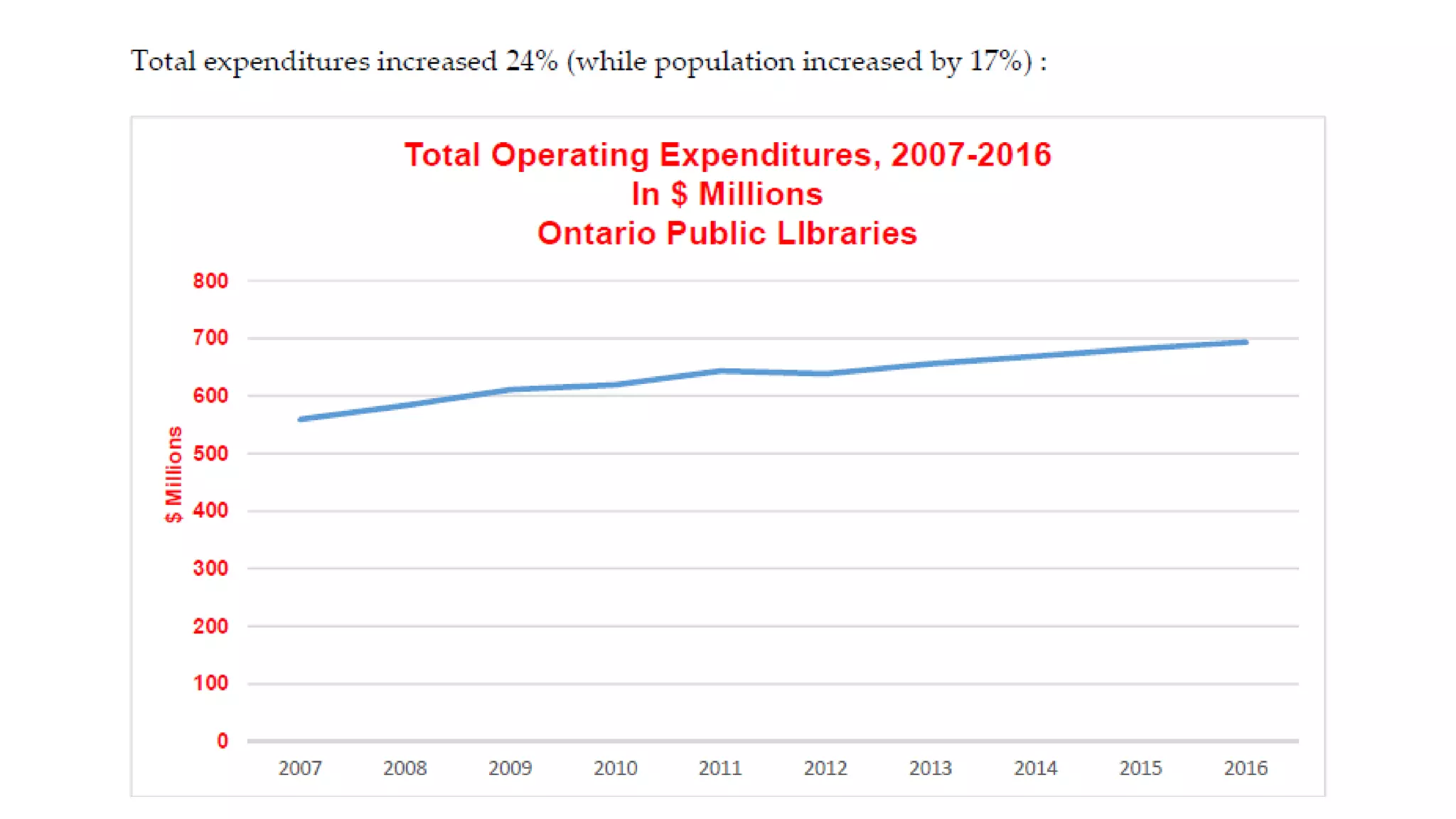
$ 61.59 $ 62.04 1%
0
20,000,000
40,000,000
60,000,000
80,000,000
100,000,000
120,000,000
140,000,000
0
200,000,000
400,000,000
600,000,000
800,000,000
1,000,000,000
1,200,000,000
1,400,000,000
1,600,000,000
1,800,000,000
2007 2008 2009 2010 2011 2012 2013 2014 2015 2016
AnnualVisitsbytype
CumulatedTotal2007-2016
Estimated Library Visits
Cumulated and Annual Visits by Type,
2007-2016
Cumulated Total Annual Visits in person Annual Visits to Website Annual Visits via social media
Market Probe Canada Report
CATI and Online surveys
2000 2005 2010 2015
Balanced panels
Mid-2015
Market Probe Canada Report
• 74% of Ontarians report having a library card
• A significant number don’t use it for borrowing but still USE the
library
Ways Users Access the Public Library
Q.2/3/4
Base: Library users (2010 - 757; 2015 - 417).
37%
1% 1%
13%
12%
In-Person
Internet
Phone
33%
2%
• The diagrams below depict all past-year library users according to their reported methods of accessing the library.
• While in-person only visitors constituted the largest group of library users in 2010, they have been outnumbered by
combined in-person/Internet users in 2015.
• The proportion of library patrons using all three access methods has also increased over the last five years, while the
total percentage visiting the library in person remains extremely high, at 94%.
27%
1% 1%
20%
11%
In-Person
Internet
Phone
36%
3%
2015 2010
84%
56%
34%
28%
26%
25%
23%
23%
16%
14%
10%
90%
70%
41%
33%
26%
17%
33%
23%
13%
21%
16%
88%
73%
38%
31%
32%
18%
9%
21%
16%
88%
77%
47%
19%
32%
17%
9%
24%
18%
0% 20% 40% 60% 80% 100%Q.6a/b
Base: Those who personally visited the public library (2000 - 678; 2005 - 713; 2010 - 723; 2015 - 394); households where
anyone used the public library (2010 - 843; 2015 - 444). *Wording changed in 2015 from “Access electronic databases.”
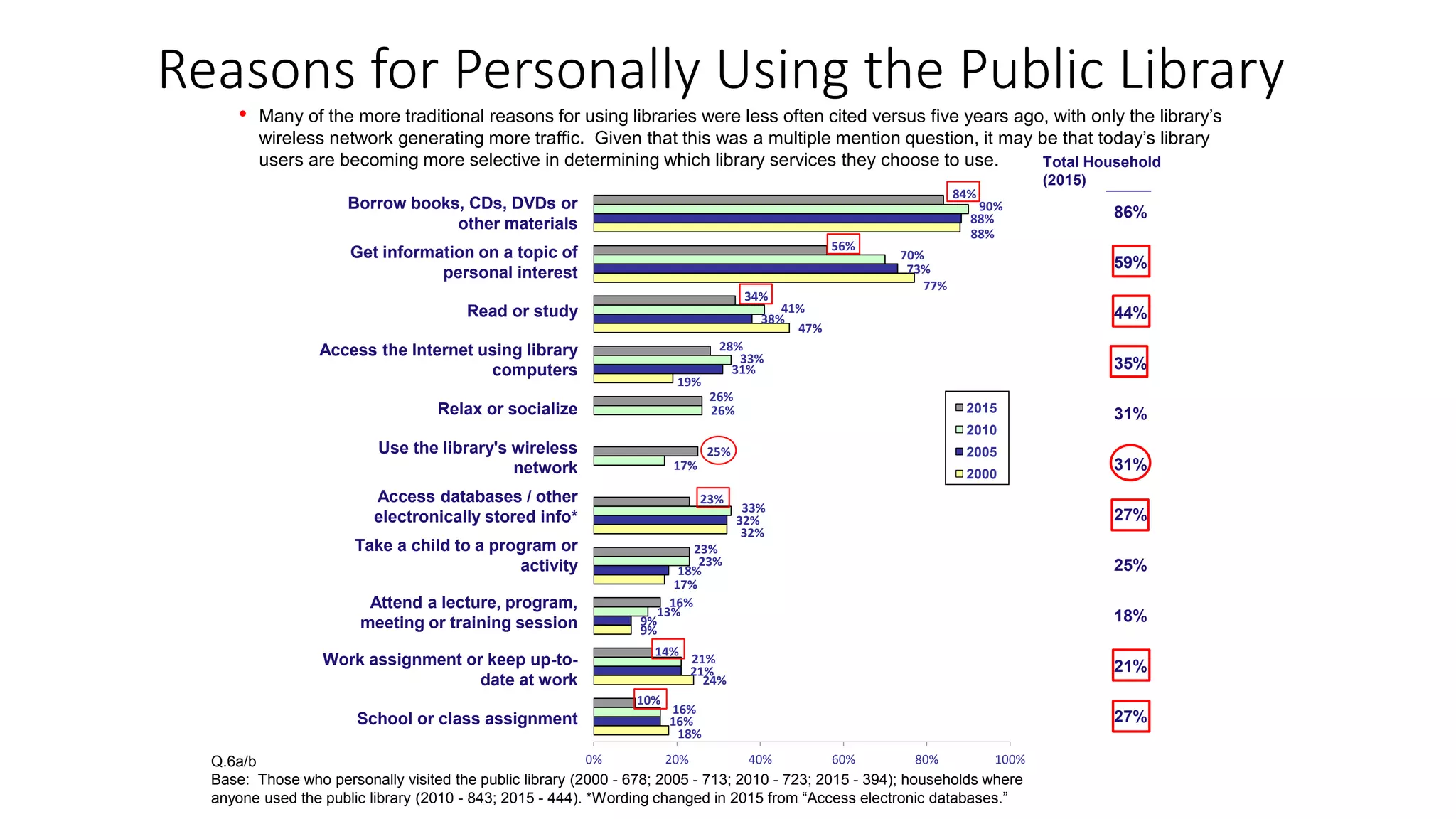
Reasons for Personally Using the Public Library
• Many of the more traditional reasons for using libraries were less often cited versus five years ago, with only the library’s
wireless network generating more traffic. Given that this was a multiple mention question, it may be that today’s library
users are becoming more selective in determining which library services they choose to use.
Borrow books, CDs, DVDs or
other materials
Get information on a topic of
personal interest
Read or study
Access the Internet using library
computers
Relax or socialize
Use the library's wireless
network
Access databases / other
electronically stored info*
Take a child to a program or
activity
Attend a lecture, program,
meeting or training session
Work assignment or keep up-to-
date at work
School or class assignment
86%
59%
44%
35%
31%
31%
27%
25%
18%
21%
27%
Total Household
(2015)
68%
32%
65%
35%
65%
35%
0% 20% 40% 60% 80% 100%
Yes
No
2015
2010
2005
2000
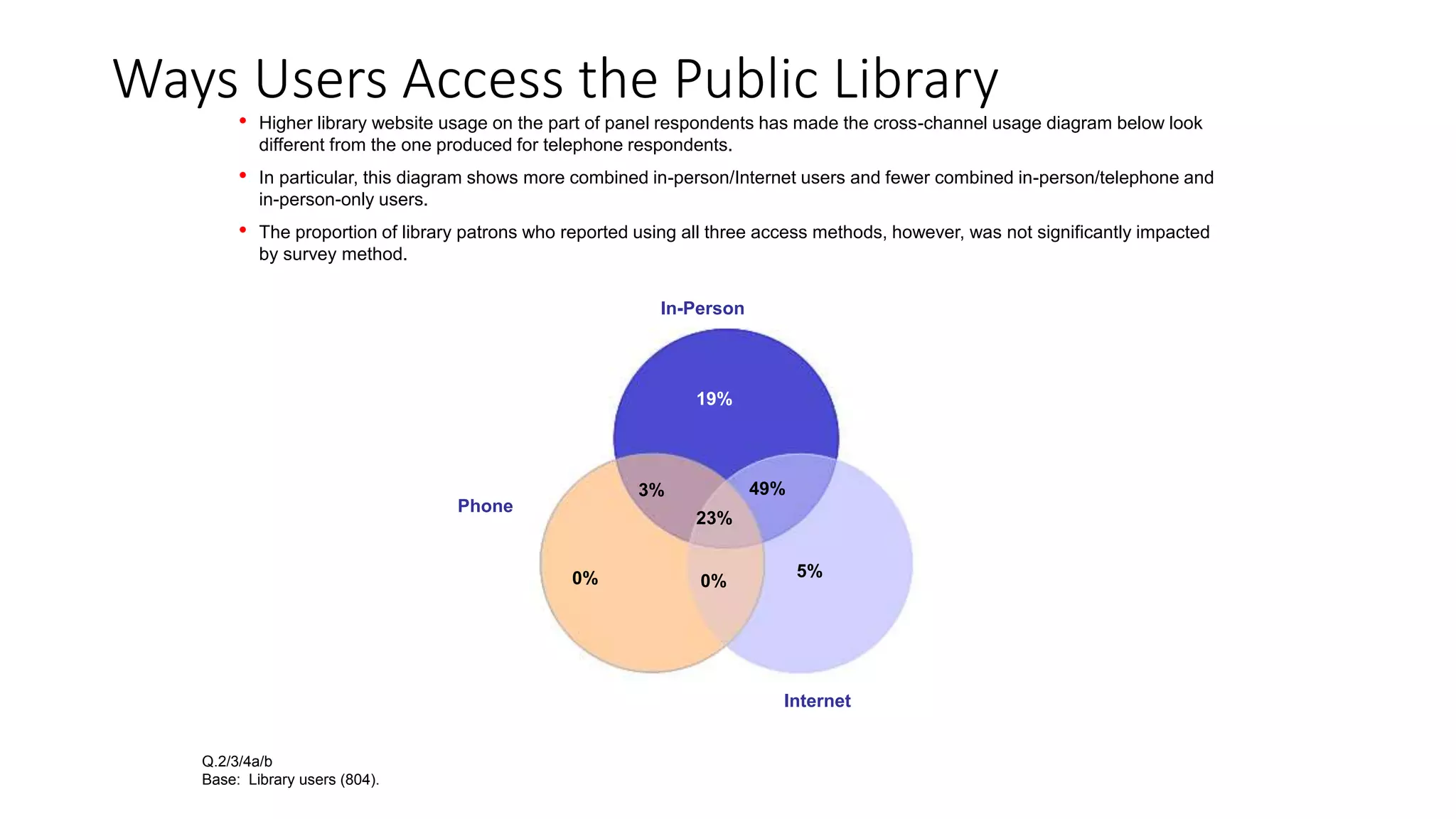
Ways Users Access the Public Library
Q.2/3/4a/b
Base: Library users (804).
• Higher library website usage on the part of panel respondents has made the cross-channel usage diagram below look
different from the one produced for telephone respondents.
• In particular, this diagram shows more combined in-person/Internet users and fewer combined in-person/telephone and
in-person-only users.
• The proportion of library patrons who reported using all three access methods, however, was not significantly impacted
by survey method.
19%
0% 0%
23%
3%
In-Person
Internet
Phone
49%
5%
A program that allows people to try out the newest tech devices or
applications, such as 3D printers or laser cutters
Library kiosks located throughout the community where people
can check out books, movies or music without having to go to the
library itself
A personalized online account that gives you recommendations
based on your past library activity
A cell phone app that allows you to access library services from
your mobile phone
An online research service where you could pose questions and
get responses from librarians
A cell phone app that helps you locate material easily in the library
using GPS
E-book readers already loaded with the book you want to read
Instruction on how to use handheld reading devices and tablets
Classes on how to download library e-books to handheld devices
A digital media lab where you could create and upload new digital
content like your own movies or e-books
The Likelihood of Using Library Services
• Online survey participants were asked their likelihood of using some new services libraries are either offering or thinking
of offering in the future. Interest in these concepts varied, in many cases based on age.
• There were very few suggestions made for other services over and above those shown.
Other Services Library Should Provide
More selection of materials / updated
materials
2%
Computer / Internet skills / technical
devices
2%
For kids / students 2%
Educational courses / lectures /
seminars / community events
2%
Hobbies / special interests 2%
Quiet space / reading / sitting areas 1%
More online services, i.e. card
renewals / book / material reserving
1%
They do a good job 7%
Other 16%
No comments / suggestions 65%
19%
15%
15%
16%
10%
12%
12%
9%
9%
7%
36%
35%
35%
29%
33%
27%
26%
26%
24%
24%
55%
50%
49%
44%
44%
39%
38%
35%
33%
31%
Very Likely Somewhat Likely Total
64% 46%
57% 39%
61% 39%
62% 24%
43% 37%
54% 19%
45% 34%
31% 40%
30% 38%
42% 21%
By Age
18-34 55+
Q.13c/d
Base: All respondents (1102).
Best Way to Inform about What’s Going On at the Library
Q.13e
Base: All respondents (1102).
66%
51%
45%
35%
34%
30%
26%
19%
8%
0% 20% 40% 60% 80% 100%
Email
Articles in the local paper
Information on the library's website
Social media
Notices at the library
Notices in community centres or
other public places
Inserts with your tax bill or other
local government mailings
Notices in schools
Talks/presentations to community
groups
• Panel members were asked to identify the best ways to inform them about what’s going on at their local public library.
• Email, articles in the local paper, and information posted on the library’s website received the greatest numbers of
mentions, in general, with younger people also favouring social media.
59% 73%
40% 63%
36% 48%
46% 22%
31% 34%
28% 32%
20% 32%
21% 12%
6% 12%
By Age
18-34 55+
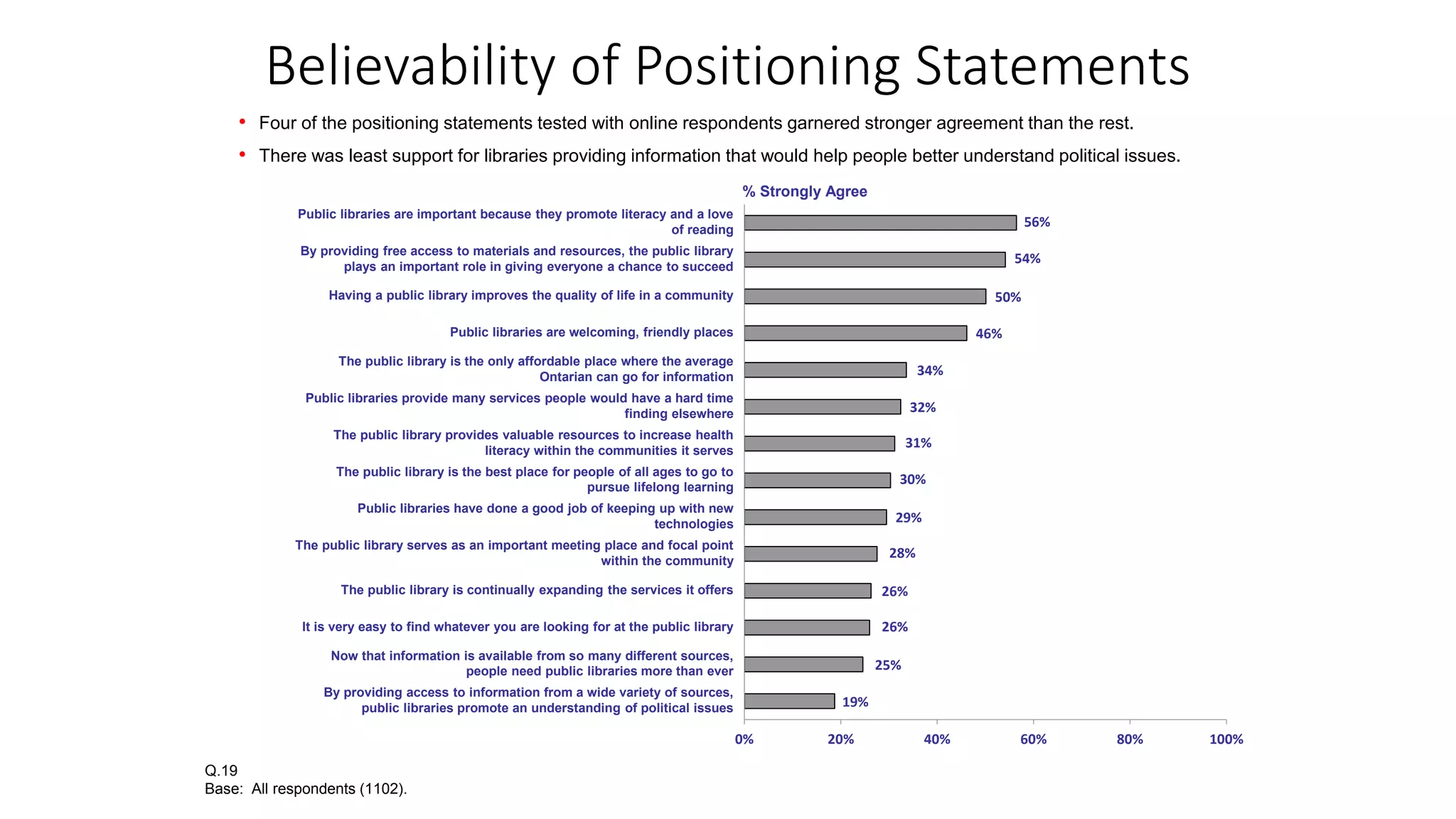
Believability of Positioning Statements
Q.19
Base: All respondents (1102).
• Four of the positioning statements tested with online respondents garnered stronger agreement than the rest.
• There was least support for libraries providing information that would help people better understand political issues.
56%
54%
50%
46%
34%
32%
31%
30%
29%
28%
26%
26%
25%
19%
0% 20% 40% 60% 80% 100%
Public libraries are important because they promote literacy and a love
of reading
By providing free access to materials and resources, the public library
plays an important role in giving everyone a chance to succeed
Having a public library improves the quality of life in a community
Public libraries are welcoming, friendly places
The public library is the only affordable place where the average
Ontarian can go for information
Public libraries provide many services people would have a hard time
finding elsewhere
The public library provides valuable resources to increase health
literacy within the communities it serves
The public library is the best place for people of all ages to go to
pursue lifelong learning
Public libraries have done a good job of keeping up with new
technologies
The public library serves as an important meeting place and focal point
within the community
The public library is continually expanding the services it offers
It is very easy to find whatever you are looking for at the public library
Now that information is available from so many different sources,
people need public libraries more than ever
By providing access to information from a wide variety of sources,
public libraries promote an understanding of political issues
% Strongly Agree
Programs and Technology
Adapting to Trends – Libraries Rock
• Cloud
• Partnerships
• Tech – beyond mouse and MS Office
• To creativity, apps, coding, maker, voice devices
• Outreach
• Food and beverage
• BIG events
Management Trends
• Master Facility Plans
• Institutional Strategic Plans
• Strategic Financial Plans (ROI and SROI)
• Strategic Technology Plans
• Facility Technical Audits and Plans
• Strategic Planning for Sustainable Programming in Libraries
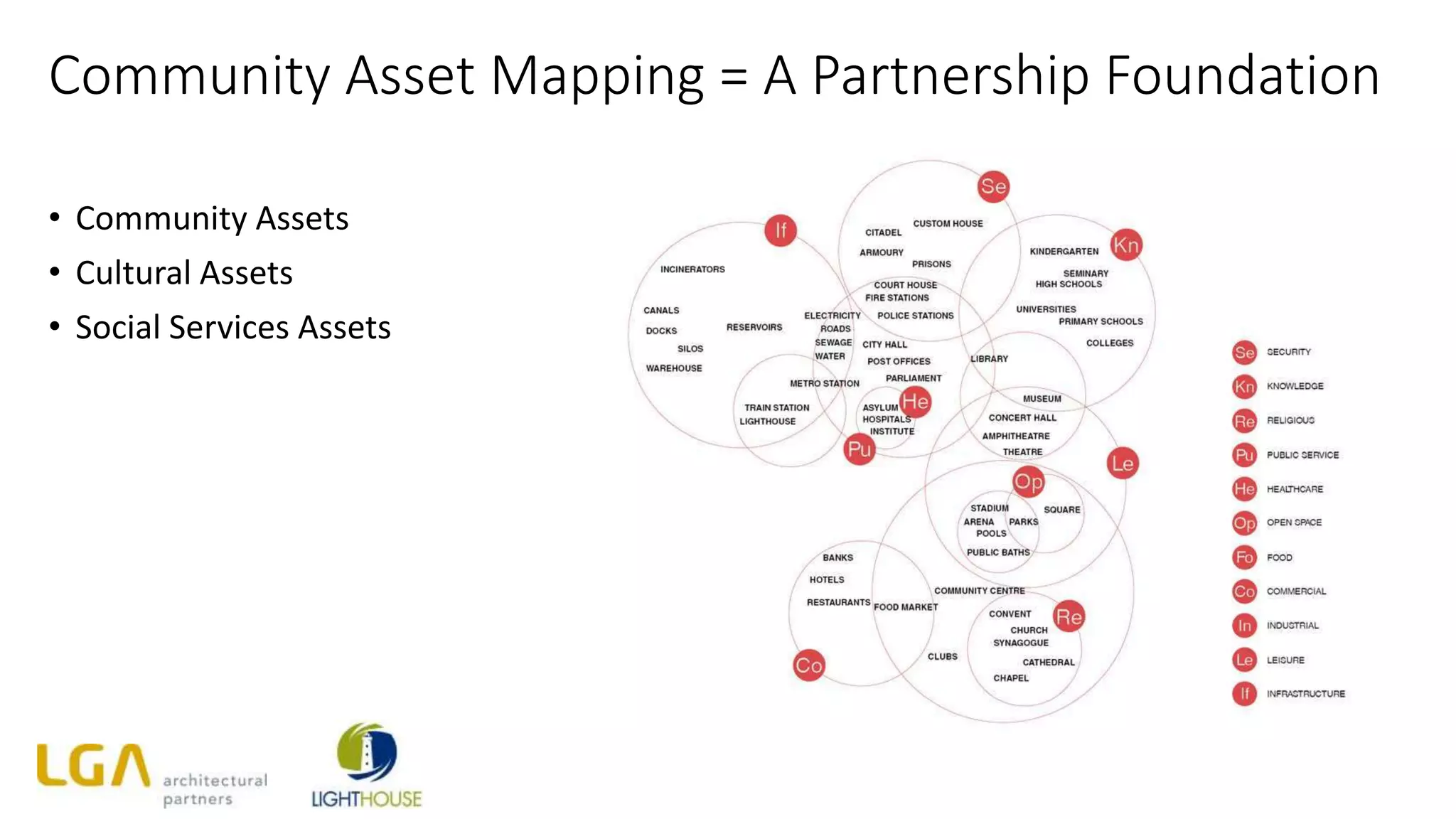
Community Asset Mapping = A Partnership Foundation
• Community Assets
• Cultural Assets
• Social Services Assets
Strategic Planning for Sustainable
Programming in Libraries
• Focus on Series. For example, if every toddler storytime is marketing
and presented to the parents as a 6-part series, even though they can
miss one or just attend one – you’ll build greater success. Indeed, at
the end of it you’ll have a program that can measure impact too – and
not just parent satisfaction. Did the kid get better at clapping,
singing, holding the book?
Strategic Planning for Sustainable
Programming in Libraries
• Series Scheduling and Timing
• Focus on Cycles: Build an annual plan with three years in mind
• Annual and special days
• Quarterly
• Weekly / Monthly
• Specific Cycles (school year, winter break, College year/reading week.
• Local events, fairs, and celebration alignments
• National special days – from St. Valentine’s to National Doughnut Day!
• ALA, PLA, CFLA, OLA, etc. ‘weeks’ and more, like Freedom to Read, Challenged Book
Week, National Library Month, etc.
Strategic Planning for Sustainable
Programming in Libraries
• A focus on cycles for an annual calendarized basis has a critical benefit of allowing
management to focus the resources and attention on the major goals and not
allow one program to drag programming productivity down. If your library is
eating up all its resources on children’s programs and under-resourcing teens or
adults (which is common) what are the strategies to serve your major
populations?
Strategic Planning for Sustainable
Programming in Libraries
• Use these filters to evaluate your series
• Targeted
• Replicable/Repeatable
• Trialable
• Testable/Measureable
• Shareable
• Scalable
• Size
• Certificates
• Competition
• Partnerships and Coopetition
• Facilities
Strategic Planning for Sustainable
Programming in Libraries
The Power of Buckets
• There are big buckets and little buckets. You don’t need to fill them up rights
away – that’s what a five year plan is for – building a full bucket of programs that
align with your strategic community learning and engagement goals. Note: Don’t
confuse markets with your program buckets. The market/audience targets are a
matrix overlay that give another dimension to your strategies. Programs that are
planned for teens, tweens, toddlers, adults, or seniors don’t provide you with the
lifelong arc you want your patrons to follow in developing their personal
relationship with the library. Also, don’t confuse your foundations – collections,
rooms, staff, resources, technologies, etc. with a program. Those are necessary
foundations for success but when library cardholders talk about the value of the
library to them they use action verbs like reading, meeting and making friends,
chatting, learning, and more. The value is found in verbs not nouns.
Strategic Planning for Sustainable
Programming in Libraries
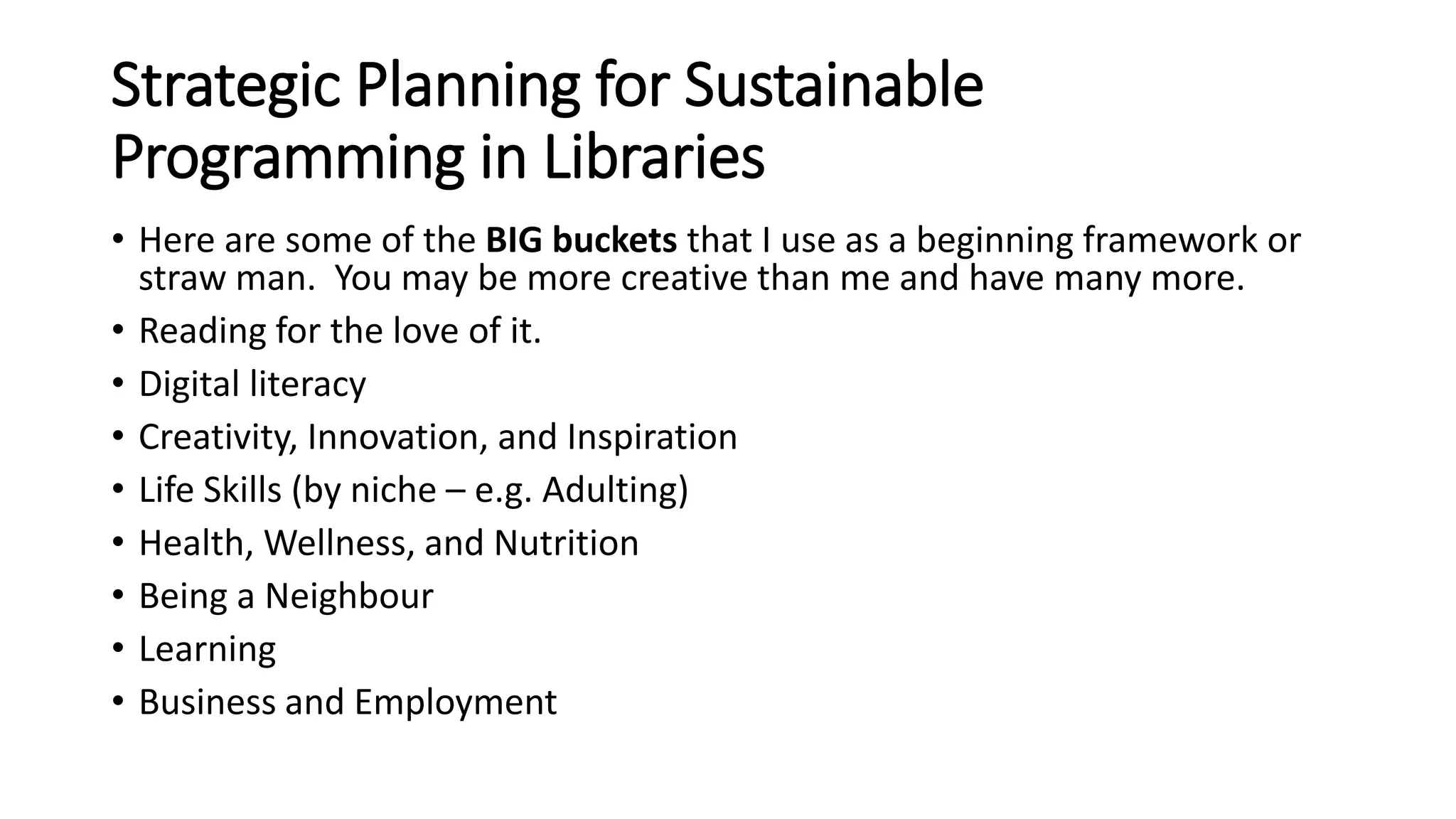
• Here are some of the BIG buckets that I use as a beginning framework or
straw man. You may be more creative than me and have many more.
• Reading for the love of it.
• Digital literacy
• Creativity, Innovation, and Inspiration
• Life Skills (by niche – e.g. Adulting)
• Health, Wellness, and Nutrition
• Being a Neighbour
• Learning
• Business and Employment
Strategic Planning for Sustainable
Programming in Libraries
• By organizing your strategic program plan into frameworks and
marketing it as a series, you build success, marketing power and help
make sense for you and your audiences of what you offer to the
community.
Enjoy your day!
Stephen Abram, MLS, FSLA
Executive Director, Federation of Ontario Public Libraries
Consultant, Lighthouse Consulting Inc.
Cel: 416-669-4855
stephen.abram@gmail.com
Stephen’s Lighthouse Blog
http://stephenslighthouse.com
Facebook, Pinterest, Tumblr, LinkedIn: Stephen Abram
Twitter: @sabram
SlideShare: StephenAbram1
Skype: stephenkabram

Gathering

  • 1.
    Provincial Election June 7,2018 The Gathering May 9, 2018 Stephen Abram, MLS Federation of Ontario Public Libraries Lighthouse Consulting Inc.
  • 2.
    GUEST SPEAKER: Stephen Abram Federationof Ontario Public Libraries
  • 4.
    • In Ontario’s305 public library systems there are 1157 public library branches serving 99.34% of Ontario’s population including indigenous communities. In person, Libraries see 137 in-person visits per minute – over 80 million visits a year. With our 24/7/365 digital services, that rate more than doubles!
  • 5.
    • With 155.8Million visits per year, 426,849 Visits per day, and 17,785 Visits per hour, that comes to 296 visits per minute! There’s simply no other public institution which gets 5 visits every second, all year long.
  • 6.
    • Ontario’s PublicLibraries offer so many fantastic programs equitably for all – over 250,000 in 2016 which attracted over 4.5 Million residents! We’ve grown over 82% in ten years. The public value goes on and on: Early literacy and early learning, career skills, and job help, genealogy, business, entrepreneur and community development, Summer Reading Club, homework help, teen programs, newcomers to Canada, seniors programs, Book Clubs, Culture Days, Makerspaces, and so many more! Choose to visit and learn!
  • 7.
    The Public Libraryvalue proposition is strong and includes (but isn’t limited to): • Excellent Return on Investment for municipalities and the province • Strong Economic Development and Impact (averaging $6 for every $1 invested) • Great Employment and Business Support • Access to all kinds of technology – with talented support • Welcoming New Canadians & Refugees • Provable Early and Adult Literacy Development • Ongoing Lifelong Support for Formal Education and Homework Help • Serving the whole community equitably • Affordable access to community resources • Guided access to Government Services and e-government • Questions Deserve Quality Answers • Support for Cultural Vitality, creativity, and innovation • AND Recognized and Valued Leisure Activities for majority of Ontarians
  • 10.
    The 2018 ProvincialElection You Can Help!
  • 11.
  • 18.
  • 19.
    It can beconfusing . . . but all of the parts fit together Our ASK Open Media Desk Counsel Public Affairs QP DAY The ED & Board CFLA Stats
  • 20.
    Knowing Our Numbersbeyond Volume • Continue to keep our numbers up-to-date. • Build a new file & report based on the early release of 2017 data in 2018. • Make the data more visual Statistics & Measurements
  • 21.
    Marketing Impact &Valueof Public Libraries • Exploit the network web we have created • Move to Phase two • Formalize it as a go-to tool for e-learning • Build LDRI – measure effectiveness Open Media Desk
  • 22.
    Meetings, meetings, meetings •Exploit CFLA membership for national issues • Use the strengths of our Board • Use the strengths in our members • Evaluate whether a QP Day is needed in 2018 • Follow through with building cabinet, MPP and municipal relationships • Continue to expand our relationships with the civil service • Continue to build positive and impactful relationship with our partners (OLA, SOLS, OLS-North, CULC) QP DAY The ED & Board CFLA
  • 23.
    Professional Advice • Weshould move forward with them to: • Achieve new meetings with the new government • Re-group and evaluate • Retain our 2018 successes • Build on our successes Counsel Public Affairs
  • 24.
    Knowing what wewant • We had three formal asks in the 2018 budget • We will have more asks in the future • We are working on less formal influence too • e.g. Regulation 976, PLOG and COLA, School library envelope, etc. • Future consultation activities Our ASK
  • 25.
    Following Through • Municipaland Library Board Resolutions • Provincial Budget • Toolkits for Provincial Election • Toolkits for Municipal Elections • Thank you letters • Re-group at the appropriate times (June, October, …) • Post-election follow-through.
  • 26.
    So now weknow . . . • All the pieces fit together • Let’s ask ourselves if anything is missing • We have a lot of work to do this year!
  • 28.
    Have you seenthe OLCF Funding Outcomes • The BRIDGE Toolkit for assessing technology Impact in Ontario Public Libraries! • For the past two years, Toronto Public Library has been leading a team of all sizes of libraries – including First Nation Public Libraries. Our goal was: • Every Ontarian has convenient, local access to the technology they want and need, and the comfort and confidence to use it, so that they can access economic, educational, social, health and civic opportunities to achieve prosperity, advancement, and overall well-being. • The development team was a diverse group of all types of public libraries. • Innisfil Public Library | Kitchener Public Library | Mattawa Public Library | Naotkamegwanning First Nations Public Library | Perth & District Union Public Library | Toronto Public Library | Wikwemikong First Nation Library | Windsor Public Library
  • 29.
    Of Ontarians donot have Internet access at home or work.
  • 36.
    And, for theNorth! • Valuing Northern Libraries Toolkit • http://home.olsn.ca/resources/valuing- northern-libraries-toolkit • This framework identifies seven areas where libraries contribute to building individual, organizational, and community level capacity. • Cultural Integrity & Regional Identity • Social Inclusion • Cognitive & Literacy Development • Health & Wellness • Engaged Citizens & Safer Communities • Entertainment & Enjoyment • Economic Development
  • 37.
    Ontario Public LibraryOperating Data 2007-2016 Overview, Primer Library Statistics, and Tables • 2016 Ontario Public Library Data Analysis (Main Report) • http://fopl.ca/news/2016-ontario-public-library-data-analysis/ • Preview: Ontario Public Library Data Analysis • http://fopl.ca/news/preview-ontario-public-library-data-analysis/ • Ontario Public Library 2016 Culture Partnerships • http://fopl.ca/news/ontario-public-library-2016-culture-partnerships/ • Highlights of Public Library Education Partnerships: • http://fopl.ca/news/highlights-of-public-library-education-partnerships/ • 3D Printers, Maker Space Labs, and Digital Media Labs, 2015-2016 • http://fopl.ca/news/3d-printers-maker-space-labs-and-digital-media-lab-2015- 2016/ • 2016 Analysis of Public Library Partnerships • http://fopl.ca/news/2016-analysis-of-public-library-partnerships/
  • 38.
    Ontario’s Population Growth Library numbers 20072016 Growth POPULATION Total 11,655,750 13,594,876 17% Per library 38,595 45,016
  • 39.
    Circulation Growth overTen Years CIRCULATION Total (excludes digital) 115,256,552 125,052,817 8% Per library 381,644 414,082
  • 40.
    Growth in Programsover Ten Years PROGRAMS Total number of library programs 137,488 250,344 82% Total Attendance 2,717,774 4,506,217 66% Programs per library 455 829 54% Attendance per library 8,999 14,921 60% Average attendance per capita 0.6 0.8 70%
  • 41.
    Budget growth 10year Cumulative EXPENDITURES Per Capita $ 61.59 $ 62.04 1%
  • 46.
    0 20,000,000 40,000,000 60,000,000 80,000,000 100,000,000 120,000,000 140,000,000 0 200,000,000 400,000,000 600,000,000 800,000,000 1,000,000,000 1,200,000,000 1,400,000,000 1,600,000,000 1,800,000,000 2007 2008 20092010 2011 2012 2013 2014 2015 2016 AnnualVisitsbytype CumulatedTotal2007-2016 Estimated Library Visits Cumulated and Annual Visits by Type, 2007-2016 Cumulated Total Annual Visits in person Annual Visits to Website Annual Visits via social media
  • 53.
    Market Probe CanadaReport CATI and Online surveys 2000 2005 2010 2015 Balanced panels Mid-2015
  • 54.
    Market Probe CanadaReport • 74% of Ontarians report having a library card • A significant number don’t use it for borrowing but still USE the library
  • 55.
    Ways Users Accessthe Public Library Q.2/3/4 Base: Library users (2010 - 757; 2015 - 417). 37% 1% 1% 13% 12% In-Person Internet Phone 33% 2% • The diagrams below depict all past-year library users according to their reported methods of accessing the library. • While in-person only visitors constituted the largest group of library users in 2010, they have been outnumbered by combined in-person/Internet users in 2015. • The proportion of library patrons using all three access methods has also increased over the last five years, while the total percentage visiting the library in person remains extremely high, at 94%. 27% 1% 1% 20% 11% In-Person Internet Phone 36% 3% 2015 2010
  • 56.
    84% 56% 34% 28% 26% 25% 23% 23% 16% 14% 10% 90% 70% 41% 33% 26% 17% 33% 23% 13% 21% 16% 88% 73% 38% 31% 32% 18% 9% 21% 16% 88% 77% 47% 19% 32% 17% 9% 24% 18% 0% 20% 40%60% 80% 100%Q.6a/b Base: Those who personally visited the public library (2000 - 678; 2005 - 713; 2010 - 723; 2015 - 394); households where anyone used the public library (2010 - 843; 2015 - 444). *Wording changed in 2015 from “Access electronic databases.” Reasons for Personally Using the Public Library • Many of the more traditional reasons for using libraries were less often cited versus five years ago, with only the library’s wireless network generating more traffic. Given that this was a multiple mention question, it may be that today’s library users are becoming more selective in determining which library services they choose to use. Borrow books, CDs, DVDs or other materials Get information on a topic of personal interest Read or study Access the Internet using library computers Relax or socialize Use the library's wireless network Access databases / other electronically stored info* Take a child to a program or activity Attend a lecture, program, meeting or training session Work assignment or keep up-to- date at work School or class assignment 86% 59% 44% 35% 31% 31% 27% 25% 18% 21% 27% Total Household (2015) 68% 32% 65% 35% 65% 35% 0% 20% 40% 60% 80% 100% Yes No 2015 2010 2005 2000
  • 57.
    Ways Users Accessthe Public Library Q.2/3/4a/b Base: Library users (804). • Higher library website usage on the part of panel respondents has made the cross-channel usage diagram below look different from the one produced for telephone respondents. • In particular, this diagram shows more combined in-person/Internet users and fewer combined in-person/telephone and in-person-only users. • The proportion of library patrons who reported using all three access methods, however, was not significantly impacted by survey method. 19% 0% 0% 23% 3% In-Person Internet Phone 49% 5%
  • 58.
    A program thatallows people to try out the newest tech devices or applications, such as 3D printers or laser cutters Library kiosks located throughout the community where people can check out books, movies or music without having to go to the library itself A personalized online account that gives you recommendations based on your past library activity A cell phone app that allows you to access library services from your mobile phone An online research service where you could pose questions and get responses from librarians A cell phone app that helps you locate material easily in the library using GPS E-book readers already loaded with the book you want to read Instruction on how to use handheld reading devices and tablets Classes on how to download library e-books to handheld devices A digital media lab where you could create and upload new digital content like your own movies or e-books The Likelihood of Using Library Services • Online survey participants were asked their likelihood of using some new services libraries are either offering or thinking of offering in the future. Interest in these concepts varied, in many cases based on age. • There were very few suggestions made for other services over and above those shown. Other Services Library Should Provide More selection of materials / updated materials 2% Computer / Internet skills / technical devices 2% For kids / students 2% Educational courses / lectures / seminars / community events 2% Hobbies / special interests 2% Quiet space / reading / sitting areas 1% More online services, i.e. card renewals / book / material reserving 1% They do a good job 7% Other 16% No comments / suggestions 65% 19% 15% 15% 16% 10% 12% 12% 9% 9% 7% 36% 35% 35% 29% 33% 27% 26% 26% 24% 24% 55% 50% 49% 44% 44% 39% 38% 35% 33% 31% Very Likely Somewhat Likely Total 64% 46% 57% 39% 61% 39% 62% 24% 43% 37% 54% 19% 45% 34% 31% 40% 30% 38% 42% 21% By Age 18-34 55+ Q.13c/d Base: All respondents (1102).
  • 59.
    Best Way toInform about What’s Going On at the Library Q.13e Base: All respondents (1102). 66% 51% 45% 35% 34% 30% 26% 19% 8% 0% 20% 40% 60% 80% 100% Email Articles in the local paper Information on the library's website Social media Notices at the library Notices in community centres or other public places Inserts with your tax bill or other local government mailings Notices in schools Talks/presentations to community groups • Panel members were asked to identify the best ways to inform them about what’s going on at their local public library. • Email, articles in the local paper, and information posted on the library’s website received the greatest numbers of mentions, in general, with younger people also favouring social media. 59% 73% 40% 63% 36% 48% 46% 22% 31% 34% 28% 32% 20% 32% 21% 12% 6% 12% By Age 18-34 55+
  • 60.
    Believability of PositioningStatements Q.19 Base: All respondents (1102). • Four of the positioning statements tested with online respondents garnered stronger agreement than the rest. • There was least support for libraries providing information that would help people better understand political issues. 56% 54% 50% 46% 34% 32% 31% 30% 29% 28% 26% 26% 25% 19% 0% 20% 40% 60% 80% 100% Public libraries are important because they promote literacy and a love of reading By providing free access to materials and resources, the public library plays an important role in giving everyone a chance to succeed Having a public library improves the quality of life in a community Public libraries are welcoming, friendly places The public library is the only affordable place where the average Ontarian can go for information Public libraries provide many services people would have a hard time finding elsewhere The public library provides valuable resources to increase health literacy within the communities it serves The public library is the best place for people of all ages to go to pursue lifelong learning Public libraries have done a good job of keeping up with new technologies The public library serves as an important meeting place and focal point within the community The public library is continually expanding the services it offers It is very easy to find whatever you are looking for at the public library Now that information is available from so many different sources, people need public libraries more than ever By providing access to information from a wide variety of sources, public libraries promote an understanding of political issues % Strongly Agree
  • 61.
    Programs and Technology Adaptingto Trends – Libraries Rock • Cloud • Partnerships • Tech – beyond mouse and MS Office • To creativity, apps, coding, maker, voice devices • Outreach • Food and beverage • BIG events
  • 62.
    Management Trends • MasterFacility Plans • Institutional Strategic Plans • Strategic Financial Plans (ROI and SROI) • Strategic Technology Plans • Facility Technical Audits and Plans • Strategic Planning for Sustainable Programming in Libraries
  • 64.
    Community Asset Mapping= A Partnership Foundation • Community Assets • Cultural Assets • Social Services Assets
  • 65.
    Strategic Planning forSustainable Programming in Libraries • Focus on Series. For example, if every toddler storytime is marketing and presented to the parents as a 6-part series, even though they can miss one or just attend one – you’ll build greater success. Indeed, at the end of it you’ll have a program that can measure impact too – and not just parent satisfaction. Did the kid get better at clapping, singing, holding the book?
  • 66.
    Strategic Planning forSustainable Programming in Libraries • Series Scheduling and Timing • Focus on Cycles: Build an annual plan with three years in mind • Annual and special days • Quarterly • Weekly / Monthly • Specific Cycles (school year, winter break, College year/reading week. • Local events, fairs, and celebration alignments • National special days – from St. Valentine’s to National Doughnut Day! • ALA, PLA, CFLA, OLA, etc. ‘weeks’ and more, like Freedom to Read, Challenged Book Week, National Library Month, etc.
  • 67.
    Strategic Planning forSustainable Programming in Libraries • A focus on cycles for an annual calendarized basis has a critical benefit of allowing management to focus the resources and attention on the major goals and not allow one program to drag programming productivity down. If your library is eating up all its resources on children’s programs and under-resourcing teens or adults (which is common) what are the strategies to serve your major populations?
  • 68.
    Strategic Planning forSustainable Programming in Libraries • Use these filters to evaluate your series • Targeted • Replicable/Repeatable • Trialable • Testable/Measureable • Shareable • Scalable • Size • Certificates • Competition • Partnerships and Coopetition • Facilities
  • 69.
    Strategic Planning forSustainable Programming in Libraries The Power of Buckets • There are big buckets and little buckets. You don’t need to fill them up rights away – that’s what a five year plan is for – building a full bucket of programs that align with your strategic community learning and engagement goals. Note: Don’t confuse markets with your program buckets. The market/audience targets are a matrix overlay that give another dimension to your strategies. Programs that are planned for teens, tweens, toddlers, adults, or seniors don’t provide you with the lifelong arc you want your patrons to follow in developing their personal relationship with the library. Also, don’t confuse your foundations – collections, rooms, staff, resources, technologies, etc. with a program. Those are necessary foundations for success but when library cardholders talk about the value of the library to them they use action verbs like reading, meeting and making friends, chatting, learning, and more. The value is found in verbs not nouns.
  • 70.
    Strategic Planning forSustainable Programming in Libraries • Here are some of the BIG buckets that I use as a beginning framework or straw man. You may be more creative than me and have many more. • Reading for the love of it. • Digital literacy • Creativity, Innovation, and Inspiration • Life Skills (by niche – e.g. Adulting) • Health, Wellness, and Nutrition • Being a Neighbour • Learning • Business and Employment
  • 71.
    Strategic Planning forSustainable Programming in Libraries • By organizing your strategic program plan into frameworks and marketing it as a series, you build success, marketing power and help make sense for you and your audiences of what you offer to the community.
  • 72.
    Enjoy your day! StephenAbram, MLS, FSLA Executive Director, Federation of Ontario Public Libraries Consultant, Lighthouse Consulting Inc. Cel: 416-669-4855 stephen.abram@gmail.com Stephen’s Lighthouse Blog http://stephenslighthouse.com Facebook, Pinterest, Tumblr, LinkedIn: Stephen Abram Twitter: @sabram SlideShare: StephenAbram1 Skype: stephenkabram