Medication Safety Research: Types
and Opportunities
Monira Alwhaibi, Assistant Professor
Clinical Pharmacy Department, College of Pharmacy
Medication Safety Research Chair, King Saud University, Riyadh, Saudi Arabia
1
Medication Errors
 Any preventable event that may cause or lead to inappropriate medication use
or patient harm
 These errors may be related to professional practice, health care products,
procedures, and systems, including prescribing; order communication; product
labelling, packaging, and nomenclature; compounding; dispensing;
distribution; administration; education; monitoring; and use
2
The National Coordinating Council for Medication Error Reporting and Prevention (NCCMERP)
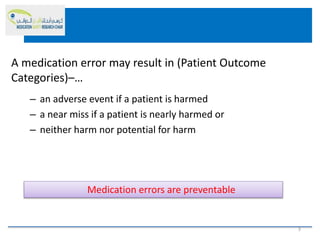
– an adverse event if a patient is harmed
– a near miss if a patient is nearly harmed or
– neither harm nor potential for harm
A medication error may result in (Patient Outcome
Categories)–…
Medication errors are preventable
3
Why do we need Research on Medication Safety
• Understand the factors that cause Medication Errors
• A step to reduce Medication Errors
• It is difficult to reduce or eliminate medication errors when information on
their prevalence is absent, inaccurate, or contradictory
• One of the Institute of Medicine (IOM) priority area for transforming health
care
4
Raebel, M. A., Chester, E. A., Brand, D. W., & Magid, D. J. (2008). Imbedding Research in Practice to Improve Medication Safety.
Conducting Research on Medication Safety
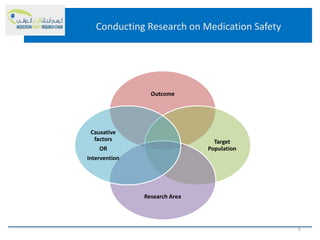
Outcome
Target
Population
Research Area
Causative
factors
OR
Intervention
5
Epidemiological Formula--
Mathematical Consideration
Y = α + βX1 + βX2 + βX3 + βX4+…..+ε
6
Causative
factors/Intervention
Outcome
Conducting Research on Medication Safety
Outcome
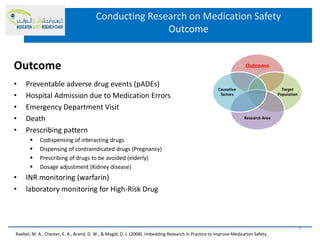
• Preventable adverse drug events (pADEs)
• Hospital Admission due to Medication Errors
• Emergency Department Visit
• Death
• Prescribing pattern
 Codispensing of interacting drugs
 Dispensing of contraindicated drugs (Pregnancy)
 Prescribing of drugs to be avoided (elderly)
 Dosage adjustment (Kidney disease)
• INR monitoring (warfarin)
• laboratory monitoring for High-Risk Drug
Outcome Outcome
Target
Population
Research Area
Causative
factors
Raebel, M. A., Chester, E. A., Brand, D. W., & Magid, D. J. (2008). Imbedding Research in Practice to Improve Medication Safety.
7
Conducting Research on Medication Safety
Research Area
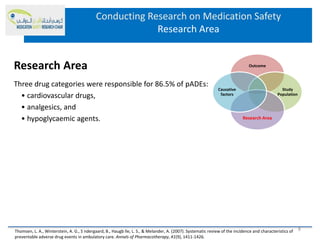
Three drug categories were responsible for 86.5% of pADEs:
• cardiovascular drugs,
• analgesics, and
• hypoglycaemic agents.
Research Area Outcome
Study
Population
Research Area
Causative
factors
Thomsen, L. A., Winterstein, A. G., S ndergaard, B., Haugb lle, L. S., & Melander, A. (2007). Systematic review of the incidence and characteristics of
preventable adverse drug events in ambulatory care. Annals of Pharmacotherapy, 41(9), 1411-1426.
8
Conducting Research on Medication Safety
Research Area
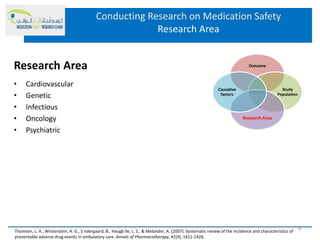
• Cardiovascular
• Genetic
• Infectious
• Oncology
• Psychiatric
Research Area Outcome
Study
Population
Research Area
Causative
factors
Thomsen, L. A., Winterstein, A. G., S ndergaard, B., Haugb lle, L. S., & Melander, A. (2007). Systematic review of the incidence and characteristics of
preventable adverse drug events in ambulatory care. Annals of Pharmacotherapy, 41(9), 1411-1426.
9
Conducting Research on Medication Safety
Study population
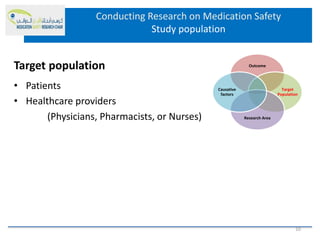
• Patients
• Healthcare providers
(Physicians, Pharmacists, or Nurses)
Target population Outcome
Target
Population
Research Area
Causative
factors
10
Data indicated
5,366 medication
error reports
68.2% resulted in
serious patient
outcomes
9.8% were fatal
48.6% occurred in
patients over 60
years
Improper dose
(40.9%)
Wrong drug (16%)
Wrong route of
administration
(9.5%)
11
Phillips, J., Beam, S., Brinker, A., Holquist, C., Honig, P., Lee, L. Y., & Pamer, C. (2001). Retrospective analysis of mortalities associated with medication
errors. American Journal of Health-System Pharmacy, 58(19), 1835-1841.
Factors related to safety Issues in Clinical Practice
• Human Factors
• Process Factors
• System Factors
The National Coordinating Council for Medication Error Reporting and Prevention (NCCMERP) , NCC MERP Taxonomy of Medication Errors
Outcome
Target
Population
Research Area
Causative
factors
Causative Factors
12
Factors related to safety Issues in Clinical Practice
• Individual characteristics
• Skill/education/ experience
• Knowledge of medications
• Fatigue/Lack of Sleep
• Miscalculation of Dosage or Infusion Rate
• Inadequate screening for allergies, interactions, etc.
Human Factors
The National Coordinating Council for Medication Error Reporting and Prevention (NCCMERP) , NCC MERP Taxonomy of Medication Errors
13
Factors related to safety Issues in Clinical Practice
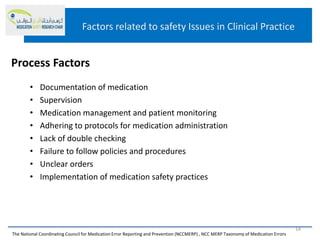
• Documentation of medication
• Supervision
• Medication management and patient monitoring
• Adhering to protocols for medication administration
• Lack of double checking
• Failure to follow policies and procedures
• Unclear orders
• Implementation of medication safety practices
Process Factors
The National Coordinating Council for Medication Error Reporting and Prevention (NCCMERP) , NCC MERP Taxonomy of Medication Errors
14
Factors related to safety Issues in Clinical Practice
• Workload and staffing
• Organizational climate (Lighting, Noise Level , etc.)
• Length of work shift
• Frequent Interruptions and distractions
• Communication systems between health care practitioners
• Patient counselling
System Factors
The National Coordinating Council for Medication Error Reporting and Prevention (NCCMERP) , NCC MERP Taxonomy of Medication Errors
15
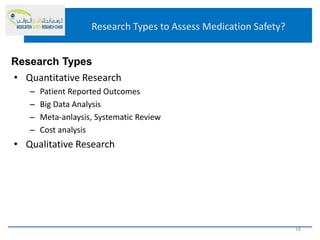
Research Types to Assess Medication Safety?
• Quantitative Research
– Patient Reported Outcomes
– Big Data Analysis
– Meta-anlaysis, Systematic Review
– Cost analysis
• Qualitative Research
Research Types
16
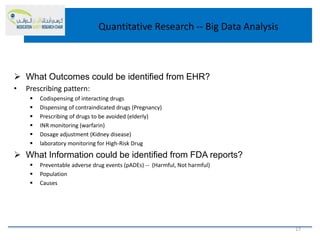
Quantitative Research -- Big Data Analysis
 What Outcomes could be identified from EHR?
• Prescribing pattern:
 Codispensing of interacting drugs
 Dispensing of contraindicated drugs (Pregnancy)
 Prescribing of drugs to be avoided (elderly)
 INR monitoring (warfarin)
 Dosage adjustment (Kidney disease)
 laboratory monitoring for High-Risk Drug
 What Information could be identified from FDA reports?
 Preventable adverse drug events (pADEs) -- (Harmful, Not harmful)
 Population
 Causes
17
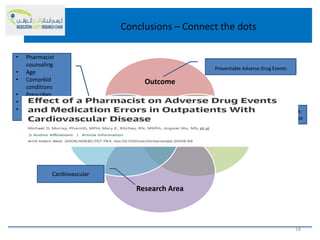
Conclusions – Connect the dots
18
Outcome
Target
Population
Research Area
Causative
factors
Preventable Adverse Drug Events
Elderly Patients with
cardiovascular disease
Cardiovascular
• Pharmacist
counseling
• Age
• Comorbid
conditions
• Prescriber
• Encounter type
• Polypharmacy
Use
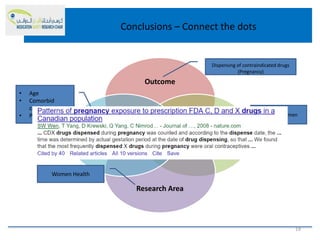
Conclusions – Connect the dots
19
Outcome
Target
Population
Research Area
Causative
factors
Dispensing of contraindicated drugs
(Pregnancy)
Pregnant Women
Women Health
• Age
• Comorbid
conditions
• Prescriber
20

Msrc types research (1)

  • 1.
    Medication Safety Research:Types and Opportunities Monira Alwhaibi, Assistant Professor Clinical Pharmacy Department, College of Pharmacy Medication Safety Research Chair, King Saud University, Riyadh, Saudi Arabia 1
  • 2.
    Medication Errors  Anypreventable event that may cause or lead to inappropriate medication use or patient harm  These errors may be related to professional practice, health care products, procedures, and systems, including prescribing; order communication; product labelling, packaging, and nomenclature; compounding; dispensing; distribution; administration; education; monitoring; and use 2 The National Coordinating Council for Medication Error Reporting and Prevention (NCCMERP)
  • 3.
    – an adverseevent if a patient is harmed – a near miss if a patient is nearly harmed or – neither harm nor potential for harm A medication error may result in (Patient Outcome Categories)–… Medication errors are preventable 3
  • 4.
    Why do weneed Research on Medication Safety • Understand the factors that cause Medication Errors • A step to reduce Medication Errors • It is difficult to reduce or eliminate medication errors when information on their prevalence is absent, inaccurate, or contradictory • One of the Institute of Medicine (IOM) priority area for transforming health care 4 Raebel, M. A., Chester, E. A., Brand, D. W., & Magid, D. J. (2008). Imbedding Research in Practice to Improve Medication Safety.
  • 5.
    Conducting Research onMedication Safety Outcome Target Population Research Area Causative factors OR Intervention 5
  • 6.
    Epidemiological Formula-- Mathematical Consideration Y= α + βX1 + βX2 + βX3 + βX4+…..+ε 6 Causative factors/Intervention Outcome
  • 7.
    Conducting Research onMedication Safety Outcome • Preventable adverse drug events (pADEs) • Hospital Admission due to Medication Errors • Emergency Department Visit • Death • Prescribing pattern  Codispensing of interacting drugs  Dispensing of contraindicated drugs (Pregnancy)  Prescribing of drugs to be avoided (elderly)  Dosage adjustment (Kidney disease) • INR monitoring (warfarin) • laboratory monitoring for High-Risk Drug Outcome Outcome Target Population Research Area Causative factors Raebel, M. A., Chester, E. A., Brand, D. W., & Magid, D. J. (2008). Imbedding Research in Practice to Improve Medication Safety. 7
  • 8.
    Conducting Research onMedication Safety Research Area Three drug categories were responsible for 86.5% of pADEs: • cardiovascular drugs, • analgesics, and • hypoglycaemic agents. Research Area Outcome Study Population Research Area Causative factors Thomsen, L. A., Winterstein, A. G., S ndergaard, B., Haugb lle, L. S., & Melander, A. (2007). Systematic review of the incidence and characteristics of preventable adverse drug events in ambulatory care. Annals of Pharmacotherapy, 41(9), 1411-1426. 8
  • 9.
    Conducting Research onMedication Safety Research Area • Cardiovascular • Genetic • Infectious • Oncology • Psychiatric Research Area Outcome Study Population Research Area Causative factors Thomsen, L. A., Winterstein, A. G., S ndergaard, B., Haugb lle, L. S., & Melander, A. (2007). Systematic review of the incidence and characteristics of preventable adverse drug events in ambulatory care. Annals of Pharmacotherapy, 41(9), 1411-1426. 9
  • 10.
    Conducting Research onMedication Safety Study population • Patients • Healthcare providers (Physicians, Pharmacists, or Nurses) Target population Outcome Target Population Research Area Causative factors 10
  • 11.
    Data indicated 5,366 medication errorreports 68.2% resulted in serious patient outcomes 9.8% were fatal 48.6% occurred in patients over 60 years Improper dose (40.9%) Wrong drug (16%) Wrong route of administration (9.5%) 11 Phillips, J., Beam, S., Brinker, A., Holquist, C., Honig, P., Lee, L. Y., & Pamer, C. (2001). Retrospective analysis of mortalities associated with medication errors. American Journal of Health-System Pharmacy, 58(19), 1835-1841.
  • 12.
    Factors related tosafety Issues in Clinical Practice • Human Factors • Process Factors • System Factors The National Coordinating Council for Medication Error Reporting and Prevention (NCCMERP) , NCC MERP Taxonomy of Medication Errors Outcome Target Population Research Area Causative factors Causative Factors 12
  • 13.
    Factors related tosafety Issues in Clinical Practice • Individual characteristics • Skill/education/ experience • Knowledge of medications • Fatigue/Lack of Sleep • Miscalculation of Dosage or Infusion Rate • Inadequate screening for allergies, interactions, etc. Human Factors The National Coordinating Council for Medication Error Reporting and Prevention (NCCMERP) , NCC MERP Taxonomy of Medication Errors 13
  • 14.
    Factors related tosafety Issues in Clinical Practice • Documentation of medication • Supervision • Medication management and patient monitoring • Adhering to protocols for medication administration • Lack of double checking • Failure to follow policies and procedures • Unclear orders • Implementation of medication safety practices Process Factors The National Coordinating Council for Medication Error Reporting and Prevention (NCCMERP) , NCC MERP Taxonomy of Medication Errors 14
  • 15.
    Factors related tosafety Issues in Clinical Practice • Workload and staffing • Organizational climate (Lighting, Noise Level , etc.) • Length of work shift • Frequent Interruptions and distractions • Communication systems between health care practitioners • Patient counselling System Factors The National Coordinating Council for Medication Error Reporting and Prevention (NCCMERP) , NCC MERP Taxonomy of Medication Errors 15
  • 16.
    Research Types toAssess Medication Safety? • Quantitative Research – Patient Reported Outcomes – Big Data Analysis – Meta-anlaysis, Systematic Review – Cost analysis • Qualitative Research Research Types 16
  • 17.
    Quantitative Research --Big Data Analysis  What Outcomes could be identified from EHR? • Prescribing pattern:  Codispensing of interacting drugs  Dispensing of contraindicated drugs (Pregnancy)  Prescribing of drugs to be avoided (elderly)  INR monitoring (warfarin)  Dosage adjustment (Kidney disease)  laboratory monitoring for High-Risk Drug  What Information could be identified from FDA reports?  Preventable adverse drug events (pADEs) -- (Harmful, Not harmful)  Population  Causes 17
  • 18.
    Conclusions – Connectthe dots 18 Outcome Target Population Research Area Causative factors Preventable Adverse Drug Events Elderly Patients with cardiovascular disease Cardiovascular • Pharmacist counseling • Age • Comorbid conditions • Prescriber • Encounter type • Polypharmacy Use
  • 19.
    Conclusions – Connectthe dots 19 Outcome Target Population Research Area Causative factors Dispensing of contraindicated drugs (Pregnancy) Pregnant Women Women Health • Age • Comorbid conditions • Prescriber
  • 20.

Editor's Notes

  • #6 In order to do a research on Medication Safety, we need to formulate our Research Question Causative factors Target Population Area of Research Outcome
  • #7 he basic require- ments for epidemiological study include: a clear study design; and an operational definition for the numerator, the condition to be evaluated; and for the denominator, the population in which it is to be evaluated.These require- ments pose problems when the object of study is error Defining Medication Error?
  • #8 Using knowledge gained from the epidemiologic studies, we designed, implemented, and evaluated a series of projects for patients who: (1) are prescribed critically interacting drugs (Critical Drug Interactions); (2) receive anticoagulation treatment and are prescribed drugs that interact with warfarin (Warfarin-Drug Interactions); (3) receive high-risk drugs requiring laboratory monitoring (High-Risk Drug Lab Monitoring); (4) have chronic kidney disease and are prescribed drugs requiring dosage adjustment based on renal function (Renal Dosing); (5) are 1 pregnant and are prescribed drugs that are contraindicated during pregnancy (Prescribing during Pregnancy); or (6) are elderly and are prescribed drugs considered inappropriate in that age group (Prescribing in the Elderly).
  • #11 Nursing staff do employ the traditional 'five right' principles - right patient, right medication, right dose, right route and right time - for safe administration. 
  • #12 The data indicated 5,366 medication error reports. Fifty-nine reports were excluded and classified as duplicate reports or intentional overdoses. Of the remaining medication error reports, 68.2% resulted in serious patient outcomes and 9.8% were fatal. Of the 469 fatal medication error reports, 48.6% occurred in patients over 60 years. The most common types of errors resulting in patient death involved administering an improper dose (40.9%), administering the wrong drug (16%), and using the wrong route of administration (9.5%). The most common causes of errors were performance and knowledge deficits (44%) and communication errors (15.8%). Fatal medication errors accounted for approximately 10% of medication errors reported to FDA and were most frequently the result of improper dosing of the intended drug and administration of an incorrect drug. A review of case reports of medication errors from 1993 to 1998 yielded information on the most frequent causes of and contributing factors involved in fatal medication errors.