LECTURE OF SUBJECT :
Dr. sharafaldin Al-musawi
College of Biotecholgy
LECTURE: 1
SUBJECT: Animal Tissue culture
LEVEL: 4
What is tissue culture?
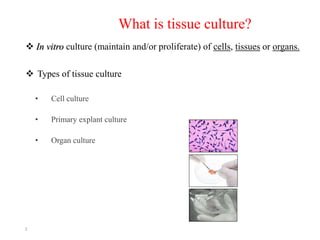
 In vitro culture (maintain and/or proliferate) of cells, tissues or organs.
 Types of tissue culture
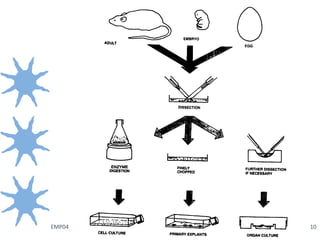
• Cell culture
• Primary explant culture
• Organ culture
2
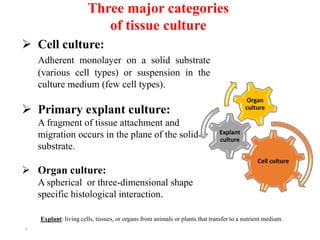
Cell culture
Explant
culture
Organ
culture
3
 Cell culture:
Adherent monolayer on a solid substrate
(various cell types) or suspension in the
culture medium (few cell types).
 Primary explant culture:
A fragment of tissue attachment and
migration occurs in the plane of the solid
substrate.
 Organ culture:
A spherical or three-dimensional shape
specific histological interaction.
Three major categories
of tissue culture
Explant: living cells, tissues, or organs from animals or plants that transfer to a nutrient medium.
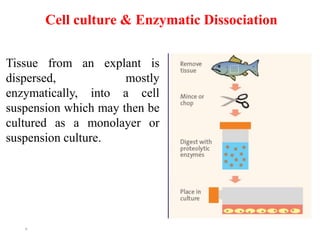
Cell culture & Enzymatic Dissociation
4
Tissue from an explant is
dispersed, mostly
enzymatically, into a cell
suspension which may then be
cultured as a monolayer or
suspension culture.
Advantages & Disadvantages
 Advantages
 Development of a cell line over several generations
 Scale-up is possible
 Absolute control of physical environment
 Homogeneity of sample
 Less compound needed than in animal models
 Disadvantages
 Cells may lose some differentiated characteristics.
 Hard to maintain
 Only grow small amount of tissue at high cost
 Dedifferentiation
 Instability, aneuploidy
5
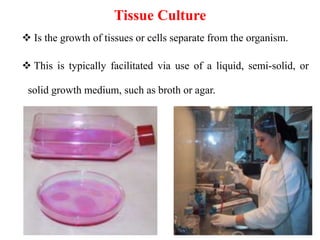
Tissue Culture
 Is the growth of tissues or cells separate from the organism.
 This is typically facilitated via use of a liquid, semi-solid, or
solid growth medium, such as broth or agar.
6
7
Advantages
 Some normal functions may be maintained.
 Better than organ culture for scale-up but not
ideal.
Disadvantages
 Original organization of tissue is lost.
Advantages & Disadvantages
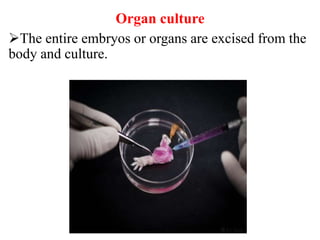
The entire embryos or organs are excised from the
body and culture.
Organ culture
 Advantages
 Normal physiological functions are maintained.
 Cells remain fully differentiated.
 Disadvantages
 Scale-up is not recommended.
 Growth is slow.
 Fresh explantation is required for every experiment.
Organ culture
EMP04 10

Animal tissue culture lecture 1

  • 1.
    LECTURE OF SUBJECT: Dr. sharafaldin Al-musawi College of Biotecholgy LECTURE: 1 SUBJECT: Animal Tissue culture LEVEL: 4
  • 2.
    What is tissueculture?  In vitro culture (maintain and/or proliferate) of cells, tissues or organs.  Types of tissue culture • Cell culture • Primary explant culture • Organ culture 2
  • 3.
    Cell culture Explant culture Organ culture 3  Cellculture: Adherent monolayer on a solid substrate (various cell types) or suspension in the culture medium (few cell types).  Primary explant culture: A fragment of tissue attachment and migration occurs in the plane of the solid substrate.  Organ culture: A spherical or three-dimensional shape specific histological interaction. Three major categories of tissue culture Explant: living cells, tissues, or organs from animals or plants that transfer to a nutrient medium.
  • 4.
    Cell culture &Enzymatic Dissociation 4 Tissue from an explant is dispersed, mostly enzymatically, into a cell suspension which may then be cultured as a monolayer or suspension culture.
  • 5.
    Advantages & Disadvantages Advantages  Development of a cell line over several generations  Scale-up is possible  Absolute control of physical environment  Homogeneity of sample  Less compound needed than in animal models  Disadvantages  Cells may lose some differentiated characteristics.  Hard to maintain  Only grow small amount of tissue at high cost  Dedifferentiation  Instability, aneuploidy 5
  • 6.
    Tissue Culture  Isthe growth of tissues or cells separate from the organism.  This is typically facilitated via use of a liquid, semi-solid, or solid growth medium, such as broth or agar. 6
  • 7.
    7 Advantages  Some normalfunctions may be maintained.  Better than organ culture for scale-up but not ideal. Disadvantages  Original organization of tissue is lost. Advantages & Disadvantages
  • 8.
    The entire embryosor organs are excised from the body and culture. Organ culture
  • 9.
     Advantages  Normalphysiological functions are maintained.  Cells remain fully differentiated.  Disadvantages  Scale-up is not recommended.  Growth is slow.  Fresh explantation is required for every experiment. Organ culture
  • 10.