
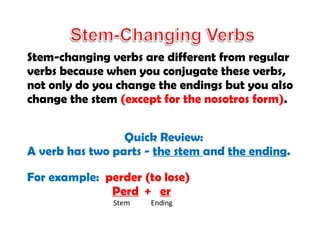
Stem-changing verbs are different from regular verbs because when you conjugate these verbs, not only do you change the endings but you also change the stem  (except for the nosotros form) .   Quick Review:  A verb has two parts -  the stem  and  the ending .  For example:  perder (to lose)  Perd   +  er Stem  Ending
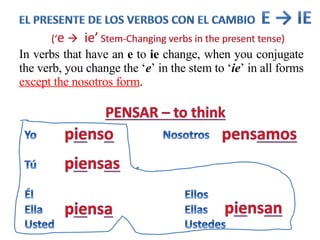
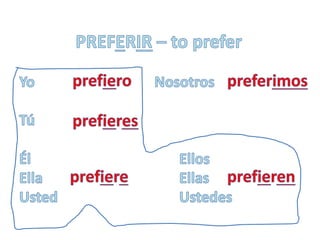
In verbs that have an  e  to  ie  change, when you conjugate the verb, you change the ‘ e ’ in the stem to ‘ ie ’ in all forms  except the nosotros form .
 
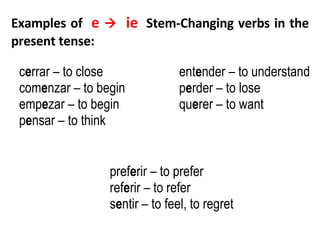
c e rrar – to close com e nzar – to begin emp e zar – to begin p e nsar – to think Examples of  e     ie   Stem-Changing verbs in the present tense: ent e nder – to understand p e rder – to lose qu e rer – to want pref e rir – to prefer ref e rir – to refer s e ntir – to feel, to regret
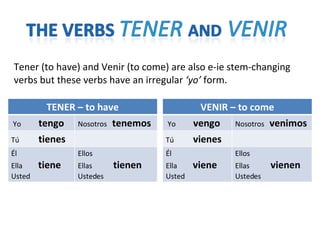
Tener (to have) and Venir (to come) are also e-ie stem-changing verbs but these verbs have an irregular  ‘yo’  form.  TENER – to have Yo  tengo Nosotros  tenemos Tú  tienes Él  Ella  tiene Usted Ellos Ellas  tienen Ustedes VENIR – to come Yo  vengo Nosotros  venimos Tú  vienes Él  Ella  viene Usted Ellos Ellas  vienen Ustedes
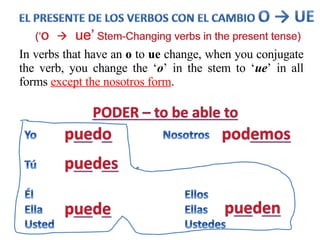
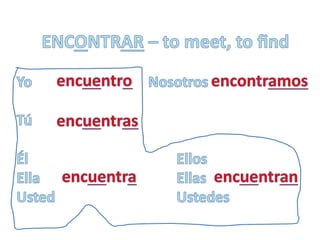
In verbs that have an  o  to  ue  change, when you conjugate the verb, you change the ‘ o ’ in the stem to ‘ ue ’ in all forms  except the nosotros form .
 
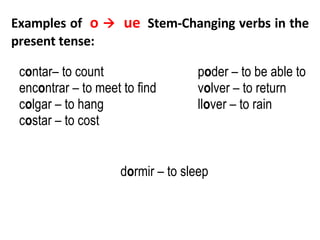
c o ntar– to count enc o ntrar – to meet to find c o lgar – to hang c o star – to cost Examples of  o     ue   Stem-Changing verbs in the present tense: p o der – to be able to v o lver – to return ll o ver – to rain d o rmir – to sleep
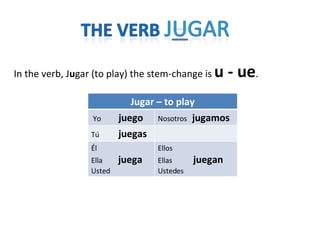
In the verb, J u gar (to play) the stem-change is  u - ue .  Jugar – to play Yo  juego Nosotros  jugamos Tú  juegas Él  Ella  juega Usted Ellos Ellas  juegan Ustedes
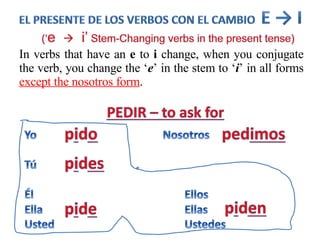
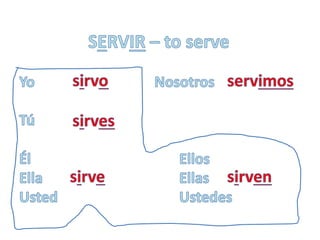
In verbs that have an  e  to  i  change, when you conjugate the verb, you change the ‘ e ’ in the stem to ‘ i ’ in all forms  except the nosotros form .
 
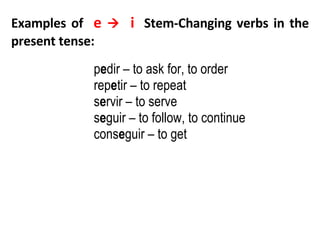
p e dir – to ask for, to order rep e tir – to repeat s e rvir – to serve s e guir – to follow, to continue cons e guir – to get Examples of  e     i   Stem-Changing verbs in the present tense:
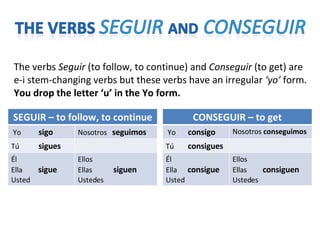
The verbs  Seguir  (to follow, to continue) and  Conseguir  (to get) are e-i stem-changing verbs but these verbs have an irregular  ‘yo’  form.  You drop the letter ‘u’ in the Yo form.  SEGUIR – to follow, to continue Yo  sigo Nosotros  seguimos Tú  sigues Él  Ella  sigue Usted Ellos Ellas  siguen Ustedes CONSEGUIR – to get Yo  consigo Nosotros  conseguimos Tú  consigues Él  Ella  consigue Usted Ellos Ellas  consiguen Ustedes

Stem Changing Verbs in the Present Tense

  • 1.
  • 2.
    Stem-changing verbs aredifferent from regular verbs because when you conjugate these verbs, not only do you change the endings but you also change the stem (except for the nosotros form) . Quick Review: A verb has two parts - the stem and the ending . For example: perder (to lose) Perd + er Stem Ending
  • 3.
    In verbs thathave an e to ie change, when you conjugate the verb, you change the ‘ e ’ in the stem to ‘ ie ’ in all forms except the nosotros form .
  • 4.
  • 5.
    c e rrar– to close com e nzar – to begin emp e zar – to begin p e nsar – to think Examples of e  ie Stem-Changing verbs in the present tense: ent e nder – to understand p e rder – to lose qu e rer – to want pref e rir – to prefer ref e rir – to refer s e ntir – to feel, to regret
  • 6.
    Tener (to have)and Venir (to come) are also e-ie stem-changing verbs but these verbs have an irregular ‘yo’ form. TENER – to have Yo tengo Nosotros tenemos Tú tienes Él Ella tiene Usted Ellos Ellas tienen Ustedes VENIR – to come Yo vengo Nosotros venimos Tú vienes Él Ella viene Usted Ellos Ellas vienen Ustedes
  • 7.
    In verbs thathave an o to ue change, when you conjugate the verb, you change the ‘ o ’ in the stem to ‘ ue ’ in all forms except the nosotros form .
  • 8.
  • 9.
    c o ntar–to count enc o ntrar – to meet to find c o lgar – to hang c o star – to cost Examples of o  ue Stem-Changing verbs in the present tense: p o der – to be able to v o lver – to return ll o ver – to rain d o rmir – to sleep
  • 10.
    In the verb,J u gar (to play) the stem-change is u - ue . Jugar – to play Yo juego Nosotros jugamos Tú juegas Él Ella juega Usted Ellos Ellas juegan Ustedes
  • 11.
    In verbs thathave an e to i change, when you conjugate the verb, you change the ‘ e ’ in the stem to ‘ i ’ in all forms except the nosotros form .
  • 12.
  • 13.
    p e dir– to ask for, to order rep e tir – to repeat s e rvir – to serve s e guir – to follow, to continue cons e guir – to get Examples of e  i Stem-Changing verbs in the present tense:
  • 14.
    The verbs Seguir (to follow, to continue) and Conseguir (to get) are e-i stem-changing verbs but these verbs have an irregular ‘yo’ form. You drop the letter ‘u’ in the Yo form. SEGUIR – to follow, to continue Yo sigo Nosotros seguimos Tú sigues Él Ella sigue Usted Ellos Ellas siguen Ustedes CONSEGUIR – to get Yo consigo Nosotros conseguimos Tú consigues Él Ella consigue Usted Ellos Ellas consiguen Ustedes