DELAMINATION
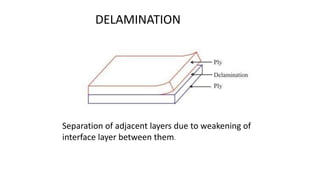
Separation of adjacent layers due to weakening of
interface layer between them.
Causes of delamination
a) Manufacturing Defects
1 .Improper laying of laminae
2 .insufficient curing temperature; pressure and duration of curing
3 . Air pockets and inclusions
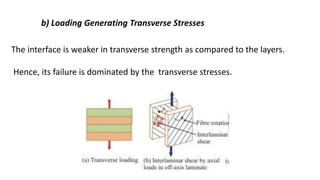
b) Loading Generating Transverse Stresses
The interface is weaker in transverse strength as compared to the layers.
Hence, its failure is dominated by the transverse stresses.
c) Laminate Geometry
1.Free edges
The free edges of the laminate have very high transverse normal and
shear stresses.
It is shown that significant interlaminar stresses are induced in regions
near the laminate free edges.
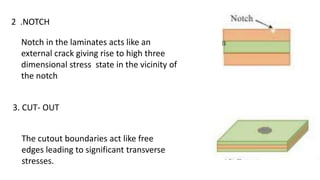
2 .NOTCH
Notch in the laminates acts like an
external crack giving rise to high three
dimensional stress state in the vicinity of
the notch
3. CUT- OUT
The cutout boundaries act like free
edges leading to significant transverse
stresses.
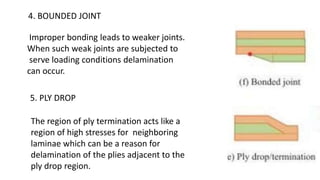
4. BOUNDED JOINT
Improper bonding leads to weaker joints.
When such weak joints are subjected to
serve loading conditions delamination
can occur.
5. PLY DROP
The region of ply termination acts like a
region of high stresses for neighboring
laminae which can be a reason for
delamination of the plies adjacent to the
ply drop region.
EFFECTS OF DELAMINATION
1 .Reduces the strength and stiffness
2. It causes stress concentration in load bearing plies and a local
instability leading to a further growth of delamination which results
in a compressive failure of the laminate.
MATRIX CRACKING
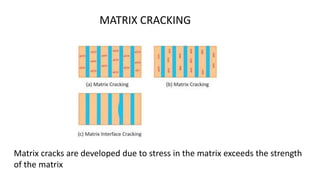
Matrix cracks are developed due to stress in the matrix exceeds the strength
of the matrix
Two types of matrix cracks
The cracks are either perpendicular or parallel to the fibre direction.
> In the first type, the cracks are developed when axial stress in
the lamina is tensile in nature.
>In the second type, the cracks are developed when the inplane
transverse stress in the lamina is tensile in nature.
Causes of matrix cracking
Coupled Micro-Macro level Failure Mechanisms
There can be another scenario that this crack terminates at the neighboring
interface. This crack front act as a stress concentration site for interface
between the adjacent layer causing it to weaken, thus initiating delamination
crack in the interface.
Suppression of Delamination
The primary cause of delamination is the low inter laminar fracture
toughness.
This is due to brittle nature of most resins (epoxy) used as matrix
material, which have low mode I fracture toughness.
The suggested models for improving this property are:
>.Adding second phase materials to matrix like rubber;
chopped fibre, fibrils, etc

Delamination in composites

  • 1.
    DELAMINATION Separation of adjacentlayers due to weakening of interface layer between them.
  • 2.
    Causes of delamination a)Manufacturing Defects 1 .Improper laying of laminae 2 .insufficient curing temperature; pressure and duration of curing 3 . Air pockets and inclusions
  • 3.
    b) Loading GeneratingTransverse Stresses The interface is weaker in transverse strength as compared to the layers. Hence, its failure is dominated by the transverse stresses.
  • 4.
    c) Laminate Geometry 1.Freeedges The free edges of the laminate have very high transverse normal and shear stresses. It is shown that significant interlaminar stresses are induced in regions near the laminate free edges.
  • 5.
    2 .NOTCH Notch inthe laminates acts like an external crack giving rise to high three dimensional stress state in the vicinity of the notch 3. CUT- OUT The cutout boundaries act like free edges leading to significant transverse stresses.
  • 6.
    4. BOUNDED JOINT Improperbonding leads to weaker joints. When such weak joints are subjected to serve loading conditions delamination can occur. 5. PLY DROP The region of ply termination acts like a region of high stresses for neighboring laminae which can be a reason for delamination of the plies adjacent to the ply drop region.
  • 7.
    EFFECTS OF DELAMINATION 1.Reduces the strength and stiffness 2. It causes stress concentration in load bearing plies and a local instability leading to a further growth of delamination which results in a compressive failure of the laminate.
  • 8.
    MATRIX CRACKING Matrix cracksare developed due to stress in the matrix exceeds the strength of the matrix
  • 9.
    Two types ofmatrix cracks The cracks are either perpendicular or parallel to the fibre direction. > In the first type, the cracks are developed when axial stress in the lamina is tensile in nature. >In the second type, the cracks are developed when the inplane transverse stress in the lamina is tensile in nature. Causes of matrix cracking
  • 10.
    Coupled Micro-Macro levelFailure Mechanisms There can be another scenario that this crack terminates at the neighboring interface. This crack front act as a stress concentration site for interface between the adjacent layer causing it to weaken, thus initiating delamination crack in the interface.
  • 11.
    Suppression of Delamination Theprimary cause of delamination is the low inter laminar fracture toughness. This is due to brittle nature of most resins (epoxy) used as matrix material, which have low mode I fracture toughness. The suggested models for improving this property are: >.Adding second phase materials to matrix like rubber; chopped fibre, fibrils, etc