Growing Seed Crops 
Russell T. Nagata 
College of Tropical Agri. and Human Resources 
Komohana Research and Education Center 
Hawai’i Public Seed Initiative 
Seed Saving and Production Basics 
Hilo, Hawaii 
russelln@hawaii.edu
Reasons for Self 
Seed Production 
 Heirloom Varieties 
 Cheaper? 
 Sustainability/Independence 
 Change Variety Makeup 
 Opportunity 
Hawai’i Public Seed Initiative 
Seed Saving and Production Basics
What to Save From? 
 Heirlooms 
 Self Pollinated Crops 
 Annuals 
 Open Pollinated Varieties 
 No Hybrids Unless… 
Hawai’i Public Seed Initiative 
Seed Saving and Production Basics
Maintaining Genetic 
Diversity 
 How Many Plants to Keep 
 Mating Biology 
 Genetic Drift 
 Available Space 
 More Plants or More Seeds 
 Seed Yield Ratio 
 Seed Quantity Needed 
Hawai’i Public Seed Initiative 
Seed Saving and Production Basics
Maintaining Genetic 
Diversity 
 How Many Plants to Keep 
 Plant Selection 
 Reason For Selection 
 Eliminated Undesirables 
 Move in New Direction 
 New Possibility 
Hawai’i Public Seed Initiative 
Seed Saving and Production Basics
Maintaining Genetic 
Diversity 
 How Many Plants to Keep 
 Plant Selection 
 Population Makeup 
 Population Uniformity 
 Narrow Genetic Base 
 Open Pollinated 
Hawai’i Public Seed Initiative 
Seed Saving and Production Basics
Maintaining Genetic 
Diversity 
 How Many Plants to Keep 
 Plant Selection 
 Population Makeup 
 Pollination Biology 
 mating behavior 
 pollen transfer 
Hawai’i Public Seed Initiative 
Seed Saving and Production Basics
Hawai’i Public Seed Initiative 
Seed Saving and Production Basics
Seed Purity 
 Dependent on Starting Material 
Hawai’i Public Seed Initiative 
Seed Saving and Production Basics
Seed Purity 
 Dependent on Starting Material 
 Selection and Rouging Procedures 
Hawai’i Public Seed Initiative 
Seed Saving and Production Basics
Seed Purity 
 Dependent on Starting Material 
 Selection and Rouging Procedures 
 Cleanliness 
Hawai’i Public Seed Initiative 
Seed Saving and Production Basics
Seed Purity 
 Dependent on Starting Material 
 Selection and Rouging Procedures 
 Cleanliness 
 Proper Labeling – Seed to Seed 
 Variety Name 
 Common or Scientific Name 
 Date 
Hawai’i Public Seed Initiative 
Seed Saving and Production Basics
Seed Purity 
 Dependent on Starting Material 
 Selection and Rouging Procedures 
 Cleanliness 
 Proper Labeling – Seed to Seed 
 Seed Saving Goals and Objectives 
Hawai’i Public Seed Initiative 
Seed Saving and Production Basics
Seed Purity 
 Dependent on Starting Material 
 Selection and Rouging Procedures 
 Cleanliness 
 Proper Labeling – Seed to Seed 
 Seed Saving Goals and Objectives 
 Pollen Flow Control 
 Start to Finish 
Hawai’i Public Seed Initiative 
Seed Saving and Production Basics
Isolation Distances 
 Crop Specific 
 Pollination Biology 
 Self Pollination 
 Cleistogamy 
 Wind Pollinated 
 Insect Pollinated 
 Animal Pollinated 
Hawai’i Public Seed Initiative 
Seed Saving and Production Basics
Isolation Distances 
 Crop Specific 
 Location Specific 
 In Geographic Space 
 In Time 
 Exclusion of Pollinators 
Hawai’i Public Seed Initiative 
Seed Saving and Production Basics
Hawai’i Public Seed Initiative 
Seed Saving and Production Basics

Growing Seed Crops

  • 1.
    Growing Seed Crops Russell T. Nagata College of Tropical Agri. and Human Resources Komohana Research and Education Center Hawai’i Public Seed Initiative Seed Saving and Production Basics Hilo, Hawaii russelln@hawaii.edu
  • 2.
    Reasons for Self Seed Production  Heirloom Varieties  Cheaper?  Sustainability/Independence  Change Variety Makeup  Opportunity Hawai’i Public Seed Initiative Seed Saving and Production Basics
  • 3.
    What to SaveFrom?  Heirlooms  Self Pollinated Crops  Annuals  Open Pollinated Varieties  No Hybrids Unless… Hawai’i Public Seed Initiative Seed Saving and Production Basics
  • 4.
    Maintaining Genetic Diversity  How Many Plants to Keep  Mating Biology  Genetic Drift  Available Space  More Plants or More Seeds  Seed Yield Ratio  Seed Quantity Needed Hawai’i Public Seed Initiative Seed Saving and Production Basics
  • 5.
    Maintaining Genetic Diversity  How Many Plants to Keep  Plant Selection  Reason For Selection  Eliminated Undesirables  Move in New Direction  New Possibility Hawai’i Public Seed Initiative Seed Saving and Production Basics
  • 6.
    Maintaining Genetic Diversity  How Many Plants to Keep  Plant Selection  Population Makeup  Population Uniformity  Narrow Genetic Base  Open Pollinated Hawai’i Public Seed Initiative Seed Saving and Production Basics
  • 7.
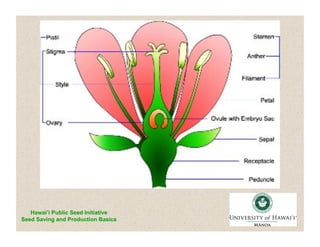
    Maintaining Genetic Diversity  How Many Plants to Keep  Plant Selection  Population Makeup  Pollination Biology  mating behavior  pollen transfer Hawai’i Public Seed Initiative Seed Saving and Production Basics
  • 8.
    Hawai’i Public SeedInitiative Seed Saving and Production Basics
  • 9.
    Seed Purity Dependent on Starting Material Hawai’i Public Seed Initiative Seed Saving and Production Basics
  • 10.
    Seed Purity Dependent on Starting Material  Selection and Rouging Procedures Hawai’i Public Seed Initiative Seed Saving and Production Basics
  • 11.
    Seed Purity Dependent on Starting Material  Selection and Rouging Procedures  Cleanliness Hawai’i Public Seed Initiative Seed Saving and Production Basics
  • 12.
    Seed Purity Dependent on Starting Material  Selection and Rouging Procedures  Cleanliness  Proper Labeling – Seed to Seed  Variety Name  Common or Scientific Name  Date Hawai’i Public Seed Initiative Seed Saving and Production Basics
  • 13.
    Seed Purity Dependent on Starting Material  Selection and Rouging Procedures  Cleanliness  Proper Labeling – Seed to Seed  Seed Saving Goals and Objectives Hawai’i Public Seed Initiative Seed Saving and Production Basics
  • 14.
    Seed Purity Dependent on Starting Material  Selection and Rouging Procedures  Cleanliness  Proper Labeling – Seed to Seed  Seed Saving Goals and Objectives  Pollen Flow Control  Start to Finish Hawai’i Public Seed Initiative Seed Saving and Production Basics
  • 15.
    Isolation Distances Crop Specific  Pollination Biology  Self Pollination  Cleistogamy  Wind Pollinated  Insect Pollinated  Animal Pollinated Hawai’i Public Seed Initiative Seed Saving and Production Basics
  • 16.
    Isolation Distances Crop Specific  Location Specific  In Geographic Space  In Time  Exclusion of Pollinators Hawai’i Public Seed Initiative Seed Saving and Production Basics
  • 17.
    Hawai’i Public SeedInitiative Seed Saving and Production Basics