CIMMYT® (www.cimmyt.org) is an internationally funded, not-for-profit organization that conducts 
research and training related to maize and wheat throughout the developing world. Drawing on strong 
science and effective partnerships, CIMMYT works to create, share, and use knowledge and technology to 
increase food security, improve the productivity and profitability of farming systems, and sustain natural 
resources. Financial support for CIMMYT's work comes from many sources, including the members of the 
Consultative Group on International Agricultural Research (CGIAR) (www.cgiar.org), national 
governments, foundations, development banks, and other public and private agencies. 
© International Maize and Wheat Improvement Center (CIMMYT) 2004. All rights reserved. The 
designations employed in the presentation of materials in this publication do not imply the expression of 
any opinion whatsoever on the part of CIMMYT or its contributory organizations concerning the legal 
status of any country, territory, city, or area, or of its authorities, or concerning the delimitation of its 
frontiers or boundaries. CIMMYT encourages fair use of this material. Proper citation is requested. 
Correct citation: Setimela, P.S., E. Monyo, and M. Bänziger (eds). 2004. Successful Community-Based 
Seed Production Strategies. Mexico, D.F.: CIMMYT. 
Abstract: Designed to address the issues that limit the access of small-scale farmers in sub-Saharan Africa 
to quality, affordable seed of the crops on which they depend for food security and livelihoods, this 
collection of articles describes successful principles for and experiences in community-based seed 
production. Among other things, the manuscripts analyze current seed production systems and models; 
propose ways to design successful community-based seed production schemes; describe proper seed 
production practices for selected cereals, vegetatively propagated plants, and other crops; and outline basic 
business practices for seed producers. 
ISBN: 970-648-115-X. 
AGROVOC descriptors: Seed production; Food security; Quality; Plant propagation; Crops; Models; 
Farmers; Partnerships; Small farms; Business management; Africa. 
AGRIS category codes: F03 Seed Production; E10 Agricultural Economics and Policies. 
Dewey decimal classification: 338.1768. 
Printed in Mexico.
Successful Community-Based 
Seed Production Strategies 
Editors 
Peter S. Setimela 
Emmanuel Monyo 
Marianne Bänziger 
Acknowledgements 
CIMMYT would like to thank the following for their support and contributions: 
• The International Crops Research Institute for the Semi-Arid Tropics (ICRISAT) 
• The International Centre for Tropical Agriculture (CIAT) 
• The International Institute for Tropical Agriculture (IITA) 
• The Southern African Root and Tuber Network (SARNET) 
• The national agricultural research systems of eastern and southern Africa 
• The United States Agency for International Development (USAID) for their financial support. 
• CIMMYT science writer Mike Listman for editing and formatting. 
i
ii
Contents 
Acknowledgements i 
Contributors iv 
Foreword vi 
Part 1: Understanding seed systems 1 
An analysis of seed systems development with special reference to smallholder farmers in 
southern Africa: Issues and challenges E.S. Monyo, M.A. Mgonja, and D.D. Rohrbach 3 
New partnerships to strengthen seed systems in Southern Africa: 
Innovative community/commercial seed supply models 
E.S. Monyo, D.D. Rohrbach, and M.A. Mgonja 11 
A community based seed production system—Schools for seed in Tanzania 
E.S. Monyo and M.A. Mgonja 19 
Choosing the right crop and variety P.S. Setimela, M. Bänziger, and M. Mwala 23 
Designing a community-based seed production scheme 
M. Bänziger, P.S. Setimela, and M. Mwala 27 
Part 2: Seed production for selected cereals 31 
Seed production of open-pollinated maize varieties 
D. Beck, M. Bänziger, S. Paliwal, and P. Setimela 33 
Seed production of sorghum and pearl millet F.P. Muuka and M. Chisi 41 
Part 3: Seed production in selected vegetatively propagated plants 47 
Seed of production of sweet potato and cassava 
C.C. Moyo, N.M. Mahungu1, V.S. Sandifolo, A.R.K. Mhone, F. Chipungu, and J. Mkumbira 49 
Part 4: Seed production in selected crops 59 
Seed of production of beans R. Chirwa 61 
Seed production of groundnut M. Siambi and A.T. Kapewa 65 
Part 5: Business skills 71 
Business skills for small-scale bean seed producers/entrepreneurs J. Rubyogo 73 
iii
Contributors 
C.C. Moyo 
IITA/SARRNET, 
P.O. Box 30258, Lilongwe 3 
Malawi 
Email: c.c.monyo@cgiar.org 
N.M. Mahungu 
IITA/SARRNET 
P.O. Box 30258, Lilongwe 3 
Malawi 
Email: n.mahungu@cgiar.org 
V.S. Sandifolo 
IITA/SARRNET 
P.O. Box 30258 
Lilongwe 
Malawi 
A.R.K. Mhone 
IITA/SARRNET 
P.O. Box 30258 
Lilongwe 
Malawi 
J. Mkumbira 
Bvumbwe, Agricultural Research Station Box 
5748, Limbe 
Malawi 
F. Chipungu 
Bvumbwe Agricultural Research Station, Box 
5748, Limbe 
Malawi 
E.S. Monyo 
ICRISAT 
P.O. Box 776 
Bulawayo 
Zimbabwe 
Email: e.monyo@cgiar.org 
D.D. Rohrbach 
ICRISAT 
P.O. Box 776 
Bulawayo 
Zimbabwe 
Email: d.rohrbach@cgiar.org 
M. Mgonja 
ICRISAT 
P.O. Box 776 
Bulawayo 
Zimbabwe 
Email: M.Mgonja@cgiar.org 
P.S. Setimela 
CIMMYT-Zimbabwe 
P.O. Box MP 163 
Harare 
Zimbabwe 
Email: p.setimela@cgiar.org 
M. Bänziger 
CIMMYT-Zimbabwe 
P.O. Box MP 163 
Harare 
Zimbabwe 
Email: m.banziger@cgiar.org 
M. Mwala 
CIMMYT-Zimbabwe, 
P.O. Box MP 163 
Harare 
Zimbabwe 
Email: m.mwala@cgiar.org 
D. Beck 
CIMMYT-Mexico 
Apdo. Postal 6-641 
06600 Mexico, D.F. 
Mexico 
Email: d.beck@cgiar.org
S. Paliwal 
Maize Program 
CIMMYT-India/RWC, CG Centre Block 
National Agricultural Science Center 
(NASC) Complex 
DP Shastri Marg, Pusa Campus 
New Delhi 110012 
India 
Email: s.paliwal@cgiar.org 
F. P. Muuka 
Zambia Agric. Research 
P.O. Box 910064 
Mongu 
Zambia 
M. Chisi 
Zambia Agric. Research 
P.O. Box 910064 
Mongu 
Zambia 
Email: Cassim_Masi@wvi.org 
R. Jean Claude 
IAT 
P.O. Box 4387 
City Square 
Nairobi 
Kenya 
Email: rupeclan@yahoo.com 
R. Chirwa 
CIAT 
P.O. Box 30258 
Lilongwe 
Malawi 
Email: r.chirwa@cgiar.org 
M. Siambi 
ICRISAT 
P.O. Box 1096 
Lilongwe 
Malawi 
Email: m.siambi@cgiar.org 
T. Kapewa1 
Maize Program 
CIMMYT-India/RWC, CG Centre Block 
National Agricultural Science Center 
(NASC) Complex 
DP Shastri Marg, Pusa Campus 
New Delhi 110012, India 
Email: Cimmyt-India@cgiar.org 
v
Foreword 
More than 70% of the population in the Southern African Development Community (SADC) region 
depends on agriculture for household food security, livelihoods, and incomes. Governments are 
determined to develop and improve this sector to alleviate poverty and hunger. 
Seed is an important catalyst for the development of agriculture. The availability of quality seed is the 
foundation for food production and productivity and a precursor to crop and food diversification—a goal 
pursued by many governments in the region. Efforts to improve the performance of the agricultural sector 
should include seed production and delivery systems. 
National agricultural research systems and international agricultural research centers have worked 
together to develop new, stress tolerant crop varieties that are well adapted to smallholder farmers’ 
conditions. However, most farmers in the region have little or no access to improved seed and continue to 
recycle seed that has been exhausted after generations of cultivation. Yields have remained poor, resulting 
in persistent food insecurity. 
To address this problem, non-governmental organizations (NGOs) have led a number of community-based 
seed production activities, but many of these projects have achieved only limited success due to 
several factors, including: 
• Lack of sustainable seed production and product markets. 
• Lack of access to foundation seed. 
• Lack of training on quality seed production. 
• Failed or rejected seed crops due to management problem. 
• Lack of or poor information about the availability, characteristics, and prices of seed of improved 
varieties. 
This manual is intended to address these issues, strategizing and sharing experiences on community-based 
seed production. I hope it will contribute to the improvement, efficiency, productivity, and sustainability 
of seed systems in the region. 
Edward Zulu 
SADC Seed Security Network Coordinator 
vi
Part 1: 
Understanding Seed Systems 
in Southern Africa 
1
Part 1: Understanding seed systems in southern Africa 
2
Seed systems development: Issue and challenges 
An Analysis of Seed Systems Development, 
with Special Reference to Smallholder Farmers 
in Southern Africa: Issues and Challenges1 
E.S. Monyo, M.A. Mgonja, and D.D. Rohrbach2 
Introduction 
Most smallholder farmers living in drought-prone regions of the Southern Africa Development 
Community (SADC) continue to rely on drought relief and informal farmer-to-farmer exchange to obtain 
seed of improved varieties. Well over 90% of smallholder farmers’ requirements are met through these 
channels. It is therefore important to give due recognition to the informal sector a low-cost source of seed, 
and to use it as a vehicle for providing resource-poor farmers with improved seed of modern varieties at 
affordable prices. 
This raises questions about the viability of commercial seed production and trade for smallholder crops— 
particularly sorghum, millets, beans, cowpea, bambaranut, pigeonpea, groundnut and open-pollinated 
maize varieties (OPVs)—in drought prone areas. Hybrid seed of maize and sorghum is more widely 
produced and marketed throughout the region, but seed of open pollinated varieties is only produced in 
anticipation of emergency purchases by governments and NGOs. Private seed companies voice concerns 
about the level and consistency of demand by the smallholder farmers for seed of open pollinated 
varieties. These concerns are reinforced by the continuing practice of delivering seed through non-commercial 
channels. 
During the past 25 years, national programs in the SADC region, in partnership with international 
agricultural research centers, have released a number of varieties. Some of these are excellent candidates 
for regional use and therefore multi-country release, if a regional policy existed. This would create a 
much larger potential market, making it more economical for the few active private seed companies in the 
region to deal with smallholder, communal, semiarid tropical crops, as well as maize OPVs. Stringent 
phytosanitary rules and lack of harmonization of seed regulations across countries have made it harder for 
the smallholder farmer to gain access to seed of these research products. 
1. Paper presented at the workshop on successful community based seed production strategies, co-organized by 
CIMMYT and ICRISAT, 3-6 August 2003, Harare, Zimbabwe. 
2 Senior Scientist Breeding/Seed Systems, Network Coordinator, and Principal Scientist Economics respectively, 
ICRISAT, PO Box 776, Bulawayo, Zimbabwe 
3
Part 1: Understanding seed systems in southern Africa 
Innovative, community-based seed production and distribution strategies, coupled with policies 
supportive of regional variety registration and release, will have a positive effect on smallholder access to 
the products of international centers and national programs. 
Issues in Seed System Development 
The objectives of a functioning seed system are to: 
• Provide seed of appropriate varieties for use by different categories of farmers. 
• Develop and identify new and more productive varieties with traits sought by consumers. 
• Multiply and distribute these on a timely basis and at a price acceptable to farmers. 
• Maintain quality control through training and regulatory systems. 
In the current system, two time lags need to be reduced to improve access by smallholder farmers to seed 
of new varieties: 
1. Delays as long as 10 years in varietal development. 
2. A long time lag from varietal release to the stage when seed actually reaches farmers. 
Types of Seed Systems 
Seed systems can be either formal or informal/local. Formal systems generally consist of public sector 
research institutions, public and private sector agencies producing and marketing seed, and organizations 
responsible for seed certification and quantity control. The informal system consists of large number of 
farmers who produce both traditional and modern varieties, market their own production, and take care of 
their own research needs. Most government- and donor-supported seed systems in Africa are part of the 
formal system. Within the formal sector, two models of seed system operate: 
1. State/parastatal model: Researchers provide breeder seed to a parastatal or state agency to multiply 
on state farms or through contract seed growers. All activities, including seed cleaning, processing, 
and marketing, are performed by state agencies. 
2. Private sector model: The private sector plays an important role. Researchers provide breeder seed 
to be multiplied into foundation and commercial seed. Seed processing and marketing is done by 
private companies and farmer cooperatives. 
4
Seed systems development: Issue and challenges 
In most developing countries the formal sector is far smaller than the informal seed sector. The latter is 
the major source of planting materials for smallholder farmers in Southern Africa, serving over 90% of 
their seed needs. Consequently, there would be very large gains if strategies to improve the quality of 
seed coming from this sector were properly designed and implemented. NGOs have already made 
substantial investments in community-based seed multiplication schemes, which are part of the informal 
sector. Assistance should be targeted at improving the efficiency of these investments, by helping NGO 
schemes improve their seed quality control and seed marketing. Specifically, NGO seed programs could 
be provided with technical support to undertake: 
• Variety evaluation and selection of the best genotypes. 
• Maintenance of improved varieties currently being grown, as well as newly selected genotypes. 
• Development of training materials to help farmers produce genetically pure seed of cultivars of their 
choice. 
The informal seed system may be the most appropriate in (1) remote areas, where seed distributors find 
access difficult and farmers cannot easily reach seed and output markets; (2) a narrow agro-ecological 
zone, where the seed market is limited and widely marketed varieties may not be suitable; or (3) areas 
where the major crops have very high seeding rates, implying high transport costs to move large 
quantities of seed over considerable distances. 
Strategies to Improve the Local/Informal Seed System 
In spite of massive investments in plant breeding research, the rate of adoption of improved seed in sub- 
Saharan Africa remains at less than 5%, partly due to the inefficiency of local seed systems. It is rare to 
find modern varieties bred at research stations being passed on to the informal sector for multiplication 
and sale, as an essential part of the national seed policy. Yet it is the informal sector that holds the key to 
improving crop productivity among smallholder farmers. In recognition of this fact, some nations in the 
region have enacted policies permitting the smooth flow of such seed to the farming community. 
The government of Tanzania, in collaboration with Denmark, is implementing a 10-year (1998-2007), on-farm 
seed production program, aiming to strengthen the informal seed sector. Under this program, the 
formal system will provide initial seed of various crops, which will then be multiplied and disseminated 
through the informal system. The initial seed is of known pedigree (that is, an approved variety) so as to 
maintain genetic identity and purity. The seed produced by the program after multiplication is termed 
“Quality Declared” (Mbwele et al. 2000): responsibility for quality lies with the seed producer. Official 
quality control is minimal; the Tanzania Official Seed Certification Agency (TOSCA) inspects only 10% 
of the crop. 
5
Part 1: Understanding seed systems in southern Africa 
The quality of informal sector seed used by small-scale farmers can be improved in several ways: 
• Train farmers in better selection, treatment, and storage of seed from their own farms. Own-saved 
seed is often the most appropriate, certainly for farmers who cannot afford to purchase seed. The 
training will help them increase production through better use of their own saved seed. 
• Encourage farmers to make their own selection of traditional varieties, to multiply and store seed of 
such varieties, and to sell this quality seed of traditional varieties to other farmers. This strategy is 
best suited to farmers capable of some experimentation and who are potential users of modern 
varieties. Initially they should be encouraged to stabilize varieties they themselves have selected. 
These are farmers with limited resources, but living in medium to high potential areas. 
• Develop modern varieties at research stations, and produce good quality seed of these varieties 
through either formal or informal channels—whichever provides good (or acceptable) quality seed at 
affordable prices. This strategy will work best for farmers who can be persuaded to buy inputs, 
provided seed is available at prices considered worth the risk by those farmers. ICRISAT and partners 
are implementing several strategies in Tanzania (Rohrbach et al. 2002) and Zimbabwe (Monyo et al. 
2003). These strategies are sustained by ensuring a reliable supply of breeder and foundation seed, 
which is then sold to seed producers, and by providing them with advice on multiplying foundation 
seed to generate commercial seed. Costs can be kept low if this seed is unprocessed and uncertified 
(Monyo et al. 2003). Little research has been done in this area to validate the added value of 
“certifying” vs. “truthfully labeled”3, beyond the proven genetic potential. 
Of these strategies, the first two deal with upgrading traditional varieties and do not depend on any 
interaction between the formal and informal systems. The third constitutes a bridge linking the formal and 
informal systems. Germplasm (breeder/ foundation seed) comes from the formal system, and subsequent 
activities are carried out in the informal system. 
Government agencies can assist the informal sector in many ways, the most important being to provide 
access to foundation seed, extension advice on seed production, processing, treatment and storage, and a 
legal framework that permits the marketing of “truthfully labeled” seed and “Quality Declared” seed. This 
will facilitate the growth of small-scale entrepreneurs in the informal seed sector. Referred to as the 
"decentralized farmer-based model," in this approach researchers’ involvement in the seed chain stops at 
producing breeder/and or foundation seed. This seed is sold to farmers who perform downstream 
activities of multiplication, harvesting, drying, processing, storage and marketing. 
3 Conforms to all technical requirements in the notification of a variety, but not “certified” 
6
Seed systems development: Issue and challenges 
Commercial/Private Sector Seed Supply 
Insofar as the main constraint to commercial sector investments is continuing uncertainty about the level 
of demand for seed, ICRISAT and its partners are implementing special projects targeting linkages with 
seed companies to help them better estimate demand. These include selling seed in small packages or 
monitoring sales under alternative retail pricing strategies. 
The private sector has the initial capital and capacity to make a difference in seed availability. ICRISAT’s 
Sorghum and Millet Improvement Program (SMIP) works with the private sector to facilitate the 
servicing of smallholder communities. ICRISAT ensures that the private sector has access to good quality 
breeder/foundation seed stocks by providing this seed directly, if it cannot be sourced locally from the 
public sector research. It also works with the private sector to improve the rural retail network for OPV 
seed (sorghum, pearl millet, cowpea, groundnut, and pigeonpea), and to test the demand for improved 
seed in the rural communities where these crops are important. Companies are profit motivated, and 
usually deal in only small volumes for the less profitable crops (OPVs). Seed companies in southern 
Africa have failed to invest in developing rural retail networks for crops other than hybrid maize, citing 
uncertainty about the level of demand for OPV seed. They also complain that rural retailers have no 
interest in stocking seed of subsistence crops. As a result, it is impossible to obtain pure seed of OPVs, 
except in major urban areas. This severely limits the adoption of new varieties. 
Whereas large commercial farmers in South Africa, Zambia, and Zimbabwe are producing hybrid maize 
and seed of sorghum, pearl millet, cowpea, groundnut, pigeonpea and even maize OPVs, much seed is 
only produced in anticipation of drought relief emergencies. Private firms and NGOs raise concerns that 
this demand is not consistent. A number of NGOs in southern Africa now produce OPV seed, but the 
sustainability of these programs is threatened by a lack of marketing strategies. Almost all sorghum and 
pearl millet seed adopted by farmers in the three countries targeted under SMIP Phase 4 (Zimbabwe, 
Mozambique and Tanzania) has been derived from free or highly subsidized seed distribution programs 
run by governments and NGOs. The common availability of this subsidized seed further limits 
commercial incentives to develop rural seed markets (Jones et al. 2001). Yet, small-scale farmers 
commonly cite the lack of access to the seed as the main reason for non-adoption of new varieties. 
The SMIP initiated a pilot project to test the commercial demand for seed of OPVs of sorghum, pearl 
millet, groundnut, and sunflower in rural markets when delivered in small seed packs—a cross-section of 
5 kg, 2 kg, 1 kg and 500 g. All were sold at prices reflecting the full costs of packaging and distribution 
(Monyo et al. 2003 in press). The findings from this study are being used to encourage broader private 
investment in the development of rural seed trade. This should contribute directly to speeding the 
adoption of new varieties. The small packs pilot program has not, in itself, contributed significantly to the 
improvement of adoption rates for these crops in Zimbabwe, because of the low volumes involved. 
However, if the scheme ultimately proves successful, and the private companies involved increase 
volumes of seed through this channel, an important breakthrough will have been achieved. Ultimately, the 
SMIP will attempt to see if this can be an important avenue for the distribution of improved seed 
commercially to small-scale farmers in the SADC region. 
7
Part 1: Understanding seed systems in southern Africa 
Seed Production and Cropping Systems 
Predominantly Self-pollinated Crops 
Seed of self-pollinated crops such as rice can be multiplied by farmers with some training, with little risk 
of admixtures, as off-types can be easily removed. Isolation distances required are minimal and it is not 
necessary to set up expensive seed processing plants or seed certification units. Breeder seed can be sold 
to prospective seed producers and the seed system can be an informal one. However it is necessary to set 
up a legal framework permitting the sale of uncertified but “truthfully labeled” seed of notified varieties. 
Predominantly Cross-pollinated Crops 
Cross-pollinated crops such as maize are more difficult to manage, since off-types are more difficult to 
detect. Larger isolation distances are necessary (300 + meters). One option is to select good seed growers 
who can manage the crop properly, register their plots, and certify only seed grown in these plots. These 
can be contract farmers producing for private public sector companies. ICRISAT is successfully using 
this approach, where smallholder farmers produce seed on contract to a private seed company. An 
alternative is to encourage the development of an informal seed system in which farmers develop faith in 
the quality of seed produced when they are able to see the seed plot and convince themselves that the seed 
is of the right quality. Another ICRISAT approach uses progressive villagers or village institutions such 
as primary schools to introduce new varieties into the village seed system (Monyo et al. 2003). Such a 
strategy aims to stimulate competition among farmers, some of whom could eventually emerge as 
reputable seed producers. Where the cropping system is dominated by OPVs and farmers use own-saved 
seed, a combination of these approaches, with emphasis on a decentralized informal seed system, would 
meet the requirements of most small-scale farmers. 
Crops with High Seed Rate and Low Multiplication Rate 
The formal sector has shown little or no interest in seed multiplication for crops like groundnut, with high 
seeding rates and low multiplication rates. Transport, processing, bagging, and certification costs make 
the seed too expensive for farmers to purchase. For such crops, the most economical way would be to 
produce seed of the notified variety and sell it to the local community without incurring the extra costs of 
processing and certification. 
Seed System Linkages to Research and Extension 
Two factors determine farmer demand for seed of modern varieties: (1) farmers' interest in the new 
varieties, and (2) whether the seed system is appropriate for the crop and varieties, and practical for 
farmers. 
8
Seed systems development: Issue and challenges 
Effective extension is important. Extension plays a crucial role in training farmers in seed production and 
is therefore a pre-requisite to establishing a seed system, particularly informal systems, where farmers 
need training in various aspects of seed production. Just as it is difficult for a seed system to be effective 
in the absence of extension, it is equally difficult for farmers to adopt extension recommendations in the 
absence of a seed system that satisfies the following criteria: 
• It covers all of the crops that most farmers grow. 
• The varieties are appropriate and endowed with critical traits. For example, for smallholder farmers in 
high risk areas, yield stability is more important than yield per se (Monyo et al. in press). 
• The political and legal environment must allow regular release of new varieties, with high quality 
seed. 
• The system must be compatible with the level of agricultural development. For example in situations 
where most farmers are poor and infrastructure is lacking, it is not desirable to put in place a 
sophisticated system involving too many institutions before the “basics” are in place. 
The system should be supported by effective research and extension services; availability of inputs such 
as fertilizer, pesticide, agricultural credit; and an efficient commodity marketing system. 
References 
Jones R.B., P. Audi, and H.A. Freeman. 2001. Seed delivery systems – Status, constraints, and potential 
in eastern and southern Africa. Pp. 118-126 in S.N. Silim, G. Mergeai, and P.M. Kimani (eds.), Status 
and Potential of Pigeonpea in Eastern and Southern Africa: Proceedings of the Regional Workshop, 
12-15 Sep 2000, Nairobi, Kenya. Patancheru 502 324, Andhra Pradesh, India: ICRISAT; and 
Gembloux, Belgium: Gembloux Agricultural University. 
Mbwele, A.A., M.Z. Lumbadia, and N.P. Sichilima. 2000. Seed production and supply system in 
Tanzania. Pp. 20-27 in E.S. Monyo, M.Z. Lumbadia, H.M. Saadan, M.A. Mgonja, and G.M. Mitawa 
(eds.), Seed Systems for the New Millennium: An Action Plan for Tanzania. Proceedings of the 
Stakeholders’ Review and Planning Workshop, 7-8 Dec 1999, Dar es Salaam, Tanzania. PO Box 
776, Bulawayo, Zimbabwe: SADC/ICRISAT Sorghum and Millet Improvement Program. 
Monyo, E.S., M.A. Mgonja, S. Chandra, and E. Chinhema. 2003. Relative stability of selected pearl 
millet varieties from southern Africa. African Crop Science Journal (in press). 
Monyo, E.S., M.A. Mgonja, D.D. Rohrbach, H.M. Saadan, D.L. Nonga, M. Bonaventura, D. Zaranyika, 
M. Kondo, C. Mwegowa, J. Mutagurwa, A. Senyagwa, and P. Chibago. 2003. Better seeds, better 
harvests – New partnerships to strengthen local seed systems in southern Africa. Paper presented to 
the 2nd Triennial Conference of The Global Forum on Agricultural Research (GFAR) – Linking 
Research and Rural Innovation to Sustainable Development, 22-24 May 2003, Dakar, Senegal. 
Monyo, E.S., L. Mpofu, and H.M. Saadan. 2003. Promotion of breeder seed production in targeted 
countries in the SADC region. SMIP Progress Report for 2002. PO Box 776, Bulawayo, Zimbabwe: 
SADC/ICRISAT Sorghum and Millet Improvement Program. 
9
Part 1: Understanding seed systems in southern Africa 
Monyo, E.S., D.D. Rohrbach, and M.A. Mgonja. 2003. New partnerships to strengthen seed systems in 
Southern Africa: Innovative community/commercial seed supply models. Paper presented to the 
successful community based seed production strategies, co-organized by CIMMYT and ICRISAT, 3rd 
– 6th August 2003, CIMMYT/ICRISAT, Harare, Zimbabwe 
Monyo, E.S., and M.A. Mgonja. 2000. Seed system models being pursued under the SADC/ICRISAT 
Sorghum and Millet Improvement Program. Pp. 48-53 in E.S. Monyo, M.Z. Lumbadia, H.M. Saadan, 
M.A. Mgonja, and G.M. Mitawa (eds.), Seed Systems for the New Millennium: An Action Plan for 
Tanzania. Proceedings of the Stakeholders’ Review and Planning Workshop, 7-8 Dec 1999, Dar es 
Salaam, Tanzania. PO Box 776, Bulawayo, Zimbabwe: SADC/ICRISAT Sorghum and Millet 
Improvement Program. 
Monyo, E.S., M.Z. Lumbadia, H.M. Saadan, M.A. Mgonja, and G.M. Mitawa (eds). 2000. Seed Systems 
for the New Millennium: An Action Plan for Tanzania. Proceedings of the Stakeholders’ Review and 
Planning Workshop, 7-8 Dec 1999, Dar es Salaam, Tanzania. PO Box 776, Bulawayo, Zimbabwe: 
SADC/ICRISAT Sorghum and Millet Improvement Program. 
Monyo, E.S., H.M. Saadan, and M.A. Mgonja (eds). 1999. Seed Systems, Higher Productivity, and 
Commercialization: Prospects for Sorghum And Millets in Tanzania. Proceedings of the 
Stakeholders’ Review and Planning Workshop, 25-26 Nov 1998, Kibaha Sugarcane Research 
Institute, Tanzania. PO Box 776, Bulawayo, Zimbabwe: SADC/ICRISAT Sorghum and Millet 
Improvement Program. 
Rohrbach, D.D., K. Mtenga, J.A.B. Kiriwaggulu, E.S. Monyo, F. Mwaisela, and H.M. Saadan. 2002. 
Comparing community seed projects in Tanzania. Local Seed System News – SADC/GTZ Small 
Scale Seed Production Project, Harare. Vol. 7, no.1. http://www.Zimbabwe.net/sadc-fanr/intro.htm 
10
Innovative seed system models 
New Partnerships to Strengthen Seed Systems 
in Southern Africa: Innovative 
Community/commercial Seed Supply Models 4 
E.S. Monyo, D.D. Rohrbach, and M.A. Mgonja5 
To improve the harvest, we must first improve the seed. This is widely recognized by governments, 
NGOs, and by farmers themselves. New crop varieties are available that mature earlier (escaping end-of-season 
drought), give higher yields, and are more resistant to pests and diseases. But smallholder farmers 
in southern Africa rarely have access to seed of these varieties. Relief agencies do distribute seed, but this 
is, at best, a short-term measure – it addresses emergency needs but does nothing to improve seed supply 
in the long term. ICRISAT and its partners are helping to design and implement cost-effective, long-term 
solutions. The aim is two-fold: 
• Improve seed availability and thus adoption of new varieties 
• Build capacity at the community level to ensure a sustainable supply of high-quality seed at 
affordable prices. 
The partners include national research and extension services, other government departments, NGOs, 
private seed companies, and most important, the community, because our approaches are based on 
collective action, with other partners providing support. We are pursuing three alternative approaches, 
depending on the area and community: 
• Contract seed production. Smallholder farmers are linked with a private seed company. They 
produce certified seed of new varieties from international centers for the company, which provides 
logistical support and credit for inputs. ICRISAT provides the needed technical support for the 
production of good quality seed. Seed Co, the leading seed company in the region, currently contracts 
more than 2,400 farmers in Zimbabwe. In the past three years more than 1,000 tons of seed of various 
crops have been produced. 
• Small seed packs. Seed is sold in small packs (500 g to 5 kg), instead of the usual 25 kg bags. 
ICRISAT has demonstrated that farmers who cannot afford the large packs eagerly buy the smaller 
quantities, paying the full cost, without subsidy. In the past two seasons, over 80% of the seed 
distributed in rural remote areas through the small seed pack program was purchased, helping to 
spread new varieties in drought-prone pilot areas. 
4 Paper presented at the workshop on successful community based seed production strategies, co-organized by 
CIMMYT and ICRISAT, 3-6 August 2003, Harare, Zimbabwe 
5 Senior Scientist Breeding/Seed Systems, Principal Scientist Economics, and Network Coordinator respectively, 
ICRISAT, PO Box 776, Bulawayo, Zimbabwe 
11
Part 1: Understanding seed systems in southern Africa 
• Seed production and distribution through primary schools. Primary schools in rural areas 
multiply seed of improved varieties, with technical and logistical support from ICRISAT, government 
agencies, and other partners. The schools then distribute this seed to nearby communities, ensuring 
that smallholder farmers have access to affordable, high-quality seed within a convenient distance 
from their homesteads. 
Each of the models is described below in more detail: 
Model I. Smallholder Farmer Seed Production on Contract for Sale to Commercial Seed 
Companies 
Drought-induced food shortages are common throughout the Southern African Development Community 
(SADC). There are two major reasons for these shortages: crop failures of maize due to insufficient 
rainfall, and low productivity of alternative cereals and legumes due to the continued use of traditional 
varieties that give poor yields and are susceptible to late-season drought. Governments and NGOs provide 
food and seed aid almost every year, but such interventions are neither sustainable nor sufficient to 
alleviate hunger and poverty in rural areas. ICRISAT and the Seed Co of Zimbabwe are working together 
to strengthen smallholder farmers’ capacity to produce quality seed. ICRISAT is an international research 
organization specializing in drought tolerant crops; Seed Co is the leading seed-house in Zimbabwe with 
an extensive retail network. ICRISAT supplies improved, open-pollinated released varieties of its 
mandate crops and offers training and supervision in seed production. Seed Co offers small-scale farmers 
contracts to produce seed, and buys it from them subject to meeting specified quality requirements. 
Strategy 
• The program involves promotion of wide-scale adoption of four new varieties with a regional market 
(Zimbabwe, Mozambique, and Zambia): one variety each of groundnut, sorghum, pearl millet and 
cowpea. 
• ICRISAT uses a block system led by local supervisors and enumerators to carry out seed production. 
The local supervisors have some formal training in agriculture, whereas the enumerators are elected 
by farmers on the condition that they hold at least a master farmer qualification. ICRISAT trains the 
enumerators and the farmers on procedures for quality seed production, and additionally trains the 
enumerators to carry out data collection, and disseminate information and program inputs. 
• ICRISAT also uses the farmer field schools extension approach to teach farmers the principles of 
improved crop management and various cost-effective options. 
12
Innovative seed system models 
Achievements 
• This project proves that smallholder farmers are committed and can grow seed as a commercial crop. 
Farmers were so eager to maintain the contracts that they were willing to sell some of their harvest 
even during the 2001/02 drought. This shows that smallholder farmer/ private sector partnership is 
feasible, if there is mutual trust. 
• Smallholder farmers are now familiar with seed production techniques. After four years of the 
program no farmer is being disqualified for not following the recommended techniques. 
• The methodology has been tested and refined in Zimbabwe and can now be applied in other SADC 
countries. 
Reasons for Success, Lessons Learned 
• The scheme is profit motivated. Farmers look at seed production as an enterprise. 
• Seed production capacity in the smallholder sector has been developed and farmers have been 
successfully linked to a private seed company. 
• The program disseminates improved OPVs to smallholder farmers in dry areas, greatly accelerating 
diffusion of these varieties. 
• In dry areas, frequent drought causes communities to remain food insecure. Consequently, some 
farmers may renege on contracts in drought years, preferring to retain their harvest for food. We are 
now thinking of diversifying smallholder seed production to include a few areas with more reliable 
rainfall. 
Examples 
Zimbabwe. Sorghum and pearl millet are susceptible to bird damage if grown in isolated blocks. This 
problem is particularly severe in seed production. Small-scale farmers' small plots do not provide for 
adequate isolation distances for seed production. However, due to the necessity to separate grazing areas 
from cropping areas, individual plots are often combined into blocks. This block farming arrangement 
provided the opportunity to test the feasibility of producing seed for commercial sale in communal areas. 
For this concept to work, the community must agree to grow only the identified variety of the selected 
seed crop. Small-scale farmers in two pilot districts in Zimbabwe have successfully produced sorghum 
and pearl millet seed of designated varieties for private seed companies. (Monyo et al. 2003). 
Tanzania. The Christian Council of Tanzania (CCT) and the Diocese of Central Tanganyika (DCT) have 
mobilized groups of farmers and assisted them to register as seed associations. The DCT operates only in 
the Dodoma region, but the CCT operates nation-wide and has facilitated registration of 11 farmer seed 
associations. The CCT supports these associations to produce improved seed of sorghum, pearl millet and 
maize OPVs for commercial sale (Mwaisela 1999; 2000). These associations rely partly on the local 
community but mostly on their affiliated churches to provide markets for the seed produced. The CCT 
retains part of earnings to purchase additional foundation seed for farmers. This model has been in 
operation since 1995. ICRISAT started working with CCT during the 1998/99 season to provide technical 
assistance and identify the most successful associations, which can serve as models for improving the 
operations of others and for scaling up. One example is Mpalanga village in Chipanga division of 
Dodoma rural district, which has significantly enhanced community seed security through NGO 
assistance. 
13
Part 1: Understanding seed systems in southern Africa 
Namibia. The Northern Namibia Farmer Seed Growers Coop is another example of ICRISAT technical 
assistance in establishing viable seed delivery systems to small-scale farmers. Initially the founding 
members (50 small-scale farmers) were trained on seed production by ICRISAT-Bulawayo with support 
from FAO-Namibia in 1994. It took only four years for this group to develop into a full-fledged, 
registered seed cooperative able to produce enough pearl millet seed to meet the country’s needs (Lechner 
et al. 1996). 
Model II. Promotion of Improved Seed through Sale of Small Seed Packets 
Seed companies in southern Africa have failed to invest in developing rural seed sales networks for crops 
other than hybrid maize. These companies commonly state their uncertainty about the level of demand for 
seed of OPVs. They also complain that rural retailers have no interest in stocking seed of these 
subsistence crops. As a result, it is impossible to obtain quality seed of OPVs, except in major urban 
areas. This severely limits the adoption of new varieties. Seed of OPVs of sorghum, pearl millet, 
bambaranut, cowpeas, groundnuts and sunflower is only produced in anticipation of drought for relief 
programs. Private seed companies and NGOs are concerned that this sort of demand is not consistent. 
Though a number of NGOs in southern Africa have started production of seed of OPVs, their 
sustainability is threatened by poor marketing strategies. Small-scale farmers commonly cite the lack of 
access to the seed of new varieties as their main justification for non-adoption. ICRISAT initiated a pilot 
project to test the commercial demand for seed of OPVs of sorghum, pearl millet, bambaranut, groundnut 
and sunflower in rural markets, when delivered in small packages. 
Strategy 
• The seed company establishes retail sales agents in rural areas. In most instances these are the same 
agents used to distribute hybrid maize seed. 
• Seed of OPVs, including sorghum, pearl millet, groundnut, cowpea, sunflower and bambaranut, is 
packaged in small packs of 500 g, 1 kg, 2 kg and 5 kg. 
• The packs are sold at prices reflecting the full cost of packaging and distribution but targeted to the 
drought-prone areas where these crops are best adapted. 
• The rural retail outlets are linked to urban wholesale centers for input supply. 
• ICRISAT conducts closely targeted surveys to monitor the success of the scheme: one for the rural 
retailers receiving the seed on credit, a second survey for urban consumers buying the seed, and a 
third survey of rural farmers buying the seed. 
Achievements 
• Approximately 80% of the seed placed in the urban shops was sold, including all of the groundnut 
and bambaranut stocked. 
• Approximately 55% of the seed placed in the rural shops was sold; sales of sorghum and bambaranut 
were strongest. 
• The main reasons buyers cited for purchasing the seed were to try a new variety and to replenish 
depleted seed stocks. 
• In general, the buyers were satisfied with the prices. 
14
Innovative seed system models 
• The variable size of the seed packs allowed farmers with less money to purchase smaller sized 
packages. 
• Most of the retailers stated their willingness to collect the seed on their own from the seed company. 
• Farmers buying seed made a number of suggestions for improving the program. These included the 
need to get the seed into the retail shops earlier and maintain this stock over an extended period. 
• Farmers appreciate the opportunity to purchase small pack seed and it is likely that sales will grow 
over time. 
Lessons Learned 
This program proves the willingness of small-scale farmers to purchase smaller packages of a range of 
different open and self-pollinated seed crops. Sales are expected to grow if the seed companies are willing 
to maintain such initiatives. The findings from this study are being used to encourage broader private 
investment in the development of rural seed trade. This should directly contribute to speeding the 
adoption of new varieties. The small packs pilot program has not, in itself, contributed significantly to 
improving adoption rates for these crops in Zimbabwe because of the low volumes involved in the pilot 
scheme. However, if the scheme ultimately proves successful and the private companies involved 
increase volumes, an important breakthrough will have been achieved. Ultimately ICRISAT will attempt 
to see if this can become an important avenue for distributing improved seed commercially to small-scale 
farmers. 
Example 
The Seed Company of Zimbabwe established 14 retail sales agents for small pack seed in the rural areas 
of Zimbabwe for the first time in 1998. This included seed of sorghum, pearl millet, groundnut, and 
sunflower in 5 kg, 2 kg, 1 kg, and 0.5 kg packages. In the second year the program added six more 
retailers and at least one additional crop (cowpea). Small seed packs were also distributed through 
wholesale trading channels for commercial sale to a much wider range of retailers. 
Most consumers expressed a strong desire to purchase small packs of seed and they wanted such 
arrangements extended to other crops, including maize. Most retailers were willing to collect seed from 
the company, but wanted to retain the credit component of the program. Sales will grow if the seed 
company is willing to maintain such incentives but the financial incentive to continue doing so remains 
unclear, since the company achieves higher returns by selling in bulk to relief programs. As long as large 
volumes of seed are distributed at subsidized prices through relief and emergency programs, the growth in 
adoption rates of these improved varieties is likely to be derived from emergency distribution, rather than 
from the development of a retail seed market. 
15
Part 1: Understanding seed systems in southern Africa 
Model III. Rural Primary Schools as Centers for Production and Dissemination of 
Improved Seed in Tanzania 
Each year many new varieties of crops are released and new technologies developed in research institutes 
all around the world. Much money, time and effort are spent on research to provide farmers with the 
means to generate higher yields and increased incomes. These varieties and technologies are tested on 
research stations and on farm, but few are widely adopted by smallholder farmers. Seed availability is a 
major problem. To address this issue, ICRISAT and partners in Tanzania are using an innovative 
approach whereby schools in rural communities serve as seed multiplication and distribution centers 
(Monyo and Mgonja 2003). 
Strategy 
• Agriculture is part of the primary school curriculum in Tanzania. 
• The project helps pupils in rural schools (who are encouraged to learn agriculture) and their parents 
benefit from easier availability of improved seed. 
• Selected schools are within 15-20 km of each other for easy access by farmers; and typically have 
over 500 students and serve approximately 500-700 farmers. 
• Only schools with adequate, isolated land are selected for seed production. 
• All selected schools are provided with enough seed to plant one hectare of the sorghum, pearl millet, 
pigeonpea, or sesame of the varieties recommended for the area. 
Achievements 
• The pilot scheme involving 50 schools in one district has expanded to 250 schools in eight districts of 
Tanzania in four years. 
• The scheme has expanded from initially providing only sorghum and pearl millet seed to currently 
supplying sorghum, pearl millet, pigeonpea, sesame and OPV maize. 
• Participating schools supply approximately 500 kg of improved seed of new varieties to the 
surrounding community every year, at affordable prices. 
• The initiative has already been adopted by Malawi NARS in collaboration with World Vision 
International to move improved sorghum and millet seed to smallholder farmers 
• Mozambique NARS have indicated interest in adopting this scheme for sorghum, millet, cowpea, 
pigeonpea and bambaranut. 
Reasons for Success 
• The successful schools had one common strategy: they enabled the villagers, through the village 
government, to “own” the project. The village government was backstopping the schools, ensuring 
community support. 
• A training program on seed production was provided to the participating schools (one teacher from 
each school) and to Ward Education Officers (WEO) who would supervise project implementation. 
Each WEO supervised seed production in ten schools. 
• Field days were held to popularize the concept and to introduce it to other districts. 
• Representatives from the Departments of Research and Seed Services Units from Malawi, 
Mozambique, Zambia, South Africa and Botswana participated in field days held in Tanzania; thus 
the concept is being extended to other SADC countries. 
16
Innovative seed system models 
Example 
Tanzania. One specific target under ICRISAT’s Sorghum and Millet Improvement Program is having at 
least one retail seed outlet within a 25 km radius of each targeted community. After a survey of the CCT’s 
school feeding programs in Tanzania, a feasibility study was carried out to investigate the potential of 
using primary schools as seed centers. All primary school heads interviewed welcomed the idea; they felt 
the project would be viable (providing the school with extra income) and useful, teaching pupils practical 
agricultural applications. A meeting between ICRISAT and district-level officials from the relevant 
government ministries was organized to discuss modalities of operation. Under the leadership of 
Commissioners from Dodoma and Singida Districts, 100 primary schools were selected, ensuring one 
seed retail outlet (school) within a maximum distance of 25 km. The teachers were trained on seed 
production methods. The District Agricultural Officer, Education officers, and staff from the Tanzania 
Official Seed Certification Agency acted as resource persons. After training each school was supplied 
with enough foundation seed to plant 1 ha each of sorghum (variety Pato) and pearl millet (variety Okoa). 
This initiative is strongly supported by the local authorities as an appropriate model for community seed 
supply. 
Zimbabwe and Tanzania. Introduction of new varieties to village seed systems is part the government’s 
Zunde (King’s Granary) Program in Zimbabwe, which combines community food and seed security. New 
varieties are demonstrated in few targeted areas. The produce harvested from the demonstration plot is 
kept in the “Zunde” for later use by the community for food and/or seed. In Tanzania this model is in 
operation under the Ministry’s Agricultural Sector Program Support sponsored by DANIDA (Granquist 
2000). Under this program, 2-3 progressive farmers are selected per village. These farmers are given the 
appropriate training, and supplied with good quality foundation seed for multiplication, so that they 
become the source of improved seed for the entire village. Each season the farmers are supplied with 
foundation seed of different crops; if they produce, say, sorghum seed for the village one year, the next 
year they will produce groundnut or another crop, returning to sorghum every third year. 
References 
Granquist, B. 2000. On-farm seed production component of the agricultural sector programme support. In 
in E.S. Monyo, M.Z. Lumbadia, H.M. Saadan, M.A. Mgonja, and G.M. Mitawa (eds.), Seed Systems 
for the New Millennium: An Action Plan for Tanzania. Proceedings of the Stakeholders’ Review and 
Planning Workshop, 7-8 Dec 1999, Dar es Salaam, Tanzania. PO Box 776, Bulawayo, Zimbabwe: 
SADC/ICRISAT Sorghum and Millet Improvement Program. 
Lechner WR 1996. Pilot project for small-scale pearl millet seed production in Namibia. In K. Leuschner 
and C.S. Manthe (eds.), Drought Tolerant Crops for Southern Africa: Proceedings of the 
SADC/ICRISAT Regional Sorghum and Pearl Millet Workshop, 24-29 July 1994, Gaborone, 
Botswana. Patancheru 502324, AP, India: ICRISAT. 
Monyo, E.S., and M.A. Mgonja. 2003. Setting a community based seed production system - A case study: 
Schools for Seed, A New Approach in Tanzania. Paper presented to the successful community based 
seed production strategies, co-organized by CIMMYT and ICRISAT, 3rd – 6th August 2003, 
CIMMYT/ICRISAT, Harare, Zimbabwe. 
17
Part 1: Understanding seed systems in southern Africa 
Monyo, E.S., M.A. Mgonja, D.D. Rohrbach, H.M. Saadan, D.L. Nonga, M. Bonaventura, D. Zaranyika , 
M. Kondo, C. Mwegowa, J. Mutagurwa, A. Senyagwa, and P. Chibago. 2003. Better seeds, better 
harvests – New partnerships to strengthen local seed systems in southern Africa. Paper presented to 
the 2nd Triennial Conference of The Global Forum on Agricultural Research (GFAR) – Linking 
Research and Rural Innovation to Sustainable Development, 22-24 May 2003, Dakar, Senegal. 
Mwaisela, F. 1999. Experiences in promoting sorghum and pearl millet through on-farm seed production. 
In E.S. Monyo, H.M. Saadan, and M.A. Mgonja (eds), Seed Systems, Higher Productivity, and 
Commercialization: Prospects for Sorghum And Millets in Tanzania. Proceedings of the 
Stakeholders’ Review and Planning Workshop, 25-26 Nov 1998, Kibaha Sugarcane Research 
Institute, Tanzania. PO Box 776, Bulawayo, Zimbabwe: SADC/ICRISAT Sorghum and Millet 
Improvement Program. 
Mwaisela F. 2000. Local seed supply systems: Case study of Mpalanga village, Dodoma district. In in 
E.S. Monyo, M.Z. Lumbadia, H.M. Saadan, M.A. Mgonja, and G.M. Mitawa (eds.), Seed Systems for 
the New Millennium: An Action Plan for Tanzania. Proceedings of the Stakeholders’ Review and 
Planning Workshop, 7-8 Dec 1999, Dar es Salaam, Tanzania. PO Box 776, Bulawayo, Zimbabwe: 
SADC/ICRISAT Sorghum and Millet Improvement Program. 
18
Schools for seed in Tanzania 
A Community Based Seed Production System— 
Schools for Seed in Tanzania6 
E.S. Monyo and M.A. Mgonja7 
Each year, many new varieties of crops are released and new technologies developed by scientists in 
research institutes all around the world. Although these varieties and technologies are extensively tested, 
only a few are widely adopted by smallholder farmers. In southern Africa over 40 varieties of sorghum 
and pearl millet have been developed and released by the SADC/ICRISAT Sorghum and Millet 
Improvement Program (SMIP), and partners, since its launch in 1983. And yet, in most countries within 
the region, less than 10% of the sorghum and millet area is sown to improved varieties. Farmers are often 
aware that new varieties are available, but are unable to obtain seed. The problem, however, is not with 
the farmers or with the researchers but, very often, with the commercial seed companies who do not 
recognize the potential of these improved varieties. It is frustrating for plant breeders who have developed 
improved varieties but, more importantly, it is holding back farmers who could benefit from them. 
Seed multiplication and distribution of improved varieties is a major problem in many countries. 
ICRISAT and its partners are using an innovative approach in Tanzania to resolve this issue, which could 
provide a model for other countries facing similar problems with seed shortages (Monyo et al 2003) 
Why Primary Schools? 
Rural primary schools were identified in two drought-prone districts (Dodoma and Singida) in central 
Tanzania. The selected schools are already involved in a school-feeding program initiated by the 
Christian Council of Tanzania (CCT) to help food insecure families suffering from the effects of 
prolonged drought. As these communities continue to be threatened by drought, it seemed logical to 
establish multiplication of seed in these schools as a means of moving improved drought-tolerant varieties 
of sorghum and millet into the communities. Each school has over 500 students and serves 500-700 
families, so there is a substantial demand for seed. Agriculture is part of the curriculum, and trained 
teachers are already in place. The schools are already engaged in agriculture, growing mainly cereals 
(sorghum, millet, maize), legumes (groundnuts, cowpea), and vegetables, to feed their students. The 
children are from farming families and benefit directly from practical experience in seed production. And 
both children and their parents benefit from the multiplication of improved seed. Many children are 
unable to continue their education after finishing primary school, which means that the skills learnt during 
6 Paper presented at the workshop on successful community based seed production strategies, co-organized by 
CIMMYT and ICRISAT, 3-6 August 2003, Harare, Zimbabwe. 
7 Senior Scientist Breeding/Seed Systems and Network Coordinator, ICRISAT, PO Box 776, Bulawayo, Zimbabwe 
19
Part 1: Understanding seed systems in southern Africa 
this project will benefit the future farming community. Adequate land is available in schools to ensure 
proper isolation distances. 
How the System was Set up 
• The initiative was introduced to the stakeholders at district, division, and ward levels. 
• Key players and responsibilities were identified. 
• Schools were selected using the following criteria: (1) schools are within 15-20 km of each other, so 
that farmers can get seed without having to travel long distances; (2) approximately 2 ha of land that 
can be isolated was available; (3) schools should be located in an area where the target crop is 
important; and (4) schools and the village governments should be willing to undertake the task— 
community ownership is necessary. 
• The Headmaster and the agricultural teacher were trained in seed production and project supervision. 
• Training programs were conducted for one teacher per school, plus Ward Education Officers 
(WEOs), covering seed production techniques, crop management, quality control, certification 
standards, and storage methods. Project partners provided funding and resource persons for the 
training; logistics were handled by the schools and the local community. 
• The government assigned WEOs to supervise project implementation. Each WEO supervised seed 
production in ten schools. 
• The following issues were addressed: source seed supply, seed distribution, crop monitoring, choice 
of variety. 
• ICRISAT and local researchers provided each school with enough breeder/foundation seed to plant 
one hectare of seed crop. The crop/variety was carefully selected for adaptability to local conditions. 
• Throughout the crop season, ICRISAT, government researchers, and the resident NGO (Diocese of 
Central Tanganyika) monitored crop management, pest control, and other factors, providing advice on 
quality control. 
• Through the Ministry of Local Government, village government and community elders ensured the 
program was successful by minimizing cross-contamination from other fields and by organizing seed 
distribution after the harvest. 
• The following crops/varieties were targeted in different areas: sorghum (Pato), pearl millet (Okoa), 
sesame (Ziada 94), groundnut (Pendo), pigeonpea (Mali) and maize (Kilima). 
Achievements 
• The program was launched as a pilot scheme 4 years ago, with 50 schools in one district. Today it 
covers 250 schools in 8 drought prone districts. 
• The range of crops has expanded. Initially only sorghum and pearl millet seed were multiplied. Today 
seed of sorghum, pearl millet, pigeon pea, sesame, groundnut, and maize is being multiplied and sold. 
20
Schools for seed in Tanzania 
• Each school supplies approximately 500 kg of high-quality seed to the surrounding community every 
year, at affordable prices. As a result, the area under improved varieties has increased 5–6 fold, 
pushing the area under improved pearl millet and sorghum varieties in Tanzania from base levels of 
around 5-7% in 1999 to current levels of 29% for pearl millet and 36% for sorghum (Monyo et al 
2002). 
• The program has been so successful in Tanzania that it is being replicated in Malawi, and the 
Mozambique government has expressed interest. 
Why Did the Program Succeed? 
Partnerships 
The program was led by the communities themselves. ICRISAT, government research and extension 
staff, and NGOs provided support. Two key government departments—the ministry of education and 
local governments (the district administration)—were closely involved, ensuring that monitoring, 
logistics, coordination, and other issues (certification, sale permits) were smooth. 
Ownership 
The community had a clear sense of ownership of the project, which was implemented at the community 
level with benefits targeted to the community. There was enormous popular support, mobilized by village 
leaders. For example, farmers with plots adjacent to the school’s seed plot agreed to plant different crops 
to minimize cross-contamination and ensure genetic purity of the seed being multiplied. 
Promotion 
Field days were held at the schools to demonstrate the benefits of the project. Over 1,000 farmers from 
the target community, from nearby areas, from other districts in Tanzania, and even from other countries 
attended these field days last season. The visitors included representatives from the national programs and 
Seed Services Units from Botswana, Malawi, Mozambique, South Africa, and Zambia. As a result, 
awareness spread rapidly. So did interest from other communities in implementing similar schemes. 
Schools-based seed projects are being implemented in Malawi, in partnership with World Vision 
International; the Mozambique government is planning similar initiatives with an even wider range of 
crops. 
References 
Monyo, E.S., D.D. Rohrbach., and M.A. Mgonja. 2003. New partnerships to strengthen seed systems in 
Southern Africa: Innovative community/commercial seed supply models. Paper presented to the 
successful community based seed production strategies, co-organized by CIMMYT and ICRISAT, 
3rd – 6th August 2003, CIMMYT/ICRISAT, Harare, Zimbabwe 
Monyo, E.S., M.A. Mgonja, A. Ngereza, and D.D. Rohrbach. 2002. Adoption of improved sorghum and 
pearl millet varieties in Tanzania. International Sorghum and Millets Newsletter 43:12-14. 
21
Part 1: Understanding seed systems in southern Africa 
22
Choosing the right crop and variety 
Choosing the Right Crop and Variety 
P.S. Setimela, M. Bänziger, and M. Mwala 
Introduction 
Over 300 varieties of several crops have been developed by plant breeders from seed companies, 
International Agricultural Research Centers (IARCs) and the public sector. These varieties are registered 
in one or more countries of the Southern African Development Community (SADC). Farmers may find it 
difficult to select an appropriate variety. The choice of a wrong crop or variety has many consequences, 
such as loss of yield, food security and profit. The choice of an improved but inappropriate variety also 
makes farmers lose confidence in improved varieties in general and this hampers technology adoption. It 
is therefore important that farmers are provided with information about varieties so that they can make a 
sound decision. This paper outlines important considerations in ensuring that farmers choose the right 
variety and points to the impact of that choice. 
Factors that Farmers Consider When Choosing a Crop or a Variety 
Many organizations are involved in making recommendations to farmers about suitable crops and 
varieties. Unfortunately, many of those recommendations do not consider the wide range of factors that 
influence a farmer’s own decision-making. When farmers choose a crop or variety, there are several 
considerations that influence their choice: 
• Household food security is important to farmers as it ensures their livelihood. The combination of 
crops and varieties chosen has to ensure food security across seasons. Drought or any other calamity 
must not endanger food security. Risk aversion is an important reason why farmers often choose to 
grow several crops and varieties. 
• Income generation/profitability, because agricultural products are farmers' main source of income and 
farmers seek to maximize profits. Selection of a particular crop or variety has to ensure that income 
generation is possible (e.g. product markets available) and the profit is maximized. Profit is to be 
understood not only in monetary terms but may include other factors that contribute to a farmer’s 
livelihood. 
• Labour influences farmers’ choice of crop and variety. For example, in Botswana, where Quela birds 
are a problem, farmers plant sorghum varieties with awns to prevent bird damage, or they chose a 
crop that is not affected by bird damage. 
• Land quality and quantity: when land is scarce or the labor to prepare and manage the land limiting, 
farmers may choose to plant high value crops (e.g. vegetables in urban agriculture) or the crop that is 
most important for their food security (often maize). Prime land may be used for high value crops to 
maximize yields and profits while poorer land is allocated to less demanding crops. 
23
Part 1: Understanding seed systems in southern Africa 
• The need for inputs, because farmers must allocate limited resources among fertilizer, seed, other 
inputs, and non-agricultural expenses. If farmers can recycle seed without a yield penalty (e.g., OPVs 
versus hybrids), they may save money for other purposes (such as purchasing fertilizer). When 
properly managed, on the other hand, hybrid varieties may increase profits and thus provide an 
attractive option for farmers with more cash and better access to resources. 
• Availability of seed and seed prices influence what farmers plant. If there is no seed or the price is too 
high, farmers may change their choice of crops or varieties, or even plant inferior material (e.g., 
weeviled grain). 
• Consumer preferences and intended use influence choices of crops and varieties. In the case of maize, 
for example, farmers often prefer different varieties when home-processing and home-storing maize 
versus when they plan to sell harvests as green maize or grain. 
• Varieties names are often complicated. They may confuse farmers when purchasing seed from the 
market. 
• Trust in the seed vender is crucial. Farmers buy seed with expectations of certain varietal 
characteristics and seed quality. Whether these expectations are met often only becomes apparent 
long after the seed has been purchased; for example, at harvest. Thus, there is a certain amount of 
trust involved when acquiring seed and other planting material. If that trust is violated, farmers’ 
livelihoods may be affected. Farmers therefore may prefer to purchase seed from a trusted source; for 
example, a known seed company or trusted neighbor. 
Assessing What Farmers Want 
There has been limited adoption of improved varieties by smallholder farmers in the region. One of the 
reasons for poor adoption of crop varieties has been the lack of understanding what farmers want or how 
they assess varieties. Learning how farmers choose varieties and crops enables plant breeders and 
extension and NGO staff to develop better varieties and make more appropriate recommendations. 
Surveys have been useful in identifying what farmers want, although they often can consider only a 
sample of a population due to limited resources. 
CIMMYT and its partners are promoting an innovative variety testing scheme, mother-baby trials, in an 
effort to assess what farmers want. The mother-baby trial scheme allows farmers to evaluate new crop 
varieties in their own environment and under their own management practices. From these trials, plant 
breeders have discovered that the most important traits to farmers is not only yield but other traits such as 
taste, storability, and drought tolerance and others. 
National and regional variety trials, as organized by the public and private seed sector, also provide 
information about varieties that are more suitable to farmers’ conditions. These trials compare the 
performance of varieties and the changes that take place from season to season. These trials may be too 
complicated for non-breeders to understand in detail but the information compiled assists in 
characterizing varieties for traits that are known to be important to farmers. Based on this information, 
farmers and organizations may choose varieties that help to spread the risk of pests, disease, and climatic 
conditions. Ministries of agriculture, seed companies, and international research centers would always 
have such information. 
24
Choosing the right crop and variety 
Seed fairs and demonstration provide some information on how farmers assess crop varieties. However, 
in many instances demonstrations are planted with the full amount of inputs applied, thereby creating 
often a very different impression of a variety than when farmers grow them under their own cropping 
conditions. Similarly, the produce shown at seed fairs is often selected from the best part of a field, 
implying a very productive variety, and does not represent the average performance of that variety. 
The Impact of Choosing the Right or Wrong Variety 
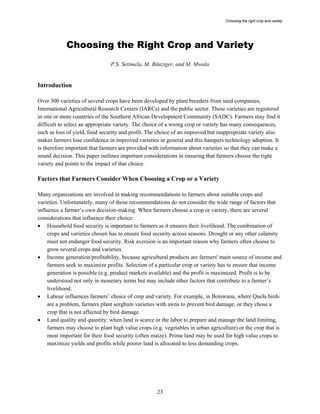
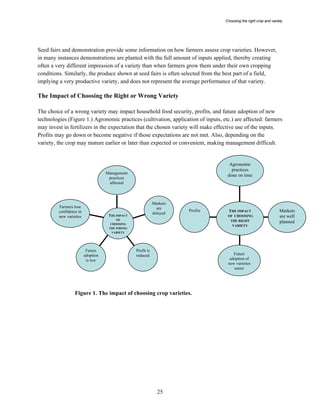
The choice of a wrong variety may impact household food security, profits, and future adoption of new 
technologies (Figure 1.) Agronomic practices (cultivation, application of inputs, etc.) are affected: farmers 
may invest in fertilizers in the expectation that the chosen variety will make effective use of the inputs. 
Profits may go down or become negative if those expectations are not met. Also, depending on the 
variety, the crop may mature earlier or later than expected or convenient, making management difficult. 
Agronomic 
practices 
done on time 
THE IMPACT 
OF CHOOSING 
THE RIGHT 
VARIETY 
Markets 
are well 
planned 
Future 
adoption of 
new varieties 
easier 
Profits 
Farmers lose 
confidence in 
new varieties 
Future 
adoption 
is low 
Management 
practices 
affected 
THE IMPACT 
OF 
CHOOSING 
THE WRONG 
VARIETY 
Markets 
are 
delayed 
Profit is 
reduced 
Figure 1. The impact of choosing crop varieties. 
25
Part 1: Understanding seed systems in southern Africa 
Steps in Selecting the Right Variety 
The following factors should be considered when selecting a crop variety: 
Determine your Agro-ecological Zone 
Determine the characteristics of the agro-ecological zone where the variety will be grown. This includes: 
• Amount of rainfall and the risk of drought during the season 
• The length of the growing season 
• Soil type 
• Prevalent diseases 
• High or low potential area 
The characteristics of an agro-ecological zone determine what characteristics a variety needs to perform 
well, what disease resistance, what maturity group, whether there is need for the variety to be tolerant to 
drought or low pH etc. Many varieties that are introduced from other parts of the world or even South 
Africa (“exotic varieties”) may not have the appropriate disease resistance or may not be adapted to the 
prevalent soil types. 
Length of Growing Season 
The length of the growing season determines the ideal maturity group for a variety. Ideally, you want to 
have a variety that matures within the growing season (or as long as there is available soil water). Crop 
varieties can be classified into the following groups: 
• An early-maturing variety can be planted early and be harvested before the end of the season or 
planted late in the season and be harvested by the end of the season. It can also be used in areas where 
the rainy season is very short. 
• An intermediate-maturing variety also does not require a full season to mature. It often can be 
harvested before the end of the season, or can be grown where rains may stop early. When conditions 
are good, an intermediate-maturing variety gives typically a higher yield than an early-maturing 
variety. 
• A late-maturing variety is a variety that needs to be planted very early in the season, often with the 
first rains, so that it can have time to mature before the season ends. When conditions are good, a late 
maturing variety typically gives a higher yield than an intermediate or early-maturing variety. 
Note, some exotic varieties may never mature due to photoperiod sensitivity. This has been a problem 
when seed of exotic varieties has been used for seed relief. 
Type of Germplasm 
Determine type of germplasm whether is a hybrid or an open-pollinated variety those seed can be 
recycled without yield penalty. Farmers often have a pronounced preference for either seed type. 
Intended Use 
Variety characteristics strongly influence the intended use. Different varieties may be chosen depending 
on the use of the produce. For example, there are maize varieties that are more suitable for green 
consumption (sweet and large cobs). Farmers often prefer different grain textures when home-processing 
and home-storing maize (they choose flint textures) versus selling maize grain (they choose types that 
give a good price in the market). 
26
Designing community-based seed production schemes 
Designing A Community-Based 
Seed Production Scheme 
M. Bänziger, P.S. Setimela, and M. Mwala 
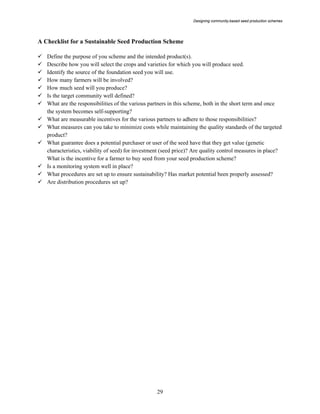
When designing a seed production scheme, it is important to be conscientious about the purpose of the 
scheme and its product. 
Community-based Seed Production: Purpose 
Many community-based seed production schemes are initiated because farmers are concerned about a 
lack of seed at planting time. Farmers have been recycling grain as seed (or other planting materials) for 
centuries, so it is important to understand what is meant by “lack of seed”. Here are two examples: 
1. Seed may be unavailable due to environmental factors (e.g., drought) or civil disturbances, which can 
cause acute shortages. Training farmers in community-based seed production will have limited 
impact, unless issues of risk aversion for crop production are addressed first: otherwise the same 
environmental or civil disturbances that reduce grain production will also reduce seed production. 
However, risk aversion strategies may include crops for which seed or planting material is not readily 
available. In this instance, community-based seed production schemes may contribute to increasing 
farmers’ access to such planting material provided the cost involved in producing the planting 
material or seed is not greater than farmers’ willingness to invest in such planting material. 
2. Seed from the formal sector may be unavailable or at prices deemed too high. In this instance, farmers 
perceive an added value to seed over grain (otherwise they would be planting grain) and are ready to 
pay a higher price for seed. The perceived value of seed may consist of varietal characteristics 
(genetic make-up) and/or its viability. Training farmers in community-based seed production may 
have an impact on farmers’ access to seed, provided seed production costs can be kept lower than 
those of the existing seed sector price and the quality of the seed produced meets the farmers' 
expectations. 
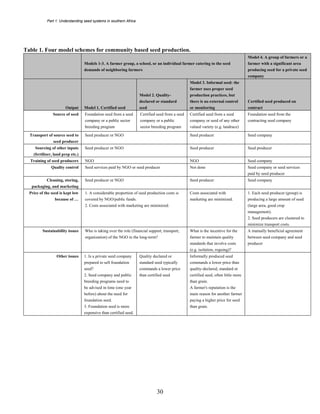
Outputs of a Seed Production Scheme 
Certified seed, quality-declared seed, or standard seed are commodities where the government guarantees 
seed quality; i.e., genetic value, purity and seed viability. The seed producer needs to follow established 
regulations; adherence to these regulations is monitored. A farmer paying a higher price for seed over 
grain can therefore feel confident about obtaining value for money. Requirements are more stringent for 
certified seed than for standard or quality-declared seed. 
27
Part 1: Understanding seed systems in southern Africa 
Seed from the Informal Sector 
The quality of informally produced seed is guaranteed only by its seller. Thus, there is little guarantee 
other than knowing and having confidence in the seller, or having seen his/her seed production field, that 
gives an incentive for paying a higher price for seed than grain. Most countries permit the trade of 
informally produced seed in a community and among neighbors, but have special regulations for formal 
trade. 
Designing a Community-Based Seed Production Scheme 
Community-based seed production is not simply about producing seed. Several other aspects have to be 
considered, including: 
• Choice of crop(s) and variety. 
• Source of seed. 
• Training of seed producers. 
• Quality control. 
• Need for credit to produce the seed. 
• Cleaning, packaging, and marketing of seed. 
• Sustainability issues. 
Table 1 compares four models of community-based seed production. It highlights the issues of costs 
involved and sustainability—issues often insufficiently addressed, when designing community-based seed 
production schemes. Unless the public sector or an NGO is prepared to invest continuously in a seed 
production scheme, costs for all components (seed production, training, quality control, marketing, 
transport, credits) must be covered by the price of the seed produced. It is therefore in the interest of all 
parties involved to design scheme that minimizes costs while meeting the purchasers’ expectations for 
quality (genetic make-up and seed viability). 
28
Designing community-based seed production schemes 
A Checklist for a Sustainable Seed Production Scheme 
9 Define the purpose of you scheme and the intended product(s). 
9 Describe how you will select the crops and varieties for which you will produce seed. 
9 Identify the source of the foundation seed you will use. 
9 How many farmers will be involved? 
9 How much seed will you produce? 
9 Is the target community well defined? 
9 What are the responsibilities of the various partners in this scheme, both in the short term and once 
the system becomes self-supporting? 
9 What are measurable incentives for the various partners to adhere to those responsibilities? 
9 What measures can you take to minimize costs while maintaining the quality standards of the targeted 
product? 
9 What guarantee does a potential purchaser or user of the seed have that they get value (genetic 
characteristics, viability of seed) for investment (seed price)? Are quality control measures in place? 
What is the incentive for a farmer to buy seed from your seed production scheme? 
9 Is a monitoring system well in place? 
9 What procedures are set up to ensure sustainability? Has market potential been properly assessed? 
9 Are distribution procedures set up? 
29
Part 1: Understanding seed systems in southern Africa 
Table 1. Four model schemes for community based seed production. 
Models 1-3. A farmer group, a school, or an individual farmer catering to the seed 
demands of neighboring farmers 
Model 4. A group of farmers or a 
farmer with a significant area 
producing seed for a private seed 
company 
Output Model 1. Certified seed 
Model 2. Quality-declared 
or standard 
seed 
Model 3. Informal seed: the 
farmer uses proper seed 
production practices, but 
there is no external control 
or monitoring 
Certified seed produced on 
contract 
Source of seed Foundation seed from a seed 
company or a public sector 
breeding program 
Certified seed from a seed 
company or a public 
sector breeding program 
Certified seed from a seed 
company or seed of any other 
valued variety (e.g. landrace) 
Foundation seed from the 
contracting seed company 
Transport of source seed to 
seed producer 
Seed producer or NGO Seed producer Seed company 
Sourcing of other inputs 
(fertilizer, land prep etc.) 
Seed producer or NGO Seed producer Seed producer 
Training of seed producers NGO NGO Seed company 
Quality control Seed services paid by NGO or seed producer Not done Seed company or seed services 
paid by seed producer 
Cleaning, storing, 
packaging, and marketing 
Seed producer or NGO Seed producer Seed company 
Price of the seed is kept low 
because of … 
1. A considerable proportion of seed production costs is 
covered by NGO/public funds. 
2. Costs associated with marketing are minimized. 
Costs associated with 
marketing are minimized. 
1. Each seed producer (group) is 
producing a large amount of seed 
(large area, good crop 
management). 
2. Seed producers are clustered to 
minimize transport costs. 
Sustainability issues Who is taking over the role (financial support, transport, 
organization) of the NGO in the long-term? 
What is the incentive for the 
farmer to maintain quality 
standards that involve costs 
(e.g. isolation, roguing)? 
A mutually beneficial agreement 
between seed company and seed 
producer 
Other issues 1. Is a private seed company 
prepared to sell foundation 
seed? 
2. Seed company and public 
breeding programs need to 
be advised in time (one year 
before) about the need for 
foundation seed. 
3. Foundation seed is more 
expensive than certified seed. 
Quality declared or 
standard seed typically 
commands a lower price 
than certified seed 
Informally produced seed 
commands a lower price than 
quality-declared, standard or 
certified seed, often little more 
than grain. 
A farmer's reputation is the 
main reason for another farmer 
paying a higher price for seed 
than grain. 
30
Part 2: 
Seed Production 
for Selected Cereals 
31
Part 2: Seed production of selected cereals 
32
Seed production of maize OPVs 
Seed Production of 
Open-Pollinated Maize Varieties (OPVs) 
D. Beck, M. Bänziger, S. Paliwal, and P. Setimela 
Introduction 
This chapter describes how farmers and farming communities may produce their own seed of open-pollinated 
maize varieties (OPVs). There is no disadvantage with this practice as long as the seed has 
been produced and stored properly. 
Reproduction in Maize 
The maize plant has separate male and female flowers (Figure 1). The male flowers, or tassels, are located 
at the top of the plant, whereas the female flowers (ears and silks) develop about half way up the stalk. 
The location of the tassel at the top of a relatively tall plant and its separation from the female flower 
promotes cross-pollination between plants. Commonly, pollen from a tassel will be blown by the wind to 
one or more plants nearby. Pollen is very small, and a single tassel may produce up to 25 million pollen 
grains. Shortly after pollen contacts the female silks, it germinates and grows down through the silk, 
eventually fertilizing the young ovule. The fertilized ovule develops into the embryonic plant within the 
developing seed. 
Choice of Maize OPVs 
Maize breeding programs are continuously developing new OPVs. They are often higher yielding than 
older varieties or farmers’ own varieties and may have other value-added traits, such as early maturity or 
better disease resistance. To benefit from a new, improved variety, farmers must first obtain seed of the 
variety. Seed production must then be done in a particular manner that maintains the purity of the variety 
and gives good quality seed. This is normally done by requesting foundation seed from either the national 
maize program or an international center such as CIMMYT. Alternatively, foundation seed may be 
available through private sector sources. 
How to Produce OPV Seed 
When producing seed, a farmer usually wants to maintain the characteristics of a variety. Cross-pollination 
between different maize varieties must therefore be prevented. Isolating the seed production 
field from other maize fields helps achieve this. If two different varieties are grown next to each other, 
cross-pollination will occur between the two varieties, and the crop grown from such seed will have a 
mixture of the characteristics of those two varieties. 
33
Part 2: Seed production of selected cereals 
Figure 1. The maize plant and its flowering parts. 
34
Seed production of maize OPVs 
Isolating a Seed Production Field 
Isolation of a seed crop can be done in four ways: 
1. By space. Maintain a distance of at least 300 meters between the seed crop and any other maize field 
that has a different variety planted (Figure 2). 
2. By time. Sow your seed crop a month earlier or later than neighboring maize fields. 
3. By certified seed barriers. A barrier of genetically pure seed of the same variety may be planted 
within the isolation distance of the seed production field. 
4. By natural barriers. Seed production plots can be established on land isolated by natural or artificial 
forests, for example. 
Distance and time isolation are the most commonly used approaches. The goal is to have no other maize 
variety shedding pollen nearby when the seed production field is flowering. Wind may carry pollen 
further than 300 meters. Thus, if there are constant strong winds in one particular direction, the distance to 
the next maize field should be at least 400 meters. 
Figure 2. Isolation in time and space of a maize seed field. 
Drawing from “Open-pollinated maize seed production handbook” 
compiled by AfricCOMMS (PVT) Ltd. Harare, 2002. SADC/GTZ. 
35
Part 2: Seed production of selected cereals 
How to Select a Suitable Field 
Consult with your neighbors about when and where they will plant their maize, so you can sow yours in a 
field that is properly isolated. Apart from considering isolation, select your best field for maize seed 
production and manage it well, because the value of good seed is higher than the value of grain. Choose a 
field where no maize has been grown during the previous year to reduce the possibility that last year’s 
maize crop may germinate and cross-pollinate your seed maize. Farming communities may want to 
produce the seed of one variety for the entire community in a single field. This will help in finding a well-isolated 
field with good soil. Also, the village can make a collective effort to look after the maize crop 
well. 
How to Manage your Seed Production Field 
Prepare the soil in your field at least two weeks prior to planting. If there are any grains from previous 
maize crops left in the soil, they may germinate in these two weeks and you should remove them when 
you sow your maize seed crop. 
If possible, sow your maize seed crop early. Choose a plant density that is recommended for your area. A 
common seeding rate for maize is 20 kg/ha. Planting in straight rows will facilitate crop management and 
seed production operations. Apply fertilizer and remove weeds in time. 
Eliminating Undesirable Plants 
Carefully examine your maize seed crop as it grows. You may find plants that look very different or 
flower much earlier or later than most other plants in the field. These plants are called off-types and they 
should be removed—a process known as "roguing"—before pollen shedding starts. Most farmers do not 
like to remove maize plants from their field, but rouging is critical to maintain varietal purity. 
Harvest and Drying 
During harvest and drying, be careful that the seed of your maize crop does not get mixed with seed or 
grain from other maize varieties. Keep only the best and healthiest ears and kernels for seed, and use the 
rest of the harvest as grain. Your best seed comes from healthy undamaged ears that are typical for the 
variety. Thus, discard off-types, rotten and damaged ears, and ears where the kernels have started to 
germinate or are affected by insects. Place the harvested ears on a clean and dry surface, such as concrete 
or plastic, and dry them well in the sun. To make sure that all kernels get exposed to the sun, spread the 
ears in a flat layer and turn them several times. Maize seed stores best at <12% moisture content. 
36
Seed production of maize OPVs 
Shelling, Cleaning, and Storing Seed 
When the maize seed is dry, it can be stored on the cob or shelled. Be careful not to damage the seed 
when shelling. Your best seed typically comes from the middle part of the ear. After shelling, clean the 
seed, removing dirt and other inert matter. Remove seeds that are small, look diseased, have started to 
germinate, or are damaged by insects. Treat the seed with an insecticide-fungicide combination, and store 
it in a dry and cool place. When treating the seed, follow the guidelines on the seed treatment package 
carefully. One good way to store seed is to place it in a jute bag, close the bag and drop it into a plastic 
bag, close the plastic bag and place this in another jute bag, finally closing the outer jute bag. Seed bags 
should be stored in a seed warehouse on wooden pallets in cool conditions away from fertilizer and 
chemicals. 
Quality Control in Maize Seed Production 
The production and distribution of quality maize seed requires diligent efforts both during field 
production and post-harvest handling. Field inspections are commonly conducted at different crop 
development stages to ensure quality. 
Field Inspections 
A planting inspection is commonly conducted to determine that the maize seed planted is genetically 
pure, of known origin, and is an appropriate variety for the area. If a mechanical planter is being used, it 
should be checked to ensure that it is clean and free of maize seed of other types and is properly calibrated 
to achieve recommended seeding densities. The field should be inspected to verify that it is properly 
isolated and free of volunteer plants. 
A second field inspection may be made during the vegetative growth phase. Isolation should be checked, 
along with the presence of disease, insect pests, or weed infestations. At this stage, off-type and diseased 
plants may be rogued. 
The most important field inspections are made just prior to and during flowering. At this time the maize 
seed field is most susceptible to genetic contamination from wind-blown pollen coming from off-type 
plants within the field or other maize varieties in surrounding fields. Therefore, it is essential during the 
pre-flowering inspection to confirm that the maize seed field has been properly rogued and is sufficiently 
isolated from other maize fields. Plants that are off-type or diseased, along with harmful weeds, must be 
removed at this time. 
A pre-harvest or harvest inspection may be conducted as the crop reaches maturity and the seed has lost a 
significant portion of its moisture content. Off-type plants, such as those that are still green when most the 
other plants are dry, may be removed at this stage. At harvest, ears with different grain color or texture 
from the produced variety should be removed. 
37
Part 2: Seed production of selected cereals 
Quality Control Tests 
Various standard tests for moisture content, germination, and physical purity can be conducted to evaluate 
the quality of the seed. The most common evaluation described here is the germination test, designed to 
determine the seed’s capacity to germinate and produce normal plants when sown under appropriate 
conditions. 
Germination Test 
Germination tests may be conducted by building an open wooden box, 1 m long, 50 cm wide, and 10 cm 
deep (Figure 3). Fill the box with insect-free, loose soil. Divide it in half and plant 100 seeds in rows 
separated by 10 cm. Since the objective is to see how many seeds germinate, sow them one by one in a 
thin line about 2 cm deep. The box should be watered thoroughly and kept in a safe place away from birds 
and other animals. Another alternative would be to conduct the germination test in a well-prepared bed 
near the homestead or in a protected garden (Figure 3). Another option is to evaluate maize seed 
germination in paper towels or newspapers. With this method, 50 maize seeds are spread out in lines on 
moistened paper and then covered by another wetted paper (Figure 3). The paper is rolled and tied with a 
string or elastic band. The paper rolls can be placed in plastic bags or other containers and kept moist for 
seven days. With each of these methods, a count for normal developing seedlings is made between 7 and 
10 days after sowing. A minimum of 80% germination is the suggested standard; anything below this 
means the seed is not of acceptable quality. 
Figure 3. Maize seed germination methods. 
Drawing from “Open-pollinated maize seed production handbook” compiled by 
AfricCOMMS (PVT) Ltd. Harare, 2002. SADC/GTZ. 
38
Seed production of maize OPVs 
References 
AfricCOMMS (PVT) Ltd. 2002. Open-pollinated maize seed production handbook. Harare, Zimbabwe: 
SADC/GTZ. 
Beck, D.L. 2004. Hybrid corn seed production. In C.W. Smith, J. Betran, and E.C.A. Runge (eds.), Corn: 
Origin, History, Technology, and Production. Hoboken, New Jersey: John Wiley & Sons, Inc. 
Cordova, H.S., J.L. Queme, and P. Rosado. 1999. Small-scale production of maize seed by farmers in 
Guatemala. Second edition. Mexico, D.F.: CIMMYT and El Programa Regional de Maiz (PRM) para 
Centroamérica y El Caribe. 
The Maize Program. 1999. Development, Maintenance, and Seed Multiplication of Open-Pollinated 
Maize Varieties, 2nd edition. Mexico, D.F.: CIMMYT. 
39
Part 2: Seed production of selected cereals 
40
Seed production of sorghum and pearl millet 
Seed Production of Sorghum and Pearl Millet 
F.P. Muuka and M. Chisi 
Introduction 
Sorghum and pearl millet are important indigenous African cereal food crops. To date, several improved 
varieties and a number of agronomic recommendations have been developed for different categories of 
farmers in different agro-ecological regions. These include open-pollinated varieties (OPVs) and hybrids 
for grain and forages; and recommendations on spacing, plant population, and fertilizer rates. The 
improved varieties are diverse in maturity, adaptation, height, seed color, and size. Generally, they are 
tolerant to prevailing diseases such as anthracnose, downy mildew, ergot, smut, viruses, leaf diseases, and 
sooty stripe. 
Due to numerous constraints, seed production and supply for traditional food crops such as sorghum and 
millet are unstable and often lack continuity. As a result, promotion and adoption of new varieties in 
Zambia is limited. Statistics on the production and sale of sorghum and pearl millet seed/grain are not 
readily available (Penninkhoff 1988; Chisi and Muuka 1996). Singh and Jain (1991) estimated national 
seed requirements at 336-480 tons for sorghum and 295 tons for pearl millet. During 1985-94, area 
planted to sorghum and millet grew by 0.2 and 13.1% per year, respectively (FAO 1996). Thus, current 
seed requirements could be higher than this estimate. Also, the estimate was made when only a few 
improved varieties were available on the market. As new varieties spread and adoption increases, seed 
demand generally increases (Lof and Nchemba 1994; Maimu et al. 1995; Ericsson and Karlsson 1999). 
Farmers are increasingly aware of the benefits of improved seed and of differences among cultivars. In 
particular, farmers value the early maturity, large seed size, and higher grain yields of new varieties. 
Guidelines for producing quality seed of these varieties have also been developed. The recommendations 
are similar to best agronomic practices for the respective varieties, although certain additional procedures 
are suggested, depending on the class of seed. 
Seed Production Procedures 
Procedures governing production and sale of seed need to conform to the national seed act. Standards 
have to be met for different crops and seed classes, and are enforced by licensed personnel affiliated to 
the Seed Control and Certification Institute (SCCI), which controls the Seed Certification Scheme. Table 
1 shows some of the requirements for seed production of sorghum and millet. 
41
Part 2: Seed production of selected cereals 
Table 1: Seed classes and production restrictions for sorghum and pearl millet. 
Sorghum* Pearl millet** 
Seed Class Isolation distance, m Seed Class Isolation distance, m 
Basic OPVs 200 Nucleus 2,000 
Certified OPVs 100 Breeder 1,000 
Basic hybrid 300 Basic 1,600 
Certified hybrid 200 Certified 300 – 400 
Basic forage 400 Inbred lines 800 
Certified forage 400 
Inbred lines 800 
* Adapted from Nath 1995. ** Adapted from Singh 1995. 
Nucleus and Breeder Seed 
Usually handled by the breeder, these are the first stages in the chain of seed production. The breeder has 
strict control, observes isolation distances, inspects the crop, and rogues off-types regularly to maintain 
genetic purity. Sufficient quantities of seed should be made available by the time a new cultivar is at the 
pre-release stage. OPV breeder seed is produced under bulk planting, but usually in small plots with wide 
spacing to allow for maximum expression and roguing. Seed production for a hybrid is highly technical 
and requires experience. Four isolations are normally maintained as follows: A-line x B-line to increase 
seed of the male-sterile A-line. Separate isolations are required to increase the B-line and R-line. Finally, 
hybrid seed is produced by crossing an A-line x R-line. Synchronous flowering of hybrid parents 
(nicking) is mandatory, as is rigorous rogueing of off-types and pollen shedders in the A-line. Hand 
pollinations and selfing in the B-and R-lines is possible. Different row ratios of hybrid parents of 4:2 or 
6:2 (A-line against the B- or R-line) are used with 4-8 border rows of B/R lines planted all round the field 
(Chopra et al. 1999). Stagger planting of the B-line is possible but could present problems for the R-line. 
This category of seed is generated every 3-6 years, either during the normal season or in the off-season, 
under irrigation. 
Basic (Foundation) Seed 
Part of the Nucleus or Breeder seed is used to produce the Basic or Foundation Seed, either by researchers 
or a few contracted seed growers. Similar guidelines are followed as those for the first class of seed. The 
seed crop must be inspected at least three times by inspectors affiliated with the SCCI: during the 
vegetative growth stage, at flowering, and at maturity. 
Certified Seed 
Basic seed is used to produce certified seed under a similar planting pattern to Breeder and Foundation 
seed. For hybrid parents, however, rows of the B-line are replaced by the R-line. 
Training Seed Producers 
Some training is given to seed growers. Training courses are offered to individuals representing groups, 
organizations institutions. Sometimes field days are conducted to improve awareness of the improved 
cultivars available and illustrate important aspects of seed production (field selection, planting pattern, 
weeding, and fertilizer rates, among others). 
42
Seed production of sorghum and pearl millet 
Site and Field Selection 
Locations and fields for seed production may differ from those for commercial crop production. 
Important consideration should be given to growing conditions, length of rainy season, irrigation 
facilities, humidity during ripening period, temperatures and daylength, protection from strong wind, 
adequate isolation distance, and the presence of birds, diseases, and insect pests or related wild/cultivated 
species. The field should be relatively fertile, free from water logging, and with a pH not below 4.5. 
Field Preparation 
Sorghum and pearl millet seeds are small. Soil should have fine tilth, and be moist and weed free at the 
time of planting. Zero tillage is not recommended. 
Sowing 
Drilling or stations should be done in rows at a depth of 2-3 cm when rains are established, and in such a 
way that the seed crop matures during a period with minimum precipitation. It is important to know the 
maturity period of the cultivar. 
Off-season planting under irrigation is possible, especially in hot valley areas. For hybrid parents, 
planting should be in such a way that they flower at the same time. Recommended seed rates are 4-6 
kg/ha for pearl millet and 8-10 kg/ha for sorghum to achieve plant populations of 60,000-80,000 and 
130,000-150,000 respectively. The recommended spacing for pearl millet is 75 cm between rows and 
20 cm between hills within a row or 60 x 60 cm. For sorghum, 60-75 cm x 50 cm is recommended, with 
4-8 seeds per station, later to be thinned to 2-3 plants per station. It is advisable for a block of farmers to 
plant the same variety at the same time. Dry planting is not recommended. 
Fertilizer Rates 
200 kg/ha of Compound D as a basal fertilizer and 100 kg/ha of urea as top dressing are recommended. 
Top dressing can be applied in two splits. Fertilizer applications will differ according to local soil type 
and fertility. 
Weeding 
Seed plots are normally weeded 2-3 times using hoes, oxen, or tractor-drawn cultivators to keep fields 
weed-free at all times. In sorghum a combination of mechanical weeding and pre-emergence Gesaprim 
herbicide should be applied at 3-4 l/ha. Weeds compete with the seed crop for nutrients, sunlight, and soil 
moisture. They could also be a reservoir of diseases that contaminate the crop at harvest. 
Thinning 
Thinning to the recommended spacing and plant population is required before tillers form. Gap filling is 
not recommended in a commercial seed crop. 
43
Part 2: Seed production of selected cereals 
Plant Protection 
Improved sorghum and pearl millet cultivars are tolerant of most prevailing diseases. Avoid growing seed 
in disease-endemic areas. Bird damage, potentially the most serious problem, can be minimized by 
careful selection of the site, growing larger areas, scaring, and planting varieties with some “resistance” to 
birds (for example, brown high-tannin sorghum and bristled types of pearl millet). 
Roguing and Inspection 
Roguing is done to remove weak, diseased and off-type plants before they shed pollen, during flowering, 
and before harvest. 
Harvesting, Threshing and Post-Harvest Handling 
Hand harvesting is the most common practice. Combine harvesting is possible for short stature varieties 
and is done after final inspection. Harvesting should be done when the seed crop is fully mature but 
before lodging. Mechanical mixtures should be avoided when harvesting hybrids and hybrid parents, 
especially when lodged plants are present. Male rows should not be used for seed. Trained workers can 
remove left-over undesirable plants during harvesting. Manually harvested panicles are sun dried for a 
few days and then threshed using suitable mechanical threshers, mortar and pestle, or sticks (beating). 
Care must be taken to avoid breaking or cracking the seed. Clean the threshing equipment before using it 
on a different variety or seed class. Clean the threshed seed by winnowing, then treat with available 
chemicals and store in screw-cup containers, bags or tins. It is important to record the identity of each 
seed type and class. Seed classes are given labels of specific colors. 
Seed Marketing and Pricing 
Seed marketing and pricing depend on various factors, including type of seed, demand, the producers 
themselves, and sometimes distance from production and selling points. Prices may vary across different 
crop species, between hybrid and OPV seed, and across seasons. 
44
Seed production of sorghum and pearl millet 
References 
Chisi, M., and F.P. Muuka. 1996. A review of cultivar release procedures, seed production, and extension 
work for sorghum and pearl millet in Zambia. Pp. 279-286 in K. Leuschner and C.S. Manthe (eds.), 
Drought-tolerant Crops for Southern Africa: Proceedings of the SADC/ICRISAT Regional Sorghum 
and Pearl Millet Workshop, 25-29 July 1994, Gaborone, Botswana. Patancheru 502 324, Andra 
Pradesh, India: International Crops Research Institute for the Semi-Arid Tropics. 
Chopra, K.R., R. Chopra, G. Rabbani, and K.K. Thimaiah. 1999. Seed production. Pp. 445-477 in Pearl 
Millet Breeding. New Delhi, India: Oxford and IBH Publishing Company Pvt. Ltd. 
Ericsson, K., and G. Karlsson. 1999. Pearl millet in the Western Province of Zambia – Small-scale 
farmers’ experiences of growing improved and local varieties. Minor Field Studies No. 66. Uppsala: 
Swedish University of Agricultural Sciences. 
FAO. 1996. The world sorghum and millet economics-facts, trends and outlook. Patancheru 502 324, 
Andra Pradesh, India: International Crops Research Institute for the Semi-Arid Tropics; and Rome, 
Italy: FAO. 
Government of Zambia. 1999. The Agriculture (Plant Varieties and Seeds) Act (Laws, Volume XIV, CAP 
236). The Agriculture (Quantity Declared Seeds) Regulations, 1999. 
Heemskerk, W. 1991. Seed selection and seed storage. Ministry of Agriculture. 
Lof, H.J., and A.C. Nchemba. 1994. Seed banks – Enhancement of farmers’ control over seed supply. 2nd 
SADC Seminar on seed research and certification, 17-20 May 1994, Maseru, Lesotho. 
Lyoba, B., and R. Tripp. (undated). Linking adaptive research to farmer seed systems: diffusion of new 
varieties in Senanga West, Zambia. Overseas Development Institute (ODI). 
Maimu, Z., S. Mupo, M. Nyambe, and G. Sitali. 1995. Evaluation of the pre-extension programme on the 
adoption of improved varieties of bulrush millet and sorghum in Senanga West. KIT, Mauritskade 63, 
1092 AD Amsterdam, Netherlands. 
Mount Makulu Central Research Station. 2002. Pearl millet production guide. 
Mount Makulu Central Research Station. 2002. Sorghum production guide. 
Nath, B. 1995. Sorghum (Sorghum bicolour L). Pages 165-171 in Zambia seed technology handbook. 
Ministry of Agriculture, Food and Fisheries. 
Singh, P. 1995. Pearl millet (Pennisetum americanum L.) pages 171-182 in Zambia seed technology 
handbook. Ministry of Agriculture, Food and Fisheries. 
45
Part 2: Seed production of selected cereals 
46
Part 3: 
Seed Production in Selected 
Vegetatively Propagated Plants 
47
Part 3: Seed Production in Selected Vegetatively Propagated Plants 
48
Seed production for cassava and sweet potato 
Quality Seed and Seed Production Procedures 
for Cassava and Sweet Potato 
C.C. Moyo, N.M. Mahungu, V.S. Sandifolo, A.R.K. Mhone, F. Chipungu, and J. Mkumbira 
Introduction 
Healthy seed is the basis for obtaining a healthy crop. Cassava and sweet potato are propagated through 
use of vegetative parts, which entails certain problems, such as low multiplication ratio, bulkiness, short 
shelf life, and difficult dry season maintenance, in the case of sweet potato. Some diseases, such as 
cassava mosaic disease, cassava brown streak disease, and sweet potato virus disease, are systemic and 
can be transmitted through use of vegetative parts. 
Farmers have to know what constitutes high quality seed in cassava and sweet potato and how to produce 
it. Good quality cassava and sweet potato seed sprouts well and grows into a healthy crop, once sown. 
Such seed should be mature, free of pests and diseases, and true to type. 
In most Southern Africa Development Community (SADC) countries, commercial seed companies are 
not interested in producing cassava or sweet potato seed, as they find it unprofitable. Government 
institutions, non-governmental organizations (NGOs), religious groups, and smallholder farmers must 
produce the seed. 
Seed Categories 
The three categories of seed are: 
1. Breeder seed. This is produced and maintained by the breeder. It is the source of planting material 
for basic seed. 
2. Basic seed. The progeny of breeder seed, this is handled under the supervision of the National Seed 
Certification Scheme. 
3. Certified seed. This is the progeny of basic seed. 
49
Part 3: Seed Production in Selected Vegetatively Propagated Plants 
Seed Multiplication Scheme 
Cassava and sweet potato are multiplied at three levels: primary, secondary and tertiary. The scheme has 
the advantage of facilitating seed distribution. At the primary level, the sites are at or near research 
stations for easy supervision by scientists. At the secondary level, the sites are established and managed 
by extension staff, NGOs, religious groups, and some individual farmers. Scientists in root crops 
programs backstop these sites. Multiplication sites at the tertiary level are mainly farmer managed. They 
are often smaller in size and more numerous. Extension staff and NGOs usually backstop these. 
Cassava 
Cassava stems can be multiplied using conventional as well as rapid multiplication techniques. In either 
case, the primary objective is stem production and not roots. 
Conventional method. The conventional cassava multiplication method is the easiest and most widely 
used. However, it has the disadvantage of having a low multiplication ratio (1:10) unlike the rapid 
multiplication technique (1:60-100). Ideally, a cassava multiplication site should have the following 
characteristics: 
• Easy access to beneficiaries. 
• Must not have been under cassava the previous season, to avoid volunteer plants. 
• Well drained soils. 
• Protection from livestock damage. 
• Away from high-pressure areas for cassava pests and diseases. 
• Away from other cassava fields: at least 200 m for breeder seed and 100 m for basic and certified 
seed. 
Variety. The best varieties to multiply are those demanded by farmers. Farmers usually prefer varieties 
that are: 
• High in dry matter content (at least 30 %). 
• Mealy (ability of the roots to cook without processing). 
• Early bulking. 
• Good for in-ground storability—that is, the ability of mature roots to stay in the ground without 
spoiling. Good storability prolongs the period over which the crop can be harvested. 
• Tolerant to pests and diseases. 
• Suitable for their cropping systems (e.g., high branching varieties for intercropping). 
• Suitable for their mode of consumption. Bitter cassava varieties are preferred where the crop is 
processed; sweet varieties for the fresh market. 
Land preparation and planting. Land for cassava multiplication should be prepared early to enable 
planting with the first rains. Early planting enables the crop to be established while there is still adequate 
soil moisture. If the site is in the dambos or low-lying areas flooded during the rainy season, planting 
should be done soon after the water has receded. 
50
Seed production for cassava and sweet potato 
Planting material. Only good quality planting material should be used. The following guidelines can 
assist in selection to avoid unhealthy stem cuttings. 
• Select plants that are mature, about 8 to 18 months old. Such plants will normally have brown-skinned 
stems. Tender portions can be planted, but these easily dehydrate and get damaged by pests 
and diseases. 
• The plants should be healthy. Healthy plants have robust stems and branches, lush foliage, and 
minimum damage from pests and diseases. 
• Avoid plants with pests and diseases. Many cassava pests and diseases are stem-borne and are spread 
through distribution and planting of infested or diseased cuttings. The major pests are cassava mealy 
bug (CM) and cassava green mite (CGM), while the major diseases are cassava mosaic (CMD), 
cassava bacterial blight (CBB), and cassava brown streak disease (CBSD). 
• Avoid bruising/wounding stems. Wounds are potential entry sites for pathogens. 
Planting. Cassava for seed multiplication should be planted at 1.0 m by 0.5 m (20,000 plants/ha) or 0.5 m 
x 0.5 m (40,000 plants/ha). Stem cuttings should be 20-30 cm long, with 6 to 8 nodes per cutting. Shorter 
cuttings, 15-20 cm, can be used, but the risk of drying is high under poor soil moisture conditions. Care 
should be taken to avoid bruises and damage to the buds when planting. 
Sometimes stem cuttings are slightly infested with CM, CGM and other stem-borne pests. Immersing the 
stems in heated water (about 60o C) for 5 to 10 minutes or treating with a 1% solution of Rogor 
(Dimethoate) can control these pests. Fungal diseases, such as anthracnose, can be controlled using 
Benlate or Decis. 
Field management. The major management practices after planting include weeding, fertilizer 
application and roguing (uprooting disease-infected plants and off-types). 
• Weeding. The multiplication field should be kept weed free. This is particularly important in the first 
three months of growth before the canopy fully develops. 
• Fertilizer application. Where soils are poor, fertilizer should be applied to boost stem growth. In 
most parts of the region, the best time for application is at or soon after planting so that the crop can 
make use of the fertilizer before the rains tail off. The amount to be applied depends on soil analysis. 
However, in Malawi a blanket application of 50 kg N and 40 kg P2O5/ha is used, in the absence of soil 
analysis. 
• Crop hygiene. Crop hygiene is of paramount importance in the production of cassava planting 
material. Routine field inspections to uproot and destroy disease-infected plants are a must. These 
should start soon after sprouting and be repeated every fortnight in the first three months of growth 
and once every month thereafter, if the disease pressure is not very high. The uprooted plants should 
be destroyed away from the multiplication field by burning or burying. 
• Roguing. Good planting material should also be true to type, with no mixtures. In field inspections, 
off-types must be identified and uprooted. In the early stages of sprouting, gaps from uprooting must 
be filled to achieve full stand. 
51
Part 3: Seed Production in Selected Vegetatively Propagated Plants 
Stem harvesting. If the field is well managed, the stems become mature 9 to 12 months after planting. 
Since the objective is stem production, at harvest the plants are not uprooted but cut 20-25 cm above the 
ground (ratooned). Several shoots sprout from the stumps after ratooning. These should be thinned to 2 or 
3 stems per stump, which will mature into stems. 
Post-harvest management. After ratooning, fertilizers should be applied where possible to boost growth, 
and the field should be kept free of weeds. Another set of stems can be harvested 9 to 12 months after 
ratooning. This process can be repeated as many times as possible, as long as there is no build up of 
diseases. The number of sets of stems that can be harvested depends on variety, soil fertility, and 
management of weeds, pests, and diseases. However, ratooning is not recommended in high CMD 
pressure areas. 
At and after harvesting care should be taken to avoid bruising the stems. Bruised buds may not sprout. 
The stems should be tied together in bundles. The size of the bundles varies with area but in Nigeria there 
are usually 50 stems per bundle. 
Stem storage. Sometimes it is necessary to store stems. Such cases arise when plants are harvested off-season 
and planting is to be done later or a farmer acquires stems before the field is ready for planting. 
However, stems can be stored only for a short time—not more than eight weeks—because they dehydrate 
easily and can be damaged by pests and diseases. 
Cassava stems can be stored by tying them in bundles and keeping them either upright or horizontally 
under shade in a well-ventilated area. Where stems are stored vertically, the buds should face upwards 
and the oldest ends of stems should be inserted into the soil and watered at the base. 
During storage, avoid exposure to direct sunlight and hot/cold winds. It should be noted that mature and 
healthy stems store better than immature ones and long stems store better than short ones. 
Rapid multiplication. The term ‘multiplication ratio’ refers to the increase in planting material over what 
is planted. When planted, a 25-30 cm cassava stem cutting yields about 10 cuttings 12 months later, 
giving a multiplication ratio of 1:10. In contrast, a maize ear may give up to 300 seeds, which is a much 
higher multiplication ratio (1:300) than that of cassava. 
Rapid multiplication overcomes the handicap of low multiplication ratios in vegetatively propagated 
crops like cassava for the benefit of germplasm evaluation, distribution, and seed multiplication. The 
technique involves rapid increases in the quantities of planting material from what is available (1:60-100). 
Preparation of mini-stem cuttings. Whole stems are cut into mini-stems: hard woods (older parts, 1 or 2 
nodes), semi-hard woods (semi-mature parts, 4-6 nodes), and tip shoots (green and tender parts, 6-10 
nodes). The number of nodes per mini-stem depends on internode length, stem diameter, and weather at 
and after planting. Tip shoots should be stripped of all leaves except the youngest and kept in water to 
prevent dehydration. Care must be taken not to damage the axillary buds. Sharp tools (shears, secatuers, 
or knives) must be used in cutting the stems. 
52
Seed production for cassava and sweet potato 
Sprouting/Planting the mini-stems. Mini-stems can be directly sprouted or planted in nursery beds or 
strong plastic bags. 
Sprouting in the nursery. Nurseries should be near a water source and on well-draining soils. Beds should 
be 1 to 1.2 m wide, to enable easy working at the center of the beds, and of any length, depending on the 
amount of seed to be produced. The mini-stems should be planted at 10 cm x 10 cm. 
Hard woods should be planted horizontally, 4-5 cm deep to avoid being uncovered during when watering. 
Plant cuttings so that the nodes are on the left and right sides of the stems and not one on top of the other 
as shoots from below have difficulties in emerging. 
Semi-hard woods and tip-shoots should be planted vertically with two thirds of the older portion firmed in 
the soil. The shoots are sensitive to low humidity and should be watered lightly, three times a day. 
After planting, the nursery should be watered immediately and thereafter every morning and evening, 
except when it has rained; too much water may cause rotting of the mini-stems. The beds should be 
provided with labels indicating variety and date of planting. The nursery should be kept weed-free by 
hand pulling. The mini-stems will take 7-10 days to sprout. After 4-6 weeks in the nursery, the seedlings 
should be transplanted to the field. One to two weeks before transplanting, the seedlings must be hardened 
by reducing the amount and frequency of watering. However, a day before transplanting the beds must be 
heavily watered to enable easy transplanting. 
Sprouting in polythene bags. Sprouting in nursery beds, though commonly used, has several 
disadvantages. It requires 4 to 6 weeks before transplanting, is labor demanding, and soil may contain 
soil-borne diseases. On the other hand, sprouting the mini-stems in polythene bags without soil is quick, 
cheap, and convenient. However, the method is suitable only for hardwood and semi-mature mini-stems. 
Tip shoots, which are tender, do not usually survive the high temperatures in the bags. 
Before bagging, the mini-stems should be immersed in a broad-spectrum fungicide such as Benlate 
(Benomyl). The mini-stems should then be directly placed into the perforated bags, leaving about a third 
of the space empty for air circulation. The bags should then be kept under shade. 
High humidity and temperature in the polythene bags promote rapid and uniform sprouting. Cuttings 
sprout in 3 to 5 days. Sprouted mini-stem cuttings sprout well in the field. 
Transplanting and field management. Care should be taken at transplanting to avoid root damage. The 
seedlings should be transplanted into a well-prepared field at 1.0 m by 0.5 m or 0.5 x 0.5 m spacing. At 
this spacing, weeds are suppressed due to early foliage cover. The plots must be labeled indicating 
variety, date of planting, and area of each variety. 
53
Part 3: Seed Production in Selected Vegetatively Propagated Plants 
Field management, stem harvesting, and storage. The field management, stem harvesting and storage 
practices are the same as those of the conventional method. 
Sweet Potato 
Sweet potato has a multiplication ratio of 1:20, which is much lower than that of maize (1:300). Rapid 
multiplication overcomes the problem of low multiplication ratio in sweet potato. 
Site. Sweet potato rapid multiplication is normally conducted in nurseries. A good site is one that: 
• Was not under sweet potato in the previous season to avoid volunteer plants and carry over pests and 
diseases. 
• Is on well draining soils. 
• Is fenced off to protect it from animals. 
• Is near a perennial source of water. 
• Is away from high-pressure areas for sweet potato virus disease (SPVD). 
• Is at least 200 m (for breeder seed) and 100 m (for basic and certified seed) from the nearest sweet 
potato field. 
Land preparation and planting. Beds for sweet potato multiplication should be 1.0 m to 1.2 wide to 
enable easy working of the center while standing in furrows. The beds can be of any length, depending on 
the amount of seed to be produced. The beds should be 0.5 m apart. Where soils are poor (e.g., sandy) it is 
recommended to plow in manure at a rate of one wheelbarrow load per square meter of bed space. 
Variety. The best varieties to multiply are those demanded by farmers. Farmers usually prefer varieties 
that are: 
• High in dry matter content (at least 30%). 
• Mealy (ability of the roots to cook without processing). 
• Early bulking. 
• Tolerant to pests and diseases. 
Vines. Only good quality vines should be planted. The following guidelines can assist in vine selection to 
avoid planting unhealthy ones: 
• Select plants that are healthy, with vigorous and lush growth. In sweet potato, tender and medium 
(semi-mature) parts are the best for planting, as they sprout better than old portions. Cuttings from 
bases of vines often carry the sweet potato worm (SPW) and the sweet potato stem borer. 
• Avoid plants with pests and diseases, especially the SPW and the SPVD. Many sweet potato pests 
and diseases are stem-borne and spread through distribution and planting of infested or diseased 
cuttings. 
54
Seed production for cassava and sweet potato 
• Vines for planting should come from actively growing and disease-free plants. The vines can be: 
- Shoot tip cuttings: These are the best parts for propagation as the meristematic cells are still 
actively dividing and hence grow faster and more vigorously. The tips should be 10-15 cm long. 
These should be planted vertically with two-thirds of the vines inserted in soil. 
- Three to four node cuttings: These are mostly used when there is inadequate planting material from 
the shoot tips. These are also planted vertically, with two-thirds of the cutting inserted into the soil. 
- Two-node cuttings: Two-node cuttings usually have 1 or 2 leaves intact. The leaves initiate 
photosynthetic activity before other leaves are formed. Two-node cuttings are also planted 
vertically, with one node in soil. However, these require high humidity and this is provided by 
covering the beds with plastic sheeting subtended 80 cm over the beds. The sheeting is removed 
once 80% of the cuttings have sprouted. 
Water the beds before planting and plant the cuttings vertically, at 10 cm x 10 cm, with leaves outside the 
soil. After planting, water the plants. 
Although tubers can also be planted they are not commonly used as seed as they can also be consumed 
and take longer to sprout than vine cuttings. Hence, the use of node cuttings is preferred. 
Nursery management. The major management practices for sweet potato multiplication nurseries are 
watering, weeding, fertilizer application and rouging. 
Watering is a must. The seedbed should be regularly watered, in the morning and evening, and should not 
be left to dry, especially in the first five days of planting. 
It is important to keep sweet potato nurseries weed free, especially in the first four weeks of growth. Once 
the crop has grown and covered the ground, weeds may not be a problem and weeding may be limited 
only to hand pulling. Care should be taken not to damage the roots when weeding. 
Where necessary, nitrogen fertilizer (50 kg N /ha) should be applied to boost growth, but too much 
fertilizer can cause rankness (tenderness of vines), which results in weak vines. Ideally, fertilizer 
applications should be based on soil analysis. 
Crop hygiene is a must in sweet potato vine multiplication. All plants infected with viral diseases must be 
uprooted and destroyed by burying or burning away from the field. Similarly, all mixtures (off-types) 
must be uprooted and destroyed to maintain seed purity. 
The beds should be marked with labels indicating variety and date of planting. 
55
Part 3: Seed Production in Selected Vegetatively Propagated Plants 
Harvesting. As soon as the vines are long enough—usually two to three months after planting— 
harvesting can be done for either further multiplication or commercial production. Harvesting is done by 
ratooning at 10 to 15 cm above ground. Sharp tools should be used for cutting. Cutting of tips will 
promote side growth, as the apical dominance will be removed. This will give rise to more vines. With 
good management, two to three vine harvests can be done within a rainy season, as long as the plants are 
healthy and free from viral diseases and SPW. 
It is important to change the sweet potato nursery sites every two years to avoid build-up of the SPW. 
Vine storage. Planting of sweet potato vines should be done preferably soon after cutting the vines. This 
may not always be possible, as the field may be not ready, but vine cuttings cannot be kept in good 
condition for more than two weeks. 
In storage it is recommended to remove most of the leaves to preserve the food reserves in the vines, 
leaving only a few at the tip. The cuttings should be tied in bundles with their bases covered with a wet 
cloth and kept in a cool area under shade. 
Common problems in cassava and sweet potato seed multiplication 
• Lack of interest on the part of commercial seed multipliers. 
• Inadequate isolation. The isolation distance is rarely respected, especially by farmers, due to land 
constraints. With cassava varieties susceptible to pests and diseases, this makes it hard to produce 
good quality planting material. 
• Failure to rogue. Farmers are usually reluctant to uproot disease-infected plants. This is partly due to 
ignorance: some view diseased plants as different varieties. Similarly, farmers are not keen to uproot 
off-types, so the purity of seed is compromised. 
• Lack of financial resources. Seed multiplication is an expensive exercise, especially in the area of 
seed, fertilizer, and nursery security. 
• Theft, especially for sweet cassava varieties. 
• Lack of seed certification. Until recently, seed certification in some countries did not cover cassava 
and sweet potato, and this led to led to selling and distributing disease-infected material and off-types. 
• Poor supervision. This is a common problem in extension and is due to lack of knowledge concerning 
the management of multiplication nurseries on the part of extension staff, along with a scarcity of 
resources for supervision. 
56
Seed production for cassava and sweet potato 
References 
Chitundu, D.C. 1993. Rapid multiplication techniques of root and tuber crops. Paper presented at the 
Third Root and Tuber In-country Training Seminar, Mansa Hotel, Zambia. 10-24 October 1993. 
Chipungu, F.P. 2000. Sweet potato rapid multiplication technique. A paper presented at 
Commercialization and Enterprise Development for Cassava and Sweet potato Planting Materials 
Production and Distribution Training Course, Bunda College, Malawi: 24 July-4 August 2000. 
IITA. 1990. Cassava in Tropical Africa. A Reference Manual. 
Ministry of Agriculture, Malawi. A Guide to Agricultural Production in Malawi (1993-94). 
Sauti, R.F.N. The Recommended Cultural Practices of Cassava and Sweet Potatoes. Bvumbwe Research 
Station, Limbe. Malawi 
Wilson, J.E. 1988. Sweet potato planting material. Agro-Facts. IRETA Publications. Apia, Western 
Samoa. 
57
Part 3: Seed Production in Selected Vegetatively Propagated Plants 
58
Part 4: 
Seed Production 
in Selected Crops 
59
Part 4: Seed Production in Selected Crops 
60
Seed production of beans 
Seed of Production of Beans 
R. Chirwa 
Introduction 
Common bean (Phaseolus vulgaris) is an important food as well as cash crop. Most farmers use seed of 
their own bean varieties, which are low yielding. The private sector and the Malawi Crop Breeding 
Institute, together with CIAT, have developed several improved, high yielding bean varieties for specific 
production agro-ecologies (Tables 1 and 2). 
Agro-ecologies 
There are three distinct agro-ecologies for bean production: 
• The high veld areas with prolonged rainfall (>1,500 masl, > 400 mm rainfall), soil pH > 5.5. 
• The medium altitude plains with average rainfall (around 1,200 masl, > 400 mm rainfall), 
soil pH > 5.5. 
• Low altitude areas in Dambos (<600 masl, under residual moisture or irrigation). Rainfall is confined 
to summer and is moderately high (750-1,000 mm). 
Any of the varieties listed in the tables can be grown under residual moisture or irrigation during off rainy 
season. 
Table 1. Recommended bean varieties for highland areas. 
Growth habit Variety Seed type 
Semi-Dwarf 
Dwarf 
Dwarf 
Iris 
Primeria 
C20 
Small cream with 
brown speckles 
Small cream (carioca) 
Small white (navy) 
Table 2. List of recommended bean varieties for medium altitude plains. 
Growth habit Variety Seed type 
Semi-Dwarf 
Semi-Dwarf 
Dwarf 
Dwarf 
Dwarf 
Semi-dwarf 
Iris 
Natal Sugar 
Ex-rico 
Primeria 
C20 
Red C Wonder 
Small cream with brown 
speckles 
Large cream speckled 
Small white (navy) 
Small cream (carioca type) 
Small white (navy) 
Large red kidney 
61
Part 4: Seed production in selected crops 
Agronomic Practices 
Under good management, yield of beans in pure stand can be as high as 2.5 t/ha. To improve bean yields 
the following cultural practices are recommended. 
Varieties 
Farmers should be encouraged to use good seed of improved and recommended varieties for their areas. 
Field Preparation and Planting 
Fields should be prepared early—by November, for the rainy season crop. The irrigated crop is planted 
when the climate is favourable, ranging from May to July. 
Isolation 
Beans are self pollinated, so there is little risk of varietal contamination through foreign pollen from 
nearby bean crops. However, there is need to separate different varieties by a few meters, to avoid 
physical mixtures. The exact isolation distances for each seed category (breeders, foundation or certified) 
can be obtained from the Seed Testing Unit. 
Plant Population 
To achieve high yields, plant populations should be as follows: 
• Rainfed crops. Plant dwarf beans in rows spaced 45-50 cm apart. Plant 1 seed per hole, 7-15 cm 
apart, in the row. This requires 60 to 120 kg of seed per hectare for large seeded varieties, and 35 to 
70 kg of seed for small seeded varieties. 
• Irrigated crops. Under furrow irrigation, plant dwarf varieties on ridges for ease of furrow irrigation. 
Space the ridges 45-50 cm apart. Plant 1 seed per planting station, spaced at 7.5-15 cm. Seeds should 
be placed 2.5-5 cm deep on the side of the ridge to take advantage of moisture. 
Fertilizer Application 
Beans require some start-up nitrogen and phosphorus for initial plant and root development. Eventually 
the plant can meet its own nitrogen requirements through rhizobium nitrogen fixation. Phosphorus is 
required for rhizobium activity. The recommended fertilizer application for a pure stand of beans depends 
on the soil type. For good soils apply 20 kg of N and P2O5, and 0 K2O. For medium quality soils, apply 
50-80 kg N, 0-50 kg P2O5, and 20-40 K2O. For poor soils, apply 90-120 kg N, 50-80 kg P2O5, and 
40-60 kg K2O, which is supplied through compound fertilizers. If manure is available, it can be applied 
alongside fertilizer. 
62
Seed production of beans 
Pest Control 
• Weeds. The crop should be kept weed free during the first six to eight weeks after planting. Weeding 
should stop after flowering to avoid flower and pod shedding. Herbicides like Dual 72 EC can be 
used pre-emergence where applicable. 
• Disease control. New varieties have resistance to major bean diseases. Refer to the pest and disease 
manual for disease management, should there be need for chemical control or cultural management. 
• Insect pest control. The major bean pests are bean stem maggot and bean beetle. Bean beetle can be 
controlled by Carbaryl 85 WP at the rate of 85 g in 14 litres of water. Spraying should be done only 
when the infestation is likely to cause damage. Bean stem maggot can be controlled by seed treatment 
with Endosulfan 35 WP. Use 10 g of Endosulfan 35WP powder to 1 kg of seed. Early planting is a 
common cultural practice some farmers have adopted to escape infestation. 
Harvesting and Processing 
The summer crop should be harvested as pods get ready. Delayed harvest may result in losses due to 
shattering and, in some cases, rotting, if unexpected rains come. Pods should be removed in the morning 
to avoid shattering. Dry the beans and thresh by hands or using sticks. Take extra care when using a stick 
not to split or crack the bean seed. Winnow the seed to remove trash. 
63
Part 4: Seed production in selected crops 
64
Seed production of groundnut 
Seed Production of Groundnut 
M. Siambi and A.T. Kapewa1 
Introduction 
Groundnut (Arachis hypogea L.) is a very important crop. The seeds contain approximately 25% 
digestible protein and 50% edible oils. Groundnut haulms and cake are valuable in livestock feed. 
Groundnut is therefore an important component of both rural and urban diets. It is widely grown and used 
for food and to generate income, particularly by women farmers. Groundnut is consumed in various ways: 
roasted pods/kernels, boiled fresh nuts, peanut butter, and in traditional dishes as a sauce and oil. When 
grown in rotation with cereals such as maize, groundnut improves soil fertility. 
Development of groundnut production technologies is the mandate of many ministries of agriculture. 
Varieties developed for commercial production include CG 7, ICGV-SM 90704 (Nsinjiro), JL 24 
(Kakoma), and IGC 12991 (Baka). The earlier releases include Chalimbana, Chitembana, Mawanga, 
Mani Pintar and RG 1. 
Although improved cultivars and management practices have been developed and recommended to 
farmers, groundnut yields in Malawi are still very low, ranging from 250-800 kg/ha (Table 1). The market 
liberalization program introduced in the 1980s saw private traders purchasing substantial amounts of 
groundnuts, leaving very little to recycle for seed. The situation was compounded by the recurrent 
droughts in 1991-92 and 1994-95. National average yields started improving after improved varieties 
were introduced into farming communities through Action Group II of the Maize Productivity Task Force 
(1994-98) and the DARTS-ICRISAT-USAID Groundnut and Pigeonpea Projects (1999-2002). This 
demonstrates that, although droughts, low producer prices, low soil fertility, poor cultural practices, and 
predominant pests and diseases are culprits for low groundnut productivity, lack of seed of improved 
varieties remains a major constraint. Continued use of recycled or unimproved groundnut seed is probably 
the most important factor contributing to the low productivity of the crop. On the other hand commercial 
seed companies prefer hybrid crop varieties to self-pollinators like groundnuts, because hybrid seed 
materials need to be replenished each season. The ability of farmers to save their own groundnut seed 
hinders the development of commercial seed enterprises. 
The Groundnut Improvement Program in partnership with ICRISAT-Lilongwe therefore has the mandate 
to produce breeder's and basic seed of improved varieties each year. This seed is multiplied in several 
ways. Breeder’s seed is produced at research station farms under direct supervision of the breeders and 
the Seed Technology Unit, to ensure varietal purity. Breeder's seed is used to produce basic seed, which is 
further multiplied into certified seed. Seed production requires high standards of management. Besides 
the recommended cultural practices, the grower is bound to observe stipulated seed production guidelines 
and standards (Table 2). 
65
Part 4: Seed production in selected crops 
Optimum Production Conditions 
Temperature, soil, rainfall, and altitude play major roles in determining whether the crop can be grown 
successfully or not. Groundnut does best on a well drained, loamy-sand, sandy-loam, or sandy-clay-loam 
soil with ample calcium and moderate organic matter. The soil should have a pH of 5.0-6.2. The optimum 
soil temperature for good seed germination is 300C. Low temperatures at sowing delay germination and 
increase the risk of seed and seedling diseases. Excessive temperatures and low relative humidity interfere 
with flowering and pegging. Ideally, a 4-5 month growing season with a steady, rather high-to-moderate 
temperature and uniformly distributed rainfall and soil moisture is all that is required. A dry period is 
required at harvesting. 
Recommended Cultural Practices 
Whether a farmer is growing groundnuts for seed or grain, recommended cultural practices are the 
following. 
Source of Seed 
Farmers should select and reserve adequate supplies of the recommended varieties for seed. These should 
be kept in shell until shortly before planting. New growers may buy seed from ICRISAT-Lilongwe or 
other reputable seed sources, such as the Seed Marketing Action Groups (SMAGs) or Community Seed 
Banks. 
Land Preparation 
Select deep, well-drained sandy loam soils that are well supplied with calcium and moderate amounts of 
organic matter. Land should be prepared early enough before the onset of rains to sow with the effective 
early rains. All debris should be plowed under thoroughly. 
Sowing 
Early sowing of groundnut is of utmost importance. Plant with the first effective rains (approximately 25- 
30 mm). At the time of sowing, make a groove 5-6 cm deep on the middle of the ridge, drop a single seed 
every 10 cm for Spanish varieties and 15 cm for Virginia varieties. Cover the groove firmly to ensure 
rapid and uniform growth. 
Spacing and Seed Rate 
To ensure optimum plant population, plant at correct ridge or row and plant spacing. To achieve this, use 
the recommended seed rates and spacing as indicated in the package of recommended practices 
(Chiyembekeza et al. 2000). 
Higher yields can be obtained on ridges spaced at 60 cm for Spanish and 75 for Virginia varieties. 
However, under dimba (off-season) cultivation sowing on flat beds is recommended to conserve moisture. 
Supplying should be done if necessary within one week of seedling emergence. 
66
Seed production of groundnut 
Weed Control 
Weeds cause severe damage to the groundnut crop during the first 45 days of its growth. Weeding at least 
twice during this critical period is imperative; i.e., at 20 and 50 days after sowing. Thorough weed control 
is very important before pegging. During pegging, only hand weeding should be done, to avoid damage to 
developing pods. 
Fertilizer Applications 
Groundnuts do not usually respond to direct application of mineral fertilizers. Generally, groundnuts do 
very well following a well fertilized maize crop, so long as phosphorus, calcium, and sulphur-containing 
fertilizers like CAN, 23-21+4S were applied. Calcium is the most limiting nutrient in sandy soils and 
where large-seeded varieties, such as Chalimbana, are grown. An application of 100 kg/ha of single 
superphosphate (SSP) fertilizer is recommended to provide 7% phosphorus, 19.5% calcium, and 12.5% 
sulphur. The fertilizer should be applied in a band on the ridge or broadcasted onto the soil and plowed 
under before sowing. 
Harvesting 
Harvest at the correct time. Check by lifting a few pods and examining the inside of the shell. The nuts 
are mature when the inside of the shell is spotted pale brown. If 75% of sampled plants show dark colour 
inside the shell, then the groundnuts are mature and ready for harvesting. The fall of leaves is not 
necessarily a sign of maturity. Timely harvesting of groundnuts is essential to avoid discolouration of 
nuts, germination, and pods remaining in the ground being contaminated with aflatoxin. 
Drying and Storage 
After lifting, the groundnut should be quickly and thoroughly dried before storage. Store groundnuts in 
dry containers. Storage under wet conditions will enhance the development of the fungus Aspergillus 
flavus, which leads to aflatoxin contamination. Store groundnuts in pods. Bag the groundnuts and stack 
them on wooden planks or poles to avoid damage from dampness from the wall and the floor. 
Shelling and Marketing 
It is bad practice to wet pods to make shelling easier, since wet nuts are not accepted at the market. After 
shelling, the nuts should be graded carefully. All mouldy nuts should be discarded and not fed to 
livestock. Shrivelled and broken nuts should be separated. Only clean whole nuts will fetch a premium 
price at the market. 
Packaging 
It is advisable to use new bags or packages to avoid contamination. The packages/bags should be well 
labelled, indicating the crop, variety, weight, and year of production. 
Conditioning and Storage 
Further dry the bean seed in the sun to <13% moisture. Sort the seed to remove cracked, split and 
shrivelled seeds. Test the moisture content using the salt method. Fill 25% of a jam jar with salt. Top it up 
with bean seed. Close the jar and shake it to mix salt and the seed. Leave to settle for 10 minutes. Check 
the salt, with your fingers. If it is moist, then beans need further drying. 
67
Part 4: Seed production in selected crops 
Make sure that the seed is of good germination percentage before you go ahead to treat and store it. Good 
fresh seed should have at least 90% germination. Treat well dried good seed with treated with Super 
Actellic liquid formula to prevent weevil damage and Thiram or Malathion against fungi. Coat the seed 
with a dye to distinguish it from grain. 
Pack seed in clean poly-sack bags. Store seed in bags stacked on a platform (pallets) to keep them off the 
ground. The stack should be at least 1 m away from the wall. Keep the room cool, dry, well ventilated and 
protected from rodents. Phostoxin tablets may be used to protect seed from storage pests in the 
warehouse. 
Variety Release 
After variety development, the next step is to release the cultivar. In Malawi, the Agricultural Technology 
Clearing Committee (ATCC) is empowered to review the proposal for release of any technology. There 
are guidelines and rules governing if an application is to be approved (Saka et al. 2002). For example, for 
a variety to be released it has to be tested multi-locationally for at least three years. 
Once a variety has been approved by the committee, issues of awareness and availability of seed stocks to 
farmers are of paramount importance. However, in the absence of proper planning, breeders are very 
often caught unawares with a high demand for seed of the newly released varieties. 
Seed Multiplication Schemes 
Groundnut is a self pollinating crop. It is not highly preferred by commercial seed companies, because 
farmers can recycle the seed for many seasons without experiencing a significant drop in their yields, as 
would occur in open pollinated crops such as maize. In Malawi, attempts to ensure availability of 
groundnut seed at the village level take the following forms. 
Smallholder Seed Production 
Recently, with assistance from donors, seed growers have organized themselves in grass-roots groups, 
such as the Association of Seed Marketing Action Group (ASMAG) in Malawi. Each ASMAG is 
affiliated with a national body known as the Association of Smallholder Seed Marketing Action Group. 
The national body coordinates seed marketing-related issues of all the member groups. So far the program 
looks very promising. 
Commercial Seed Production 
Until recently, there was very little groundnut seed produced from commercial enterprises in Malawi. 
During 2000-2002 commercial farmers were contracted to produce groundnut and pigeonpea through the 
ICRISAT-DARTS-USAID Groundnut and Pigeonpea Project. Commercial seed companies now show 
interest in producing groundnut seed. 
68
Seed production of groundnut 
Community Seed Banks 
ICRISAT initiated community seed banks to accelerate the dissemination of newly released varieties in 
Malawi. With the successes from 1997 season to date, various organisations have adopted the concept 
within Malawi and beyond. The organizations buy seed and distribute it to the community or in their 
project areas on credit/loan. The beneficiaries pay back loans to the seed banks at an agreed quantity the 
following year, usually on a one-to-two basis. The seed paid is given to other farmers in the subsequent 
seasons. Thus, non-governmental organisations, ICRISAT inclusive, are the major partners in seed 
multiplication and dissemination through their various programs. Based on results from ICRISAT run 
seed banks, there is evidence that well monitored community seed banks are a successful way of 
establishing a sustainable seed delivery system for newly released varieties (Table 3). However, over 
reliance on non-governmental organisations for seed multiplication and dissemination is not sustainable, 
as donors are liable to change their priorities and focus any time. 
State Seed Multiplication 
In the 1990s, the Malawi government, with funding from European Union (EU) through Action Group II 
of the Maize Task Force, identified farmers in different Agicultural Development Divisions (ADDs) 
across the country to multiply seed of different crops, including groundnuts. Farmers were given 
groundnut seed of the released varieties on loan. Loans were recovered in cash by Action Group II after 
selling their seed. After the EU funding came to an end, farmers were asked to look for their own markets 
for their seed. Although this arrangement helped farmers to have easy access to seed, it could not be 
sustained after funding was withdrawn. 
Summary 
From the preceding, it is apparent that there are many schemes practiced by various organisations to 
ensure the availability of improved seed at affordable prices for farmers. But the question still remains: 
which seed production scheme is the most appropriate and sustainable at the village level? 
Table 1: Groundnuts hectare and production for the past twelve years. 
Season Area (ha) Production (mt) 
National average 
(kg/ha) 
1991-92 64,686 12,060 186 
1992-93 61,059 31,753 520 
1993-94 95,399 30,654 321 
1994-95 89,373 30,664 343 
1995-96 68,722 31,724 461 
1996-97 100,140 65,718 656 
1997-98 140,867 98,756 701 
1998-99 170,517 124,605 731 
1999-2000 176,100 122,281 694 
2000-2001 189,245 155,167 819 
2001-2002 228,207 201,161 881 
2002-2003 229,996 190,112 827 
69
Part 4: Seed production in selected crops 
Table 2. Groundnut seed production and certification standards. 
Parent Seed 
Breeders/Basic Certified 
Minimum Inspections 4 field 
2 post-harvest 
2 field 
2 post-harvest 
Isolation 10 metres 5 metres 
Previous cropping No groundnut for 2 years No groundnut for 2 years 
No more than 0.1% off-type at 
any inspection 
No more than 5% Rosette 
infection at any inspection 
No more than 0.3% off-type at 
any inspection 
No more than 10% Rosette 
infection at any inspection 
Standards: 
(1) Field 
(2) Seed Inspection 
No more than 0.1% undesirable 
shell/seed 
No more than 1% 
small/shrivelled/damaged 
seed 
Purity: 98% 
Germination: 80% 
Shelling: 70% 
No more than 0.1% undesirable 
shell/seed 
No more than 5% 
small/shrivelled/damaged 
seed 
Purity: 97% 
Germination: 75% 
Shelling: 70% 
Source: MAI 
Table 3. Summary of number of seed banks, farmers accessing the seed loans from 2000-2003 
period. 
Year 
No. of seed 
banks 
No. of farmers 
on loan 
Loan given 
out (kg) 
Expected loan 
repayment (kg) 
Loan repayment 
(kg) 
2000 15 254 1,081 2,162 1,610 (74%) 
2001 19 379 1,824 3,648 3,600 (99%) 
2003 28 538 2,594 5,189 4,630 (89%) 
Total 62 1,171 5,499 10,999 9,840 
70
Part 5: 
Business Skills 
71
72
Business skills in bean seed production 
Business Skills for Small-Scale Bean Seed 
Producers/Entrepreneurs 
J. Rubyogo 
Introduction 
Local seed business enterprises should be seen in the context of enhancing linkages among research-development 
continuum stakeholders. These stakeholders include national agricultural research systems 
and extension service providers (national policy makers and local levels), seed producers and suppliers 
(local seed producers, seed companies and traders), farmers and their organizations, and the food market. 
Local seed businesses focus on making seed of improved varieties accessible to remote farmers with low 
purchasing power, as well as engaging them in a continuous feedback loop to shape research priorities. 
Farmer seed enterprises serving local markets 
through links to research and the commercial sector 
training 
feedback 
free evaluation 
Research 
station 
Figure 1. 
Secondary groups 
Farmer enterprise 
& research group 
association priorities 
local seed sales 
Local R/D 
service provider 
Seed company or 
wider market reach 
access to technology 
local seed 
traders 
training / promotion 
feedback 
training 
R. Kirkby (CIAT) 2003 
73
Part 5: Business skills 
What is Business? 
Business is a set of activities conducted to earn a profit by providing a service or a product. General 
business goals and strategies include reducing costs, reducing risks, and maximizing profits. Bean seed 
businesses are intended to put more money in farmers' pockets. There are four critical principles in seed 
businesses: 
• Improved inputs and practices lead to increased productivity and, ultimately, profits. 
• Profits are also increased through better management and informed decision-making and records 
keeping. 
• Efficiency (and profits) are increased through farmer-to-farmer associations. 
• Savings are more profitable inputs than credit. 
Business Opportunities in Bean Seed 
Business opportunity is found in buyers' needs and interests; specifically, where there is a high probability 
that a company/individual can profit by satisfying those needs and interests. Bean seed needs/demands 
can be put in the following categories: 
• Bean seed demand due to seed shortages at planting. There is a regular seed demand as result of 
inadequate seed stocks. It is very common for most resource-poor farmers to run short of bean seed. 
There is also an irregular demand due to acute seed stress situations, such as drought or floods. 
• Demand for new bean varieties to respond to emerging bean grain markets, such as sugar bean, or to 
increase the genetic pool. 
• Improved bean varieties with improved seed quality to increase productivity and profits. 
A marketing study by CIAT and the Uganda National Bean Program in four Uganda districts during 
1993-1994 to introduce new bean varieties using various seed outlets is summarized in Table 1. 
Table 1. Dissemination of seeds of MCM 5001 and CAL 96 through various channels in Uganda. 
Quantity of seeds 
Quantity of seeds 
Distribution channels 
delivered (kg) 
sold (kg) 
No. of farmers who purchased 
seeds 
Extension agents 
selling in market 
100 92.75 160 
World Vision 50 48.5 81 
Nakifuma Health 
50 50 77 
Center 
Bundanasa 
Cooperative 
40 40 50 
Bumulaha Women's 
Group 
25 23 33 
Bwinkonge Women's 
Group 
25 25 40 
Total 290 279.25 441 
Adapted from David S. et al., 1997. 
74
Business skills in bean seed production 
Since different distribution channels reach different users, seed of new bean varieties should be 
distributed through multiple channels at as many sites as possible. The number and types of households 
that have access to the new bean varieties vary with the channels used. Seed marketed through clinics and 
women's groups reaches users faster than through other channels. Rural shops, soda kiosks, and rural 
markets are promising channels for disseminating both new bean varieties and other improved bean 
varieties. 
Seed business planning involves identifying: 
• Bean farmers' seed demand and behavior (market research). 
• Inputs required for producing bean seed (physical, financial and human). 
• Actual seed production (operational activities). 
• Preparing and marketing seed (marketing activities). 
Bean Seed Market Research 
Seed market research is an organized way for seed producers/suppliers to get accurate information for 
planning and organizing their business, for product development and marketing. That information 
includes the preferred bean varieties and classes of bean seed sought by bean farmers, estimated amounts 
required, preferred packaging (size and packaging materials), the prices customers would like to pay, and 
a seed related information flow pattern. Responses to the following questions can be useful in 
understanding bean markets, potential customers, and their behavior: 
• What are bean farmers' preferences and bean seed demands? 
• Are bean farmers interested in new bean varieties? 
• Do farmers want to buy seed as result of inadequate seed stocks (that is, following disaster or 
exhausting of seed stores)? 
• Are farmers concerned about the poor quality of existing bean seed stocks or they would like to 
acquire good quality seeds? 
• Which products do bean farmers want or can they afford? (For example, what level of quality: 
certified, declared quality and farmers grains/seeds?) 
• How much seed do bean farmers require in a targeted bean market? 
• What are purchasing and selling prices for seed? What price are most bean farmers willing to pay? 
• What are the alternative sources of bean seed (farm-saved bean seed, grain traders, farmer-to-farmer 
exchange) and their marketing capacities? 
• How much does the bean seed market fluctuate and is there a usual pattern? 
• What are the constraints to the bean seed and grain markets? 
• What is the existing regulatory and policy framework? 
Based on the above information, seed entrepreneurs can decide to begin a bean seed business focused on a 
given product (e.g., breeder's, basic, certified, quality declared seeds; standard seed or farmers' seed). 
Success will be determined by combinations of the following qualities. 
75
Part 5: Business skills 
Knowledge, Attitude, Practices, and Skills Needed 
• Determination to succeed 
• Ability to take risks 
• Knowledge, experience, and practices 
• Experience in farming 
• Business orientation/acumen 
• Financial management 
• Marketing skills/salesmanship 
Business Plan 
Project Income Statement 
This planning tool allows a businessperson to predict the probable outcome (profit and loss) of a business 
venture, comparing costs and opportunities for various products. Doing one requires determining the 
following: 
• Cost of production: total costs (Table 2) divided by the total marketed commodity. 
• Variable costs for a single production season include land rental fees. 
• Costs of seed, fertilizer, pesticides, harvesting bags, and labor (land preparation, weeding and 
harvesting, pest and disease controls, etc.) 
• Post-harvest losses. 
• Fixed costs (per unit area), including equipment and facilities (hoes, pangas, land lease, storage 
facilities, etc.). 
• Yield (bean seed per unit area), multiplied by its projected value on the market. 
Table 2. Some items to include in the calculation of cost of production. 
Items Unit required Price per unit Total cost 
Seeds (kg) 
Fertilizers (kg) 
Stakes 
Other inputs 
Labour (person days) for plowing… 
…planting 
…staking 
…weeding 
Certification/field inspection 
Harvesting 
Land rent 
Post harvest cost (pesticide, bags and 
packaging) 
Fixed costs 
Total cost of production per unit 
areas 
76
Business skills in bean seed production 
Table 3. Yield of bean seed. 
Bean seed harvested Unit (kg) Price per kg Income 
Bean 
Table 4. Post harvest losses. 
Damaged bean seeds Unit (kg) Price per kg Loss 
Cost of Depreciation 
This is the money put aside every year based on the original price of the equipment. It applies only to the 
most expensive equipment, and is calculated on the original price of the item divided by the number of 
years plus a certain percentage of depreciation. 
Profit Mark-up Calculation 
In general, the profit mark-up for seed should be fixed in the range of 20-25% of the total costs 
(production + depreciation + post harvest losses) and is calculated per commodity unit (kg). 
Selling Price 
Selling price is the sum of the following: production cost + depreciation cost + post harvest losses + 
transport cost + profit mark-up. In fixing the selling price, bean seed producers should also consider other 
competitive forces, consumer preferences, and conditions. This is most important with regard to seed 
business viability. To make a profit, seed producers must lower costs and increase yields. This can be 
done by: 
• Designing a bean seed production system that fits the targeted market (product design). 
• Planting appropriate and high yielding bean varieties (market attractive). 
• Optimizing use of other inputs. 
• Adequate agronomic management. 
Business Management 
Record Keeping 
A seed producer needs accurate information for planning and decision-making. Good records allow one to 
know: 
• How resources (money, input, etc.) are used. 
• When most sales are made. 
• How the seed business is growing. 
• When to make purchases. 
77
Part 5: Business skills 
Adding Value 
This enables producers to keep customers and ultimately obtain more profits. Bean seed 
producers/suppliers can add value to seed by: 
• Timely delivery of seed. 
• Transport of seeds to deficit areas. 
• Product differentiation (production of certified seed, quality declared seed, etc.). 
• High quality seeds. 
• Supportive information on characteristics of improved bean varieties, regular training and coaching of 
customers/farmers, public demonstrations. 
• Adequate promotion campaigns (customer oriented; e.g., church announcements, pamphlets, posters). 
• Customer oriented product packaging (Table 5). In one project, small packaging seed units mitigated 
bean farmers' perception of high seed prices. Customers most often bought packages of 100, 250, or 
500 g. 
Table 5. Quantities of MCM 5001 seed sold (%) in relation to bean seed packaging units. 
Type of seed 
packaging unit 
(kg) 
Market 
(n=89) 
Shops 
(n=47) 
Clinic 
(n=5) Women groups (n=91) 
World Vision 
(n=61) 
Total areas 
(n=314) 
0.25 47 0 30 55 61 50 
0.50 39 51 60 37 39 44 
0.75 2 0 0 4 0 2 
1.00 10 26 0 4 0 4 
>1.00 1 24 0 0 0 <1 
Adapted from David S. et al 1997 about the experience of CIAT/UNBP seed marketing study in Uganda, 1993-94. 
Efficiency and Economy of Scale in Smallholder Organizations 
It is profitable and convenient to foster the creation and consolidation of seed producer organizations. 
This facilitates the spread of risks and costs among the members, as well as enhancing their bargaining 
power. 
Customer Oriented Bean Seed Promotion 
Promotion covers all the communication/awareness creation tools that can deliver relevant messages and 
information to customers. This can be grouped in four categories: (1) advertisement, (2) sales promotion, 
(3) public relations, and (4) sales forces (Table 6). Before choosing an approach, one should keep in mind 
the following: 
• In-depth knowledge of customers and the best methods to make them aware of a product are required. 
• Local or in neighborhood markets are the most important ones. 
• Promotion involves additional costs, as well as benefits. 
• Adequate package labeling should indicate the source of seed (producers' names and addresses) for 
further sourcing, the name of the variety and its characteristics, and a production date. In addition to 
informing customers and establishing an image/relationship, this guarantees accountability. 
78
Business skills in bean seed production 
Table 6. Promotion tools. 
Advertisement Sale promotion Public relation Sales forces 
Sign posts in front of the 
main production/supply 
unit 
Posters and other 
branding/identity signs 
(logos, stamps) 
Demonstration in the right 
place 
Organise sale promotion 
in wider audience: 
market, schools, 
seed fairs and agric. 
shows 
Drama and games 
Sampling to new areas 
and communities 
Public/letters announcement 
letters to potential 
customers with details of the 
products (new varieties and 
their potentials 
Develop good working 
relationship with institutions 
with a wider audience 
(GOs/NGOs, CBOs, 
Farmers' 
Organisations/churches, 
local leadership 
Organise local baraza 
Diversification of seed 
outlets/Middlemen 
(food/soda kiosks, 
local clinics/shops 
Summary: Bean Seed Business Development 
The right skills, experiences, and resources are required to start a seed business. Seed producers must: 
• Be hard working. 
• Be adequately organized. 
• Be able to make decisions and take risks. 
• Have good business sense and financial knowledge. 
One must select seed varieties and the type of seed supply based on adequate market research. A seed 
business works best for bean varieties that have a high or moderate seed demand. Market research should 
be conducted before starting a seed business and every 3-4 years to update the customers' bean seed 
needs. A sound business is based on accurate information about the market. To make profit from bean 
selling seeds, bean seed producers: 
• Should grow seed efficiently to lower production costs and maximise profit. 
• Must plant high yielding varieties in fertile soils and manage fields well. 
• Must set seed prices at a level that allows a profit but that is affordable for farmers. 
Bean seed producers should promote seed by: 
• Making efforts to increase bean seed demand, thus expanding the market. 
• Looking for new customers and changing varieties regularly. 
• Convincing customers of the superior quality of the seed and through attractive, relevant packaging 
and labeling. 
• Offering good, friendly service. 
• Maintaining a reputation for high quality seed. 
79
Part 5: Business skills 
Bean seed producers must plan by: 
• Keeping good records of sales, profits, net worth and spending. 
• Making realistic business decisions based on monthly income records. 
A successful bean seed business must expand and grow over time by: 
• Gradual increase of bean seed production. 
• Encouragement to create interest groups and seed growers associations. 
A successful bean seed business enterprise must be linked to a more profitable or organized bean grain 
market. This means linking to farmers' grain production and helping them to be more productive and 
profitable. 
References 
ACDI/VOCA. 2000. Farming as Business Handbook. 
David, S., S. Kasozi, and C. Wortman. 1997. An Investigation of Alternative Bean Seed Marketing 
Channels in Uganda. 
David, S., and B. Oliver. 2002. Network on Bean Research in Africa. Occasional Publications Series, No 
19. Business skills for small-scale seed. Handbooks for Small-scale Seed Producers. Handbook 2. 
Kampala, Uganda: CIAT. 
Network on Bean Research in Africa. Occasional Publication series No 36. Kampala, Uganda: CIAT. 
80
Successful Community-Based Seed Production Strategies