Seed Saving - TM Organics 
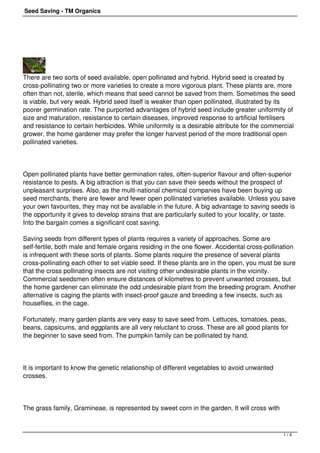
There are two sorts of seed available, open pollinated and hybrid. Hybrid seed is created by 
cross-pollinating two or more varieties to create a more vigorous plant. These plants are, more 
often than not, sterile, which means that seed cannot be saved from them. Sometimes the seed 
is viable, but very weak. Hybrid seed itself is weaker than open pollinated, illustrated by its 
poorer germination rate. The purported advantages of hybrid seed include greater uniformity of 
size and maturation, resistance to certain diseases, improved response to artificial fertilisers 
and resistance to certain herbicides. While uniformity is a desirable attribute for the commercial 
grower, the home gardener may prefer the longer harvest period of the more traditional open 
pollinated varieties. 
Open pollinated plants have better germination rates, often-superior flavour and often-superior 
resistance to pests. A big attraction is that you can save their seeds without the prospect of 
unpleasant surprises. Also, as the multi-national chemical companies have been buying up 
seed merchants, there are fewer and fewer open pollinated varieties available. Unless you save 
your own favourites, they may not be available in the future. A big advantage to saving seeds is 
the opportunity it gives to develop strains that are particularly suited to your locality, or taste. 
Into the bargain comes a significant cost saving. 
Saving seeds from different types of plants requires a variety of approaches. Some are 
self-fertile, both male and female organs residing in the one flower. Accidental cross-pollination 
is infrequent with these sorts of plants. Some plants require the presence of several plants 
cross-pollinating each other to set viable seed. If these plants are in the open, you must be sure 
that the cross pollinating insects are not visiting other undesirable plants in the vicinity. 
Commercial seedsmen often ensure distances of kilometres to prevent unwanted crosses, but 
the home gardener can eliminate the odd undesirable plant from the breeding program. Another 
alternative is caging the plants with insect-proof gauze and breeding a few insects, such as 
houseflies, in the cage. 
Fortunately, many garden plants are very easy to save seed from. Lettuces, tomatoes, peas, 
beans, capsicums, and eggplants are all very reluctant to cross. These are all good plants for 
the beginner to save seed from. The pumpkin family can be pollinated by hand. 
It is important to know the genetic relationship of different vegetables to avoid unwanted 
crosses. 
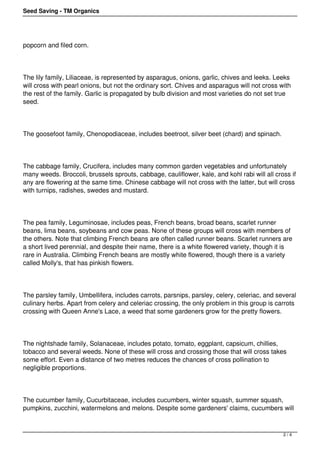
The grass family, Gramineae, is represented by sweet corn in the garden. It will cross with 
1 / 4
Seed Saving - TM Organics 
popcorn and filed corn. 
The lily family, Liliaceae, is represented by asparagus, onions, garlic, chives and leeks. Leeks 
will cross with pearl onions, but not the ordinary sort. Chives and asparagus will not cross with 
the rest of the family. Garlic is propagated by bulb division and most varieties do not set true 
seed. 
The goosefoot family, Chenopodiaceae, includes beetroot, silver beet (chard) and spinach. 
The cabbage family, Crucifera, includes many common garden vegetables and unfortunately 
many weeds. Broccoli, brussels sprouts, cabbage, cauliflower, kale, and kohl rabi will all cross if 
any are flowering at the same time. Chinese cabbage will not cross with the latter, but will cross 
with turnips, radishes, swedes and mustard. 
The pea family, Leguminosae, includes peas, French beans, broad beans, scarlet runner 
beans, lima beans, soybeans and cow peas. None of these groups will cross with members of 
the others. Note that climbing French beans are often called runner beans. Scarlet runners are 
a short lived perennial, and despite their name, there is a white flowered variety, though it is 
rare in Australia. Climbing French beans are mostly white flowered, though there is a variety 
called Molly's, that has pinkish flowers. 
The parsley family, Umbellifera, includes carrots, parsnips, parsley, celery, celeriac, and several 
culinary herbs. Apart from celery and celeriac crossing, the only problem in this group is carrots 
crossing with Queen Anne's Lace, a weed that some gardeners grow for the pretty flowers. 
The nightshade family, Solanaceae, includes potato, tomato, eggplant, capsicum, chillies, 
tobacco and several weeds. None of these will cross and crossing those that will cross takes 
some effort. Even a distance of two metres reduces the chances of cross pollination to 
negligible proportions. 
The cucumber family, Cucurbitaceae, includes cucumbers, winter squash, summer squash, 
pumpkins, zucchini, watermelons and melons. Despite some gardeners' claims, cucumbers will 
2 / 4
Seed Saving - TM Organics 
not cross with melons or pumpkins. There is limited crossing between some members of winter 
squash/pumpkin groups. 
The daisy family, Compositae, includes lettuce, Jerusalem artichoke and salsify. Lettuces will 
reluctantly cross with each other, but not the others. 
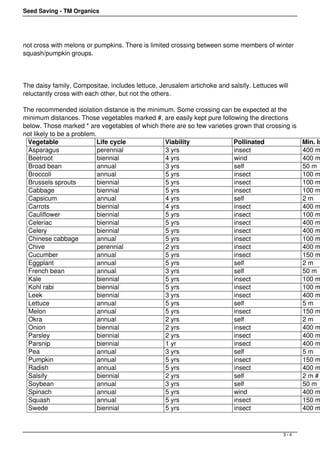
The recommended isolation distance is the minimum. Some crossing can be expected at the 
minimum distances. Those vegetables marked #, are easily kept pure following the directions 
below. Those marked * are vegetables of which there are so few varieties grown that crossing is 
not likely to be a problem. 
Vegetable Life cycle Viability Pollinated Min. Isolation 
Asparagus perennial 3 yrs insect 400 m Beetroot biennial 4 yrs wind 400 m 
Broad bean annual 3 yrs self 50 m 
Broccoli annual 5 yrs insect 100 m 
Brussels sprouts biennial 5 yrs insect 100 m 
Cabbage biennial 5 yrs insect 100 m 
Capsicum annual 4 yrs self 2 m 
Carrots biennial 4 yrs insect 400 m 
Cauliflower biennial 5 yrs insect 100 m 
Celeriac biennial 5 yrs insect 400 m Celery biennial 5 yrs insect 400 m 
Chinese cabbage annual 5 yrs insect 100 m 
Chive perennial 2 yrs insect 400 m Cucumber annual 5 yrs insect 150 m Eggplant annual 5 yrs self 2 m 
French bean annual 3 yrs self 50 m 
Kale biennial 5 yrs insect 100 m 
Kohl rabi biennial 5 yrs insect 100 m 
Leek biennial 3 yrs insect 400 m 
Lettuce annual 5 yrs self 5 m 
Melon annual 5 yrs insect 150 m Okra annual 2 yrs self 2 m 
Onion biennial 2 yrs insect 400 m 
Parsley biennial 2 yrs insect 400 m 
Parsnip biennial 1 yr insect 400 m 
Pea annual 3 yrs self 5 m 
Pumpkin annual 5 yrs insect 150 m 
Radish annual 5 yrs insect 400 m 
Salsify biennial 2 yrs self 2 m # 
Soybean annual 3 yrs self 50 m 
Spinach annual 5 yrs wind 400 m 
Squash annual 5 yrs insect 150 m 
Swede biennial 5 yrs insect 400 m 
3 / 4
Seed Saving - TM Organics 
Sweet corn annual 2 yrs wind 100 m 
Tomato annual 4 yrs self 2 m 
Turnip annual 5 yrs insect 400 m 
The cucumber family are easily pollinated by hand. The plants set two sorts of flowers. The 
female is easily distinguished by a swelling at the base. This will become the fruit. The male 
flower has no swelling. Learn to identify which flowers are going to open the following day. Tie 
some up with cotton or rubber bands to prevent the insects beating you to it. The following day, 
remove a male flower and strip its petals. Open a female flower and rub the male part against 
the female. One male flower will pollinate several females. The cucumber family do not mind if 
the flowers all are from the one plant. Place a paper bag over the female flower for three or four 
days, so the insects do not intrude. Mark the specially pollinated fruit by placing a ribbon around 
the stem. The seeds of the cucumber family and the nightshade family all benefit from being 
fermented in some lukewarm water for several days. This frees the seeds from the pulp and 
destroys several virus diseases into the bargain. 
Dry them thoroughly afterward on absorbent paper. All seeds should be dead ripe at harvest. 
Wait until the seeds start to fall off, or out of the pods. This is called shattering. Because it is 
dead ripe, home saved seed often germinates much better than commercially grown seed. The 
best storage containers are brown paper bags. Clearly label them with the name of the variety 
and the year of collection. Store them in a cool, dark place. A ten-degree lower temperature will 
double the storage life of many varieties. 
4 / 4

Seed Saving ~ TMorganics

  • 1.
    Seed Saving -TM Organics There are two sorts of seed available, open pollinated and hybrid. Hybrid seed is created by cross-pollinating two or more varieties to create a more vigorous plant. These plants are, more often than not, sterile, which means that seed cannot be saved from them. Sometimes the seed is viable, but very weak. Hybrid seed itself is weaker than open pollinated, illustrated by its poorer germination rate. The purported advantages of hybrid seed include greater uniformity of size and maturation, resistance to certain diseases, improved response to artificial fertilisers and resistance to certain herbicides. While uniformity is a desirable attribute for the commercial grower, the home gardener may prefer the longer harvest period of the more traditional open pollinated varieties. Open pollinated plants have better germination rates, often-superior flavour and often-superior resistance to pests. A big attraction is that you can save their seeds without the prospect of unpleasant surprises. Also, as the multi-national chemical companies have been buying up seed merchants, there are fewer and fewer open pollinated varieties available. Unless you save your own favourites, they may not be available in the future. A big advantage to saving seeds is the opportunity it gives to develop strains that are particularly suited to your locality, or taste. Into the bargain comes a significant cost saving. Saving seeds from different types of plants requires a variety of approaches. Some are self-fertile, both male and female organs residing in the one flower. Accidental cross-pollination is infrequent with these sorts of plants. Some plants require the presence of several plants cross-pollinating each other to set viable seed. If these plants are in the open, you must be sure that the cross pollinating insects are not visiting other undesirable plants in the vicinity. Commercial seedsmen often ensure distances of kilometres to prevent unwanted crosses, but the home gardener can eliminate the odd undesirable plant from the breeding program. Another alternative is caging the plants with insect-proof gauze and breeding a few insects, such as houseflies, in the cage. Fortunately, many garden plants are very easy to save seed from. Lettuces, tomatoes, peas, beans, capsicums, and eggplants are all very reluctant to cross. These are all good plants for the beginner to save seed from. The pumpkin family can be pollinated by hand. It is important to know the genetic relationship of different vegetables to avoid unwanted crosses. The grass family, Gramineae, is represented by sweet corn in the garden. It will cross with 1 / 4
  • 2.
    Seed Saving -TM Organics popcorn and filed corn. The lily family, Liliaceae, is represented by asparagus, onions, garlic, chives and leeks. Leeks will cross with pearl onions, but not the ordinary sort. Chives and asparagus will not cross with the rest of the family. Garlic is propagated by bulb division and most varieties do not set true seed. The goosefoot family, Chenopodiaceae, includes beetroot, silver beet (chard) and spinach. The cabbage family, Crucifera, includes many common garden vegetables and unfortunately many weeds. Broccoli, brussels sprouts, cabbage, cauliflower, kale, and kohl rabi will all cross if any are flowering at the same time. Chinese cabbage will not cross with the latter, but will cross with turnips, radishes, swedes and mustard. The pea family, Leguminosae, includes peas, French beans, broad beans, scarlet runner beans, lima beans, soybeans and cow peas. None of these groups will cross with members of the others. Note that climbing French beans are often called runner beans. Scarlet runners are a short lived perennial, and despite their name, there is a white flowered variety, though it is rare in Australia. Climbing French beans are mostly white flowered, though there is a variety called Molly's, that has pinkish flowers. The parsley family, Umbellifera, includes carrots, parsnips, parsley, celery, celeriac, and several culinary herbs. Apart from celery and celeriac crossing, the only problem in this group is carrots crossing with Queen Anne's Lace, a weed that some gardeners grow for the pretty flowers. The nightshade family, Solanaceae, includes potato, tomato, eggplant, capsicum, chillies, tobacco and several weeds. None of these will cross and crossing those that will cross takes some effort. Even a distance of two metres reduces the chances of cross pollination to negligible proportions. The cucumber family, Cucurbitaceae, includes cucumbers, winter squash, summer squash, pumpkins, zucchini, watermelons and melons. Despite some gardeners' claims, cucumbers will 2 / 4
  • 3.
    Seed Saving -TM Organics not cross with melons or pumpkins. There is limited crossing between some members of winter squash/pumpkin groups. The daisy family, Compositae, includes lettuce, Jerusalem artichoke and salsify. Lettuces will reluctantly cross with each other, but not the others. The recommended isolation distance is the minimum. Some crossing can be expected at the minimum distances. Those vegetables marked #, are easily kept pure following the directions below. Those marked * are vegetables of which there are so few varieties grown that crossing is not likely to be a problem. Vegetable Life cycle Viability Pollinated Min. Isolation Asparagus perennial 3 yrs insect 400 m Beetroot biennial 4 yrs wind 400 m Broad bean annual 3 yrs self 50 m Broccoli annual 5 yrs insect 100 m Brussels sprouts biennial 5 yrs insect 100 m Cabbage biennial 5 yrs insect 100 m Capsicum annual 4 yrs self 2 m Carrots biennial 4 yrs insect 400 m Cauliflower biennial 5 yrs insect 100 m Celeriac biennial 5 yrs insect 400 m Celery biennial 5 yrs insect 400 m Chinese cabbage annual 5 yrs insect 100 m Chive perennial 2 yrs insect 400 m Cucumber annual 5 yrs insect 150 m Eggplant annual 5 yrs self 2 m French bean annual 3 yrs self 50 m Kale biennial 5 yrs insect 100 m Kohl rabi biennial 5 yrs insect 100 m Leek biennial 3 yrs insect 400 m Lettuce annual 5 yrs self 5 m Melon annual 5 yrs insect 150 m Okra annual 2 yrs self 2 m Onion biennial 2 yrs insect 400 m Parsley biennial 2 yrs insect 400 m Parsnip biennial 1 yr insect 400 m Pea annual 3 yrs self 5 m Pumpkin annual 5 yrs insect 150 m Radish annual 5 yrs insect 400 m Salsify biennial 2 yrs self 2 m # Soybean annual 3 yrs self 50 m Spinach annual 5 yrs wind 400 m Squash annual 5 yrs insect 150 m Swede biennial 5 yrs insect 400 m 3 / 4
  • 4.
    Seed Saving -TM Organics Sweet corn annual 2 yrs wind 100 m Tomato annual 4 yrs self 2 m Turnip annual 5 yrs insect 400 m The cucumber family are easily pollinated by hand. The plants set two sorts of flowers. The female is easily distinguished by a swelling at the base. This will become the fruit. The male flower has no swelling. Learn to identify which flowers are going to open the following day. Tie some up with cotton or rubber bands to prevent the insects beating you to it. The following day, remove a male flower and strip its petals. Open a female flower and rub the male part against the female. One male flower will pollinate several females. The cucumber family do not mind if the flowers all are from the one plant. Place a paper bag over the female flower for three or four days, so the insects do not intrude. Mark the specially pollinated fruit by placing a ribbon around the stem. The seeds of the cucumber family and the nightshade family all benefit from being fermented in some lukewarm water for several days. This frees the seeds from the pulp and destroys several virus diseases into the bargain. Dry them thoroughly afterward on absorbent paper. All seeds should be dead ripe at harvest. Wait until the seeds start to fall off, or out of the pods. This is called shattering. Because it is dead ripe, home saved seed often germinates much better than commercially grown seed. The best storage containers are brown paper bags. Clearly label them with the name of the variety and the year of collection. Store them in a cool, dark place. A ten-degree lower temperature will double the storage life of many varieties. 4 / 4