International Journal on Recent and Innovation Trends in Computing and Communication ISSN: 2321-8169
Volume: 5 Issue: 10 95 – 98
_______________________________________________________________________________________________
95
IJRITCC | October 2017, Available @ http://www.ijritcc.org
_______________________________________________________________________________________
Zigbee based System for Individuals with Multiple Handicapness in Household
Environment
Shraddha R. Parashar
M. Tech. Student, Department of E&TC
Government College of Engineering,
Jalgaon, India.
e-mail:shraddha911994@gmail.com
Devendra S. Chaudhari
Professor, Department of E&TC
Government College of Engineering,
Jalgaon, India.
e-mail:ddsscc@yahoo.com
Abstract—Most of the prevailing smart home monitoring and control systems do not accommodate special indigent users to manage their home
appliances. A wireless sensor network [WSN] based system for smart home automation can be developed, built and tested to address such
missing functionality. The system’s major contribution is that it is customized to provide the special needy residents with tools and services to
monitor and operate home appliances remotely. The system provides home residents with disabilities to take advantage of the advancement in
technology. It enables them to perform their daily activities by remotely monitoring and controlling their home appliances independently. The
system is programmed so that it can be configured to adjust to the customer’s disability providing them with better and convenient lifestyle. The
system can be scalable and might be extended to incorporate additional and different services and tools. The system can provide portability,
compactness, affordability and easier to use.
Keywords - sensor, WSN, embedded, special needs, home environment
__________________________________________________*****_________________________________________________
I. INTRODUCTION
Nowadays physically challenged individuals especially people
with visual and hearing impairment find it troublesome to do
their daily activities during loneliness. Existing system is that
either there family members are concerned about them to take
care or might have an aided person to assist them by payment
basis. This becomes hectic for family members to keep a
servant to take care of them. Therefore in order to overcome
these problems a system should be developed for these kinds
of physically challenged people such that the system will
ensure the safety of disabled peoples and also assist them to
live independently.
Therefore to beat these issues, system will be enabled for
dealing with controlling of hardware appliances using the
electronic relay based switching circuit.As a part of security,
system will have sensor based circuitry which will alert user in
critical condition. By configuring, system can send a SMS
based alert to assistant user. To work all modules together and
to make modules accessible through the ZigBee interface,
system modules communicate with each other using IEEE
802.15.4 Protocol.
In this paper, section II deals with METHODOLOGY for
work while section III includes system IMPLEMENTATION
with block diagram. Section IV summarizes performance
analysis and results are discussed.
II. METHODOLOGY
A. Subjects
A ZigBee based system was developed for people with hearing
impairment, visual impairment, physical handicapness, etc.
The system can enable user to urge notification and
applying dominant actions in keeping with choice of
handicapness. For testing of system, five normal subjects in
age group of 21-30 years participated in experiment. The
persons were normal subjects with simulated disabilities. The
integrated control system is a sort of automated smart home.
By taking this point in consideration, any type of situation can
arise at any time. Therefore some accidental situations were
made to happen randomly and system performance was tested
by collecting the data of these five subjects. Subjects were
asked about their comfortable level while handling the system
and qualitative analysis was carries out.
B. Material
The system is a distributed wireless network of master and
slave units for controlling and monitoring different appliances
to assist disabled individuals. The master node is responsible
for instructing slave nodes to perform actions according to
user’s needs. To develop such integrated standalone embedded
system;
1. Controller Required
Each appliance has its own control board which contains an
individual microcontroller and another controller is used for
master controller. ARM 7 LPC2148 is programmed as master
International Journal on Recent and Innovation Trends in Computing and Communication ISSN: 2321-8169
Volume: 5 Issue: 10 95 – 98
_______________________________________________________________________________________________
96
IJRITCC |October 2017, Available @ http://www.ijritcc.org
_______________________________________________________________________________________
controller and Arduino Uno ATmega328P is used as slave
controller.
2. Communication Media Required
The control system is a distributed wireless sensor network
which requires faithful trans reception between nodes. For
fulfilling this purpose efficient communication media has to
choose. Xbee S2C module from digi international is used as
transreceiver in WSN. This module utilizes 2.4 GHz ISM
frequency band.
C. Procedure for establishing WSN
In a home area network environment, a home with m
appliances can be denoted by (1).
𝐴 = { 𝐴1 , 𝐴2, … . , 𝐴 𝑚 } (1)
An appliance is a physical device that is capable of executing
tasks or requests and exchange data. For example, in a smart
home environment an appliance can be a television, lights, a
washing machine, etc. Each appliance can be defined by a set
of capabilities in (2)
𝐴𝑖 = {𝑐𝑖
1
, 𝑐𝑖
2
, … . , 𝑐𝑖
𝑎 𝑗
} (2)
ajis the number of capabilities that describe Ai. For example,
capabilities for a washing machine can be rinse, normal wash,
hand wash, water temperature, and spin speed. Each appliance
in the smart home environment is placed in a specific home
zone. A home zone defines specific areas inside the home. For
example, living room can be a zone. A home zone can be
presented in (3).
𝑍 = 𝑍1, 𝑍2, … . , 𝑍 𝑞 (3)
Let Aiqdenote appliance i in zone q.
A set of n tasks for in a home environment, denoted in (4).
𝑇 = {𝑇1, 𝑇2, … 𝑇𝑛 } (4)
Task Tj T ( j =1,...,n) is formulated as a set of operations .
In a home area network environment, there is a need to
allocate requests to the capable appliances/devices at specific
time. A request may be processed by a single appliance Ai ora
group of appliances in A , in which the appliances are capable
to process request Tj. For example, a request in a household
environment can be lightning outdoor bulbs when it gets dark.
The system can allocate the request to the different lightning
units at home to achieve this request.
III. IMPLEMENTATION
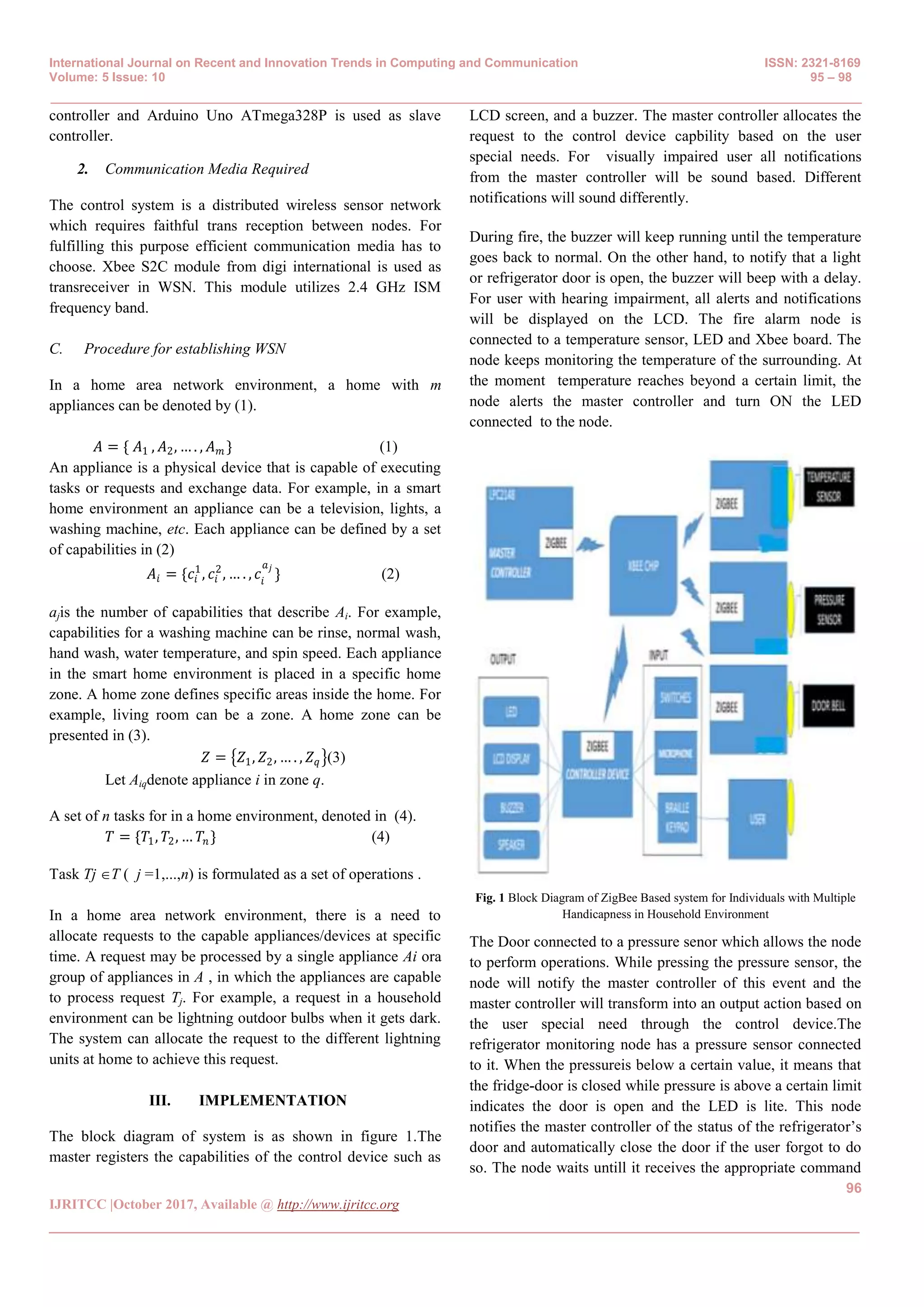
The block diagram of system is as shown in figure 1.The
master registers the capabilities of the control device such as
LCD screen, and a buzzer. The master controller allocates the
request to the control device capbility based on the user
special needs. For visually impaired user all notifications
from the master controller will be sound based. Different
notifications will sound differently.
During fire, the buzzer will keep running until the temperature
goes back to normal. On the other hand, to notify that a light
or refrigerator door is open, the buzzer will beep with a delay.
For user with hearing impairment, all alerts and notifications
will be displayed on the LCD. The fire alarm node is
connected to a temperature sensor, LED and Xbee board. The
node keeps monitoring the temperature of the surrounding. At
the moment temperature reaches beyond a certain limit, the
node alerts the master controller and turn ON the LED
connected to the node.
Fig. 1 Block Diagram of ZigBee Based system for Individuals with Multiple
Handicapness in Household Environment
The Door connected to a pressure senor which allows the node
to perform operations. While pressing the pressure sensor, the
node will notify the master controller of this event and the
master controller will transform into an output action based on
the user special need through the control device.The
refrigerator monitoring node has a pressure sensor connected
to it. When the pressureis below a certain value, it means that
the fridge-door is closed while pressure is above a certain limit
indicates the door is open and the LED is lite. This node
notifies the master controller of the status of the refrigerator’s
door and automatically close the door if the user forgot to do
so. The node waits untill it receives the appropriate command
International Journal on Recent and Innovation Trends in Computing and Communication ISSN: 2321-8169
Volume: 5 Issue: 10 95 – 98
_______________________________________________________________________________________________
97
IJRITCC |October 2017, Available @ http://www.ijritcc.org
_______________________________________________________________________________________
from the master controller, check the status of the door, and
send the status back to the master controller. For auto closing
the door, the system will start a timer when the refrigerator’s
door is open, the timer checks status of door in every 10
seconds. After a certain time has passed and the door is still
open, the node will automatically close.
A. Experimental Model of Control System
Experimental model of the system has master controller,
wireless communication unit and four slave nodes designed as
prototype model of home appliances as major building blocks.
In line with the block diagram shown, system is developed by
interfacing the building blocks with each others making the
node as a single unit.
The whole system is built around ARM 7 board as master
controller which will monitor and control system functionality.
The prototype system is designed for three types of disabilities
like visual handicapness, hearing handicapness and physical
handicapness. This system relies on IEEE 802.15.4 ZigBee
standard for wireless communication. There are four prototype
slave modules for updating the status at different positions in
home. The slave module contain refrigerator control unit, door
control unit, fire alarm unit and home automation unit.
Master controller unit performs function of selecting type of
disabilities, accordingly gives notification and enters input
from user. For performing controlling action by user various
devices are added to master board. Various output devices like
LED, LCD display and buzzer is connected for notifying user
according to disability type selected. Also keypad, voice
recognition module and switches are used for applying input to
perform controlling action by user to control various
situations.
Refrigerator control unit implemented with tactile switch as a
pressure sensor for checking status of refrigerator door and
Arduino Uno ATmega328P works as controller for slave units.
Door control unit also has pressure sensor to check door status
and motor assembly to open and close door automatically. Fire
alarm control unit contains thermistor as temperature sensor
which is connected in voltage divider biasing of transistor.
Sensitivity of temperature can be changed by changing value
of resistors in voltage divider. Home automation unit contains
relay driver circuitry for driving home appliances like light,
fan, etc.
IV. RESULTS AND DISCUSSION
To analyze the system performance normal subjects with
simulated disabilities are considered and numbers of trials
executions are carried and the results are summarized in
following tables:
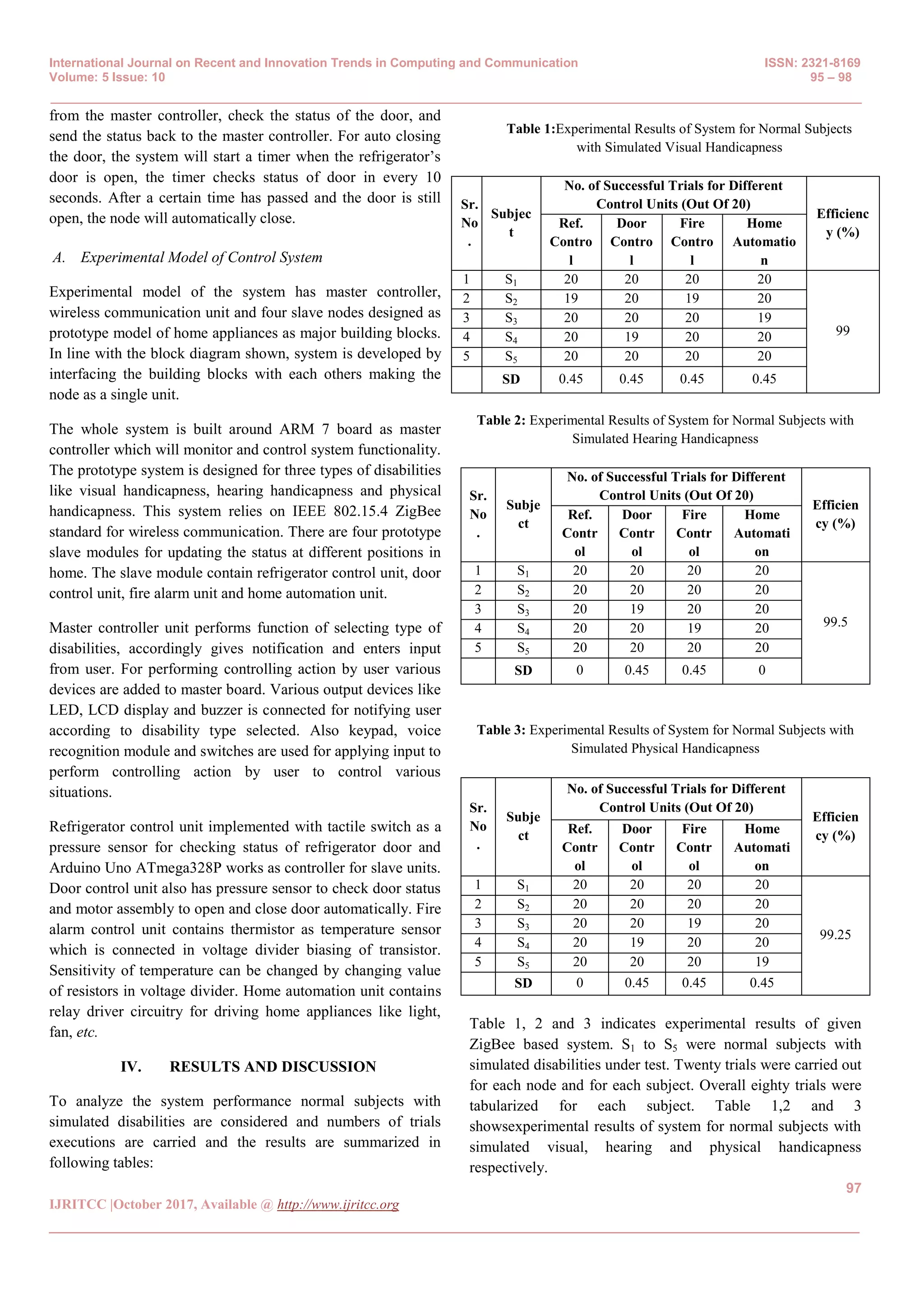
Table 1:Experimental Results of System for Normal Subjects
with Simulated Visual Handicapness
Sr.
No
.
Subjec
t
No. of Successful Trials for Different
Control Units (Out Of 20)
Efficienc
y (%)
Ref.
Contro
l
Door
Contro
l
Fire
Contro
l
Home
Automatio
n
1 S1 20 20 20 20
99
2 S2 19 20 19 20
3 S3 20 20 20 19
4 S4 20 19 20 20
5 S5 20 20 20 20
SD 0.45 0.45 0.45 0.45
Table 2: Experimental Results of System for Normal Subjects with
Simulated Hearing Handicapness
Sr.
No
.
Subje
ct
No. of Successful Trials for Different
Control Units (Out Of 20)
Efficien
cy (%)
Ref.
Contr
ol
Door
Contr
ol
Fire
Contr
ol
Home
Automati
on
1 S1 20 20 20 20
99.5
2 S2 20 20 20 20
3 S3 20 19 20 20
4 S4 20 20 19 20
5 S5 20 20 20 20
SD 0 0.45 0.45 0
Table 3: Experimental Results of System for Normal Subjects with
Simulated Physical Handicapness
Sr.
No
.
Subje
ct
No. of Successful Trials for Different
Control Units (Out Of 20)
Efficien
cy (%)Ref.
Contr
ol
Door
Contr
ol
Fire
Contr
ol
Home
Automati
on
1 S1 20 20 20 20
99.25
2 S2 20 20 20 20
3 S3 20 20 19 20
4 S4 20 19 20 20
5 S5 20 20 20 19
SD 0 0.45 0.45 0.45
Table 1, 2 and 3 indicates experimental results of given
ZigBee based system. S1 to S5 were normal subjects with
simulated disabilities under test. Twenty trials were carried out
for each node and for each subject. Overall eighty trials were
tabularized for each subject. Table 1,2 and 3
showsexperimental results of system for normal subjects with
simulated visual, hearing and physical handicapness
respectively.
International Journal on Recent and Innovation Trends in Computing and Communication ISSN: 2321-8169
Volume: 5 Issue: 10 95 – 98
_______________________________________________________________________________________________
98
IJRITCC |October 2017, Available @ http://www.ijritcc.org
_______________________________________________________________________________________
Data of normal subjects with simulated disabilities are
summarized in above tables and standard deviation is
calculated. Standard deviation of a system provides an
indication of how far the individual responses vary or
"deviate" from the mean. For this system the value of standard
deviation ranges from 0 to 0.45. Standard deviation should
have small value for desired performance. Here deviation is
negligible therefore the system will perform faithfully and all
types of subjects can handle system with ease.
Above results also indicate that GUI of system should be
better than provide to reduce deviation to zero so that system
will be more interactive with user. Therefore system can be
implemented in field as per requirements.
V. CONCLUSIONS
The ZigBee based control system developed as assistance
system for disabled peoples has met its goals based on
simulations, tests results and cost analysis. The proposed
system not only makes disabled peoples self-reliant but also
provides them with multitude of input options to carry out
their daily living activities with more ease. The system
provides indoor communication range up to 40 meters. Results
obtained from progressive testing of system indicate that
deviation is lesser. Its better results were observed with
sufficient training.
REFERENCES
[1] Basma M. Mohammad El-Basioni , Sherine Mohamed Abd El-
Kader , and Hussein S. Eissa, “Independent Living for Persons
with Disabilities and Elderly People Using Smart Home
Technology”, International Journal of Application or Innovation in
Engineering and Management Volume 3, Issue 4, April 2014
[2] Datasheet Digi International Xbee S2 Module. Retrieved from
http://www.digi.com/support/productdetail?pid=3430
[3] H. Ardam and I. Coskun, "A remote controller for home and office
appliances by telephone", IEEE Transactions on Consumer
Electronics, vol. 44, no. 4, pp. 1291-1297, 1998
[4] Md. Raihaan Kamarudin., Md. Aiman F. Md. Yusof. “Low Cost
Smart Home Automation via Microsoft Speech Recognition” 2013
IJENS Vol: 13 No: 03
[5] R. Al-Ali and M. Al-Rousan,"Java-based home automation
system", IEEE Transactions on Consumer Electronics 2004, vol.
50, no. 2, pp. 498-504
[6] T. Kirankumar, B. Bhavani “A Sustainable Automated System for
Elderly People Using Voice Recognition and Touch Screen
Technology”, International Journal of Science and Research,
Volume 2, Issue 8, 2013
[7] Vinay Sagar K., Kusuma S., “Home Automation Using Internet of
Things”, International Research Journal of Engineering and
Technology, Volume 2, Issue 3, June 2015
[8] N. Sriskanthan, F. Tan and A. Karande, "Bluetooth Based Home
Automation System", Microprocessors and Microsystems, Vol. 26,
no. 6, pp. 281-289, 2002

Zigbee based System for Individuals with Multiple Handicapness in Household Environment

  • 1.
    International Journal onRecent and Innovation Trends in Computing and Communication ISSN: 2321-8169 Volume: 5 Issue: 10 95 – 98 _______________________________________________________________________________________________ 95 IJRITCC | October 2017, Available @ http://www.ijritcc.org _______________________________________________________________________________________ Zigbee based System for Individuals with Multiple Handicapness in Household Environment Shraddha R. Parashar M. Tech. Student, Department of E&TC Government College of Engineering, Jalgaon, India. e-mail:shraddha911994@gmail.com Devendra S. Chaudhari Professor, Department of E&TC Government College of Engineering, Jalgaon, India. e-mail:ddsscc@yahoo.com Abstract—Most of the prevailing smart home monitoring and control systems do not accommodate special indigent users to manage their home appliances. A wireless sensor network [WSN] based system for smart home automation can be developed, built and tested to address such missing functionality. The system’s major contribution is that it is customized to provide the special needy residents with tools and services to monitor and operate home appliances remotely. The system provides home residents with disabilities to take advantage of the advancement in technology. It enables them to perform their daily activities by remotely monitoring and controlling their home appliances independently. The system is programmed so that it can be configured to adjust to the customer’s disability providing them with better and convenient lifestyle. The system can be scalable and might be extended to incorporate additional and different services and tools. The system can provide portability, compactness, affordability and easier to use. Keywords - sensor, WSN, embedded, special needs, home environment __________________________________________________*****_________________________________________________ I. INTRODUCTION Nowadays physically challenged individuals especially people with visual and hearing impairment find it troublesome to do their daily activities during loneliness. Existing system is that either there family members are concerned about them to take care or might have an aided person to assist them by payment basis. This becomes hectic for family members to keep a servant to take care of them. Therefore in order to overcome these problems a system should be developed for these kinds of physically challenged people such that the system will ensure the safety of disabled peoples and also assist them to live independently. Therefore to beat these issues, system will be enabled for dealing with controlling of hardware appliances using the electronic relay based switching circuit.As a part of security, system will have sensor based circuitry which will alert user in critical condition. By configuring, system can send a SMS based alert to assistant user. To work all modules together and to make modules accessible through the ZigBee interface, system modules communicate with each other using IEEE 802.15.4 Protocol. In this paper, section II deals with METHODOLOGY for work while section III includes system IMPLEMENTATION with block diagram. Section IV summarizes performance analysis and results are discussed. II. METHODOLOGY A. Subjects A ZigBee based system was developed for people with hearing impairment, visual impairment, physical handicapness, etc. The system can enable user to urge notification and applying dominant actions in keeping with choice of handicapness. For testing of system, five normal subjects in age group of 21-30 years participated in experiment. The persons were normal subjects with simulated disabilities. The integrated control system is a sort of automated smart home. By taking this point in consideration, any type of situation can arise at any time. Therefore some accidental situations were made to happen randomly and system performance was tested by collecting the data of these five subjects. Subjects were asked about their comfortable level while handling the system and qualitative analysis was carries out. B. Material The system is a distributed wireless network of master and slave units for controlling and monitoring different appliances to assist disabled individuals. The master node is responsible for instructing slave nodes to perform actions according to user’s needs. To develop such integrated standalone embedded system; 1. Controller Required Each appliance has its own control board which contains an individual microcontroller and another controller is used for master controller. ARM 7 LPC2148 is programmed as master
  • 2.
    International Journal onRecent and Innovation Trends in Computing and Communication ISSN: 2321-8169 Volume: 5 Issue: 10 95 – 98 _______________________________________________________________________________________________ 96 IJRITCC |October 2017, Available @ http://www.ijritcc.org _______________________________________________________________________________________ controller and Arduino Uno ATmega328P is used as slave controller. 2. Communication Media Required The control system is a distributed wireless sensor network which requires faithful trans reception between nodes. For fulfilling this purpose efficient communication media has to choose. Xbee S2C module from digi international is used as transreceiver in WSN. This module utilizes 2.4 GHz ISM frequency band. C. Procedure for establishing WSN In a home area network environment, a home with m appliances can be denoted by (1). 𝐴 = { 𝐴1 , 𝐴2, … . , 𝐴 𝑚 } (1) An appliance is a physical device that is capable of executing tasks or requests and exchange data. For example, in a smart home environment an appliance can be a television, lights, a washing machine, etc. Each appliance can be defined by a set of capabilities in (2) 𝐴𝑖 = {𝑐𝑖 1 , 𝑐𝑖 2 , … . , 𝑐𝑖 𝑎 𝑗 } (2) ajis the number of capabilities that describe Ai. For example, capabilities for a washing machine can be rinse, normal wash, hand wash, water temperature, and spin speed. Each appliance in the smart home environment is placed in a specific home zone. A home zone defines specific areas inside the home. For example, living room can be a zone. A home zone can be presented in (3). 𝑍 = 𝑍1, 𝑍2, … . , 𝑍 𝑞 (3) Let Aiqdenote appliance i in zone q. A set of n tasks for in a home environment, denoted in (4). 𝑇 = {𝑇1, 𝑇2, … 𝑇𝑛 } (4) Task Tj T ( j =1,...,n) is formulated as a set of operations . In a home area network environment, there is a need to allocate requests to the capable appliances/devices at specific time. A request may be processed by a single appliance Ai ora group of appliances in A , in which the appliances are capable to process request Tj. For example, a request in a household environment can be lightning outdoor bulbs when it gets dark. The system can allocate the request to the different lightning units at home to achieve this request. III. IMPLEMENTATION The block diagram of system is as shown in figure 1.The master registers the capabilities of the control device such as LCD screen, and a buzzer. The master controller allocates the request to the control device capbility based on the user special needs. For visually impaired user all notifications from the master controller will be sound based. Different notifications will sound differently. During fire, the buzzer will keep running until the temperature goes back to normal. On the other hand, to notify that a light or refrigerator door is open, the buzzer will beep with a delay. For user with hearing impairment, all alerts and notifications will be displayed on the LCD. The fire alarm node is connected to a temperature sensor, LED and Xbee board. The node keeps monitoring the temperature of the surrounding. At the moment temperature reaches beyond a certain limit, the node alerts the master controller and turn ON the LED connected to the node. Fig. 1 Block Diagram of ZigBee Based system for Individuals with Multiple Handicapness in Household Environment The Door connected to a pressure senor which allows the node to perform operations. While pressing the pressure sensor, the node will notify the master controller of this event and the master controller will transform into an output action based on the user special need through the control device.The refrigerator monitoring node has a pressure sensor connected to it. When the pressureis below a certain value, it means that the fridge-door is closed while pressure is above a certain limit indicates the door is open and the LED is lite. This node notifies the master controller of the status of the refrigerator’s door and automatically close the door if the user forgot to do so. The node waits untill it receives the appropriate command
  • 3.
    International Journal onRecent and Innovation Trends in Computing and Communication ISSN: 2321-8169 Volume: 5 Issue: 10 95 – 98 _______________________________________________________________________________________________ 97 IJRITCC |October 2017, Available @ http://www.ijritcc.org _______________________________________________________________________________________ from the master controller, check the status of the door, and send the status back to the master controller. For auto closing the door, the system will start a timer when the refrigerator’s door is open, the timer checks status of door in every 10 seconds. After a certain time has passed and the door is still open, the node will automatically close. A. Experimental Model of Control System Experimental model of the system has master controller, wireless communication unit and four slave nodes designed as prototype model of home appliances as major building blocks. In line with the block diagram shown, system is developed by interfacing the building blocks with each others making the node as a single unit. The whole system is built around ARM 7 board as master controller which will monitor and control system functionality. The prototype system is designed for three types of disabilities like visual handicapness, hearing handicapness and physical handicapness. This system relies on IEEE 802.15.4 ZigBee standard for wireless communication. There are four prototype slave modules for updating the status at different positions in home. The slave module contain refrigerator control unit, door control unit, fire alarm unit and home automation unit. Master controller unit performs function of selecting type of disabilities, accordingly gives notification and enters input from user. For performing controlling action by user various devices are added to master board. Various output devices like LED, LCD display and buzzer is connected for notifying user according to disability type selected. Also keypad, voice recognition module and switches are used for applying input to perform controlling action by user to control various situations. Refrigerator control unit implemented with tactile switch as a pressure sensor for checking status of refrigerator door and Arduino Uno ATmega328P works as controller for slave units. Door control unit also has pressure sensor to check door status and motor assembly to open and close door automatically. Fire alarm control unit contains thermistor as temperature sensor which is connected in voltage divider biasing of transistor. Sensitivity of temperature can be changed by changing value of resistors in voltage divider. Home automation unit contains relay driver circuitry for driving home appliances like light, fan, etc. IV. RESULTS AND DISCUSSION To analyze the system performance normal subjects with simulated disabilities are considered and numbers of trials executions are carried and the results are summarized in following tables: Table 1:Experimental Results of System for Normal Subjects with Simulated Visual Handicapness Sr. No . Subjec t No. of Successful Trials for Different Control Units (Out Of 20) Efficienc y (%) Ref. Contro l Door Contro l Fire Contro l Home Automatio n 1 S1 20 20 20 20 99 2 S2 19 20 19 20 3 S3 20 20 20 19 4 S4 20 19 20 20 5 S5 20 20 20 20 SD 0.45 0.45 0.45 0.45 Table 2: Experimental Results of System for Normal Subjects with Simulated Hearing Handicapness Sr. No . Subje ct No. of Successful Trials for Different Control Units (Out Of 20) Efficien cy (%) Ref. Contr ol Door Contr ol Fire Contr ol Home Automati on 1 S1 20 20 20 20 99.5 2 S2 20 20 20 20 3 S3 20 19 20 20 4 S4 20 20 19 20 5 S5 20 20 20 20 SD 0 0.45 0.45 0 Table 3: Experimental Results of System for Normal Subjects with Simulated Physical Handicapness Sr. No . Subje ct No. of Successful Trials for Different Control Units (Out Of 20) Efficien cy (%)Ref. Contr ol Door Contr ol Fire Contr ol Home Automati on 1 S1 20 20 20 20 99.25 2 S2 20 20 20 20 3 S3 20 20 19 20 4 S4 20 19 20 20 5 S5 20 20 20 19 SD 0 0.45 0.45 0.45 Table 1, 2 and 3 indicates experimental results of given ZigBee based system. S1 to S5 were normal subjects with simulated disabilities under test. Twenty trials were carried out for each node and for each subject. Overall eighty trials were tabularized for each subject. Table 1,2 and 3 showsexperimental results of system for normal subjects with simulated visual, hearing and physical handicapness respectively.
  • 4.
    International Journal onRecent and Innovation Trends in Computing and Communication ISSN: 2321-8169 Volume: 5 Issue: 10 95 – 98 _______________________________________________________________________________________________ 98 IJRITCC |October 2017, Available @ http://www.ijritcc.org _______________________________________________________________________________________ Data of normal subjects with simulated disabilities are summarized in above tables and standard deviation is calculated. Standard deviation of a system provides an indication of how far the individual responses vary or "deviate" from the mean. For this system the value of standard deviation ranges from 0 to 0.45. Standard deviation should have small value for desired performance. Here deviation is negligible therefore the system will perform faithfully and all types of subjects can handle system with ease. Above results also indicate that GUI of system should be better than provide to reduce deviation to zero so that system will be more interactive with user. Therefore system can be implemented in field as per requirements. V. CONCLUSIONS The ZigBee based control system developed as assistance system for disabled peoples has met its goals based on simulations, tests results and cost analysis. The proposed system not only makes disabled peoples self-reliant but also provides them with multitude of input options to carry out their daily living activities with more ease. The system provides indoor communication range up to 40 meters. Results obtained from progressive testing of system indicate that deviation is lesser. Its better results were observed with sufficient training. REFERENCES [1] Basma M. Mohammad El-Basioni , Sherine Mohamed Abd El- Kader , and Hussein S. Eissa, “Independent Living for Persons with Disabilities and Elderly People Using Smart Home Technology”, International Journal of Application or Innovation in Engineering and Management Volume 3, Issue 4, April 2014 [2] Datasheet Digi International Xbee S2 Module. Retrieved from http://www.digi.com/support/productdetail?pid=3430 [3] H. Ardam and I. Coskun, "A remote controller for home and office appliances by telephone", IEEE Transactions on Consumer Electronics, vol. 44, no. 4, pp. 1291-1297, 1998 [4] Md. Raihaan Kamarudin., Md. Aiman F. Md. Yusof. “Low Cost Smart Home Automation via Microsoft Speech Recognition” 2013 IJENS Vol: 13 No: 03 [5] R. Al-Ali and M. Al-Rousan,"Java-based home automation system", IEEE Transactions on Consumer Electronics 2004, vol. 50, no. 2, pp. 498-504 [6] T. Kirankumar, B. Bhavani “A Sustainable Automated System for Elderly People Using Voice Recognition and Touch Screen Technology”, International Journal of Science and Research, Volume 2, Issue 8, 2013 [7] Vinay Sagar K., Kusuma S., “Home Automation Using Internet of Things”, International Research Journal of Engineering and Technology, Volume 2, Issue 3, June 2015 [8] N. Sriskanthan, F. Tan and A. Karande, "Bluetooth Based Home Automation System", Microprocessors and Microsystems, Vol. 26, no. 6, pp. 281-289, 2002