
Zero-Trust Server Management 
Boston DevOps August 2014
Traditional server access management 
has been based on Active Directory and 
VPN / perimeter
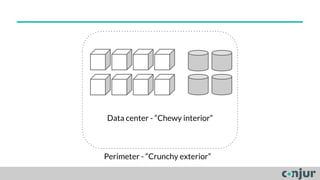
Data center - “Chewy interior” 
Perimeter - “Crunchy exterior”
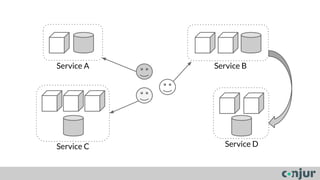
What do you do when your 
perimeter is taken away?
Service A Service B 
Service C Service D
Zero-Trust: 
No “root” privilege 
Division of systems into sub-systems 
Least privilege among all users, machines and code
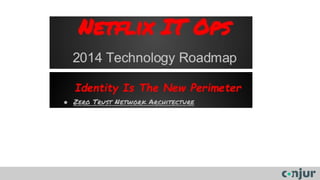
Zero-Trust is the future of infrastructure 
management 
http://www.slideshare.net/mdkail/it-ops-2014-technology-roadmap
What’s the practical challenge to implement zero-trust 
auth for systems management?
Don’t try and use Active Directory 
in the cloud. It won’t work, for more reasons 
than I can list here.
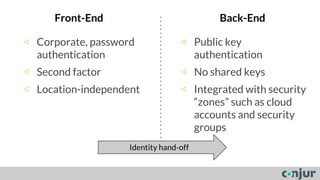
Front-End Back-End 
◁ Corporate, password 
authentication 
◁ Second factor 
◁ Location-independent 
◁ Public key 
authentication 
◁ No shared keys 
◁ Integrated with security 
“zones” such as cloud 
accounts and security 
groups 
Identity hand-off
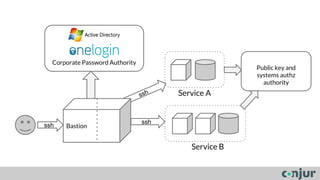
ssh 
Corporate Password Authority 
ssh 
Bastion 
Service A 
Service B 
ssh 
Public key and 
systems authz 
authority
Apply intelligent use of openssh and PAM 
◁ Public keys available as a network service 
◁ Granular authorization via PAM 
◁ Automatic audit of login/logout events
Use Bastions to create security zones 
◁ Dedicated admin bastion(s) for access to management 
services such as Chef/Puppet server, log server, Conjur 
◁ General-purpose bastions for access to everything else 
◁ Let the back-end authz system provide most of the 
access control
Zero-Trust Server Management 
Boston DevOps August 2014

Zero trust server management - lightning

  • 1.
    Zero-Trust Server Management Boston DevOps August 2014
  • 2.
    Traditional server accessmanagement has been based on Active Directory and VPN / perimeter
  • 3.
    Data center -“Chewy interior” Perimeter - “Crunchy exterior”
  • 4.
    What do youdo when your perimeter is taken away?
  • 5.
    Service A ServiceB Service C Service D
  • 6.
    Zero-Trust: No “root”privilege Division of systems into sub-systems Least privilege among all users, machines and code
  • 7.
    Zero-Trust is thefuture of infrastructure management http://www.slideshare.net/mdkail/it-ops-2014-technology-roadmap
  • 10.
    What’s the practicalchallenge to implement zero-trust auth for systems management?
  • 11.
    Don’t try anduse Active Directory in the cloud. It won’t work, for more reasons than I can list here.
  • 12.
    Front-End Back-End ◁Corporate, password authentication ◁ Second factor ◁ Location-independent ◁ Public key authentication ◁ No shared keys ◁ Integrated with security “zones” such as cloud accounts and security groups Identity hand-off
  • 13.
    ssh Corporate PasswordAuthority ssh Bastion Service A Service B ssh Public key and systems authz authority
  • 14.
    Apply intelligent useof openssh and PAM ◁ Public keys available as a network service ◁ Granular authorization via PAM ◁ Automatic audit of login/logout events
  • 15.
    Use Bastions tocreate security zones ◁ Dedicated admin bastion(s) for access to management services such as Chef/Puppet server, log server, Conjur ◁ General-purpose bastions for access to everything else ◁ Let the back-end authz system provide most of the access control
  • 16.
    Zero-Trust Server Management Boston DevOps August 2014