Deepika et al. Int. Journal of Engineering Research and Applications www.ijera.com
ISSN: 2248-9622, Vol. 5, Issue 7, (Part - 2) July 2015, pp.164-169
www.ijera.com 164 | P a g e
Automatic Selection of Open Source Multimedia Softwares Using
Error Back-Propagation Neural Network
Deepika1 , Suman2 , Arshdeep Singh3 , Dr. G.N. Verma4
1M.Tech Student Sri Sukhmani Institute of Engineering & Technology, Punjab, India
2Assistant Professor Sri Sukhmani Institute of Engineering & Technology, Punjab, India
3M.E Scholar National Institute of Teachers Training & Research, Chandigarh, India
4Coordinator Sri Sukhmani Institute of Engineering & Technology, Punjab, India
Abstract—
Open source opens a new era to provide license of the software for the user at free of cost which is advantage
over paid licensed software. In Multimedia applications there are many versions of software are available and
there is a problem for the user to select compatible software for their own system. Most of the time while surfing
for software a huge list of software opens in response. The selection of particular software which is pretty
suitable for the system from a real big list is the biggest challenge that is faced by the users. This work has been
done that focuses on the existing open source software that are widely used and to design an automatic system
for selection of particular open source software according to the compatibility of users own system. In this work,
error back-propagation based neural network is designed in MATLAB for automatic selection of open source
software. The system provides the open source software name after taking the information from user.
Regression coefficient of 0.93877 is obtained and the results shown are up to the mark and can be utilized for
the fast and effective software search.
Keywords—Back-propagtion, Open Source, Neural network
I. Introduction
The motivation to build an automatic software
selection system comes from the human brain system.
Our brain is able to categorize many complex tasks.
Human brain has billions of processing units called
neurons. Human eyes can sense the external
environment which acts as a receptor. Photons on
retina receive the information from external world.
Neurons in the brain process the information in
massively parallel mode. The output of the brain
activates the muscles which is called effector action.
Effectors interact with the environment. The
biological neural system learns from examples and
can take decisions based on purely new environment
[1]. Human brain has the excellent power of decision
making. But this power is very much limited to local
problems. Human can take decision well when the
number of decisive class is limited. The open source
software exists large in number. The configuration of
computer system changes the selection of software
completely. In these conditions it is very difficult for
the humans to decide which software is
compatible.
Open source refers to a computer program in which
the source code is available to the general public for
use and/or modification from its original design.
Open-source code is meant to be a collaborative
effort, where programmers improve upon the source
code and share the changes within the community In
production and development, open source as a
development model promotes a universal access via a
free license to a product's design or blueprint, and
universal redistribution of that design or blueprint,
including subsequent improvements to it by anyone.
M. St. Laurent [2] presents Open-source software
made available with a license in which the copyright
holder provides the rights to study, change, and
distribute the software to anyone and for any purpose.
Irina Guseva [3] explains the top four reasons (as
provided by Open Source Business Conference
survey) individuals or organizations choose open
source software are: lower cost, security, no vendor
lock in, and better quality.
Artificial neural network has been widely used for
solving non-linear complex tasks. With the
development of computer technology, machine
learning techniques are becoming good choice. The
selection of the machine learning technique depends
upon the viability for particular application. Most of
the non-linear problems have been solved using back
propagation based neural network. Errorback
propagation based neural network has found
applications in various areas. R Tuli [4] applied
neural network technique for character recognition
and this paper attempts to recognize the characters
using a back propagation algorithm. M. M. Subashini
RESEARCH ARTICLE OPEN ACCESS
Deepika et al. Int. Journal of Engineering Research and Applications www.ijera.com
ISSN: 2248-9622, Vol. 5, Issue 7, (Part - 2) July 2015, pp.164-169
www.ijera.com 165 | P a g e
et. al. [5] proposed a neural network technique for
classification of brain tumor presence or not.
Ngaopitakkul et. al. [6] proposed a decision algorithm
for identifying the phase with fault appearance of a
two-winding three-phase transformer. A decision
algorithm based on a combination of Discrete
Wavelet Transforms and backpropagation neural
networks (BPNN) is developed. S. A. Radzi et. al. [7]
applied 5 layers CNN for recognizing Malaysian
license plate. Gradient based back propagation
method is used for learning. Choon-Boon Tay et al.
[8] proposed a 5 layer CNN for gender classification
of pedestrians.
J. Jiang et. al. [9] proposed application of bpnn for
pattern recognition purposes. The Back Propagation
neural network is used improve the high resolution
remote sensing image classification precision.
N. L. D. Khoa et. al. [10] proposed a method to
forecast the stock price using neural networks. Both
feed forward neural network and simple recurrent
neural network, trained by time and profit based back
propagation algorithm.
V. Jaiganesh et. al. [11] proposed a novel intrusion
detection system (IDS) by back propagation neural
networks (BPN). K. U. Rani [12] proposed a neural
network technique for classification of heart disease.
The neural network is trained with Heart Diseases
database by using feed forward neural network model
and backpropagation learning algorithm with
momentum and variable learning rate. T. A. Anjit et.
al. [13] presents a new approach for the detection of
nasal bone for ultrasonogram of foetus of 11 to 13
weeks of gestation. The proposed method is based on
the extraction of image texture parameter of nasal
bone region of ultrasonogram and their subsequent
classification using Back Propagation Neural
Network (BPNN). From the above, we can draw an
inference that Open Source Software is the common
demand of today„s scenario. It costs zero. Artificial
neural network techniques are widely used in solving
complex non-linear tasks. Breast cancer detection,
character recognition, athletics problems, gender
classification, filter designing fault diagnosis of
analog circuits and stock price forecasting are some
of the wide range of applications employing
backpropagation neural network successfully.
II.Data Collection and data preprocessing
The data of five open source software is being
collected. Table 1 provides the information of this
dataset. Type field is the type of software for which it
is user for to either convert or to play. File Format is
the different files for which the software is supporting
and operating system is the system software platform
on which this software can run.
Table 1 Data set of five open source softwares
III. Data Preprocessing
The data has been mapped into numerical form.
The 5 software as shown in table 1 under the field
name are taken as target class. The features on which
selection of this software depends are type, file
format, purpose and operating system as given in
table 1. The data has been coded in the range of 0 to
Architecture Best validation
performance
and @epoch
Training
R
Validation R Testing R Overall R Overfitting
Problem
4-8-1 0.00281@7 .91679 .92286 .90278 .91548 Yes
4-10-1 0.0030834@56 0.93825 0.93393 0.9496 0.93877 no
4-12-1 0.0047082@4 .90283 .89624 .90096 .90196 yes
4-15-1 .0038416@6 .92826 .91207 .91473 .92278 yes
4-6-4-1 0.0046136@6 .92101 .89448 .92235 .91745 yes
4-8-4-1 0.0031709@8 0.91836 0.92961 0.92013 0.92011 yes
4-7-3-1 0.0049219@13 0.92112 0.89642 0.90633 0.91342 no
4-8-5-1 0.012375@6 0.92529 0.91677 0.91964 0.92303 no
4-10-5-1 0.012123@10 0.92652 0.90658 0.91957 0.92283 yes
4-15-5-1 0.015592@9 0.93049 0.90431 0.92371 0.92471 yes
Deepika et al. Int. Journal of Engineering Research and Applications www.ijera.com
ISSN: 2248-9622, Vol. 5, Issue 7, (Part - 2) July 2015, pp.164-169
www.ijera.com 166 | P a g e
9. Also the coded data is normalized before feeding
to neural system.
IV. Simulation , Results and discussion
MATLAB NN tool box is used for neural network
architecture design. All the five categories of data are
fed simultaneously and in random fashion.
Table 2 Various Neural Architecture Results
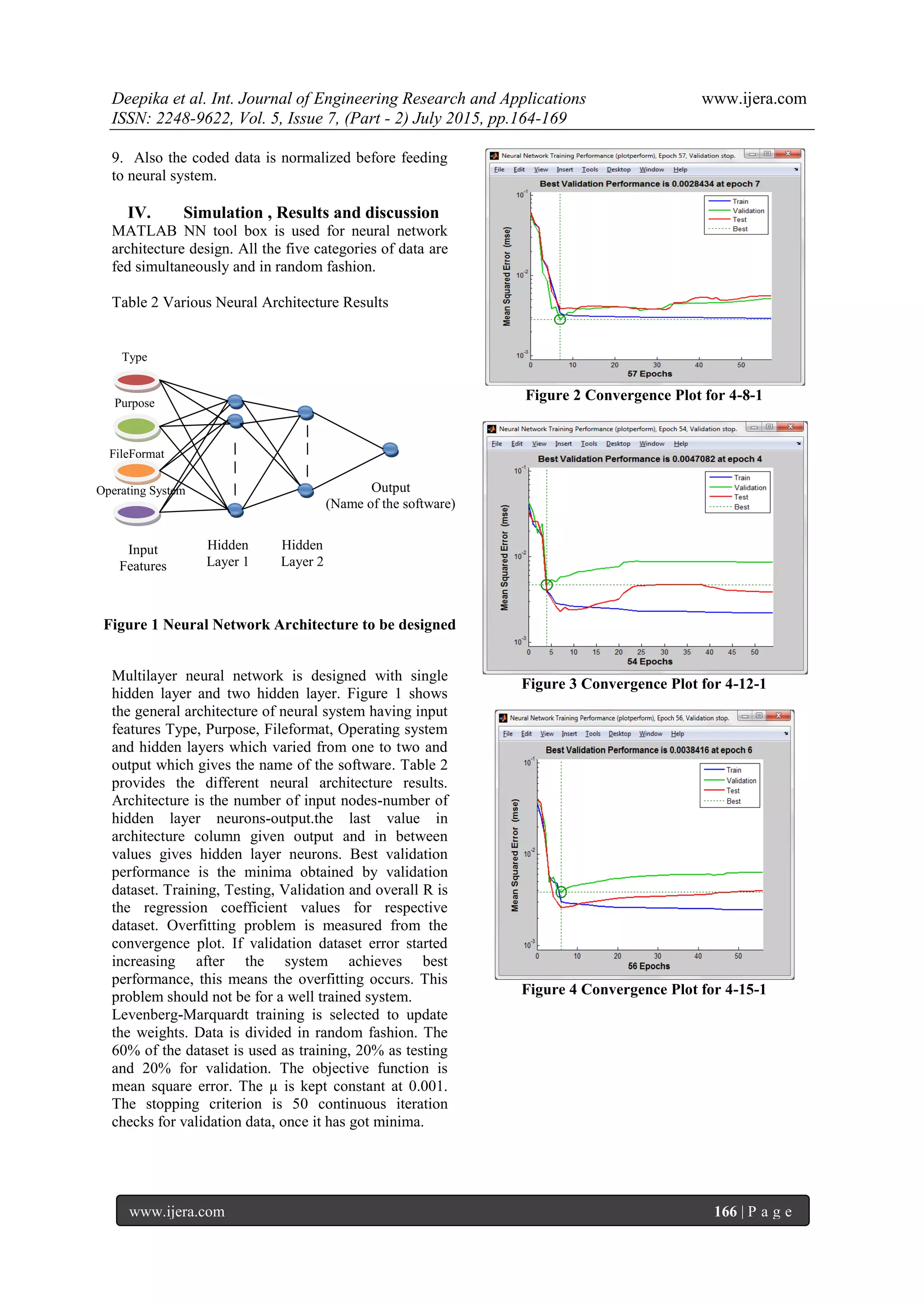
Multilayer neural network is designed with single
hidden layer and two hidden layer. Figure 1 shows
the general architecture of neural system having input
features Type, Purpose, Fileformat, Operating system
and hidden layers which varied from one to two and
output which gives the name of the software. Table 2
provides the different neural architecture results.
Architecture is the number of input nodes-number of
hidden layer neurons-output.the last value in
architecture column given output and in between
values gives hidden layer neurons. Best validation
performance is the minima obtained by validation
dataset. Training, Testing, Validation and overall R is
the regression coefficient values for respective
dataset. Overfitting problem is measured from the
convergence plot. If validation dataset error started
increasing after the system achieves best
performance, this means the overfitting occurs. This
problem should not be for a well trained system.
Levenberg-Marquardt training is selected to update
the weights. Data is divided in random fashion. The
60% of the dataset is used as training, 20% as testing
and 20% for validation. The objective function is
mean square error. The µ is kept constant at 0.001.
The stopping criterion is 50 continuous iteration
checks for validation data, once it has got minima.
Figure 2 Convergence Plot for 4-8-1
Figure 3 Convergence Plot for 4-12-1
Figure 4 Convergence Plot for 4-15-1
Output
(Name of the software)
Input
Features
Purpose
FileFormat
Operating System
Type
Hidden
Layer 1
Hidden
Layer 2
Figure 1 Neural Network Architecture to be designed
Deepika et al. Int. Journal of Engineering Research and Applications www.ijera.com
ISSN: 2248-9622, Vol. 5, Issue 7, (Part - 2) July 2015, pp.164-169
www.ijera.com 167 | P a g e
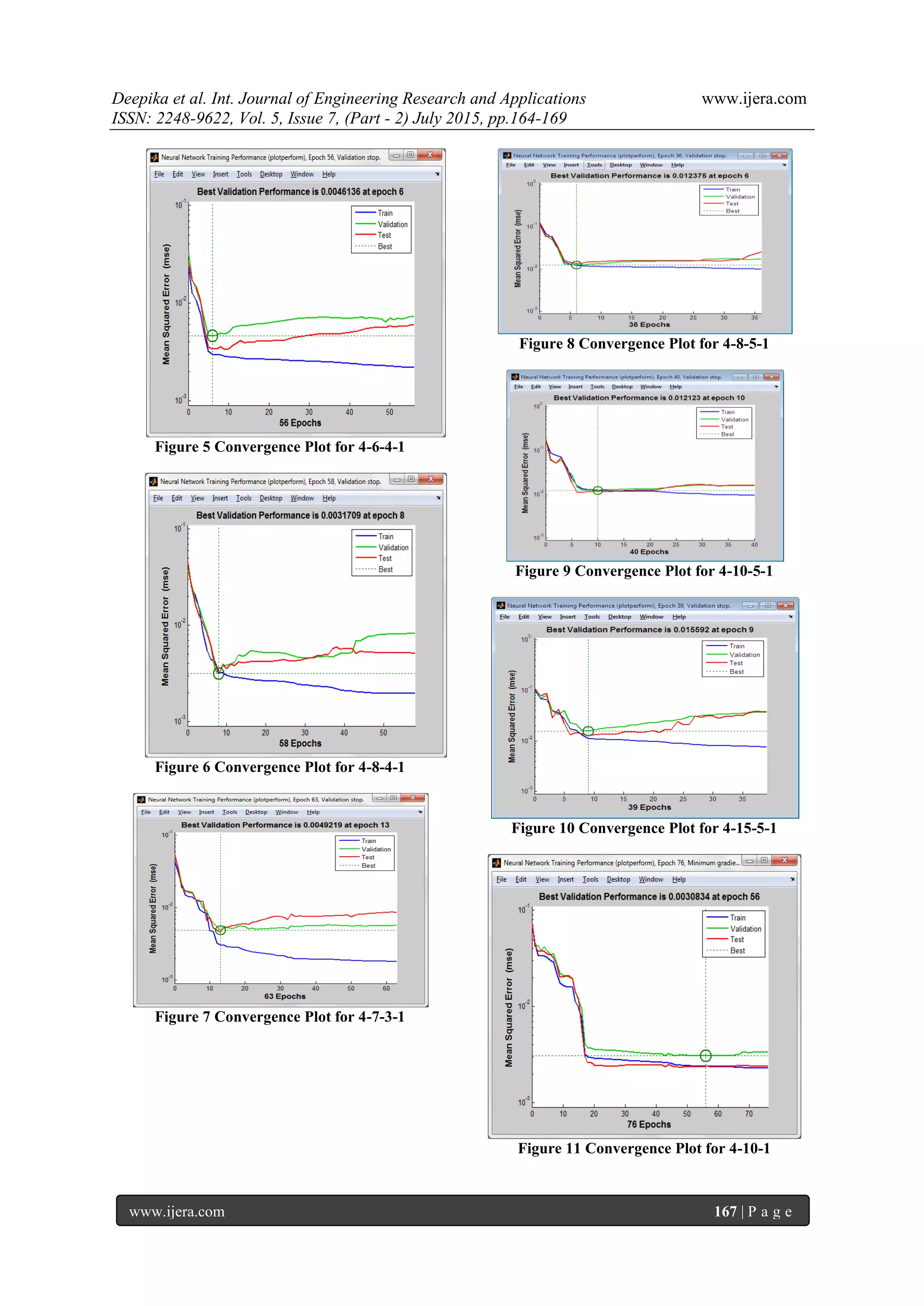
Figure 5 Convergence Plot for 4-6-4-1
Figure 6 Convergence Plot for 4-8-4-1
Figure 7 Convergence Plot for 4-7-3-1
Figure 8 Convergence Plot for 4-8-5-1
Figure 9 Convergence Plot for 4-10-5-1
Figure 10 Convergence Plot for 4-15-5-1
Figure 11 Convergence Plot for 4-10-1
Deepika et al. Int. Journal of Engineering Research and Applications www.ijera.com
ISSN: 2248-9622, Vol. 5, Issue 7, (Part - 2) July 2015, pp.164-169
www.ijera.com 168 | P a g e
Figure 2 to Figure 11 provides the convergence graph
for different architecture. The red highlighted portion
in Table 2, the neural system for which the validation
error is remaining constant after the best validation
performance. For other architecture, the error
increases which mean those architectures are having
overfitting problem. 4-10-1 has maximum R value
than 4-7-3-1 and 4-8-5-1. Also 4-10-1 has minima
validation error however this architecture takes more
time to achieve minima. Figure 12 shows the
regression plot for 4-10-1 architecture.
Figure 12 Regression Plot for 4-10-1
V. Conclusion
In this research, the main focus is to make a user
friendly environment for online open source software
selection. The software selection according to the
computer architecture or specification is the problem
for users. The installation of unwanted software
consumes time. To overcome this problem an
automatic system is designed which provides the
software according to computer specification. Open
source software data is used for automatic system
design.
A data of various open source software has been
collected and coded into numeric form.
Backpropagation based neural network is used as an
automatic classification system. Input features from
user are accepted by the NN system. The NN system
is trained with training dataset. The performance
parameter is mean square error. Once the system gets
trained, the regression plot gives the measure how
efficient the system is. Multilayer network with one
hidden layer is providing satisfactory results with fit
value of 0.93877.
References
[1] N. Networks, “Biological Neurons and Neural
Networks , Artificial Neurons,” Neural
Networks, pp. 1–14, 2004.
[2] A. M. St. Laurent, “Understanding Open
Source and Free Software Licensing,” in
Understanding Open Source and Free
Software Licensing, First., S. St. Laurent, Ed.
O‟Reilly Media, 2004, p. 4.
[3] Irina Guseva, “Bad Economy Is Good for
Open Source,” 2012. [Online]. Available:
http://www.cmswire.com/.
[4] R. Tuli, “Character recognition in neural
networks using back propagation method,” in
Advance Computing Conference (IACC), 2013
IEEE 3rd International, 2013, pp. 593–599.
[5] M. M. Subashini and S. K. Sahoo, “Brain
tumour detection using Pulse coupled neural
network (PCNN) and back propagation
network,” Sustainable Energy and Intelligent
Systems (SEISCON 2012), IET Chennai 3rd
International on, pp. 1–6, 2012.
[6] A. Ngaopitakkul, C. Pothisarn, S. Bunjongjit,
J. Klomjit, and B. Suechoey, “Application of
back-propagation neural network for
transformer differential protection schemes
part 2 identification the phase with fault
appearance in power transformer,” in Soft
Computing and Intelligent Systems (SCIS) and
13th International Symposium on Advanced
Intelligent Systems (ISIS), 2012 Joint 6th
International Conference on, 2012, pp. 1499–
1503.
[7] S. A. Radzi and M. Khalil-Hani, “Character
recognition of license plate number using
convolutional neural network,” Lecture Notes
in Computer Science (including subseries
Lecture Notes in Artificial Intelligence and
Lecture Notes in Bioinformatics), vol. 7066
LNCS, pp. 45–55, 2011.
[8] C.-B. Ng, Y.-H. Tay, and B.-M. Goi, “A
convolutional neural network for pedestrian
gender recognition,” in Advances in Neural
Networks--ISNN , Lecture Notes in Computer
Science, volume 7951, Springer International
Publishing, 2013, pp. 558–564.
[9] J. Jiang, J. Zhang, G. Yang, D. Zhang, and L.
Zhang, “Application of back propagation
neural network in the classification of high
resolution remote sensing image: Take remote
sensing image of beijing for instance,” in
Geoinformatics, 2010 18th International
Conference on, IEEE, 2010, pp. 1–6.
[10] N. L. D. Khoa, K. Sakakibara, and I.
Nishikawa, “Stock price forecasting using
back propagation neural networks with time
and profit based adjusted weight factors,” in
SICE-ICASE, 2006. International Joint
Conference, IEEE, 2006, pp. 5484–5488.
[11] V. Jaiganesh, P. Sumathi, and S.
Mangayarkarasi, “An Analysis of Intrusion
Detection System using back propagation
neural network,” in Information
Communication and Embedded Systems
Deepika et al. Int. Journal of Engineering Research and Applications www.ijera.com
ISSN: 2248-9622, Vol. 5, Issue 7, (Part - 2) July 2015, pp.164-169
www.ijera.com 169 | P a g e
(ICICES), 2013 International Conference on,
IEEE, 2013, pp. 232–236.
[12] K. U. Rani, “Analysis of heart diseases dataset
using neural network approach,” in journal
arXiv preprint arXiv:1110.2626, 2011.
[13] T. A. Anjit and S. Rishidas, “Identification of
nasal bone for the early detection of down
syndrome using Back Propagation Neural
Network,” in Communications and Signal
Processing (ICCSP), 2011 International
Conference on, 2011, pp. 136–140.

Automatic Selection of Open Source Multimedia Softwares Using Error Back-Propagation Neural Network

  • 1.
    Deepika et al.Int. Journal of Engineering Research and Applications www.ijera.com ISSN: 2248-9622, Vol. 5, Issue 7, (Part - 2) July 2015, pp.164-169 www.ijera.com 164 | P a g e Automatic Selection of Open Source Multimedia Softwares Using Error Back-Propagation Neural Network Deepika1 , Suman2 , Arshdeep Singh3 , Dr. G.N. Verma4 1M.Tech Student Sri Sukhmani Institute of Engineering & Technology, Punjab, India 2Assistant Professor Sri Sukhmani Institute of Engineering & Technology, Punjab, India 3M.E Scholar National Institute of Teachers Training & Research, Chandigarh, India 4Coordinator Sri Sukhmani Institute of Engineering & Technology, Punjab, India Abstract— Open source opens a new era to provide license of the software for the user at free of cost which is advantage over paid licensed software. In Multimedia applications there are many versions of software are available and there is a problem for the user to select compatible software for their own system. Most of the time while surfing for software a huge list of software opens in response. The selection of particular software which is pretty suitable for the system from a real big list is the biggest challenge that is faced by the users. This work has been done that focuses on the existing open source software that are widely used and to design an automatic system for selection of particular open source software according to the compatibility of users own system. In this work, error back-propagation based neural network is designed in MATLAB for automatic selection of open source software. The system provides the open source software name after taking the information from user. Regression coefficient of 0.93877 is obtained and the results shown are up to the mark and can be utilized for the fast and effective software search. Keywords—Back-propagtion, Open Source, Neural network I. Introduction The motivation to build an automatic software selection system comes from the human brain system. Our brain is able to categorize many complex tasks. Human brain has billions of processing units called neurons. Human eyes can sense the external environment which acts as a receptor. Photons on retina receive the information from external world. Neurons in the brain process the information in massively parallel mode. The output of the brain activates the muscles which is called effector action. Effectors interact with the environment. The biological neural system learns from examples and can take decisions based on purely new environment [1]. Human brain has the excellent power of decision making. But this power is very much limited to local problems. Human can take decision well when the number of decisive class is limited. The open source software exists large in number. The configuration of computer system changes the selection of software completely. In these conditions it is very difficult for the humans to decide which software is compatible. Open source refers to a computer program in which the source code is available to the general public for use and/or modification from its original design. Open-source code is meant to be a collaborative effort, where programmers improve upon the source code and share the changes within the community In production and development, open source as a development model promotes a universal access via a free license to a product's design or blueprint, and universal redistribution of that design or blueprint, including subsequent improvements to it by anyone. M. St. Laurent [2] presents Open-source software made available with a license in which the copyright holder provides the rights to study, change, and distribute the software to anyone and for any purpose. Irina Guseva [3] explains the top four reasons (as provided by Open Source Business Conference survey) individuals or organizations choose open source software are: lower cost, security, no vendor lock in, and better quality. Artificial neural network has been widely used for solving non-linear complex tasks. With the development of computer technology, machine learning techniques are becoming good choice. The selection of the machine learning technique depends upon the viability for particular application. Most of the non-linear problems have been solved using back propagation based neural network. Errorback propagation based neural network has found applications in various areas. R Tuli [4] applied neural network technique for character recognition and this paper attempts to recognize the characters using a back propagation algorithm. M. M. Subashini RESEARCH ARTICLE OPEN ACCESS
  • 2.
    Deepika et al.Int. Journal of Engineering Research and Applications www.ijera.com ISSN: 2248-9622, Vol. 5, Issue 7, (Part - 2) July 2015, pp.164-169 www.ijera.com 165 | P a g e et. al. [5] proposed a neural network technique for classification of brain tumor presence or not. Ngaopitakkul et. al. [6] proposed a decision algorithm for identifying the phase with fault appearance of a two-winding three-phase transformer. A decision algorithm based on a combination of Discrete Wavelet Transforms and backpropagation neural networks (BPNN) is developed. S. A. Radzi et. al. [7] applied 5 layers CNN for recognizing Malaysian license plate. Gradient based back propagation method is used for learning. Choon-Boon Tay et al. [8] proposed a 5 layer CNN for gender classification of pedestrians. J. Jiang et. al. [9] proposed application of bpnn for pattern recognition purposes. The Back Propagation neural network is used improve the high resolution remote sensing image classification precision. N. L. D. Khoa et. al. [10] proposed a method to forecast the stock price using neural networks. Both feed forward neural network and simple recurrent neural network, trained by time and profit based back propagation algorithm. V. Jaiganesh et. al. [11] proposed a novel intrusion detection system (IDS) by back propagation neural networks (BPN). K. U. Rani [12] proposed a neural network technique for classification of heart disease. The neural network is trained with Heart Diseases database by using feed forward neural network model and backpropagation learning algorithm with momentum and variable learning rate. T. A. Anjit et. al. [13] presents a new approach for the detection of nasal bone for ultrasonogram of foetus of 11 to 13 weeks of gestation. The proposed method is based on the extraction of image texture parameter of nasal bone region of ultrasonogram and their subsequent classification using Back Propagation Neural Network (BPNN). From the above, we can draw an inference that Open Source Software is the common demand of today„s scenario. It costs zero. Artificial neural network techniques are widely used in solving complex non-linear tasks. Breast cancer detection, character recognition, athletics problems, gender classification, filter designing fault diagnosis of analog circuits and stock price forecasting are some of the wide range of applications employing backpropagation neural network successfully. II.Data Collection and data preprocessing The data of five open source software is being collected. Table 1 provides the information of this dataset. Type field is the type of software for which it is user for to either convert or to play. File Format is the different files for which the software is supporting and operating system is the system software platform on which this software can run. Table 1 Data set of five open source softwares III. Data Preprocessing The data has been mapped into numerical form. The 5 software as shown in table 1 under the field name are taken as target class. The features on which selection of this software depends are type, file format, purpose and operating system as given in table 1. The data has been coded in the range of 0 to Architecture Best validation performance and @epoch Training R Validation R Testing R Overall R Overfitting Problem 4-8-1 0.00281@7 .91679 .92286 .90278 .91548 Yes 4-10-1 0.0030834@56 0.93825 0.93393 0.9496 0.93877 no 4-12-1 0.0047082@4 .90283 .89624 .90096 .90196 yes 4-15-1 .0038416@6 .92826 .91207 .91473 .92278 yes 4-6-4-1 0.0046136@6 .92101 .89448 .92235 .91745 yes 4-8-4-1 0.0031709@8 0.91836 0.92961 0.92013 0.92011 yes 4-7-3-1 0.0049219@13 0.92112 0.89642 0.90633 0.91342 no 4-8-5-1 0.012375@6 0.92529 0.91677 0.91964 0.92303 no 4-10-5-1 0.012123@10 0.92652 0.90658 0.91957 0.92283 yes 4-15-5-1 0.015592@9 0.93049 0.90431 0.92371 0.92471 yes
  • 3.
    Deepika et al.Int. Journal of Engineering Research and Applications www.ijera.com ISSN: 2248-9622, Vol. 5, Issue 7, (Part - 2) July 2015, pp.164-169 www.ijera.com 166 | P a g e 9. Also the coded data is normalized before feeding to neural system. IV. Simulation , Results and discussion MATLAB NN tool box is used for neural network architecture design. All the five categories of data are fed simultaneously and in random fashion. Table 2 Various Neural Architecture Results Multilayer neural network is designed with single hidden layer and two hidden layer. Figure 1 shows the general architecture of neural system having input features Type, Purpose, Fileformat, Operating system and hidden layers which varied from one to two and output which gives the name of the software. Table 2 provides the different neural architecture results. Architecture is the number of input nodes-number of hidden layer neurons-output.the last value in architecture column given output and in between values gives hidden layer neurons. Best validation performance is the minima obtained by validation dataset. Training, Testing, Validation and overall R is the regression coefficient values for respective dataset. Overfitting problem is measured from the convergence plot. If validation dataset error started increasing after the system achieves best performance, this means the overfitting occurs. This problem should not be for a well trained system. Levenberg-Marquardt training is selected to update the weights. Data is divided in random fashion. The 60% of the dataset is used as training, 20% as testing and 20% for validation. The objective function is mean square error. The µ is kept constant at 0.001. The stopping criterion is 50 continuous iteration checks for validation data, once it has got minima. Figure 2 Convergence Plot for 4-8-1 Figure 3 Convergence Plot for 4-12-1 Figure 4 Convergence Plot for 4-15-1 Output (Name of the software) Input Features Purpose FileFormat Operating System Type Hidden Layer 1 Hidden Layer 2 Figure 1 Neural Network Architecture to be designed
  • 4.
    Deepika et al.Int. Journal of Engineering Research and Applications www.ijera.com ISSN: 2248-9622, Vol. 5, Issue 7, (Part - 2) July 2015, pp.164-169 www.ijera.com 167 | P a g e Figure 5 Convergence Plot for 4-6-4-1 Figure 6 Convergence Plot for 4-8-4-1 Figure 7 Convergence Plot for 4-7-3-1 Figure 8 Convergence Plot for 4-8-5-1 Figure 9 Convergence Plot for 4-10-5-1 Figure 10 Convergence Plot for 4-15-5-1 Figure 11 Convergence Plot for 4-10-1
  • 5.
    Deepika et al.Int. Journal of Engineering Research and Applications www.ijera.com ISSN: 2248-9622, Vol. 5, Issue 7, (Part - 2) July 2015, pp.164-169 www.ijera.com 168 | P a g e Figure 2 to Figure 11 provides the convergence graph for different architecture. The red highlighted portion in Table 2, the neural system for which the validation error is remaining constant after the best validation performance. For other architecture, the error increases which mean those architectures are having overfitting problem. 4-10-1 has maximum R value than 4-7-3-1 and 4-8-5-1. Also 4-10-1 has minima validation error however this architecture takes more time to achieve minima. Figure 12 shows the regression plot for 4-10-1 architecture. Figure 12 Regression Plot for 4-10-1 V. Conclusion In this research, the main focus is to make a user friendly environment for online open source software selection. The software selection according to the computer architecture or specification is the problem for users. The installation of unwanted software consumes time. To overcome this problem an automatic system is designed which provides the software according to computer specification. Open source software data is used for automatic system design. A data of various open source software has been collected and coded into numeric form. Backpropagation based neural network is used as an automatic classification system. Input features from user are accepted by the NN system. The NN system is trained with training dataset. The performance parameter is mean square error. Once the system gets trained, the regression plot gives the measure how efficient the system is. Multilayer network with one hidden layer is providing satisfactory results with fit value of 0.93877. References [1] N. Networks, “Biological Neurons and Neural Networks , Artificial Neurons,” Neural Networks, pp. 1–14, 2004. [2] A. M. St. Laurent, “Understanding Open Source and Free Software Licensing,” in Understanding Open Source and Free Software Licensing, First., S. St. Laurent, Ed. O‟Reilly Media, 2004, p. 4. [3] Irina Guseva, “Bad Economy Is Good for Open Source,” 2012. [Online]. Available: http://www.cmswire.com/. [4] R. Tuli, “Character recognition in neural networks using back propagation method,” in Advance Computing Conference (IACC), 2013 IEEE 3rd International, 2013, pp. 593–599. [5] M. M. Subashini and S. K. Sahoo, “Brain tumour detection using Pulse coupled neural network (PCNN) and back propagation network,” Sustainable Energy and Intelligent Systems (SEISCON 2012), IET Chennai 3rd International on, pp. 1–6, 2012. [6] A. Ngaopitakkul, C. Pothisarn, S. Bunjongjit, J. Klomjit, and B. Suechoey, “Application of back-propagation neural network for transformer differential protection schemes part 2 identification the phase with fault appearance in power transformer,” in Soft Computing and Intelligent Systems (SCIS) and 13th International Symposium on Advanced Intelligent Systems (ISIS), 2012 Joint 6th International Conference on, 2012, pp. 1499– 1503. [7] S. A. Radzi and M. Khalil-Hani, “Character recognition of license plate number using convolutional neural network,” Lecture Notes in Computer Science (including subseries Lecture Notes in Artificial Intelligence and Lecture Notes in Bioinformatics), vol. 7066 LNCS, pp. 45–55, 2011. [8] C.-B. Ng, Y.-H. Tay, and B.-M. Goi, “A convolutional neural network for pedestrian gender recognition,” in Advances in Neural Networks--ISNN , Lecture Notes in Computer Science, volume 7951, Springer International Publishing, 2013, pp. 558–564. [9] J. Jiang, J. Zhang, G. Yang, D. Zhang, and L. Zhang, “Application of back propagation neural network in the classification of high resolution remote sensing image: Take remote sensing image of beijing for instance,” in Geoinformatics, 2010 18th International Conference on, IEEE, 2010, pp. 1–6. [10] N. L. D. Khoa, K. Sakakibara, and I. Nishikawa, “Stock price forecasting using back propagation neural networks with time and profit based adjusted weight factors,” in SICE-ICASE, 2006. International Joint Conference, IEEE, 2006, pp. 5484–5488. [11] V. Jaiganesh, P. Sumathi, and S. Mangayarkarasi, “An Analysis of Intrusion Detection System using back propagation neural network,” in Information Communication and Embedded Systems
  • 6.
    Deepika et al.Int. Journal of Engineering Research and Applications www.ijera.com ISSN: 2248-9622, Vol. 5, Issue 7, (Part - 2) July 2015, pp.164-169 www.ijera.com 169 | P a g e (ICICES), 2013 International Conference on, IEEE, 2013, pp. 232–236. [12] K. U. Rani, “Analysis of heart diseases dataset using neural network approach,” in journal arXiv preprint arXiv:1110.2626, 2011. [13] T. A. Anjit and S. Rishidas, “Identification of nasal bone for the early detection of down syndrome using Back Propagation Neural Network,” in Communications and Signal Processing (ICCSP), 2011 International Conference on, 2011, pp. 136–140.