Presented by
Siddharth Satyajit Kar
1341012069 | CSE Section D
Guided by
Asst. Prof. Rashmita Routray
Machine Learning
1
Contents
Brief Intro to Machine Learning
Types of Machine Learning
How to train your computer?
Decision tree
Feature
Classifiers
and more
Machine Learning in Real World
Conclusion
References
2
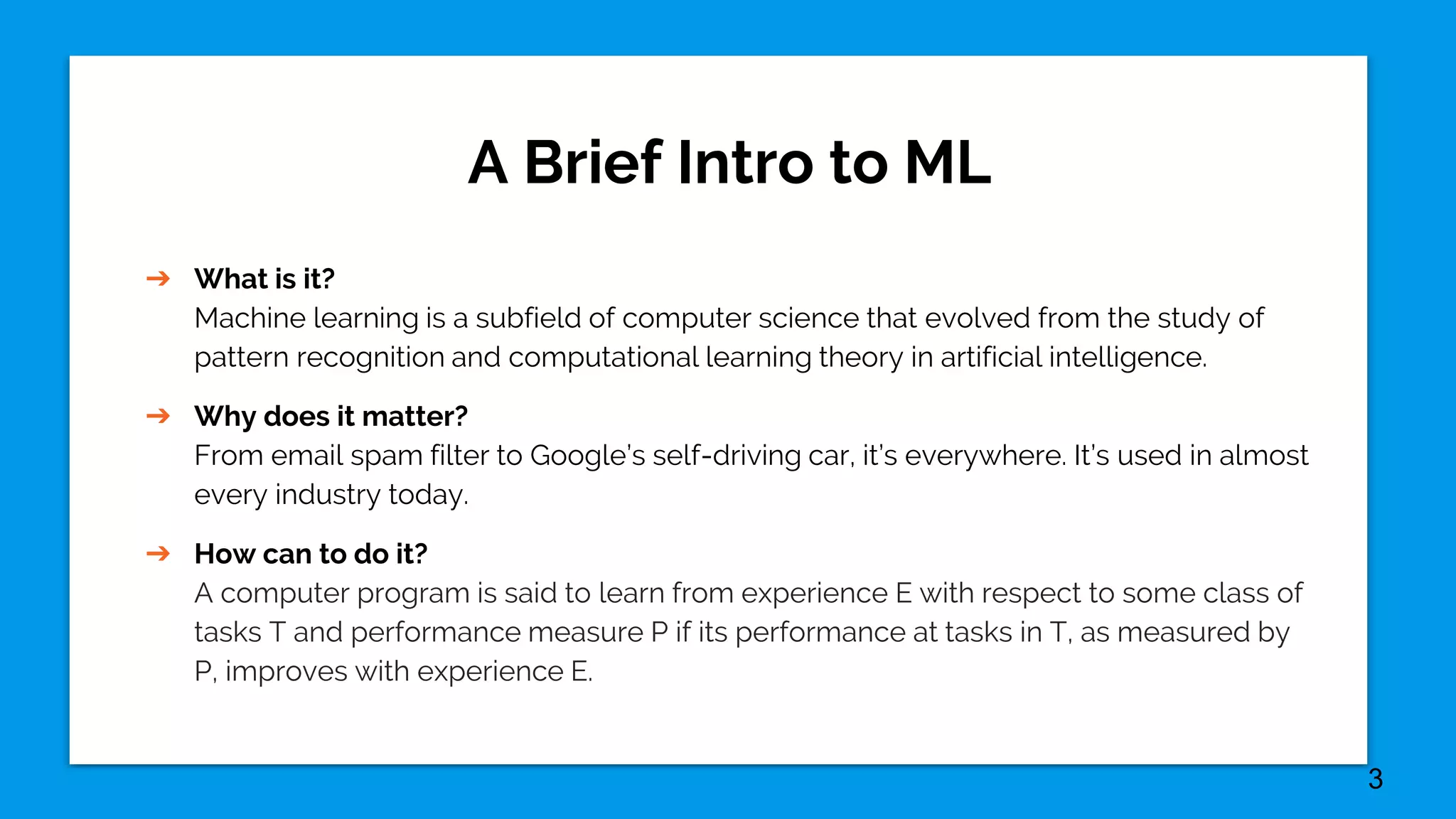
A Brief Intro to ML
➔ What is it?
Machine learning is a subfield of computer science that evolved from the study of
pattern recognition and computational learning theory in artificial intelligence.
➔ Why does it matter?
From email spam filter to Google’s self-driving car, it’s everywhere. It’s used in almost
every industry today.
➔ How can to do it?
A computer program is said to learn from experience E with respect to some class of
tasks T and performance measure P if its performance at tasks in T, as measured by
P, improves with experience E.
3
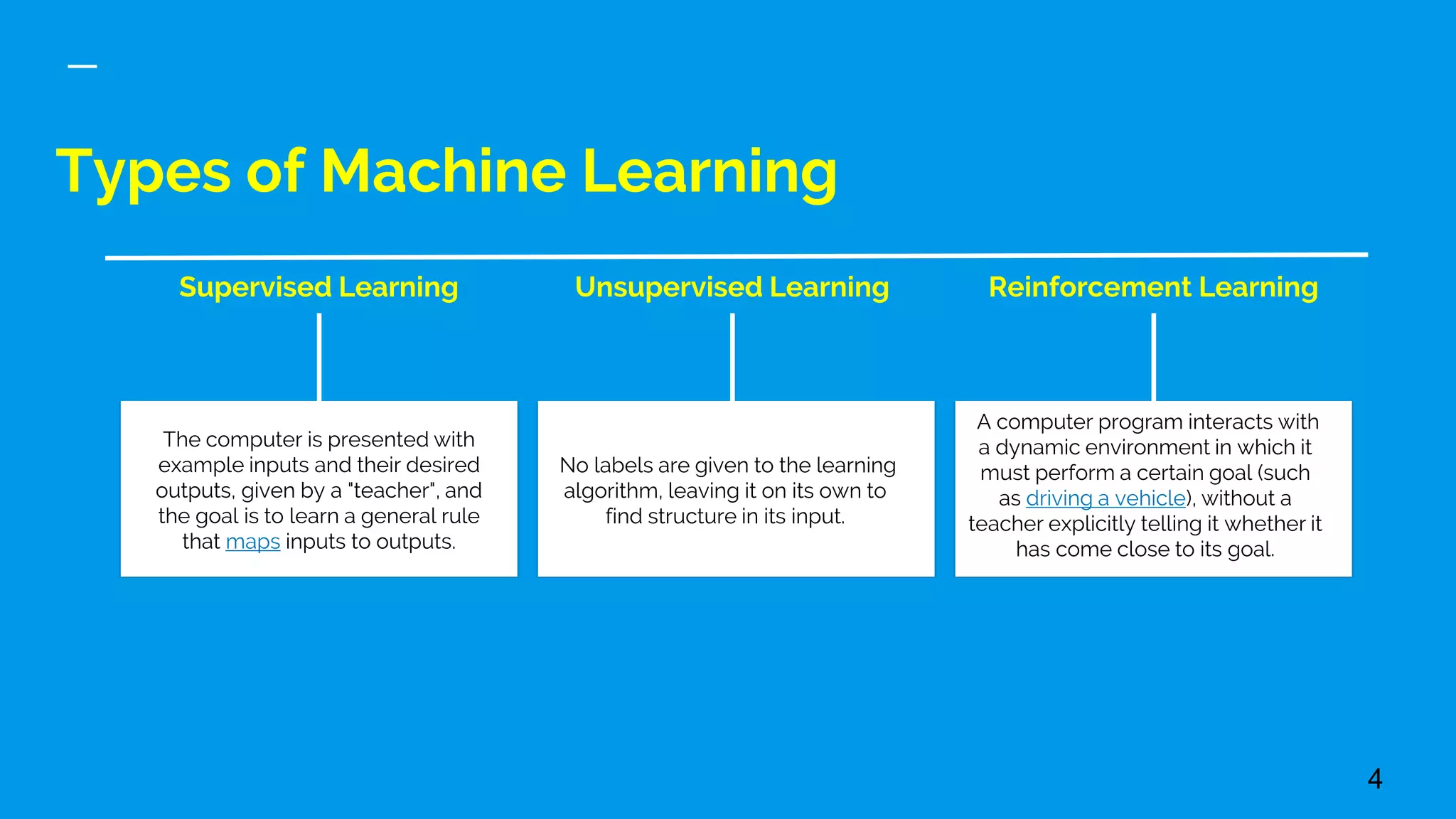
Types of Machine Learning
Supervised Learning Unsupervised Learning Reinforcement Learning
The computer is presented with
example inputs and their desired
outputs, given by a "teacher", and
the goal is to learn a general rule
that maps inputs to outputs.
No labels are given to the learning
algorithm, leaving it on its own to
find structure in its input.
A computer program interacts with
a dynamic environment in which it
must perform a certain goal (such
as driving a vehicle), without a
teacher explicitly telling it whether it
has come close to its goal.
4
Approaches of Machine Learning
● Decision tree learning
Decision tree learning uses a decision tree as a predictive model, which maps observations about an
item to conclusions about the item's target value.
● Association rule learning
Association rule learning is a method for discovering interesting relations between variables in large
databases.
● Artificial neural networks
An artificial neural network (ANN) learning algorithm, usually called "neural network" (NN), is a learning
algorithm that is inspired by the structure and functional aspects of biological neural networks.
● Deep Learning
Falling hardware prices and the development of GPUs for personal use in the last few years have
contributed to the development of the concept of Deep learning which consists of multiple hidden
layers in an artificial neural network.
5
● Genetic algorithms
A genetic algorithm (GA) is a search heuristic that mimics the process of natural selection, and uses
methods such as mutation and crossover to generate new genotype in the hope of finding good
solutions to a given problem. In machine learning, genetic algorithms found some uses in the 1980s
and 1990s. Vice versa, machine learning techniques have been used to improve the performance of
genetic and evolutionary algorithms.
● Bayesian Network
A Bayesian network, belief network or directed acyclic graphical model is a probabilistic graphical
model that represents a set of random variables and their conditional independencies via a directed
acyclic graph (DAG).
● Inductive logic programming
Inductive logic programming (ILP) is an approach to rule learning using logic programming as a
uniform representation for input examples, background knowledge, and hypotheses.
6
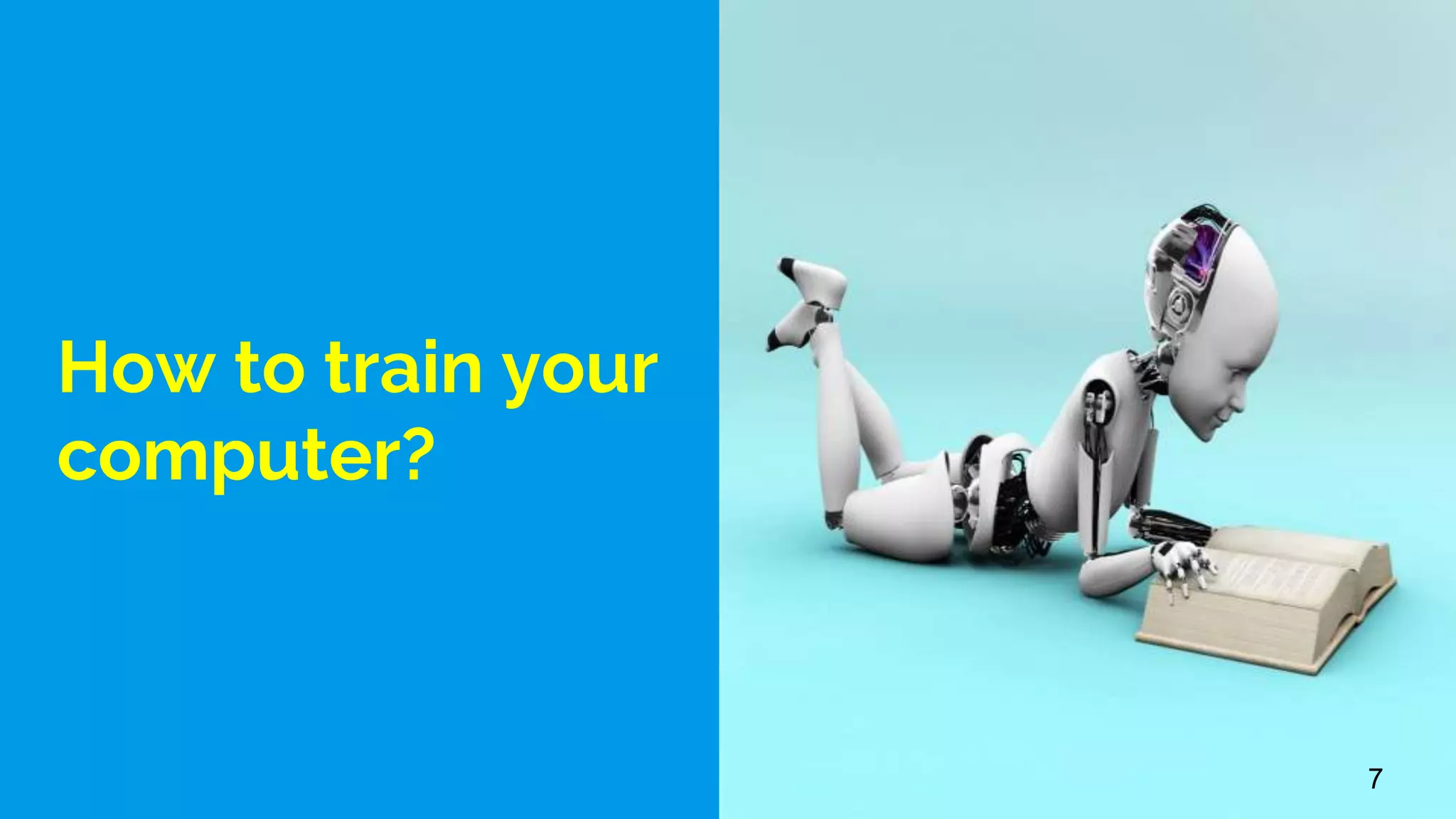
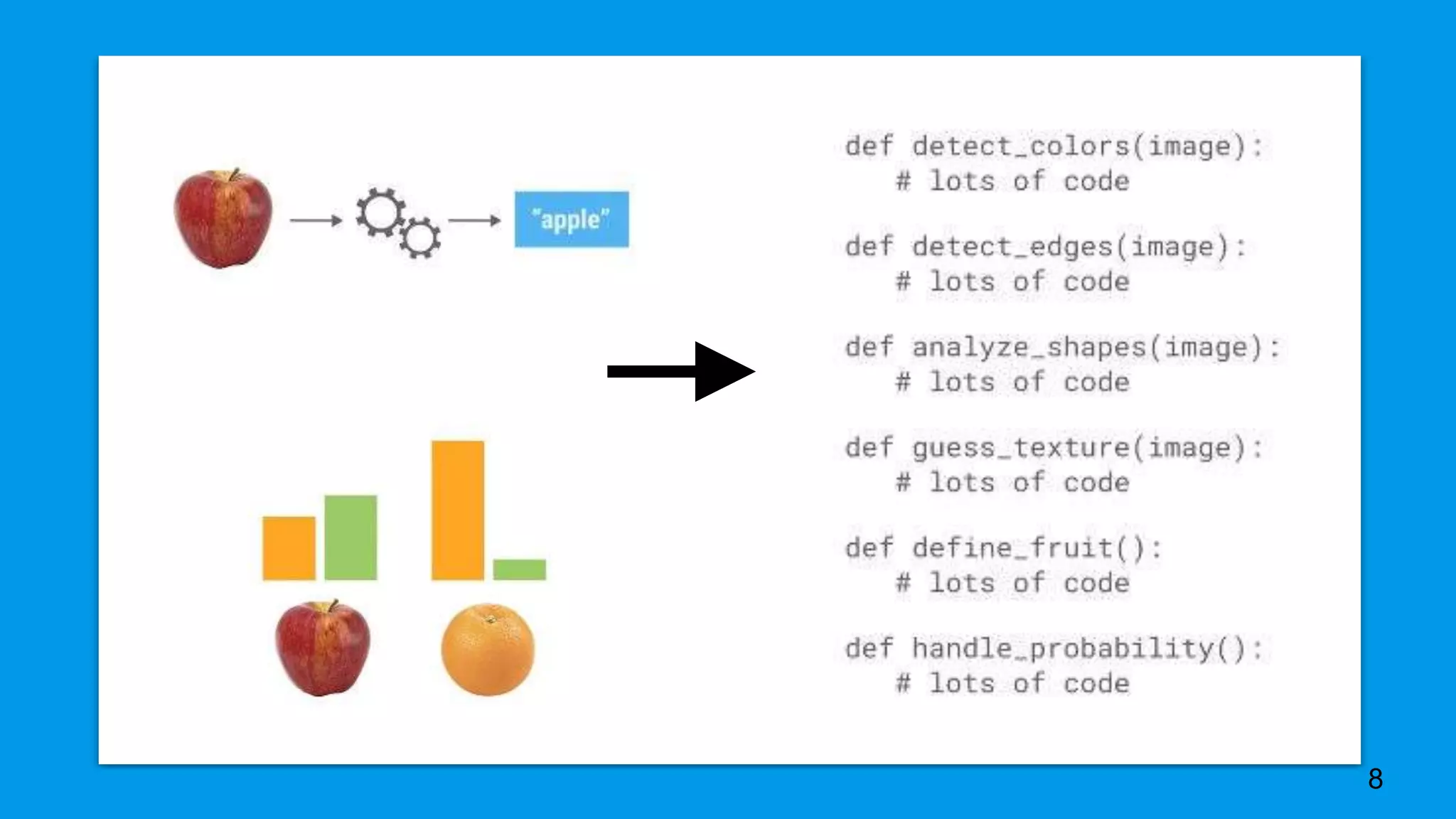
How to train your
computer? Tip
Don’t wait till the end of
the presentation to give
the bottom line.
Reveal your product or
idea (in this case a
translation app) up front.
7
8
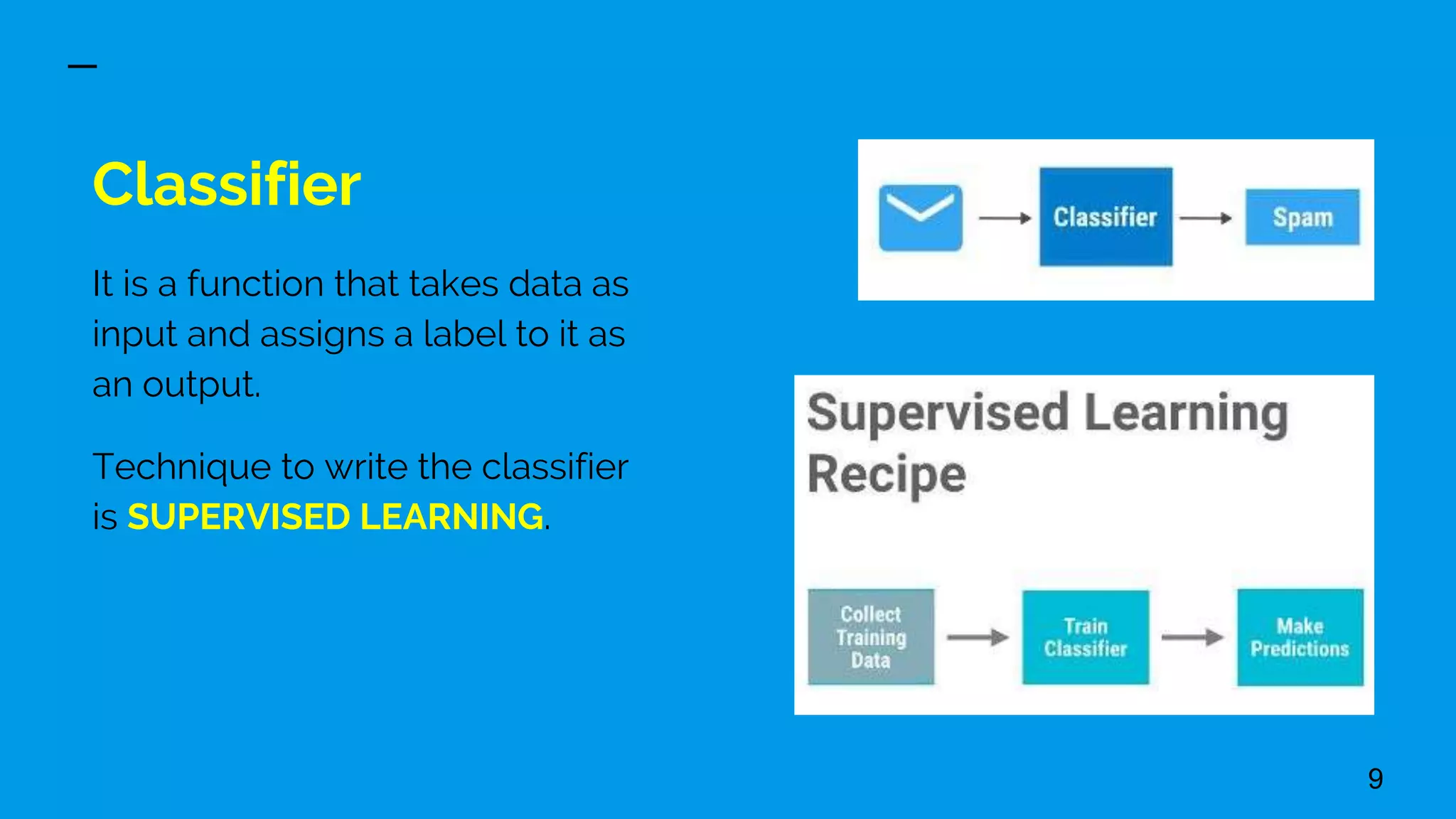
Classifier
It is a function that takes data as
input and assigns a label to it as
an output.
Technique to write the classifier
is SUPERVISED LEARNING.
9
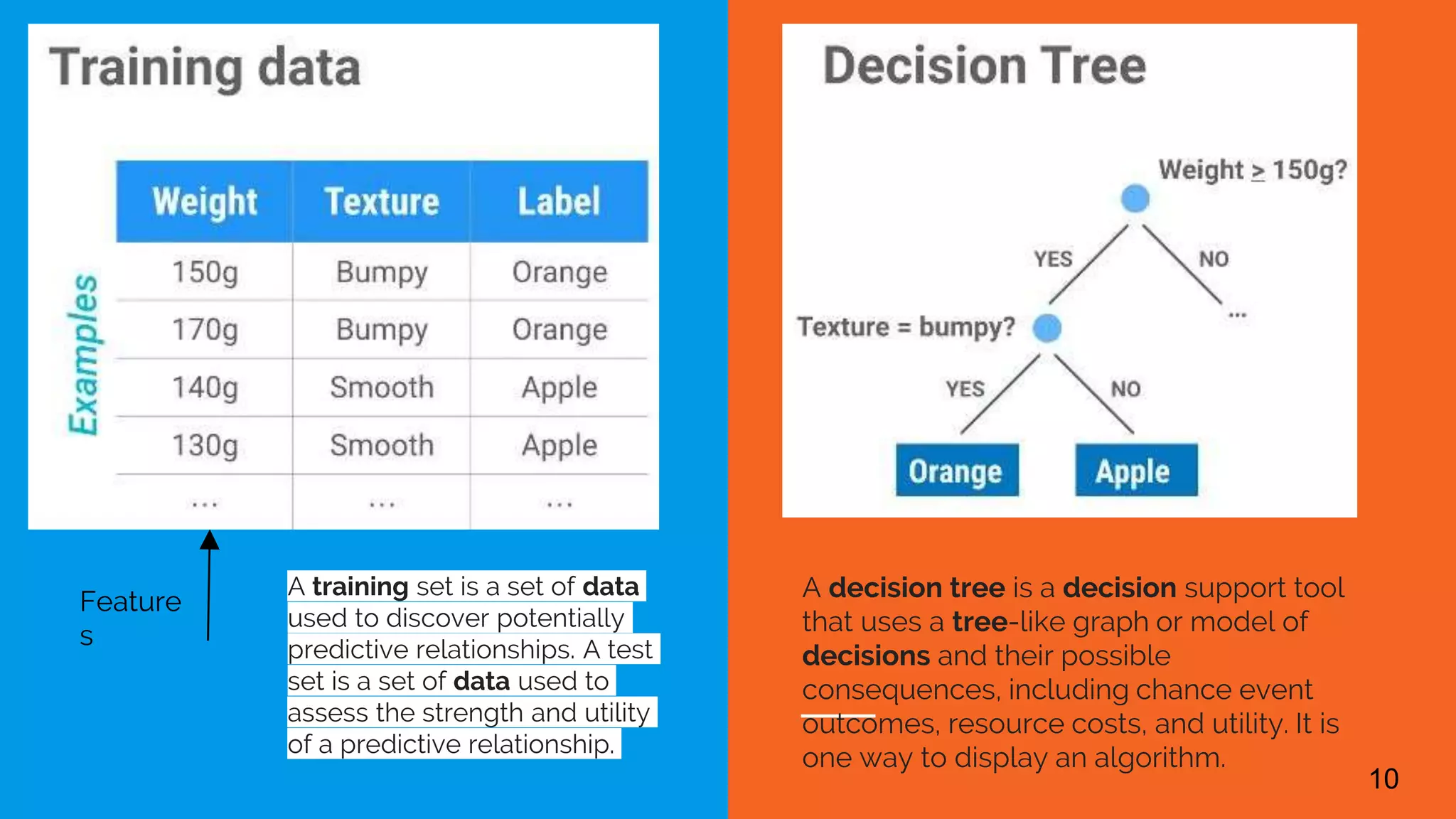
Feature
s
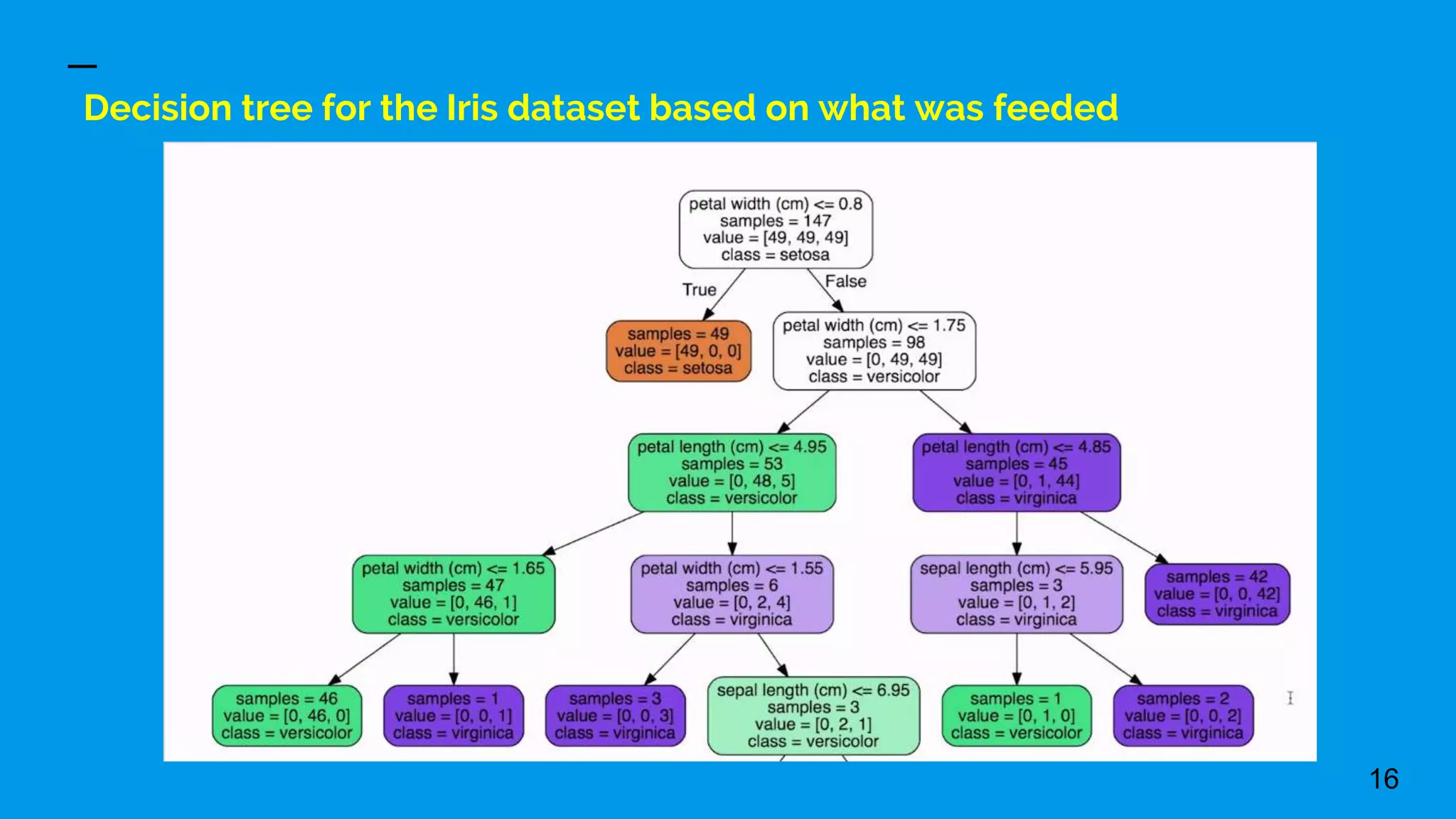
A decision tree is a decision support tool
that uses a tree-like graph or model of
decisions and their possible
consequences, including chance event
outcomes, resource costs, and utility. It is
one way to display an algorithm.
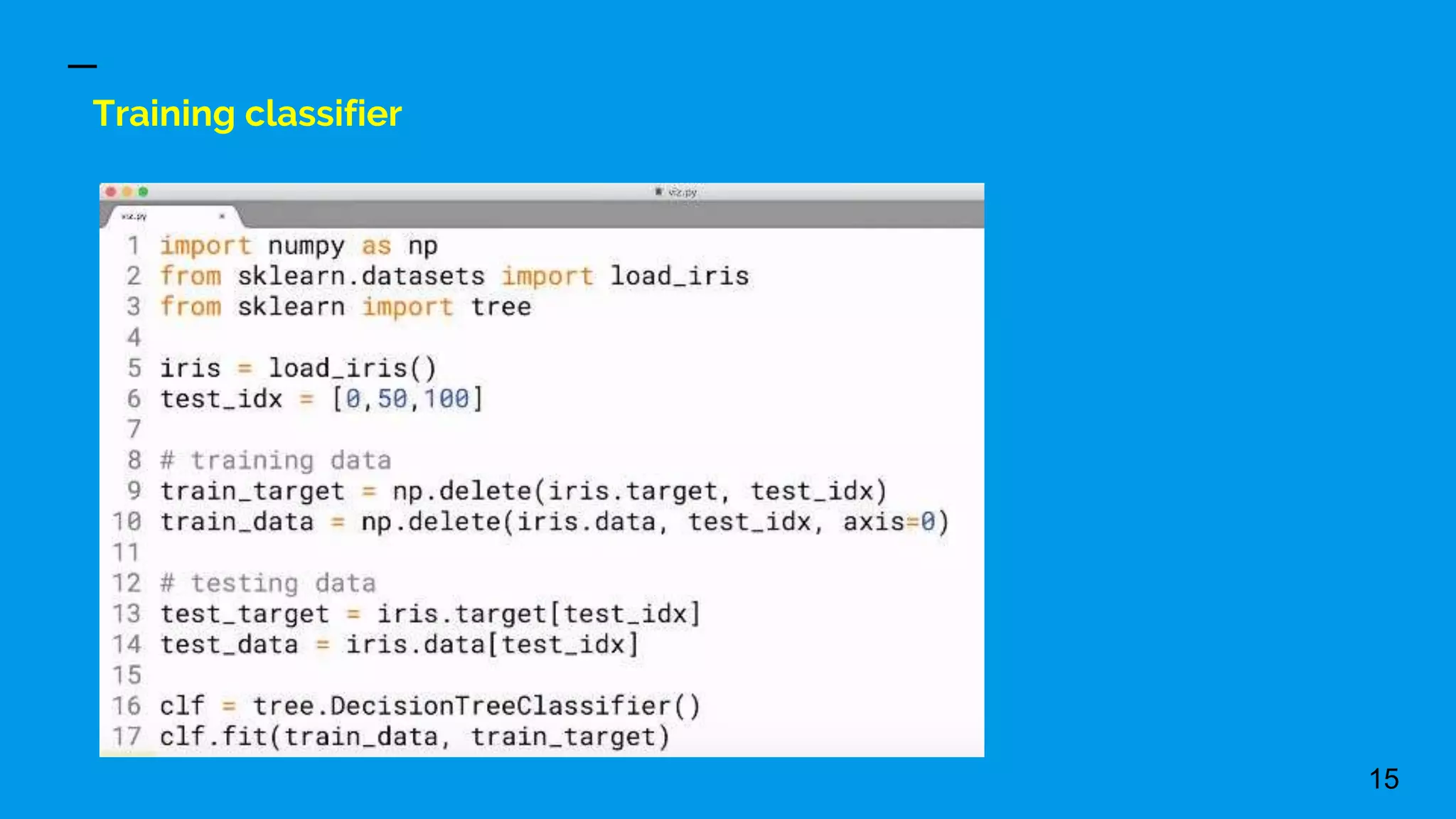
A training set is a set of data
used to discover potentially
predictive relationships. A test
set is a set of data used to
assess the strength and utility
of a predictive relationship.
10
Let’s visualise how
this works...
11
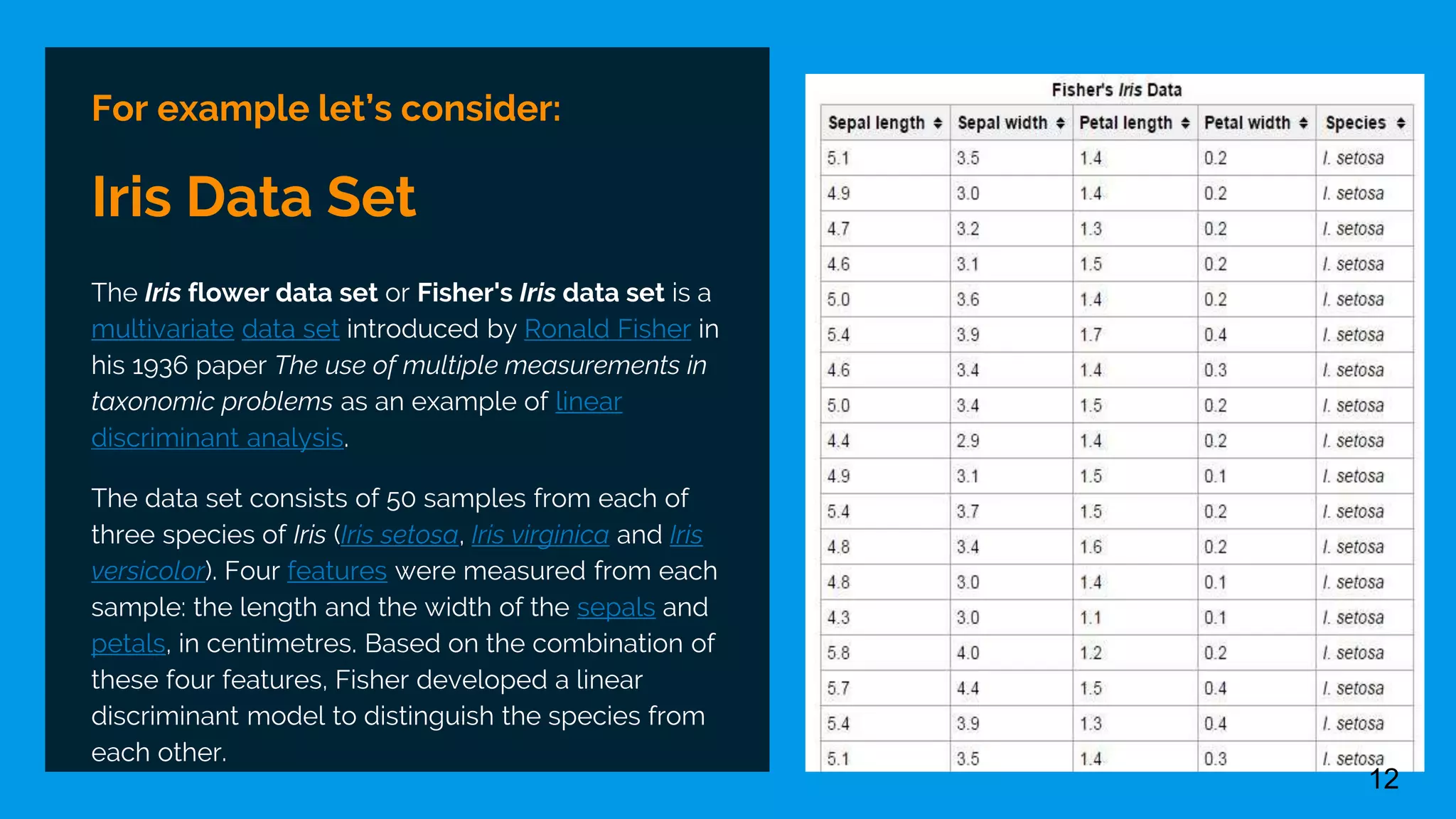
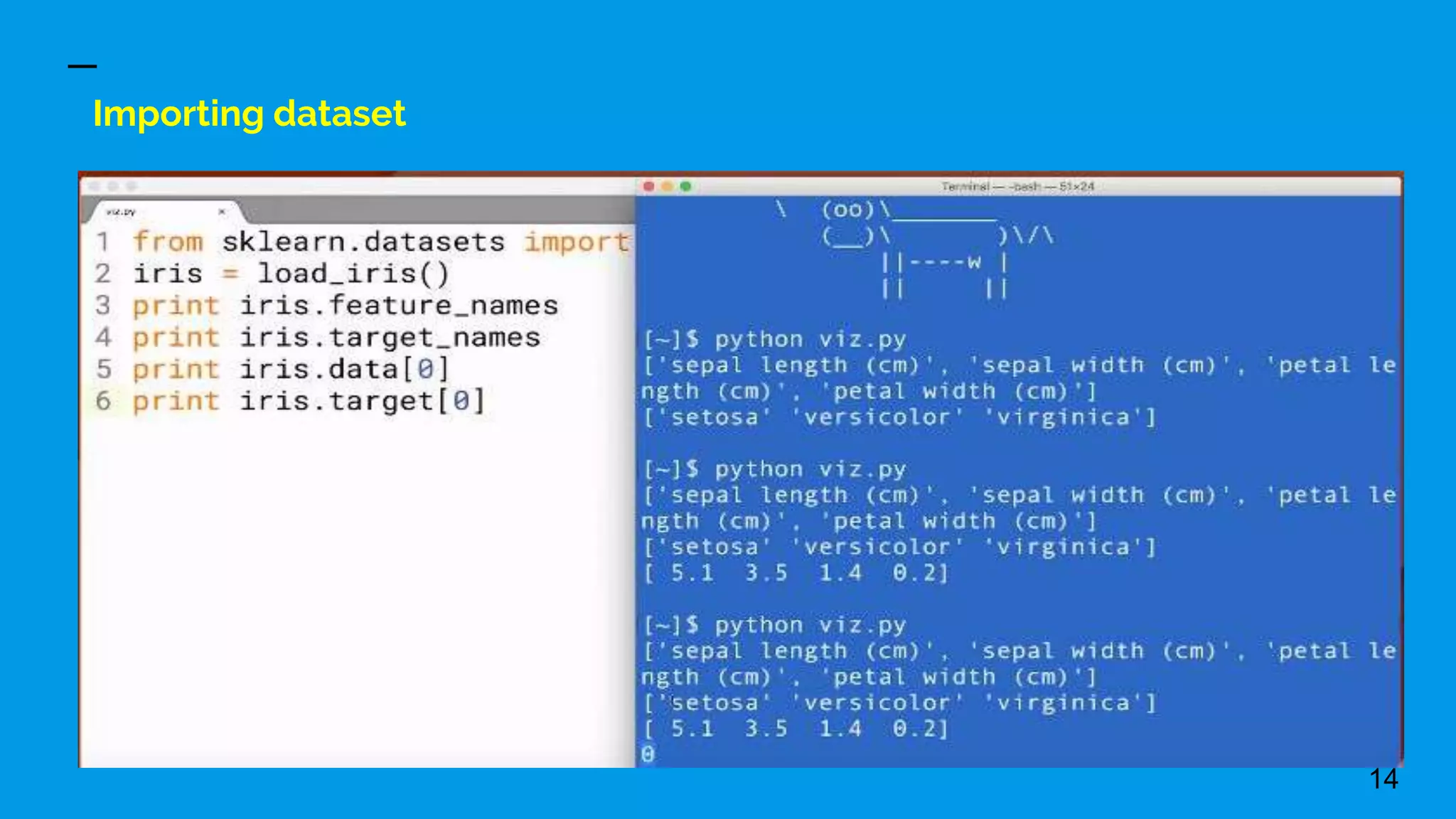
For example let’s consider:
Iris Data Set
The Iris flower data set or Fisher's Iris data set is a
multivariate data set introduced by Ronald Fisher in
his 1936 paper The use of multiple measurements in
taxonomic problems as an example of linear
discriminant analysis.
The data set consists of 50 samples from each of
three species of Iris (Iris setosa, Iris virginica and Iris
versicolor). Four features were measured from each
sample: the length and the width of the sepals and
petals, in centimetres. Based on the combination of
these four features, Fisher developed a linear
discriminant model to distinguish the species from
each other.
12
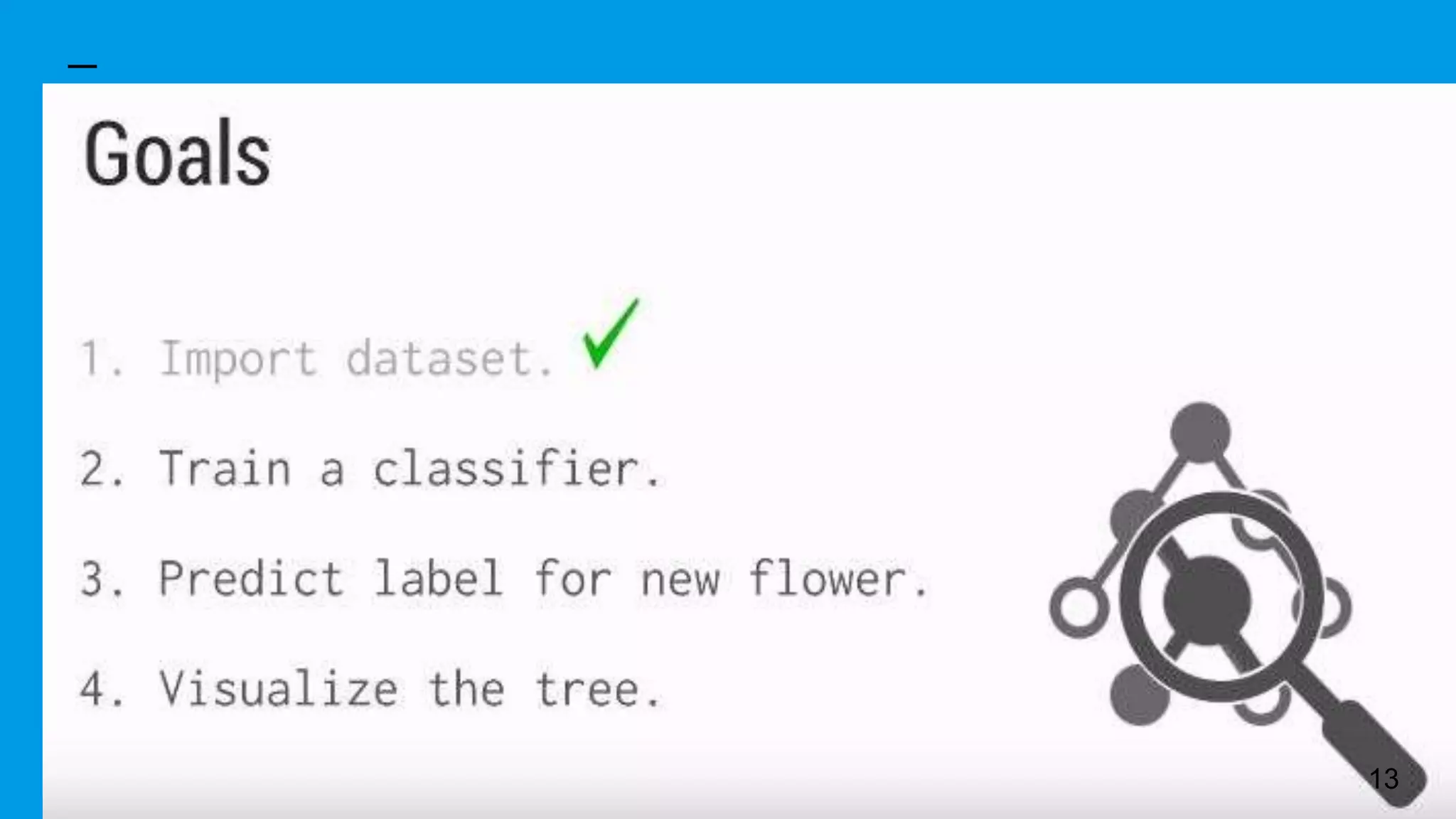
13
Importing dataset
14
Training classifier
15
Decision tree for the Iris dataset based on what was feeded
16
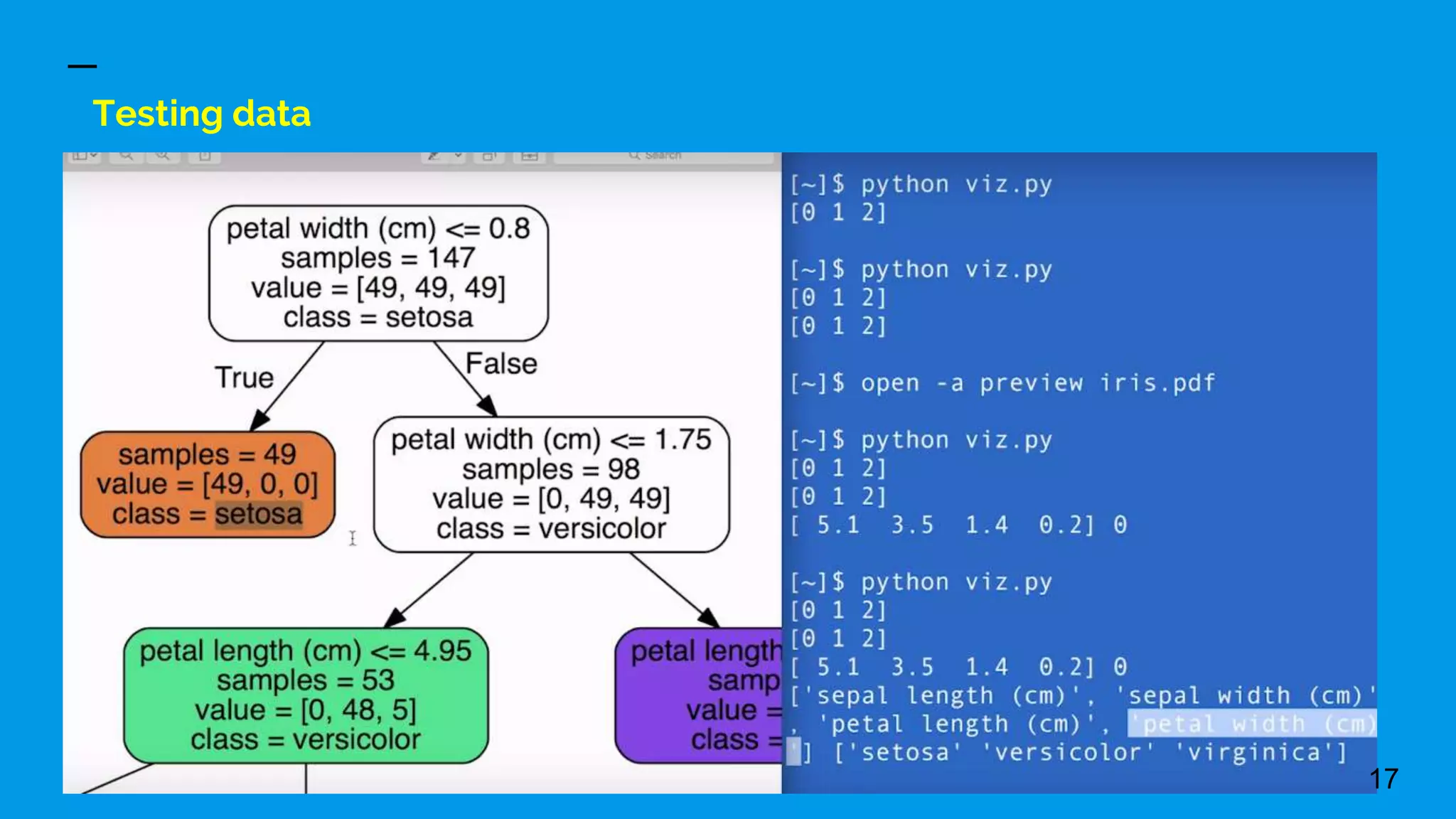
Testing data
17
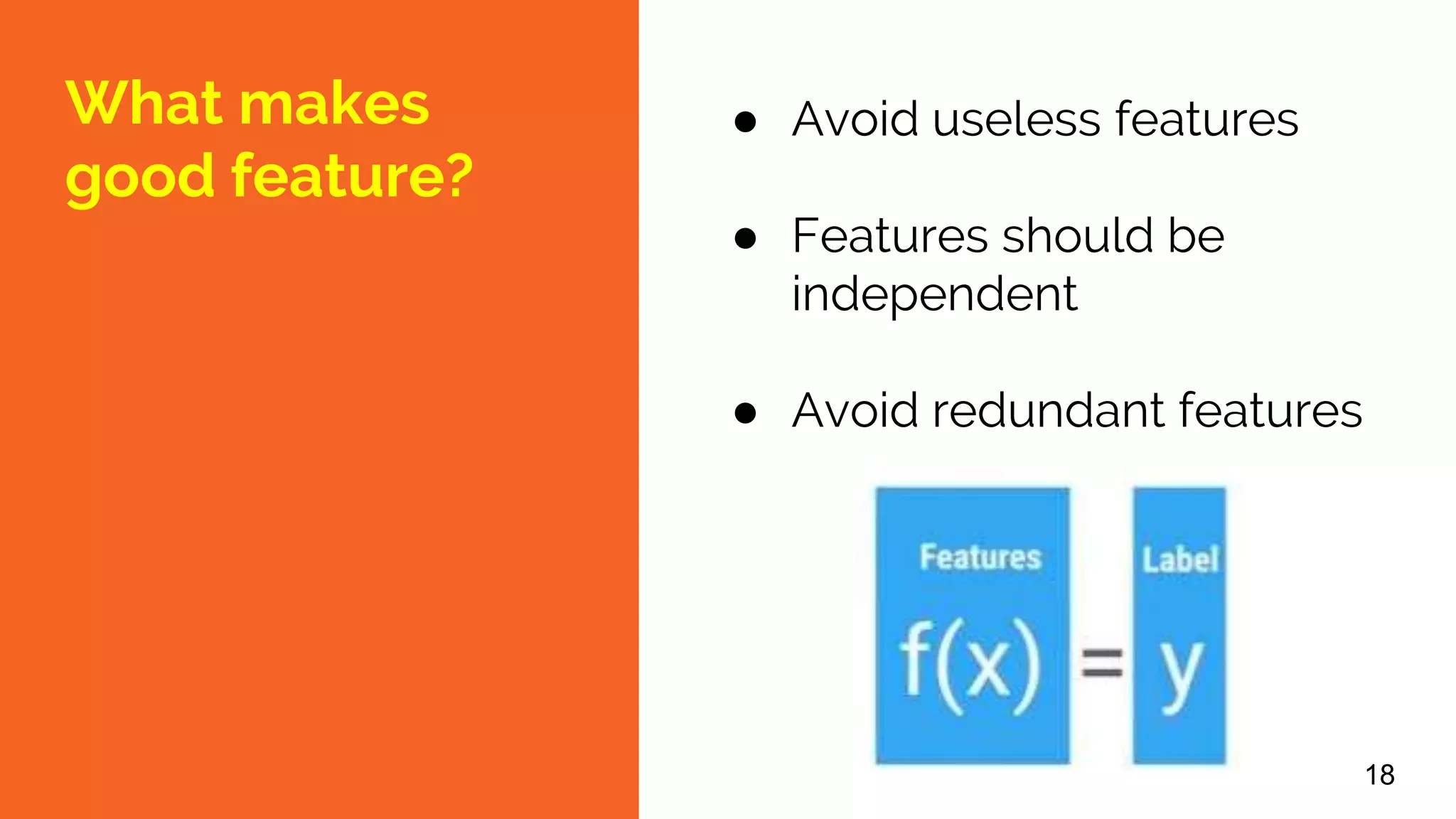
What makes
good feature?
● Avoid useless features
● Features should be
independent
● Avoid redundant features
18
19
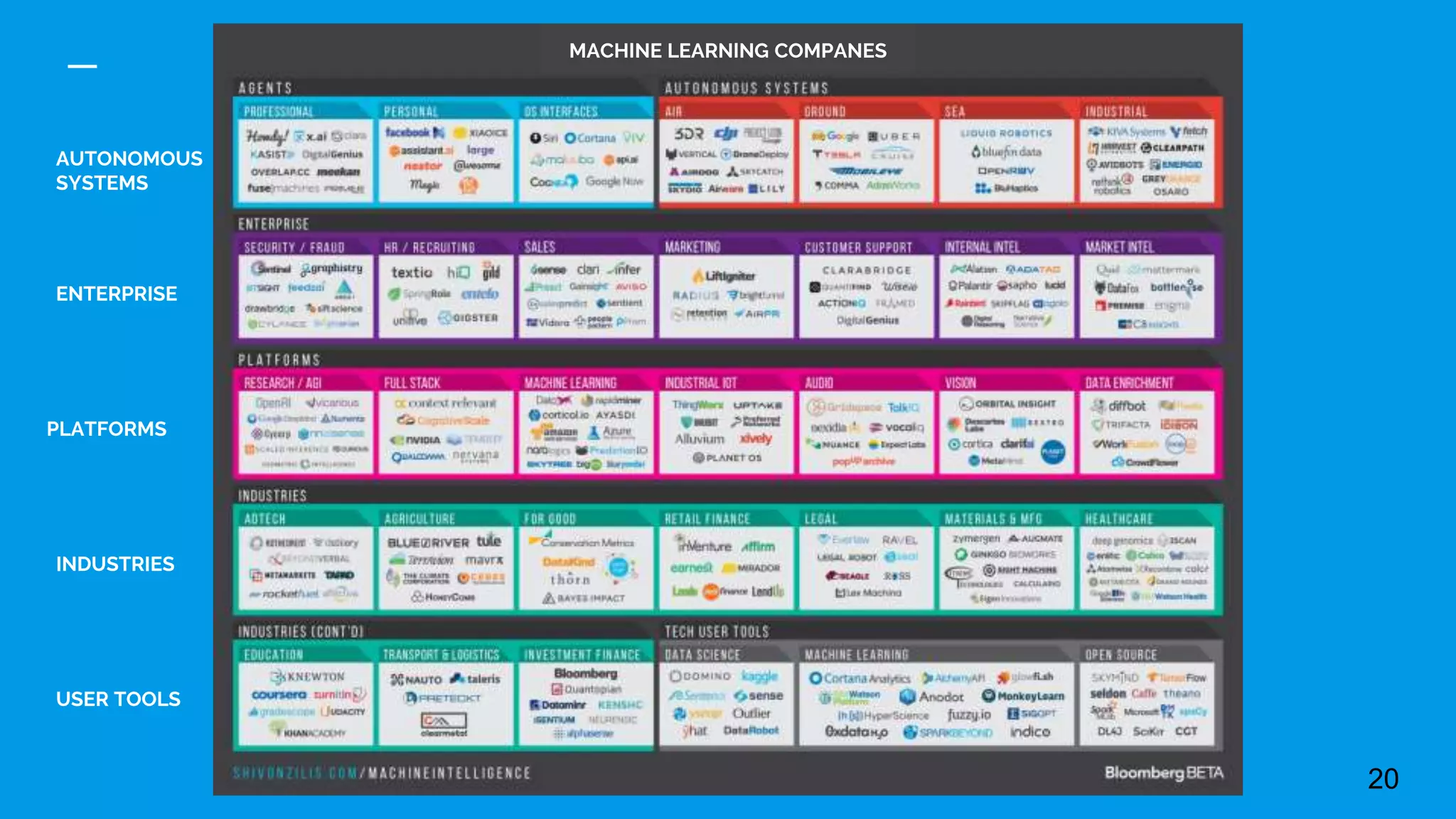
ENTERPRISE
PLATFORMS
INDUSTRIES
USER TOOLS
AUTONOMOUS
SYSTEMS
MACHINE LEARNING COMPANES
20
DATA
MINING
PATTERN MINING
ADVERTISEMENTS
SMART DEVICES
AUTOMATION
HUMAN
FEATURE
RECOGNITION
ROBOTS
CREATIVE
INDUSTRY
and much more...21
Conclusion
22
The question is then, why isn't everybody using this great
technology yet? There are two big challenges for neural
networks right now. The first is that training deep neural
networks requires a lot of computation power, and the second
is that they require large training data sets. It can take several
days or even weeks for a powerful GPU server to train a deep
network with a dataset of millions of images.
Also, it takes a lot of trial and error to get the best training
results with many combinations of different network designs
and algorithms. Today, some researchers use tens of GPU
servers or even supercomputers to perform large-scale
distributed training.
References
23
1. Kaz Sato (Google Inc.), "Understanding neural networks with
TensorFlow Playground", in Google Cloud Platform, 2016. [Online].
Available: https://goo.gl/HRZaX5. Accessed: Aug. 31, 2016.
2. A.Geitgey, "Machine learning is fun!," in Medium, Medium, 2014.
[Online]. Available: http://goo.gl/z8cF7N. Accessed: Aug. 31, 2016.
3. "Machine learning," in Wikipedia, Wikimedia Foundation, 2016.
[Online]. Available: https://en.wikipedia.org/wiki/Machine_learning.
Accessed: Aug. 31, 2016.
4. Udacity, "Intro to machine learning," in YouTube, YouTube, 2015.
[Online]. Available: http://goo.gl/8TvyJx. Accessed: Aug. 31, 2016.
Thank You!
24

Machine learning

  • 1.
    Presented by Siddharth SatyajitKar 1341012069 | CSE Section D Guided by Asst. Prof. Rashmita Routray Machine Learning 1
  • 2.
    Contents Brief Intro toMachine Learning Types of Machine Learning How to train your computer? Decision tree Feature Classifiers and more Machine Learning in Real World Conclusion References 2
  • 3.
    A Brief Introto ML ➔ What is it? Machine learning is a subfield of computer science that evolved from the study of pattern recognition and computational learning theory in artificial intelligence. ➔ Why does it matter? From email spam filter to Google’s self-driving car, it’s everywhere. It’s used in almost every industry today. ➔ How can to do it? A computer program is said to learn from experience E with respect to some class of tasks T and performance measure P if its performance at tasks in T, as measured by P, improves with experience E. 3
  • 4.
    Types of MachineLearning Supervised Learning Unsupervised Learning Reinforcement Learning The computer is presented with example inputs and their desired outputs, given by a "teacher", and the goal is to learn a general rule that maps inputs to outputs. No labels are given to the learning algorithm, leaving it on its own to find structure in its input. A computer program interacts with a dynamic environment in which it must perform a certain goal (such as driving a vehicle), without a teacher explicitly telling it whether it has come close to its goal. 4
  • 5.
    Approaches of MachineLearning ● Decision tree learning Decision tree learning uses a decision tree as a predictive model, which maps observations about an item to conclusions about the item's target value. ● Association rule learning Association rule learning is a method for discovering interesting relations between variables in large databases. ● Artificial neural networks An artificial neural network (ANN) learning algorithm, usually called "neural network" (NN), is a learning algorithm that is inspired by the structure and functional aspects of biological neural networks. ● Deep Learning Falling hardware prices and the development of GPUs for personal use in the last few years have contributed to the development of the concept of Deep learning which consists of multiple hidden layers in an artificial neural network. 5
  • 6.
    ● Genetic algorithms Agenetic algorithm (GA) is a search heuristic that mimics the process of natural selection, and uses methods such as mutation and crossover to generate new genotype in the hope of finding good solutions to a given problem. In machine learning, genetic algorithms found some uses in the 1980s and 1990s. Vice versa, machine learning techniques have been used to improve the performance of genetic and evolutionary algorithms. ● Bayesian Network A Bayesian network, belief network or directed acyclic graphical model is a probabilistic graphical model that represents a set of random variables and their conditional independencies via a directed acyclic graph (DAG). ● Inductive logic programming Inductive logic programming (ILP) is an approach to rule learning using logic programming as a uniform representation for input examples, background knowledge, and hypotheses. 6
  • 7.
    How to trainyour computer? Tip Don’t wait till the end of the presentation to give the bottom line. Reveal your product or idea (in this case a translation app) up front. 7
  • 8.
  • 9.
    Classifier It is afunction that takes data as input and assigns a label to it as an output. Technique to write the classifier is SUPERVISED LEARNING. 9
  • 10.
    Feature s A decision treeis a decision support tool that uses a tree-like graph or model of decisions and their possible consequences, including chance event outcomes, resource costs, and utility. It is one way to display an algorithm. A training set is a set of data used to discover potentially predictive relationships. A test set is a set of data used to assess the strength and utility of a predictive relationship. 10
  • 11.
  • 12.
    For example let’sconsider: Iris Data Set The Iris flower data set or Fisher's Iris data set is a multivariate data set introduced by Ronald Fisher in his 1936 paper The use of multiple measurements in taxonomic problems as an example of linear discriminant analysis. The data set consists of 50 samples from each of three species of Iris (Iris setosa, Iris virginica and Iris versicolor). Four features were measured from each sample: the length and the width of the sepals and petals, in centimetres. Based on the combination of these four features, Fisher developed a linear discriminant model to distinguish the species from each other. 12
  • 13.
  • 14.
  • 15.
  • 16.
    Decision tree forthe Iris dataset based on what was feeded 16
  • 17.
  • 18.
    What makes good feature? ●Avoid useless features ● Features should be independent ● Avoid redundant features 18
  • 19.
  • 20.
  • 21.
  • 22.
    Conclusion 22 The question isthen, why isn't everybody using this great technology yet? There are two big challenges for neural networks right now. The first is that training deep neural networks requires a lot of computation power, and the second is that they require large training data sets. It can take several days or even weeks for a powerful GPU server to train a deep network with a dataset of millions of images. Also, it takes a lot of trial and error to get the best training results with many combinations of different network designs and algorithms. Today, some researchers use tens of GPU servers or even supercomputers to perform large-scale distributed training.
  • 23.
    References 23 1. Kaz Sato(Google Inc.), "Understanding neural networks with TensorFlow Playground", in Google Cloud Platform, 2016. [Online]. Available: https://goo.gl/HRZaX5. Accessed: Aug. 31, 2016. 2. A.Geitgey, "Machine learning is fun!," in Medium, Medium, 2014. [Online]. Available: http://goo.gl/z8cF7N. Accessed: Aug. 31, 2016. 3. "Machine learning," in Wikipedia, Wikimedia Foundation, 2016. [Online]. Available: https://en.wikipedia.org/wiki/Machine_learning. Accessed: Aug. 31, 2016. 4. Udacity, "Intro to machine learning," in YouTube, YouTube, 2015. [Online]. Available: http://goo.gl/8TvyJx. Accessed: Aug. 31, 2016.
  • 24.