Working with Pupils
A Guide for Teachers
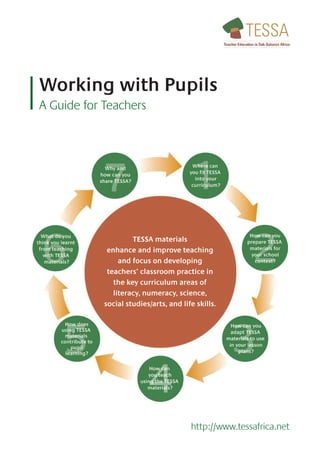
TESSA materials
enhance and improve teaching
and focus on developing
teachers’ classroom practice in
the key curriculum areas of
literacy, numeracy, science,
social studies/arts, and life skills.
http://www.tessafrica.net
2
TESSA WORKING WITH PUPILS
TESSA: Working with pupils
About this guide
This guide aims to support teachers to use TESSA materials and activities
in their classrooms.
TESSA materials enhance and improve teaching and focus on developing
teachers’ classroom practice in the key curriculum areas of literacy,
life skills.
Please use available space within this book to scribble notes.
AGUIDEFORTEACHERSS
TESSA WORKING WITH PUPILS
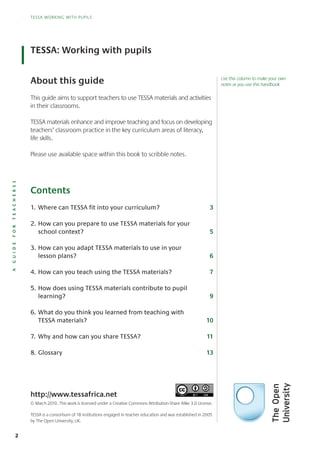
Contents
1. Where can TESSA fit into your curriculum? 3
2. How can you prepare to use TESSA materials for your
school context? 5
3. How can you adapt TESSA materials to use in your
lesson plans? 6
4. How can you teach using the TESSA materials? 7
5. How does using TESSA materials contribute to pupil
learning? 9
6. What do you think you learned from teaching with
TESSA materials? 10
7. Why and how can you share TESSA? 11
8. Glossary 13
http://www.tessafrica.net
© March 2010. This work is licensed under a Creative Commons Attribution-Share Alike 3.0 LIcense.
TESSA is a consortium of 18 institutions engaged in teacher education and was established in 2005
by The Open University, UK.
Use this column to make your own
notes as you use this handbook
3
TESSA WORKING WITH PUPILS
AGUIDEFORTEACHERS
1. Where can you fit TESSA into your curriculum?
TESSA materials aim to enhance and improve teaching. They
focus on developing teachers’ classroom practice in the key
curriculum areas of literacy, numeracy, science, social studies/
arts, and life skills. The TESSA materials are all ‘Open
Educational Resources’ (OERs), this means these materials can
be freely downloaded, adapted, translated and integrated
with other materials at no cost.
There are seventy-five sections organised in three modules in each of the
five module areas shown in Table 1 below. More detail on the content
of each module is found on the TESSA website by clicking on ‘Getting
Started’ in the left-hand navigation bar, and then clicking on ‘Curriculum
Overview’.
‘Key Resources’ can also be found on the TESSA website under your country
area. These include ideas for teaching techniques such as brainstorming
as well as advice on how to cope with specific issues like large classes.
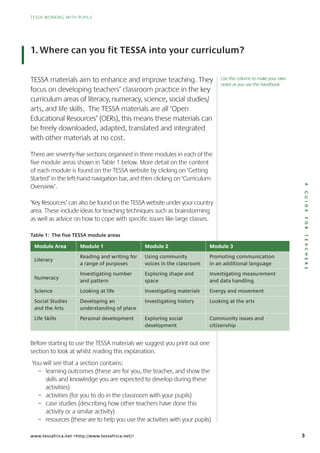
Table 1: The five TESSA module areas
Module Area
Literacy
Numeracy
Science
Social Studies
and the Arts
Life Skills
Module 1
Reading and writing for
a range of purposes
Investigating number
and pattern
Looking at life
Developing an
understanding of place
Personal development
Module 2
Using community
voices in the classroom
Exploring shape and
space
Investigating materials
Investigating history
Exploring social
development
Module 3
Promoting communication
in an additional language
Investigating measurement
and data handling
Energy and movement
Looking at the arts
Community issues and
citizenship
Before starting to use the TESSA materials we suggest you print out one
section to look at whilst reading this explanation.
You will see that a section contains:
– learning outcomes (these are for you, the teacher, and show the
skills and knowledge you are expected to develop during these
activities)
– activities (for you to do in the classroom with your pupils)
– case studies (describing how other teachers have done this
activity or a similar activity)
– resources (these are to help you use the activities with your pupils)
www.tessafrica.net <http://www.tessafrica.net/>
Use this column to make your own
notes as you use this handbook
TESSA WORKING WITH PUPILS
4 www.tessafrica.net <http://www.tessafrica.net/>
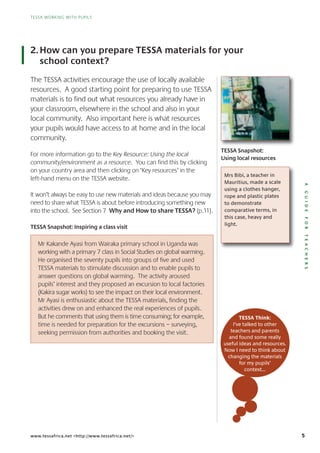
Mrs Jenestar Wanjiru, an
upper primary school
teacher in Kenya,
realised that her learners
were not performing
well in creative writing.
“After going through
the TESSA Literacy
Module 1 Section 5:
Ways of Becoming a
Critical Reader and
Writer, I found a suitable
solution and tried it.
It’s working.
”
TESSA Think:
Now I know where
the TESSA materials
fit into my curriculum,
but I need to think about
preparing the materials
for my classroom
context...
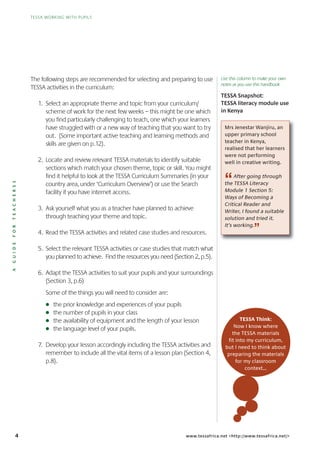
The following steps are recommended for selecting and preparing to use
TESSA activities in the curriculum:
1. Select an appropriate theme and topic from your curriculum/
scheme of work for the next few weeks – this might be one which
you find particularly challenging to teach, one which your learners
have struggled with or a new way of teaching that you want to try
out. (Some important active teaching and learning methods and
skills are given on p.12).
2. Locate and review relevant TESSA materials to identify suitable
sections which match your chosen theme, topic or skill. You might
find it helpful to look at the TESSA Curriculum Summaries (in your
country area, under ‘Curriculum Overview’) or use the Search
facility if you have internet access.
3. Ask yourself what you as a teacher have planned to achieve
through teaching your theme and topic.
4. Read the TESSA activities and related case studies and resources.
5. Select the relevant TESSA activities or case studies that match what
you planned to achieve. Find the resources you need (Section 2, p.5).
6. Adapt the TESSA activities to suit your pupils and your surroundings
(Section 3, p.6)
Some of the things you will need to consider are:
G the prior knowledge and experiences of your pupils
G the number of pupils in your class
G the availability of equipment and the length of your lesson
G the language level of your pupils.
7. Develop your lesson accordingly including the TESSA activities and
remember to include all the vital items of a lesson plan (Section 4,
p.8).
TESSA Snapshot:
TESSA literacy module use
in Kenya
AGUIDEFORTEACHERSS
Use this column to make your own
notes as you use this handbook
5
AGUIDEFORTEACHERS
TESSA WORKING WITH PUPILS
www.tessafrica.net <http://www.tessafrica.net/>
2.How can you prepare TESSA materials for your
school context?
The TESSA activities encourage the use of locally available
resources. A good starting point for preparing to use TESSA
materials is to find out what resources you already have in
your classroom, elsewhere in the school and also in your
local community. Also important here is what resources
your pupils would have access to at home and in the local
community.
For more information go to the Key Resource: Using the local
community/environment as a resource. You can find this by clicking
on your country area and then clicking on ‘Key resources’ in the
left-hand menu on the TESSA website.
It won’t always be easy to use new materials and ideas because you may
need to share what TESSA is about before introducing something new
into the school. See Section 7 Why and How to share TESSA? (p.11).
TESSA Snapshot: Inspiring a class visit
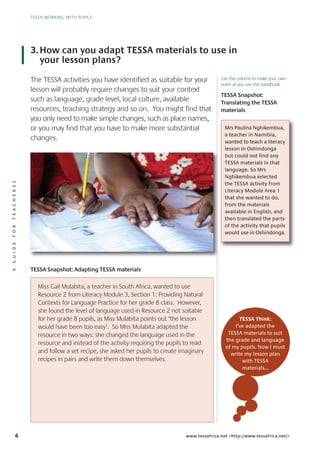
Mrs Bibi, a teacher in
Mauritius, made a scale
using a clothes hanger,
rope and plastic plates
to demonstrate
comparative terms, in
this case, heavy and
light.
TESSA Think:
I’ve talked to other
teachers and parents
and found some really
useful ideas and resources.
Now I need to think about
changing the materials
for my pupils’
context…
Mr Kakande Ayasi from Wairaka primary school in Uganda was
working with a primary 7 class in Social Studies on global warming.
He organised the seventy pupils into groups of five and used
TESSA materials to stimulate discussion and to enable pupils to
answer questions on global warming. The activity aroused
pupils’ interest and they proposed an excursion to local factories
(Kakira sugar works) to see the impact on their local environment.
Mr Ayasi is enthusiastic about the TESSA materials, finding the
activities drew on and enhanced the real experiences of pupils.
But he comments that using them is time consuming; for example,
time is needed for preparation for the excursions – surveying,
seeking permission from authorities and booking the visit.
TESSA Snapshot:
Using local resources
6
TESSA WORKING WITH PUPILS
AGUIDEFORTEACHERSS
TESSA WORKING WITH PUPILS
www.tessafrica.net <http://www.tessafrica.net/>
The TESSA activities you have identified as suitable for your
lesson will probably require changes to suit your context
such as language, grade level, local culture, available
resources, teaching strategy and so on. You might find that
you only need to make simple changes, such as place names,
or you may find that you have to make more substantial
changes.
3.How can you adapt TESSA materials to use in
your lesson plans?
Miss Gail Mulabita, a teacher in South Africa, wanted to use
Resource 2 from Literacy Module 3, Section 1: Providing Natural
Contexts for Language Practice for her grade 8 class. However,
she found the level of language used in Resource 2 not suitable
for her grade 8 pupils, as Miss Mulabita points out ‘the lesson
would have been too easy’. So Miss Mulabita adapted the
resource in two ways: she changed the language used in the
resource and instead of the activity requiring the pupils to read
and follow a set recipe, she asked her pupils to create imaginary
recipes in pairs and write them down themselves.
TESSA Think:
I’ve adapted the
TESSA materials to suit
the grade and language
of my pupils. Now I must
write my lesson plan
with TESSA
materials…
TESSA Snapshot:
Translating the TESSA
materials
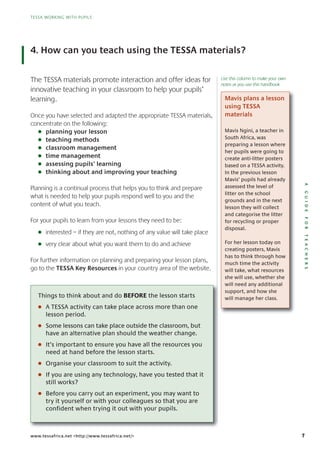
Mrs Paulina Nghikembua,
a teacher in Namibia,
wanted to teach a literacy
lesson in Oshindonga
but could not find any
TESSA materials in that
language. So Mrs
Nghikembua selected
the TESSA activity from
Literacy Module Area 1
that she wanted to do,
from the materials
available in English, and
then translated the parts
of the activity that pupils
would use in Oshindonga.
TESSA Snapshot: Adapting TESSA materials
Use this column to make your own
notes as you use this handbook
7
TESSA WORKING WITH PUPILS
AGUIDEFORTEACHERS
TESSA WORKING WITH PUPILS
www.tessafrica.net <http://www.tessafrica.net/>
4. How can you teach using the TESSA materials?
The TESSA materials promote interaction and offer ideas for
innovative teaching in your classroom to help your pupils’
learning.
Once you have selected and adapted the appropriate TESSA materials,
concentrate on the following:
G planning your lesson
G teaching methods
G classroom management
G time management
G assessing pupils’ learning
G thinking about and improving your teaching
Planning is a continual process that helps you to think and prepare
what is needed to help your pupils respond well to you and the
content of what you teach.
For your pupils to learn from your lessons they need to be:
G interested – if they are not, nothing of any value will take place
G very clear about what you want them to do and achieve
For further information on planning and preparing your lesson plans,
go to the TESSA Key Resources in your country area of the website.
Mavis plans a lesson
using TESSA
materials
Things to think about and do BEFORE the lesson starts
G A TESSA activity can take place across more than one
lesson period.
G Some lessons can take place outside the classroom, but
have an alternative plan should the weather change.
G It’s important to ensure you have all the resources you
need at hand before the lesson starts.
G Organise your classroom to suit the activity.
G If you are using any technology, have you tested that it
still works?
G Before you carry out an experiment, you may want to
try it yourself or with your colleagues so that you are
confident when trying it out with your pupils.
Mavis Ngini, a teacher in
South Africa, was
preparing a lesson where
her pupils were going to
create anti-litter posters
based on a TESSA activity.
In the previous lesson
Mavis’ pupils had already
assessed the level of
litter on the school
grounds and in the next
lesson they will collect
and categorise the litter
for recycling or proper
disposal.
For her lesson today on
creating posters, Mavis
has to think through how
much time the activity
will take, what resources
she will use, whether she
will need any additional
support, and how she
will manage her class.
Use this column to make your own
notes as you use this handbook
8
TESSA WORKING WITH PUPILS
AGUIDEFORTEACHERSS
TESSA WORKING WITH PUPILS
www.tessafrica.net <http://www.tessafrica.net/>
The TESSA materials promote activity-based learning, however, as a
teacher you need to remain involved throughout the lesson, even
when your pupils are engaged in group work. For more information
on using group work in your classroom, go to the Key Resources.
Do not panic if something in your lesson does not go according to plan.
Wherever possible, during your lesson planning, create alternative
activities to ensure the success of your lesson.
Things to think about and do DURING and AFTER the
lesson
G If you involve people from outside the school in your
lessons, ensure you have an alternative plan should
they not turn up.
G Ensure that your alternative plan fits in with the
classroom arrangements already made.
G Should something unexpected happen just before or
during the lesson:
o Acknowledge the problem.
o Involve the pupils in solving the problem.
o Identify parts of the lesson plan that can still take
place.
G Ensure that you follow-up on any promises made to
the class.
TESSA Snapshot:
Facilitating small group
work
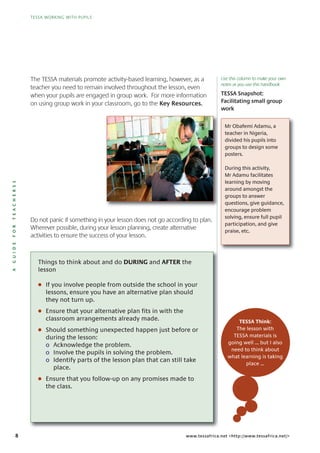
Mr Obafemi Adamu, a
teacher in Nigeria,
divided his pupils into
groups to design some
posters.
During this activity,
Mr Adamu facilitates
learning by moving
around amongst the
groups to answer
questions, give guidance,
encourage problem
solving, ensure full pupil
participation, and give
praise, etc.
TESSA Think:
The lesson with
TESSA materials is
going well … but I also
need to think about
what learning is taking
place …
Use this column to make your own
notes as you use this handbook
9
TESSA WORKING WITH PUPILS
AGUIDEFORTEACHERS
TESSA WORKING WITH PUPILS
www.tessafrica.net <http://www.tessafrica.net/>
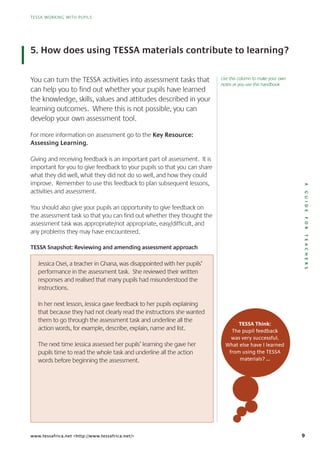
5. How does using TESSA materials contribute to learning?
You can turn the TESSA activities into assessment tasks that
can help you to find out whether your pupils have learned
the knowledge, skills, values and attitudes described in your
learning outcomes. Where this is not possible, you can
develop your own assessment tool.
For more information on assessment go to the Key Resource:
Assessing Learning.
Giving and receiving feedback is an important part of assessment. It is
important for you to give feedback to your pupils so that you can share
what they did well, what they did not do so well, and how they could
improve. Remember to use this feedback to plan subsequent lessons,
activities and assessment.
You should also give your pupils an opportunity to give feedback on
the assessment task so that you can find out whether they thought the
assessment task was appropriate/not appropriate, easy/difficult, and
any problems they may have encountered.
TESSA Snapshot: Reviewing and amending assessment approach
Jessica Osei, a teacher in Ghana, was disappointed with her pupils’
performance in the assessment task. She reviewed their written
responses and realised that many pupils had misunderstood the
instructions.
In her next lesson, Jessica gave feedback to her pupils explaining
that because they had not clearly read the instructions she wanted
them to go through the assessment task and underline all the
action words, for example, describe, explain, name and list.
The next time Jessica assessed her pupils’ learning she gave her
pupils time to read the whole task and underline all the action
words before beginning the assessment.
TESSA Think:
The pupil feedback
was very successful.
What else have I learned
from using the TESSA
materials? …
Use this column to make your own
notes as you use this handbook
10
TESSA WORKING WITH PUPILS
AGUIDEFORTEACHERSS
TESSA WORKING WITH PUPILS
www.tessafrica.net <http://www.tessafrica.net/>
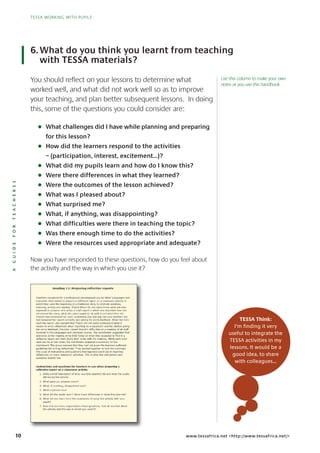
You should reflect on your lessons to determine what
worked well, and what did not work well so as to improve
your teaching, and plan better subsequent lessons. In doing
this, some of the questions you could consider are:
G What challenges did I have while planning and preparing
for this lesson?
G How did the learners respond to the activities
– (participation, interest, excitement...)?
G What did my pupils learn and how do I know this?
G Were there differences in what they learned?
G Were the outcomes of the lesson achieved?
G What was I pleased about?
G What surprised me?
G What, if anything, was disappointing?
G What difficulties were there in teaching the topic?
G Was there enough time to do the activities?
G Were the resources used appropriate and adequate?
Now you have responded to these questions, how do you feel about
the activity and the way in which you use it?
6.What do you think you learnt from teaching
with TESSA materials?
TESSA Think:
I’m finding it very
useful to integrate the
TESSA activities in my
lessons. It would be a
good idea, to share
with colleagues…
Use this column to make your own
notes as you use this handbook
11
TESSA WORKING WITH PUPILS
AGUIDEFORTEACHERS
TESSA WORKING WITH PUPILS
www.tessafrica.net <http://tessafrica.net/>
7. Why and how you can Share TESSA?
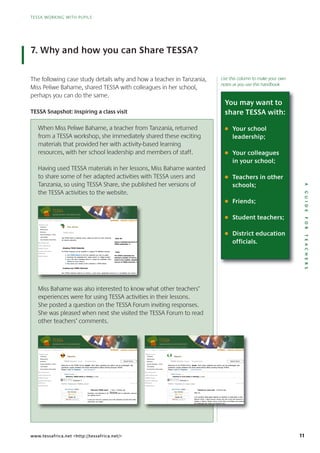
When Miss Peliwe Bahame, a teacher from Tanzania, returned
from a TESSA workshop, she immediately shared these exciting
materials that provided her with activity-based learning
resources, with her school leadership and members of staff.
Having used TESSA materials in her lessons, Miss Bahame wanted
to share some of her adapted activities with TESSA users and
Tanzania, so using TESSA Share, she published her versions of
the TESSA activities to the website.
Miss Bahame was also interested to know what other teachers’
experiences were for using TESSA activities in their lessons.
She posted a question on the TESSA Forum inviting responses.
She was pleased when next she visited the TESSA Forum to read
other teachers’ comments.
Home >> Pan Africa >> TESSA Share
Module Area
Literacy
Numeracy
Science
Social Studies / Arts
Life Skills
Curriculum Overview
Key Resources
Audio Resources
TESSA Forum
Teacher Educator
Guidance
TESSA Share
Pan Africa
TESSA Share
Use TESSA Share to explore, share, adapt and add your own resources
for teacher education.
View All
Explore materials shared by the
TESSA community >>
Adapting TESSA Materials
All TESSA materials can be modified or adapted for different contexts.
Use TESSA Search to find the materials you wish to adapt.
Download the materials from ‘Adapt section’ or ‘Adapt module’.
Use a MS Word compliant editor to change the materials. (See
TOOLS for more advice)
Now share your version of the materials in TESSA Share.
Tools
The TESSA community has
selected a number of tools to
assist in the creation, adaptation
and use of TESSA materials >>
Creating new TESSA Materials
New TESSA materials could be an activity, a case study, supporting resources or a completely new section. Use
t
Home >> AfricaPan TESSA>> ShareTESSA
Area
Literacy
Numeracy
Science
Arts
Skills
Overview
Resources
Module
/StudiesSocial
Life
Curriculum
Key
Africa
Share
Pan
Share
TESSA
TESSAUse explore,to
education.teacherfor
addandadaptshare,explore, ownyour own All
materials
resources View
Explore
communityTESSA
thbysharedmaterials
community >>
Resources
Forum
Educator
Share
Audio
TESSA
Teacher
Guidance
TESSA
be
MaterialsTESSAAdapting
canmaterialsTESSAAll
Use SearchTESSA
Download materialsthe
Use compliantWordMSa
TOOLS morefor
versionyourshareNow
different
Materials
foradaptedormodifiedbe
Search wishyoumaterialsthefindto
frommaterials ‘Adapt ‘Adaptorsection’
materials.thechangetoeditorcompliant
advice)
Share.TESSAinmaterialstheofversion
contexts.
community
Tools
community
TESSA
different
to adapt.
module’.‘Adapt
(Seematerials.
Share.
TESSAThe
numberaselected
creation,theinassist
TESSAofuseand
community
has
>>
community
totoolsofnumber
adaptationcreation,
>>materialsTESSA
could
TESSAnewCreating
materialsTESSANew supporting
MaterialsTESSA
study,caseaactivity,anbecould completely
S
aorresourcessupporting
s
Usection.newcompletely
y
T M
>
Forum Threaded View
TOPIC: Welcome, TESSA users!
Home >> Uganda >> TESSA Forum
Module Area
Literacy
Numeracy
Science
Social Studies / Arts
Life Skills
Curriculum Overview
Key Resources
Audio Resources
TESSA Forum
Teacher Educator
Guidance
TESSA Share
Uganda
TESSA Forums
Welcome to the TESSA Forum, Guest. Here ideas, opinions and advice can be exchanged. Ask
questions, supply answers and share observations about working through TESSA.
Please Login or Register. Lost Password?
TESSA Forums
Welcome, TESSA users! (1 viewing) (1) Guest
Favoured: 0
#
Welcome, TESSA users! 1 Year, 2 Months ago
Logged
Search Forum
AlisonBuckler (User)
New Member
Posts: 15
Greetings, and welcome to the TESSA site! In particular, welcome to
the Uganda forum!
I hope you have fun exploring all of the materials and find them both
informative and useful.
W
Forum Tools
Home >> Uganda TESSA>> ForumTESSA
Area
Literacy
Numeracy
Science
Arts
Skills
Overview
Resources
Module
/StudiesSocial
Life
Curriculum
Key
Uganda
Forum
TESSA
Forums
ForumsTESSA
thetoWelcome
answerssupplyquestions,
Please Login or Register
TESSA
Forum
Forum,
ViewThreaded
Guest opinionsideas,Here.
aboutobservationsshareandanswers
Register. ?PasswordLost
exchanged.
e
becanadviceandopinions
TESSA.throughworkingabout
S
Ask
m
exchanged.
uroFhcar
Resources
Forum
Educator
Share
Audio
TESSA
Teacher
Guidance
TESSA
Forums
users!
TOPIC:
AlisonBuckler
TESSAWelcome,
TESSA
TESSAWelcome,
Favoured:
Member
15
(User)
New
Posts:
Favoured:
users!
users!TESSA
viewing)(1 Guest(1)
0
welcome
TESSAWelcome,
andGreetings,
forum!Ugandathe
agousers!TESSA Months2Year,1
thetowelcome TESSA particular,Insite! welcomeparticular,
TooForum
15Posts:
funhaveyouhopeI
useful.andinformative
andmaterialstheofallexploring
useful.
boththemfind
Forum Threaded View
TOPIC: Teachers in rural areas
Home >> Nigeria >> TESSA Forum
Module Area
Literacy
Numeracy
Science
Social Studies / Arts
Life Skills
Curriculum Overview
Key Resources
Audio Resources
TESSA Forum
Teacher Educator
Guidance
TESSA Share
Nigeria
TESSA Forums
Welcome to the TESSA Forum, Guest. Here ideas, opinions and advice can be exchanged. Ask
questions, supply answers and share observations about working through TESSA.
Please Login or Register. Lost Password?
TESSA Forums
Teachers in rural areas (1 viewing) (1) Guest
Favoured: 0
#
Teachers in rural areas 8 Months ago
Logged
Search Forum
AlisonBuckler (User)
New Member
Posts: 15
Hello all.
I am currently doing some research on teachers in rural areas in Sub-
Saharan Africa. I spent several months last year living with teachers in
villages in Nigeria, Ghana, Kenya, South Africa and Sudan, and understand
the challenges that many rural teachers face.
I have recently come across two very different articles.
O
Forum Tools
Home >> Nigeria TESSA>> ForumTESSA
Area
Literacy
Numeracy
Science
Arts
Skills
Overview
Resources
Module
/StudiesSocial
Life
Curriculum
Key
Nigeria
Forum
TESSA
Forums
ForumsTESSA
thetoWelcome
answerssupplyquestions,
Please Login or Register
TESSA
Forum
Forum,
ViewThreaded
Guest opinionsideas,Here.
aboutobservationsshareandanswers
Register. ?PasswordLost
exchanged.
e
becanadviceandopinions
TESSA.throughworkingabout
S
Ask
m
exchanged.
uroFhcar
Resources
Forum
Educator
Share
Audio
TESSA
Teacher
Guidance
TESSA
Forums
areas
TOPIC:
AlisonBuckler
ruralinTeachers
TESSA
ruralinTeachers
Favoured:
Member
15
(User)
New
Posts:
Favoured:
areas
areasrural
viewing)(1 Guest(1)
0
all.
ruralinTeachers
Hello
somedoingcurrentlyamI
agoareasrural Months8
ruralinteachersonresearchsome Sub
#
inareasrural
ToolsForum
15Posts: somedoingcurrentlyamI
spentIAfrica.Saharan
Ghana,Nigeria,invillages
manythatchallengesthe
c
ruralinteachersonresearchsome
livingyearlastmonthsseveralspent
Sudan,andAfricaSouthKenya,Ghana,
face.teachersruralmany
a
-Subinareasrural
inteacherswith
understandandSudan,
a
You may want to
share TESSA with:
G Your school
leadership;
G Your colleagues
in your school;
G Teachers in other
schools;
G Friends;
G Student teachers;
G District education
officials.
The following case study details why and how a teacher in Tanzania,
Miss Peliwe Bahame, shared TESSA with colleagues in her school,
perhaps you can do the same.
TESSA Snapshot: Inspiring a class visit
Use this column to make your own
notes as you use this handbook
12
TESSA WORKING WITH PUPILS
AGUIDEFORTEACHERSS
TESSA WORKING WITH PUPILS
www.tessafrica.net <http://www.tessafrica.net/>
S/N Active teaching and Some of the teaching skills you need
learning methods
1. Building models Thinking about what your pupils will learn.
Being able to build the model yourself.
2. Classification Using observation.
3. Collaborative activities Knowing your pupils to decide on working groups.
5. Debate Giving all pupils an opportunity to participate.
6. Demonstration Identifying what you will use to demonstrate.
Allowing pupils to handle, draw and discuss.
7. Discussion Giving all pupils an opportunity to participate.
8. Displaying real items Organising your classroom or exhibition space.
(exhibitions) Thinking how pupils can share their knowledge e.g. labels.
9. Games Thinking about what your pupils will learn.
Being able to play the game yourself.
10. Group work Arranging your classroom in advance.
Deciding how to divide your pupils.
Deciding on a job for each pupil in the group.
11. Investigation/inquiry Planning the investigation/inquiry with your pupils.
Deciding how pupils will report.
12. Making deductions Helping pupils to discover for themselves.
13. Mind mapping/ Identifying clearly the issue or problem.
brainstorming Letting pupils know the rules.
Giving a clear summary at the end.
14. Observation/identification Using local resources.
Using questioning.
15. Prediction Helping pupils form appropriate questions.
16. Problem solving Setting out the problem clearly.
Identifying in advance areas of difficulty.
Thinking of questions which will help pupils.
17. Project method Using group work.
Helping pupils discover and think for themselves.
18. Questioning Thinking about the type of question – open or closed.
Encouraging a range of pupils to answer.
Encouraging pupils to think for themselves.
19. Reporting/oral presentation Using a variety of ways – oral, posters, etc.
20. Researching/exploration Defining the research question.
Deciding on the research method.
Deciding on how the findings will be recorded.
21. Role play Using group work.
Thinking about where the groups will work – inside or outside of
the classroom.
22. Simulation Giving pupils a clear brief.
23. Story telling/folk tales Identifying where you can find local and other stories.
Using different people to tell stories – you, pupils and local people.
24. Student field work Planning.
Setting clear learning objectives for pupils.
Using investigations.
25. Think-pair-share Using good time management.
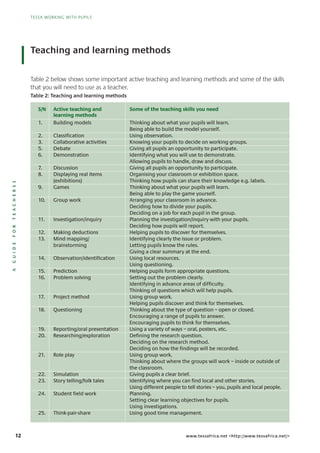
Table 2 below shows some important active teaching and learning methods and some of the skills
that you will need to use as a teacher.
Table 2: Teaching and learning methods
Teaching and learning methods
13
TESSA WORKING WITH PUPILS
AGUIDEFORTEACHERS
TESSA WORKING WITH PUPILS
www.tessafrica.net <http://www.tessafrica.net/>
Assessment: Finding out what pupils have learned and using this
knowledge to help you plan the next step in their learning. You can
use TESSA materials as assessment activities.
Formative assessment is finding out whether pupils are learning the
knowledge and skills you want them to by asking questions as you go
along and showing pupils how they can improve.
Summative assessment is usually done in the form of tests and marks
and gives a pupil a grade at the end of a unit of work.
Attitudes: How a person or group of people thinks about an issue.
Attitudes can be positive or negative.
Classroom management: Organising and running your classroom
to support the learning of all the pupils in your class.
Community: People who live, work or study together. Your school
community includes the pupils, teachers, head teacher and parents.
Everyone who uses TESSA materials is another community.
Curriculum: The knowledge, understanding, skills and attitudes that
you teach your pupils. TESSA materials help you to teach this
curriculum to your pupils.
Facilitating learning: Good teachers facilitate or guide the learning
of their pupils and build their understanding. Good teachers are not
limited to passing on information. A teacher would help pupils to
actively participate in class, they might do this by moving around and
assisting groups of pupils rather than standing at the front of the
classroom.
Feedback: You give pupils feedback by telling them what they have
done well or how to improve. Pupils can give you feedback on a lesson.
Grade level: The educational level of a pupil or group of pupils.
Group work: Organising pupils into smaller groups (from 3–12 pupils)
to work together on a task.
Knowledge: What is known about a particular topic – the facts and
information.
8.Glossary
Use this column to make your own
notes as you use this handbook
14
TESSA WORKING WITH PUPILS
AGUIDEFORTEACHERSS
TESSA WORKING WITH PUPILS
www.tessafrica.net <http://www.tessafrica.net/>
Learner profile: The characteristics that describe what a pupil is like,
knowing your pupils’ profiles can help you adapt TESSA materials for
your class.
Learning outcomes: These say what skills and knowledge a learner
(pupil or teacher) is expected to learn at the end of a lesson or set of
activities.
Local context: The circumstances of your school – the type of area
(rural, urban) and culture of the local community.
Mediating learning: This is improving your pupils’ learning by
constructing the activities and situations which are relevant to them
and their interests and needs. Making it easier for a pupil to learn by
presenting information in a way that they can understand.
Reflection: Thinking about your experience of teaching; which
lessons and activities have gone well or badly? This helps you improve
future lessons.
Reinforcing learning: Improving your pupils’ learning by using
several different sorts of activities all on the same topic. Helping a
pupil to learn and remember something by using incentives to
encourage them.
Resources: The equipment and materials you need for your lessons –
this might include TESSA materials, books, pens, other people and
local materials such as boxes, newspapers and food containers. You
can use resources to help you teach and your pupils learn.
Use this column to make your own
notes as you use this handbook
15
TESSA WORKING WITH PUPILS
AGUIDEFORTEACHERS
TESSA WORKING WITH PUPILS
www.tessafrica.net <http://www.tessafrica.net/>
TESSA WORKING WITH PUPILS
www.tessafrica.net

Teacher Resource Guidebook - Working with Pupils

  • 1.
    Working with Pupils AGuide for Teachers TESSA materials enhance and improve teaching and focus on developing teachers’ classroom practice in the key curriculum areas of literacy, numeracy, science, social studies/arts, and life skills. http://www.tessafrica.net
  • 2.
    2 TESSA WORKING WITHPUPILS TESSA: Working with pupils About this guide This guide aims to support teachers to use TESSA materials and activities in their classrooms. TESSA materials enhance and improve teaching and focus on developing teachers’ classroom practice in the key curriculum areas of literacy, life skills. Please use available space within this book to scribble notes. AGUIDEFORTEACHERSS TESSA WORKING WITH PUPILS Contents 1. Where can TESSA fit into your curriculum? 3 2. How can you prepare to use TESSA materials for your school context? 5 3. How can you adapt TESSA materials to use in your lesson plans? 6 4. How can you teach using the TESSA materials? 7 5. How does using TESSA materials contribute to pupil learning? 9 6. What do you think you learned from teaching with TESSA materials? 10 7. Why and how can you share TESSA? 11 8. Glossary 13 http://www.tessafrica.net © March 2010. This work is licensed under a Creative Commons Attribution-Share Alike 3.0 LIcense. TESSA is a consortium of 18 institutions engaged in teacher education and was established in 2005 by The Open University, UK. Use this column to make your own notes as you use this handbook
  • 3.
    3 TESSA WORKING WITHPUPILS AGUIDEFORTEACHERS 1. Where can you fit TESSA into your curriculum? TESSA materials aim to enhance and improve teaching. They focus on developing teachers’ classroom practice in the key curriculum areas of literacy, numeracy, science, social studies/ arts, and life skills. The TESSA materials are all ‘Open Educational Resources’ (OERs), this means these materials can be freely downloaded, adapted, translated and integrated with other materials at no cost. There are seventy-five sections organised in three modules in each of the five module areas shown in Table 1 below. More detail on the content of each module is found on the TESSA website by clicking on ‘Getting Started’ in the left-hand navigation bar, and then clicking on ‘Curriculum Overview’. ‘Key Resources’ can also be found on the TESSA website under your country area. These include ideas for teaching techniques such as brainstorming as well as advice on how to cope with specific issues like large classes. Table 1: The five TESSA module areas Module Area Literacy Numeracy Science Social Studies and the Arts Life Skills Module 1 Reading and writing for a range of purposes Investigating number and pattern Looking at life Developing an understanding of place Personal development Module 2 Using community voices in the classroom Exploring shape and space Investigating materials Investigating history Exploring social development Module 3 Promoting communication in an additional language Investigating measurement and data handling Energy and movement Looking at the arts Community issues and citizenship Before starting to use the TESSA materials we suggest you print out one section to look at whilst reading this explanation. You will see that a section contains: – learning outcomes (these are for you, the teacher, and show the skills and knowledge you are expected to develop during these activities) – activities (for you to do in the classroom with your pupils) – case studies (describing how other teachers have done this activity or a similar activity) – resources (these are to help you use the activities with your pupils) www.tessafrica.net <http://www.tessafrica.net/> Use this column to make your own notes as you use this handbook
  • 4.
    TESSA WORKING WITHPUPILS 4 www.tessafrica.net <http://www.tessafrica.net/> Mrs Jenestar Wanjiru, an upper primary school teacher in Kenya, realised that her learners were not performing well in creative writing. “After going through the TESSA Literacy Module 1 Section 5: Ways of Becoming a Critical Reader and Writer, I found a suitable solution and tried it. It’s working. ” TESSA Think: Now I know where the TESSA materials fit into my curriculum, but I need to think about preparing the materials for my classroom context... The following steps are recommended for selecting and preparing to use TESSA activities in the curriculum: 1. Select an appropriate theme and topic from your curriculum/ scheme of work for the next few weeks – this might be one which you find particularly challenging to teach, one which your learners have struggled with or a new way of teaching that you want to try out. (Some important active teaching and learning methods and skills are given on p.12). 2. Locate and review relevant TESSA materials to identify suitable sections which match your chosen theme, topic or skill. You might find it helpful to look at the TESSA Curriculum Summaries (in your country area, under ‘Curriculum Overview’) or use the Search facility if you have internet access. 3. Ask yourself what you as a teacher have planned to achieve through teaching your theme and topic. 4. Read the TESSA activities and related case studies and resources. 5. Select the relevant TESSA activities or case studies that match what you planned to achieve. Find the resources you need (Section 2, p.5). 6. Adapt the TESSA activities to suit your pupils and your surroundings (Section 3, p.6) Some of the things you will need to consider are: G the prior knowledge and experiences of your pupils G the number of pupils in your class G the availability of equipment and the length of your lesson G the language level of your pupils. 7. Develop your lesson accordingly including the TESSA activities and remember to include all the vital items of a lesson plan (Section 4, p.8). TESSA Snapshot: TESSA literacy module use in Kenya AGUIDEFORTEACHERSS Use this column to make your own notes as you use this handbook
  • 5.
    5 AGUIDEFORTEACHERS TESSA WORKING WITHPUPILS www.tessafrica.net <http://www.tessafrica.net/> 2.How can you prepare TESSA materials for your school context? The TESSA activities encourage the use of locally available resources. A good starting point for preparing to use TESSA materials is to find out what resources you already have in your classroom, elsewhere in the school and also in your local community. Also important here is what resources your pupils would have access to at home and in the local community. For more information go to the Key Resource: Using the local community/environment as a resource. You can find this by clicking on your country area and then clicking on ‘Key resources’ in the left-hand menu on the TESSA website. It won’t always be easy to use new materials and ideas because you may need to share what TESSA is about before introducing something new into the school. See Section 7 Why and How to share TESSA? (p.11). TESSA Snapshot: Inspiring a class visit Mrs Bibi, a teacher in Mauritius, made a scale using a clothes hanger, rope and plastic plates to demonstrate comparative terms, in this case, heavy and light. TESSA Think: I’ve talked to other teachers and parents and found some really useful ideas and resources. Now I need to think about changing the materials for my pupils’ context… Mr Kakande Ayasi from Wairaka primary school in Uganda was working with a primary 7 class in Social Studies on global warming. He organised the seventy pupils into groups of five and used TESSA materials to stimulate discussion and to enable pupils to answer questions on global warming. The activity aroused pupils’ interest and they proposed an excursion to local factories (Kakira sugar works) to see the impact on their local environment. Mr Ayasi is enthusiastic about the TESSA materials, finding the activities drew on and enhanced the real experiences of pupils. But he comments that using them is time consuming; for example, time is needed for preparation for the excursions – surveying, seeking permission from authorities and booking the visit. TESSA Snapshot: Using local resources
  • 6.
    6 TESSA WORKING WITHPUPILS AGUIDEFORTEACHERSS TESSA WORKING WITH PUPILS www.tessafrica.net <http://www.tessafrica.net/> The TESSA activities you have identified as suitable for your lesson will probably require changes to suit your context such as language, grade level, local culture, available resources, teaching strategy and so on. You might find that you only need to make simple changes, such as place names, or you may find that you have to make more substantial changes. 3.How can you adapt TESSA materials to use in your lesson plans? Miss Gail Mulabita, a teacher in South Africa, wanted to use Resource 2 from Literacy Module 3, Section 1: Providing Natural Contexts for Language Practice for her grade 8 class. However, she found the level of language used in Resource 2 not suitable for her grade 8 pupils, as Miss Mulabita points out ‘the lesson would have been too easy’. So Miss Mulabita adapted the resource in two ways: she changed the language used in the resource and instead of the activity requiring the pupils to read and follow a set recipe, she asked her pupils to create imaginary recipes in pairs and write them down themselves. TESSA Think: I’ve adapted the TESSA materials to suit the grade and language of my pupils. Now I must write my lesson plan with TESSA materials… TESSA Snapshot: Translating the TESSA materials Mrs Paulina Nghikembua, a teacher in Namibia, wanted to teach a literacy lesson in Oshindonga but could not find any TESSA materials in that language. So Mrs Nghikembua selected the TESSA activity from Literacy Module Area 1 that she wanted to do, from the materials available in English, and then translated the parts of the activity that pupils would use in Oshindonga. TESSA Snapshot: Adapting TESSA materials Use this column to make your own notes as you use this handbook
  • 7.
    7 TESSA WORKING WITHPUPILS AGUIDEFORTEACHERS TESSA WORKING WITH PUPILS www.tessafrica.net <http://www.tessafrica.net/> 4. How can you teach using the TESSA materials? The TESSA materials promote interaction and offer ideas for innovative teaching in your classroom to help your pupils’ learning. Once you have selected and adapted the appropriate TESSA materials, concentrate on the following: G planning your lesson G teaching methods G classroom management G time management G assessing pupils’ learning G thinking about and improving your teaching Planning is a continual process that helps you to think and prepare what is needed to help your pupils respond well to you and the content of what you teach. For your pupils to learn from your lessons they need to be: G interested – if they are not, nothing of any value will take place G very clear about what you want them to do and achieve For further information on planning and preparing your lesson plans, go to the TESSA Key Resources in your country area of the website. Mavis plans a lesson using TESSA materials Things to think about and do BEFORE the lesson starts G A TESSA activity can take place across more than one lesson period. G Some lessons can take place outside the classroom, but have an alternative plan should the weather change. G It’s important to ensure you have all the resources you need at hand before the lesson starts. G Organise your classroom to suit the activity. G If you are using any technology, have you tested that it still works? G Before you carry out an experiment, you may want to try it yourself or with your colleagues so that you are confident when trying it out with your pupils. Mavis Ngini, a teacher in South Africa, was preparing a lesson where her pupils were going to create anti-litter posters based on a TESSA activity. In the previous lesson Mavis’ pupils had already assessed the level of litter on the school grounds and in the next lesson they will collect and categorise the litter for recycling or proper disposal. For her lesson today on creating posters, Mavis has to think through how much time the activity will take, what resources she will use, whether she will need any additional support, and how she will manage her class. Use this column to make your own notes as you use this handbook
  • 8.
    8 TESSA WORKING WITHPUPILS AGUIDEFORTEACHERSS TESSA WORKING WITH PUPILS www.tessafrica.net <http://www.tessafrica.net/> The TESSA materials promote activity-based learning, however, as a teacher you need to remain involved throughout the lesson, even when your pupils are engaged in group work. For more information on using group work in your classroom, go to the Key Resources. Do not panic if something in your lesson does not go according to plan. Wherever possible, during your lesson planning, create alternative activities to ensure the success of your lesson. Things to think about and do DURING and AFTER the lesson G If you involve people from outside the school in your lessons, ensure you have an alternative plan should they not turn up. G Ensure that your alternative plan fits in with the classroom arrangements already made. G Should something unexpected happen just before or during the lesson: o Acknowledge the problem. o Involve the pupils in solving the problem. o Identify parts of the lesson plan that can still take place. G Ensure that you follow-up on any promises made to the class. TESSA Snapshot: Facilitating small group work Mr Obafemi Adamu, a teacher in Nigeria, divided his pupils into groups to design some posters. During this activity, Mr Adamu facilitates learning by moving around amongst the groups to answer questions, give guidance, encourage problem solving, ensure full pupil participation, and give praise, etc. TESSA Think: The lesson with TESSA materials is going well … but I also need to think about what learning is taking place … Use this column to make your own notes as you use this handbook
  • 9.
    9 TESSA WORKING WITHPUPILS AGUIDEFORTEACHERS TESSA WORKING WITH PUPILS www.tessafrica.net <http://www.tessafrica.net/> 5. How does using TESSA materials contribute to learning? You can turn the TESSA activities into assessment tasks that can help you to find out whether your pupils have learned the knowledge, skills, values and attitudes described in your learning outcomes. Where this is not possible, you can develop your own assessment tool. For more information on assessment go to the Key Resource: Assessing Learning. Giving and receiving feedback is an important part of assessment. It is important for you to give feedback to your pupils so that you can share what they did well, what they did not do so well, and how they could improve. Remember to use this feedback to plan subsequent lessons, activities and assessment. You should also give your pupils an opportunity to give feedback on the assessment task so that you can find out whether they thought the assessment task was appropriate/not appropriate, easy/difficult, and any problems they may have encountered. TESSA Snapshot: Reviewing and amending assessment approach Jessica Osei, a teacher in Ghana, was disappointed with her pupils’ performance in the assessment task. She reviewed their written responses and realised that many pupils had misunderstood the instructions. In her next lesson, Jessica gave feedback to her pupils explaining that because they had not clearly read the instructions she wanted them to go through the assessment task and underline all the action words, for example, describe, explain, name and list. The next time Jessica assessed her pupils’ learning she gave her pupils time to read the whole task and underline all the action words before beginning the assessment. TESSA Think: The pupil feedback was very successful. What else have I learned from using the TESSA materials? … Use this column to make your own notes as you use this handbook
  • 10.
    10 TESSA WORKING WITHPUPILS AGUIDEFORTEACHERSS TESSA WORKING WITH PUPILS www.tessafrica.net <http://www.tessafrica.net/> You should reflect on your lessons to determine what worked well, and what did not work well so as to improve your teaching, and plan better subsequent lessons. In doing this, some of the questions you could consider are: G What challenges did I have while planning and preparing for this lesson? G How did the learners respond to the activities – (participation, interest, excitement...)? G What did my pupils learn and how do I know this? G Were there differences in what they learned? G Were the outcomes of the lesson achieved? G What was I pleased about? G What surprised me? G What, if anything, was disappointing? G What difficulties were there in teaching the topic? G Was there enough time to do the activities? G Were the resources used appropriate and adequate? Now you have responded to these questions, how do you feel about the activity and the way in which you use it? 6.What do you think you learnt from teaching with TESSA materials? TESSA Think: I’m finding it very useful to integrate the TESSA activities in my lessons. It would be a good idea, to share with colleagues… Use this column to make your own notes as you use this handbook
  • 11.
    11 TESSA WORKING WITHPUPILS AGUIDEFORTEACHERS TESSA WORKING WITH PUPILS www.tessafrica.net <http://tessafrica.net/> 7. Why and how you can Share TESSA? When Miss Peliwe Bahame, a teacher from Tanzania, returned from a TESSA workshop, she immediately shared these exciting materials that provided her with activity-based learning resources, with her school leadership and members of staff. Having used TESSA materials in her lessons, Miss Bahame wanted to share some of her adapted activities with TESSA users and Tanzania, so using TESSA Share, she published her versions of the TESSA activities to the website. Miss Bahame was also interested to know what other teachers’ experiences were for using TESSA activities in their lessons. She posted a question on the TESSA Forum inviting responses. She was pleased when next she visited the TESSA Forum to read other teachers’ comments. Home >> Pan Africa >> TESSA Share Module Area Literacy Numeracy Science Social Studies / Arts Life Skills Curriculum Overview Key Resources Audio Resources TESSA Forum Teacher Educator Guidance TESSA Share Pan Africa TESSA Share Use TESSA Share to explore, share, adapt and add your own resources for teacher education. View All Explore materials shared by the TESSA community >> Adapting TESSA Materials All TESSA materials can be modified or adapted for different contexts. Use TESSA Search to find the materials you wish to adapt. Download the materials from ‘Adapt section’ or ‘Adapt module’. Use a MS Word compliant editor to change the materials. (See TOOLS for more advice) Now share your version of the materials in TESSA Share. Tools The TESSA community has selected a number of tools to assist in the creation, adaptation and use of TESSA materials >> Creating new TESSA Materials New TESSA materials could be an activity, a case study, supporting resources or a completely new section. Use t Home >> AfricaPan TESSA>> ShareTESSA Area Literacy Numeracy Science Arts Skills Overview Resources Module /StudiesSocial Life Curriculum Key Africa Share Pan Share TESSA TESSAUse explore,to education.teacherfor addandadaptshare,explore, ownyour own All materials resources View Explore communityTESSA thbysharedmaterials community >> Resources Forum Educator Share Audio TESSA Teacher Guidance TESSA be MaterialsTESSAAdapting canmaterialsTESSAAll Use SearchTESSA Download materialsthe Use compliantWordMSa TOOLS morefor versionyourshareNow different Materials foradaptedormodifiedbe Search wishyoumaterialsthefindto frommaterials ‘Adapt ‘Adaptorsection’ materials.thechangetoeditorcompliant advice) Share.TESSAinmaterialstheofversion contexts. community Tools community TESSA different to adapt. module’.‘Adapt (Seematerials. Share. TESSAThe numberaselected creation,theinassist TESSAofuseand community has >> community totoolsofnumber adaptationcreation, >>materialsTESSA could TESSAnewCreating materialsTESSANew supporting MaterialsTESSA study,caseaactivity,anbecould completely S aorresourcessupporting s Usection.newcompletely y T M > Forum Threaded View TOPIC: Welcome, TESSA users! Home >> Uganda >> TESSA Forum Module Area Literacy Numeracy Science Social Studies / Arts Life Skills Curriculum Overview Key Resources Audio Resources TESSA Forum Teacher Educator Guidance TESSA Share Uganda TESSA Forums Welcome to the TESSA Forum, Guest. Here ideas, opinions and advice can be exchanged. Ask questions, supply answers and share observations about working through TESSA. Please Login or Register. Lost Password? TESSA Forums Welcome, TESSA users! (1 viewing) (1) Guest Favoured: 0 # Welcome, TESSA users! 1 Year, 2 Months ago Logged Search Forum AlisonBuckler (User) New Member Posts: 15 Greetings, and welcome to the TESSA site! In particular, welcome to the Uganda forum! I hope you have fun exploring all of the materials and find them both informative and useful. W Forum Tools Home >> Uganda TESSA>> ForumTESSA Area Literacy Numeracy Science Arts Skills Overview Resources Module /StudiesSocial Life Curriculum Key Uganda Forum TESSA Forums ForumsTESSA thetoWelcome answerssupplyquestions, Please Login or Register TESSA Forum Forum, ViewThreaded Guest opinionsideas,Here. aboutobservationsshareandanswers Register. ?PasswordLost exchanged. e becanadviceandopinions TESSA.throughworkingabout S Ask m exchanged. uroFhcar Resources Forum Educator Share Audio TESSA Teacher Guidance TESSA Forums users! TOPIC: AlisonBuckler TESSAWelcome, TESSA TESSAWelcome, Favoured: Member 15 (User) New Posts: Favoured: users! users!TESSA viewing)(1 Guest(1) 0 welcome TESSAWelcome, andGreetings, forum!Ugandathe agousers!TESSA Months2Year,1 thetowelcome TESSA particular,Insite! welcomeparticular, TooForum 15Posts: funhaveyouhopeI useful.andinformative andmaterialstheofallexploring useful. boththemfind Forum Threaded View TOPIC: Teachers in rural areas Home >> Nigeria >> TESSA Forum Module Area Literacy Numeracy Science Social Studies / Arts Life Skills Curriculum Overview Key Resources Audio Resources TESSA Forum Teacher Educator Guidance TESSA Share Nigeria TESSA Forums Welcome to the TESSA Forum, Guest. Here ideas, opinions and advice can be exchanged. Ask questions, supply answers and share observations about working through TESSA. Please Login or Register. Lost Password? TESSA Forums Teachers in rural areas (1 viewing) (1) Guest Favoured: 0 # Teachers in rural areas 8 Months ago Logged Search Forum AlisonBuckler (User) New Member Posts: 15 Hello all. I am currently doing some research on teachers in rural areas in Sub- Saharan Africa. I spent several months last year living with teachers in villages in Nigeria, Ghana, Kenya, South Africa and Sudan, and understand the challenges that many rural teachers face. I have recently come across two very different articles. O Forum Tools Home >> Nigeria TESSA>> ForumTESSA Area Literacy Numeracy Science Arts Skills Overview Resources Module /StudiesSocial Life Curriculum Key Nigeria Forum TESSA Forums ForumsTESSA thetoWelcome answerssupplyquestions, Please Login or Register TESSA Forum Forum, ViewThreaded Guest opinionsideas,Here. aboutobservationsshareandanswers Register. ?PasswordLost exchanged. e becanadviceandopinions TESSA.throughworkingabout S Ask m exchanged. uroFhcar Resources Forum Educator Share Audio TESSA Teacher Guidance TESSA Forums areas TOPIC: AlisonBuckler ruralinTeachers TESSA ruralinTeachers Favoured: Member 15 (User) New Posts: Favoured: areas areasrural viewing)(1 Guest(1) 0 all. ruralinTeachers Hello somedoingcurrentlyamI agoareasrural Months8 ruralinteachersonresearchsome Sub # inareasrural ToolsForum 15Posts: somedoingcurrentlyamI spentIAfrica.Saharan Ghana,Nigeria,invillages manythatchallengesthe c ruralinteachersonresearchsome livingyearlastmonthsseveralspent Sudan,andAfricaSouthKenya,Ghana, face.teachersruralmany a -Subinareasrural inteacherswith understandandSudan, a You may want to share TESSA with: G Your school leadership; G Your colleagues in your school; G Teachers in other schools; G Friends; G Student teachers; G District education officials. The following case study details why and how a teacher in Tanzania, Miss Peliwe Bahame, shared TESSA with colleagues in her school, perhaps you can do the same. TESSA Snapshot: Inspiring a class visit Use this column to make your own notes as you use this handbook
  • 12.
    12 TESSA WORKING WITHPUPILS AGUIDEFORTEACHERSS TESSA WORKING WITH PUPILS www.tessafrica.net <http://www.tessafrica.net/> S/N Active teaching and Some of the teaching skills you need learning methods 1. Building models Thinking about what your pupils will learn. Being able to build the model yourself. 2. Classification Using observation. 3. Collaborative activities Knowing your pupils to decide on working groups. 5. Debate Giving all pupils an opportunity to participate. 6. Demonstration Identifying what you will use to demonstrate. Allowing pupils to handle, draw and discuss. 7. Discussion Giving all pupils an opportunity to participate. 8. Displaying real items Organising your classroom or exhibition space. (exhibitions) Thinking how pupils can share their knowledge e.g. labels. 9. Games Thinking about what your pupils will learn. Being able to play the game yourself. 10. Group work Arranging your classroom in advance. Deciding how to divide your pupils. Deciding on a job for each pupil in the group. 11. Investigation/inquiry Planning the investigation/inquiry with your pupils. Deciding how pupils will report. 12. Making deductions Helping pupils to discover for themselves. 13. Mind mapping/ Identifying clearly the issue or problem. brainstorming Letting pupils know the rules. Giving a clear summary at the end. 14. Observation/identification Using local resources. Using questioning. 15. Prediction Helping pupils form appropriate questions. 16. Problem solving Setting out the problem clearly. Identifying in advance areas of difficulty. Thinking of questions which will help pupils. 17. Project method Using group work. Helping pupils discover and think for themselves. 18. Questioning Thinking about the type of question – open or closed. Encouraging a range of pupils to answer. Encouraging pupils to think for themselves. 19. Reporting/oral presentation Using a variety of ways – oral, posters, etc. 20. Researching/exploration Defining the research question. Deciding on the research method. Deciding on how the findings will be recorded. 21. Role play Using group work. Thinking about where the groups will work – inside or outside of the classroom. 22. Simulation Giving pupils a clear brief. 23. Story telling/folk tales Identifying where you can find local and other stories. Using different people to tell stories – you, pupils and local people. 24. Student field work Planning. Setting clear learning objectives for pupils. Using investigations. 25. Think-pair-share Using good time management. Table 2 below shows some important active teaching and learning methods and some of the skills that you will need to use as a teacher. Table 2: Teaching and learning methods Teaching and learning methods
  • 13.
    13 TESSA WORKING WITHPUPILS AGUIDEFORTEACHERS TESSA WORKING WITH PUPILS www.tessafrica.net <http://www.tessafrica.net/> Assessment: Finding out what pupils have learned and using this knowledge to help you plan the next step in their learning. You can use TESSA materials as assessment activities. Formative assessment is finding out whether pupils are learning the knowledge and skills you want them to by asking questions as you go along and showing pupils how they can improve. Summative assessment is usually done in the form of tests and marks and gives a pupil a grade at the end of a unit of work. Attitudes: How a person or group of people thinks about an issue. Attitudes can be positive or negative. Classroom management: Organising and running your classroom to support the learning of all the pupils in your class. Community: People who live, work or study together. Your school community includes the pupils, teachers, head teacher and parents. Everyone who uses TESSA materials is another community. Curriculum: The knowledge, understanding, skills and attitudes that you teach your pupils. TESSA materials help you to teach this curriculum to your pupils. Facilitating learning: Good teachers facilitate or guide the learning of their pupils and build their understanding. Good teachers are not limited to passing on information. A teacher would help pupils to actively participate in class, they might do this by moving around and assisting groups of pupils rather than standing at the front of the classroom. Feedback: You give pupils feedback by telling them what they have done well or how to improve. Pupils can give you feedback on a lesson. Grade level: The educational level of a pupil or group of pupils. Group work: Organising pupils into smaller groups (from 3–12 pupils) to work together on a task. Knowledge: What is known about a particular topic – the facts and information. 8.Glossary Use this column to make your own notes as you use this handbook
  • 14.
    14 TESSA WORKING WITHPUPILS AGUIDEFORTEACHERSS TESSA WORKING WITH PUPILS www.tessafrica.net <http://www.tessafrica.net/> Learner profile: The characteristics that describe what a pupil is like, knowing your pupils’ profiles can help you adapt TESSA materials for your class. Learning outcomes: These say what skills and knowledge a learner (pupil or teacher) is expected to learn at the end of a lesson or set of activities. Local context: The circumstances of your school – the type of area (rural, urban) and culture of the local community. Mediating learning: This is improving your pupils’ learning by constructing the activities and situations which are relevant to them and their interests and needs. Making it easier for a pupil to learn by presenting information in a way that they can understand. Reflection: Thinking about your experience of teaching; which lessons and activities have gone well or badly? This helps you improve future lessons. Reinforcing learning: Improving your pupils’ learning by using several different sorts of activities all on the same topic. Helping a pupil to learn and remember something by using incentives to encourage them. Resources: The equipment and materials you need for your lessons – this might include TESSA materials, books, pens, other people and local materials such as boxes, newspapers and food containers. You can use resources to help you teach and your pupils learn. Use this column to make your own notes as you use this handbook
  • 15.
    15 TESSA WORKING WITHPUPILS AGUIDEFORTEACHERS TESSA WORKING WITH PUPILS www.tessafrica.net <http://www.tessafrica.net/>
  • 16.
    TESSA WORKING WITHPUPILS www.tessafrica.net