Instructional
   Inquiry
   Danielle Hajduk
Instructional Inquiry
I took a deeper look into a York Elementary School’s classroom. It
is a first grade classroom and consists of roughly 20 students. The
   teacher is very experienced with literacy and the York school
   system. York recently adopted a new literacy program called
 Lead 21, therefore the teachers are still learning the program and
 working out the flaws. This teacher teaches the Lead 21 program
            and includes extra literacy throughout the day.
Literacy Instruction
                             Methods
• Lead 21 program – aligned with CCSS (50/50 fiction non-fiction
  texts) Lead 21 Program

• Lead 21 program is new to York, it divides the school year into
  units and takes a deeper look at ideas and topics. The program
  lays out exactly what the teacher should teach each day

• Units range from investigating different habitats to learning
  about your community

• Very rigorous, fast program helping kids prepare for their future

• Program has set units for teachers to follow – units include
  reading material based on content areas, author studies, etc.

• Some of the units are based on Science and Social Studies
Literacy Instruction
               Methods Cont.
• Writing is also incorporated into the program – takes
  ideas from both Lead 21 and Lucy Cauwkins

• Writing is trait based and moves very quickly

• Uses Cauwkins units of study to form the foundation of
  writing
• Launches writing through Cauwkins and adds in the traits
  slowly, not all at once
• Models writing workshop – not a rushed program

• All forms of writing – narrative, opinion, information, etc.
Literacy Instruction
              Methods Cont.
• Students have time during the day to read
  independently and with a buddy, choose their own
  books

• Guided reading groups occur daily
  • Teacher tries to meet with every differentiated group
    daily
  • Groups range from 3-6 students
  • Occurs during center time
Materials
• Lead 21 comes with all the materials necessary
• Main staple is a teacher’s guide book that explains
  explicitly what to teach and how
• The program also includes “Big Books” that go along
  with each unit
• Includes work books for students on writing, phonics,
  vocabulary, etc.
• Additional writing worksheets are also added to this
  program
Grouping
• This program incorporates both whole and small
  group work

• This program also includes guided reading groups

• Centers is also included in small group work

• 1:1 occurs with specific children when necessary
Assessments
• Variety of assessments – weekly, unit
  assessments, assessments on certain skills

• DRA’s are given to children several times a year to
  monitor progress

• DIBELS


• When needed teacher gives more assessments to
  certain students
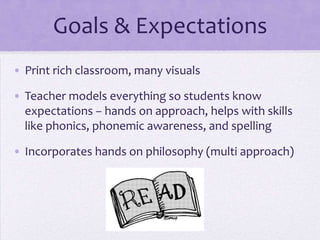
Goals & Expectations
• Print rich classroom, many visuals

• Teacher models everything so students know
  expectations – hands on approach, helps with skills
  like phonics, phonemic awareness, and spelling

• Incorporates hands on philosophy (multi approach)
Values
• Teaches children to value reading and enjoy it

• Children should learn that reading is fun and
  enjoyable, not a struggle or task you must complete

• Believes that reading occurs throughout all parts of
  life, therefore you should incorporate it throughout
  your entire day
Home-to-School Connection
• Lots of communication with home to keep parents
  up-to-date with what is occurring in school

• Newsletters, parent volunteers

• Students have planners that are signed daily from
  parent or guardian

• Constant communication with phone calls, both
  positive and negative
Types of Texts in Classroom
• Guided reading groups spend two days on each book – alternate
  types of books (fiction & non-fiction)

• Always uses a “Big Book” with each unit to teach information
   • The “big book” summarizes everything the students are going to
     learn throughout that unit. Usually occurs in a story and includes
     new vocabulary and questions to get the children thinking
   • The “big book” also includes a table of contents, dictionary in the
     back, etc. – all the components of a non-fiction text when
     appropriate

• Incorporates author studies when possible – teacher chooses
  which authors to include

• Students have book buddy books and browsing books (they
  choose)

• Books cover all different genres, levels, interests, and content
Analysis of Texts in
                     Classroom
• Classroom is very text rich, reading is included in most areas of
  the day
• Teacher includes a variety of texts so all students interests are
  meet
• All students are exposed to well-written and a variety of texts
• Exposed to a variety of ways to look at and read a text –
  buddy reading, student choice text, author studies, read-
  alouds
• Guided reading groups texts are based on students level and
  what skills that group needs to work on
• Throughout the day includes both enjoyable text (read alouds)
  and instructional (“big book” and guided reading groups)
Instructional Time in
              Whole Group
• Calendar and morning meeting – students all read
  morning message together every morning, work on their
  fluency and expression
• Lead 21 whole group instruction – work on daily routines,
  oral language and vocabulary, reading and
  comprehension, word work
• Writing – teacher models the new skill
• Read alouds and author studies
• Math, Science, Social Studies, etc.
Instructional Time in
         Small Groups
• Writing – students practice what the teacher modeled

• Math – after lesson is taught sometimes the students
  are broken up into smaller groups based on ability

• Centers
  • Guided reading groups – broken up based on skill level
  • Flip charts – vocabulary, writer’s desk, phonics focus, or
    book corner
  • Spelling/word work
  • Listening
  • Math games
Instructional Time Spent
               1:1
• Writing – if student needs extra support with a skill

• Centers/reading – if student is struggling with a
  reading skill or behind in general
Analysis of Instructional
• Lead 21 Program
                  Time
  • During this time the teacher is focused on explaining and
    diving deeper into the unit they are working on. The
    students start off on the carpet and the teacher reads
    from the “big book”. Then as a class they discuss the
    main topic they are working on. During this time new
    vocabulary, comprehension, and oral language are being
    worked on. This program really focuses on moving the
    children forward and creating a well-rounded body of
    knowledge.

• Centers
  • During this time the students are all working in small
    groups on a certain task. Guided reading groups also
    occur during this time. During this time all of the
    students are working on a new skill that they learned or
    worked on through the Lead 21 Program. The skills range
    from writing, vocabulary, phonics, reading, word
    work, etc.
Analysis of Instructional
              Time Cont
• Additional teaching time
  • During the rest of the day the teacher is incorporating
    Math, Science, Social Studies, read alouds, author
    studies, and second step. During these instructional times
    the teacher is constantly incorporating reading. During
    second step the students work on building a good
    community and learning social skills. Throughout the day
    Lead 21 incorporates all these important skills the children
    need to know across all content areas.
Considerations/
               Suggestions
This classroom is truly centered around literacy and helping
 the students succeed in school. Lead 21 is a great program
to prepare students for their future. It really tries to create
   well-rounded students with knowledge in all areas. The
 teacher is very focused on creating a fun, inviting, learning
 rich classroom. In this situation the teacher does not have
 very much wiggle room to change things, because she has
 to stick to the new Lead 21 program. However, I would try
    to incorporate other things into my day. The Lead 21
program focuses on a lot of worksheets and seat-work. My
 suggestion is to find other activities or ways to accomplish
what is on the worksheet. Maybe through a game or activity
  the group of students can do together. Something other
               than seat-work for the students.
Considerations/
           Suggestions Cont.
    I also recommend incorporating more projects for the
students. The Lead 21 program does not include projects for
   the students to work on. There are plenty opportunities
with the units to add a project for the students to complete
to further their understanding of that topic. Overall, I would
   try to add new items to the Lead 21 program. It is a very
   rigorous, fast program and some of the students in this
 classroom need the extra time and support to digest what
   they are learning. Lead 21 is a great program to prepare
 students, however in order to keep students attention and
  love for learning I believe the teacher needs to add more
                    exciting, fun activities.

Danielle Hajduk Instructional Inquiry

  • 1.
    Instructional Inquiry Danielle Hajduk
  • 2.
    Instructional Inquiry I tooka deeper look into a York Elementary School’s classroom. It is a first grade classroom and consists of roughly 20 students. The teacher is very experienced with literacy and the York school system. York recently adopted a new literacy program called Lead 21, therefore the teachers are still learning the program and working out the flaws. This teacher teaches the Lead 21 program and includes extra literacy throughout the day.
  • 3.
    Literacy Instruction Methods • Lead 21 program – aligned with CCSS (50/50 fiction non-fiction texts) Lead 21 Program • Lead 21 program is new to York, it divides the school year into units and takes a deeper look at ideas and topics. The program lays out exactly what the teacher should teach each day • Units range from investigating different habitats to learning about your community • Very rigorous, fast program helping kids prepare for their future • Program has set units for teachers to follow – units include reading material based on content areas, author studies, etc. • Some of the units are based on Science and Social Studies
  • 4.
    Literacy Instruction Methods Cont. • Writing is also incorporated into the program – takes ideas from both Lead 21 and Lucy Cauwkins • Writing is trait based and moves very quickly • Uses Cauwkins units of study to form the foundation of writing • Launches writing through Cauwkins and adds in the traits slowly, not all at once • Models writing workshop – not a rushed program • All forms of writing – narrative, opinion, information, etc.
  • 5.
    Literacy Instruction Methods Cont. • Students have time during the day to read independently and with a buddy, choose their own books • Guided reading groups occur daily • Teacher tries to meet with every differentiated group daily • Groups range from 3-6 students • Occurs during center time
  • 6.
    Materials • Lead 21comes with all the materials necessary • Main staple is a teacher’s guide book that explains explicitly what to teach and how • The program also includes “Big Books” that go along with each unit • Includes work books for students on writing, phonics, vocabulary, etc. • Additional writing worksheets are also added to this program
  • 7.
    Grouping • This programincorporates both whole and small group work • This program also includes guided reading groups • Centers is also included in small group work • 1:1 occurs with specific children when necessary
  • 8.
    Assessments • Variety ofassessments – weekly, unit assessments, assessments on certain skills • DRA’s are given to children several times a year to monitor progress • DIBELS • When needed teacher gives more assessments to certain students
  • 9.
    Goals & Expectations •Print rich classroom, many visuals • Teacher models everything so students know expectations – hands on approach, helps with skills like phonics, phonemic awareness, and spelling • Incorporates hands on philosophy (multi approach)
  • 10.
    Values • Teaches childrento value reading and enjoy it • Children should learn that reading is fun and enjoyable, not a struggle or task you must complete • Believes that reading occurs throughout all parts of life, therefore you should incorporate it throughout your entire day
  • 11.
    Home-to-School Connection • Lotsof communication with home to keep parents up-to-date with what is occurring in school • Newsletters, parent volunteers • Students have planners that are signed daily from parent or guardian • Constant communication with phone calls, both positive and negative
  • 12.
    Types of Textsin Classroom • Guided reading groups spend two days on each book – alternate types of books (fiction & non-fiction) • Always uses a “Big Book” with each unit to teach information • The “big book” summarizes everything the students are going to learn throughout that unit. Usually occurs in a story and includes new vocabulary and questions to get the children thinking • The “big book” also includes a table of contents, dictionary in the back, etc. – all the components of a non-fiction text when appropriate • Incorporates author studies when possible – teacher chooses which authors to include • Students have book buddy books and browsing books (they choose) • Books cover all different genres, levels, interests, and content
  • 13.
    Analysis of Textsin Classroom • Classroom is very text rich, reading is included in most areas of the day • Teacher includes a variety of texts so all students interests are meet • All students are exposed to well-written and a variety of texts • Exposed to a variety of ways to look at and read a text – buddy reading, student choice text, author studies, read- alouds • Guided reading groups texts are based on students level and what skills that group needs to work on • Throughout the day includes both enjoyable text (read alouds) and instructional (“big book” and guided reading groups)
  • 14.
    Instructional Time in Whole Group • Calendar and morning meeting – students all read morning message together every morning, work on their fluency and expression • Lead 21 whole group instruction – work on daily routines, oral language and vocabulary, reading and comprehension, word work • Writing – teacher models the new skill • Read alouds and author studies • Math, Science, Social Studies, etc.
  • 15.
    Instructional Time in Small Groups • Writing – students practice what the teacher modeled • Math – after lesson is taught sometimes the students are broken up into smaller groups based on ability • Centers • Guided reading groups – broken up based on skill level • Flip charts – vocabulary, writer’s desk, phonics focus, or book corner • Spelling/word work • Listening • Math games
  • 16.
    Instructional Time Spent 1:1 • Writing – if student needs extra support with a skill • Centers/reading – if student is struggling with a reading skill or behind in general
  • 17.
    Analysis of Instructional •Lead 21 Program Time • During this time the teacher is focused on explaining and diving deeper into the unit they are working on. The students start off on the carpet and the teacher reads from the “big book”. Then as a class they discuss the main topic they are working on. During this time new vocabulary, comprehension, and oral language are being worked on. This program really focuses on moving the children forward and creating a well-rounded body of knowledge. • Centers • During this time the students are all working in small groups on a certain task. Guided reading groups also occur during this time. During this time all of the students are working on a new skill that they learned or worked on through the Lead 21 Program. The skills range from writing, vocabulary, phonics, reading, word work, etc.
  • 18.
    Analysis of Instructional Time Cont • Additional teaching time • During the rest of the day the teacher is incorporating Math, Science, Social Studies, read alouds, author studies, and second step. During these instructional times the teacher is constantly incorporating reading. During second step the students work on building a good community and learning social skills. Throughout the day Lead 21 incorporates all these important skills the children need to know across all content areas.
  • 19.
    Considerations/ Suggestions This classroom is truly centered around literacy and helping the students succeed in school. Lead 21 is a great program to prepare students for their future. It really tries to create well-rounded students with knowledge in all areas. The teacher is very focused on creating a fun, inviting, learning rich classroom. In this situation the teacher does not have very much wiggle room to change things, because she has to stick to the new Lead 21 program. However, I would try to incorporate other things into my day. The Lead 21 program focuses on a lot of worksheets and seat-work. My suggestion is to find other activities or ways to accomplish what is on the worksheet. Maybe through a game or activity the group of students can do together. Something other than seat-work for the students.
  • 20.
    Considerations/ Suggestions Cont. I also recommend incorporating more projects for the students. The Lead 21 program does not include projects for the students to work on. There are plenty opportunities with the units to add a project for the students to complete to further their understanding of that topic. Overall, I would try to add new items to the Lead 21 program. It is a very rigorous, fast program and some of the students in this classroom need the extra time and support to digest what they are learning. Lead 21 is a great program to prepare students, however in order to keep students attention and love for learning I believe the teacher needs to add more exciting, fun activities.