Traditional
knowledge
in the
Philippines
Progress of IPR protection
Andrea B. Agillon
Reported by: Ernesto E. Empig
Professor: Liwayway S. Viloria, Ph.D.
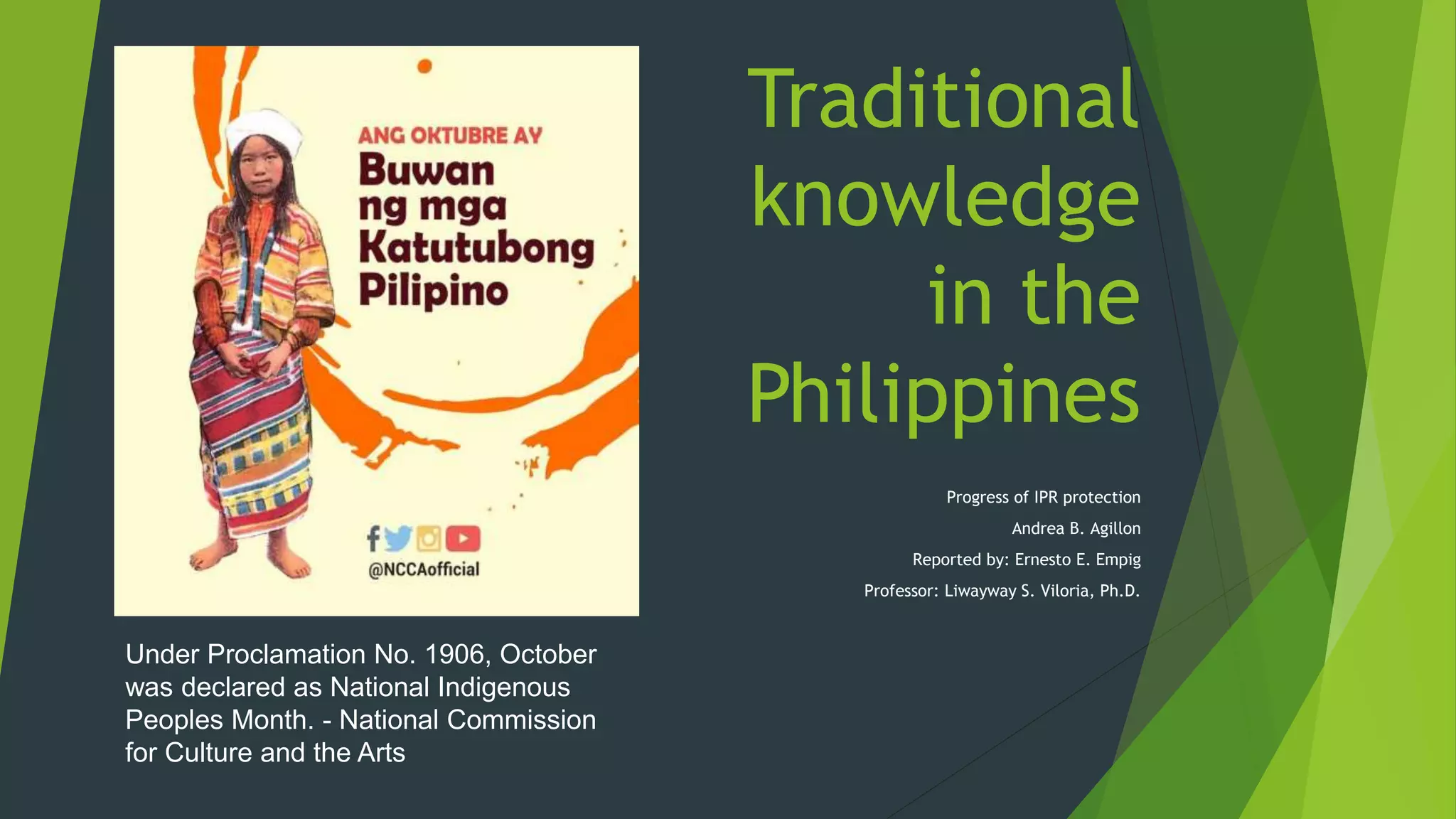
Under Proclamation No. 1906, October
was declared as National Indigenous
Peoples Month. - National Commission
for Culture and the Arts
Strategies in the Philippines
 The Filipino indigenous cultural communities or “tribal Filipinos”
constitute about ten per cent of the Philippine population3 or 126
ethnolinguistic groups
 During the 1999 roundtable discussion on IP and TK, Filipino TK
was identified as being mostly on health care, agriculture, forestry
systems, mining, arts, crafts, music, dances and literature.
 The fundamental legal basis for the protection of traditional
knowledge (TK) is embodied in its 1987 Constitution (Article XIV
Section 17), which states that “the state shall recognize, respect
and protect the rights of the indigenous cultural communities to
preserve and develop their cultures, traditions and institutions
The list of Philippine laws that feature or
have references to TK are as follows:
 Executive Order No. 247, 1995,
 which prescribes a regulatory framework for the prospecting of biological and genetic resources,
their by-products and derivatives, for scientific and commercial purposes, and for other purposes;
 EO 247 Implementing Rules and Regulations (IRR), 1996;
 The Indigenous Peoples’ Rights Act (IPRA), 1997 or Republic Act 8317 with its regulations;
 Traditional and Alternative Medicine Act, 1997
 which created the Philippine Institute of Traditional and Alternative Health Care (PITAHC) in 2000,
providing for a Traditional and Alternative Health Care Development Fund and for other purposes;
 Plant Variety Protection Act, 2000;
 Wildlife Resources Conservation and Protection Act of 2001 or Republic Act 9147;
 IRR for Wildlife Act or Guidelines for Bioprospecting Activities in the Philippines - Joint DENR-DAPCSD-
NCIP AO No. 1, 2004; and
 Community Intellectual Rights Protection Act (CIRPA), 2000 (pending Senate approval).
Wildlife Resources Conservation and
Protection Act
 The Wildlife Resources Conservation and Protection Act -
popularly known as the Wildlife Act (WA) - was enacted to
rectify some problems encountered in the previously
enacted EO 247 and its Implementing Rules and
Regulations
 Limitations of previous laws in terms of benefit-sharing
are rectified in Chapter VI of the Guidelines, which
includes bioprospecting fees, royalty payments, and up-
front payments as well as other non-monetary benefits
that may be agreed upon by the users and providers:
There are also exemptions in the scope
of the guidelines:
 Ex-situ collections of biological resources sourced from traditional
use, subsistence consumption or conventional commercial
consumption for direct use as in logging or fishing;
 Scientific researches on wildlife except for commercial purposes;
 Scientific researches on biodiversity;
 Existing procedures of collection and transport of wildlife species
exclusively for commercial or conservation breeding or
propagation; and
 Ex-situ collections currently accessed under international
agreements where the Philippines is a party.
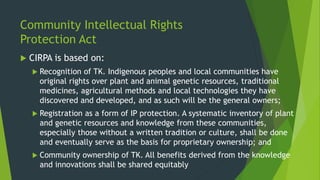
Community Intellectual Rights
Protection Act
 CIRPA is based on:
 Recognition of TK. Indigenous peoples and local communities have
original rights over plant and animal genetic resources, traditional
medicines, agricultural methods and local technologies they have
discovered and developed, and as such will be the general owners;
 Registration as a form of IP protection. A systematic inventory of plant
and genetic resources and knowledge from these communities,
especially those without a written tradition or culture, shall be done
and eventually serve as the basis for proprietary ownership; and
 Community ownership of TK. All benefits derived from the knowledge
and innovations shall be shared equitably
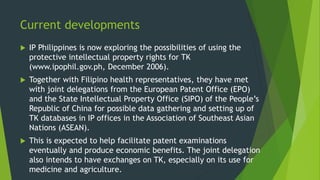
Current developments
 IP Philippines is now exploring the possibilities of using the
protective intellectual property rights for TK
(www.ipophil.gov.ph, December 2006).
 Together with Filipino health representatives, they have met
with joint delegations from the European Patent Office (EPO)
and the State Intellectual Property Office (SIPO) of the People’s
Republic of China for possible data gathering and setting up of
TK databases in IP offices in the Association of Southeast Asian
Nations (ASEAN).
 This is expected to help facilitate patent examinations
eventually and produce economic benefits. The joint delegation
also intends to have exchanges on TK, especially on its use for
medicine and agriculture.
Indigenous Knowledge for Development
Opportunities and Challenges
Nicolas Gorjestani
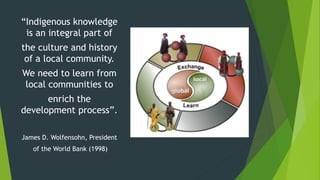
“Indigenous knowledge
is an integral part of
the culture and history
of a local community.
We need to learn from
local communities to
enrich the
development process”.
James D. Wolfensohn, President
of the World Bank (1998)
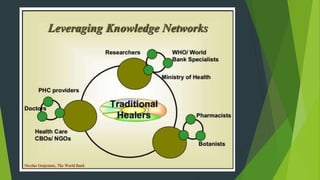
 IK is used at the local level by communities as the
basis for decisions pertaining to food security,
human and animal health, education, natural
resources management, and other vital activities.
 IK is a key element of the social capital of the
poor and constitutes their main asset in their
efforts to gain control of their own lives.
 For these reasons, the potential contribution of IK
to locally managed, sustainable and cost-effective
survival strategies should be promoted in the
development process.
The priorities would be to:
 encourage more countries to formulate and
implement strategies for IK integration
 enhance the capacity of national and regional IK
networks
 promote the local exchange and adaptation of
indigenous knowledge
 identify innovative mechanisms to protect IK in a
way that fosters the further development,
promotion, validation, and exchange of IK.
Conclusion
 Indigenous knowledge is a critical factor for sustainable development
 Empowerment of local communities is a prerequisite for the integration of IK in the development
process.
 The integration of appropriate IK systems into development programs has already contributed to
efficiency, effectiveness, and sustainable development impact.
 IK, like any other knowledge, needs to be constantly used, challenged, and further adapted to the
evolving local contexts.
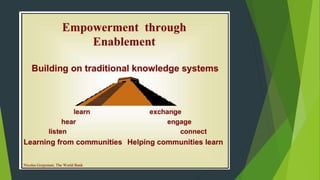
 Supporting local and regional networks of traditional practitioners and community exchanges can help
to disseminate useful and relevant IK and to enable communities to participate more actively in the
development process
 While innovative mechanisms for the protection of IK need to be developed, many indigenous
knowledge practices can at the same time be integrated into local, national, regional, or even global
development efforts.
 However, experience has shown that this cannot be done by one institution alone. Therefore,
partnerships are needed to support this process at all levels.
 The Indigenous Knowledge for Development Program of the World Bank will continue to champion IK
and join others in their efforts to harness indigenous knowledge for development in a process of
continuous learning from local communities.
Conclusion
 Indigenous knowledge is a critical factor for sustainable development. Empowerment of local communities is a prerequisite for the integration of IK in the development process. The integration of appropriate
 IK systems into development programs has already contributed to efficiency, effectiveness, and sustainable
 development impact. IK, like any other knowledge, needs to be constantly used, challenged, and further
 adapted to the evolving local contexts. Supporting local and regional networks of traditional practitioners
 and community exchanges can help to disseminate useful and relevant IK and to enable communities to
 participate more actively in the development process. While innovative mechanisms for the protection of
 Box 6
 In Cameroon, the US National Cancer Institute reportedly signed
 a contract with the government following the discovery of a forest
 plant species with a potential anti-AIDS chemical. Cameroon provides plant samples in return for payments which are used for
 community development projects. *
 * Posey, D. and Dutfield G. (1996). “Beyond Intellectual Property:
 Toward Traditional Resource Rights for Indigenous Peoples and Local
 Communities.” IDRC, Ottawa.
 8
 Nicolas Gorjestani is Chief Knowledge Officer, Africa Region, The World Bank. This paper is based on a presentation
 made by the author at the UNCTAD Conference on Traditional Knowledge in Geneva, November 1, 2000. The paper was
 completed after the Conference and includes some additional material, which has since become available.
 The views expressed in this paper are entirely those of the author and should not be attributed in any manner to the World
 Bank, to its affiliated organizations or to members of its Board of Executive Directors or the countries they represent.
 IK need to be developed, many indigenous knowledge practices can at the same time be integrated into
 local, national, regional, or even global development efforts. However, experience has shown that this
 cannot be done by one institution alone. Therefore, partnerships are needed to support this process at all
 levels. The Indigenous Knowledge for Development Program of the World Bank will continue to champion IK and join others in their efforts to harness indigenous knowledge for development in a process of
 continuous learning from local communities.
Marginalised knowledge: An agenda
for indigenous
knowledge development and
integration
with other forms of knowledge
Dennis N. Ocholla
The purpose of this chapter is to re-examine
indigenous knowledge (IK) in order to suggest an
agenda for its development and integration with
other forms of knowledge. The chapter
discusses what marginalisation of IK means,
examines the challenges of integrating IK into the
mainstream of other forms of knowledge, and
suggests an agenda for IK development. The
agenda focuses on mapping and auditing IK capacity
in Africa, legal and ethical issues, IK
management, IK education and training, integration
of IK and KM, and IK brain drain. The
chapter concludes by recommending that
information on IK be widely shared for evaluation,
use and further developmen
IK Definition
 ... a complex set of knowledge and
technologies existing and developed around
specific conditions of populations and
communities indigenous to a particular
geographic area, [with an emphasis on
how] these forms of knowledge have
hitherto been suppressed […] therefore, IKS
should be brought into the mainstream of
knowledge in order to establish its place
within the larger body of knowledge.
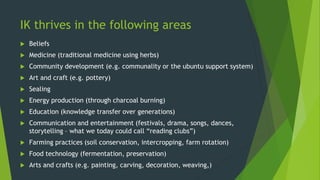
IK thrives in the following areas
 Beliefs
 Medicine (traditional medicine using herbs)
 Community development (e.g. communality or the ubuntu support system)
 Art and craft (e.g. pottery)
 Sealing
 Energy production (through charcoal burning)
 Education (knowledge transfer over generations)
 Communication and entertainment (festivals, drama, songs, dances,
storytelling – what we today could call “reading clubs”)
 Farming practices (soil conservation, intercropping, farm rotation)
 Food technology (fermentation, preservation)
 Arts and crafts (e.g. painting, carving, decoration, weaving,)

Traditional knowledge in the philippines

  • 1.
    Traditional knowledge in the Philippines Progress ofIPR protection Andrea B. Agillon Reported by: Ernesto E. Empig Professor: Liwayway S. Viloria, Ph.D. Under Proclamation No. 1906, October was declared as National Indigenous Peoples Month. - National Commission for Culture and the Arts
  • 2.
    Strategies in thePhilippines  The Filipino indigenous cultural communities or “tribal Filipinos” constitute about ten per cent of the Philippine population3 or 126 ethnolinguistic groups  During the 1999 roundtable discussion on IP and TK, Filipino TK was identified as being mostly on health care, agriculture, forestry systems, mining, arts, crafts, music, dances and literature.  The fundamental legal basis for the protection of traditional knowledge (TK) is embodied in its 1987 Constitution (Article XIV Section 17), which states that “the state shall recognize, respect and protect the rights of the indigenous cultural communities to preserve and develop their cultures, traditions and institutions
  • 3.
    The list ofPhilippine laws that feature or have references to TK are as follows:  Executive Order No. 247, 1995,  which prescribes a regulatory framework for the prospecting of biological and genetic resources, their by-products and derivatives, for scientific and commercial purposes, and for other purposes;  EO 247 Implementing Rules and Regulations (IRR), 1996;  The Indigenous Peoples’ Rights Act (IPRA), 1997 or Republic Act 8317 with its regulations;  Traditional and Alternative Medicine Act, 1997  which created the Philippine Institute of Traditional and Alternative Health Care (PITAHC) in 2000, providing for a Traditional and Alternative Health Care Development Fund and for other purposes;  Plant Variety Protection Act, 2000;  Wildlife Resources Conservation and Protection Act of 2001 or Republic Act 9147;  IRR for Wildlife Act or Guidelines for Bioprospecting Activities in the Philippines - Joint DENR-DAPCSD- NCIP AO No. 1, 2004; and  Community Intellectual Rights Protection Act (CIRPA), 2000 (pending Senate approval).
  • 4.
    Wildlife Resources Conservationand Protection Act  The Wildlife Resources Conservation and Protection Act - popularly known as the Wildlife Act (WA) - was enacted to rectify some problems encountered in the previously enacted EO 247 and its Implementing Rules and Regulations  Limitations of previous laws in terms of benefit-sharing are rectified in Chapter VI of the Guidelines, which includes bioprospecting fees, royalty payments, and up- front payments as well as other non-monetary benefits that may be agreed upon by the users and providers:
  • 5.
    There are alsoexemptions in the scope of the guidelines:  Ex-situ collections of biological resources sourced from traditional use, subsistence consumption or conventional commercial consumption for direct use as in logging or fishing;  Scientific researches on wildlife except for commercial purposes;  Scientific researches on biodiversity;  Existing procedures of collection and transport of wildlife species exclusively for commercial or conservation breeding or propagation; and  Ex-situ collections currently accessed under international agreements where the Philippines is a party.
  • 6.
    Community Intellectual Rights ProtectionAct  CIRPA is based on:  Recognition of TK. Indigenous peoples and local communities have original rights over plant and animal genetic resources, traditional medicines, agricultural methods and local technologies they have discovered and developed, and as such will be the general owners;  Registration as a form of IP protection. A systematic inventory of plant and genetic resources and knowledge from these communities, especially those without a written tradition or culture, shall be done and eventually serve as the basis for proprietary ownership; and  Community ownership of TK. All benefits derived from the knowledge and innovations shall be shared equitably
  • 8.
    Current developments  IPPhilippines is now exploring the possibilities of using the protective intellectual property rights for TK (www.ipophil.gov.ph, December 2006).  Together with Filipino health representatives, they have met with joint delegations from the European Patent Office (EPO) and the State Intellectual Property Office (SIPO) of the People’s Republic of China for possible data gathering and setting up of TK databases in IP offices in the Association of Southeast Asian Nations (ASEAN).  This is expected to help facilitate patent examinations eventually and produce economic benefits. The joint delegation also intends to have exchanges on TK, especially on its use for medicine and agriculture.
  • 9.
    Indigenous Knowledge forDevelopment Opportunities and Challenges Nicolas Gorjestani
  • 10.
    “Indigenous knowledge is anintegral part of the culture and history of a local community. We need to learn from local communities to enrich the development process”. James D. Wolfensohn, President of the World Bank (1998)
  • 11.
     IK isused at the local level by communities as the basis for decisions pertaining to food security, human and animal health, education, natural resources management, and other vital activities.  IK is a key element of the social capital of the poor and constitutes their main asset in their efforts to gain control of their own lives.  For these reasons, the potential contribution of IK to locally managed, sustainable and cost-effective survival strategies should be promoted in the development process.
  • 13.
    The priorities wouldbe to:  encourage more countries to formulate and implement strategies for IK integration  enhance the capacity of national and regional IK networks  promote the local exchange and adaptation of indigenous knowledge  identify innovative mechanisms to protect IK in a way that fosters the further development, promotion, validation, and exchange of IK.
  • 15.
    Conclusion  Indigenous knowledgeis a critical factor for sustainable development  Empowerment of local communities is a prerequisite for the integration of IK in the development process.  The integration of appropriate IK systems into development programs has already contributed to efficiency, effectiveness, and sustainable development impact.  IK, like any other knowledge, needs to be constantly used, challenged, and further adapted to the evolving local contexts.  Supporting local and regional networks of traditional practitioners and community exchanges can help to disseminate useful and relevant IK and to enable communities to participate more actively in the development process  While innovative mechanisms for the protection of IK need to be developed, many indigenous knowledge practices can at the same time be integrated into local, national, regional, or even global development efforts.  However, experience has shown that this cannot be done by one institution alone. Therefore, partnerships are needed to support this process at all levels.  The Indigenous Knowledge for Development Program of the World Bank will continue to champion IK and join others in their efforts to harness indigenous knowledge for development in a process of continuous learning from local communities.
  • 16.
    Conclusion  Indigenous knowledgeis a critical factor for sustainable development. Empowerment of local communities is a prerequisite for the integration of IK in the development process. The integration of appropriate  IK systems into development programs has already contributed to efficiency, effectiveness, and sustainable  development impact. IK, like any other knowledge, needs to be constantly used, challenged, and further  adapted to the evolving local contexts. Supporting local and regional networks of traditional practitioners  and community exchanges can help to disseminate useful and relevant IK and to enable communities to  participate more actively in the development process. While innovative mechanisms for the protection of  Box 6  In Cameroon, the US National Cancer Institute reportedly signed  a contract with the government following the discovery of a forest  plant species with a potential anti-AIDS chemical. Cameroon provides plant samples in return for payments which are used for  community development projects. *  * Posey, D. and Dutfield G. (1996). “Beyond Intellectual Property:  Toward Traditional Resource Rights for Indigenous Peoples and Local  Communities.” IDRC, Ottawa.  8  Nicolas Gorjestani is Chief Knowledge Officer, Africa Region, The World Bank. This paper is based on a presentation  made by the author at the UNCTAD Conference on Traditional Knowledge in Geneva, November 1, 2000. The paper was  completed after the Conference and includes some additional material, which has since become available.  The views expressed in this paper are entirely those of the author and should not be attributed in any manner to the World  Bank, to its affiliated organizations or to members of its Board of Executive Directors or the countries they represent.  IK need to be developed, many indigenous knowledge practices can at the same time be integrated into  local, national, regional, or even global development efforts. However, experience has shown that this  cannot be done by one institution alone. Therefore, partnerships are needed to support this process at all  levels. The Indigenous Knowledge for Development Program of the World Bank will continue to champion IK and join others in their efforts to harness indigenous knowledge for development in a process of  continuous learning from local communities.
  • 17.
    Marginalised knowledge: Anagenda for indigenous knowledge development and integration with other forms of knowledge Dennis N. Ocholla
  • 18.
    The purpose ofthis chapter is to re-examine indigenous knowledge (IK) in order to suggest an agenda for its development and integration with other forms of knowledge. The chapter discusses what marginalisation of IK means, examines the challenges of integrating IK into the mainstream of other forms of knowledge, and suggests an agenda for IK development. The agenda focuses on mapping and auditing IK capacity in Africa, legal and ethical issues, IK management, IK education and training, integration of IK and KM, and IK brain drain. The chapter concludes by recommending that information on IK be widely shared for evaluation, use and further developmen
  • 19.
    IK Definition  ...a complex set of knowledge and technologies existing and developed around specific conditions of populations and communities indigenous to a particular geographic area, [with an emphasis on how] these forms of knowledge have hitherto been suppressed […] therefore, IKS should be brought into the mainstream of knowledge in order to establish its place within the larger body of knowledge.
  • 20.
    IK thrives inthe following areas  Beliefs  Medicine (traditional medicine using herbs)  Community development (e.g. communality or the ubuntu support system)  Art and craft (e.g. pottery)  Sealing  Energy production (through charcoal burning)  Education (knowledge transfer over generations)  Communication and entertainment (festivals, drama, songs, dances, storytelling – what we today could call “reading clubs”)  Farming practices (soil conservation, intercropping, farm rotation)  Food technology (fermentation, preservation)  Arts and crafts (e.g. painting, carving, decoration, weaving,)