Methods
For this study 120 participants were randomly selected to take a
survey, which consisted of 24 questions pertaining to knowledge,
physical activity, environment and attitude. The survey also included
demographic information, including age, major, gender, and the type
of residence in which they reside. The demographics of students
ranged from college students in their freshman year through graduate
students. The majority of students surveyed were sophomores. The
surveys were taken by 78 females and 42 males. The ages of the
participants ranged from 18-35 years old, with the majority of
participants being 21 years old. Among the 120 participants, 76 lived
off campus, and 44 lived on campus. Our survey was approximately
3.5 pages in length. Participants used a writing utensil to circle or write
the option that pertains to them. To analyze the surveys taken, PASW
Statistics 18 software was used to analyze descriptive statistics such as
the results, and to thoroughly analyze demographic information.
Results
As stated within the introduction, the primary purpose of this study
was to analyze the perceived body image of students at a Midwestern
university. The results are divided among the factors of knowledge,
physical activity, environment and attitude.
The first factor addressed in the survey was students’ knowledge
of health and body image. Results indicated that the majority of
students, at 30% received their health information from their friends
and family. The results also indicated that the earlier the participants
were in college, the higher the percentage for health information
received from family and friends. Participants were asked if they knew
the recommendation for each food group. The following percentages
show participants knowledge of recommendations for food groups:
• Grains (79.2%)
• Fruit (85%)
• Vegetable (85%)
• Milk (86.7%)
• Oils (45%)
Finally, participants were asked if they knew the recommendations for
daily amount of exercise. Results showed the following:
Knowledge of Recommendation for Daily Exercise
Figure 1. Participants knowledge of Recommendation for Daily
Exercise.
The second factor addressed in the survey was physical activity.
Participants were asked a series of questions to find out how often
participants engaged in physical activity.
Discussion
Our findings demonstrate that among the factors, knowledge has the
strongest influence on one’s body perception. In addition, evidence
shows a correlation between knowledge, age and gender, indicating
that together these factors have the greatest influence on one’s body
image.
Based on the information above, it appears our results support what
many past studies have found; this is young females are the most likely
to have a negative body image. Participants who were younger and
female looked toward family and friends for their health information,
and were less knowledgeable in important health recommendations,
which can result in being misinformed of important health facts.
Consequently, these individuals have a greater chance of being less
confident in their body image.
The majority of participants indicated that they are interested in
improving their body image, which is a positive sign for future
programs related to the issue. Knowledge, age, and gender appear to
be the most influential factors on body image, and must be considered
during the planning and implementation stages to ensure a program’s
success. Body image is an issue that many college students will
continue to face. This study’s results can help university health
professionals create interventions that will improve students’ body
image, thus improving their overall college experience.
Molly Caton, Cid Martland, Aimie Heinz, Abby Walker, Tia Feather, Amber Werre
Department of Health, Exercise, and Rehabilitative Sciences, Winona State University
References
Alfano, L., Hildebrandt, T., Bannon, K., Walker, C., & Walton, K. E. (2011). The
impact of gender on the assessment of body checking behavior. Body Image , 8 (1),
20-25.
Anschutza, D. J., Spruijt-Metz, D., Van Strien, T., & Engels, R. C. (2011). The direct
effect of thin ideal focused adult television on young girls' ideal body figure. Body
Image , 8 (1), 26-33.
Bays, H. E., Bazata, D. D., Fox, K. M., Grandy, S., Gavin, J. R., & Group, S. S.
(2009). Perceived body image in men and women with type 2 diabetes mellitus:
correlation of body mass index with the figure rating scale. Nutrition Journal .
Results indicated that 31.7% took part in low impact activity 8 or
more times a day, 30.8% attend a gym 1 to 2 times per week, 37.5%
participate in aerobic activity 3 to 4 times a week and 59.2% do not
participate in organized sports. One question addressed during the
analysis was whether or not there was an association between the
participants’ residence and participants’ gym attendance. Results show
the following:
Residencies Effect on Gym Attendance
Figure 2. Results show that 63.3% of participants attend the gym as
off campus students compared to 26.7% of participants gym
attendance of those who live on campus.
The Third factor addressed in the survey was certain types of
environments that participants felt the most and least comfortable.
Results indicated that the majority of participants at 35% feel most
comfortable in a restaurant setting and the majority of participants at
6.7% feel the least comfortable in public speaking. One question
addressed was whether there was an association between being
comfortable at a gym and gym attendance. Results show that 66.7% of
participants felt comfortable in the gym setting and attended the gym 8
or more times a week. A second question addressed was whether there
was an association between gym attendance and body satisfaction.
Results indicated below:
Gym Attendance Association with Body Satisfaction
Figure 3. Results show that 45.5% of participants that said yes to
being satisfied with their body attend the gym 3 to 4 times a week.
This shows the more satisfaction someone has with their body the
more likely they are to attend the gym.
How Perceived Body Image Affects the Health of College Students
Abstract
In this Body Image Study, we aimed to determine the dominant factor
that influences body image among Winona State Students. For this
study, 120 participants were randomly selected throughout campus and
asked to fill out a short survey with 24 questions pertaining to
knowledge, physical activity, environment, attitude, and demographic
information. Approximately, 70% of females and 30% of males
indicated that they are interested in improving their body image. Our
findings also demonstrate that, compared to physical activity,
environment, and attitude, knowledge has the greatest influence on
one’s body perception. In addition, there appeared to be a correlation
between knowledge, age and gender, indicating that together these
three factors have the greatest influence on one’s body image. It
appears our results support what many past studies have found; this is,
young females are the most likely to have a negative body image.
The final factor addressed in the survey was participants attitude
toward body image with themselves and others around them.
Participants were asked to rate themselves on a scale of 1 to 5. Results
show the following:
Body Satisfaction Rating Scale
Figure 4. Results show that the majority of participants at 48.3% rate
themselves as a 4.
Introduction
The purpose of this study was to analyze the perception of body
image of Winona State University students. Research questions
addressed specific descriptive and association findings. The objective
was to investigate the presence of relationships between demographic
information and the perception of body image as well as to determine
the status of students’ body image perception at the time the survey
was administered.
Body Image encompasses both self-perceptions and self-attitudes
and is related to socio-cultural norms and ideals, more specifically to
the ideal of thinness for females and muscularity in men (Isomaa
2010). Body Image development is influenced by many factors such
as: optic & tactile sensations, emotional experience, social experience,
and our own attitudes and values (Breakey 1997). Self esteem is one
of the most important variables in the development of a positive body
image (Alfano 2010). Through the observation of parents and other
adults, we begin as children and learn about how our bodies should
look (Anshultz 2010). Personal appearance is a means to many valued
ends in society, and if a person deems themselves as unattractive they
feel their access to these goals are limited, leading to anxiety and self
devaluation (Breakly 1997).
The analysis revealed what is stated from several recent studies
involving body image. That body image correlates with age, older
women are more confident and hold a better self image than do
younger women. Knowledge is a another variable considered in the
survey analysis. Those subjects which had the most knowledge about
daily nutritional requirements and requirements for exercise had a
higher body image. The results for gym attendance and use showed
that those who live off campus have a higher use rate than those that
live on campus. This again reflects a correlation between age and
knowledge, as older students tend to be the ones living off campus
and also hold a higher placement in their education level. The results
also show us that those who use the gym regularly have a higher
perception of their body image than those who don’t. This also held
true in the literature review, as consistent exercise is known to
alleviate the symptoms of depression which often lead to a poor
perception of self image.

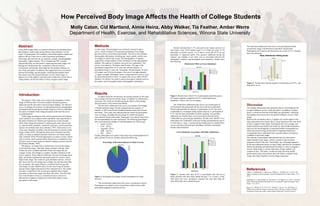
BodyImagePoster[1]

  • 1.
    Methods For this study120 participants were randomly selected to take a survey, which consisted of 24 questions pertaining to knowledge, physical activity, environment and attitude. The survey also included demographic information, including age, major, gender, and the type of residence in which they reside. The demographics of students ranged from college students in their freshman year through graduate students. The majority of students surveyed were sophomores. The surveys were taken by 78 females and 42 males. The ages of the participants ranged from 18-35 years old, with the majority of participants being 21 years old. Among the 120 participants, 76 lived off campus, and 44 lived on campus. Our survey was approximately 3.5 pages in length. Participants used a writing utensil to circle or write the option that pertains to them. To analyze the surveys taken, PASW Statistics 18 software was used to analyze descriptive statistics such as the results, and to thoroughly analyze demographic information. Results As stated within the introduction, the primary purpose of this study was to analyze the perceived body image of students at a Midwestern university. The results are divided among the factors of knowledge, physical activity, environment and attitude. The first factor addressed in the survey was students’ knowledge of health and body image. Results indicated that the majority of students, at 30% received their health information from their friends and family. The results also indicated that the earlier the participants were in college, the higher the percentage for health information received from family and friends. Participants were asked if they knew the recommendation for each food group. The following percentages show participants knowledge of recommendations for food groups: • Grains (79.2%) • Fruit (85%) • Vegetable (85%) • Milk (86.7%) • Oils (45%) Finally, participants were asked if they knew the recommendations for daily amount of exercise. Results showed the following: Knowledge of Recommendation for Daily Exercise Figure 1. Participants knowledge of Recommendation for Daily Exercise. The second factor addressed in the survey was physical activity. Participants were asked a series of questions to find out how often participants engaged in physical activity. Discussion Our findings demonstrate that among the factors, knowledge has the strongest influence on one’s body perception. In addition, evidence shows a correlation between knowledge, age and gender, indicating that together these factors have the greatest influence on one’s body image. Based on the information above, it appears our results support what many past studies have found; this is young females are the most likely to have a negative body image. Participants who were younger and female looked toward family and friends for their health information, and were less knowledgeable in important health recommendations, which can result in being misinformed of important health facts. Consequently, these individuals have a greater chance of being less confident in their body image. The majority of participants indicated that they are interested in improving their body image, which is a positive sign for future programs related to the issue. Knowledge, age, and gender appear to be the most influential factors on body image, and must be considered during the planning and implementation stages to ensure a program’s success. Body image is an issue that many college students will continue to face. This study’s results can help university health professionals create interventions that will improve students’ body image, thus improving their overall college experience. Molly Caton, Cid Martland, Aimie Heinz, Abby Walker, Tia Feather, Amber Werre Department of Health, Exercise, and Rehabilitative Sciences, Winona State University References Alfano, L., Hildebrandt, T., Bannon, K., Walker, C., & Walton, K. E. (2011). The impact of gender on the assessment of body checking behavior. Body Image , 8 (1), 20-25. Anschutza, D. J., Spruijt-Metz, D., Van Strien, T., & Engels, R. C. (2011). The direct effect of thin ideal focused adult television on young girls' ideal body figure. Body Image , 8 (1), 26-33. Bays, H. E., Bazata, D. D., Fox, K. M., Grandy, S., Gavin, J. R., & Group, S. S. (2009). Perceived body image in men and women with type 2 diabetes mellitus: correlation of body mass index with the figure rating scale. Nutrition Journal . Results indicated that 31.7% took part in low impact activity 8 or more times a day, 30.8% attend a gym 1 to 2 times per week, 37.5% participate in aerobic activity 3 to 4 times a week and 59.2% do not participate in organized sports. One question addressed during the analysis was whether or not there was an association between the participants’ residence and participants’ gym attendance. Results show the following: Residencies Effect on Gym Attendance Figure 2. Results show that 63.3% of participants attend the gym as off campus students compared to 26.7% of participants gym attendance of those who live on campus. The Third factor addressed in the survey was certain types of environments that participants felt the most and least comfortable. Results indicated that the majority of participants at 35% feel most comfortable in a restaurant setting and the majority of participants at 6.7% feel the least comfortable in public speaking. One question addressed was whether there was an association between being comfortable at a gym and gym attendance. Results show that 66.7% of participants felt comfortable in the gym setting and attended the gym 8 or more times a week. A second question addressed was whether there was an association between gym attendance and body satisfaction. Results indicated below: Gym Attendance Association with Body Satisfaction Figure 3. Results show that 45.5% of participants that said yes to being satisfied with their body attend the gym 3 to 4 times a week. This shows the more satisfaction someone has with their body the more likely they are to attend the gym. How Perceived Body Image Affects the Health of College Students Abstract In this Body Image Study, we aimed to determine the dominant factor that influences body image among Winona State Students. For this study, 120 participants were randomly selected throughout campus and asked to fill out a short survey with 24 questions pertaining to knowledge, physical activity, environment, attitude, and demographic information. Approximately, 70% of females and 30% of males indicated that they are interested in improving their body image. Our findings also demonstrate that, compared to physical activity, environment, and attitude, knowledge has the greatest influence on one’s body perception. In addition, there appeared to be a correlation between knowledge, age and gender, indicating that together these three factors have the greatest influence on one’s body image. It appears our results support what many past studies have found; this is, young females are the most likely to have a negative body image. The final factor addressed in the survey was participants attitude toward body image with themselves and others around them. Participants were asked to rate themselves on a scale of 1 to 5. Results show the following: Body Satisfaction Rating Scale Figure 4. Results show that the majority of participants at 48.3% rate themselves as a 4. Introduction The purpose of this study was to analyze the perception of body image of Winona State University students. Research questions addressed specific descriptive and association findings. The objective was to investigate the presence of relationships between demographic information and the perception of body image as well as to determine the status of students’ body image perception at the time the survey was administered. Body Image encompasses both self-perceptions and self-attitudes and is related to socio-cultural norms and ideals, more specifically to the ideal of thinness for females and muscularity in men (Isomaa 2010). Body Image development is influenced by many factors such as: optic & tactile sensations, emotional experience, social experience, and our own attitudes and values (Breakey 1997). Self esteem is one of the most important variables in the development of a positive body image (Alfano 2010). Through the observation of parents and other adults, we begin as children and learn about how our bodies should look (Anshultz 2010). Personal appearance is a means to many valued ends in society, and if a person deems themselves as unattractive they feel their access to these goals are limited, leading to anxiety and self devaluation (Breakly 1997). The analysis revealed what is stated from several recent studies involving body image. That body image correlates with age, older women are more confident and hold a better self image than do younger women. Knowledge is a another variable considered in the survey analysis. Those subjects which had the most knowledge about daily nutritional requirements and requirements for exercise had a higher body image. The results for gym attendance and use showed that those who live off campus have a higher use rate than those that live on campus. This again reflects a correlation between age and knowledge, as older students tend to be the ones living off campus and also hold a higher placement in their education level. The results also show us that those who use the gym regularly have a higher perception of their body image than those who don’t. This also held true in the literature review, as consistent exercise is known to alleviate the symptoms of depression which often lead to a poor perception of self image.