Results
Undergraduate/Graduate Category: Undergraduate
Degree Level: Bachelor
Abstract ID# 1345
Abstract
Body image concerns have become exceptionally
prevalent, impairing women’s ability to correctly identify
healthy body weights after media exposure. The purpose
of this study was to analyze how women’s perceptions of
healthy body types are influenced by the costs of being
overweight, the positive valence of being thin, and the
extent of internalizing media ideals. Eight computer-
generated female body images were created with Body
Mass Indices (BMI) ranging from 18 to 35. Participants
(16 women 18–22 years old) were asked to rate the
images, presented randomly over a series of trials, before
and after viewing a webpage of swimsuit advertisements.
Participants rated how “typical” the images looked on a
scale from 1 (thinnest) to 9 (heaviest). Higher perceived
cost of being overweight was associated with rating
thinner bodies as more “typical” following the swimsuit
advertisements (r=-.635, p<.009). Higher perceived
benefit of being thin was associated with more extreme
dieting behavior (r= .775, p<.001). These preliminary
findings support the correlation between media exposure
and skewed body image.
Introduction
The media is saturated with cultural ideals depicting thinner women as more attractive,
more desirable and more successful, which adversely impacts women’s body perception.
This phenomenon negatively affects women’s ability to correctly distinguish healthy body
weights. In previous studies, Stice et al. examined the effects of body dissatisfaction and
how body image distortions cause a person to view their body to be larger than it is in
reality (Stice et al. 2002). This study attributed body dissatisfaction to have stemmed from
sociocultural pressures like media, family, etc. (Stice et al.). Rhodes et al. took the Stice
study further by investigating whether exposure to distorted bodies can change
perceptions of attractiveness. In many Western cultures, attractiveness translates to being
thin (Rhodes et al. 2005). The study concluded that the most attractive body was thinner
than the normal body after exposure (Rhodes et al.). In more recent studies, Glauert et
al. examined how women from Western cultures cope with both body dissatisfaction and
the effects of perceptual exposure to body ideals (Glauert et al. 2009). This study found
that women’s body perceptions were impressionable to these body ideals because higher
rates of body dissatisfaction were recorded after media exposure (Glauert et al.). With
consideration to the previous studies on body dissatisfaction and perceptual exposure to
body ideals, the purpose of our study was to analyze the extent to which media ideals can
impact social norms related to body image, and to examine the influence it has on
women’s perceptions of a healthy body weight. Our study also examined how much
having this ideal body shown in media would affect their lives. We examined the
perceived costs of being overweight and the perceived benefits of being thin.
Methods
Conclusion
The results from this study lean towards the notion that women’s perceptions of body image are
influenced by the perceived costs of being overweight. If one believes that social status or
approval may decrease if one’s weight increases, then a thinner body type is considered more
typical after media exposure; media exposure thus skewing the perception of body images. The
positive valence of being thin also influences perception because of the belief that being thin is
more attractive and more successful. If perceiving benefits of being thin is correlated with
extreme dieting behavior, women exposed to idealized bodies in media might be more likely to
engage in unhealthy disordered eating behaviors. The internalizing of beauty and idealistic
norms has a negative influence on the way women perceive themselves and others, even
computer generated stimuli. These preliminary findings support the correlation between media
exposure and skewed body image.
NEW ! VERY SEXY&FRINGE
M ACRAMÉBRALETTE
$58.50
Matching)Bo, om)$48.50
5&Colors
PLUNGE-FRONT CAFTAN
$79.50
4&Colors
NEW ! BEACH SEXY&MESH CROP
TOP
$34.50
Matching)Bo, om)$22.50
NEW ! BEACH SEXY&THEFLIRT
BANDEAU
$38.50
Matching)Bo, om)$20.50
2&Colors
BEACH SEXY&ZIP-FRONT ONE-
PIECE
$54.50
6&Colors
NEW ! BOM BSHELL SW IM TOPS
THEBOM BSHELL ADD-2-CUPS
PUSH-UPHALTER
$64.50
Matching)Bo, om)$34.509$38.50
3&Colors
NEW ! VERY SEXY&FRINGE
MACRAMÉMONOKINI
$108.50
3&Colors
NEW ! VERY SEXY&ONE-
SHOULDER TRIANGLETOP
$46.50
Matching)Bo, om)$38.509$42.50
2&Colors
Media exposure impairs perception of body image
Olesnycky, Olenka1; Asi, Suhair2; Cutrim, Paula1; Hartley, Ludger3; McDonald, Daniel4; Dubois, Russell Heyden5; Rodgers, Rachel5; Lynn, Spencer4
Figure 1: Example stimuli created according to the participant’s self described personal
characteristics.
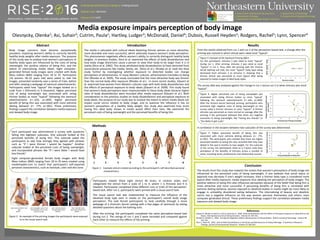
Participants viewed these eight stimuli 40 times, in random order, and
categorized the stimuli from a scale of 1 to 9, where 1 is thinnest and 9 is
heaviest. Participants completed three different runs or trials of the perception-
based task. After run 1, participants were primed with a visual search task.
The visual search task was implemented to measure the influence of the
idealized body type seen in media on the participant’s overall body image
perception. The task forced participants to look carefully through a mock
webpage of a Victoria’s Secret catalog with a few pages of swimsuits by asking
detailed questions about the bathing suits.
After the priming, the participants completed the same perception-based task
during run 2. The ratings of run 1 and 2 were recorded and compared against
each other to measure the effects of the priming.
Figure 2: An example of the priming images the participants were exposed
to in the visual search task.
-0.8
-0.6
-0.4
-0.2
0
0.2
0.4
0.6
0.8
0 20 40 60 80
Changeinstimulusnumberrated
most“typical”
Perceived cost of being overweight
0
10
20
30
40
50
60
70
0 20 40 60 80
HigherDietingScoreonSurvey
Perceived Benefits of Being Thin
The survey data was analyzed against the change in run 1 versus run 2 in what stimulus was most
“typical”.
From the results obtained from run 1 and run 2 of the perception-based task, a change after the
priming was noticed in which stimuli were rated most “typical”.
A correlation in the answers between two subscales of the survey was determined.
References
Glauert R, Rhodes G, Byrne S, Fink B, Grammer K. 2009. Body Dissatisfaction and the Effects of Perceptual Exposure on Body Norms and
Ideals. International Journal of Eating Disorders. Volume 42: 443-452.
Rhodes G, Winkler C. 2005. Perceptual Adaptation Affects Attractiveness of Female Bodies. British Journal of Psychology. Volume 96:
141-154.
Stice E, Shaw HE. 2002. Role of Body Dissatisfaction in the Onset and Maintenance of Eating Pathology: A Synthesis of Research
Findings. Journal of Psychosomatic Research. Volume 53: 985-993.
Figure 3: Example of the Swimsuit Priming Effect
For this participant, stimulus 3 was rated as most “typical”
during run 1. After priming, stimulus 2 was rated as most
“typical” in run 2. Thus, after the priming with the Victoria
Secret bathing suit task, the most “typical” body type rating
decreased from stimulus 3 to stimulus 2, showing that a
thinner stimuli was perceived as more typical after being
exposed to media images of ideal body types.
1
2
3
4
5
6
7
8
9
1 2 3 4 5 6 7 8
Mean"typical"rating
Stimulus number
Run 1 Run 2
Figure 4: Higher perceived cost of being overweight was
associated with rating thinner bodies as more “typical”
following the swimsuit advertisements (r=-.635, p<.009).
After the Victoria Secret Swimsuit priming, participants who
perceived high negative costs of being overweight on the
survey rated a thinner stimulus as most “typical”. A thinner
stimulus was perceived as more normal on average after the
priming if the participant believed that there are negative
outcomes to being overweight, like “having less friends” or
“less likely to get a job.”
Figure 5: Higher perceived benefit of being thin was
associated with more extreme dieting behavior (r= .775,
p<.001). The participants who marked that there are higher
perceived benefits to being thin also recorded that they have
dieted in the past 6 months to lose weight. For this subscale
of the survey, the participants rated on a 5-point scale their
perception of the benefits of thinness across a number of
areas, including social, professional, and relationship success.
1 2 3 4 5 6 7 8
Each participant was administered a survey with questions
falling into eighteen subscales. One subscale looked at the
perceived benefits of being thin. This subscale asked the
participants to rate how strongly they agreed with phrases
such as “If I were thinner I would be happier.” Another
subscale looked at the perceived costs of being overweight,
and incorporated phrases like “If I were fatter I would have
less friends”.
Eight computer-generated female body images with Body
Mass Indices (BMI) ranging from 18 to 35 were created using
modelmydiet.com to match that participant’s self-reported
personal characteristics, such as hairstyle, color and skin tone.
1. Department of Behavioral Neuroscience
2. Department of Biology
3. Department of Psychology, Bangor University
4. Department of Psychology
5. Department of Applied Psychology

RISE Poster Final

  • 1.
    Results Undergraduate/Graduate Category: Undergraduate DegreeLevel: Bachelor Abstract ID# 1345 Abstract Body image concerns have become exceptionally prevalent, impairing women’s ability to correctly identify healthy body weights after media exposure. The purpose of this study was to analyze how women’s perceptions of healthy body types are influenced by the costs of being overweight, the positive valence of being thin, and the extent of internalizing media ideals. Eight computer- generated female body images were created with Body Mass Indices (BMI) ranging from 18 to 35. Participants (16 women 18–22 years old) were asked to rate the images, presented randomly over a series of trials, before and after viewing a webpage of swimsuit advertisements. Participants rated how “typical” the images looked on a scale from 1 (thinnest) to 9 (heaviest). Higher perceived cost of being overweight was associated with rating thinner bodies as more “typical” following the swimsuit advertisements (r=-.635, p<.009). Higher perceived benefit of being thin was associated with more extreme dieting behavior (r= .775, p<.001). These preliminary findings support the correlation between media exposure and skewed body image. Introduction The media is saturated with cultural ideals depicting thinner women as more attractive, more desirable and more successful, which adversely impacts women’s body perception. This phenomenon negatively affects women’s ability to correctly distinguish healthy body weights. In previous studies, Stice et al. examined the effects of body dissatisfaction and how body image distortions cause a person to view their body to be larger than it is in reality (Stice et al. 2002). This study attributed body dissatisfaction to have stemmed from sociocultural pressures like media, family, etc. (Stice et al.). Rhodes et al. took the Stice study further by investigating whether exposure to distorted bodies can change perceptions of attractiveness. In many Western cultures, attractiveness translates to being thin (Rhodes et al. 2005). The study concluded that the most attractive body was thinner than the normal body after exposure (Rhodes et al.). In more recent studies, Glauert et al. examined how women from Western cultures cope with both body dissatisfaction and the effects of perceptual exposure to body ideals (Glauert et al. 2009). This study found that women’s body perceptions were impressionable to these body ideals because higher rates of body dissatisfaction were recorded after media exposure (Glauert et al.). With consideration to the previous studies on body dissatisfaction and perceptual exposure to body ideals, the purpose of our study was to analyze the extent to which media ideals can impact social norms related to body image, and to examine the influence it has on women’s perceptions of a healthy body weight. Our study also examined how much having this ideal body shown in media would affect their lives. We examined the perceived costs of being overweight and the perceived benefits of being thin. Methods Conclusion The results from this study lean towards the notion that women’s perceptions of body image are influenced by the perceived costs of being overweight. If one believes that social status or approval may decrease if one’s weight increases, then a thinner body type is considered more typical after media exposure; media exposure thus skewing the perception of body images. The positive valence of being thin also influences perception because of the belief that being thin is more attractive and more successful. If perceiving benefits of being thin is correlated with extreme dieting behavior, women exposed to idealized bodies in media might be more likely to engage in unhealthy disordered eating behaviors. The internalizing of beauty and idealistic norms has a negative influence on the way women perceive themselves and others, even computer generated stimuli. These preliminary findings support the correlation between media exposure and skewed body image. NEW ! VERY SEXY&FRINGE M ACRAMÉBRALETTE $58.50 Matching)Bo, om)$48.50 5&Colors PLUNGE-FRONT CAFTAN $79.50 4&Colors NEW ! BEACH SEXY&MESH CROP TOP $34.50 Matching)Bo, om)$22.50 NEW ! BEACH SEXY&THEFLIRT BANDEAU $38.50 Matching)Bo, om)$20.50 2&Colors BEACH SEXY&ZIP-FRONT ONE- PIECE $54.50 6&Colors NEW ! BOM BSHELL SW IM TOPS THEBOM BSHELL ADD-2-CUPS PUSH-UPHALTER $64.50 Matching)Bo, om)$34.509$38.50 3&Colors NEW ! VERY SEXY&FRINGE MACRAMÉMONOKINI $108.50 3&Colors NEW ! VERY SEXY&ONE- SHOULDER TRIANGLETOP $46.50 Matching)Bo, om)$38.509$42.50 2&Colors Media exposure impairs perception of body image Olesnycky, Olenka1; Asi, Suhair2; Cutrim, Paula1; Hartley, Ludger3; McDonald, Daniel4; Dubois, Russell Heyden5; Rodgers, Rachel5; Lynn, Spencer4 Figure 1: Example stimuli created according to the participant’s self described personal characteristics. Participants viewed these eight stimuli 40 times, in random order, and categorized the stimuli from a scale of 1 to 9, where 1 is thinnest and 9 is heaviest. Participants completed three different runs or trials of the perception- based task. After run 1, participants were primed with a visual search task. The visual search task was implemented to measure the influence of the idealized body type seen in media on the participant’s overall body image perception. The task forced participants to look carefully through a mock webpage of a Victoria’s Secret catalog with a few pages of swimsuits by asking detailed questions about the bathing suits. After the priming, the participants completed the same perception-based task during run 2. The ratings of run 1 and 2 were recorded and compared against each other to measure the effects of the priming. Figure 2: An example of the priming images the participants were exposed to in the visual search task. -0.8 -0.6 -0.4 -0.2 0 0.2 0.4 0.6 0.8 0 20 40 60 80 Changeinstimulusnumberrated most“typical” Perceived cost of being overweight 0 10 20 30 40 50 60 70 0 20 40 60 80 HigherDietingScoreonSurvey Perceived Benefits of Being Thin The survey data was analyzed against the change in run 1 versus run 2 in what stimulus was most “typical”. From the results obtained from run 1 and run 2 of the perception-based task, a change after the priming was noticed in which stimuli were rated most “typical”. A correlation in the answers between two subscales of the survey was determined. References Glauert R, Rhodes G, Byrne S, Fink B, Grammer K. 2009. Body Dissatisfaction and the Effects of Perceptual Exposure on Body Norms and Ideals. International Journal of Eating Disorders. Volume 42: 443-452. Rhodes G, Winkler C. 2005. Perceptual Adaptation Affects Attractiveness of Female Bodies. British Journal of Psychology. Volume 96: 141-154. Stice E, Shaw HE. 2002. Role of Body Dissatisfaction in the Onset and Maintenance of Eating Pathology: A Synthesis of Research Findings. Journal of Psychosomatic Research. Volume 53: 985-993. Figure 3: Example of the Swimsuit Priming Effect For this participant, stimulus 3 was rated as most “typical” during run 1. After priming, stimulus 2 was rated as most “typical” in run 2. Thus, after the priming with the Victoria Secret bathing suit task, the most “typical” body type rating decreased from stimulus 3 to stimulus 2, showing that a thinner stimuli was perceived as more typical after being exposed to media images of ideal body types. 1 2 3 4 5 6 7 8 9 1 2 3 4 5 6 7 8 Mean"typical"rating Stimulus number Run 1 Run 2 Figure 4: Higher perceived cost of being overweight was associated with rating thinner bodies as more “typical” following the swimsuit advertisements (r=-.635, p<.009). After the Victoria Secret Swimsuit priming, participants who perceived high negative costs of being overweight on the survey rated a thinner stimulus as most “typical”. A thinner stimulus was perceived as more normal on average after the priming if the participant believed that there are negative outcomes to being overweight, like “having less friends” or “less likely to get a job.” Figure 5: Higher perceived benefit of being thin was associated with more extreme dieting behavior (r= .775, p<.001). The participants who marked that there are higher perceived benefits to being thin also recorded that they have dieted in the past 6 months to lose weight. For this subscale of the survey, the participants rated on a 5-point scale their perception of the benefits of thinness across a number of areas, including social, professional, and relationship success. 1 2 3 4 5 6 7 8 Each participant was administered a survey with questions falling into eighteen subscales. One subscale looked at the perceived benefits of being thin. This subscale asked the participants to rate how strongly they agreed with phrases such as “If I were thinner I would be happier.” Another subscale looked at the perceived costs of being overweight, and incorporated phrases like “If I were fatter I would have less friends”. Eight computer-generated female body images with Body Mass Indices (BMI) ranging from 18 to 35 were created using modelmydiet.com to match that participant’s self-reported personal characteristics, such as hairstyle, color and skin tone. 1. Department of Behavioral Neuroscience 2. Department of Biology 3. Department of Psychology, Bangor University 4. Department of Psychology 5. Department of Applied Psychology