Your Role in Youth Success at
      Work and Beyond
         Presented by
   Virginia Nonaca Chavez
                            1
Welcome to
Make and Take Youth Leadership

Before we begin…
  Please sign in using your text box.
  1. Agency Name and number of people expected to attend today
  2. About your group -- Will you have people attending today’s webinar who are
     SPECIFICALLY working with youth programs?
  3. Name of people wishing to receive CEUs for this webinar (example: Jodi
     Rudick, CEUs)
  If anyone in your group has not yet watched the 3 minute
      Trailer at Inocentedoc.com, please show it for your group
      before we begin. (Make sure to open a new window or tab if
     viewing the video. Do NOT close out of the webinar room! )
  Icebreaker Question… Please discuss and list some
     of the Youth Development Programs (formal or
     informal you were involved in when you were a “kid?”
                                                     2
Desktop Education for Parks And Recreation
            Welcome and Sign-In
                              • We will mute all phone
Please sign in (by typing       lines before we begin.
in the chat box):             • YOU will be not be speaking
                                during the webinar. However,
• Agency Name and number        YOU WILL use the webinar chat
  of people expected to
                                and feedback box often.
  attend today                • Phone audio is much more
                                reliable than computer audio. If
• About your group -- Will      you are listening through your
  you have people attending     computer speakers and have
  today’s webinar who are       audio problems during the
  SPECIFICALLY working          webinar PLEASE dial in to the
  with youth programs?          conference number
• Name of people wishing to     718.432.3900. Conference ID#
  receive CEUs for this         890590
  webinar (example: Jodi      • Have you downloaded and
  Rudick, CEUs                  printed a copy of your handouts?
                                (Sent in today’s reminder
                                update.)                   3
Two Part Activity
Tell us about Your Agency

Our agency is very committed to creating or
 offering programs which specifically focus
 on youth leadership.

• In your text box list some of the youth
  leadership programs you offer.


                                              4
OPENING ACTIVITY
Where does the United States rate academically
  compared to 28 other developing nations?

a.   5th Place
b.   10th Place
c.   15th Place
d.   20th Place

http://www.greatschools.org/students/academic-skills/1075-u-s-students-compare.gs


                                                                               5
Name the Next
              Generation
A.   I Generation (Igen)   F. Gen Z
B.   Gen Tech              G. Post Generation (Post Gen)
C.   Gen WII               H. Gen Next
D.   Net Gen               I. Homeland Generation
                           J. Pluralist Generation
E.   Digital Natives

 Type the name you think best
 depicts the NEXT generation. Tell us
 why you chose this answer!
Traits of Gen Z (?)
                  Early1990s-2010
•   Highly “Connected” - Lifelong use of communication and
    media technology (Digital Natives)
      World Wide Web
      Instant Messaging
      Text Messaging
      Mobile Phone

•   Pluralist Generation - Reflects their ethnic composition
    most diverse generation (Last to have a Caucasian Majority)

•   Least likely to believe in the “American Dream”

•   First generation to earn less than their parents.
“No Action WITHOUT
      Research
        and
No Research WITHOUT
       Action”
  --KURT LEWIN (Cooper Jackson, 2006, p. 139)
QUESTIONS TO ASK
when planning youth activities
• Why are you doing the activity?
• What are you trying to change or achieve in
  youth development in the activity?
• How are you going to measure youth success
  and what is the outcome you hope for?


    “If what you are doing in youth development is not
        working why are you doing the same things?

      And why do you expect to get different results”
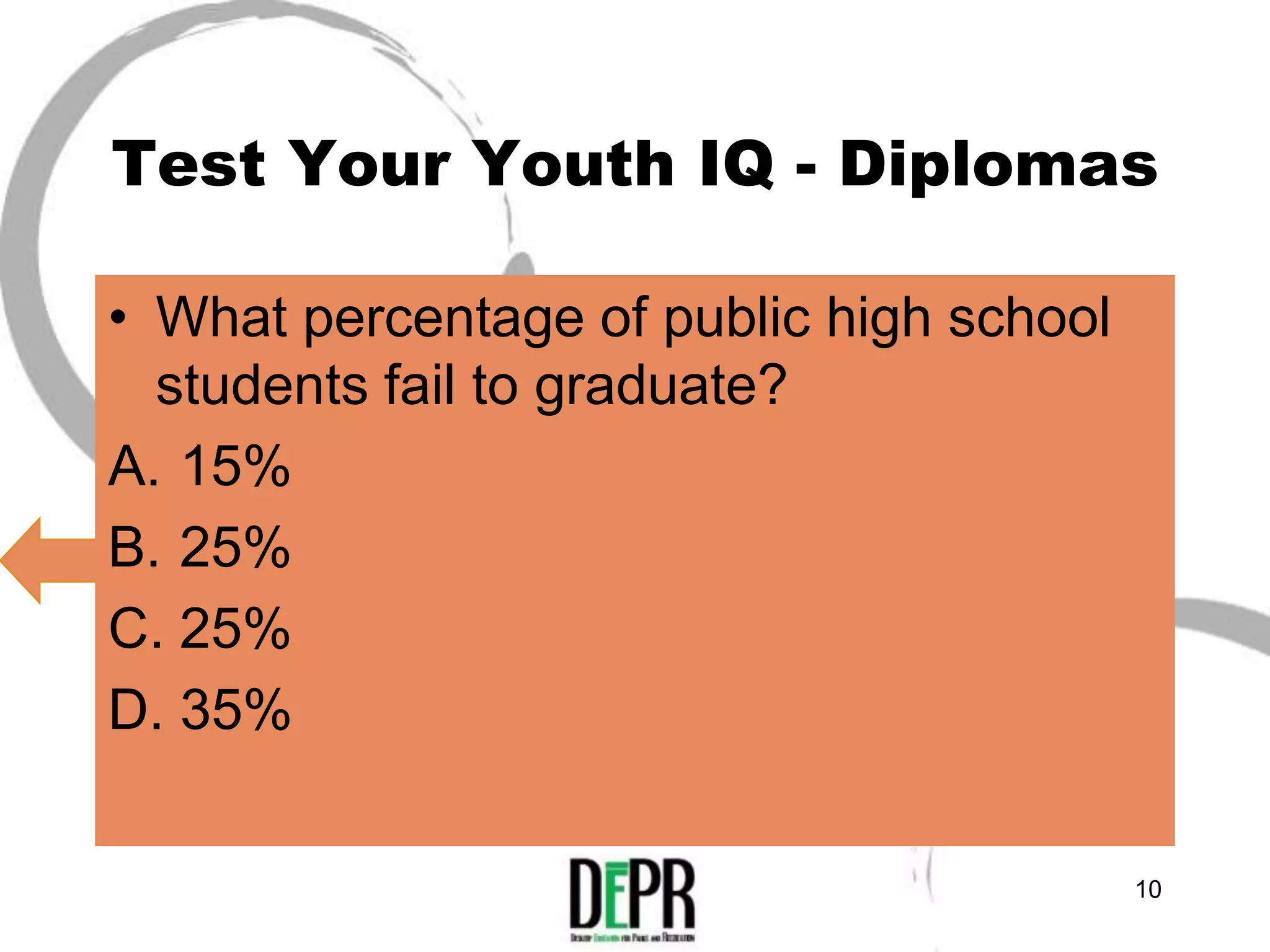
Test Your Youth IQ - Diplomas

• What percentage of public high school
  students fail to graduate?
A. 15%
B. 25%
C. 25%
D. 35%

                                          10
Test Your Youth IQ - Obesity

• How many of today’s 12 – 19 year olds
  are overweight?
A. 1 in 100
B. 1 in 25
C. 1 in 12
D. 1 in 6

                                          11
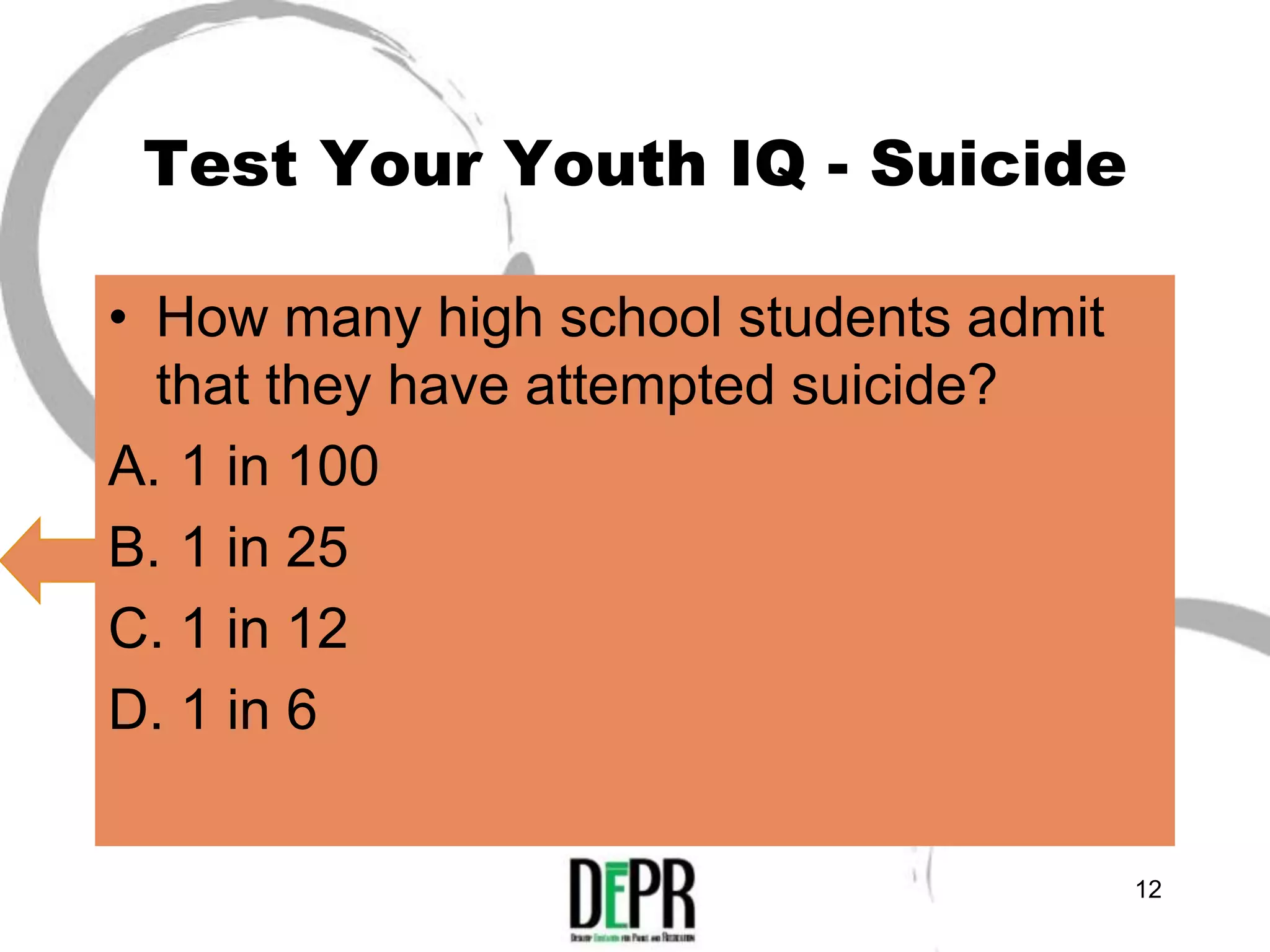
Test Your Youth IQ - Suicide

• How many high school students admit
  that they have attempted suicide?
A. 1 in 100
B. 1 in 25
C. 1 in 12
D. 1 in 6

                                        12
How did you do?
          WHAT WE KNOW
• Approximately 25% of all public high school
  students fail to graduate*
• Approximately one in six American children
  between the ages 6-19 are overweight.
• 1 in 12 high school students has attempted
  suicide
• Nearly 1.6 million 12-19 year-olds are victims
  of violent crimes

Study: “Every Child Every Promise” - A report from America’s Promise
   Alliance
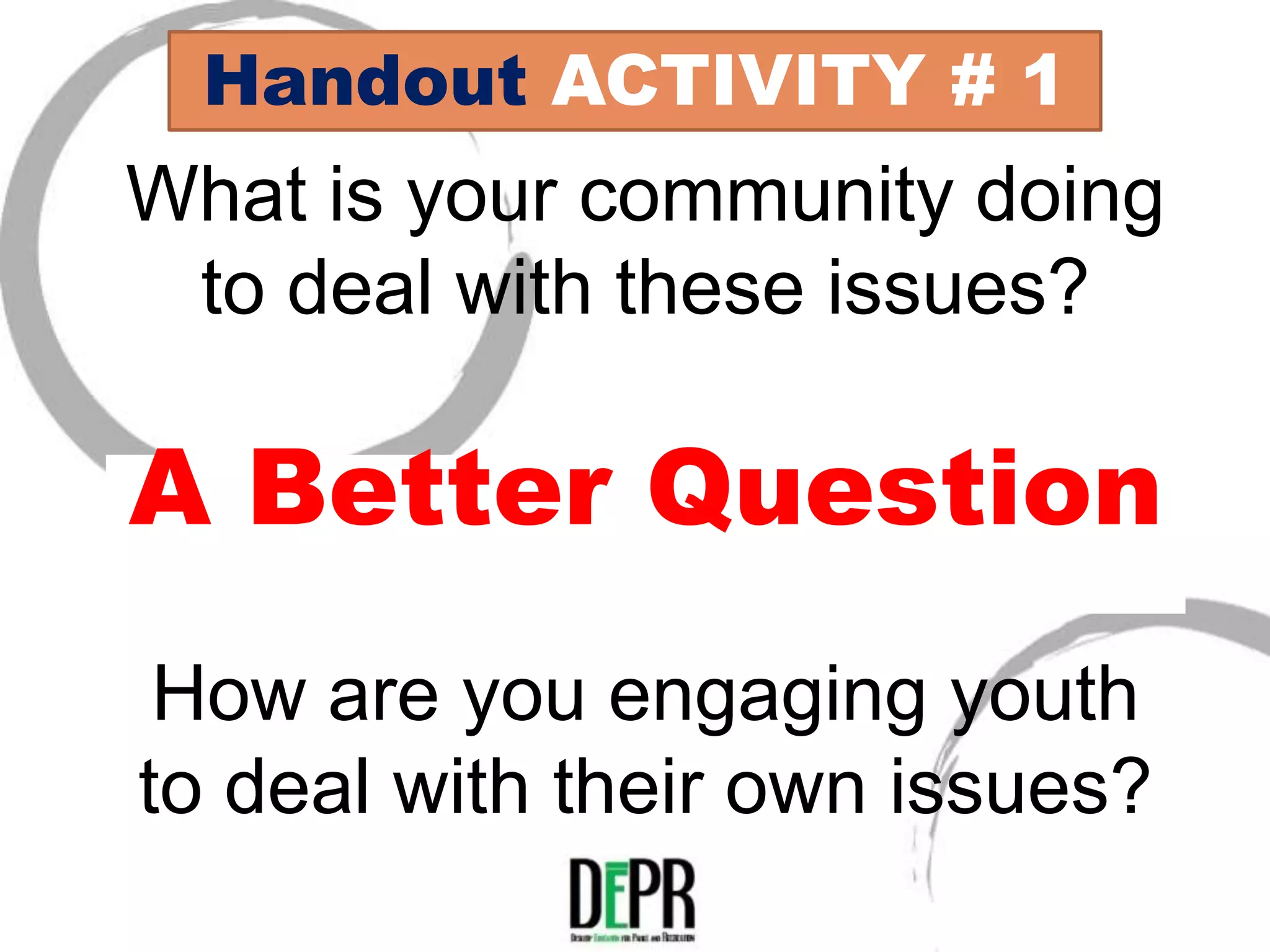
Handout ACTIVITY # 1
What is your community doing
 to deal with these issues?

A Better Question
 How are you engaging youth
to deal with their own issues?
Pre-Webinar Assignment #1
Review CPRS Youth Development Resources
DEFINING YOUTH DEVELOPMENT
    A framework addressing human needs
        for the healthy growth of young
       people, including competencies
    (knowledge, skills, behaviors, values)
          necessary for adult success.

         CPRS Youth Development Committee
PRINCIPLES TO
            SUCCESS
• Treating youth as an equal partner

• A safe & caring environment

• A positive relationship with a caring adult

• An opportunity to be involved in
  meaningful activities

• Competencies (SKILLS) needed to be a
  successful adult
Handout Activity #2
              REALITY CHECK
           RESULTS NOT IN PLACE
On your handout VALUE RANK each principle 1-5.
1 being the principle your community needs to work on (not in
place yet) to 5 what’s in place in your community. Use each
number only once.


Treating youth as an equal partner
A safe and caring environment
A positive relationship with a caring adult
An opportunity to be involved in meaningful
 activities
Competencies (SKILLS) needed to be a
 successful adult
Room for Improvement…
Of the items listed in the previous activity:
   •   Treating youth as an equal partner
   •   A safe and caring environment
   •   A positive relationship with a caring adult
   •   An opportunity to be involved in meaningful activities
   •   Competencies needed
please discuss and type in your text box
  the principles that your agency most
  needs to incorporate into it’s youth
  development culture
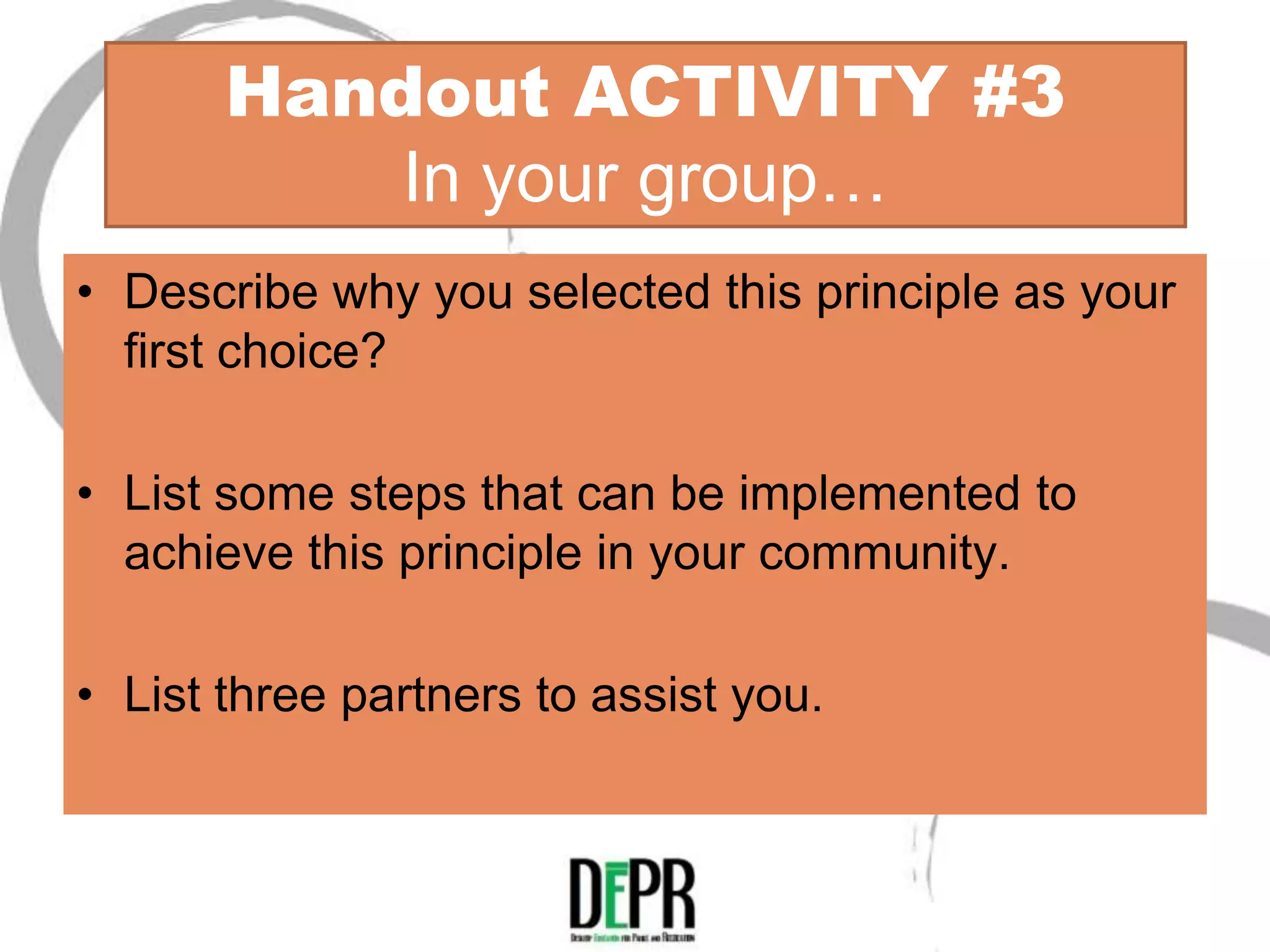
Handout ACTIVITY #3
           In your group…
• Describe why you selected this principle as your
  first choice?

• List some steps that can be implemented to
  achieve this principle in your community.

• List three partners to assist you.
Outcomes of Success
Youth who participated in our model will be
   more likely:
1. To graduate from high-school
2. To attend college/trade school for 1+ years
3. Not to be involved in the juvenile justice
   system
4. To Volunteer in other community activities
5. To come back to our program (become a
   mentor)
YOUTH MODELS
                                    .
• Search Institute - Asset Building 40
• America’s Promise - 4 Key Promises
  •   Caring Adults
  •   Safe Places
  •   A Healthy Start
  •   Effective Education Opportunities to Serve Other

• Community That Cares - Youth Bonded
• Leadership Concepts, Inc - Train and Engage


Tell us which model (if any) your
community is using.
MAKE AN IMPACT
• Training youth in skills such as group
  dynamics, project planning, personal
  goal setting, leadership…
• Engage them in the process as peer
  trainers
• Mentor them to adulthood
• Utilize as mentors for other youth
HOW TO DO IT?

• Train in a skill and engage them in an
  activity
• Find the trainers through partnership in
  the community or existing staff
• Come to the CPRS Teen Leadership
  Academy
Did you watch the
         videos?

At least ONE PERSON in our group
 watched both videos listed in the
 PRE-WEBINAR assignment


                                     24
Pre-Webinar Assignment #3
     Video Review -- Inocente

 Discuss and answer in the text box…

• How can a mentor put a child on the
  right path?
• How did one activity change the life of a
  child?


                                          25
Pre-Webinar Assignment #3
  Video Review “Caine’s Arcade”

• Please discuss with your group and
  answer the following in your text …
• What did this adult mentor do to help
  this 9 year‐old succeed?
• How does the community (world) benefit
  from the strengths of one child?


                                       26
Handout ACTIVITY #4


    STAFF EXERCISE
Think of five characteristics essential
for a leader.
Using these five characteristics create
a recipe for a leader using cooking
terms such as mix, boil, blend…
Share with us via your text box…
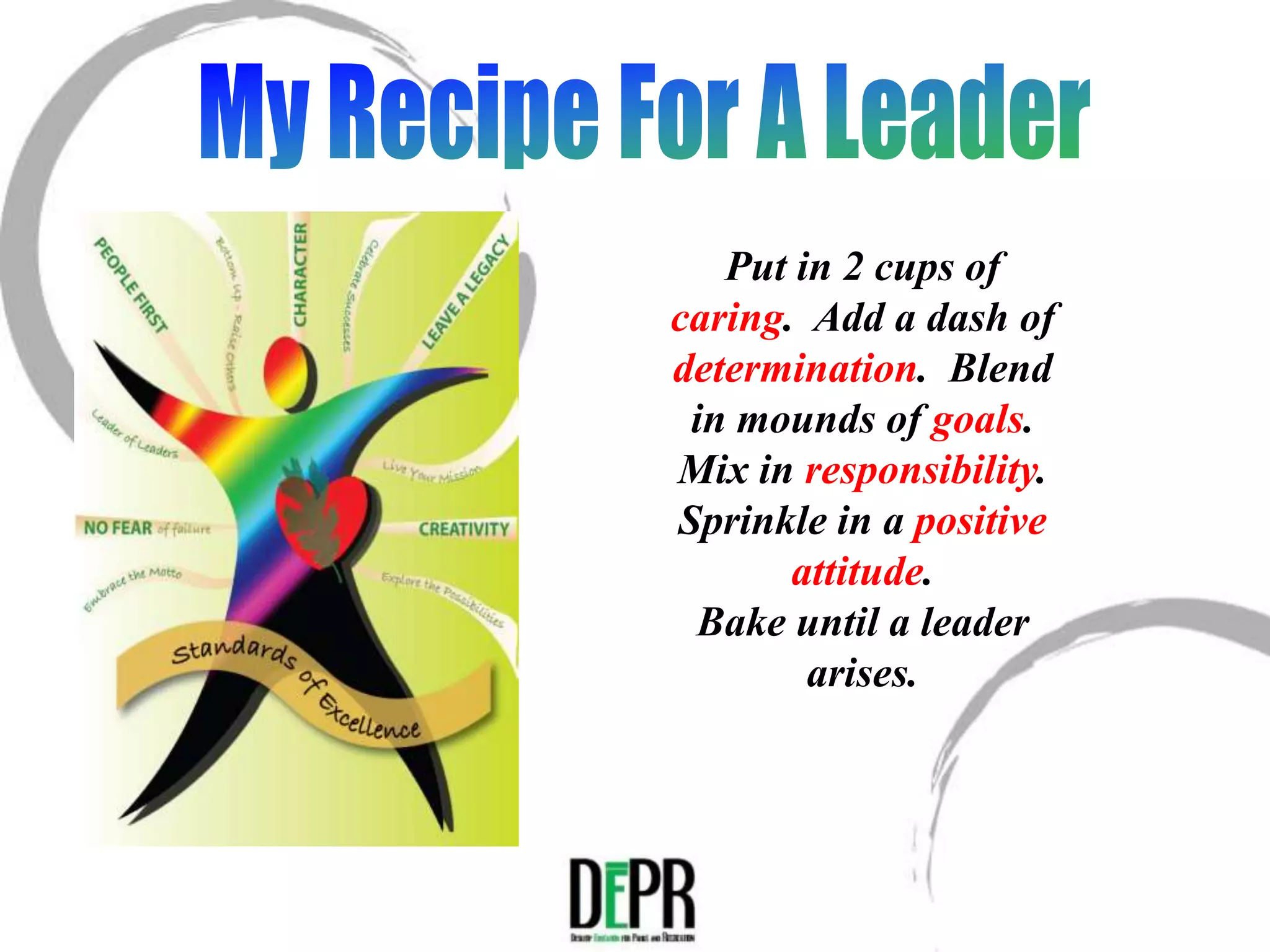
Put in 2 cups of
caring. Add a dash of
determination. Blend
 in mounds of goals.
Mix in responsibility.
Sprinkle in a positive
       attitude.
 Bake until a leader
        arises.
The IMPACT of Developing
           Youth Leaders
•   A capable workforce will enable us as a nation to compete in global
    markets.

•   Successful youth programs will prepare youth to be more competitive in
    the workforce, more responsible citizens to deal with their own welfare,
    less people in the criminal justice system, and economic benefits to the
    society’s growth.

•   The financial future of this nation depends on communities that nurture
    their future citizens to success.


“There can be no keener revelation of a society’s soul than the way in
            which it treats its children.” Nelson Mandela


                                                                               29
Where to Learn more…
   Websites to Explore
• www.fastweb.com - Scholarships

• www.collegeboard - Activities for college

• www.search-institute.org - List of asset resources

• www.americaspromise.org - Read their Annual Report

• www.youthfirstinc.org/programs/communities-that-
  care.aspxn - Prevention and research based

                                                       30
Share Your Resources…
Pre- Webinar Assignment Review
• Please list one of the resources you
  discovered and found valuable when
  you Googled “Youth Development
  Approaches.”
• What about this resource did you find
  valuable?


                                          31
Now you know…
  TODAY’s LEARNING OUTCOMES
• Communicate the fundamental principles of youth and
  leadership development in creating a framework for existing
  youth programming

• Discuss the role of youth advisors in encouraging youth leaders

• List and review outcomes that can evaluate and promote
  program success

• Identify resource tools and tips for youth training
Webinar References
• America’s Promise (2007). Every child, every promise: Turning failure
  into action. Washington: DC. America’s Promise. Retrieved:
  www.americaspromise.org

• http://gettingsmart.com/2012/12/meet-generation-z/

• Armstrong, B. (1996). “Creating whole villages to raise whole children.”
  Western Cities Magazine. May 1996 pp 6-9. Sacramento, CA: League of
  California Cities.

• Brideland, J.M., Diluilo, J.J. & Morison, K. B. (2006). The silent epidemic:
  Perspectives of high school dropouts. Washington, D.C.: Peter D. Hart
  Research Associates.

• http://usatoday30.usatoday.com/money/advertising/story/2012-05-
  03/naming-the-next-generation/54737518/1
PARTING THOUGHTS


“He who saves a single life,
 saves the entire world”
    --Inscribed on a ring given to Oscar Schindler


                                               34
Where will you go from here?


Please list the most valuable ideas,

strategies, things
you got out of this webinar…


                                       35
Feedback please…
How strongly do you agree with
       this statement…


  This webinar helped us explore and
         focus on creating a
youth development strategy for our
        agency or programs.


                                       36
Thank you for your hard work!
 • Virginia’s email: dot2dot_vc@hotmail.com
 • Don’t hesitate to contact Virginia about how to
   launch or implement a Youth Leadership
   Program in your organization.


                                                     37
Next Month’s Webinar…
• Marie Knight, City of Orange
• Make and Take Conflict Resolution: Face
to Face with Life’s Challenges


                                            38

Youth Leadership

  • 1.
    Your Role inYouth Success at Work and Beyond Presented by Virginia Nonaca Chavez 1
  • 2.
    Welcome to Make andTake Youth Leadership Before we begin… Please sign in using your text box. 1. Agency Name and number of people expected to attend today 2. About your group -- Will you have people attending today’s webinar who are SPECIFICALLY working with youth programs? 3. Name of people wishing to receive CEUs for this webinar (example: Jodi Rudick, CEUs) If anyone in your group has not yet watched the 3 minute Trailer at Inocentedoc.com, please show it for your group before we begin. (Make sure to open a new window or tab if viewing the video. Do NOT close out of the webinar room! ) Icebreaker Question… Please discuss and list some of the Youth Development Programs (formal or informal you were involved in when you were a “kid?” 2
  • 3.
    Desktop Education forParks And Recreation Welcome and Sign-In • We will mute all phone Please sign in (by typing lines before we begin. in the chat box): • YOU will be not be speaking during the webinar. However, • Agency Name and number YOU WILL use the webinar chat of people expected to and feedback box often. attend today • Phone audio is much more reliable than computer audio. If • About your group -- Will you are listening through your you have people attending computer speakers and have today’s webinar who are audio problems during the SPECIFICALLY working webinar PLEASE dial in to the with youth programs? conference number • Name of people wishing to 718.432.3900. Conference ID# receive CEUs for this 890590 webinar (example: Jodi • Have you downloaded and Rudick, CEUs printed a copy of your handouts? (Sent in today’s reminder update.) 3
  • 4.
    Two Part Activity Tellus about Your Agency Our agency is very committed to creating or offering programs which specifically focus on youth leadership. • In your text box list some of the youth leadership programs you offer. 4
  • 5.
    OPENING ACTIVITY Where doesthe United States rate academically compared to 28 other developing nations? a. 5th Place b. 10th Place c. 15th Place d. 20th Place http://www.greatschools.org/students/academic-skills/1075-u-s-students-compare.gs 5
  • 6.
    Name the Next Generation A. I Generation (Igen) F. Gen Z B. Gen Tech G. Post Generation (Post Gen) C. Gen WII H. Gen Next D. Net Gen I. Homeland Generation J. Pluralist Generation E. Digital Natives Type the name you think best depicts the NEXT generation. Tell us why you chose this answer!
  • 7.
    Traits of GenZ (?) Early1990s-2010 • Highly “Connected” - Lifelong use of communication and media technology (Digital Natives) World Wide Web Instant Messaging Text Messaging Mobile Phone • Pluralist Generation - Reflects their ethnic composition most diverse generation (Last to have a Caucasian Majority) • Least likely to believe in the “American Dream” • First generation to earn less than their parents.
  • 8.
    “No Action WITHOUT Research and No Research WITHOUT Action” --KURT LEWIN (Cooper Jackson, 2006, p. 139)
  • 9.
    QUESTIONS TO ASK whenplanning youth activities • Why are you doing the activity? • What are you trying to change or achieve in youth development in the activity? • How are you going to measure youth success and what is the outcome you hope for? “If what you are doing in youth development is not working why are you doing the same things? And why do you expect to get different results”
  • 10.
    Test Your YouthIQ - Diplomas • What percentage of public high school students fail to graduate? A. 15% B. 25% C. 25% D. 35% 10
  • 11.
    Test Your YouthIQ - Obesity • How many of today’s 12 – 19 year olds are overweight? A. 1 in 100 B. 1 in 25 C. 1 in 12 D. 1 in 6 11
  • 12.
    Test Your YouthIQ - Suicide • How many high school students admit that they have attempted suicide? A. 1 in 100 B. 1 in 25 C. 1 in 12 D. 1 in 6 12
  • 13.
    How did youdo? WHAT WE KNOW • Approximately 25% of all public high school students fail to graduate* • Approximately one in six American children between the ages 6-19 are overweight. • 1 in 12 high school students has attempted suicide • Nearly 1.6 million 12-19 year-olds are victims of violent crimes Study: “Every Child Every Promise” - A report from America’s Promise Alliance
  • 14.
    Handout ACTIVITY #1 What is your community doing to deal with these issues? A Better Question How are you engaging youth to deal with their own issues?
  • 15.
    Pre-Webinar Assignment #1 ReviewCPRS Youth Development Resources DEFINING YOUTH DEVELOPMENT A framework addressing human needs for the healthy growth of young people, including competencies (knowledge, skills, behaviors, values) necessary for adult success. CPRS Youth Development Committee
  • 16.
    PRINCIPLES TO SUCCESS • Treating youth as an equal partner • A safe & caring environment • A positive relationship with a caring adult • An opportunity to be involved in meaningful activities • Competencies (SKILLS) needed to be a successful adult
  • 17.
    Handout Activity #2 REALITY CHECK RESULTS NOT IN PLACE On your handout VALUE RANK each principle 1-5. 1 being the principle your community needs to work on (not in place yet) to 5 what’s in place in your community. Use each number only once. Treating youth as an equal partner A safe and caring environment A positive relationship with a caring adult An opportunity to be involved in meaningful activities Competencies (SKILLS) needed to be a successful adult
  • 18.
    Room for Improvement… Ofthe items listed in the previous activity: • Treating youth as an equal partner • A safe and caring environment • A positive relationship with a caring adult • An opportunity to be involved in meaningful activities • Competencies needed please discuss and type in your text box the principles that your agency most needs to incorporate into it’s youth development culture
  • 19.
    Handout ACTIVITY #3 In your group… • Describe why you selected this principle as your first choice? • List some steps that can be implemented to achieve this principle in your community. • List three partners to assist you.
  • 20.
    Outcomes of Success Youthwho participated in our model will be more likely: 1. To graduate from high-school 2. To attend college/trade school for 1+ years 3. Not to be involved in the juvenile justice system 4. To Volunteer in other community activities 5. To come back to our program (become a mentor)
  • 21.
    YOUTH MODELS . • Search Institute - Asset Building 40 • America’s Promise - 4 Key Promises • Caring Adults • Safe Places • A Healthy Start • Effective Education Opportunities to Serve Other • Community That Cares - Youth Bonded • Leadership Concepts, Inc - Train and Engage Tell us which model (if any) your community is using.
  • 22.
    MAKE AN IMPACT •Training youth in skills such as group dynamics, project planning, personal goal setting, leadership… • Engage them in the process as peer trainers • Mentor them to adulthood • Utilize as mentors for other youth
  • 23.
    HOW TO DOIT? • Train in a skill and engage them in an activity • Find the trainers through partnership in the community or existing staff • Come to the CPRS Teen Leadership Academy
  • 24.
    Did you watchthe videos? At least ONE PERSON in our group watched both videos listed in the PRE-WEBINAR assignment 24
  • 25.
    Pre-Webinar Assignment #3 Video Review -- Inocente Discuss and answer in the text box… • How can a mentor put a child on the right path? • How did one activity change the life of a child? 25
  • 26.
    Pre-Webinar Assignment #3 Video Review “Caine’s Arcade” • Please discuss with your group and answer the following in your text … • What did this adult mentor do to help this 9 year‐old succeed? • How does the community (world) benefit from the strengths of one child? 26
  • 27.
    Handout ACTIVITY #4 STAFF EXERCISE Think of five characteristics essential for a leader. Using these five characteristics create a recipe for a leader using cooking terms such as mix, boil, blend… Share with us via your text box…
  • 28.
    Put in 2cups of caring. Add a dash of determination. Blend in mounds of goals. Mix in responsibility. Sprinkle in a positive attitude. Bake until a leader arises.
  • 29.
    The IMPACT ofDeveloping Youth Leaders • A capable workforce will enable us as a nation to compete in global markets. • Successful youth programs will prepare youth to be more competitive in the workforce, more responsible citizens to deal with their own welfare, less people in the criminal justice system, and economic benefits to the society’s growth. • The financial future of this nation depends on communities that nurture their future citizens to success. “There can be no keener revelation of a society’s soul than the way in which it treats its children.” Nelson Mandela 29
  • 30.
    Where to Learnmore… Websites to Explore • www.fastweb.com - Scholarships • www.collegeboard - Activities for college • www.search-institute.org - List of asset resources • www.americaspromise.org - Read their Annual Report • www.youthfirstinc.org/programs/communities-that- care.aspxn - Prevention and research based 30
  • 31.
    Share Your Resources… Pre-Webinar Assignment Review • Please list one of the resources you discovered and found valuable when you Googled “Youth Development Approaches.” • What about this resource did you find valuable? 31
  • 32.
    Now you know… TODAY’s LEARNING OUTCOMES • Communicate the fundamental principles of youth and leadership development in creating a framework for existing youth programming • Discuss the role of youth advisors in encouraging youth leaders • List and review outcomes that can evaluate and promote program success • Identify resource tools and tips for youth training
  • 33.
    Webinar References • America’sPromise (2007). Every child, every promise: Turning failure into action. Washington: DC. America’s Promise. Retrieved: www.americaspromise.org • http://gettingsmart.com/2012/12/meet-generation-z/ • Armstrong, B. (1996). “Creating whole villages to raise whole children.” Western Cities Magazine. May 1996 pp 6-9. Sacramento, CA: League of California Cities. • Brideland, J.M., Diluilo, J.J. & Morison, K. B. (2006). The silent epidemic: Perspectives of high school dropouts. Washington, D.C.: Peter D. Hart Research Associates. • http://usatoday30.usatoday.com/money/advertising/story/2012-05- 03/naming-the-next-generation/54737518/1
  • 34.
    PARTING THOUGHTS “He whosaves a single life, saves the entire world” --Inscribed on a ring given to Oscar Schindler 34
  • 35.
    Where will yougo from here? Please list the most valuable ideas, strategies, things you got out of this webinar… 35
  • 36.
    Feedback please… How stronglydo you agree with this statement… This webinar helped us explore and focus on creating a youth development strategy for our agency or programs. 36
  • 37.
    Thank you foryour hard work! • Virginia’s email: dot2dot_vc@hotmail.com • Don’t hesitate to contact Virginia about how to launch or implement a Youth Leadership Program in your organization. 37
  • 38.
    Next Month’s Webinar… •Marie Knight, City of Orange • Make and Take Conflict Resolution: Face to Face with Life’s Challenges 38

Editor's Notes

  • #27 Can use this while training youth programming staff
  • #36 Jodi- fill in whatever you want---Merchandise? One how to use collateral idea?
  • #37 Jodi- fill in whatever you want---Merchandise? One how to use collateral idea?