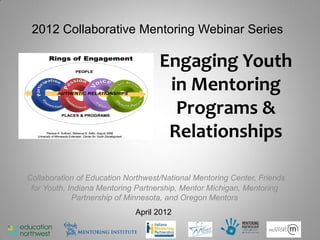
2012 Collaborative Mentoring Webinar Series

                                    Engaging Youth
                                     in Mentoring
                                      Programs &
                                     Relationships

Collaboration of Education Northwest/National Mentoring Center, Friends
 for Youth, Indiana Mentoring Partnership, Mentor Michigan, Mentoring
             Partnership of Minnesota, and Oregon Mentors
                             April 2012
Good to Know…
All attendees will receive an email after the webinar
that will include:

 Instructions for how to access PDF of
  presentation slides and webinar recording

 Link to the Mentoring Forum for resources,
  contact information & opportunities to continue
  the dialogue

  Please help us by taking the time to complete a
  short 5-question survey as you exit the webinar.

                                                        1
2012 Collaborative Mentoring
              Webinar Series
                                 Michael Garringer
        o Research               Resource Advisor & Forums
         o Practice              Administrator
                                 National Mentoring Center at
        o Innovation             Education Northwest


                                 Amber Troupe
Date: Third Thursday of every    Director
month.                           Mentor Michigan


Time: 10-11:15am Pacific/11am-
12:15pm Mountain/12-1:15 pm      April Riordan
Central/1-2:15pm Eastern         Director of Training & Community
                                 Partnerships
                                 Mentoring Partnership of Minnesota
Cost: Free


                                                                      2
Participate in Today’s Webinar
•   All attendees muted for best
    sound
•   Type questions and
    comments in the question
    box
•   We may invite you to “raise
    your hand” during interactive
    activities


                                     3
Today’s Webinar
1. What is Youth Engagement?
  – Why does it matter for mentoring programs?
    How do we do it? What gets in the way?
2. Youth Engagement in Action
  – National Youth Leadership Council (NYLC)
  – Youthprise & MN Alliance with Youth
  – YouthBuild USA – National Mentoring Alliance
3. Q & A


                                                   4
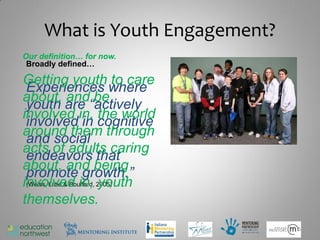
What is Youth Engagement?
Our definition… for now.
 Broadly defined…

Getting youth to care
 Experiences where
about, and be
 youth are “actively
involved in, the world
 involved in cognitive
around them through
 and social
acts of adults caring
 endeavors that
about, and being
 promote growth.”
involved in, 2005)
 (Weiss, Little & Bouffard, youth

themselves.
                                    5
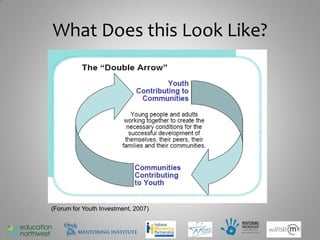
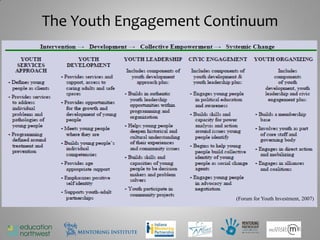
What Does this Look Like?


(Forum for Youth Investment, 2007)


                                     6
Levels of Engagement
• Engagement in the community
  (addressing big-picture concerns)
• Engagement in a relationships are at the
Authentic youth-adult program
 heart of allinto support and services)
  (buying     youth engagement experiences,
         both formal and informal.
                 (Sullivan, 2011)
• Engagement with people
  (relationships with caring adults)


                                              7
The Youth Engagement Continuum


                        (Forum for Youth Investment, 2007)


                                                  8
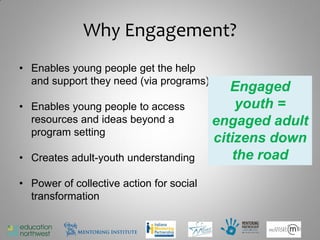
Why Engagement?
• Enables young people get the help
  and support they need (via programs)
                                             Engaged
• Enables young people to access              youth =
  resources and ideas beyond a            engaged adult
  program setting
                                          citizens down
• Creates adult-youth understanding          the road
• Power of collective action for social
  transformation

                                                     9
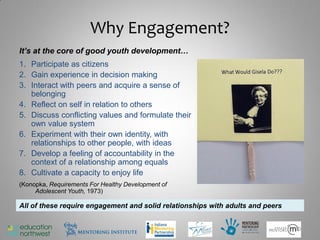
Why Engagement?
It’s at the core of good youth development…
1. Participate as citizens
2. Gain experience in decision making
3. Interact with peers and acquire a sense of
   belonging
4. Reflect on self in relation to others
5. Discuss conflicting values and formulate their
   own value system
6. Experiment with their own identity, with
   relationships to other people, with ideas
7. Develop a feeling of accountability in the
   context of a relationship among equals
8. Cultivate a capacity to enjoy life
(Konopka, Requirements For Healthy Development of
     Adolescent Youth, 1973)

All of these require engagement and solid relationships with adults and peers


                                                                                10
Unfortunately…

According to the Search Institute,      Social trends have left citizens of
almost 40% of 15 year olds don’t        all ages less engaged with one
score high on any of their three        another:
engagement scales
                                            privatization of leisure time
Older youth are far less likely to be       labor market changes
“engaged” (they control                     suburban sprawl
participation, not a parent)


Shifts in attitudes about youth
(behavior, culture, values) have
hurt generational relations


                                                                              11
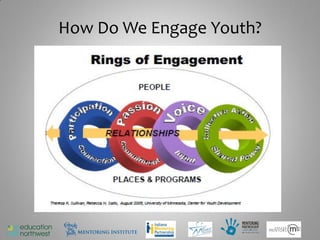
How Do We Engage Youth?


                          12
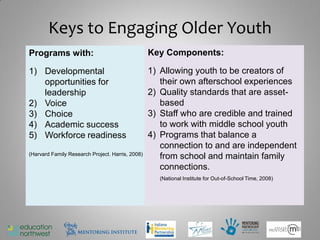
Keys to Engaging Older Youth
Programs with:                                    Key Components:

1) Developmental                                  1) Allowing youth to be creators of
   opportunities for                                 their own afterschool experiences
   leadership                                     2) Quality standards that are asset-
2) Voice                                             based
3) Choice                                         3) Staff who are credible and trained
4) Academic success                                  to work with middle school youth
5) Workforce readiness                            4) Programs that balance a
                                                     connection to and are independent
(Harvard Family Research Project. Harris, 2008)
                                                     from school and maintain family
                                                     connections.
                                                    (National Institute for Out-of-School Time, 2008)


                                                                                                        13
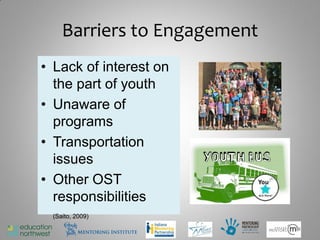
Barriers to Engagement
• Lack of interest on
  the part of youth
• Unaware of
  programs
• Transportation
  issues
• Other OST
  responsibilities
 (Saito, 2009)

                             14
Mentoring:
A Pathway to Youth Engagement
 True engagement with a mentor brings:

 • Increased participation in the relationship
 • Bonding with the overall program
 • Increased use of other supports (both in
   program and out)
 • Opportunity to use new skills and personal
   values
 • Skills for connecting with other mentors and
   caring adults


                                                  15
How Do Mentors Engage Youth?
• Finding the right blend of purposefulness
  and personal connection
• Giving the youth voice and choice
• Consistent interaction
• Opportunities to contribute to the world
  around them A good mentor will foster personal
                  growth, but also teach a young person
                   how to DO SOMETHING with all that
                                 growth.


                                                      16
What Do Youth Say About Engagement?
1. Spend time talking with       7. Laugh with us
   us                            8. Attend our concerts,
2. Listen, don’t multi-task or       games and other events
   get distracted when           9. Show that you have
   you’re with us                    confidence in us
3. Respond to our e-mail,        10. Ask us to help you, and
   voice and text messages           to show you what we can
4. Do what you say you are           do
   going to do                   11. Teach us what you know
5. Show appreciation for         12. Push us to do our best
   what we do
6. Relax, don’t feel like you
   have to be on your guard       (Scales et al., 2010)


                                                               17
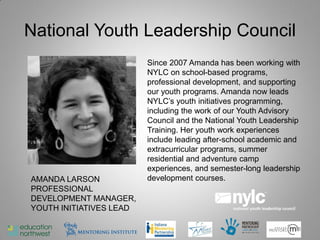
National Youth Leadership Council
                         Since 2007 Amanda has been working with
                         NYLC on school-based programs,
                         professional development, and supporting
                         our youth programs. Amanda now leads
                         NYLC’s youth initiatives programming,
                         including the work of our Youth Advisory
                         Council and the National Youth Leadership
                         Training. Her youth work experiences
                         include leading after-school academic and
                         extracurricular programs, summer
                         residential and adventure camp
                         experiences, and semester-long leadership
AMANDA LARSON            development courses.
PROFESSIONAL
DEVELOPMENT MANAGER,
YOUTH INITIATIVES LEAD

                                                                18
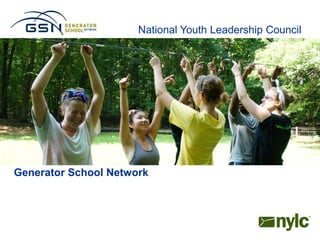
National Youth Leadership Council


Generator School Network
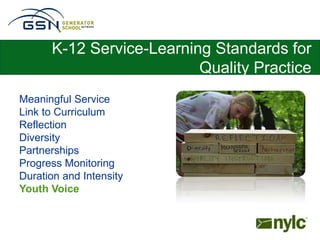
K-12 Service-Learning Standards for
                          Quality Practice
Meaningful Service
Link to Curriculum
Reflection
Diversity
Partnerships
Progress Monitoring
Duration and Intensity
Youth Voice
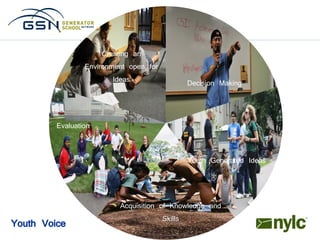
Creating an
                 Environment open for
                         Ideas              Decision Making


         Evaluation


                                            Youth Generated Ideas


                          Acquisition of Knowledge and
                                       Skills
Youth Voice
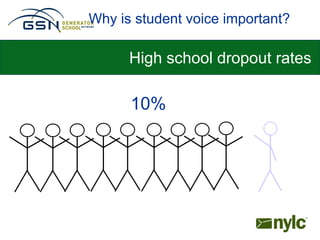
Why is student voice important?

      High school dropout rates

      10%
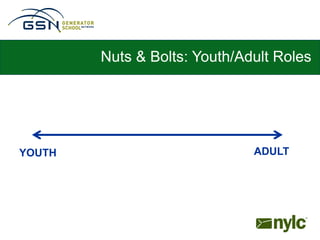
Nuts & Bolts: Youth/Adult Roles


YOUTH                         ADULT
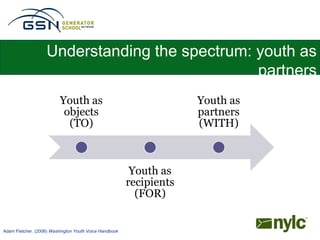
Understanding the spectrum: youth as
                                               partners


Adam Fletcher. (2006) Washington Youth Voice Handbook
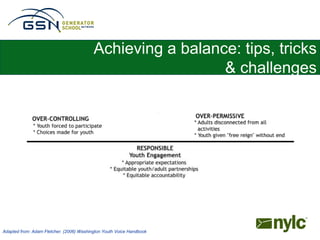
Achieving a balance: tips, tricks
                                                            & challenges


Adapted from: Adam Fletcher. (2006) Washington Youth Voice Handbook
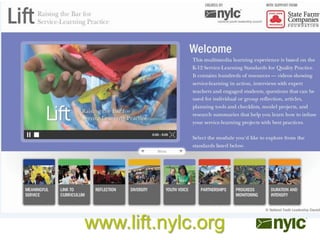
www.lift.nylc.org
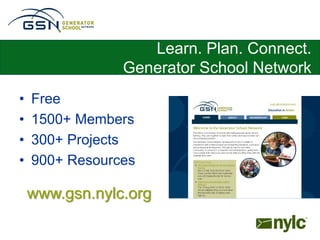
Learn. Plan. Connect.
                Generator School Network
•   Free
•   1500+ Members
•   300+ Projects
•   900+ Resources

    www.gsn.nylc.org
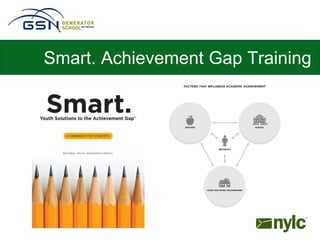
Smart. Achievement Gap Training
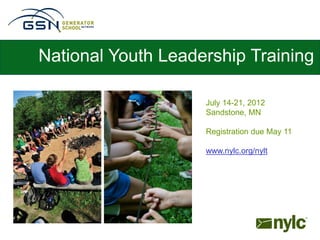
National Youth Leadership Training

                    July 14-21, 2012
                    Sandstone, MN

                    Registration due May 11

                    www.nylc.org/nylt
For more information

 National Youth Leadership Council
           www.nylc.org


Amanda Larson, Youth Initiatives Lead
  alarson@nylc.org, 651.999.7362
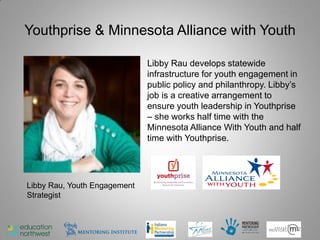
Youthprise & Minnesota Alliance with Youth

                              Libby Rau develops statewide
                              infrastructure for youth engagement in
                              public policy and philanthropy. Libby’s
                              job is a creative arrangement to
                              ensure youth leadership in Youthprise
                              – she works half time with the
                              Minnesota Alliance With Youth and half
                              time with Youthprise.


Libby Rau, Youth Engagement
Strategist


                                                                   32
COST SHARED POSITION

   In collaboration with MN Alliance with Youth & Youthprise
       1 position description
       Shared vision and goals
       Collective impact
       Leverage resources
       Model of authentic partnership
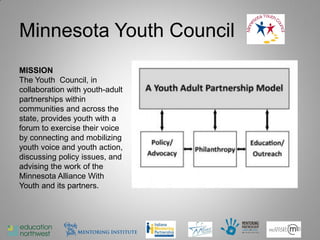
MINNESOTA YOUTH COUNCIL

   State-wide council 36 youth and 36 adult partners (4 in
    each of the 8 congressional districts and 4 at large)

   Youth Adult Partnership Model
       Policy/Advocacy
       Philanthropy
       Education/Outreach
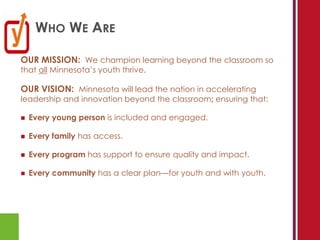
WHO WE ARE

OUR MISSION: We champion learning beyond the classroom so
that all Minnesota’s youth thrive.

OUR VISION: Minnesota will lead the nation in accelerating
leadership and innovation beyond the classroom; ensuring that:

   Every young person is included and engaged.

   Every family has access.

   Every program has support to ensure quality and impact.

   Every community has a clear plan—for youth and with youth.
OUR GOALS
   Mobilize the power of youth to enliven, expand and transform programs
    and systems.

   Expand access to quality learning experiences that prepare youth for
    education, work and civic life.

   Advance integrated, community-based systems that increase
    opportunities and improve outcomes for all youth.

   Leverage and grow resources to close the opportunity gap for under-
    engaged and under-served youth.

   Ignite public insistence on engaging, accessible, quality learning
    opportunities for all youth.
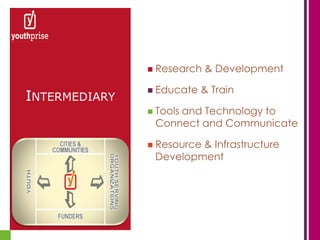
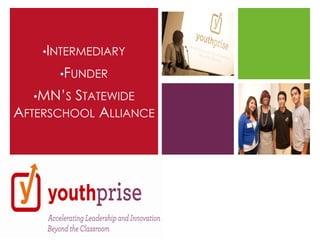
•INTERMEDIARY

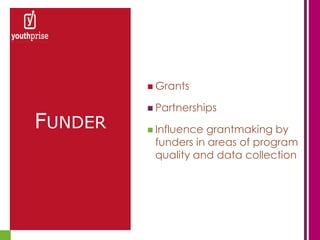
      •FUNDER

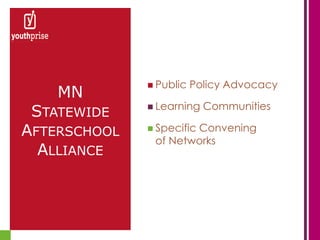
  •MN’S  STATEWIDE
AFTERSCHOOL ALLIANCE
 Research   & Development

                Educate   & Train
INTERMEDIARY
                Tools
                    and Technology to
                Connect and Communicate

                Resource
                        & Infrastructure
                Development
 Grants

          Partnerships

FUNDER    Influencegrantmaking by
          funders in areas of program
          quality and data collection
 Public   Policy Advocacy
    MN
               Learning   Communities
 STATEWIDE
AFTERSCHOOL    Specific
                      Convening
               of Networks
  ALLIANCE
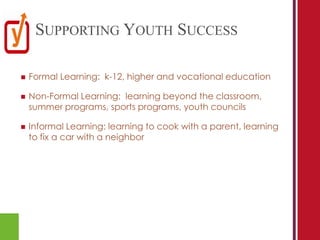
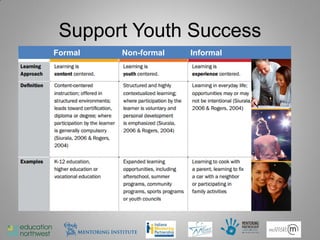
SUPPORTING YOUTH SUCCESS

   Formal Learning: k-12, higher and vocational education

   Non-Formal Learning: learning beyond the classroom,
    summer programs, sports programs, youth councils

   Informal Learning: learning to cook with a parent, learning
    to fix a car with a neighbor
Minnesota Youth Council
MISSION
The Youth Council, in
collaboration with youth-adult
partnerships within
communities and across the
state, provides youth with a
forum to exercise their voice
by connecting and mobilizing
youth voice and youth action,
discussing policy issues, and
advising the work of the
Minnesota Alliance With
Youth and its partners.


                                 43
Support Youth Success
Formal   Non-formal   Informal
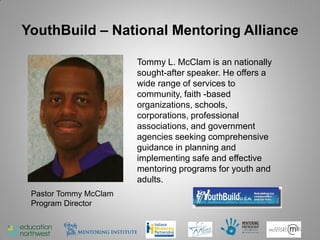
YouthBuild – National Mentoring Alliance

                       Tommy L. McClam is an nationally
                       sought-after speaker. He offers a
                       wide range of services to
                       community, faith -based
                       organizations, schools,
                       corporations, professional
                       associations, and government
                       agencies seeking comprehensive
                       guidance in planning and
                       implementing safe and effective
                       mentoring programs for youth and
                       adults.
 Pastor Tommy McClam
 Program Director


                                                           45
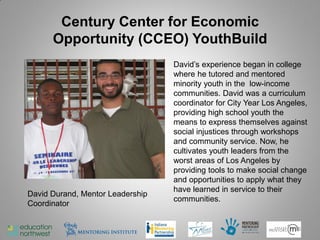
Century Center for Economic
      Opportunity (CCEO) YouthBuild
                                  David’s experience began in college
                                  where he tutored and mentored
                                  minority youth in the low-income
                                  communities. David was a curriculum
                                  coordinator for City Year Los Angeles,
                                  providing high school youth the
                                  means to express themselves against
                                  social injustices through workshops
                                  and community service. Now, he
                                  cultivates youth leaders from the
                                  worst areas of Los Angeles by
                                  providing tools to make social change
                                  and opportunities to apply what they
                                  have learned in service to their
David Durand, Mentor Leadership
                                  communities.
Coordinator


                                                                    46
47
48
49
50
Before we go…
All attendees will receive an email after the webinar
that will include:

 Instructions for how to access PDF of
  presentation slides and webinar recording

 Link to the Mentoring Forum for resources,
  contact information & opportunities to continue
  the dialogue

  Please help us by taking the time to complete a
  short 5-question survey as you exit the webinar.

                                                        51
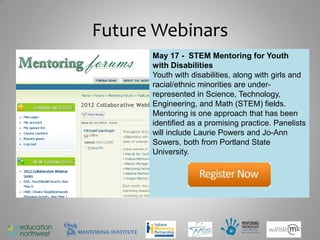
Future Webinars
      May 17 - STEM Mentoring for Youth
      with Disabilities
      Youth with disabilities, along with girls and
      racial/ethnic minorities are under-
      represented in Science, Technology,
      Engineering, and Math (STEM) fields.
      Mentoring is one approach that has been
      identified as a promising practice. Panelists
      will include Laurie Powers and Jo-Ann
      Sowers, both from Portland State
      University.


                                               52
2012 Collaborative Mentoring Webinar Series


                       Thank you!
      Michael Garringer, michael.garringer@educationnorthwest.org
              Celeste Janssen, celeste@oregonmentors.org
               Sarah Kremer, sarah@friendsforyouth.org
                     April Riordan, april@mpmn.org
                 Amber Troupe, troupea@michigan.gov
                   December Warren, dwarren@iyi.org


Collaboration of Education Northwest/National Mentoring Center, Friends
 for Youth, Indiana Mentoring Partnership, Mentor Michigan, Mentoring
             Partnership of Minnesota, and Oregon Mentors

Engaging Youth in Mentoring Programs & Relationships

  • 1.
    2012 Collaborative MentoringWebinar Series Engaging Youth in Mentoring Programs & Relationships Collaboration of Education Northwest/National Mentoring Center, Friends for Youth, Indiana Mentoring Partnership, Mentor Michigan, Mentoring Partnership of Minnesota, and Oregon Mentors April 2012
  • 2.
    Good to Know… Allattendees will receive an email after the webinar that will include:  Instructions for how to access PDF of presentation slides and webinar recording  Link to the Mentoring Forum for resources, contact information & opportunities to continue the dialogue Please help us by taking the time to complete a short 5-question survey as you exit the webinar. 1
  • 3.
    2012 Collaborative Mentoring Webinar Series Michael Garringer o Research Resource Advisor & Forums o Practice Administrator National Mentoring Center at o Innovation Education Northwest Amber Troupe Date: Third Thursday of every Director month. Mentor Michigan Time: 10-11:15am Pacific/11am- 12:15pm Mountain/12-1:15 pm April Riordan Central/1-2:15pm Eastern Director of Training & Community Partnerships Mentoring Partnership of Minnesota Cost: Free 2
  • 4.
    Participate in Today’sWebinar • All attendees muted for best sound • Type questions and comments in the question box • We may invite you to “raise your hand” during interactive activities 3
  • 5.
    Today’s Webinar 1. Whatis Youth Engagement? – Why does it matter for mentoring programs? How do we do it? What gets in the way? 2. Youth Engagement in Action – National Youth Leadership Council (NYLC) – Youthprise & MN Alliance with Youth – YouthBuild USA – National Mentoring Alliance 3. Q & A 4
  • 6.
    What is YouthEngagement? Our definition… for now. Broadly defined… Getting youth to care Experiences where about, and be youth are “actively involved in, the world involved in cognitive around them through and social acts of adults caring endeavors that about, and being promote growth.” involved in, 2005) (Weiss, Little & Bouffard, youth themselves. 5
  • 7.
    What Does thisLook Like? (Forum for Youth Investment, 2007) 6
  • 8.
    Levels of Engagement •Engagement in the community (addressing big-picture concerns) • Engagement in a relationships are at the Authentic youth-adult program heart of allinto support and services) (buying youth engagement experiences, both formal and informal. (Sullivan, 2011) • Engagement with people (relationships with caring adults) 7
  • 9.
    The Youth EngagementContinuum (Forum for Youth Investment, 2007) 8
  • 10.
    Why Engagement? • Enablesyoung people get the help and support they need (via programs) Engaged • Enables young people to access youth = resources and ideas beyond a engaged adult program setting citizens down • Creates adult-youth understanding the road • Power of collective action for social transformation 9
  • 11.
    Why Engagement? It’s atthe core of good youth development… 1. Participate as citizens 2. Gain experience in decision making 3. Interact with peers and acquire a sense of belonging 4. Reflect on self in relation to others 5. Discuss conflicting values and formulate their own value system 6. Experiment with their own identity, with relationships to other people, with ideas 7. Develop a feeling of accountability in the context of a relationship among equals 8. Cultivate a capacity to enjoy life (Konopka, Requirements For Healthy Development of Adolescent Youth, 1973) All of these require engagement and solid relationships with adults and peers 10
  • 12.
    Unfortunately… According to theSearch Institute, Social trends have left citizens of almost 40% of 15 year olds don’t all ages less engaged with one score high on any of their three another: engagement scales  privatization of leisure time Older youth are far less likely to be  labor market changes “engaged” (they control  suburban sprawl participation, not a parent) Shifts in attitudes about youth (behavior, culture, values) have hurt generational relations 11
  • 13.
    How Do WeEngage Youth? 12
  • 14.
    Keys to EngagingOlder Youth Programs with: Key Components: 1) Developmental 1) Allowing youth to be creators of opportunities for their own afterschool experiences leadership 2) Quality standards that are asset- 2) Voice based 3) Choice 3) Staff who are credible and trained 4) Academic success to work with middle school youth 5) Workforce readiness 4) Programs that balance a connection to and are independent (Harvard Family Research Project. Harris, 2008) from school and maintain family connections. (National Institute for Out-of-School Time, 2008) 13
  • 15.
    Barriers to Engagement •Lack of interest on the part of youth • Unaware of programs • Transportation issues • Other OST responsibilities (Saito, 2009) 14
  • 16.
    Mentoring: A Pathway toYouth Engagement True engagement with a mentor brings: • Increased participation in the relationship • Bonding with the overall program • Increased use of other supports (both in program and out) • Opportunity to use new skills and personal values • Skills for connecting with other mentors and caring adults 15
  • 17.
    How Do MentorsEngage Youth? • Finding the right blend of purposefulness and personal connection • Giving the youth voice and choice • Consistent interaction • Opportunities to contribute to the world around them A good mentor will foster personal growth, but also teach a young person how to DO SOMETHING with all that growth. 16
  • 18.
    What Do YouthSay About Engagement? 1. Spend time talking with 7. Laugh with us us 8. Attend our concerts, 2. Listen, don’t multi-task or games and other events get distracted when 9. Show that you have you’re with us confidence in us 3. Respond to our e-mail, 10. Ask us to help you, and voice and text messages to show you what we can 4. Do what you say you are do going to do 11. Teach us what you know 5. Show appreciation for 12. Push us to do our best what we do 6. Relax, don’t feel like you have to be on your guard (Scales et al., 2010) 17
  • 19.
    National Youth LeadershipCouncil Since 2007 Amanda has been working with NYLC on school-based programs, professional development, and supporting our youth programs. Amanda now leads NYLC’s youth initiatives programming, including the work of our Youth Advisory Council and the National Youth Leadership Training. Her youth work experiences include leading after-school academic and extracurricular programs, summer residential and adventure camp experiences, and semester-long leadership AMANDA LARSON development courses. PROFESSIONAL DEVELOPMENT MANAGER, YOUTH INITIATIVES LEAD 18
  • 20.
    National Youth LeadershipCouncil Generator School Network
  • 21.
    K-12 Service-Learning Standardsfor Quality Practice Meaningful Service Link to Curriculum Reflection Diversity Partnerships Progress Monitoring Duration and Intensity Youth Voice
  • 23.
    Creating an Environment open for Ideas Decision Making Evaluation Youth Generated Ideas Acquisition of Knowledge and Skills Youth Voice
  • 24.
    Why is studentvoice important? High school dropout rates 10%
  • 25.
    Nuts & Bolts:Youth/Adult Roles YOUTH ADULT
  • 26.
    Understanding the spectrum:youth as partners Adam Fletcher. (2006) Washington Youth Voice Handbook
  • 27.
    Achieving a balance:tips, tricks & challenges Adapted from: Adam Fletcher. (2006) Washington Youth Voice Handbook
  • 28.
  • 29.
    Learn. Plan. Connect. Generator School Network • Free • 1500+ Members • 300+ Projects • 900+ Resources www.gsn.nylc.org
  • 30.
  • 31.
    National Youth LeadershipTraining July 14-21, 2012 Sandstone, MN Registration due May 11 www.nylc.org/nylt
  • 32.
    For more information National Youth Leadership Council www.nylc.org Amanda Larson, Youth Initiatives Lead alarson@nylc.org, 651.999.7362
  • 33.
    Youthprise & MinnesotaAlliance with Youth Libby Rau develops statewide infrastructure for youth engagement in public policy and philanthropy. Libby’s job is a creative arrangement to ensure youth leadership in Youthprise – she works half time with the Minnesota Alliance With Youth and half time with Youthprise. Libby Rau, Youth Engagement Strategist 32
  • 35.
    COST SHARED POSITION  In collaboration with MN Alliance with Youth & Youthprise  1 position description  Shared vision and goals  Collective impact  Leverage resources  Model of authentic partnership
  • 36.
    MINNESOTA YOUTH COUNCIL  State-wide council 36 youth and 36 adult partners (4 in each of the 8 congressional districts and 4 at large)  Youth Adult Partnership Model  Policy/Advocacy  Philanthropy  Education/Outreach
  • 37.
    WHO WE ARE OURMISSION: We champion learning beyond the classroom so that all Minnesota’s youth thrive. OUR VISION: Minnesota will lead the nation in accelerating leadership and innovation beyond the classroom; ensuring that:  Every young person is included and engaged.  Every family has access.  Every program has support to ensure quality and impact.  Every community has a clear plan—for youth and with youth.
  • 38.
    OUR GOALS  Mobilize the power of youth to enliven, expand and transform programs and systems.  Expand access to quality learning experiences that prepare youth for education, work and civic life.  Advance integrated, community-based systems that increase opportunities and improve outcomes for all youth.  Leverage and grow resources to close the opportunity gap for under- engaged and under-served youth.  Ignite public insistence on engaging, accessible, quality learning opportunities for all youth.
  • 39.
    •INTERMEDIARY •FUNDER •MN’S STATEWIDE AFTERSCHOOL ALLIANCE
  • 40.
     Research & Development  Educate & Train INTERMEDIARY  Tools and Technology to Connect and Communicate  Resource & Infrastructure Development
  • 41.
     Grants  Partnerships FUNDER  Influencegrantmaking by funders in areas of program quality and data collection
  • 42.
     Public Policy Advocacy MN  Learning Communities STATEWIDE AFTERSCHOOL  Specific Convening of Networks ALLIANCE
  • 43.
    SUPPORTING YOUTH SUCCESS  Formal Learning: k-12, higher and vocational education  Non-Formal Learning: learning beyond the classroom, summer programs, sports programs, youth councils  Informal Learning: learning to cook with a parent, learning to fix a car with a neighbor
  • 44.
    Minnesota Youth Council MISSION TheYouth Council, in collaboration with youth-adult partnerships within communities and across the state, provides youth with a forum to exercise their voice by connecting and mobilizing youth voice and youth action, discussing policy issues, and advising the work of the Minnesota Alliance With Youth and its partners. 43
  • 45.
    Support Youth Success Formal Non-formal Informal
  • 46.
    YouthBuild – NationalMentoring Alliance Tommy L. McClam is an nationally sought-after speaker. He offers a wide range of services to community, faith -based organizations, schools, corporations, professional associations, and government agencies seeking comprehensive guidance in planning and implementing safe and effective mentoring programs for youth and adults. Pastor Tommy McClam Program Director 45
  • 47.
    Century Center forEconomic Opportunity (CCEO) YouthBuild David’s experience began in college where he tutored and mentored minority youth in the low-income communities. David was a curriculum coordinator for City Year Los Angeles, providing high school youth the means to express themselves against social injustices through workshops and community service. Now, he cultivates youth leaders from the worst areas of Los Angeles by providing tools to make social change and opportunities to apply what they have learned in service to their David Durand, Mentor Leadership communities. Coordinator 46
  • 48.
  • 49.
  • 50.
  • 51.
  • 52.
    Before we go… Allattendees will receive an email after the webinar that will include:  Instructions for how to access PDF of presentation slides and webinar recording  Link to the Mentoring Forum for resources, contact information & opportunities to continue the dialogue Please help us by taking the time to complete a short 5-question survey as you exit the webinar. 51
  • 53.
    Future Webinars May 17 - STEM Mentoring for Youth with Disabilities Youth with disabilities, along with girls and racial/ethnic minorities are under- represented in Science, Technology, Engineering, and Math (STEM) fields. Mentoring is one approach that has been identified as a promising practice. Panelists will include Laurie Powers and Jo-Ann Sowers, both from Portland State University. 52
  • 54.
    2012 Collaborative MentoringWebinar Series Thank you! Michael Garringer, michael.garringer@educationnorthwest.org Celeste Janssen, celeste@oregonmentors.org Sarah Kremer, sarah@friendsforyouth.org April Riordan, april@mpmn.org Amber Troupe, troupea@michigan.gov December Warren, dwarren@iyi.org Collaboration of Education Northwest/National Mentoring Center, Friends for Youth, Indiana Mentoring Partnership, Mentor Michigan, Mentoring Partnership of Minnesota, and Oregon Mentors