






SRI BALAJI VIDYAPEETH
(Deemed University Accredited with “A” Grade by NAAC)
Centre for Yoga Therapy, Education
and Research (CYTER)
Salutogenesis, our focus!
RETAINING “YOGA” IN
YOGA THERAPY
Presented by
Dr Meena Ramanathan
Deputy Director & Associate Professor,
CYTER of Sri Balaji Vidyapeeth, Pondicherry .
www,sbvu.ac.in/cyter
Presented at the Conference on Philosophy and Practice of Yoga: Issues of
Authenticity, integrity and Ingenuity. 15-16 Feb 2020. Bangalore, India
Disclaimer
Acknowledge with deep sense of
gratitude and thank all those whose
creations I have used through the
known and unknown sources in this
presentation
Acknowledgements
Special and sincere acknowledgements and
thanks to my Guru
Dr Ananda Balayogi Bhavanani
for magnanimously permitting me to use his
materials in this presentation
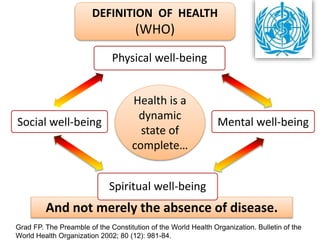
And not merely the absence of disease.
Physical well-being
Mental well-being
Spiritual well-being
Social well-being
DEFINITION OF HEALTH
(WHO)
Health is a
dynamic
state of
complete…
Grad FP. The Preamble of the Constitution of the World Health Organization. Bulletin of the
World Health Organization 2002; 80 (12): 981-84.
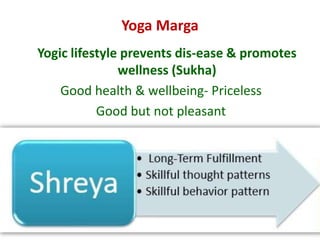
Yoga Marga
Yogic lifestyle prevents dis-ease & promotes
wellness (Sukha)
Good health & wellbeing- Priceless
Good but not pleasant
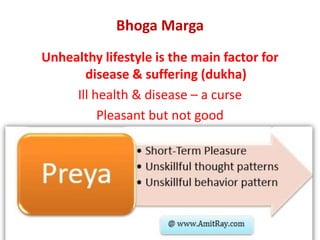
Bhoga Marga
Unhealthy lifestyle is the main factor for
disease & suffering (dukha)
Ill health & disease – a curse
Pleasant but not good
YOGA & YOGA THERAPY
• YOGA is the process & state of integrative
synchrony of mind-body-spirit
• Dissolution of individual (microcosm) into the
Infinite (macrocosm)
• YOGA THERAPY consists of the concepts & tools
to attain state of integrative synchrony.
• It requires in-depth knowledge of yogic practice
& not just ability
– to perform advanced asanas (or)
– treat aches & pains
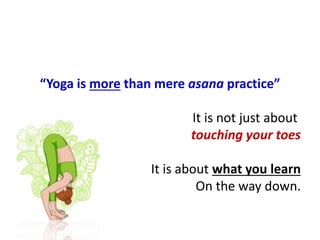
“Yoga is more than mere asana practice”
It is not just about
touching your toes
It is about what you learn
On the way down.
Bhavanani AB, Sullivan M, Taylor MJ, Wheeler A. Shared Foundations for Practice: The
Language of Yoga Therapy. Yoga Therapy Today 2019. 15 (3): 44-47.
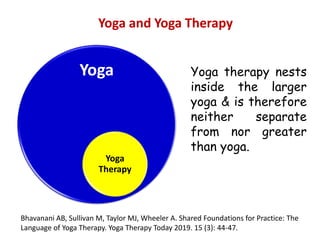
Yoga
Yoga
Therapy
Yoga therapy nests
inside the larger
yoga & is therefore
neither separate
from nor greater
than yoga.
Yoga and Yoga Therapy
“Yoga therapy is the process of
empowering individuals to
progress toward improved health
and wellbeing through the
application of the teachings and
practices of Yoga”. – IAYT
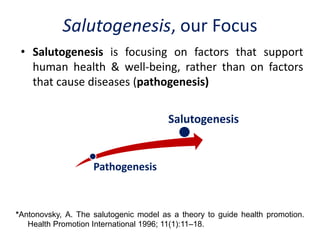
Salutogenesis, our Focus
• Salutogenesis is focusing on factors that support
human health & well-being, rather than on factors
that cause diseases (pathogenesis)
Pathogenesis
Salutogenesis
*Antonovsky, A. The salutogenic model as a theory to guide health promotion.
Health Promotion International 1996; 11(1):11–18.
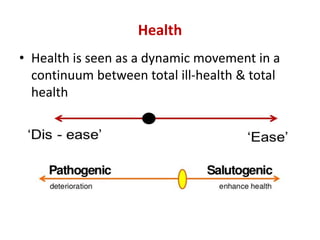
Health
• Health is seen as a dynamic movement in a
continuum between total ill-health & total
health
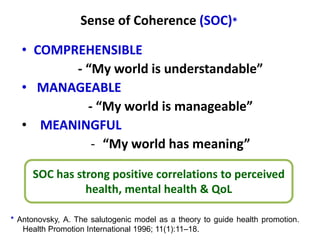
Sense of Coherence (SOC)*
• COMPREHENSIBLE
- “My world is understandable”
• MANAGEABLE
- “My world is manageable”
• MEANINGFUL
- “My world has meaning”
SOC has strong positive correlations to perceived
health, mental health & QoL
* Antonovsky, A. The salutogenic model as a theory to guide health promotion.
Health Promotion International 1996; 11(1):11–18.
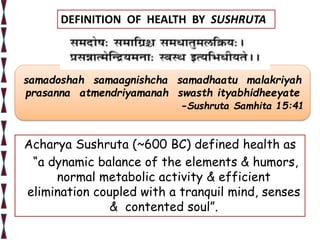
Acharya Sushruta (~600 BC) defined health as
“a dynamic balance of the elements & humors,
normal metabolic activity & efficient
elimination coupled with a tranquil mind, senses
& contented soul”.
DEFINITION OF HEALTH BY SUSHRUTA
samadoshah samaagnishcha samadhaatu malakriyah
prasanna atmendriyamanah swasth ityabhidheeyate
-Sushruta Samhita 15:41
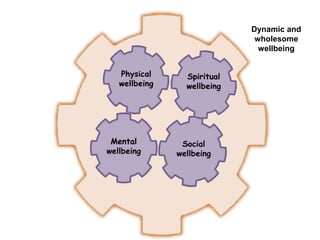
Physical
wellbeing
Mental
wellbeing
Social
wellbeing
Dynamic and
wholesome
wellbeing
Spiritual
wellbeing
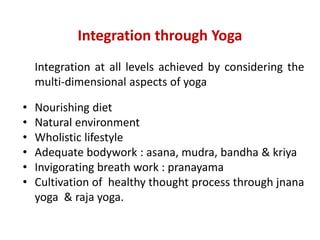
Integration through Yoga
Integration at all levels achieved by considering the
multi-dimensional aspects of yoga
• Nourishing diet
• Natural environment
• Wholistic lifestyle
• Adequate bodywork : asana, mudra, bandha & kriya
• Invigorating breath work : pranayama
• Cultivation of healthy thought process through jnana
yoga & raja yoga.
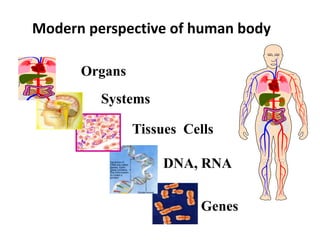
Systems
Tissues Cells
DNA, RNA
Genes
Organs
Modern perspective of human body
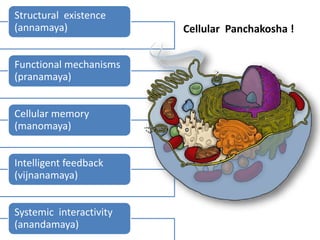
Structural existence
(annamaya)
Functional mechanisms
(pranamaya)
Cellular memory
(manomaya)
Intelligent feedback
(vijnanamaya)
Systemic interactivity
(anandamaya)
Cellular Panchakosha !
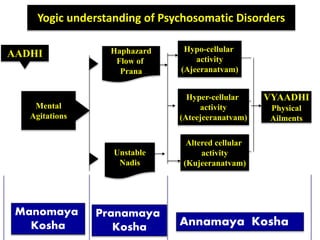
Mental
Agitations
Haphazard
Flow of
Prana
Unstable
Nadis
Hypo-cellular
activity
(Ajeeranatvam)
Hyper-cellular
activity
(Ateejeeranatvam)
Altered cellular
activity
(Kujeeranatvam)
VYAADHI
Physical
Ailments
Yogic understanding of Psychosomatic Disorders
AADHI
Manomaya
Kosha Annamaya Kosha
Pranamaya
Kosha
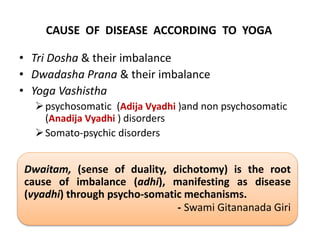
CAUSE OF DISEASE ACCORDING TO YOGA
• Tri Dosha & their imbalance
• Dwadasha Prana & their imbalance
• Yoga Vashistha
psychosomatic (Adija Vyadhi )and non psychosomatic
(Anadija Vyadhi ) disorders
Somato-psychic disorders
Dwaitam, (sense of duality, dichotomy) is the root
cause of imbalance (adhi), manifesting as disease
(vyadhi) through psycho-somatic mechanisms.
- Swami Gitananada Giri
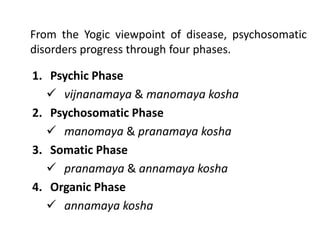
From the Yogic viewpoint of disease, psychosomatic
disorders progress through four phases.
1. Psychic Phase
 vijnanamaya & manomaya kosha
2. Psychosomatic Phase
 manomaya & pranamaya kosha
3. Somatic Phase
 pranamaya & annamaya kosha
4. Organic Phase
 annamaya kosha
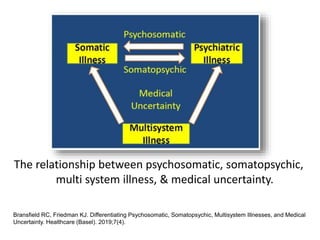
The relationship between psychosomatic, somatopsychic,
multi system illness, & medical uncertainty.
Bransfield RC, Friedman KJ. Differentiating Psychosomatic, Somatopsychic, Multisystem Illnesses, and Medical
Uncertainty. Healthcare (Basel). 2019;7(4).
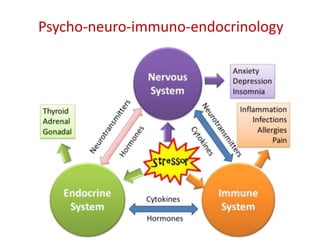
Psycho-neuro-immuno-endocrinology
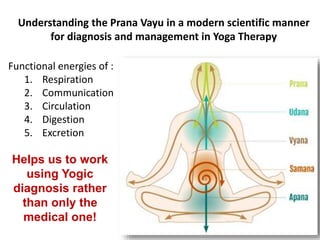
Understanding the Prana Vayu in a modern scientific manner
for diagnosis and management in Yoga Therapy
Functional energies of :
1. Respiration
2. Communication
3. Circulation
4. Digestion
5. Excretion
Helps us to work
using Yogic
diagnosis rather
than only the
medical one!
Yoga places great importance on a proper and healthy
lifestyle whose main components are:
• ACHAR – healthy physical activities & exercise
• VICHAR – right thoughts and right attitude towards
life that are vital for wellbeing.
• AHAR – healthy, nourishing diet with adequate intake
of fresh water; balanced intake of fresh food, green
salads, sprouts, unrefined cereals & fresh fruits.
Sattwic diet, prepared & served with love & affection.
• VIHAR – proper recreational activities to relax body
and mind are essential for good health.
• VYAVAHAR – healthy relationships for social health
* Bhavanani AB. Are we practicing yoga therapy or yogopathy? Yoga Therapy
Today 2011; 7 (2): 26-28
Yoga Therapy “without” Yoga
Will no longer be Yoga Therapy
• Yoga Chikitsa is based on salutogenesis
• Yogopathy * is based on pathogenesis
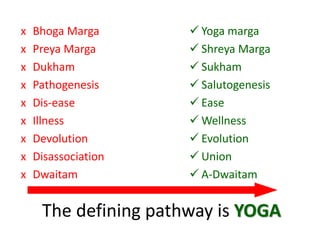
The defining pathway is YOGA
x Bhoga Marga
x Preya Marga
x Dukham
x Pathogenesis
x Dis-ease
x Illness
x Devolution
x Disassociation
x Dwaitam
 Yoga marga
 Shreya Marga
 Sukham
 Salutogenesis
 Ease
 Wellness
 Evolution
 Union
 A-Dwaitam
Conclusion
• The ultimate aim & goal of any system of treatment
is to generate optimal health & well being
though methodology differs in each.
• While modern science looks outward for the cause of
all ills, the Yogi searches depths of his own self.
This two way search can lead us to
many answers for the troubles
that plague modern man.
May we all be blessed to travel this
yogic journey!
Hari om tat sat
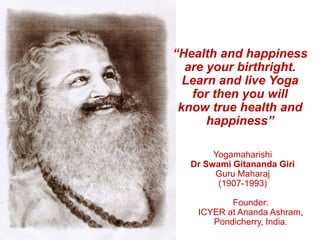
“Health and happiness
are your birthright.
Learn and live Yoga
for then you will
know true health and
happiness”
Yogamaharishi
Dr Swami Gitananda Giri
Guru Maharaj
(1907-1993)
Founder:
ICYER at Ananda Ashram,
Pondicherry, India.
References
1. Grad FP. The Preamble of the Constitution of the World Health Organization. Bulletin of the
World Health Organization 2002; 80 (12): 981-84.
2. Bhavanani AB, Sullivan M, Taylor MJ, Wheeler A. Shared Foundations for Practice: The
Language of Yoga Therapy. Yoga Therapy Today 2019. 15 (3): 44-47.
3. Antonovsky, A. The salutogenic model as a theory to guide health promotion. Health
Promotion International 1996; 11(1):11–18.
4. Taylor MJ. What is yoga therapy? An IAYT definition. Yoga Therapy in Practice 2007;3.
5. Bransfield RC, Friedman KJ. Differentiating Psychosomatic, Somatopsychic, Multisystem
Illnesses, and Medical Uncertainty. Healthcare (Basel). 2019;7(4).
6. Bhavanani AB. Are we practicing yoga therapy or yogopathy? Yoga Therapy Today 2011; 7
(2): 26-28
7. Bhavanani AB. Psychosomatic mechanisms of yoga. Annals of SBV 2013; 2 (2): 27-31.
8. Bhavanani AB. Yoga Chikitsa: Application of Yoga as a therapy. Pondicherry, India:
Dhivyananda Creations; 2013
9. Innes et al (2005) Risk indices associated with the insulin resistance syndrome,
cardiovascular disease, and possible protection with yoga: a systematic review ; Nov-
Dec;18(6):491-519
10. Ramanathan M, Bhavanani AB. Understanding how yoga works: a short review of findings
from CYTER, Pondicherry, India. EJPMR 2017; 4(1): 256-262.
11. Ramanathan Meena. Applied Yoga. Pondicherry, India: AarogyaYogalayam; 2007
12. Streeter, et al. (2007) Yoga Asana sessions increase brain GABA levels: a pilot study
(Journal of Alternative and Complementary Medicine, May, 13(4):419-26)
13. The evaluation of a mind/body intervention to reduce psychological distress and perceived
stress in college students. Deckro GR, Benson H; J Am Coll Health. 2002 May;50(6):281-7.
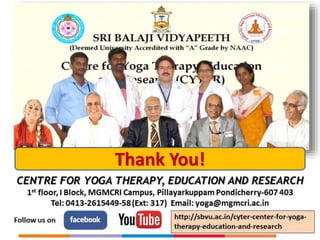
Thank You!

RETAINING “YOGA” IN YOGA THERAPY

  • 1.
    SRI BALAJI VIDYAPEETH (DeemedUniversity Accredited with “A” Grade by NAAC) Centre for Yoga Therapy, Education and Research (CYTER) Salutogenesis, our focus!
  • 2.
    RETAINING “YOGA” IN YOGATHERAPY Presented by Dr Meena Ramanathan Deputy Director & Associate Professor, CYTER of Sri Balaji Vidyapeeth, Pondicherry . www,sbvu.ac.in/cyter Presented at the Conference on Philosophy and Practice of Yoga: Issues of Authenticity, integrity and Ingenuity. 15-16 Feb 2020. Bangalore, India
  • 3.
    Disclaimer Acknowledge with deepsense of gratitude and thank all those whose creations I have used through the known and unknown sources in this presentation
  • 4.
    Acknowledgements Special and sincereacknowledgements and thanks to my Guru Dr Ananda Balayogi Bhavanani for magnanimously permitting me to use his materials in this presentation
  • 5.
    And not merelythe absence of disease. Physical well-being Mental well-being Spiritual well-being Social well-being DEFINITION OF HEALTH (WHO) Health is a dynamic state of complete… Grad FP. The Preamble of the Constitution of the World Health Organization. Bulletin of the World Health Organization 2002; 80 (12): 981-84.
  • 6.
    Yoga Marga Yogic lifestyleprevents dis-ease & promotes wellness (Sukha) Good health & wellbeing- Priceless Good but not pleasant
  • 7.
    Bhoga Marga Unhealthy lifestyleis the main factor for disease & suffering (dukha) Ill health & disease – a curse Pleasant but not good
  • 9.
    YOGA & YOGATHERAPY • YOGA is the process & state of integrative synchrony of mind-body-spirit • Dissolution of individual (microcosm) into the Infinite (macrocosm) • YOGA THERAPY consists of the concepts & tools to attain state of integrative synchrony. • It requires in-depth knowledge of yogic practice & not just ability – to perform advanced asanas (or) – treat aches & pains
  • 10.
    “Yoga is morethan mere asana practice” It is not just about touching your toes It is about what you learn On the way down.
  • 11.
    Bhavanani AB, SullivanM, Taylor MJ, Wheeler A. Shared Foundations for Practice: The Language of Yoga Therapy. Yoga Therapy Today 2019. 15 (3): 44-47. Yoga Yoga Therapy Yoga therapy nests inside the larger yoga & is therefore neither separate from nor greater than yoga. Yoga and Yoga Therapy
  • 12.
    “Yoga therapy isthe process of empowering individuals to progress toward improved health and wellbeing through the application of the teachings and practices of Yoga”. – IAYT
  • 13.
    Salutogenesis, our Focus •Salutogenesis is focusing on factors that support human health & well-being, rather than on factors that cause diseases (pathogenesis) Pathogenesis Salutogenesis *Antonovsky, A. The salutogenic model as a theory to guide health promotion. Health Promotion International 1996; 11(1):11–18.
  • 14.
    Health • Health isseen as a dynamic movement in a continuum between total ill-health & total health
  • 15.
    Sense of Coherence(SOC)* • COMPREHENSIBLE - “My world is understandable” • MANAGEABLE - “My world is manageable” • MEANINGFUL - “My world has meaning” SOC has strong positive correlations to perceived health, mental health & QoL * Antonovsky, A. The salutogenic model as a theory to guide health promotion. Health Promotion International 1996; 11(1):11–18.
  • 16.
    Acharya Sushruta (~600BC) defined health as “a dynamic balance of the elements & humors, normal metabolic activity & efficient elimination coupled with a tranquil mind, senses & contented soul”. DEFINITION OF HEALTH BY SUSHRUTA samadoshah samaagnishcha samadhaatu malakriyah prasanna atmendriyamanah swasth ityabhidheeyate -Sushruta Samhita 15:41
  • 18.
  • 19.
    Integration through Yoga Integrationat all levels achieved by considering the multi-dimensional aspects of yoga • Nourishing diet • Natural environment • Wholistic lifestyle • Adequate bodywork : asana, mudra, bandha & kriya • Invigorating breath work : pranayama • Cultivation of healthy thought process through jnana yoga & raja yoga.
  • 21.
  • 22.
    Structural existence (annamaya) Functional mechanisms (pranamaya) Cellularmemory (manomaya) Intelligent feedback (vijnanamaya) Systemic interactivity (anandamaya) Cellular Panchakosha !
  • 23.
  • 24.
    CAUSE OF DISEASEACCORDING TO YOGA • Tri Dosha & their imbalance • Dwadasha Prana & their imbalance • Yoga Vashistha psychosomatic (Adija Vyadhi )and non psychosomatic (Anadija Vyadhi ) disorders Somato-psychic disorders Dwaitam, (sense of duality, dichotomy) is the root cause of imbalance (adhi), manifesting as disease (vyadhi) through psycho-somatic mechanisms. - Swami Gitananada Giri
  • 25.
    From the Yogicviewpoint of disease, psychosomatic disorders progress through four phases. 1. Psychic Phase  vijnanamaya & manomaya kosha 2. Psychosomatic Phase  manomaya & pranamaya kosha 3. Somatic Phase  pranamaya & annamaya kosha 4. Organic Phase  annamaya kosha
  • 26.
    The relationship betweenpsychosomatic, somatopsychic, multi system illness, & medical uncertainty. Bransfield RC, Friedman KJ. Differentiating Psychosomatic, Somatopsychic, Multisystem Illnesses, and Medical Uncertainty. Healthcare (Basel). 2019;7(4).
  • 27.
  • 28.
    Understanding the PranaVayu in a modern scientific manner for diagnosis and management in Yoga Therapy Functional energies of : 1. Respiration 2. Communication 3. Circulation 4. Digestion 5. Excretion Helps us to work using Yogic diagnosis rather than only the medical one!
  • 29.
    Yoga places greatimportance on a proper and healthy lifestyle whose main components are: • ACHAR – healthy physical activities & exercise • VICHAR – right thoughts and right attitude towards life that are vital for wellbeing. • AHAR – healthy, nourishing diet with adequate intake of fresh water; balanced intake of fresh food, green salads, sprouts, unrefined cereals & fresh fruits. Sattwic diet, prepared & served with love & affection. • VIHAR – proper recreational activities to relax body and mind are essential for good health. • VYAVAHAR – healthy relationships for social health
  • 30.
    * Bhavanani AB.Are we practicing yoga therapy or yogopathy? Yoga Therapy Today 2011; 7 (2): 26-28 Yoga Therapy “without” Yoga Will no longer be Yoga Therapy • Yoga Chikitsa is based on salutogenesis • Yogopathy * is based on pathogenesis
  • 31.
    The defining pathwayis YOGA x Bhoga Marga x Preya Marga x Dukham x Pathogenesis x Dis-ease x Illness x Devolution x Disassociation x Dwaitam  Yoga marga  Shreya Marga  Sukham  Salutogenesis  Ease  Wellness  Evolution  Union  A-Dwaitam
  • 32.
    Conclusion • The ultimateaim & goal of any system of treatment is to generate optimal health & well being though methodology differs in each. • While modern science looks outward for the cause of all ills, the Yogi searches depths of his own self. This two way search can lead us to many answers for the troubles that plague modern man.
  • 35.
    May we allbe blessed to travel this yogic journey! Hari om tat sat
  • 36.
    “Health and happiness areyour birthright. Learn and live Yoga for then you will know true health and happiness” Yogamaharishi Dr Swami Gitananda Giri Guru Maharaj (1907-1993) Founder: ICYER at Ananda Ashram, Pondicherry, India.
  • 37.
    References 1. Grad FP.The Preamble of the Constitution of the World Health Organization. Bulletin of the World Health Organization 2002; 80 (12): 981-84. 2. Bhavanani AB, Sullivan M, Taylor MJ, Wheeler A. Shared Foundations for Practice: The Language of Yoga Therapy. Yoga Therapy Today 2019. 15 (3): 44-47. 3. Antonovsky, A. The salutogenic model as a theory to guide health promotion. Health Promotion International 1996; 11(1):11–18. 4. Taylor MJ. What is yoga therapy? An IAYT definition. Yoga Therapy in Practice 2007;3. 5. Bransfield RC, Friedman KJ. Differentiating Psychosomatic, Somatopsychic, Multisystem Illnesses, and Medical Uncertainty. Healthcare (Basel). 2019;7(4). 6. Bhavanani AB. Are we practicing yoga therapy or yogopathy? Yoga Therapy Today 2011; 7 (2): 26-28 7. Bhavanani AB. Psychosomatic mechanisms of yoga. Annals of SBV 2013; 2 (2): 27-31. 8. Bhavanani AB. Yoga Chikitsa: Application of Yoga as a therapy. Pondicherry, India: Dhivyananda Creations; 2013 9. Innes et al (2005) Risk indices associated with the insulin resistance syndrome, cardiovascular disease, and possible protection with yoga: a systematic review ; Nov- Dec;18(6):491-519 10. Ramanathan M, Bhavanani AB. Understanding how yoga works: a short review of findings from CYTER, Pondicherry, India. EJPMR 2017; 4(1): 256-262. 11. Ramanathan Meena. Applied Yoga. Pondicherry, India: AarogyaYogalayam; 2007 12. Streeter, et al. (2007) Yoga Asana sessions increase brain GABA levels: a pilot study (Journal of Alternative and Complementary Medicine, May, 13(4):419-26) 13. The evaluation of a mind/body intervention to reduce psychological distress and perceived stress in college students. Deckro GR, Benson H; J Am Coll Health. 2002 May;50(6):281-7.
  • 38.

Editor's Notes

  • #6 So how can we achieve this??? By walking the path of yoga
  • #7 Tough, but propels you to spiral upwards – elevates the individual to evolution .. Health & well-being are understood as a dynamic continuum of human nature & not a ‘state’ to be attained & maintained.
  • #8 Deranged thoughts and emotions leading to unhealthy habit patterns…. Pushes the individual downwards to devolution
  • #14 S is the medical approach that focusses on…
  • #16 3 components of Sense of Coherence (SOC), The heart of Salutogenesis is SOC . it's a mixture of optimism and control.
  • #18 Maharishi Patanjali has gifted this to us centuries ago… in the form of Ashtanga yoga wherein
  • #19 So…how do we keep this connectivity sustained??? How to stay integrated?? Yoga has many suggestions
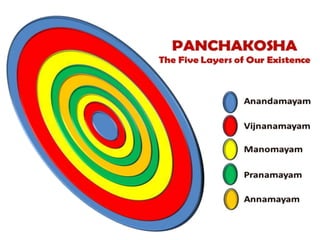
  • #21 To understand the multi dimensional nature of man… we need to understand pancha koshas, the various levels of existence . Yogic perspective
  • #23 Anna- anatomical existence . prana- physiological functioning of the cell. Mano- mind, the memory of the cell which helps the cell to function, say how the liver cell has its specific memory and methodof working etc… vijnana is kind of the feedback mechanism of the cell that helps it to discriminate whether more is needed or less…how much to function etc …. Individual cell interacting with other cells, and each is interconnected to the others …influences each other. … like the diff systems functioning together… to the individual cell, u are the universe. To us the individual being..universe lies out there… andam-pindam-
  • #24 Man has this tendency of often focussing on what is happening on the “outside”—i.e., what we think is happening around us (perceive) or what we may encounter—causes a constant emotional turbulence ‘turning-on’ the adi-vyadhi vicious cycle Yoga teaches us that the physical diseases manifest as a result of the digestive imbalances that may be hypo, hyper or deranged in nature (Ajjeranatvam, Atijeeranatvam and Kujeeranatvam). Yoga also teaches us about the approach to food, the types of food as well as the importance of timings and moderation in diet. A combination of the modern aspects of diet with a dose of Yogic thought can help us eat not only the right things but also in the right way and at the right time thus ensuing our good health and longevity.
  • #27 difficulty differentiating between psychosomatic, somatopsychic, multisystem illness, and different degrees of medical uncertainty. Many "all in your head" conditions may be related to the microbiome and the immune system
  • #28 The multi system illness dysfunctioning … where does it all start ?? What is the source??? The culprit is Ur mind--- the way u perceive things… the stressors… affecting all angles…
  • #29 RSA is differential change of HR in response to inspiration & expiration & a non-invasive sensitive index of parasympathetic cardiac control. based on variation of HR with respiration wherein inspiration increases HR while expiration decreases it. thus playing a role in cardiovascular regulation and health [9].
  • #30 thus playing a role in cardiovascular regulation and health [9].
  • #31 Hathenas are forcing techniques, consisting of asanas , kriyas and mudras to mindfully utilise all parts of lungs by cons forcing air into all the broncho pul segments. …
  • #36 Musk deer roam for miles. An important goal of the deer is the discovery of the source from which the fragrance emerges. Practically, the deer is madly in love with it. But, it never finds the source or the truth.
  • #37 We look outside for motivation/ inspiration/ happiness….