YOGA AND LIFE STYLE
UNIT 3
BY SCHOLAR SAKSHAM HAJELA
PGT-P.H.ED
CONTENTS
Obesity: procedure, benefits and contraindications for Tadasana, Katichakrasana,
Pavanmuktasana, Matsayasana, Halasana, Pachimottansana, Ardha – Matsyendrasana,
Dhanurasana, Ushtrasana, Suryabedhan pranayama.
Diabetes: procedure, benefits and contraindications for Katichakrasana,
Pavanmuktasana,Bhujangasana, Shalabhasana, Dhanurasana, Supta-vajarasana,
Paschimottanasana, Ardha-Mastendrasana, Mandukasana, Gomukasana, Yogmudra,
Ushtrasana, Kapalabhati.
Asthma: procedure, benefits and contraindications for Tadasana,
Urdhwahastottansana, UttanMandukasana, Bhujangasana, Dhanurasana, Ushtrasana,
Vakrasana, Kapalbhati, Gomukhasana Matsyaasana, Anuloma-Viloma.
Hypertension: procedure, benefits and contraindications for Tadasana,
Katichakransan, Uttanpadasana, Ardha Halasana, Sarala Matyasana, Gomukhasana,
UttanMandukasana, Vakrasana, Bhujangasana, Makarasana, Shavasana, Nadi-
shodhanapranayam, Sitlipranayam.
Back Pain and Arthritis:procedure, benefits and contraindications for
Tadasana, Urdhawahastootansana, Ardh-Chakrasana, Ushtrasana, Vakrasana, Sarala
Maysyendrsana, Bhujandgasana, Gomukhasana, Bhadrasana, Makarasana, Nadi-Shodhana
pranayama
ASANAS
‱ Acc. To Patanjali,” sthiram sukham asanam” i.e., “ that position which is comfortable and
steady”
‱ In Brahamanopanishad, “To sit in a comfortable position or posture for everlasting period is
called asana”.
‱ “Lifestyle is the way of life or style of living that reflects the attitudes and values of a person
or group.”
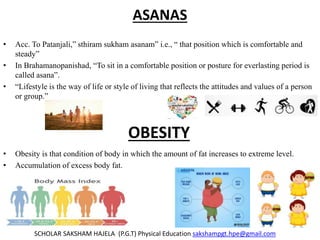
‱ Obesity is that condition of body in which the amount of fat increases to extreme level.
‱ Accumulation of excess body fat.
SCHOLAR SAKSHAM HAJELA (P.G.T) Physical Education sakshampgt.hpe@gmail.com
OBESITY
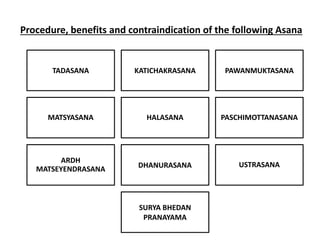
Procedure, benefits and contraindication of the following Asana
TADASANA KATICHAKRASANA PAWANMUKTASANA
MATSYASANA HALASANA PASCHIMOTTANASANA
ARDH
MATSEYENDRASANA DHANURASANA USTRASANA
SURYA BHEDAN
PRANAYAMA
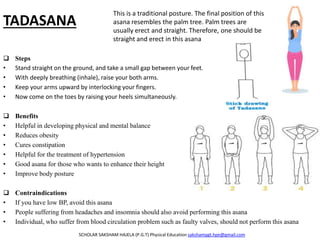
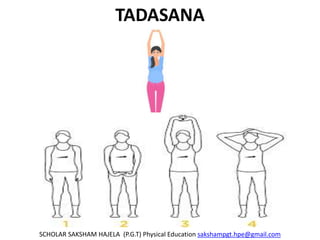
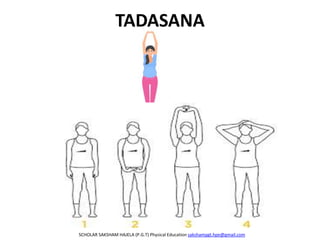
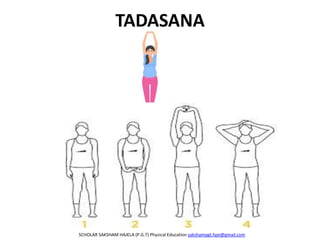
TADASANA
 Steps
‱ Stand straight on the ground, and take a small gap between your feet.
‱ With deeply breathing (inhale), raise your both arms.
‱ Keep your arms upward by interlocking your fingers.
‱ Now come on the toes by raising your heels simultaneously.
 Benefits
‱ Helpful in developing physical and mental balance
‱ Reduces obesity
‱ Cures constipation
‱ Helpful for the treatment of hypertension
‱ Good asana for those who wants to enhance their height
‱ Improve body posture
 Contraindications
‱ If you have low BP, avoid this asana
‱ People suffering from headaches and insomnia should also avoid performing this asana
‱ Individual, who suffer from blood circulation problem such as faulty valves, should not perform this asana
SCHOLAR SAKSHAM HAJELA (P.G.T) Physical Education sakshampgt.hpe@gmail.com
This is a traditional posture. The final position of this
asana resembles the palm tree. Palm trees are
usually erect and straight. Therefore, one should be
straight and erect in this asana
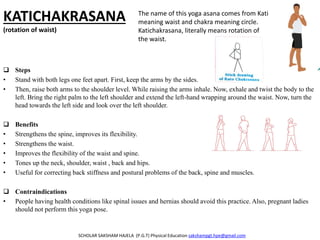
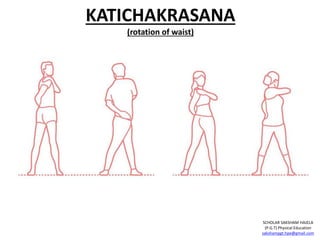
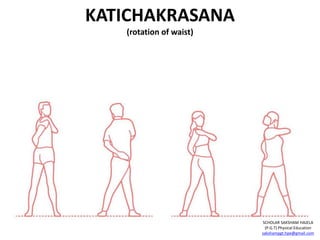
KATICHAKRASANA
(rotation of waist)
 Steps
‱ Stand with both legs one feet apart. First, keep the arms by the sides.
‱ Then, raise both arms to the shoulder level. While raising the arms inhale. Now, exhale and twist the body to the
left. Bring the right palm to the left shoulder and extend the left-hand wrapping around the waist. Now, turn the
head towards the left side and look over the left shoulder.
 Benefits
‱ Strengthens the spine, improves its flexibility.
‱ Strengthens the waist.
‱ Improves the flexibility of the waist and spine.
‱ Tones up the neck, shoulder, waist , back and hips.
‱ Useful for correcting back stiffness and postural problems of the back, spine and muscles.
 Contraindications
‱ People having health conditions like spinal issues and hernias should avoid this practice. Also, pregnant ladies
should not perform this yoga pose.
SCHOLAR SAKSHAM HAJELA (P.G.T) Physical Education sakshampgt.hpe@gmail.com
The name of this yoga asana comes from Kati
meaning waist and chakra meaning circle.
Katichakrasana, literally means rotation of
the waist.
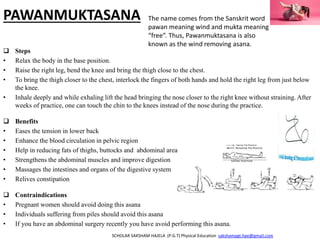
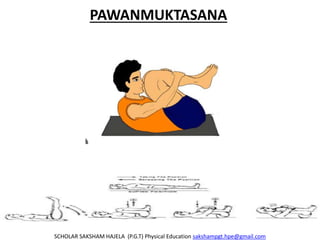
PAWANMUKTASANA
 Steps
‱ Relax the body in the base position.
‱ Raise the right leg, bend the knee and bring the thigh close to the chest.
‱ To bring the thigh closer to the chest, interlock the fingers of both hands and hold the right leg from just below
the knee.
‱ Inhale deeply and while exhaling lift the head bringing the nose closer to the right knee without straining. After
weeks of practice, one can touch the chin to the knees instead of the nose during the practice.
 Benefits
‱ Eases the tension in lower back
‱ Enhance the blood circulation in pelvic region
‱ Help in reducing fats of thighs, buttocks and abdominal area
‱ Strengthens the abdominal muscles and improve digestion
‱ Massages the intestines and organs of the digestive system
‱ Relives constipation
 Contraindications
‱ Pregnant women should avoid doing this asana
‱ Individuals suffering from piles should avoid this asana
‱ If you have an abdominal surgery recently you have avoid performing this asana.
SCHOLAR SAKSHAM HAJELA (P.G.T) Physical Education sakshampgt.hpe@gmail.com
The name comes from the Sanskrit word
pawan meaning wind and mukta meaning
“free”. Thus, Pawanmuktasana is also
known as the wind removing asana.
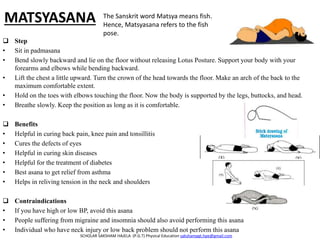
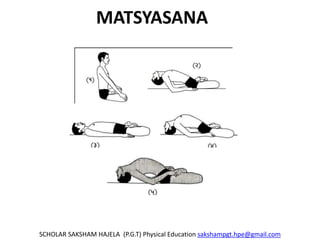
MATSYASANA
 Step
‱ Sit in padmasana
‱ Bend slowly backward and lie on the floor without releasing Lotus Posture. Support your body with your
forearms and elbows while bending backward.
‱ Lift the chest a little upward. Turn the crown of the head towards the floor. Make an arch of the back to the
maximum comfortable extent.
‱ Hold on the toes with elbows touching the floor. Now the body is supported by the legs, buttocks, and head.
‱ Breathe slowly. Keep the position as long as it is comfortable.
 Benefits
‱ Helpful in curing back pain, knee pain and tonsillitis
‱ Cures the defects of eyes
‱ Helpful in curing skin diseases
‱ Helpful for the treatment of diabetes
‱ Best asana to get relief from asthma
‱ Helps in reliving tension in the neck and shoulders
 Contraindications
‱ If you have high or low BP, avoid this asana
‱ People suffering from migraine and insomnia should also avoid performing this asana
‱ Individual who have neck injury or low back problem should not perform this asana
SCHOLAR SAKSHAM HAJELA (P.G.T) Physical Education sakshampgt.hpe@gmail.com
The Sanskrit word Matsya means fish.
Hence, Matsyasana refers to the fish
pose.
HALASANA
 Steps
‱ Lie on your back with your arms next to your body and palms pressing into the floor. As you inhale, lift your
legs to 90 degrees. As you exhale, roll your pelvis off the floor, moving your legs back toward your head. Slowly
lower your legs over your head, toward the floor.
 Benefits
‱ Improves digestion and appetite.
‱ Improve blood circulation.
‱ Strengthens the thigh muscles and calf muscles.
‱ Helpful to reduce abdomen fat and lose weight.
‱ Stimulates the abdominal organs.
 Contraindication
‱ People suffering from any cardiac problem, back pain, high blood pressure should avoid this practice.
SCHOLAR SAKSHAM HAJELA (P.G.T) Physical Education sakshampgt.hpe@gmail.com
Hala means plough. This posture is known
as Halasana because in its final position the
shape of the body resembles the Indian
plough.
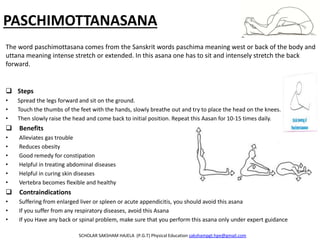
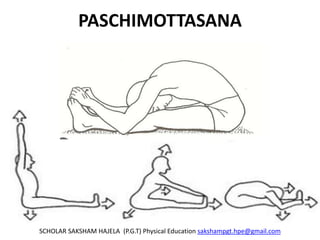
PASCHIMOTTANASANA
 Steps
‱ Spread the legs forward and sit on the ground.
‱ Touch the thumbs of the feet with the hands, slowly breathe out and try to place the head on the knees.
‱ Then slowly raise the head and come back to initial position. Repeat this Aasan for 10-15 times daily.
 Benefits
‱ Alleviates gas trouble
‱ Reduces obesity
‱ Good remedy for constipation
‱ Helpful in treating abdominal diseases
‱ Helpful in curing skin diseases
‱ Vertebra becomes flexible and healthy
 Contraindications
‱ Suffering from enlarged liver or spleen or acute appendicitis, you should avoid this asana
‱ If you suffer from any respiratory diseases, avoid this Asana
‱ If you Have any back or spinal problem, make sure that you perform this asana only under expert guidance
SCHOLAR SAKSHAM HAJELA (P.G.T) Physical Education sakshampgt.hpe@gmail.com
The word paschimottasana comes from the Sanskrit words paschima meaning west or back of the body and
uttana meaning intense stretch or extended. In this asana one has to sit and intensely stretch the back
forward.
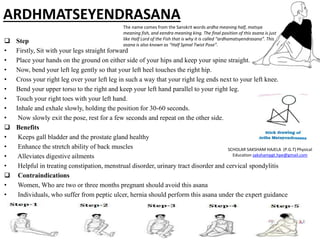
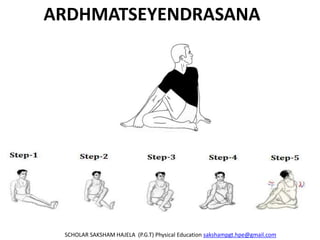
ARDHMATSEYENDRASANA
 Step
‱ Firstly, Sit with your legs straight forward
‱ Place your hands on the ground on either side of your hips and keep your spine straight.
‱ Now, bend your left leg gently so that your left heel touches the right hip.
‱ Cross your right leg over your left leg in such a way that your right leg ends next to your left knee.
‱ Bend your upper torso to the right and keep your left hand parallel to your right leg.
‱ Touch your right toes with your left hand.
‱ Inhale and exhale slowly, holding the position for 30-60 seconds.
‱ Now slowly exit the pose, rest for a few seconds and repeat on the other side.
 Benefits
‱ Keeps gall bladder and the prostate gland healthy
‱ Enhance the stretch ability of back muscles
‱ Alleviates digestive ailments
‱ Helpful in treating constipation, menstrual disorder, urinary tract disorder and cervical spondylitis
 Contraindications
‱ Women, Who are two or three months pregnant should avoid this asana
‱ Individuals, who suffer from peptic ulcer, hernia should perform this asana under the expert guidance
SCHOLAR SAKSHAM HAJELA (P.G.T) Physical
Education sakshampgt.hpe@gmail.com
The name comes from the Sanskrit words ardha meaning half, matsya
meaning fish, and eendra meaning king. The final position of this asana is just
like Half Lord of the Fish that is why it is called “ardhamatsyendrasana”. This
asana is also known as “Half Spinal Twist Pose”.
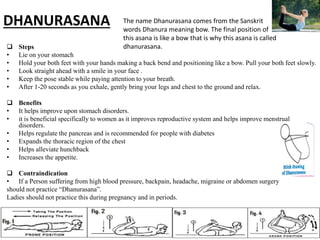
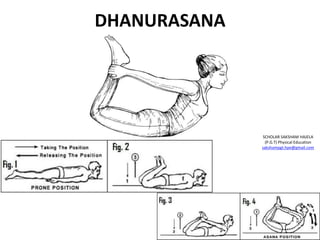
DHANURASANA
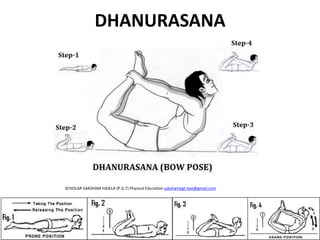
 Steps
‱ Lie on your stomach
‱ Hold your both feet with your hands making a back bend and positioning like a bow. Pull your both feet slowly.
‱ Look straight ahead with a smile in your face .
‱ Keep the pose stable while paying attention to your breath.
‱ After 1-20 seconds as you exhale, gently bring your legs and chest to the ground and relax.
 Benefits
‱ It helps improve upon stomach disorders.
‱ it is beneficial specifically to women as it improves reproductive system and helps improve menstrual
disorders.
‱ Helps regulate the pancreas and is recommended for people with diabetes
‱ Expands the thoracic region of the chest
‱ Helps alleviate hunchback
‱ Increases the appetite.
 Contraindication
‱ If a Person suffering from high blood pressure, backpain, headache, migraine or abdomen surgery
should not practice “Dhanurasana”.
Ladies should not practice this during pregnancy and in periods.
The name Dhanurasana comes from the Sanskrit
words Dhanura meaning bow. The final position of
this asana is like a bow that is why this asana is called
dhanurasana.
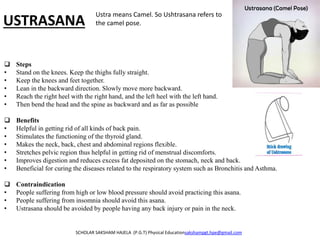
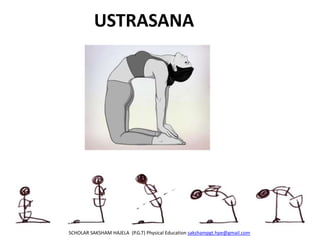
USTRASANA
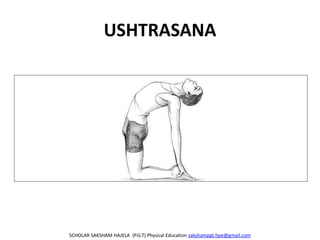
 Steps
‱ Stand on the knees. Keep the thighs fully straight.
‱ Keep the knees and feet together.
‱ Lean in the backward direction. Slowly move more backward.
‱ Reach the right heel with the right hand, and the left heel with the left hand.
‱ Then bend the head and the spine as backward and as far as possible
 Benefits
‱ Helpful in getting rid of all kinds of back pain.
‱ Stimulates the functioning of the thyroid gland.
‱ Makes the neck, back, chest and abdominal regions flexible.
‱ Stretches pelvic region thus helpful in getting rid of menstrual discomforts.
‱ Improves digestion and reduces excess fat deposited on the stomach, neck and back.
‱ Beneficial for curing the diseases related to the respiratory system such as Bronchitis and Asthma.
 Contraindication
‱ People suffering from high or low blood pressure should avoid practicing this asana.
‱ People suffering from insomnia should avoid this asana.
‱ Ustrasana should be avoided by people having any back injury or pain in the neck.
SCHOLAR SAKSHAM HAJELA (P.G.T) Physical Educationsakshampgt.hpe@gmail.com
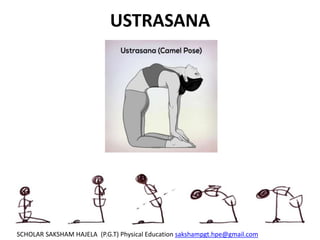
Ustra means Camel. So Ushtrasana refers to
the camel pose.
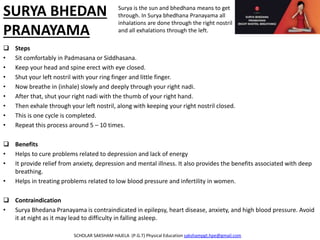
SURYA BHEDAN
PRANAYAMA
 Steps
‱ Sit comfortably in Padmasana or Siddhasana.
‱ Keep your head and spine erect with eye closed.
‱ Shut your left nostril with your ring finger and little finger.
‱ Now breathe in (inhale) slowly and deeply through your right nadi.
‱ After that, shut your right nadi with the thumb of your right hand.
‱ Then exhale through your left nostril, along with keeping your right nostril closed.
‱ This is one cycle is completed.
‱ Repeat this process around 5 – 10 times.
 Benefits
‱ Helps to cure problems related to depression and lack of energy
‱ It provide relief from anxiety, depression and mental illness. It also provides the benefits associated with deep
breathing.
‱ Helps in treating problems related to low blood pressure and infertility in women.
 Contraindication
‱ Surya Bhedana Pranayama is contraindicated in epilepsy, heart disease, anxiety, and high blood pressure. Avoid
it at night as it may lead to difficulty in falling asleep.
SCHOLAR SAKSHAM HAJELA (P.G.T) Physical Education sakshampgt.hpe@gmail.com
Surya is the sun and bhedhana means to get
through. In Surya bhedhana Pranayama all
inhalations are done through the right nostril
and all exhalations through the left.
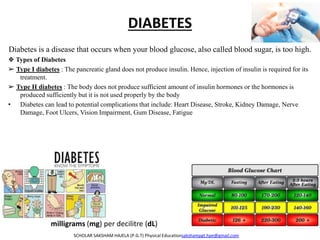
DIABETES
Diabetes is a disease that occurs when your blood glucose, also called blood sugar, is too high.
❖ Types of Diabetes
➱ Type I diabetes : The pancreatic gland does not produce insulin. Hence, injection of insulin is required for its
treatment.
➱ Type II diabetes : The body does not produce sufficient amount of insulin hormones or the hormones is
produced sufficiently but it is not used properly by the body
‱ Diabetes can lead to potential complications that include: Heart Disease, Stroke, Kidney Damage, Nerve
Damage, Foot Ulcers, Vision Impairment, Gum Disease, Fatigue
milligrams (mg) per decilitre (dL)
SCHOLAR SAKSHAM HAJELA (P.G.T) Physical Educationsakshampgt.hpe@gmail.com
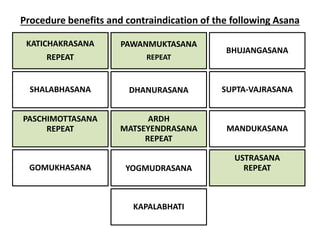
Procedure benefits and contraindication of the following Asana
KATICHAKRASANA
REPEAT
PAWANMUKTASANA
REPEAT
BHUJANGASANA
SHALABHASANA DHANURASANA SUPTA-VAJRASANA
PASCHIMOTTASANA
REPEAT
ARDH
MATSEYENDRASANA
REPEAT
MANDUKASANA
GOMUKHASANA YOGMUDRASANA
USTRASANA
REPEAT
KAPALABHATI
KATICHAKRASANA
(rotation of waist)
SCHOLAR SAKSHAM HAJELA
(P.G.T) Physical Education
sakshampgt.hpe@gmail.com
PAWANMUKTASANA
SCHOLAR SAKSHAM HAJELA (P.G.T) Physical Education sakshampgt.hpe@gmail.com
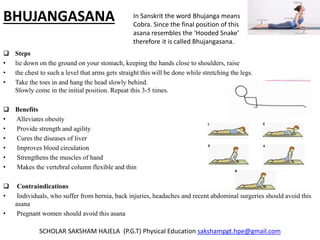
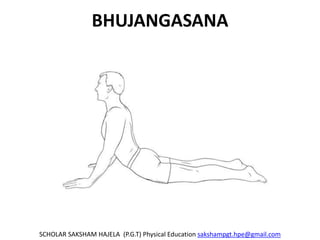
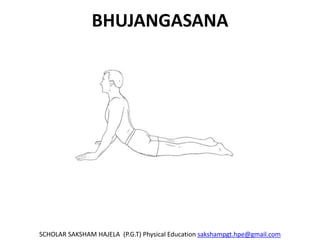
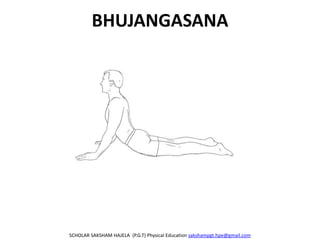
BHUJANGASANA
 Steps
‱ lie down on the ground on your stomach, keeping the hands close to shoulders, raise
‱ the chest to such a level that arms gets straight this will be done while stretching the legs.
‱ Take the toes in and hang the head slowly behind.
Slowly come in the initial position. Repeat this 3-5 times.
 Benefits
‱ Alleviates obesity
‱ Provide strength and agility
‱ Cures the diseases of liver
‱ Improves blood circulation
‱ Strengthens the muscles of hand
‱ Makes the vertebral column flexible and thin
 Contraindications
‱ Individuals, who suffer from hernia, back injuries, headaches and recent abdominal surgeries should avoid this
asana
‱ Pregnant women should avoid this asana
SCHOLAR SAKSHAM HAJELA (P.G.T) Physical Education sakshampgt.hpe@gmail.com
In Sanskrit the word Bhujanga means
Cobra. Since the final position of this
asana resembles the ‘Hooded Snake’
therefore it is called Bhujangasana.
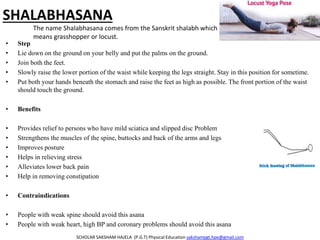
SHALABHASANA
‱ Step
‱ Lie down on the ground on your belly and put the palms on the ground.
‱ Join both the feet.
‱ Slowly raise the lower portion of the waist while keeping the legs straight. Stay in this position for sometime.
‱ Put both your hands beneath the stomach and raise the feet as high as possible. The front portion of the waist
should touch the ground.
‱ Benefits
‱ Provides relief to persons who have mild sciatica and slipped disc Problem
‱ Strengthens the muscles of the spine, buttocks and back of the arms and legs
‱ Improves posture
‱ Helps in relieving stress
‱ Alleviates lower back pain
‱ Help in removing constipation
‱ Contraindications
‱ People with weak spine should avoid this asana
‱ People with weak heart, high BP and coronary problems should avoid this asana
SCHOLAR SAKSHAM HAJELA (P.G.T) Physical Education sakshampgt.hpe@gmail.com
The name Shalabhasana comes from the Sanskrit shalabh which
means grasshopper or locust.
DHANURASANA
SCHOLAR SAKSHAM HAJELA (P.G.T) Physical Education sakshampgt.hpe@gmail.com
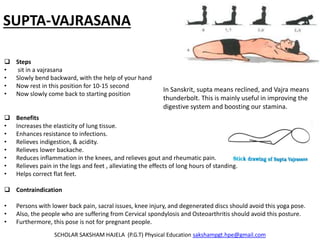
SUPTA-VAJRASANA
 Steps
‱ sit in a vajrasana
‱ Slowly bend backward, with the help of your hand
‱ Now rest in this position for 10-15 second
‱ Now slowly come back to starting position
 Benefits
‱ Increases the elasticity of lung tissue.
‱ Enhances resistance to infections.
‱ Relieves indigestion, & acidity.
‱ Relieves lower backache.
‱ Reduces inflammation in the knees, and relieves gout and rheumatic pain.
‱ Relieves pain in the legs and feet , alleviating the effects of long hours of standing.
‱ Helps correct flat feet.
 Contraindication
‱ Persons with lower back pain, sacral issues, knee injury, and degenerated discs should avoid this yoga pose.
‱ Also, the people who are suffering from Cervical spondylosis and Osteoarthritis should avoid this posture.
‱ Furthermore, this pose is not for pregnant people.
SCHOLAR SAKSHAM HAJELA (P.G.T) Physical Education sakshampgt.hpe@gmail.com
In Sanskrit, supta means reclined, and Vajra means
thunderbolt. This is mainly useful in improving the
digestive system and boosting our stamina.
PASCHIMOTTASANA
SCHOLAR SAKSHAM HAJELA (P.G.T) Physical Education sakshampgt.hpe@gmail.com
ARDHMATSEYENDRASANA
SCHOLAR SAKSHAM HAJELA (P.G.T) Physical Education sakshampgt.hpe@gmail.com
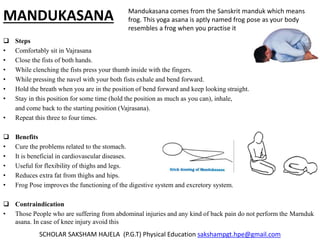
MANDUKASANA
 Steps
‱ Comfortably sit in Vajrasana
‱ Close the fists of both hands.
‱ While clenching the fists press your thumb inside with the fingers.
‱ While pressing the navel with your both fists exhale and bend forward.
‱ Hold the breath when you are in the position of bend forward and keep looking straight.
‱ Stay in this position for some time (hold the position as much as you can), inhale,
and come back to the starting position (Vajrasana).
‱ Repeat this three to four times.
 Benefits
‱ Cure the problems related to the stomach.
‱ It is beneficial in cardiovascular diseases.
‱ Useful for flexibility of thighs and legs.
‱ Reduces extra fat from thighs and hips.
‱ Frog Pose improves the functioning of the digestive system and excretory system.
 Contraindication
‱ Those People who are suffering from abdominal injuries and any kind of back pain do not perform the Marnduk
asana. In case of knee injury avoid this
SCHOLAR SAKSHAM HAJELA (P.G.T) Physical Education sakshampgt.hpe@gmail.com
Mandukasana comes from the Sanskrit manduk which means
frog. This yoga asana is aptly named frog pose as your body
resembles a frog when you practise it
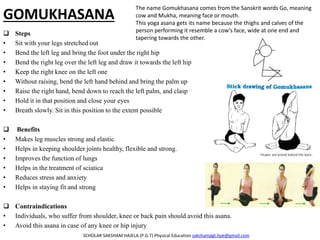
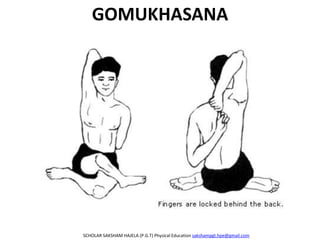
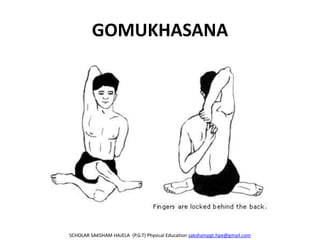
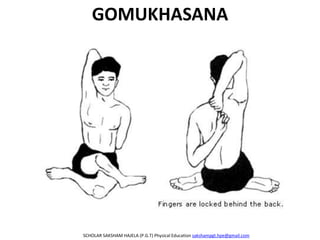
GOMUKHASANA
 Steps
‱ Sit with your legs stretched out
‱ Bend the left leg and bring the foot under the right hip
‱ Bend the right leg over the left leg and draw it towards the left hip
‱ Keep the right knee on the left one
‱ Without raising, bend the left hand behind and bring the palm up
‱ Raise the right hand, bend down to reach the left palm, and clasp
‱ Hold it in that position and close your eyes
‱ Breath slowly. Sit in this position to the extent possible
 Benefits
‱ Makes leg muscles strong and elastic.
‱ Helps in keeping shoulder joints healthy, flexible and strong.
‱ Improves the function of lungs
‱ Helps in the treatment of sciatica
‱ Reduces stress and anxiety
‱ Helps in staying fit and strong
 Contraindications
‱ Individuals, who suffer from shoulder, knee or back pain should avoid this asana.
‱ Avoid this asana in case of any knee or hip injury
SCHOLAR SAKSHAM HAJELA (P.G.T) Physical Education sakshampgt.hpe@gmail.com
The name Gomukhasana comes from the Sanskrit words Go, meaning
cow and Mukha, meaning face or mouth.
This yoga asana gets its name because the thighs and calves of the
person performing it resemble a cow’s face, wide at one end and
tapering towards the other.
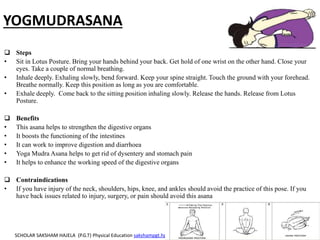
YOGMUDRASANA
 Steps
‱ Sit in Lotus Posture. Bring your hands behind your back. Get hold of one wrist on the other hand. Close your
eyes. Take a couple of normal breathing.
‱ Inhale deeply. Exhaling slowly, bend forward. Keep your spine straight. Touch the ground with your forehead.
Breathe normally. Keep this position as long as you are comfortable.
‱ Exhale deeply. Come back to the sitting position inhaling slowly. Release the hands. Release from Lotus
Posture.
 Benefits
‱ This asana helps to strengthen the digestive organs
‱ It boosts the functioning of the intestines
‱ It can work to improve digestion and diarrhoea
‱ Yoga Mudra Asana helps to get rid of dysentery and stomach pain
‱ It helps to enhance the working speed of the digestive organs
 Contraindications
‱ If you have injury of the neck, shoulders, hips, knee, and ankles should avoid the practice of this pose. If you
have back issues related to injury, surgery, or pain should avoid this asana
SCHOLAR SAKSHAM HAJELA (P.G.T) Physical Education sakshampgt.hpe@gmail.com
USTRASANA
SCHOLAR SAKSHAM HAJELA (P.G.T) Physical Education sakshampgt.hpe@gmail.com
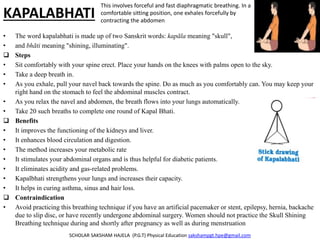
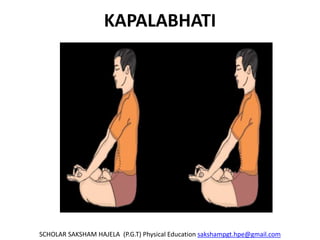
KAPALABHATI
‱ The word kapalabhati is made up of two Sanskrit words: kapāla meaning "skull",
‱ and bhāti meaning "shining, illuminating".
 Steps
‱ Sit comfortably with your spine erect. Place your hands on the knees with palms open to the sky.
‱ Take a deep breath in.
‱ As you exhale, pull your navel back towards the spine. Do as much as you comfortably can. You may keep your
right hand on the stomach to feel the abdominal muscles contract.
‱ As you relax the navel and abdomen, the breath flows into your lungs automatically.
‱ Take 20 such breaths to complete one round of Kapal Bhati.
 Benefits
‱ It improves the functioning of the kidneys and liver.
‱ It enhances blood circulation and digestion.
‱ The method increases your metabolic rate
‱ It stimulates your abdominal organs and is thus helpful for diabetic patients.
‱ It eliminates acidity and gas-related problems.
‱ Kapalbhati strengthens your lungs and increases their capacity.
‱ It helps in curing asthma, sinus and hair loss.
 Contraindication
‱ Avoid practicing this breathing technique if you have an artificial pacemaker or stent, epilepsy, hernia, backache
due to slip disc, or have recently undergone abdominal surgery. Women should not practice the Skull Shining
Breathing technique during and shortly after pregnancy as well as during menstruation
SCHOLAR SAKSHAM HAJELA (P.G.T) Physical Education sakshampgt.hpe@gmail.com
This involves forceful and fast diaphragmatic breathing. In a
comfortable sitting position, one exhales forcefully by
contracting the abdomen
ASTHMA
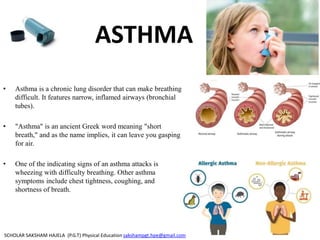
‱ Asthma is a chronic lung disorder that can make breathing
difficult. It features narrow, inflamed airways (bronchial
tubes).
‱ "Asthma" is an ancient Greek word meaning "short
breath," and as the name implies, it can leave you gasping
for air.
‱ One of the indicating signs of an asthma attacks is
wheezing with difficulty breathing. Other asthma
symptoms include chest tightness, coughing, and
shortness of breath.
SCHOLAR SAKSHAM HAJELA (P.G.T) Physical Education sakshampgt.hpe@gmail.com
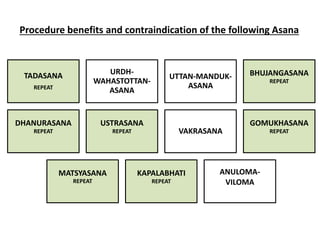
Procedure benefits and contraindication of the following Asana
TADASANA
REPEAT
URDH-
WAHASTOTTAN-
ASANA
UTTAN-MANDUK-
ASANA
BHUJANGASANA
REPEAT
DHANURASANA
REPEAT
USTRASANA
REPEAT VAKRASANA
GOMUKHASANA
REPEAT
MATSYASANA
REPEAT
KAPALABHATI
REPEAT
ANULOMA-
VILOMA
TADASANA
SCHOLAR SAKSHAM HAJELA (P.G.T) Physical Education sakshampgt.hpe@gmail.com
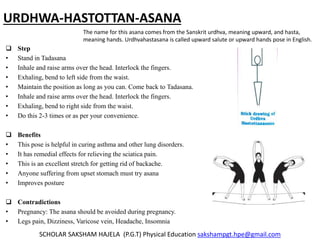
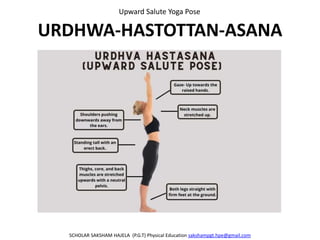
URDHWA-HASTOTTAN-ASANA
 Step
‱ Stand in Tadasana
‱ Inhale and raise arms over the head. Interlock the fingers.
‱ Exhaling, bend to left side from the waist.
‱ Maintain the position as long as you can. Come back to Tadasana.
‱ Inhale and raise arms over the head. Interlock the fingers.
‱ Exhaling, bend to right side from the waist.
‱ Do this 2-3 times or as per your convenience.
 Benefits
‱ This pose is helpful in curing asthma and other lung disorders.
‱ It has remedial effects for relieving the sciatica pain.
‱ This is an excellent stretch for getting rid of backache.
‱ Anyone suffering from upset stomach must try asana
‱ Improves posture
 Contradictions
‱ Pregnancy: The asana should be avoided during pregnancy.
‱ Legs pain, Dizziness, Varicose vein, Headache, Insomnia
SCHOLAR SAKSHAM HAJELA (P.G.T) Physical Education sakshampgt.hpe@gmail.com
The name for this asana comes from the Sanskrit urdhva, meaning upward, and hasta,
meaning hands. Urdhvahastasana is called upward salute or upward hands pose in English.
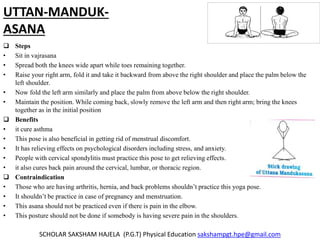
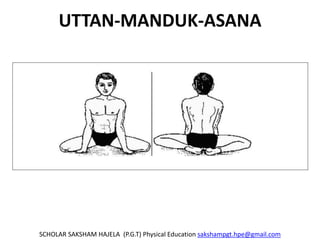
UTTAN-MANDUK-
ASANA
 Steps
‱ Sit in vajrasana
‱ Spread both the knees wide apart while toes remaining together.
‱ Raise your right arm, fold it and take it backward from above the right shoulder and place the palm below the
left shoulder.
‱ Now fold the left arm similarly and place the palm from above below the right shoulder.
‱ Maintain the position. While coming back, slowly remove the left arm and then right arm; bring the knees
together as in the initial position
 Benefits
‱ it cure asthma
‱ This pose is also beneficial in getting rid of menstrual discomfort.
‱ It has relieving effects on psychological disorders including stress, and anxiety.
‱ People with cervical spondylitis must practice this pose to get relieving effects.
‱ it also cures back pain around the cervical, lumbar, or thoracic region.
 Contraindication
‱ Those who are having arthritis, hernia, and back problems shouldn’t practice this yoga pose.
‱ It shouldn’t be practice in case of pregnancy and menstruation.
‱ This asana should not be practiced even if there is pain in the elbow.
‱ This posture should not be done if somebody is having severe pain in the shoulders.
SCHOLAR SAKSHAM HAJELA (P.G.T) Physical Education sakshampgt.hpe@gmail.com
BHUJANGASANA
SCHOLAR SAKSHAM HAJELA (P.G.T) Physical Education sakshampgt.hpe@gmail.com
DHANURASANA
SCHOLAR SAKSHAM HAJELA
(P.G.T) Physical Education
sakshampgt.hpe@gmail.com
USTRASANA
SCHOLAR SAKSHAM HAJELA (P.G.T) Physical Education sakshampgt.hpe@gmail.com
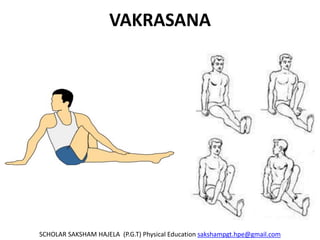
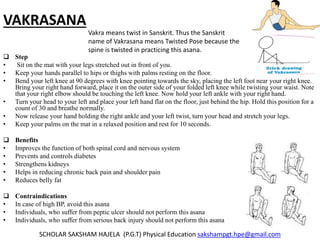
VAKRASANA
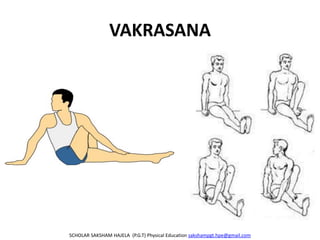
 Step
‱ Sit on the mat with your legs stretched out in front of you.
‱ Keep your hands parallel to hips or thighs with palms resting on the floor.
‱ Bend your left knee at 90 degrees with knee pointing towards the sky, placing the left foot near your right knee.
Bring your right hand forward, place it on the outer side of your folded left knee while twisting your waist. Note
that your right elbow should be touching the left knee. Now hold your left ankle with your right hand.
‱ Turn your head to your left and place your left hand flat on the floor, just behind the hip. Hold this position for a
count of 30 and breathe normally.
‱ Now release your hand holding the right ankle and your left twist, turn your head and stretch your legs.
‱ Keep your palms on the mat in a relaxed position and rest for 10 seconds.
 Benefits
‱ Improves the function of both spinal cord and nervous system
‱ Prevents and controls diabetes
‱ Strengthens kidneys
‱ Helps in reducing chronic back pain and shoulder pain
‱ Reduces belly fat
 Contraindications
‱ In case of high BP, avoid this asana
‱ Individuals, who suffer from peptic ulcer should not perform this asana
‱ Individuals, who suffer from serious back injury should not perform this asana
SCHOLAR SAKSHAM HAJELA (P.G.T) Physical Education sakshampgt.hpe@gmail.com
Vakra means twist in Sanskrit. Thus the Sanskrit
name of Vakrasana means Twisted Pose because the
spine is twisted in practicing this asana.
GOMUKHASANA
SCHOLAR SAKSHAM HAJELA (P.G.T) Physical Education sakshampgt.hpe@gmail.com
MATSYASANA
SCHOLAR SAKSHAM HAJELA (P.G.T) Physical Education sakshampgt.hpe@gmail.com
KAPALABHATI
SCHOLAR SAKSHAM HAJELA (P.G.T) Physical Education sakshampgt.hpe@gmail.com
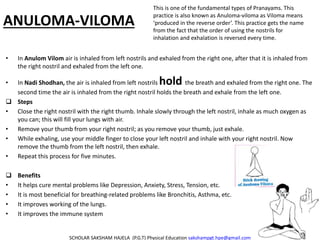
ANULOMA-VILOMA
‱ In Anulom Vilom air is inhaled from left nostrils and exhaled from the right one, after that it is inhaled from
the right nostril and exhaled from the left one.
‱ In Nadi Shodhan, the air is inhaled from left nostrils hold the breath and exhaled from the right one. The
second time the air is inhaled from the right nostril holds the breath and exhale from the left one.
 Steps
‱ Close the right nostril with the right thumb. Inhale slowly through the left nostril, inhale as much oxygen as
you can; this will fill your lungs with air.
‱ Remove your thumb from your right nostril; as you remove your thumb, just exhale.
‱ While exhaling, use your middle finger to close your left nostril and inhale with your right nostril. Now
remove the thumb from the left nostril, then exhale.
‱ Repeat this process for five minutes.
 Benefits
‱ It helps cure mental problems like Depression, Anxiety, Stress, Tension, etc.
‱ It is most beneficial for breathing-related problems like Bronchitis, Asthma, etc.
‱ It improves working of the lungs.
‱ It improves the immune system
SCHOLAR SAKSHAM HAJELA (P.G.T) Physical Education sakshampgt.hpe@gmail.com
This is one of the fundamental types of Pranayams. This
practice is also known as Anuloma-viloma as Viloma means
‘produced in the reverse order’. This practice gets the name
from the fact that the order of using the nostrils for
inhalation and exhalation is reversed every time.
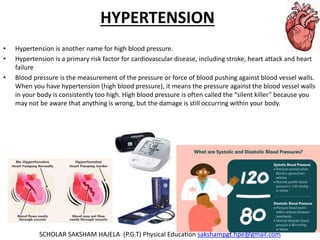
HYPERTENSION
‱ Hypertension is another name for high blood pressure.
‱ Hypertension is a primary risk factor for cardiovascular disease, including stroke, heart attack and heart
failure
‱ Blood pressure is the measurement of the pressure or force of blood pushing against blood vessel walls.
When you have hypertension (high blood pressure), it means the pressure against the blood vessel walls
in your body is consistently too high. High blood pressure is often called the “silent killer” because you
may not be aware that anything is wrong, but the damage is still occurring within your body.
SCHOLAR SAKSHAM HAJELA (P.G.T) Physical Education sakshampgt.hpe@gmail.com
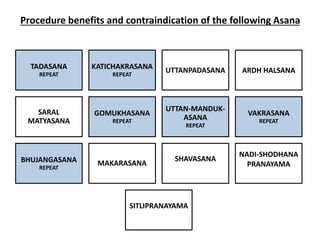
Procedure benefits and contraindication of the following Asana
TADASANA
REPEAT
KATICHAKRASANA
REPEAT
UTTANPADASANA ARDH HALSANA
SARAL
MATYASANA
GOMUKHASANA
REPEAT
UTTAN-MANDUK-
ASANA
REPEAT
VAKRASANA
REPEAT
BHUJANGASANA
REPEAT
MAKARASANA
SHAVASANA
NADI-SHODHANA
PRANAYAMA
SITLIPRANAYAMA
TADASANA
SCHOLAR SAKSHAM HAJELA (P.G.T) Physical Education sakshampgt.hpe@gmail.com
KATICHAKRASANA
(rotation of waist)
SCHOLAR SAKSHAM HAJELA
(P.G.T) Physical Education
sakshampgt.hpe@gmail.com
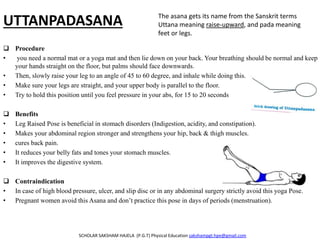
UTTANPADASANA
 Procedure
‱ you need a normal mat or a yoga mat and then lie down on your back. Your breathing should be normal and keep
your hands straight on the floor, but palms should face downwards.
‱ Then, slowly raise your leg to an angle of 45 to 60 degree, and inhale while doing this.
‱ Make sure your legs are straight, and your upper body is parallel to the floor.
‱ Try to hold this position until you feel pressure in your abs, for 15 to 20 seconds
 Benefits
‱ Leg Raised Pose is beneficial in stomach disorders (Indigestion, acidity, and constipation).
‱ Makes your abdominal region stronger and strengthens your hip, back & thigh muscles.
‱ cures back pain.
‱ It reduces your belly fats and tones your stomach muscles.
‱ It improves the digestive system.
 Contraindication
‱ In case of high blood pressure, ulcer, and slip disc or in any abdominal surgery strictly avoid this yoga Pose.
‱ Pregnant women avoid this Asana and don’t practice this pose in days of periods (menstruation).
SCHOLAR SAKSHAM HAJELA (P.G.T) Physical Education sakshampgt.hpe@gmail.com
The asana gets its name from the Sanskrit terms
Uttana meaning raise-upward, and pada meaning
feet or legs.
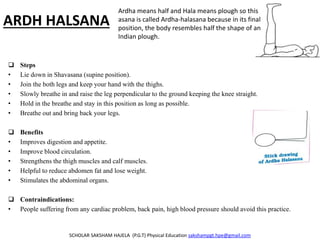
ARDH HALSANA
 Steps
‱ Lie down in Shavasana (supine position).
‱ Join the both legs and keep your hand with the thighs.
‱ Slowly breathe in and raise the leg perpendicular to the ground keeping the knee straight.
‱ Hold in the breathe and stay in this position as long as possible.
‱ Breathe out and bring back your legs.
 Benefits
‱ Improves digestion and appetite.
‱ Improve blood circulation.
‱ Strengthens the thigh muscles and calf muscles.
‱ Helpful to reduce abdomen fat and lose weight.
‱ Stimulates the abdominal organs.
 Contraindications:
‱ People suffering from any cardiac problem, back pain, high blood pressure should avoid this practice.
SCHOLAR SAKSHAM HAJELA (P.G.T) Physical Education sakshampgt.hpe@gmail.com
Ardha means half and Hala means plough so this
asana is called Ardha-halasana because in its final
position, the body resembles half the shape of an
Indian plough.
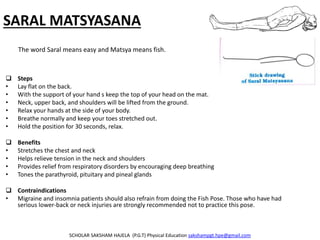
SARAL MATSYASANA
 Steps
‱ Lay flat on the back.
‱ With the support of your hand s keep the top of your head on the mat.
‱ Neck, upper back, and shoulders will be lifted from the ground.
‱ Relax your hands at the side of your body.
‱ Breathe normally and keep your toes stretched out.
‱ Hold the position for 30 seconds, relax.
 Benefits
‱ Stretches the chest and neck
‱ Helps relieve tension in the neck and shoulders
‱ Provides relief from respiratory disorders by encouraging deep breathing
‱ Tones the parathyroid, pituitary and pineal glands
 Contraindications
‱ Migraine and insomnia patients should also refrain from doing the Fish Pose. Those who have had
serious lower-back or neck injuries are strongly recommended not to practice this pose.
SCHOLAR SAKSHAM HAJELA (P.G.T) Physical Education sakshampgt.hpe@gmail.com
The word Saral means easy and Matsya means fish.
GOMUKHASANA
SCHOLAR SAKSHAM HAJELA (P.G.T) Physical Education sakshampgt.hpe@gmail.com
UTTAN-MANDUK-ASANA
SCHOLAR SAKSHAM HAJELA (P.G.T) Physical Education sakshampgt.hpe@gmail.com
VAKRASANA
SCHOLAR SAKSHAM HAJELA (P.G.T) Physical Education sakshampgt.hpe@gmail.com
BHUJANGASANA
SCHOLAR SAKSHAM HAJELA (P.G.T) Physical Education sakshampgt.hpe@gmail.com
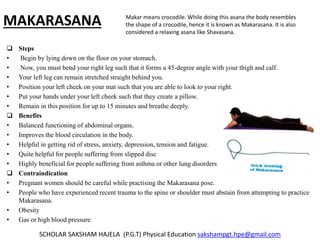
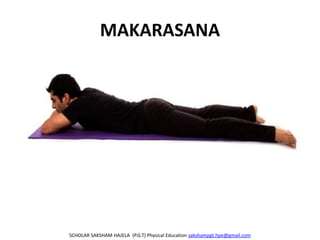
MAKARASANA
 Steps
‱ Begin by lying down on the floor on your stomach.
‱ Now, you must bend your right leg such that it forms a 45-degree angle with your thigh and calf.
‱ Your left leg can remain stretched straight behind you.
‱ Position your left cheek on your mat such that you are able to look to your right.
‱ Put your hands under your left cheek such that they create a pillow.
‱ Remain in this position for up to 15 minutes and breathe deeply.
 Benefits
‱ Balanced functioning of abdominal organs.
‱ Improves the blood circulation in the body.
‱ Helpful in getting rid of stress, anxiety, depression, tension and fatigue.
‱ Quite helpful for people suffering from slipped disc
‱ Highly beneficial for people suffering from asthma or other lung disorders
 Contraindication
‱ Pregnant women should be careful while practising the Makarasana pose.
‱ People who have experienced recent trauma to the spine or shoulder must abstain from attempting to practice
Makarasana.
‱ Obesity
‱ Gas or high blood pressure
SCHOLAR SAKSHAM HAJELA (P.G.T) Physical Education sakshampgt.hpe@gmail.com
Makar means crocodile. While doing this asana the body resembles
the shape of a crocodile, hence it is known as Makarasana. It is also
considered a relaxing asana like Shavasana.
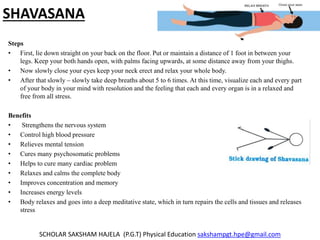
SHAVASANA
Steps
‱ First, lie down straight on your back on the floor. Put or maintain a distance of 1 foot in between your
legs. Keep your both hands open, with palms facing upwards, at some distance away from your thighs.
‱ Now slowly close your eyes keep your neck erect and relax your whole body.
‱ After that slowly – slowly take deep breaths about 5 to 6 times. At this time, visualize each and every part
of your body in your mind with resolution and the feeling that each and every organ is in a relaxed and
free from all stress.
Benefits
‱ Strengthens the nervous system
‱ Control high blood pressure
‱ Relieves mental tension
‱ Cures many psychosomatic problems
‱ Helps to cure many cardiac problem
‱ Relaxes and calms the complete body
‱ Improves concentration and memory
‱ Increases energy levels
‱ Body relaxes and goes into a deep meditative state, which in turn repairs the cells and tissues and releases
stress
SCHOLAR SAKSHAM HAJELA (P.G.T) Physical Education sakshampgt.hpe@gmail.com
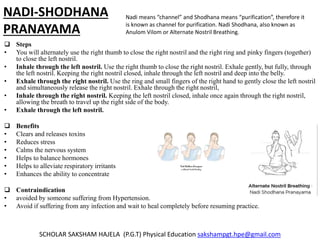
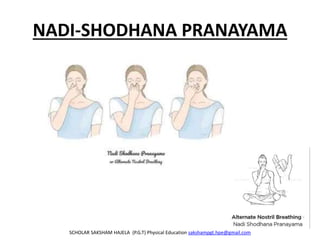
NADI-SHODHANA
PRANAYAMA
 Steps
‱ You will alternately use the right thumb to close the right nostril and the right ring and pinky fingers (together)
to close the left nostril.
‱ Inhale through the left nostril. Use the right thumb to close the right nostril. Exhale gently, but fully, through
the left nostril. Keeping the right nostril closed, inhale through the left nostril and deep into the belly.
‱ Exhale through the right nostril. Use the ring and small fingers of the right hand to gently close the left nostril
and simultaneously release the right nostril. Exhale through the right nostril,
‱ Inhale through the right nostril. Keeping the left nostril closed, inhale once again through the right nostril,
allowing the breath to travel up the right side of the body.
‱ Exhale through the left nostril.
 Benefits
‱ Clears and releases toxins
‱ Reduces stress
‱ Calms the nervous system
‱ Helps to balance hormones
‱ Helps to alleviate respiratory irritants
‱ Enhances the ability to concentrate
 Contraindication
‱ avoided by someone suffering from Hypertension.
‱ Avoid if suffering from any infection and wait to heal completely before resuming practice.
SCHOLAR SAKSHAM HAJELA (P.G.T) Physical Education sakshampgt.hpe@gmail.com
Nadi means “channel” and Shodhana means “purification”, therefore it
is known as channel for purification. Nadi Shodhana, also known as
Anulom Vilom or Alternate Nostril Breathing.
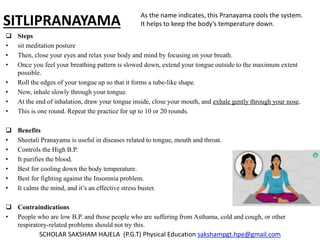
SITLIPRANAYAMA
 Steps
‱ sit meditation posture
‱ Then, close your eyes and relax your body and mind by focusing on your breath.
‱ Once you feel your breathing pattern is slowed down, extend your tongue outside to the maximum extent
possible.
‱ Roll the edges of your tongue up so that it forms a tube-like shape.
‱ Now, inhale slowly through your tongue.
‱ At the end of inhalation, draw your tongue inside, close your mouth, and exhale gently through your nose.
‱ This is one round. Repeat the practice for up to 10 or 20 rounds.
 Benefits
‱ Sheetali Pranayama is useful in diseases related to tongue, mouth and throat.
‱ Controls the High B.P.
‱ It purifies the blood.
‱ Best for cooling down the body temperature.
‱ Best for fighting against the Insomnia problem.
‱ It calms the mind, and it’s an effective stress buster.
 Contraindications
‱ People who are low B.P. and those people who are suffering from Asthama, cold and cough, or other
respiratory-related problems should not try this.
SCHOLAR SAKSHAM HAJELA (P.G.T) Physical Education sakshampgt.hpe@gmail.com
As the name indicates, this Pranayama cools the system.
It helps to keep the body’s temperature down.
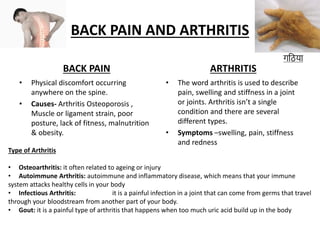
BACK PAIN AND ARTHRITIS
BACK PAIN
‱ Physical discomfort occurring
anywhere on the spine.
‱ Causes- Arthritis Osteoporosis ,
Muscle or ligament strain, poor
posture, lack of fitness, malnutrition
& obesity.
ARTHRITIS
‱ The word arthritis is used to describe
pain, swelling and stiffness in a joint
or joints. Arthritis isn’t a single
condition and there are several
different types.
‱ Symptoms –swelling, pain, stiffness
and redness
à€—à€ à€żà€Żà€Ÿ
Type of Arthritis
‱ Osteoarthritis: it often related to ageing or injury
‱ Autoimmune Arthritis: autoimmune and inflammatory disease, which means that your immune
system attacks healthy cells in your body
‱ Infectious Arthritis: it is a painful infection in a joint that can come from germs that travel
through your bloodstream from another part of your body.
‱ Gout: it is a painful type of arthritis that happens when too much uric acid build up in the body
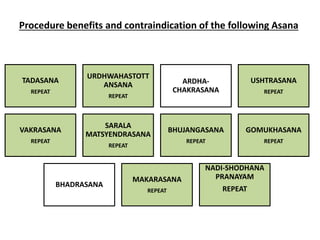
Procedure benefits and contraindication of the following Asana
TADASANA
REPEAT
URDHWAHASTOTT
ANSANA
REPEAT
ARDHA-
CHAKRASANA
USHTRASANA
REPEAT
VAKRASANA
REPEAT
SARALA
MATSYENDRASANA
REPEAT
BHUJANGASANA
REPEAT
GOMUKHASANA
REPEAT
BHADRASANA
MAKARASANA
REPEAT
NADI-SHODHANA
PRANAYAM
REPEAT
TADASANA
SCHOLAR SAKSHAM HAJELA (P.G.T) Physical Education sakshampgt.hpe@gmail.com
URDHWA-HASTOTTAN-ASANA
SCHOLAR SAKSHAM HAJELA (P.G.T) Physical Education sakshampgt.hpe@gmail.com
Upward Salute Yoga Pose
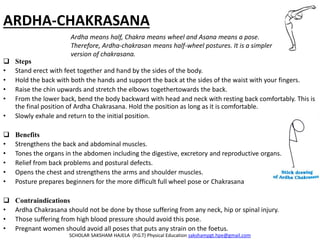
ARDHA-CHAKRASANA
 Steps
‱ Stand erect with feet together and hand by the sides of the body.
‱ Hold the back with both the hands and support the back at the sides of the waist with your fingers.
‱ Raise the chin upwards and stretch the elbows togethertowards the back.
‱ From the lower back, bend the body backward with head and neck with resting back comfortably. This is
the final position of Ardha Chakrasana. Hold the position as long as it is comfortable.
‱ Slowly exhale and return to the initial position.
 Benefits
‱ Strengthens the back and abdominal muscles.
‱ Tones the organs in the abdomen including the digestive, excretory and reproductive organs.
‱ Relief from back problems and postural defects.
‱ Opens the chest and strengthens the arms and shoulder muscles.
‱ Posture prepares beginners for the more difficult full wheel pose or Chakrasana
 Contraindications
‱ Ardha Chakrasana should not be done by those suffering from any neck, hip or spinal injury.
‱ Those suffering from high blood pressure should avoid this pose.
‱ Pregnant women should avoid all poses that puts any strain on the foetus.
Ardha means half, Chakra means wheel and Asana means a pose.
Therefore, Ardha-chakrasan means half-wheel postures. It is a simpler
version of chakrasana.
SCHOLAR SAKSHAM HAJELA (P.G.T) Physical Education sakshampgt.hpe@gmail.com
USHTRASANA
SCHOLAR SAKSHAM HAJELA (P.G.T) Physical Education sakshampgt.hpe@gmail.com
VAKRASANA
SCHOLAR SAKSHAM HAJELA (P.G.T) Physical Education sakshampgt.hpe@gmail.com
SARAL MATSYENDRASANA
SCHOLAR SAKSHAM HAJELA (P.G.T) Physical Education sakshampgt.hpe@gmail.com
BHUJANGASANA
SCHOLAR SAKSHAM HAJELA (P.G.T) Physical Education sakshampgt.hpe@gmail.com
GOMUKHASANA
SCHOLAR SAKSHAM HAJELA (P.G.T) Physical Education sakshampgt.hpe@gmail.com
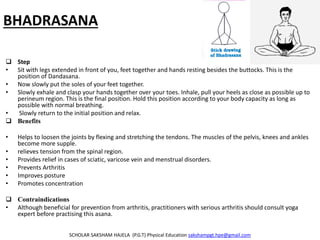
BHADRASANA
 Step
‱ Sit with legs extended in front of you, feet together and hands resting besides the buttocks. This is the
position of Dandasana.
‱ Now slowly put the soles of your feet together.
‱ Slowly exhale and clasp your hands together over your toes. Inhale, pull your heels as close as possible up to
perineum region. This is the final position. Hold this position according to your body capacity as long as
possible with normal breathing.
‱ Slowly return to the initial position and relax.
 Benefits
‱ Helps to loosen the joints by flexing and stretching the tendons. The muscles of the pelvis, knees and ankles
become more supple.
‱ relieves tension from the spinal region.
‱ Provides relief in cases of sciatic, varicose vein and menstrual disorders.
‱ Prevents Arthritis
‱ Improves posture
‱ Promotes concentration
 Contraindications
‱ Although beneficial for prevention from arthritis, practitioners with serious arthritis should consult yoga
expert before practising this asana.
SCHOLAR SAKSHAM HAJELA (P.G.T) Physical Education sakshampgt.hpe@gmail.com
MAKARASANA
SCHOLAR SAKSHAM HAJELA (P.G.T) Physical Education sakshampgt.hpe@gmail.com
NADI-SHODHANA PRANAYAMA
SCHOLAR SAKSHAM HAJELA (P.G.T) Physical Education sakshampgt.hpe@gmail.com
For Any Query Feel Free To Contact Me
SCHOLAR SAKSHAM HAJELA (P.G.T) Physical Education
sakshampgt.hpe@gmail.com
naturalimages160993@gmail.com
@natural_images160993

12th unit 3 YOGA.pptx

  • 1.
    YOGA AND LIFESTYLE UNIT 3 BY SCHOLAR SAKSHAM HAJELA PGT-P.H.ED
  • 2.
    CONTENTS Obesity: procedure, benefitsand contraindications for Tadasana, Katichakrasana, Pavanmuktasana, Matsayasana, Halasana, Pachimottansana, Ardha – Matsyendrasana, Dhanurasana, Ushtrasana, Suryabedhan pranayama. Diabetes: procedure, benefits and contraindications for Katichakrasana, Pavanmuktasana,Bhujangasana, Shalabhasana, Dhanurasana, Supta-vajarasana, Paschimottanasana, Ardha-Mastendrasana, Mandukasana, Gomukasana, Yogmudra, Ushtrasana, Kapalabhati. Asthma: procedure, benefits and contraindications for Tadasana, Urdhwahastottansana, UttanMandukasana, Bhujangasana, Dhanurasana, Ushtrasana, Vakrasana, Kapalbhati, Gomukhasana Matsyaasana, Anuloma-Viloma. Hypertension: procedure, benefits and contraindications for Tadasana, Katichakransan, Uttanpadasana, Ardha Halasana, Sarala Matyasana, Gomukhasana, UttanMandukasana, Vakrasana, Bhujangasana, Makarasana, Shavasana, Nadi- shodhanapranayam, Sitlipranayam. Back Pain and Arthritis:procedure, benefits and contraindications for Tadasana, Urdhawahastootansana, Ardh-Chakrasana, Ushtrasana, Vakrasana, Sarala Maysyendrsana, Bhujandgasana, Gomukhasana, Bhadrasana, Makarasana, Nadi-Shodhana pranayama
  • 3.
    ASANAS ‱ Acc. ToPatanjali,” sthiram sukham asanam” i.e., “ that position which is comfortable and steady” ‱ In Brahamanopanishad, “To sit in a comfortable position or posture for everlasting period is called asana”. ‱ “Lifestyle is the way of life or style of living that reflects the attitudes and values of a person or group.” ‱ Obesity is that condition of body in which the amount of fat increases to extreme level. ‱ Accumulation of excess body fat. SCHOLAR SAKSHAM HAJELA (P.G.T) Physical Education sakshampgt.hpe@gmail.com OBESITY
  • 4.
    Procedure, benefits andcontraindication of the following Asana TADASANA KATICHAKRASANA PAWANMUKTASANA MATSYASANA HALASANA PASCHIMOTTANASANA ARDH MATSEYENDRASANA DHANURASANA USTRASANA SURYA BHEDAN PRANAYAMA
  • 5.
    TADASANA  Steps ‱ Standstraight on the ground, and take a small gap between your feet. ‱ With deeply breathing (inhale), raise your both arms. ‱ Keep your arms upward by interlocking your fingers. ‱ Now come on the toes by raising your heels simultaneously.  Benefits ‱ Helpful in developing physical and mental balance ‱ Reduces obesity ‱ Cures constipation ‱ Helpful for the treatment of hypertension ‱ Good asana for those who wants to enhance their height ‱ Improve body posture  Contraindications ‱ If you have low BP, avoid this asana ‱ People suffering from headaches and insomnia should also avoid performing this asana ‱ Individual, who suffer from blood circulation problem such as faulty valves, should not perform this asana SCHOLAR SAKSHAM HAJELA (P.G.T) Physical Education sakshampgt.hpe@gmail.com This is a traditional posture. The final position of this asana resembles the palm tree. Palm trees are usually erect and straight. Therefore, one should be straight and erect in this asana
  • 6.
    KATICHAKRASANA (rotation of waist) Steps ‱ Stand with both legs one feet apart. First, keep the arms by the sides. ‱ Then, raise both arms to the shoulder level. While raising the arms inhale. Now, exhale and twist the body to the left. Bring the right palm to the left shoulder and extend the left-hand wrapping around the waist. Now, turn the head towards the left side and look over the left shoulder.  Benefits ‱ Strengthens the spine, improves its flexibility. ‱ Strengthens the waist. ‱ Improves the flexibility of the waist and spine. ‱ Tones up the neck, shoulder, waist , back and hips. ‱ Useful for correcting back stiffness and postural problems of the back, spine and muscles.  Contraindications ‱ People having health conditions like spinal issues and hernias should avoid this practice. Also, pregnant ladies should not perform this yoga pose. SCHOLAR SAKSHAM HAJELA (P.G.T) Physical Education sakshampgt.hpe@gmail.com The name of this yoga asana comes from Kati meaning waist and chakra meaning circle. Katichakrasana, literally means rotation of the waist.
  • 7.
    PAWANMUKTASANA  Steps ‱ Relaxthe body in the base position. ‱ Raise the right leg, bend the knee and bring the thigh close to the chest. ‱ To bring the thigh closer to the chest, interlock the fingers of both hands and hold the right leg from just below the knee. ‱ Inhale deeply and while exhaling lift the head bringing the nose closer to the right knee without straining. After weeks of practice, one can touch the chin to the knees instead of the nose during the practice.  Benefits ‱ Eases the tension in lower back ‱ Enhance the blood circulation in pelvic region ‱ Help in reducing fats of thighs, buttocks and abdominal area ‱ Strengthens the abdominal muscles and improve digestion ‱ Massages the intestines and organs of the digestive system ‱ Relives constipation  Contraindications ‱ Pregnant women should avoid doing this asana ‱ Individuals suffering from piles should avoid this asana ‱ If you have an abdominal surgery recently you have avoid performing this asana. SCHOLAR SAKSHAM HAJELA (P.G.T) Physical Education sakshampgt.hpe@gmail.com The name comes from the Sanskrit word pawan meaning wind and mukta meaning “free”. Thus, Pawanmuktasana is also known as the wind removing asana.
  • 8.
    MATSYASANA  Step ‱ Sitin padmasana ‱ Bend slowly backward and lie on the floor without releasing Lotus Posture. Support your body with your forearms and elbows while bending backward. ‱ Lift the chest a little upward. Turn the crown of the head towards the floor. Make an arch of the back to the maximum comfortable extent. ‱ Hold on the toes with elbows touching the floor. Now the body is supported by the legs, buttocks, and head. ‱ Breathe slowly. Keep the position as long as it is comfortable.  Benefits ‱ Helpful in curing back pain, knee pain and tonsillitis ‱ Cures the defects of eyes ‱ Helpful in curing skin diseases ‱ Helpful for the treatment of diabetes ‱ Best asana to get relief from asthma ‱ Helps in reliving tension in the neck and shoulders  Contraindications ‱ If you have high or low BP, avoid this asana ‱ People suffering from migraine and insomnia should also avoid performing this asana ‱ Individual who have neck injury or low back problem should not perform this asana SCHOLAR SAKSHAM HAJELA (P.G.T) Physical Education sakshampgt.hpe@gmail.com The Sanskrit word Matsya means fish. Hence, Matsyasana refers to the fish pose.
  • 9.
    HALASANA  Steps ‱ Lieon your back with your arms next to your body and palms pressing into the floor. As you inhale, lift your legs to 90 degrees. As you exhale, roll your pelvis off the floor, moving your legs back toward your head. Slowly lower your legs over your head, toward the floor.  Benefits ‱ Improves digestion and appetite. ‱ Improve blood circulation. ‱ Strengthens the thigh muscles and calf muscles. ‱ Helpful to reduce abdomen fat and lose weight. ‱ Stimulates the abdominal organs.  Contraindication ‱ People suffering from any cardiac problem, back pain, high blood pressure should avoid this practice. SCHOLAR SAKSHAM HAJELA (P.G.T) Physical Education sakshampgt.hpe@gmail.com Hala means plough. This posture is known as Halasana because in its final position the shape of the body resembles the Indian plough.
  • 10.
    PASCHIMOTTANASANA  Steps ‱ Spreadthe legs forward and sit on the ground. ‱ Touch the thumbs of the feet with the hands, slowly breathe out and try to place the head on the knees. ‱ Then slowly raise the head and come back to initial position. Repeat this Aasan for 10-15 times daily.  Benefits ‱ Alleviates gas trouble ‱ Reduces obesity ‱ Good remedy for constipation ‱ Helpful in treating abdominal diseases ‱ Helpful in curing skin diseases ‱ Vertebra becomes flexible and healthy  Contraindications ‱ Suffering from enlarged liver or spleen or acute appendicitis, you should avoid this asana ‱ If you suffer from any respiratory diseases, avoid this Asana ‱ If you Have any back or spinal problem, make sure that you perform this asana only under expert guidance SCHOLAR SAKSHAM HAJELA (P.G.T) Physical Education sakshampgt.hpe@gmail.com The word paschimottasana comes from the Sanskrit words paschima meaning west or back of the body and uttana meaning intense stretch or extended. In this asana one has to sit and intensely stretch the back forward.
  • 11.
    ARDHMATSEYENDRASANA  Step ‱ Firstly,Sit with your legs straight forward ‱ Place your hands on the ground on either side of your hips and keep your spine straight. ‱ Now, bend your left leg gently so that your left heel touches the right hip. ‱ Cross your right leg over your left leg in such a way that your right leg ends next to your left knee. ‱ Bend your upper torso to the right and keep your left hand parallel to your right leg. ‱ Touch your right toes with your left hand. ‱ Inhale and exhale slowly, holding the position for 30-60 seconds. ‱ Now slowly exit the pose, rest for a few seconds and repeat on the other side.  Benefits ‱ Keeps gall bladder and the prostate gland healthy ‱ Enhance the stretch ability of back muscles ‱ Alleviates digestive ailments ‱ Helpful in treating constipation, menstrual disorder, urinary tract disorder and cervical spondylitis  Contraindications ‱ Women, Who are two or three months pregnant should avoid this asana ‱ Individuals, who suffer from peptic ulcer, hernia should perform this asana under the expert guidance SCHOLAR SAKSHAM HAJELA (P.G.T) Physical Education sakshampgt.hpe@gmail.com The name comes from the Sanskrit words ardha meaning half, matsya meaning fish, and eendra meaning king. The final position of this asana is just like Half Lord of the Fish that is why it is called “ardhamatsyendrasana”. This asana is also known as “Half Spinal Twist Pose”.
  • 12.
    DHANURASANA  Steps ‱ Lieon your stomach ‱ Hold your both feet with your hands making a back bend and positioning like a bow. Pull your both feet slowly. ‱ Look straight ahead with a smile in your face . ‱ Keep the pose stable while paying attention to your breath. ‱ After 1-20 seconds as you exhale, gently bring your legs and chest to the ground and relax.  Benefits ‱ It helps improve upon stomach disorders. ‱ it is beneficial specifically to women as it improves reproductive system and helps improve menstrual disorders. ‱ Helps regulate the pancreas and is recommended for people with diabetes ‱ Expands the thoracic region of the chest ‱ Helps alleviate hunchback ‱ Increases the appetite.  Contraindication ‱ If a Person suffering from high blood pressure, backpain, headache, migraine or abdomen surgery should not practice “Dhanurasana”. Ladies should not practice this during pregnancy and in periods. The name Dhanurasana comes from the Sanskrit words Dhanura meaning bow. The final position of this asana is like a bow that is why this asana is called dhanurasana.
  • 13.
    USTRASANA  Steps ‱ Standon the knees. Keep the thighs fully straight. ‱ Keep the knees and feet together. ‱ Lean in the backward direction. Slowly move more backward. ‱ Reach the right heel with the right hand, and the left heel with the left hand. ‱ Then bend the head and the spine as backward and as far as possible  Benefits ‱ Helpful in getting rid of all kinds of back pain. ‱ Stimulates the functioning of the thyroid gland. ‱ Makes the neck, back, chest and abdominal regions flexible. ‱ Stretches pelvic region thus helpful in getting rid of menstrual discomforts. ‱ Improves digestion and reduces excess fat deposited on the stomach, neck and back. ‱ Beneficial for curing the diseases related to the respiratory system such as Bronchitis and Asthma.  Contraindication ‱ People suffering from high or low blood pressure should avoid practicing this asana. ‱ People suffering from insomnia should avoid this asana. ‱ Ustrasana should be avoided by people having any back injury or pain in the neck. SCHOLAR SAKSHAM HAJELA (P.G.T) Physical Educationsakshampgt.hpe@gmail.com Ustra means Camel. So Ushtrasana refers to the camel pose.
  • 14.
    SURYA BHEDAN PRANAYAMA  Steps ‱Sit comfortably in Padmasana or Siddhasana. ‱ Keep your head and spine erect with eye closed. ‱ Shut your left nostril with your ring finger and little finger. ‱ Now breathe in (inhale) slowly and deeply through your right nadi. ‱ After that, shut your right nadi with the thumb of your right hand. ‱ Then exhale through your left nostril, along with keeping your right nostril closed. ‱ This is one cycle is completed. ‱ Repeat this process around 5 – 10 times.  Benefits ‱ Helps to cure problems related to depression and lack of energy ‱ It provide relief from anxiety, depression and mental illness. It also provides the benefits associated with deep breathing. ‱ Helps in treating problems related to low blood pressure and infertility in women.  Contraindication ‱ Surya Bhedana Pranayama is contraindicated in epilepsy, heart disease, anxiety, and high blood pressure. Avoid it at night as it may lead to difficulty in falling asleep. SCHOLAR SAKSHAM HAJELA (P.G.T) Physical Education sakshampgt.hpe@gmail.com Surya is the sun and bhedhana means to get through. In Surya bhedhana Pranayama all inhalations are done through the right nostril and all exhalations through the left.
  • 15.
    DIABETES Diabetes is adisease that occurs when your blood glucose, also called blood sugar, is too high. ❖ Types of Diabetes ➱ Type I diabetes : The pancreatic gland does not produce insulin. Hence, injection of insulin is required for its treatment. ➱ Type II diabetes : The body does not produce sufficient amount of insulin hormones or the hormones is produced sufficiently but it is not used properly by the body ‱ Diabetes can lead to potential complications that include: Heart Disease, Stroke, Kidney Damage, Nerve Damage, Foot Ulcers, Vision Impairment, Gum Disease, Fatigue milligrams (mg) per decilitre (dL) SCHOLAR SAKSHAM HAJELA (P.G.T) Physical Educationsakshampgt.hpe@gmail.com
  • 16.
    Procedure benefits andcontraindication of the following Asana KATICHAKRASANA REPEAT PAWANMUKTASANA REPEAT BHUJANGASANA SHALABHASANA DHANURASANA SUPTA-VAJRASANA PASCHIMOTTASANA REPEAT ARDH MATSEYENDRASANA REPEAT MANDUKASANA GOMUKHASANA YOGMUDRASANA USTRASANA REPEAT KAPALABHATI
  • 17.
    KATICHAKRASANA (rotation of waist) SCHOLARSAKSHAM HAJELA (P.G.T) Physical Education sakshampgt.hpe@gmail.com
  • 18.
    PAWANMUKTASANA SCHOLAR SAKSHAM HAJELA(P.G.T) Physical Education sakshampgt.hpe@gmail.com
  • 19.
    BHUJANGASANA  Steps ‱ liedown on the ground on your stomach, keeping the hands close to shoulders, raise ‱ the chest to such a level that arms gets straight this will be done while stretching the legs. ‱ Take the toes in and hang the head slowly behind. Slowly come in the initial position. Repeat this 3-5 times.  Benefits ‱ Alleviates obesity ‱ Provide strength and agility ‱ Cures the diseases of liver ‱ Improves blood circulation ‱ Strengthens the muscles of hand ‱ Makes the vertebral column flexible and thin  Contraindications ‱ Individuals, who suffer from hernia, back injuries, headaches and recent abdominal surgeries should avoid this asana ‱ Pregnant women should avoid this asana SCHOLAR SAKSHAM HAJELA (P.G.T) Physical Education sakshampgt.hpe@gmail.com In Sanskrit the word Bhujanga means Cobra. Since the final position of this asana resembles the ‘Hooded Snake’ therefore it is called Bhujangasana.
  • 20.
    SHALABHASANA ‱ Step ‱ Liedown on the ground on your belly and put the palms on the ground. ‱ Join both the feet. ‱ Slowly raise the lower portion of the waist while keeping the legs straight. Stay in this position for sometime. ‱ Put both your hands beneath the stomach and raise the feet as high as possible. The front portion of the waist should touch the ground. ‱ Benefits ‱ Provides relief to persons who have mild sciatica and slipped disc Problem ‱ Strengthens the muscles of the spine, buttocks and back of the arms and legs ‱ Improves posture ‱ Helps in relieving stress ‱ Alleviates lower back pain ‱ Help in removing constipation ‱ Contraindications ‱ People with weak spine should avoid this asana ‱ People with weak heart, high BP and coronary problems should avoid this asana SCHOLAR SAKSHAM HAJELA (P.G.T) Physical Education sakshampgt.hpe@gmail.com The name Shalabhasana comes from the Sanskrit shalabh which means grasshopper or locust.
  • 21.
    DHANURASANA SCHOLAR SAKSHAM HAJELA(P.G.T) Physical Education sakshampgt.hpe@gmail.com
  • 22.
    SUPTA-VAJRASANA  Steps ‱ sitin a vajrasana ‱ Slowly bend backward, with the help of your hand ‱ Now rest in this position for 10-15 second ‱ Now slowly come back to starting position  Benefits ‱ Increases the elasticity of lung tissue. ‱ Enhances resistance to infections. ‱ Relieves indigestion, & acidity. ‱ Relieves lower backache. ‱ Reduces inflammation in the knees, and relieves gout and rheumatic pain. ‱ Relieves pain in the legs and feet , alleviating the effects of long hours of standing. ‱ Helps correct flat feet.  Contraindication ‱ Persons with lower back pain, sacral issues, knee injury, and degenerated discs should avoid this yoga pose. ‱ Also, the people who are suffering from Cervical spondylosis and Osteoarthritis should avoid this posture. ‱ Furthermore, this pose is not for pregnant people. SCHOLAR SAKSHAM HAJELA (P.G.T) Physical Education sakshampgt.hpe@gmail.com In Sanskrit, supta means reclined, and Vajra means thunderbolt. This is mainly useful in improving the digestive system and boosting our stamina.
  • 23.
    PASCHIMOTTASANA SCHOLAR SAKSHAM HAJELA(P.G.T) Physical Education sakshampgt.hpe@gmail.com
  • 24.
    ARDHMATSEYENDRASANA SCHOLAR SAKSHAM HAJELA(P.G.T) Physical Education sakshampgt.hpe@gmail.com
  • 25.
    MANDUKASANA  Steps ‱ Comfortablysit in Vajrasana ‱ Close the fists of both hands. ‱ While clenching the fists press your thumb inside with the fingers. ‱ While pressing the navel with your both fists exhale and bend forward. ‱ Hold the breath when you are in the position of bend forward and keep looking straight. ‱ Stay in this position for some time (hold the position as much as you can), inhale, and come back to the starting position (Vajrasana). ‱ Repeat this three to four times.  Benefits ‱ Cure the problems related to the stomach. ‱ It is beneficial in cardiovascular diseases. ‱ Useful for flexibility of thighs and legs. ‱ Reduces extra fat from thighs and hips. ‱ Frog Pose improves the functioning of the digestive system and excretory system.  Contraindication ‱ Those People who are suffering from abdominal injuries and any kind of back pain do not perform the Marnduk asana. In case of knee injury avoid this SCHOLAR SAKSHAM HAJELA (P.G.T) Physical Education sakshampgt.hpe@gmail.com Mandukasana comes from the Sanskrit manduk which means frog. This yoga asana is aptly named frog pose as your body resembles a frog when you practise it
  • 26.
    GOMUKHASANA  Steps ‱ Sitwith your legs stretched out ‱ Bend the left leg and bring the foot under the right hip ‱ Bend the right leg over the left leg and draw it towards the left hip ‱ Keep the right knee on the left one ‱ Without raising, bend the left hand behind and bring the palm up ‱ Raise the right hand, bend down to reach the left palm, and clasp ‱ Hold it in that position and close your eyes ‱ Breath slowly. Sit in this position to the extent possible  Benefits ‱ Makes leg muscles strong and elastic. ‱ Helps in keeping shoulder joints healthy, flexible and strong. ‱ Improves the function of lungs ‱ Helps in the treatment of sciatica ‱ Reduces stress and anxiety ‱ Helps in staying fit and strong  Contraindications ‱ Individuals, who suffer from shoulder, knee or back pain should avoid this asana. ‱ Avoid this asana in case of any knee or hip injury SCHOLAR SAKSHAM HAJELA (P.G.T) Physical Education sakshampgt.hpe@gmail.com The name Gomukhasana comes from the Sanskrit words Go, meaning cow and Mukha, meaning face or mouth. This yoga asana gets its name because the thighs and calves of the person performing it resemble a cow’s face, wide at one end and tapering towards the other.
  • 27.
    YOGMUDRASANA  Steps ‱ Sitin Lotus Posture. Bring your hands behind your back. Get hold of one wrist on the other hand. Close your eyes. Take a couple of normal breathing. ‱ Inhale deeply. Exhaling slowly, bend forward. Keep your spine straight. Touch the ground with your forehead. Breathe normally. Keep this position as long as you are comfortable. ‱ Exhale deeply. Come back to the sitting position inhaling slowly. Release the hands. Release from Lotus Posture.  Benefits ‱ This asana helps to strengthen the digestive organs ‱ It boosts the functioning of the intestines ‱ It can work to improve digestion and diarrhoea ‱ Yoga Mudra Asana helps to get rid of dysentery and stomach pain ‱ It helps to enhance the working speed of the digestive organs  Contraindications ‱ If you have injury of the neck, shoulders, hips, knee, and ankles should avoid the practice of this pose. If you have back issues related to injury, surgery, or pain should avoid this asana SCHOLAR SAKSHAM HAJELA (P.G.T) Physical Education sakshampgt.hpe@gmail.com
  • 28.
    USTRASANA SCHOLAR SAKSHAM HAJELA(P.G.T) Physical Education sakshampgt.hpe@gmail.com
  • 29.
    KAPALABHATI ‱ The wordkapalabhati is made up of two Sanskrit words: kapāla meaning "skull", ‱ and bhāti meaning "shining, illuminating".  Steps ‱ Sit comfortably with your spine erect. Place your hands on the knees with palms open to the sky. ‱ Take a deep breath in. ‱ As you exhale, pull your navel back towards the spine. Do as much as you comfortably can. You may keep your right hand on the stomach to feel the abdominal muscles contract. ‱ As you relax the navel and abdomen, the breath flows into your lungs automatically. ‱ Take 20 such breaths to complete one round of Kapal Bhati.  Benefits ‱ It improves the functioning of the kidneys and liver. ‱ It enhances blood circulation and digestion. ‱ The method increases your metabolic rate ‱ It stimulates your abdominal organs and is thus helpful for diabetic patients. ‱ It eliminates acidity and gas-related problems. ‱ Kapalbhati strengthens your lungs and increases their capacity. ‱ It helps in curing asthma, sinus and hair loss.  Contraindication ‱ Avoid practicing this breathing technique if you have an artificial pacemaker or stent, epilepsy, hernia, backache due to slip disc, or have recently undergone abdominal surgery. Women should not practice the Skull Shining Breathing technique during and shortly after pregnancy as well as during menstruation SCHOLAR SAKSHAM HAJELA (P.G.T) Physical Education sakshampgt.hpe@gmail.com This involves forceful and fast diaphragmatic breathing. In a comfortable sitting position, one exhales forcefully by contracting the abdomen
  • 30.
    ASTHMA ‱ Asthma isa chronic lung disorder that can make breathing difficult. It features narrow, inflamed airways (bronchial tubes). ‱ "Asthma" is an ancient Greek word meaning "short breath," and as the name implies, it can leave you gasping for air. ‱ One of the indicating signs of an asthma attacks is wheezing with difficulty breathing. Other asthma symptoms include chest tightness, coughing, and shortness of breath. SCHOLAR SAKSHAM HAJELA (P.G.T) Physical Education sakshampgt.hpe@gmail.com
  • 31.
    Procedure benefits andcontraindication of the following Asana TADASANA REPEAT URDH- WAHASTOTTAN- ASANA UTTAN-MANDUK- ASANA BHUJANGASANA REPEAT DHANURASANA REPEAT USTRASANA REPEAT VAKRASANA GOMUKHASANA REPEAT MATSYASANA REPEAT KAPALABHATI REPEAT ANULOMA- VILOMA
  • 32.
    TADASANA SCHOLAR SAKSHAM HAJELA(P.G.T) Physical Education sakshampgt.hpe@gmail.com
  • 33.
    URDHWA-HASTOTTAN-ASANA  Step ‱ Standin Tadasana ‱ Inhale and raise arms over the head. Interlock the fingers. ‱ Exhaling, bend to left side from the waist. ‱ Maintain the position as long as you can. Come back to Tadasana. ‱ Inhale and raise arms over the head. Interlock the fingers. ‱ Exhaling, bend to right side from the waist. ‱ Do this 2-3 times or as per your convenience.  Benefits ‱ This pose is helpful in curing asthma and other lung disorders. ‱ It has remedial effects for relieving the sciatica pain. ‱ This is an excellent stretch for getting rid of backache. ‱ Anyone suffering from upset stomach must try asana ‱ Improves posture  Contradictions ‱ Pregnancy: The asana should be avoided during pregnancy. ‱ Legs pain, Dizziness, Varicose vein, Headache, Insomnia SCHOLAR SAKSHAM HAJELA (P.G.T) Physical Education sakshampgt.hpe@gmail.com The name for this asana comes from the Sanskrit urdhva, meaning upward, and hasta, meaning hands. Urdhvahastasana is called upward salute or upward hands pose in English.
  • 34.
    UTTAN-MANDUK- ASANA  Steps ‱ Sitin vajrasana ‱ Spread both the knees wide apart while toes remaining together. ‱ Raise your right arm, fold it and take it backward from above the right shoulder and place the palm below the left shoulder. ‱ Now fold the left arm similarly and place the palm from above below the right shoulder. ‱ Maintain the position. While coming back, slowly remove the left arm and then right arm; bring the knees together as in the initial position  Benefits ‱ it cure asthma ‱ This pose is also beneficial in getting rid of menstrual discomfort. ‱ It has relieving effects on psychological disorders including stress, and anxiety. ‱ People with cervical spondylitis must practice this pose to get relieving effects. ‱ it also cures back pain around the cervical, lumbar, or thoracic region.  Contraindication ‱ Those who are having arthritis, hernia, and back problems shouldn’t practice this yoga pose. ‱ It shouldn’t be practice in case of pregnancy and menstruation. ‱ This asana should not be practiced even if there is pain in the elbow. ‱ This posture should not be done if somebody is having severe pain in the shoulders. SCHOLAR SAKSHAM HAJELA (P.G.T) Physical Education sakshampgt.hpe@gmail.com
  • 35.
    BHUJANGASANA SCHOLAR SAKSHAM HAJELA(P.G.T) Physical Education sakshampgt.hpe@gmail.com
  • 36.
    DHANURASANA SCHOLAR SAKSHAM HAJELA (P.G.T)Physical Education sakshampgt.hpe@gmail.com
  • 37.
    USTRASANA SCHOLAR SAKSHAM HAJELA(P.G.T) Physical Education sakshampgt.hpe@gmail.com
  • 38.
    VAKRASANA  Step ‱ Siton the mat with your legs stretched out in front of you. ‱ Keep your hands parallel to hips or thighs with palms resting on the floor. ‱ Bend your left knee at 90 degrees with knee pointing towards the sky, placing the left foot near your right knee. Bring your right hand forward, place it on the outer side of your folded left knee while twisting your waist. Note that your right elbow should be touching the left knee. Now hold your left ankle with your right hand. ‱ Turn your head to your left and place your left hand flat on the floor, just behind the hip. Hold this position for a count of 30 and breathe normally. ‱ Now release your hand holding the right ankle and your left twist, turn your head and stretch your legs. ‱ Keep your palms on the mat in a relaxed position and rest for 10 seconds.  Benefits ‱ Improves the function of both spinal cord and nervous system ‱ Prevents and controls diabetes ‱ Strengthens kidneys ‱ Helps in reducing chronic back pain and shoulder pain ‱ Reduces belly fat  Contraindications ‱ In case of high BP, avoid this asana ‱ Individuals, who suffer from peptic ulcer should not perform this asana ‱ Individuals, who suffer from serious back injury should not perform this asana SCHOLAR SAKSHAM HAJELA (P.G.T) Physical Education sakshampgt.hpe@gmail.com Vakra means twist in Sanskrit. Thus the Sanskrit name of Vakrasana means Twisted Pose because the spine is twisted in practicing this asana.
  • 39.
    GOMUKHASANA SCHOLAR SAKSHAM HAJELA(P.G.T) Physical Education sakshampgt.hpe@gmail.com
  • 40.
    MATSYASANA SCHOLAR SAKSHAM HAJELA(P.G.T) Physical Education sakshampgt.hpe@gmail.com
  • 41.
    KAPALABHATI SCHOLAR SAKSHAM HAJELA(P.G.T) Physical Education sakshampgt.hpe@gmail.com
  • 42.
    ANULOMA-VILOMA ‱ In AnulomVilom air is inhaled from left nostrils and exhaled from the right one, after that it is inhaled from the right nostril and exhaled from the left one. ‱ In Nadi Shodhan, the air is inhaled from left nostrils hold the breath and exhaled from the right one. The second time the air is inhaled from the right nostril holds the breath and exhale from the left one.  Steps ‱ Close the right nostril with the right thumb. Inhale slowly through the left nostril, inhale as much oxygen as you can; this will fill your lungs with air. ‱ Remove your thumb from your right nostril; as you remove your thumb, just exhale. ‱ While exhaling, use your middle finger to close your left nostril and inhale with your right nostril. Now remove the thumb from the left nostril, then exhale. ‱ Repeat this process for five minutes.  Benefits ‱ It helps cure mental problems like Depression, Anxiety, Stress, Tension, etc. ‱ It is most beneficial for breathing-related problems like Bronchitis, Asthma, etc. ‱ It improves working of the lungs. ‱ It improves the immune system SCHOLAR SAKSHAM HAJELA (P.G.T) Physical Education sakshampgt.hpe@gmail.com This is one of the fundamental types of Pranayams. This practice is also known as Anuloma-viloma as Viloma means ‘produced in the reverse order’. This practice gets the name from the fact that the order of using the nostrils for inhalation and exhalation is reversed every time.
  • 43.
    HYPERTENSION ‱ Hypertension isanother name for high blood pressure. ‱ Hypertension is a primary risk factor for cardiovascular disease, including stroke, heart attack and heart failure ‱ Blood pressure is the measurement of the pressure or force of blood pushing against blood vessel walls. When you have hypertension (high blood pressure), it means the pressure against the blood vessel walls in your body is consistently too high. High blood pressure is often called the “silent killer” because you may not be aware that anything is wrong, but the damage is still occurring within your body. SCHOLAR SAKSHAM HAJELA (P.G.T) Physical Education sakshampgt.hpe@gmail.com
  • 44.
    Procedure benefits andcontraindication of the following Asana TADASANA REPEAT KATICHAKRASANA REPEAT UTTANPADASANA ARDH HALSANA SARAL MATYASANA GOMUKHASANA REPEAT UTTAN-MANDUK- ASANA REPEAT VAKRASANA REPEAT BHUJANGASANA REPEAT MAKARASANA SHAVASANA NADI-SHODHANA PRANAYAMA SITLIPRANAYAMA
  • 45.
    TADASANA SCHOLAR SAKSHAM HAJELA(P.G.T) Physical Education sakshampgt.hpe@gmail.com
  • 46.
    KATICHAKRASANA (rotation of waist) SCHOLARSAKSHAM HAJELA (P.G.T) Physical Education sakshampgt.hpe@gmail.com
  • 47.
    UTTANPADASANA  Procedure ‱ youneed a normal mat or a yoga mat and then lie down on your back. Your breathing should be normal and keep your hands straight on the floor, but palms should face downwards. ‱ Then, slowly raise your leg to an angle of 45 to 60 degree, and inhale while doing this. ‱ Make sure your legs are straight, and your upper body is parallel to the floor. ‱ Try to hold this position until you feel pressure in your abs, for 15 to 20 seconds  Benefits ‱ Leg Raised Pose is beneficial in stomach disorders (Indigestion, acidity, and constipation). ‱ Makes your abdominal region stronger and strengthens your hip, back & thigh muscles. ‱ cures back pain. ‱ It reduces your belly fats and tones your stomach muscles. ‱ It improves the digestive system.  Contraindication ‱ In case of high blood pressure, ulcer, and slip disc or in any abdominal surgery strictly avoid this yoga Pose. ‱ Pregnant women avoid this Asana and don’t practice this pose in days of periods (menstruation). SCHOLAR SAKSHAM HAJELA (P.G.T) Physical Education sakshampgt.hpe@gmail.com The asana gets its name from the Sanskrit terms Uttana meaning raise-upward, and pada meaning feet or legs.
  • 48.
    ARDH HALSANA  Steps ‱Lie down in Shavasana (supine position). ‱ Join the both legs and keep your hand with the thighs. ‱ Slowly breathe in and raise the leg perpendicular to the ground keeping the knee straight. ‱ Hold in the breathe and stay in this position as long as possible. ‱ Breathe out and bring back your legs.  Benefits ‱ Improves digestion and appetite. ‱ Improve blood circulation. ‱ Strengthens the thigh muscles and calf muscles. ‱ Helpful to reduce abdomen fat and lose weight. ‱ Stimulates the abdominal organs.  Contraindications: ‱ People suffering from any cardiac problem, back pain, high blood pressure should avoid this practice. SCHOLAR SAKSHAM HAJELA (P.G.T) Physical Education sakshampgt.hpe@gmail.com Ardha means half and Hala means plough so this asana is called Ardha-halasana because in its final position, the body resembles half the shape of an Indian plough.
  • 49.
    SARAL MATSYASANA  Steps ‱Lay flat on the back. ‱ With the support of your hand s keep the top of your head on the mat. ‱ Neck, upper back, and shoulders will be lifted from the ground. ‱ Relax your hands at the side of your body. ‱ Breathe normally and keep your toes stretched out. ‱ Hold the position for 30 seconds, relax.  Benefits ‱ Stretches the chest and neck ‱ Helps relieve tension in the neck and shoulders ‱ Provides relief from respiratory disorders by encouraging deep breathing ‱ Tones the parathyroid, pituitary and pineal glands  Contraindications ‱ Migraine and insomnia patients should also refrain from doing the Fish Pose. Those who have had serious lower-back or neck injuries are strongly recommended not to practice this pose. SCHOLAR SAKSHAM HAJELA (P.G.T) Physical Education sakshampgt.hpe@gmail.com The word Saral means easy and Matsya means fish.
  • 50.
    GOMUKHASANA SCHOLAR SAKSHAM HAJELA(P.G.T) Physical Education sakshampgt.hpe@gmail.com
  • 51.
    UTTAN-MANDUK-ASANA SCHOLAR SAKSHAM HAJELA(P.G.T) Physical Education sakshampgt.hpe@gmail.com
  • 52.
    VAKRASANA SCHOLAR SAKSHAM HAJELA(P.G.T) Physical Education sakshampgt.hpe@gmail.com
  • 53.
    BHUJANGASANA SCHOLAR SAKSHAM HAJELA(P.G.T) Physical Education sakshampgt.hpe@gmail.com
  • 54.
    MAKARASANA  Steps ‱ Beginby lying down on the floor on your stomach. ‱ Now, you must bend your right leg such that it forms a 45-degree angle with your thigh and calf. ‱ Your left leg can remain stretched straight behind you. ‱ Position your left cheek on your mat such that you are able to look to your right. ‱ Put your hands under your left cheek such that they create a pillow. ‱ Remain in this position for up to 15 minutes and breathe deeply.  Benefits ‱ Balanced functioning of abdominal organs. ‱ Improves the blood circulation in the body. ‱ Helpful in getting rid of stress, anxiety, depression, tension and fatigue. ‱ Quite helpful for people suffering from slipped disc ‱ Highly beneficial for people suffering from asthma or other lung disorders  Contraindication ‱ Pregnant women should be careful while practising the Makarasana pose. ‱ People who have experienced recent trauma to the spine or shoulder must abstain from attempting to practice Makarasana. ‱ Obesity ‱ Gas or high blood pressure SCHOLAR SAKSHAM HAJELA (P.G.T) Physical Education sakshampgt.hpe@gmail.com Makar means crocodile. While doing this asana the body resembles the shape of a crocodile, hence it is known as Makarasana. It is also considered a relaxing asana like Shavasana.
  • 55.
    SHAVASANA Steps ‱ First, liedown straight on your back on the floor. Put or maintain a distance of 1 foot in between your legs. Keep your both hands open, with palms facing upwards, at some distance away from your thighs. ‱ Now slowly close your eyes keep your neck erect and relax your whole body. ‱ After that slowly – slowly take deep breaths about 5 to 6 times. At this time, visualize each and every part of your body in your mind with resolution and the feeling that each and every organ is in a relaxed and free from all stress. Benefits ‱ Strengthens the nervous system ‱ Control high blood pressure ‱ Relieves mental tension ‱ Cures many psychosomatic problems ‱ Helps to cure many cardiac problem ‱ Relaxes and calms the complete body ‱ Improves concentration and memory ‱ Increases energy levels ‱ Body relaxes and goes into a deep meditative state, which in turn repairs the cells and tissues and releases stress SCHOLAR SAKSHAM HAJELA (P.G.T) Physical Education sakshampgt.hpe@gmail.com
  • 56.
    NADI-SHODHANA PRANAYAMA  Steps ‱ Youwill alternately use the right thumb to close the right nostril and the right ring and pinky fingers (together) to close the left nostril. ‱ Inhale through the left nostril. Use the right thumb to close the right nostril. Exhale gently, but fully, through the left nostril. Keeping the right nostril closed, inhale through the left nostril and deep into the belly. ‱ Exhale through the right nostril. Use the ring and small fingers of the right hand to gently close the left nostril and simultaneously release the right nostril. Exhale through the right nostril, ‱ Inhale through the right nostril. Keeping the left nostril closed, inhale once again through the right nostril, allowing the breath to travel up the right side of the body. ‱ Exhale through the left nostril.  Benefits ‱ Clears and releases toxins ‱ Reduces stress ‱ Calms the nervous system ‱ Helps to balance hormones ‱ Helps to alleviate respiratory irritants ‱ Enhances the ability to concentrate  Contraindication ‱ avoided by someone suffering from Hypertension. ‱ Avoid if suffering from any infection and wait to heal completely before resuming practice. SCHOLAR SAKSHAM HAJELA (P.G.T) Physical Education sakshampgt.hpe@gmail.com Nadi means “channel” and Shodhana means “purification”, therefore it is known as channel for purification. Nadi Shodhana, also known as Anulom Vilom or Alternate Nostril Breathing.
  • 57.
    SITLIPRANAYAMA  Steps ‱ sitmeditation posture ‱ Then, close your eyes and relax your body and mind by focusing on your breath. ‱ Once you feel your breathing pattern is slowed down, extend your tongue outside to the maximum extent possible. ‱ Roll the edges of your tongue up so that it forms a tube-like shape. ‱ Now, inhale slowly through your tongue. ‱ At the end of inhalation, draw your tongue inside, close your mouth, and exhale gently through your nose. ‱ This is one round. Repeat the practice for up to 10 or 20 rounds.  Benefits ‱ Sheetali Pranayama is useful in diseases related to tongue, mouth and throat. ‱ Controls the High B.P. ‱ It purifies the blood. ‱ Best for cooling down the body temperature. ‱ Best for fighting against the Insomnia problem. ‱ It calms the mind, and it’s an effective stress buster.  Contraindications ‱ People who are low B.P. and those people who are suffering from Asthama, cold and cough, or other respiratory-related problems should not try this. SCHOLAR SAKSHAM HAJELA (P.G.T) Physical Education sakshampgt.hpe@gmail.com As the name indicates, this Pranayama cools the system. It helps to keep the body’s temperature down.
  • 58.
    BACK PAIN ANDARTHRITIS BACK PAIN ‱ Physical discomfort occurring anywhere on the spine. ‱ Causes- Arthritis Osteoporosis , Muscle or ligament strain, poor posture, lack of fitness, malnutrition & obesity. ARTHRITIS ‱ The word arthritis is used to describe pain, swelling and stiffness in a joint or joints. Arthritis isn’t a single condition and there are several different types. ‱ Symptoms –swelling, pain, stiffness and redness à€—à€ à€żà€Żà€Ÿ Type of Arthritis ‱ Osteoarthritis: it often related to ageing or injury ‱ Autoimmune Arthritis: autoimmune and inflammatory disease, which means that your immune system attacks healthy cells in your body ‱ Infectious Arthritis: it is a painful infection in a joint that can come from germs that travel through your bloodstream from another part of your body. ‱ Gout: it is a painful type of arthritis that happens when too much uric acid build up in the body
  • 59.
    Procedure benefits andcontraindication of the following Asana TADASANA REPEAT URDHWAHASTOTT ANSANA REPEAT ARDHA- CHAKRASANA USHTRASANA REPEAT VAKRASANA REPEAT SARALA MATSYENDRASANA REPEAT BHUJANGASANA REPEAT GOMUKHASANA REPEAT BHADRASANA MAKARASANA REPEAT NADI-SHODHANA PRANAYAM REPEAT
  • 60.
    TADASANA SCHOLAR SAKSHAM HAJELA(P.G.T) Physical Education sakshampgt.hpe@gmail.com
  • 61.
    URDHWA-HASTOTTAN-ASANA SCHOLAR SAKSHAM HAJELA(P.G.T) Physical Education sakshampgt.hpe@gmail.com Upward Salute Yoga Pose
  • 62.
    ARDHA-CHAKRASANA  Steps ‱ Standerect with feet together and hand by the sides of the body. ‱ Hold the back with both the hands and support the back at the sides of the waist with your fingers. ‱ Raise the chin upwards and stretch the elbows togethertowards the back. ‱ From the lower back, bend the body backward with head and neck with resting back comfortably. This is the final position of Ardha Chakrasana. Hold the position as long as it is comfortable. ‱ Slowly exhale and return to the initial position.  Benefits ‱ Strengthens the back and abdominal muscles. ‱ Tones the organs in the abdomen including the digestive, excretory and reproductive organs. ‱ Relief from back problems and postural defects. ‱ Opens the chest and strengthens the arms and shoulder muscles. ‱ Posture prepares beginners for the more difficult full wheel pose or Chakrasana  Contraindications ‱ Ardha Chakrasana should not be done by those suffering from any neck, hip or spinal injury. ‱ Those suffering from high blood pressure should avoid this pose. ‱ Pregnant women should avoid all poses that puts any strain on the foetus. Ardha means half, Chakra means wheel and Asana means a pose. Therefore, Ardha-chakrasan means half-wheel postures. It is a simpler version of chakrasana. SCHOLAR SAKSHAM HAJELA (P.G.T) Physical Education sakshampgt.hpe@gmail.com
  • 63.
    USHTRASANA SCHOLAR SAKSHAM HAJELA(P.G.T) Physical Education sakshampgt.hpe@gmail.com
  • 64.
    VAKRASANA SCHOLAR SAKSHAM HAJELA(P.G.T) Physical Education sakshampgt.hpe@gmail.com
  • 65.
    SARAL MATSYENDRASANA SCHOLAR SAKSHAMHAJELA (P.G.T) Physical Education sakshampgt.hpe@gmail.com
  • 66.
    BHUJANGASANA SCHOLAR SAKSHAM HAJELA(P.G.T) Physical Education sakshampgt.hpe@gmail.com
  • 67.
    GOMUKHASANA SCHOLAR SAKSHAM HAJELA(P.G.T) Physical Education sakshampgt.hpe@gmail.com
  • 68.
    BHADRASANA  Step ‱ Sitwith legs extended in front of you, feet together and hands resting besides the buttocks. This is the position of Dandasana. ‱ Now slowly put the soles of your feet together. ‱ Slowly exhale and clasp your hands together over your toes. Inhale, pull your heels as close as possible up to perineum region. This is the final position. Hold this position according to your body capacity as long as possible with normal breathing. ‱ Slowly return to the initial position and relax.  Benefits ‱ Helps to loosen the joints by flexing and stretching the tendons. The muscles of the pelvis, knees and ankles become more supple. ‱ relieves tension from the spinal region. ‱ Provides relief in cases of sciatic, varicose vein and menstrual disorders. ‱ Prevents Arthritis ‱ Improves posture ‱ Promotes concentration  Contraindications ‱ Although beneficial for prevention from arthritis, practitioners with serious arthritis should consult yoga expert before practising this asana. SCHOLAR SAKSHAM HAJELA (P.G.T) Physical Education sakshampgt.hpe@gmail.com
  • 69.
    MAKARASANA SCHOLAR SAKSHAM HAJELA(P.G.T) Physical Education sakshampgt.hpe@gmail.com
  • 70.
    NADI-SHODHANA PRANAYAMA SCHOLAR SAKSHAMHAJELA (P.G.T) Physical Education sakshampgt.hpe@gmail.com
  • 71.
    For Any QueryFeel Free To Contact Me SCHOLAR SAKSHAM HAJELA (P.G.T) Physical Education sakshampgt.hpe@gmail.com naturalimages160993@gmail.com @natural_images160993