Yield Management
Chapter 9
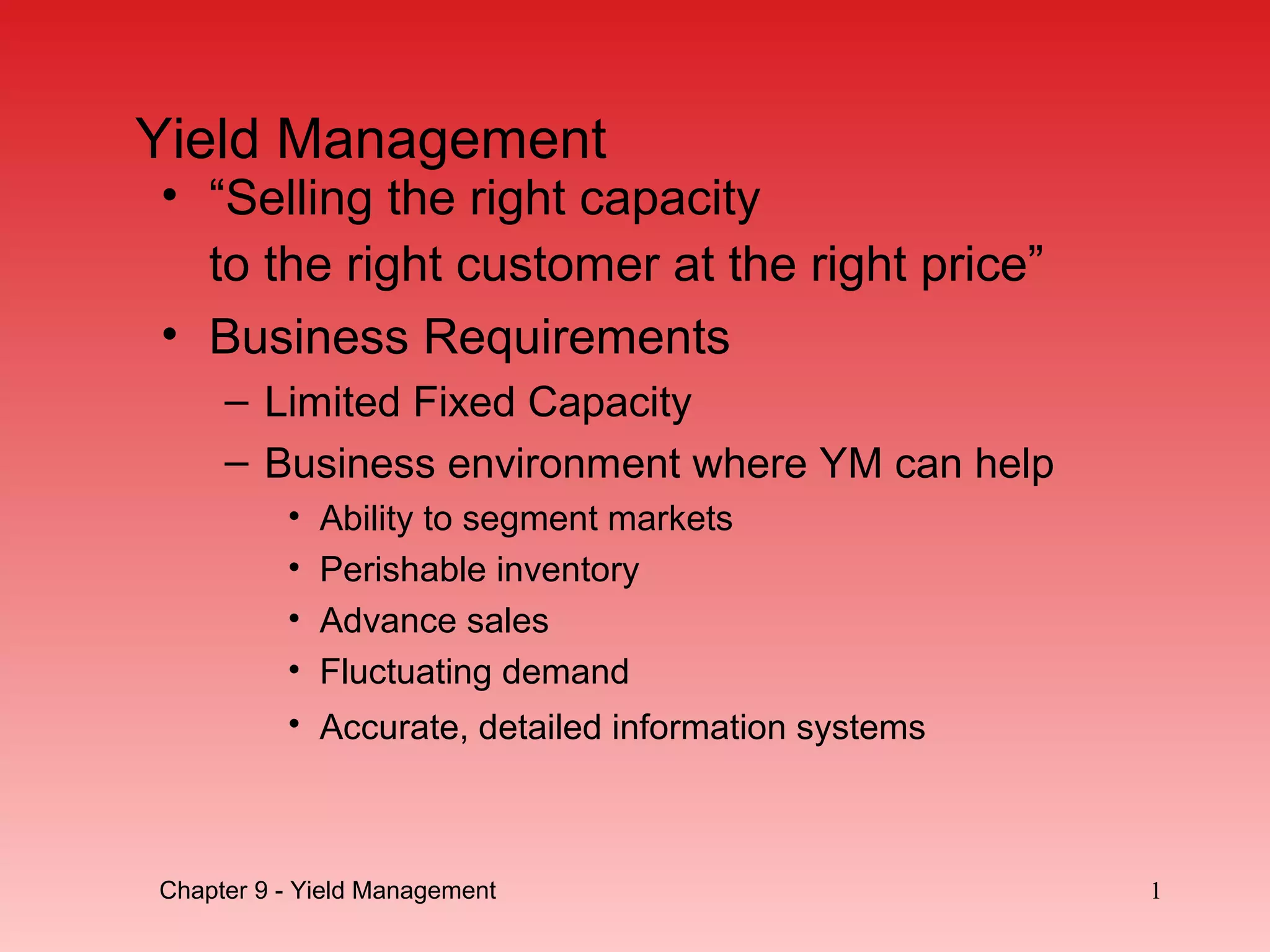
Yield Management
• “Selling the right capacity
to the right customer at the right price”
• Business Requirements
– Limited Fixed Capacity
– Business environment where YM can help
• Ability to segment markets
• Perishable inventory
• Advance sales
• Fluctuating demand
• Accurate, detailed information systems
Chapter 9 - Yield Management 1
Ontario Public Parks System
• Mission?
• Fee: $7.50 per night
Campsites Occupied
Annual Total Per Day
Summer Weekends 5,891 227/day
Spring/Fall Weekends 8,978 173/day
Summer Weekdays 6,129 67/day
Spring/Fall Fridays
Rest of Season 4,979 25/day
Total Campsites 25,997
Total Revenue $65K
3Chapter 9 - Yield Management
New Fee Schedule:
$18.00 Summer Weekends
$7.50 Spring/Fall Weekends
$1.50 Summer Weekdays
Spring/Fall Fridays
Free Rest of Season (no rangers stationed)
Results: Campsites Occupied
$7.50 Fee Sliding Fees
Summer Weekends 5,891 5,215
Spring/Fall Weekends 8,978 8,546
Summer Weekdays 6,129 15,523
Spring/Fall Fridays
Rest of Season 4,979 -
Total Campsites 25,997 29,284 >13%
Total Revenue $65K $60K
Expenses cut: no rangers stationed in WinterChapter 9 - Yield Management 2
Managerial Options
• Supply Management
– Capacity
– Work-shift scheduling
– Increasing customer participation
– Adjustable (surge) capacity
– Sharing Capacity
– Personnel – cross training, part-timers
Chapter 9 - Yield Management 4
Managerial Options
• Demand Management
– Partitioning demand
– Price incentives
– Promoting off-peak demand
– Develop complementary services
• Yield Management
5Chapter 9 - Yield Management
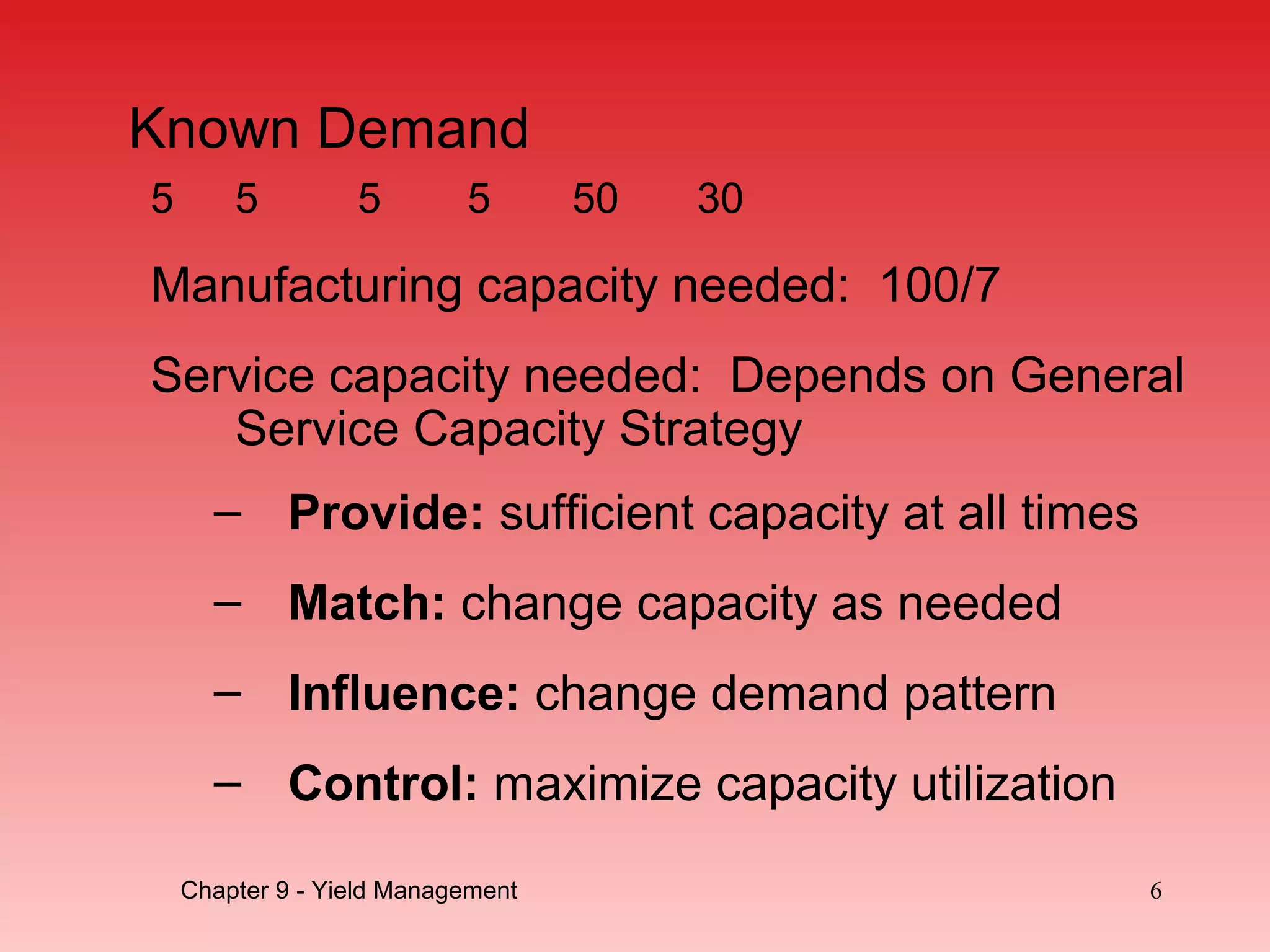
5 5 5 5 50 30
Manufacturing capacity needed: 100/7
Service capacity needed: Depends on General
Service Capacity Strategy
– Provide: sufficient capacity at all times
– Match: change capacity as needed
– Influence: change demand pattern
– Control: maximize capacity utilization
Known Demand
Chapter 9 - Yield Management 6
Services Versus Manufacturing
• Capacity planning task more difficult
–Inventory
–Timing
• Capacity planning mistakes (stock-outs)
more expensive
8Chapter 9 - Yield Management
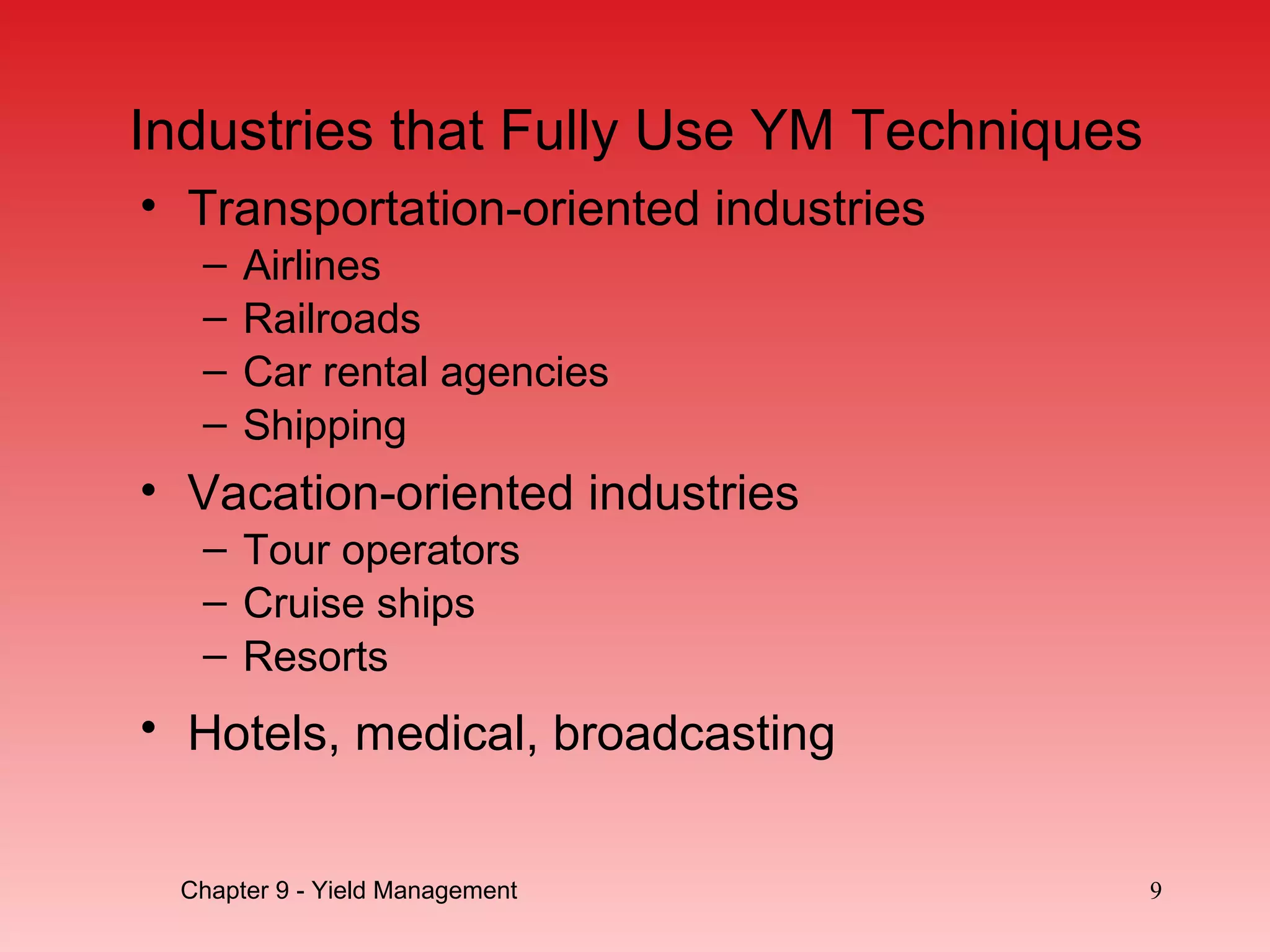
Industries that Fully Use YM Techniques
• Transportation-oriented industries
– Airlines
– Railroads
– Car rental agencies
– Shipping
• Vacation-oriented industries
– Tour operators
– Cruise ships
– Resorts
• Hotels, medical, broadcasting
Chapter 9 - Yield Management 9
Elements of a Yield Management System
• Overbooking
• Pricing
• Capacity Allocation
– Distinct versus nested
– Static versus dynamic
10Chapter 9 - Yield Management
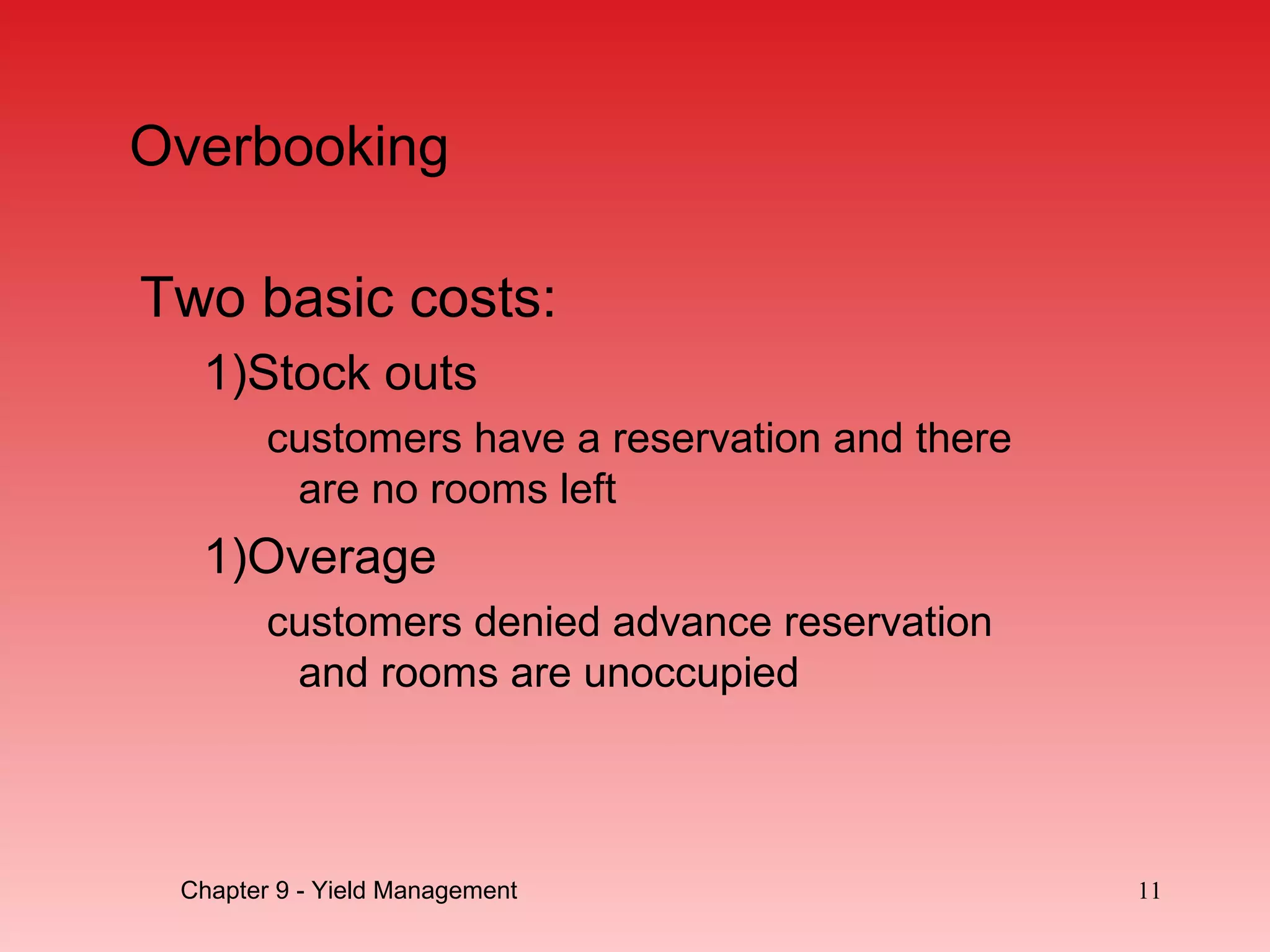
Overbooking
Two basic costs:
1)Stock outs
customers have a reservation and there
are no rooms left
1)Overage
customers denied advance reservation
and rooms are unoccupied
Chapter 9 - Yield Management 11
Example: Hotel California
Stock outs: 0.8 x $150 = $120
Overage: $50
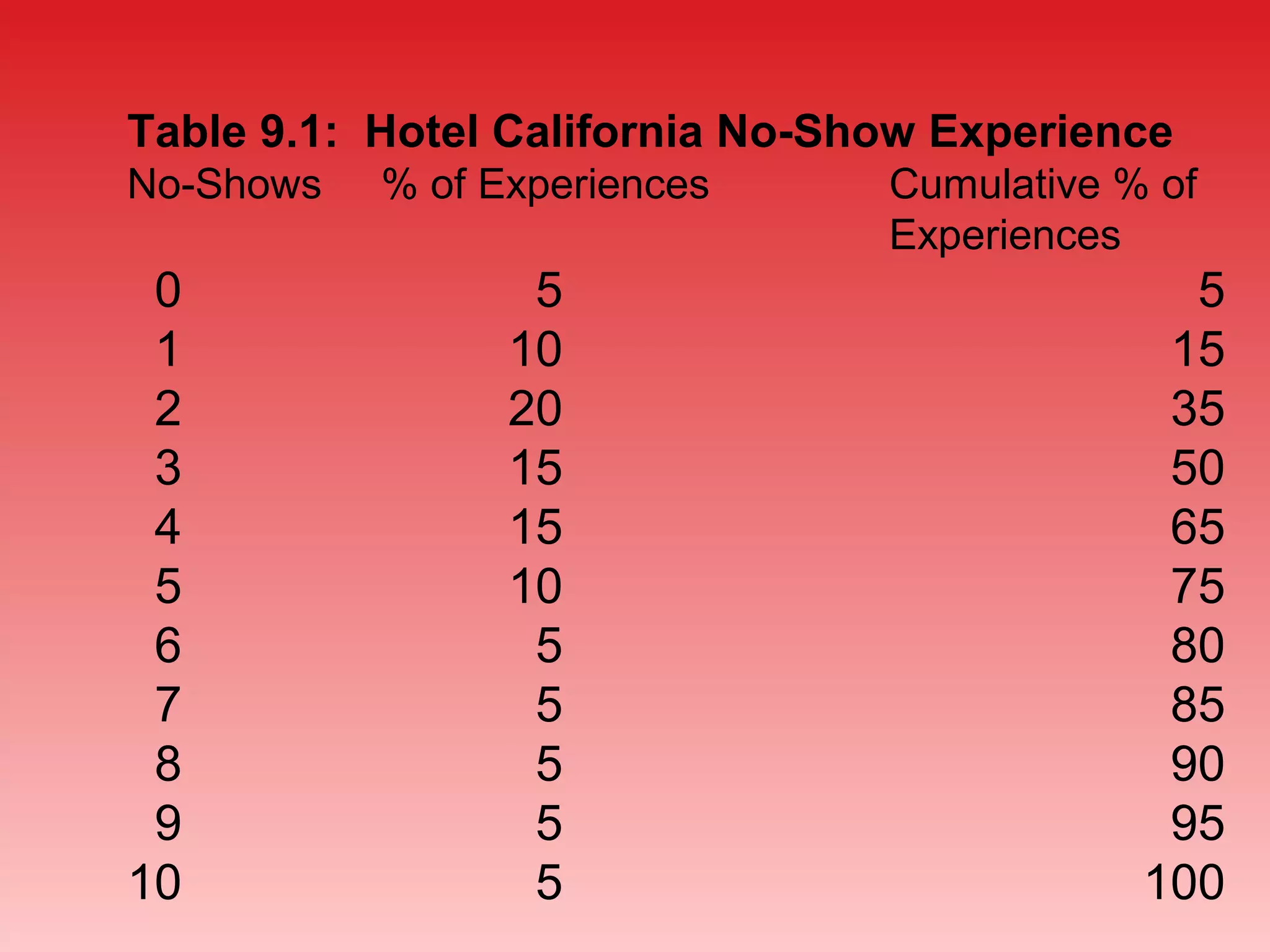
Table 9.1: Hotel California No-Show Experience
No-Shows % of Experiences Cumulative % of
Experiences
0 5 5
1 10 15
2 20 35
3 15 50
4 15 65
5 10 75
6 5 80
7 5 85
8 5 90
9 5 95
10 5 100
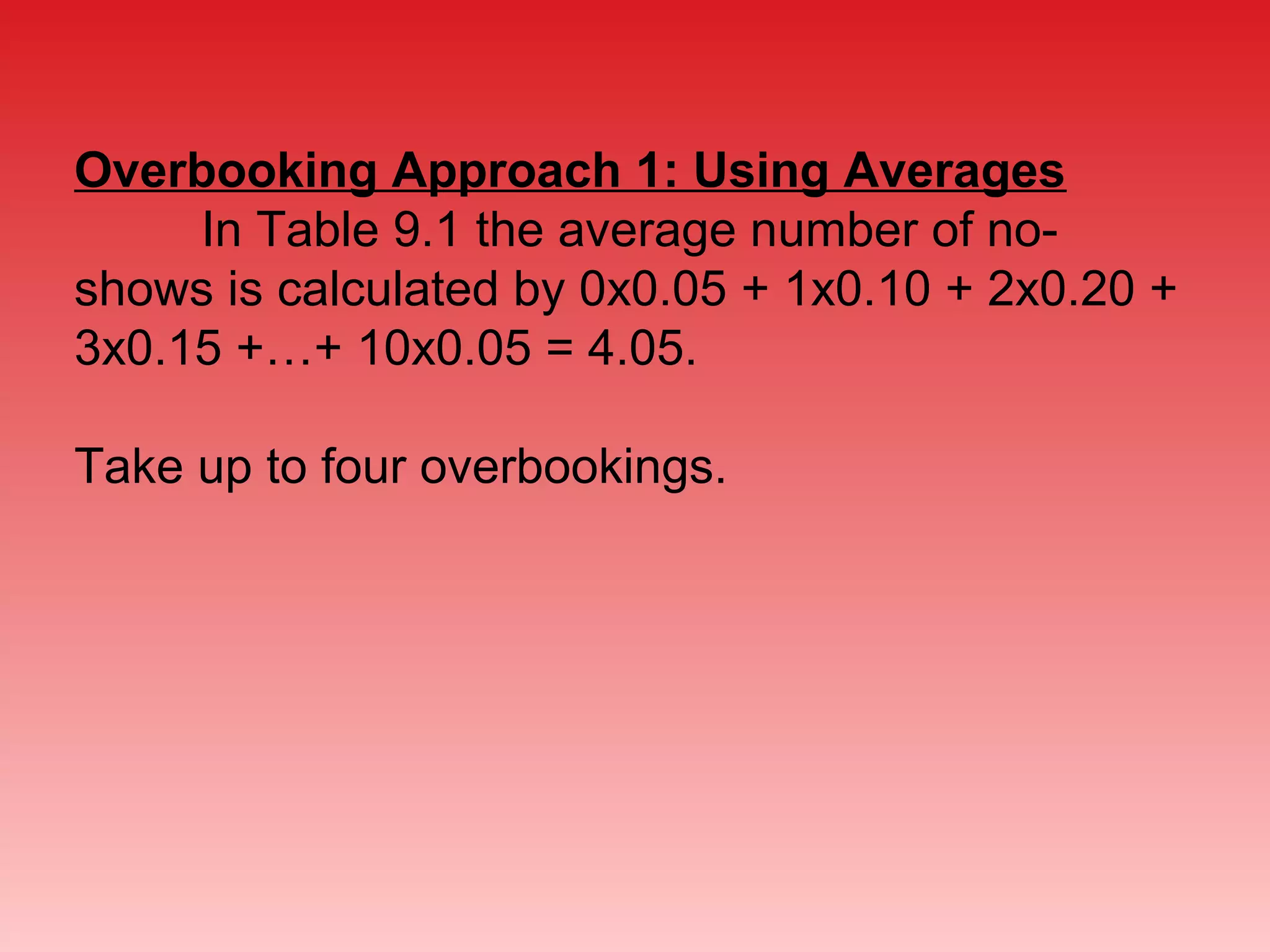
Overbooking Approach 1: Using Averages
In Table 9.1 the average number of no-
shows is calculated by 0x0.05 + 1x0.10 + 2x0.20 +
3x0.15 +…+ 10x0.05 = 4.05.
Take up to four overbookings.
Overbooking Approach 2: Spreadsheet Analysis
Book more guests until:
E(cost of dissatisfied customer) = E(cost of
empty room)
• Cost of dissatisfied customer *
Probability that there are fewer no-shows
than overbooked rooms =
• Cost of empty room *
Probability that there are more no-shows
than overbooked rooms
Chapter 9 - Yield Management 12
Overbooking Approach 3: Marginal Cost Approach
Hotel California
• Co/(Cs + Co) = P(Overbook ≥ No Shows)
Hotel Data
• Cs = $120, Co = $50.00
• Co/(Cs + Co) = 29.%
– Overbook 2 rooms
Table 9.1: Hotel California No-Show Experience
No-Shows % of Experiences Cumulative % of
Experiences
0 5 5
1 10 15
2 20 35
Chapter 9 - Yield Management 13
29%
Actual Overbooking Cost Curve
0 20 40 60 80 100 120 140
$
Percentage of Capacity Claimed
revenue from
regular bookings
linear decline
non-linear decline
Chapter 9 - Yield Management 14
loss of revenue
from unhappy
customers
Fig. 9.2 Dynamic Overbooking
Overbooking
Time to Event
Event Occurs Reservations Start
Capacity Allocation with Exogenous
Prices
Reservations
0 5 10 15 20 25 30
Days Before Event
Capacity
Necessary
Desirable
Chapter 9 - Yield Management 17
Capacity Allocation with Exogenous Prices
• Methods
– Nested vs. Distinct
– Static vs. Dynamic
Chapter 9 - Yield Management 18
Capacity Allocation with Exogenous Prices
Example (Chancey Travel)
Business capacity = 100
Demand forecast: premium profit ($10,000/seat)
demand: uniformly distributed (51, 100)
[meaning: 2% chance demand = 51, 2% chance
demand = 52,…, 2% chance demand = 100,
average demand = 75]
Discount price ($2,500/seat) demand:
unlimited demand at this price – infinite
discounters book earlier than premium
Chapter 9 - Yield Management 19
Static Methods
• Fixed Number, Fixed Time Rules
• Fixed Time Rule
– Accept discount bookings until a specific date
– Motivation
– Distinct, Static System – Fixed Number Rule
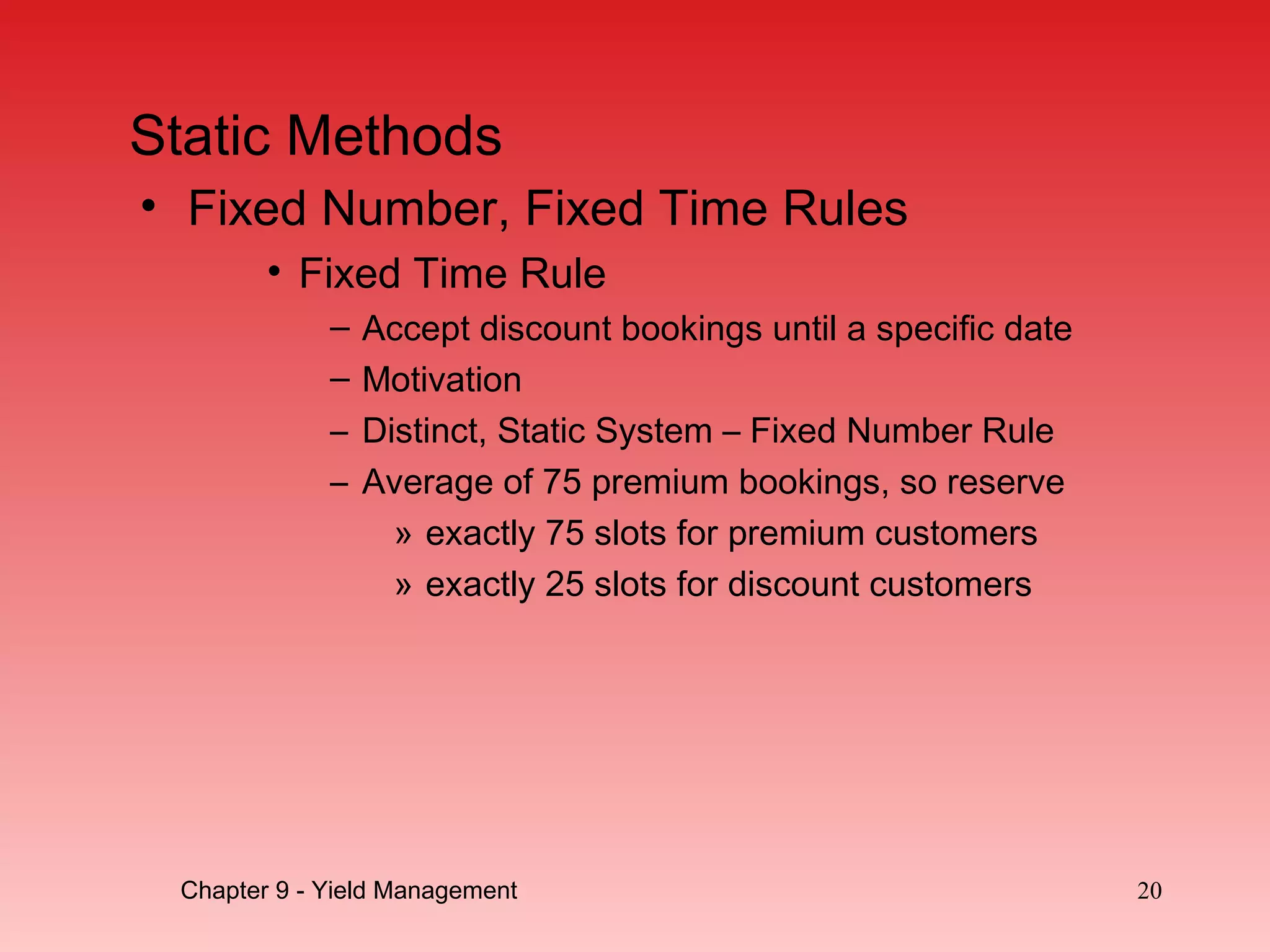
– Average of 75 premium bookings, so reserve
» exactly 75 slots for premium customers
» exactly 25 slots for discount customers
Chapter 9 - Yield Management 20
Static Methods
• Fixed Number, Fixed Time Rules
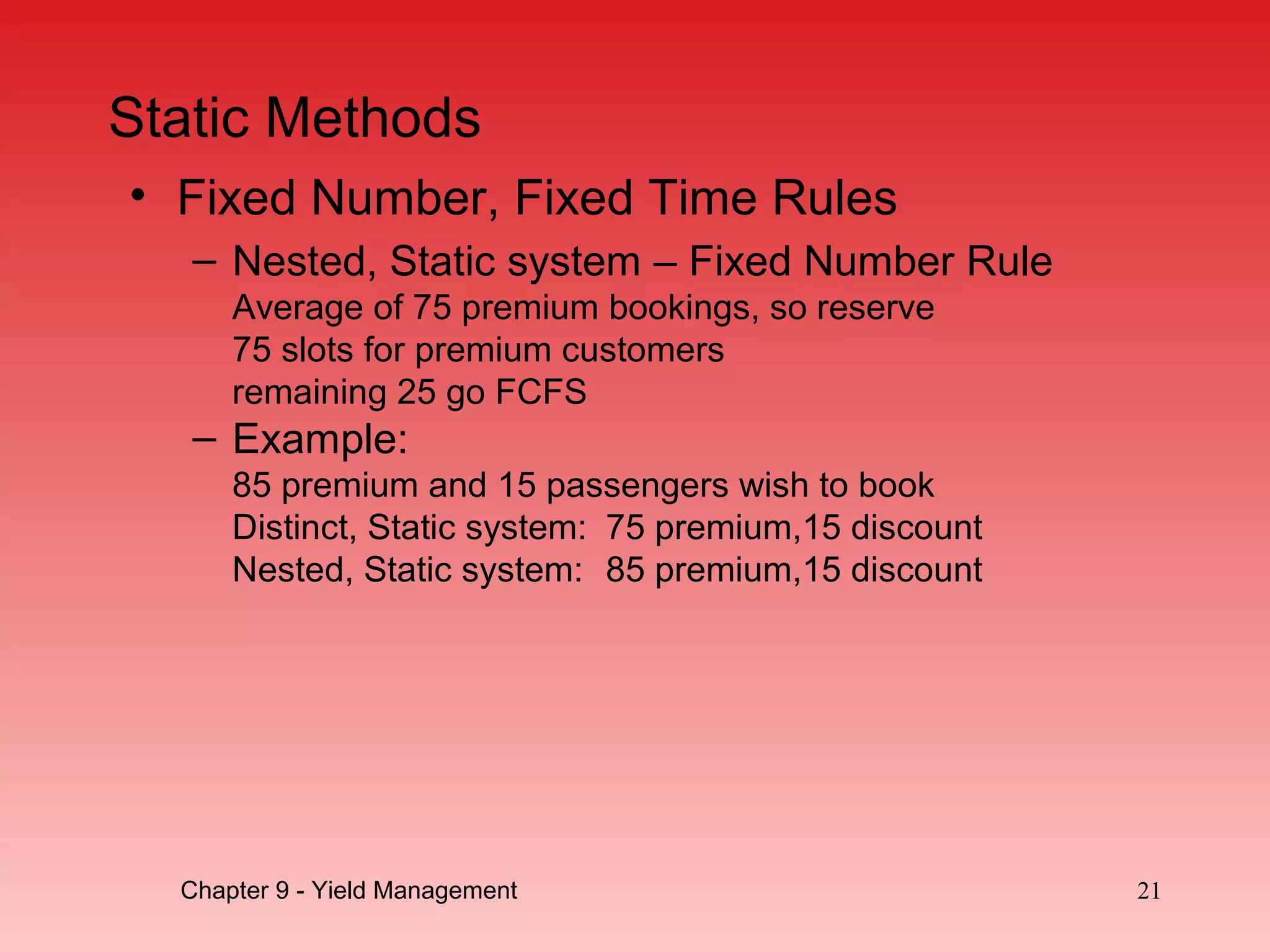
– Nested, Static system – Fixed Number Rule
Average of 75 premium bookings, so reserve
75 slots for premium customers
remaining 25 go FCFS
– Example:
85 premium and 15 passengers wish to book
Distinct, Static system: 75 premium,15 discount
Nested, Static system: 85 premium,15 discount
Chapter 9 - Yield Management 21
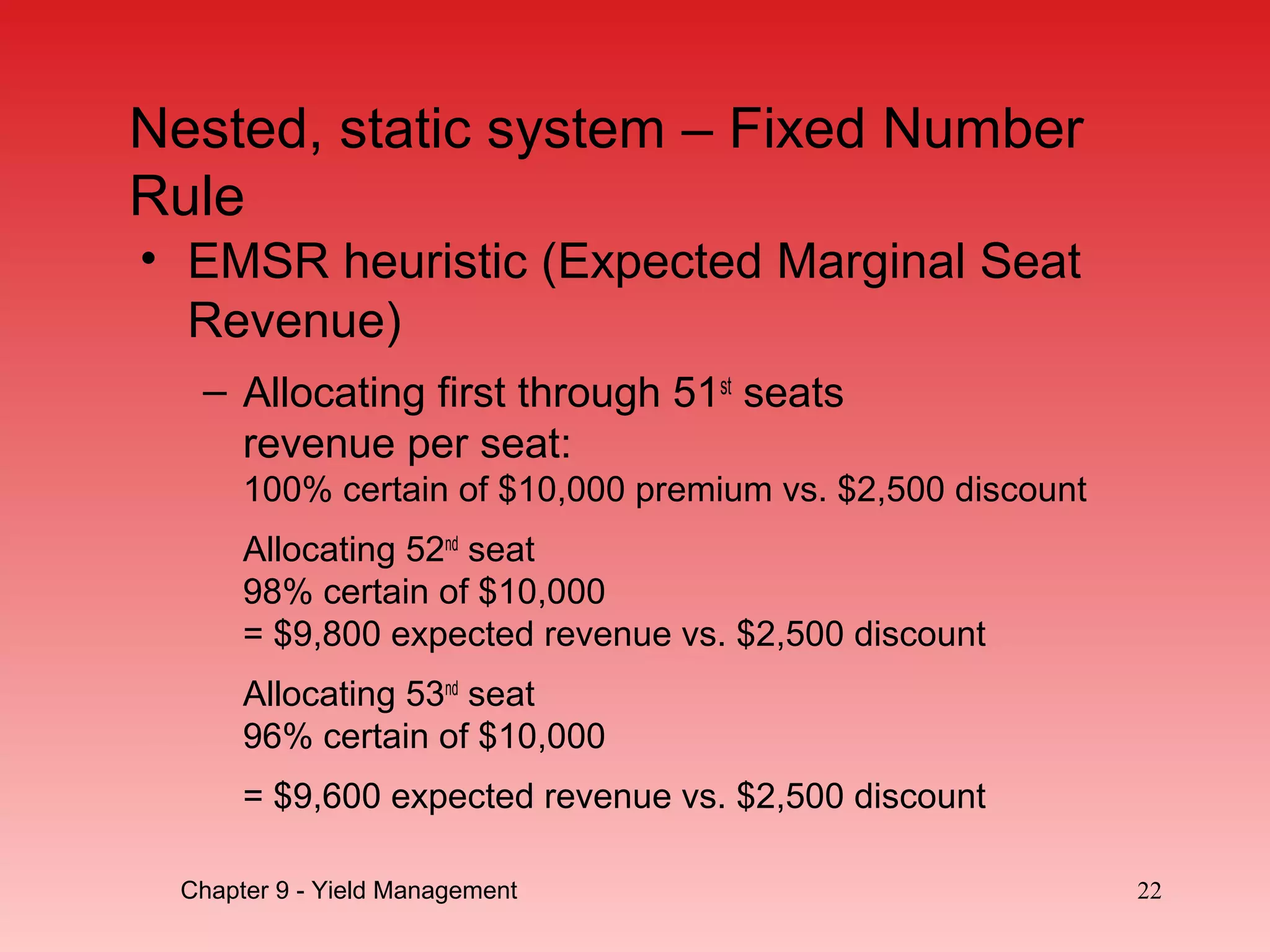
• EMSR heuristic (Expected Marginal Seat
Revenue)
– Allocating first through 51st
seats
revenue per seat:
100% certain of $10,000 premium vs. $2,500 discount
Allocating 52nd
seat
98% certain of $10,000
= $9,800 expected revenue vs. $2,500 discount
Allocating 53nd
seat
96% certain of $10,000
= $9,600 expected revenue vs. $2,500 discount
22Chapter 9 - Yield Management
Nested, static system – Fixed Number
Rule
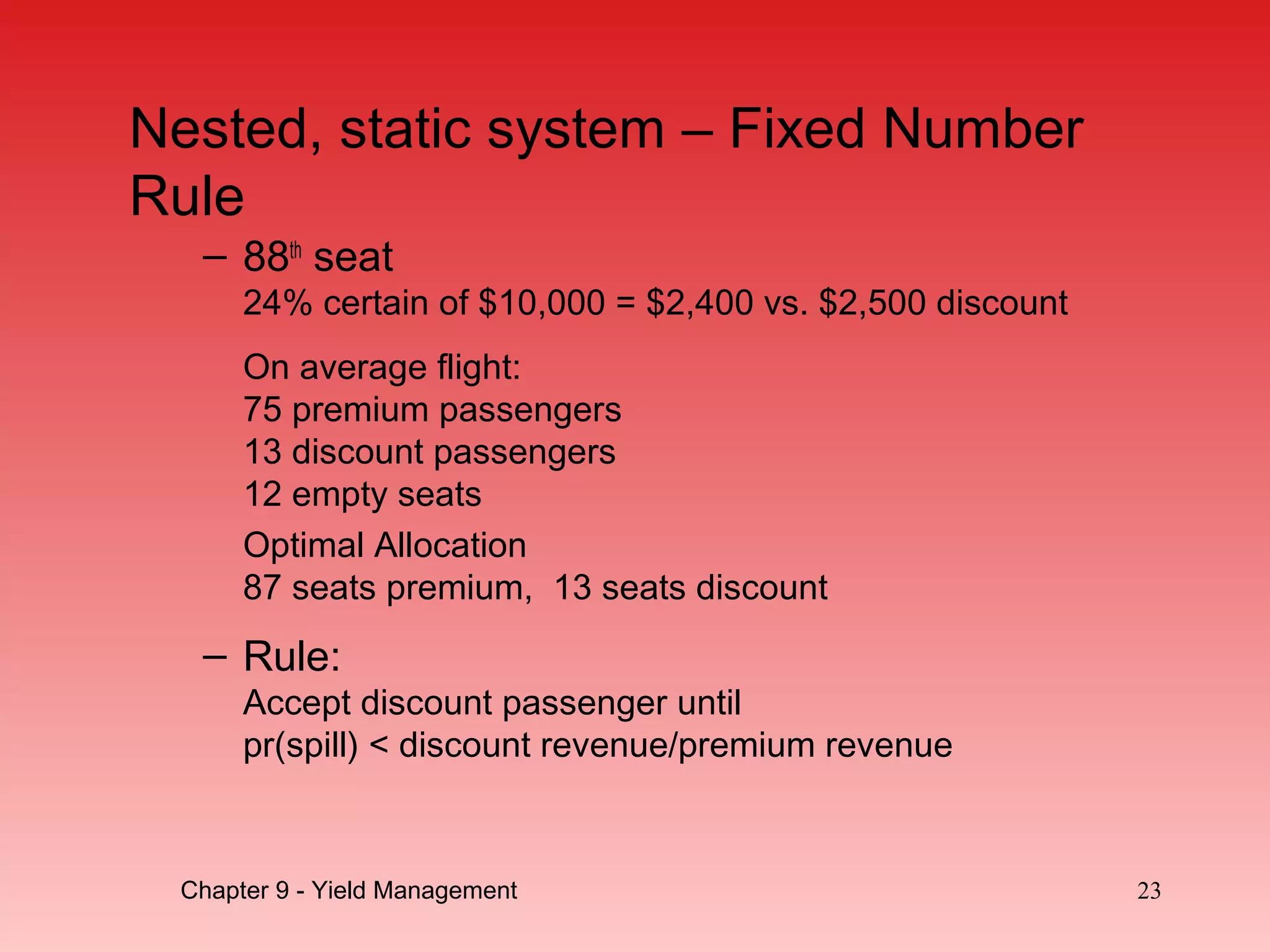
– 88th
seat
24% certain of $10,000 = $2,400 vs. $2,500 discount
On average flight:
75 premium passengers
13 discount passengers
12 empty seats
Optimal Allocation
87 seats premium, 13 seats discount
– Rule:
Accept discount passenger until
pr(spill) < discount revenue/premium revenue
23Chapter 9 - Yield Management
Nested, static system – Fixed Number
Rule
Threshold Curve Analysis
Forecasting from early reservations history
0 5 10 15 20 25 30 35 40
Capacity
Chapter 9 - Yield Management 24
City Pair Airline Coach 21 14 7 Cheapest
Wash.-Nashville USAir $598 414 210 158 79
Newark-Salt Lake Cont. 1,610 785 614 408 179
Dallas-Cleveland American 1,296 204 204 204 159
Memphis-Las Vegas N-west 1,388 463 351 351 149
Pricing and Capacity Allocation
• Effects:
– Expands overall industry
– Shifts consumer surplus to supplier
• Two views
– Using imaginative methods to expand the economy and give
consumers what they want
– Capitalist pig price gouging
25Chapter 9 - Yield Management
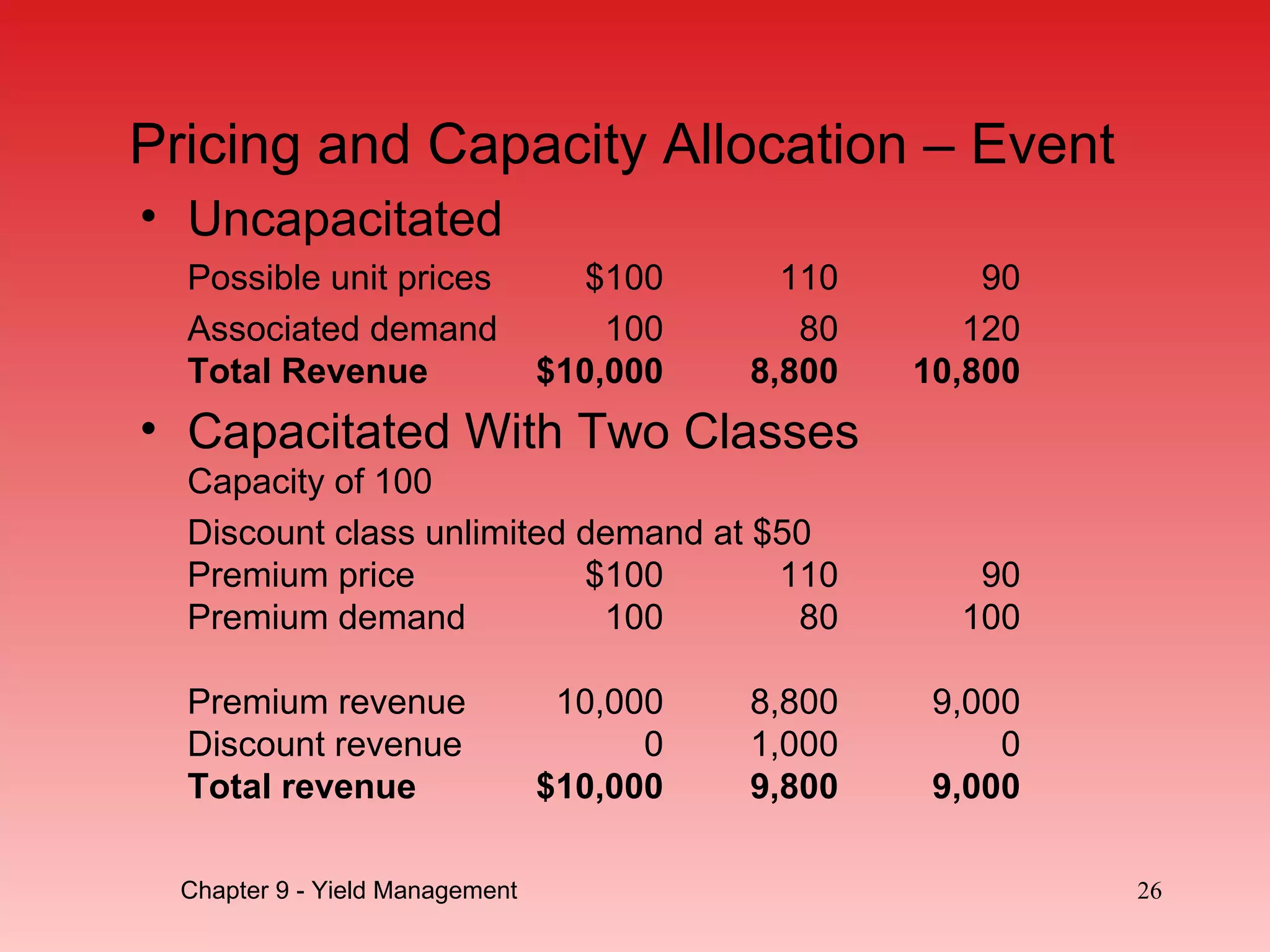
Pricing and Capacity Allocation – Event
• Uncapacitated
Possible unit prices $100 110 90
Associated demand 100 80 120
Total Revenue $10,000 8,800 10,800
• Capacitated With Two Classes
Capacity of 100
Discount class unlimited demand at $50
Premium price $100 110 90
Premium demand 100 80 100
Premium revenue 10,000 8,800 9,000
Discount revenue 0 1,000 0
Total revenue $10,000 9,800 9,000
Chapter 9 - Yield Management 26
• Capacitated with Two Classes
Capacity of 100
Discount class unlimited demand at $75
Premium price $100 110 90
Premium demand 100 80 100
Premium revenue 10,000 8,800 9,000
Discount revenue 0 1,500 0
Total revenue 10,000 10,300 9,000
Lesson:
in the capacitated environment pricing depends on the
relative demand/capacity relationships
Pricing and Capacity Allocation – Event
27Chapter 9 - Yield Management
Yield Management – Implementation
• Alienating Customers
• Difficulty of customer understanding
• Customer cheating
• Employee Issues
• Limiting decision power
• Sabotage: add, not subtract responsibility
• Reward system: in-synch with managerial goals
- Consistency across personnel and units
• Exception processing
• Monitoring
• Cost/Time of Implementation
Chapter 9 - Yield Management 28

Yield management

  • 1.
  • 2.
    Yield Management • “Sellingthe right capacity to the right customer at the right price” • Business Requirements – Limited Fixed Capacity – Business environment where YM can help • Ability to segment markets • Perishable inventory • Advance sales • Fluctuating demand • Accurate, detailed information systems Chapter 9 - Yield Management 1
  • 3.
    Ontario Public ParksSystem • Mission? • Fee: $7.50 per night Campsites Occupied Annual Total Per Day Summer Weekends 5,891 227/day Spring/Fall Weekends 8,978 173/day Summer Weekdays 6,129 67/day Spring/Fall Fridays Rest of Season 4,979 25/day Total Campsites 25,997 Total Revenue $65K 3Chapter 9 - Yield Management
  • 4.
    New Fee Schedule: $18.00Summer Weekends $7.50 Spring/Fall Weekends $1.50 Summer Weekdays Spring/Fall Fridays Free Rest of Season (no rangers stationed) Results: Campsites Occupied $7.50 Fee Sliding Fees Summer Weekends 5,891 5,215 Spring/Fall Weekends 8,978 8,546 Summer Weekdays 6,129 15,523 Spring/Fall Fridays Rest of Season 4,979 - Total Campsites 25,997 29,284 >13% Total Revenue $65K $60K Expenses cut: no rangers stationed in WinterChapter 9 - Yield Management 2
  • 5.
    Managerial Options • SupplyManagement – Capacity – Work-shift scheduling – Increasing customer participation – Adjustable (surge) capacity – Sharing Capacity – Personnel – cross training, part-timers Chapter 9 - Yield Management 4
  • 6.
    Managerial Options • DemandManagement – Partitioning demand – Price incentives – Promoting off-peak demand – Develop complementary services • Yield Management 5Chapter 9 - Yield Management
  • 7.
    5 5 55 50 30 Manufacturing capacity needed: 100/7 Service capacity needed: Depends on General Service Capacity Strategy – Provide: sufficient capacity at all times – Match: change capacity as needed – Influence: change demand pattern – Control: maximize capacity utilization Known Demand Chapter 9 - Yield Management 6
  • 8.
    Services Versus Manufacturing •Capacity planning task more difficult –Inventory –Timing • Capacity planning mistakes (stock-outs) more expensive 8Chapter 9 - Yield Management
  • 9.
    Industries that FullyUse YM Techniques • Transportation-oriented industries – Airlines – Railroads – Car rental agencies – Shipping • Vacation-oriented industries – Tour operators – Cruise ships – Resorts • Hotels, medical, broadcasting Chapter 9 - Yield Management 9
  • 10.
    Elements of aYield Management System • Overbooking • Pricing • Capacity Allocation – Distinct versus nested – Static versus dynamic 10Chapter 9 - Yield Management
  • 11.
    Overbooking Two basic costs: 1)Stockouts customers have a reservation and there are no rooms left 1)Overage customers denied advance reservation and rooms are unoccupied Chapter 9 - Yield Management 11
  • 12.
    Example: Hotel California Stockouts: 0.8 x $150 = $120 Overage: $50
  • 13.
    Table 9.1: HotelCalifornia No-Show Experience No-Shows % of Experiences Cumulative % of Experiences 0 5 5 1 10 15 2 20 35 3 15 50 4 15 65 5 10 75 6 5 80 7 5 85 8 5 90 9 5 95 10 5 100
  • 14.
    Overbooking Approach 1:Using Averages In Table 9.1 the average number of no- shows is calculated by 0x0.05 + 1x0.10 + 2x0.20 + 3x0.15 +…+ 10x0.05 = 4.05. Take up to four overbookings.
  • 15.
    Overbooking Approach 2:Spreadsheet Analysis
  • 16.
    Book more guestsuntil: E(cost of dissatisfied customer) = E(cost of empty room) • Cost of dissatisfied customer * Probability that there are fewer no-shows than overbooked rooms = • Cost of empty room * Probability that there are more no-shows than overbooked rooms Chapter 9 - Yield Management 12 Overbooking Approach 3: Marginal Cost Approach
  • 17.
    Hotel California • Co/(Cs+ Co) = P(Overbook ≥ No Shows) Hotel Data • Cs = $120, Co = $50.00 • Co/(Cs + Co) = 29.% – Overbook 2 rooms Table 9.1: Hotel California No-Show Experience No-Shows % of Experiences Cumulative % of Experiences 0 5 5 1 10 15 2 20 35 Chapter 9 - Yield Management 13 29%
  • 19.
    Actual Overbooking CostCurve 0 20 40 60 80 100 120 140 $ Percentage of Capacity Claimed revenue from regular bookings linear decline non-linear decline Chapter 9 - Yield Management 14 loss of revenue from unhappy customers
  • 20.
    Fig. 9.2 DynamicOverbooking Overbooking Time to Event Event Occurs Reservations Start
  • 21.
    Capacity Allocation withExogenous Prices Reservations 0 5 10 15 20 25 30 Days Before Event Capacity Necessary Desirable Chapter 9 - Yield Management 17
  • 22.
    Capacity Allocation withExogenous Prices • Methods – Nested vs. Distinct – Static vs. Dynamic Chapter 9 - Yield Management 18
  • 23.
    Capacity Allocation withExogenous Prices Example (Chancey Travel) Business capacity = 100 Demand forecast: premium profit ($10,000/seat) demand: uniformly distributed (51, 100) [meaning: 2% chance demand = 51, 2% chance demand = 52,…, 2% chance demand = 100, average demand = 75] Discount price ($2,500/seat) demand: unlimited demand at this price – infinite discounters book earlier than premium Chapter 9 - Yield Management 19
  • 24.
    Static Methods • FixedNumber, Fixed Time Rules • Fixed Time Rule – Accept discount bookings until a specific date – Motivation – Distinct, Static System – Fixed Number Rule – Average of 75 premium bookings, so reserve » exactly 75 slots for premium customers » exactly 25 slots for discount customers Chapter 9 - Yield Management 20
  • 25.
    Static Methods • FixedNumber, Fixed Time Rules – Nested, Static system – Fixed Number Rule Average of 75 premium bookings, so reserve 75 slots for premium customers remaining 25 go FCFS – Example: 85 premium and 15 passengers wish to book Distinct, Static system: 75 premium,15 discount Nested, Static system: 85 premium,15 discount Chapter 9 - Yield Management 21
  • 26.
    • EMSR heuristic(Expected Marginal Seat Revenue) – Allocating first through 51st seats revenue per seat: 100% certain of $10,000 premium vs. $2,500 discount Allocating 52nd seat 98% certain of $10,000 = $9,800 expected revenue vs. $2,500 discount Allocating 53nd seat 96% certain of $10,000 = $9,600 expected revenue vs. $2,500 discount 22Chapter 9 - Yield Management Nested, static system – Fixed Number Rule
  • 27.
    – 88th seat 24% certainof $10,000 = $2,400 vs. $2,500 discount On average flight: 75 premium passengers 13 discount passengers 12 empty seats Optimal Allocation 87 seats premium, 13 seats discount – Rule: Accept discount passenger until pr(spill) < discount revenue/premium revenue 23Chapter 9 - Yield Management Nested, static system – Fixed Number Rule
  • 28.
    Threshold Curve Analysis Forecastingfrom early reservations history 0 5 10 15 20 25 30 35 40 Capacity Chapter 9 - Yield Management 24
  • 29.
    City Pair AirlineCoach 21 14 7 Cheapest Wash.-Nashville USAir $598 414 210 158 79 Newark-Salt Lake Cont. 1,610 785 614 408 179 Dallas-Cleveland American 1,296 204 204 204 159 Memphis-Las Vegas N-west 1,388 463 351 351 149 Pricing and Capacity Allocation • Effects: – Expands overall industry – Shifts consumer surplus to supplier • Two views – Using imaginative methods to expand the economy and give consumers what they want – Capitalist pig price gouging 25Chapter 9 - Yield Management
  • 30.
    Pricing and CapacityAllocation – Event • Uncapacitated Possible unit prices $100 110 90 Associated demand 100 80 120 Total Revenue $10,000 8,800 10,800 • Capacitated With Two Classes Capacity of 100 Discount class unlimited demand at $50 Premium price $100 110 90 Premium demand 100 80 100 Premium revenue 10,000 8,800 9,000 Discount revenue 0 1,000 0 Total revenue $10,000 9,800 9,000 Chapter 9 - Yield Management 26
  • 31.
    • Capacitated withTwo Classes Capacity of 100 Discount class unlimited demand at $75 Premium price $100 110 90 Premium demand 100 80 100 Premium revenue 10,000 8,800 9,000 Discount revenue 0 1,500 0 Total revenue 10,000 10,300 9,000 Lesson: in the capacitated environment pricing depends on the relative demand/capacity relationships Pricing and Capacity Allocation – Event 27Chapter 9 - Yield Management
  • 32.
    Yield Management –Implementation • Alienating Customers • Difficulty of customer understanding • Customer cheating • Employee Issues • Limiting decision power • Sabotage: add, not subtract responsibility • Reward system: in-synch with managerial goals - Consistency across personnel and units • Exception processing • Monitoring • Cost/Time of Implementation Chapter 9 - Yield Management 28

Editor's Notes

  • #6 The material in the next few slides is from chapter 2, but it may be appropriate to use when discussing yield management.