Yet Another Introduction to
Linux RCU
Viller Hsiao <villerhsiao@gmail.com>
May. 14, 2015
9/3/16 2/60
Who am I ?
Viller Hsiao
Embedded Linux / RTOS engineer
  
http://image.dfdaily.com/2012/5/4/634716931128751250504b050c1_nEO_IMG.jpg
9/3/16 3/60
http://www.anec.com/assets/images/call_before_you_dig.jpg
Presented For HCSM
9/3/16 4/60
What is RCU ?
●
Read-Copy Update
●
A kind of read/write synchronization
mechanism
9/3/16 5/60
Agenda
●
Synchronization inside Linux
●
RCU basic operations
●
Linux RCU internal
9/3/16 6/60
Synchronization Synchronization 
insideinside
Linux KernelLinux Kernel
9/3/16 7/60
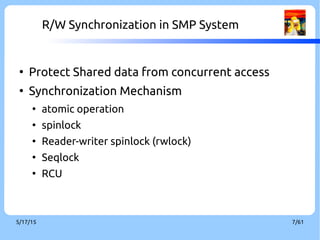
R/W Synchronization in SMP System
●
Protect Shared data from concurrent access
●
Synchronization mechanism
●
atomic operation
●
spinlock
●
reader-writer spinlock (rwlock)
●
seqlock
●
RCU
9/3/16 8/60
Atomic Operation
●
Operations that read and change data within a
single, uninterruptible step
●
Architecture support
●
test-and-set (TSR)
●
compare-and-swap (CAS)
●
load-link/store-conditional (ll/sc)
9/3/16 9/60
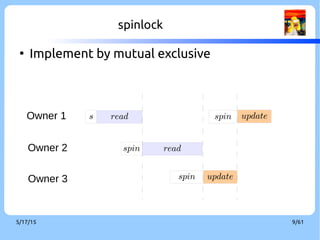
spinlock
Owner 3 update
Owner 2 read
Owner 1 read
spin
spinsp
in
spin
update
●
Implement by mutual exclusive
u
u
u
u
9/3/16 10/60
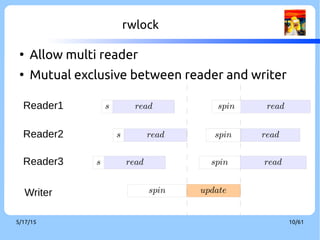
rwlock
●
Allow multi reader
●
Mutual exclusive between reader and writer
Reader3
Writer update
read
Reader2 read
Reader1 read
spin
read
read
read
spin
spin
spinsp
in
spinsp
in
sp
in
u
u
u u
u
u
u
9/3/16 11/60
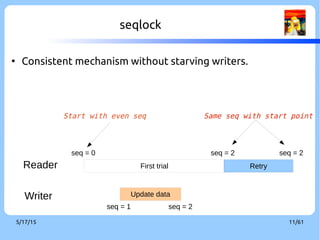
seqlock
●
Consistent mechanism without starving writers.
Reader
Writer Update data
seq = 1 seq = 2
seq = 0 seq = 2 seq = 2
RetryFirst trial
Start with even seq Same seq with start point
9/3/16 12/60
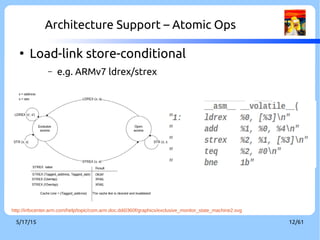
Architecture Support – Atomic Ops
●
Load-link store-conditional
– e.g. ARMv7 ldrex/strex
http://infocenter.arm.com/help/topic/com.arm.doc.ddi0360f/graphics/exclusive_monitor_state_machine2.svg
9/3/16 13/60
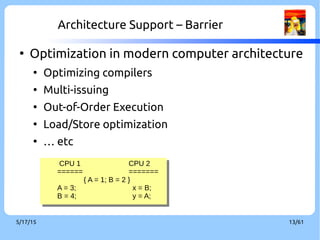
Architecture Support – Barrier
●
Optimization in modern computer architecture
●
Optimizing compilers
●
Multi-issuing
●
Out-of-Order Execution
●
Load/Store optimization
●
… etc
CPU 1 CPU 2
====== =======
{ A = 1; B = 2 }
A = 3; x = B;
B = 4; y = A;
CPU 1 CPU 2
====== =======
{ A = 1; B = 2 }
A = 3; x = B;
B = 4; y = A;
9/3/16 14/60
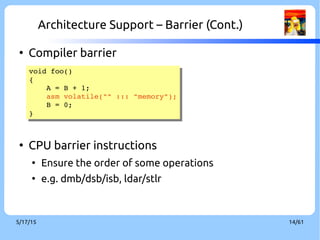
Architecture Support – Barrier (Cont.)
●
Compiler barrier
●
CPU barrier instructions
●
Ensure the order of some operations
●
e.g. dmb/dsb/isb, ldar/stlr
void foo()
{
    A = B + 1;
    asm volatile("" ::: "memory");
    B = 0;
}
void foo()
{
    A = B + 1;
    asm volatile("" ::: "memory");
    B = 0;
}
9/3/16 15/60
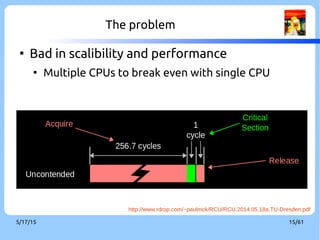
The problem
●
Bad in scalability and performance
●
Multiple CPUs to break even with single CPU
http://www.rdrop.com/~paulmck/RCU/RCU.2014.05.18a.TU-Dresden.pdf
9/3/16 16/60
RCU Basic OperationRCU Basic Operation
9/3/16 17/60
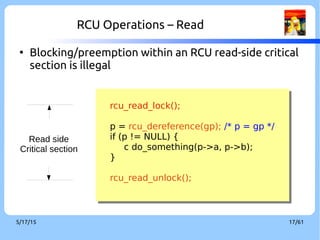
RCU Operations – Read
rcu_read_lock();
p = rcu_dereference(gp); /* p = gp */
if (p != NULL) {
c do_something(p->a, p->b);
}
rcu_read_unlock();
rcu_read_lock();
p = rcu_dereference(gp); /* p = gp */
if (p != NULL) {
c do_something(p->a, p->b);
}
rcu_read_unlock();
Read side
Critical section
●
Blocking/preemption within an RCU read-side critical
section is illegal
9/3/16 18/60
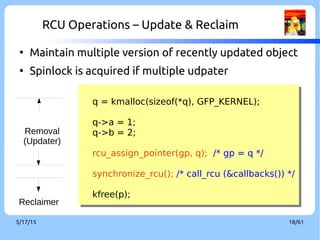
RCU Operations – Update & Reclaim
q = kmalloc(sizeof(*q), GFP_KERNEL);
q->a = 1;
q->b = 2;
rcu_assign_pointer(gp, q); /* gp = q */
synchronize_rcu(); /* call_rcu (&callbacks()) */
kfree(p);
q = kmalloc(sizeof(*q), GFP_KERNEL);
q->a = 1;
q->b = 2;
rcu_assign_pointer(gp, q); /* gp = q */
synchronize_rcu(); /* call_rcu (&callbacks()) */
kfree(p);
Removal
(Updater)
Reclaimer
●
Maintain multiple version of recently updated object
●
Spinlock is acquired if multiple udpater
9/3/16 19/60
RCU Primitives
READER
UPDATER RECLAIMER
rcu_dereference()
rcu_assign_pointer()
rcu_read_lock()
rcu_read_unlock()
call_rcu()
synchronize_rcu()
wmb
rmb only on
DEC alpha
preempt­disable
only if
preemptible kernel
Re-painted from [13]
9/3/16 20/60
Quiz: Why does it improve scalability in
read side?
9/3/16 21/60
Why RCU is better?
●
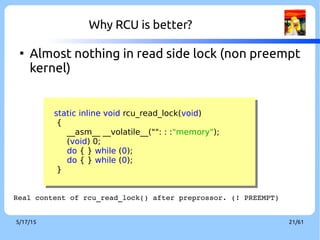
Almost nothing in read side lock (non preempt
kernel)
static inline void rcu_read_lock(void)
{
__asm__ __volatile__("": : :"memory");
(void) 0;
do { } while (0);
do { } while (0);
}
static inline void rcu_read_lock(void)
{
__asm__ __volatile__("": : :"memory");
(void) 0;
do { } while (0);
do { } while (0);
}
Real content of rcu_read_lock() after preprocessor. (! PREEMPT)
9/3/16 22/60
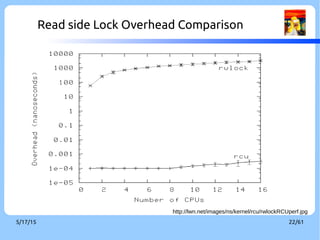
Read side Lock Overhead Comparison
http://lwn.net/images/ns/kernel/rcu/rwlockRCUperf.jpg
9/3/16 23/60
What's the benifit?
●
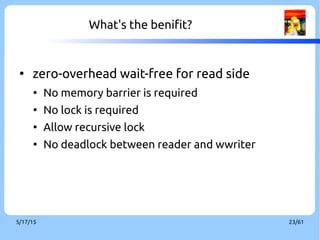
Zero-overhead and wait-free in read side
●
No memory barrier is required
●
No lock is required
●
Allow recursive lock
●
No deadlock between readers and writer
9/3/16 24/60
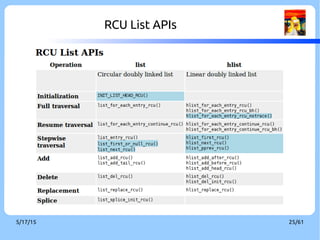
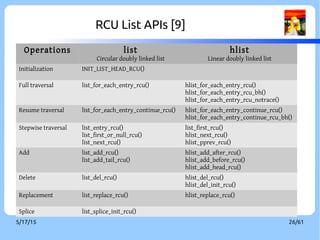
RCU List APIs [10]
Operations list
Circular doubly linked list
hlist
Linear doubly linked list
Initialization INIT_LIST_HEAD_RCU()
Full traversal list_for_each_entry_rcu() hlist_for_each_entry_rcu()
hlist_for_each_entry_rcu_bh()
hlist_for_each_entry_rcu_notrace()
Resume traversal list_for_each_entry_continue_rcu() hlist_for_each_entry_continue_rcu()
hlist_for_each_entry_continue_rcu_bh()
Stepwise traversal list_entry_rcu()
list_first_or_null_rcu()
list_next_rcu()
list_first_rcu()
hlist_next_rcu()
hlist_pprev_rcu()
Add list_add_rcu()
list_add_tail_rcu()
hlist_add_after_rcu()
hlist_add_before_rcu()
hlist_add_head_rcu()
Delete list_del_rcu() hlist_del_rcu()
hlist_del_init_rcu()
Replacement list_replace_rcu() hlist_replace_rcu()
Splice list_splice_init_rcu()
9/3/16 25/60
RCU Model
Removal ReclamationGrace Period
Reader
Reader
Reader
Reader
Reader
Reader Reader
Reader Reader
Repainted from https://lwn.net/images/ns/kernel/rcu/GracePeriodGood.png
9/3/16 26/60
RCU vs rwlock
●
RCU has lower overhead and better scalability
●
RCU readers see updated data faster
●
rwlock readers get the consistent data after writer updated
c
https://lwn.net/Articles/263130/
9/3/16 27/60
Replace rwlock by RCU[13]
http://en.wikipedia.org/wiki/Read-copy-update
9/3/16 28/60
Replace rwlock by RCU[13]
http://en.wikipedia.org/wiki/Read-copy-update
9/3/16 29/60
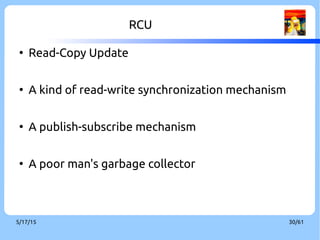
What is RCU, again
●
Read-Copy Update
●
A kind of read-write synchronization mechanism
●
A publish-subscribe mechanism[5]
●
A poor man's garbage collector[5]
9/3/16 30/60
But
Quiz: How does reclaimer know the time
to release old object?
9/3/16 31/60
Linux RCU InternalLinux RCU Internal
9/3/16 32/60
History and Contributors[9][13]
●
1980 H. T. Kung and Q. Lehman 
●
use of garbage collectors to defer destruction of nodes in a parellel binary search tree.
●
1986, Hennessy, Osisek, and Seigh
●
Passive serialization, which is an RCU­like mechanism that relies on the presence of "quiescent states" in 
the VM/XA hypervisor 
●
1995 J. Slingwine and P. E. McKenney
●
US Patent 5,442,758, implement RCU in DYNIX/ptx kernel.
●
2002, D. Sarma
●
added RCU to version 2.5.43 of the Linux kernel
●
2005, P. E. McKenney
●
Permitting preemption of RCU realtime critical sections
●
2009, P. E. McKenny 
●
Introduce user­level RCU implementation
●
Work of P. E. McKenney, Mathieu Desnoyers, Alan Stern, Michel Dagenais, Manish Gupta, Maged 
Michael, Phil Howard, Joshua Triplett, Jonathan Walpole, and the Linux kernel community
9/3/16 33/60
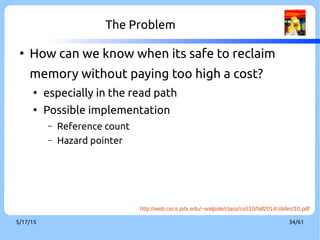
The Problem
●
How can we know when it's safe to reclaim
memory without paying too high a cost?
●
especially in the read path
●
Possible implementation
– Reference count
– Hazard pointer
~ The page is extracted and tweaked from [14]
9/3/16 34/60
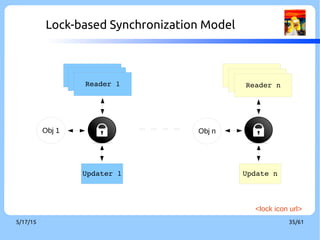
Lock-based Synchronization Model
Reader nReader 1
Update nUpdater 1
Reader 1
Reader 1
Reader n
Reader n
<lock icon url>
Obj 1 Obj n
9/3/16 35/60
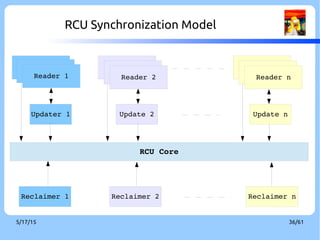
RCU Synchronization Model
RCU Core
Reader 2 Reader nReader 1
Reclaimer 2 Reclaimer nReclaimer 1
Update 2 Update nUpdater 1
Reader 1
Reader 1
Reader 2
Reader 2
Reader n
Reader n
9/3/16 36/60
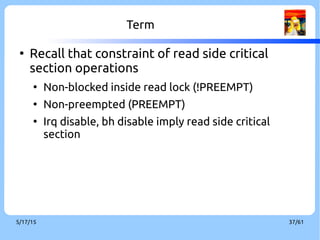
Terms
●
Recall that constraint of read side critical
section operations
●
Non-blocked inside read lock (!PREEMPT)
●
Non-preempted (PREEMPT)
●
Irq disable, bh disable imply read side critical
section
9/3/16 37/60
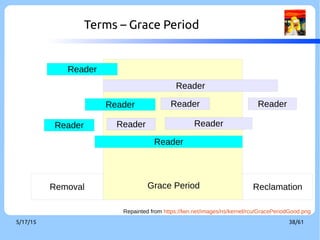
Terms – Grace Period
Removal ReclamationGrace Period
Reader
Reader
Reader
Reader
Reader
Reader Reader
Reader Reader
Repainted from https://lwn.net/images/ns/kernel/rcu/GracePeriodGood.png
9/3/16 38/60
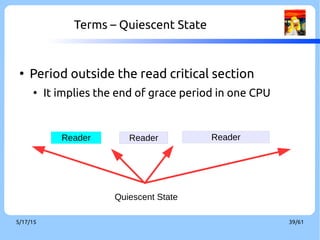
Terms – Quiescent State
Reader Reader Reader
Quiescent State
●
Period outside the read critical section
●
It implies complete of one grace period in its CPU
9/3/16 39/60
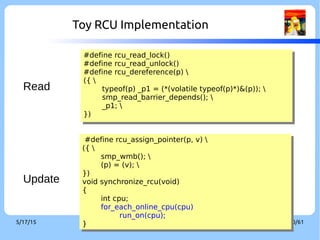
Toy RCU Implementation
#define rcu_assign_pointer(p, v) 
({ 
        smp_wmb(); 
        (p) = (v); 
})
void synchronize_rcu(void)
{
        int cpu;
        for_each_online_cpu(cpu)
                run_on(cpu);
}
#define rcu_assign_pointer(p, v) 
({ 
        smp_wmb(); 
        (p) = (v); 
})
void synchronize_rcu(void)
{
        int cpu;
        for_each_online_cpu(cpu)
                run_on(cpu);
}
#define rcu_read_lock()
#define rcu_read_unlock()
#define rcu_dereference(p) 
({ 
        typeof(p) _p1 = (*(volatile typeof(p)*)&(p)); 
        smp_read_barrier_depends(); 
        _p1; 
})
#define rcu_read_lock()
#define rcu_read_unlock()
#define rcu_dereference(p) 
({ 
        typeof(p) _p1 = (*(volatile typeof(p)*)&(p)); 
        smp_read_barrier_depends(); 
        _p1; 
})
Read
Update
9/3/16 40/60
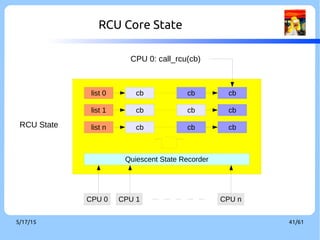
RCU Core State
CPU 0: call_rcu(cb)
RCU State
list 0 cb cb cb
list 1 cb cb cb
list n cb cb cb
Quiescent State Recorder
CPU 0 CPU 1 CPU n
9/3/16 41/60
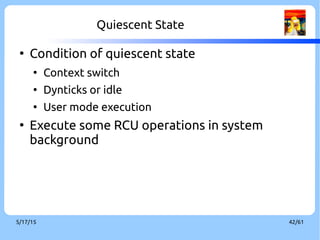
Quiescent State
●
Condition of quiescent state
●
Context switch
●
Dynticks or idle
●
User mode execution
●
Check RCU state and execute RCU operations
in system background
9/3/16 42/60
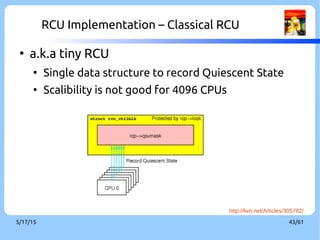
RCU Implementation – Classical RCU
●
a.k.a tiny RCU
●
Single data structure to record Quiescent State
●
Scalability is not good for large numbers of CPUs,
e.g. 4096 CPUs
http://lwn.net/Articles/305782/
9/3/16 43/60
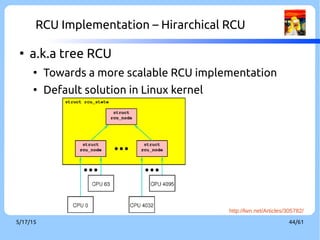
RCU Implementation – Hirarchical RCU
●
a.k.a tree RCU
●
Towards a more scalable RCU implementation
●
Default solution in Linux kernel
http://lwn.net/Articles/305782/
9/3/16 44/60
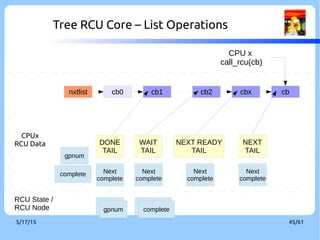
Tree RCU Core – List Operations
CPU x
call_rcu(cb)
cb1 cb2 cbxnxtlist cb0
DONE
TAIL
WAIT
TAIL
NEXT READY
TAIL
NEXT
TAIL
cb
Next
Complete
(DONE)
Next
Complete
(WAIT)
Next
Complete
(NXTRDY)
Next
complete
CPUx
RCU Data
RCU State /
RCU Node gpnum complete
gpnum complete
gpnum
complete
9/3/16 45/60
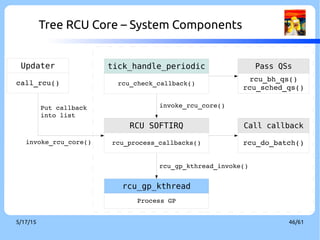
Tree RCU Core – System Components
invoke_rcu_core()
rcu_gp_kthread_invoke()
Put callback
into list
Updater
call_rcu()
tick_handle_periodic
rcu_check_callback()
RCU SOFTIRQ
rcu_process_callbacks()
rcu_gp_kthread
Process GP
Call callback
rcu_do_batch()
Pass QSs
rcu_bh_qs()
rcu_sched_qs()
invoke_rcu_core()
9/3/16 46/60
Tree RCU Core
http://lwn.net/images/ns/kernel/brcu/RCUbweBlock.png
9/3/16 47/60
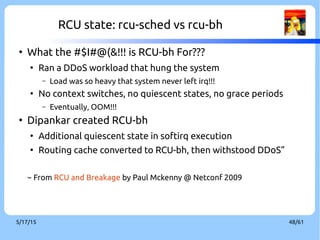
RCU state: rcu-sched vs rcu-bh
●
What the #$I#@(&!!! is RCU-bh For???
●
Ran a DDoS workload that hung the system
– Load was so heavy that system never left irq!!!
●
No context switches, no quiescent states, no grace periods
– Eventually, OOM!!!
●
Dipankar created RCU-bh
●
Additional quiescent state in softirq execution
●
Routing cache converted to RCU-bh, then withstood DDoS”
~ The page is extracted from [8]
9/3/16 48/60
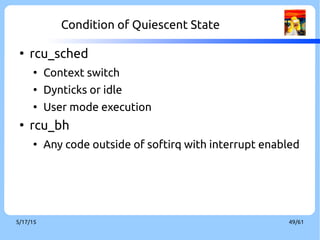
Condition of Quiescent State
●
rcu_sched
●
Context switch
●
Dynticks or idle
●
User mode execution
●
rcu_bh
●
Any code outside of softirq with interrupt enabled
9/3/16 49/60
Condition of Quiescent State
●
When to check it?
●
Scheduler
●
__do_softirq()
●
Scheduler clock interrupt handler
– rcu_check_callbacks()
9/3/16 50/60
RCU Stall[16]
●
Possiblility of memory leak if it takes a long grace period
●
Force Quiescent state
●
Part of conditions of which RCU stall happened
●
Documentation/RCU/stallwarn.txt
●
A CPU looping in an RCU read-side critical section.
●
A CPU looping with interrupts disabled. This condition can result in RCU-
sched and RCU-bh stalls.
●
A CPU looping with preemption disabled. This condition can result in RCU-
sched stalls and, if ksoftirqd is in use, RCU-bh stalls.
●
A CPU looping with bottom halves disabled. This condition can result in
RCU-sched and RCU-bh stalls.
9/3/16 51/60
Topic – Sleepable RCU[2]
●
Blocking or sleeping of any sort is strictly prohibited
in classical RCU. This has frequently been an obstacle
to the use of RCU
●
Implement the sleepable RCU (SRCU) that permits
arbitrary sleeping (or blocking) within RCU read-side
critical sections.
9/3/16 52/60
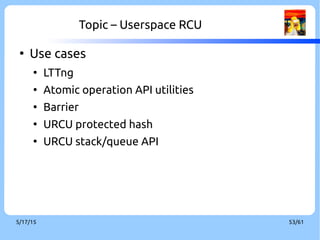
Topic – Userspace RCU[7]
●
Use cases
●
LTTng
●
Atomic operation API utilities
●
Barrier
●
URCU protected hash
●
URCU stack/queue API
9/3/16 53/60
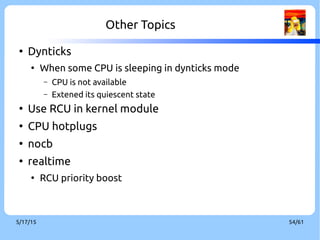
Other Topics
●
Dynticks
●
When some CPU is sleeping in dynticks mode
– Waking up CPU for quiescent state consumes power
– Extened its quiescent state
●
Use RCU in kernel module
●
CPU hotplugs
●
nocb
●
realtime
●
RCU priority boost
9/3/16 54/60
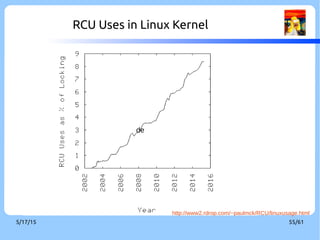
RCU Uses in Linux Kernel
http://www2.rdrop.com/~paulmck/RCU/linuxusage.html
9/3/16 55/60
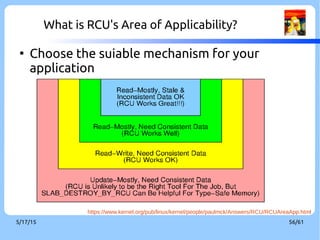
What is RCU's Area of Applicability?
●
Choose the suitable mechanism for your
application
https://www.kernel.org/pub/linux/kernel/people/paulmck/Answers/RCU/RCUAreaApp.html
9/3/16 56/60
Q & A
9/3/16 57/60
Reference
[1] McKenney, Paul E., “Introduction to RCU”
[2] McKenney Paul E. (Oct. 2006), “Sleepable RCU”, LWN
[3] McKenney Paul E. (Feb. 2007), “Priority-Boosting RCU Read-Side Critical Sections ”, LWN
[4] McKenney, Paul E.; Walpole, Jonathan (Dec. 2007), “What is RCU, Fundamentally?”, LWN.
[5] McKenney Paul E. (Dec. 2007), “What is RCU? Part 2: Usage”, LWN.
[6] McKenney Paul E. (Dec. 2008), “Hierarchical RCU”, LWN.
[7] McKenney Paul E. (Nov. 2013), “User-space RCU”, LWN
[8] McKenney, Paul E. (Sep. 2009), “RCU and Breakage ”, presented to Netconf 2009
[9] McKenney, Paul E. (May 2014), “What Is RCU? ”, presented to TU Dresden Distributed OS class
[10] Jake (Sep. 2014), "The RCU API tables", LWN.
[11] Wiki: “Load-link/store-conditional”
[12] Wiki: “Memory Barrier”
[13] Wiki: “Read-Copy Update”
9/3/16 58/60
Reference (Cont.)
[12] 杨燚 , (Jul. 2005), “ Linux 2.6内核中新的锁机制--RCU“ , IBM Developer Work
[13] Leiflindholm, (Mar. 2011), “Memory access ordering - an introduction”, ARM Connected
Community
[14] Walpole, Jonathan (2014), “CS510 Concurrent Systems: What is RCU, Fundamentally?”
[15] “What is RCU's Area of Applicability?”
[16] All Linux kernel documentations under Documentation/RCU/
9/3/16 59/60
●
ARM are trademarks or registered trademarks of ARM Holdings.
●
DYNIX (short for DYNamic unIX) is an operating system developed by Sequent Computer
Systems.
●
Linux is a registered trademark of Linus Torvalds.
●
The RCU, spinlock, seqlock are the joint work of its maintainers and the Linux kernel
community.
●
HCSM is the community of Hsinchu Coders in Taiwan.
●
Other company, product, and service names may be trademarks or service marks
of others.
●
The license of each graph belongs to each website listed individually.
●
The others of my work in the slide is licensed under a CC-BY-SA License.
●
License text: http://creativecommons.org/licenses/by-sa/4.0/legalcode
Rights to Copy
copyright © 2015 Viller Hsiao
9/3/16 Viller Hsiao
THE END

Yet another introduction to Linux RCU

  • 1.
    Yet Another Introductionto Linux RCU Viller Hsiao <villerhsiao@gmail.com> May. 14, 2015
  • 2.
    9/3/16 2/60 Who amI ? Viller Hsiao Embedded Linux / RTOS engineer    http://image.dfdaily.com/2012/5/4/634716931128751250504b050c1_nEO_IMG.jpg
  • 3.
  • 4.
    9/3/16 4/60 What isRCU ? ● Read-Copy Update ● A kind of read/write synchronization mechanism
  • 5.
    9/3/16 5/60 Agenda ● Synchronization insideLinux ● RCU basic operations ● Linux RCU internal
  • 6.
  • 7.
    9/3/16 7/60 R/W Synchronizationin SMP System ● Protect Shared data from concurrent access ● Synchronization mechanism ● atomic operation ● spinlock ● reader-writer spinlock (rwlock) ● seqlock ● RCU
  • 8.
    9/3/16 8/60 Atomic Operation ● Operationsthat read and change data within a single, uninterruptible step ● Architecture support ● test-and-set (TSR) ● compare-and-swap (CAS) ● load-link/store-conditional (ll/sc)
  • 9.
    9/3/16 9/60 spinlock Owner 3update Owner 2 read Owner 1 read spin spinsp in spin update ● Implement by mutual exclusive u u u u
  • 10.
    9/3/16 10/60 rwlock ● Allow multireader ● Mutual exclusive between reader and writer Reader3 Writer update read Reader2 read Reader1 read spin read read read spin spin spinsp in spinsp in sp in u u u u u u u
  • 11.
    9/3/16 11/60 seqlock ● Consistent mechanismwithout starving writers. Reader Writer Update data seq = 1 seq = 2 seq = 0 seq = 2 seq = 2 RetryFirst trial Start with even seq Same seq with start point
  • 12.
    9/3/16 12/60 Architecture Support– Atomic Ops ● Load-link store-conditional – e.g. ARMv7 ldrex/strex http://infocenter.arm.com/help/topic/com.arm.doc.ddi0360f/graphics/exclusive_monitor_state_machine2.svg
  • 13.
    9/3/16 13/60 Architecture Support– Barrier ● Optimization in modern computer architecture ● Optimizing compilers ● Multi-issuing ● Out-of-Order Execution ● Load/Store optimization ● … etc CPU 1 CPU 2 ====== ======= { A = 1; B = 2 } A = 3; x = B; B = 4; y = A; CPU 1 CPU 2 ====== ======= { A = 1; B = 2 } A = 3; x = B; B = 4; y = A;
  • 14.
    9/3/16 14/60 Architecture Support– Barrier (Cont.) ● Compiler barrier ● CPU barrier instructions ● Ensure the order of some operations ● e.g. dmb/dsb/isb, ldar/stlr void foo() {     A = B + 1;     asm volatile("" ::: "memory");     B = 0; } void foo() {     A = B + 1;     asm volatile("" ::: "memory");     B = 0; }
  • 15.
    9/3/16 15/60 The problem ● Badin scalability and performance ● Multiple CPUs to break even with single CPU http://www.rdrop.com/~paulmck/RCU/RCU.2014.05.18a.TU-Dresden.pdf
  • 16.
  • 17.
    9/3/16 17/60 RCU Operations– Read rcu_read_lock(); p = rcu_dereference(gp); /* p = gp */ if (p != NULL) { c do_something(p->a, p->b); } rcu_read_unlock(); rcu_read_lock(); p = rcu_dereference(gp); /* p = gp */ if (p != NULL) { c do_something(p->a, p->b); } rcu_read_unlock(); Read side Critical section ● Blocking/preemption within an RCU read-side critical section is illegal
  • 18.
    9/3/16 18/60 RCU Operations– Update & Reclaim q = kmalloc(sizeof(*q), GFP_KERNEL); q->a = 1; q->b = 2; rcu_assign_pointer(gp, q); /* gp = q */ synchronize_rcu(); /* call_rcu (&callbacks()) */ kfree(p); q = kmalloc(sizeof(*q), GFP_KERNEL); q->a = 1; q->b = 2; rcu_assign_pointer(gp, q); /* gp = q */ synchronize_rcu(); /* call_rcu (&callbacks()) */ kfree(p); Removal (Updater) Reclaimer ● Maintain multiple version of recently updated object ● Spinlock is acquired if multiple udpater
  • 19.
    9/3/16 19/60 RCU Primitives READER UPDATERRECLAIMER rcu_dereference() rcu_assign_pointer() rcu_read_lock() rcu_read_unlock() call_rcu() synchronize_rcu() wmb rmb only on DEC alpha preempt­disable only if preemptible kernel Re-painted from [13]
  • 20.
    9/3/16 20/60 Quiz: Whydoes it improve scalability in read side?
  • 21.
    9/3/16 21/60 Why RCUis better? ● Almost nothing in read side lock (non preempt kernel) static inline void rcu_read_lock(void) { __asm__ __volatile__("": : :"memory"); (void) 0; do { } while (0); do { } while (0); } static inline void rcu_read_lock(void) { __asm__ __volatile__("": : :"memory"); (void) 0; do { } while (0); do { } while (0); } Real content of rcu_read_lock() after preprocessor. (! PREEMPT)
  • 22.
    9/3/16 22/60 Read sideLock Overhead Comparison http://lwn.net/images/ns/kernel/rcu/rwlockRCUperf.jpg
  • 23.
    9/3/16 23/60 What's thebenifit? ● Zero-overhead and wait-free in read side ● No memory barrier is required ● No lock is required ● Allow recursive lock ● No deadlock between readers and writer
  • 24.
    9/3/16 24/60 RCU ListAPIs [10] Operations list Circular doubly linked list hlist Linear doubly linked list Initialization INIT_LIST_HEAD_RCU() Full traversal list_for_each_entry_rcu() hlist_for_each_entry_rcu() hlist_for_each_entry_rcu_bh() hlist_for_each_entry_rcu_notrace() Resume traversal list_for_each_entry_continue_rcu() hlist_for_each_entry_continue_rcu() hlist_for_each_entry_continue_rcu_bh() Stepwise traversal list_entry_rcu() list_first_or_null_rcu() list_next_rcu() list_first_rcu() hlist_next_rcu() hlist_pprev_rcu() Add list_add_rcu() list_add_tail_rcu() hlist_add_after_rcu() hlist_add_before_rcu() hlist_add_head_rcu() Delete list_del_rcu() hlist_del_rcu() hlist_del_init_rcu() Replacement list_replace_rcu() hlist_replace_rcu() Splice list_splice_init_rcu()
  • 25.
    9/3/16 25/60 RCU Model RemovalReclamationGrace Period Reader Reader Reader Reader Reader Reader Reader Reader Reader Repainted from https://lwn.net/images/ns/kernel/rcu/GracePeriodGood.png
  • 26.
    9/3/16 26/60 RCU vsrwlock ● RCU has lower overhead and better scalability ● RCU readers see updated data faster ● rwlock readers get the consistent data after writer updated c https://lwn.net/Articles/263130/
  • 27.
    9/3/16 27/60 Replace rwlockby RCU[13] http://en.wikipedia.org/wiki/Read-copy-update
  • 28.
    9/3/16 28/60 Replace rwlockby RCU[13] http://en.wikipedia.org/wiki/Read-copy-update
  • 29.
    9/3/16 29/60 What isRCU, again ● Read-Copy Update ● A kind of read-write synchronization mechanism ● A publish-subscribe mechanism[5] ● A poor man's garbage collector[5]
  • 30.
    9/3/16 30/60 But Quiz: Howdoes reclaimer know the time to release old object?
  • 31.
  • 32.
    9/3/16 32/60 History andContributors[9][13] ● 1980 H. T. Kung and Q. Lehman  ● use of garbage collectors to defer destruction of nodes in a parellel binary search tree. ● 1986, Hennessy, Osisek, and Seigh ● Passive serialization, which is an RCU­like mechanism that relies on the presence of "quiescent states" in  the VM/XA hypervisor  ● 1995 J. Slingwine and P. E. McKenney ● US Patent 5,442,758, implement RCU in DYNIX/ptx kernel. ● 2002, D. Sarma ● added RCU to version 2.5.43 of the Linux kernel ● 2005, P. E. McKenney ● Permitting preemption of RCU realtime critical sections ● 2009, P. E. McKenny  ● Introduce user­level RCU implementation ● Work of P. E. McKenney, Mathieu Desnoyers, Alan Stern, Michel Dagenais, Manish Gupta, Maged  Michael, Phil Howard, Joshua Triplett, Jonathan Walpole, and the Linux kernel community
  • 33.
    9/3/16 33/60 The Problem ● Howcan we know when it's safe to reclaim memory without paying too high a cost? ● especially in the read path ● Possible implementation – Reference count – Hazard pointer ~ The page is extracted and tweaked from [14]
  • 34.
    9/3/16 34/60 Lock-based SynchronizationModel Reader nReader 1 Update nUpdater 1 Reader 1 Reader 1 Reader n Reader n <lock icon url> Obj 1 Obj n
  • 35.
    9/3/16 35/60 RCU SynchronizationModel RCU Core Reader 2 Reader nReader 1 Reclaimer 2 Reclaimer nReclaimer 1 Update 2 Update nUpdater 1 Reader 1 Reader 1 Reader 2 Reader 2 Reader n Reader n
  • 36.
    9/3/16 36/60 Terms ● Recall thatconstraint of read side critical section operations ● Non-blocked inside read lock (!PREEMPT) ● Non-preempted (PREEMPT) ● Irq disable, bh disable imply read side critical section
  • 37.
    9/3/16 37/60 Terms –Grace Period Removal ReclamationGrace Period Reader Reader Reader Reader Reader Reader Reader Reader Reader Repainted from https://lwn.net/images/ns/kernel/rcu/GracePeriodGood.png
  • 38.
    9/3/16 38/60 Terms –Quiescent State Reader Reader Reader Quiescent State ● Period outside the read critical section ● It implies complete of one grace period in its CPU
  • 39.
    9/3/16 39/60 Toy RCUImplementation #define rcu_assign_pointer(p, v)  ({          smp_wmb();          (p) = (v);  }) void synchronize_rcu(void) {         int cpu;         for_each_online_cpu(cpu)                 run_on(cpu); } #define rcu_assign_pointer(p, v)  ({          smp_wmb();          (p) = (v);  }) void synchronize_rcu(void) {         int cpu;         for_each_online_cpu(cpu)                 run_on(cpu); } #define rcu_read_lock() #define rcu_read_unlock() #define rcu_dereference(p)  ({          typeof(p) _p1 = (*(volatile typeof(p)*)&(p));          smp_read_barrier_depends();          _p1;  }) #define rcu_read_lock() #define rcu_read_unlock() #define rcu_dereference(p)  ({          typeof(p) _p1 = (*(volatile typeof(p)*)&(p));          smp_read_barrier_depends();          _p1;  }) Read Update
  • 40.
    9/3/16 40/60 RCU CoreState CPU 0: call_rcu(cb) RCU State list 0 cb cb cb list 1 cb cb cb list n cb cb cb Quiescent State Recorder CPU 0 CPU 1 CPU n
  • 41.
    9/3/16 41/60 Quiescent State ● Conditionof quiescent state ● Context switch ● Dynticks or idle ● User mode execution ● Check RCU state and execute RCU operations in system background
  • 42.
    9/3/16 42/60 RCU Implementation– Classical RCU ● a.k.a tiny RCU ● Single data structure to record Quiescent State ● Scalability is not good for large numbers of CPUs, e.g. 4096 CPUs http://lwn.net/Articles/305782/
  • 43.
    9/3/16 43/60 RCU Implementation– Hirarchical RCU ● a.k.a tree RCU ● Towards a more scalable RCU implementation ● Default solution in Linux kernel http://lwn.net/Articles/305782/
  • 44.
    9/3/16 44/60 Tree RCUCore – List Operations CPU x call_rcu(cb) cb1 cb2 cbxnxtlist cb0 DONE TAIL WAIT TAIL NEXT READY TAIL NEXT TAIL cb Next Complete (DONE) Next Complete (WAIT) Next Complete (NXTRDY) Next complete CPUx RCU Data RCU State / RCU Node gpnum complete gpnum complete gpnum complete
  • 45.
    9/3/16 45/60 Tree RCUCore – System Components invoke_rcu_core() rcu_gp_kthread_invoke() Put callback into list Updater call_rcu() tick_handle_periodic rcu_check_callback() RCU SOFTIRQ rcu_process_callbacks() rcu_gp_kthread Process GP Call callback rcu_do_batch() Pass QSs rcu_bh_qs() rcu_sched_qs() invoke_rcu_core()
  • 46.
    9/3/16 46/60 Tree RCUCore http://lwn.net/images/ns/kernel/brcu/RCUbweBlock.png
  • 47.
    9/3/16 47/60 RCU state:rcu-sched vs rcu-bh ● What the #$I#@(&!!! is RCU-bh For??? ● Ran a DDoS workload that hung the system – Load was so heavy that system never left irq!!! ● No context switches, no quiescent states, no grace periods – Eventually, OOM!!! ● Dipankar created RCU-bh ● Additional quiescent state in softirq execution ● Routing cache converted to RCU-bh, then withstood DDoS” ~ The page is extracted from [8]
  • 48.
    9/3/16 48/60 Condition ofQuiescent State ● rcu_sched ● Context switch ● Dynticks or idle ● User mode execution ● rcu_bh ● Any code outside of softirq with interrupt enabled
  • 49.
    9/3/16 49/60 Condition ofQuiescent State ● When to check it? ● Scheduler ● __do_softirq() ● Scheduler clock interrupt handler – rcu_check_callbacks()
  • 50.
    9/3/16 50/60 RCU Stall[16] ● Possiblilityof memory leak if it takes a long grace period ● Force Quiescent state ● Part of conditions of which RCU stall happened ● Documentation/RCU/stallwarn.txt ● A CPU looping in an RCU read-side critical section. ● A CPU looping with interrupts disabled. This condition can result in RCU- sched and RCU-bh stalls. ● A CPU looping with preemption disabled. This condition can result in RCU- sched stalls and, if ksoftirqd is in use, RCU-bh stalls. ● A CPU looping with bottom halves disabled. This condition can result in RCU-sched and RCU-bh stalls.
  • 51.
    9/3/16 51/60 Topic –Sleepable RCU[2] ● Blocking or sleeping of any sort is strictly prohibited in classical RCU. This has frequently been an obstacle to the use of RCU ● Implement the sleepable RCU (SRCU) that permits arbitrary sleeping (or blocking) within RCU read-side critical sections.
  • 52.
    9/3/16 52/60 Topic –Userspace RCU[7] ● Use cases ● LTTng ● Atomic operation API utilities ● Barrier ● URCU protected hash ● URCU stack/queue API
  • 53.
    9/3/16 53/60 Other Topics ● Dynticks ● Whensome CPU is sleeping in dynticks mode – Waking up CPU for quiescent state consumes power – Extened its quiescent state ● Use RCU in kernel module ● CPU hotplugs ● nocb ● realtime ● RCU priority boost
  • 54.
    9/3/16 54/60 RCU Usesin Linux Kernel http://www2.rdrop.com/~paulmck/RCU/linuxusage.html
  • 55.
    9/3/16 55/60 What isRCU's Area of Applicability? ● Choose the suitable mechanism for your application https://www.kernel.org/pub/linux/kernel/people/paulmck/Answers/RCU/RCUAreaApp.html
  • 56.
  • 57.
    9/3/16 57/60 Reference [1] McKenney,Paul E., “Introduction to RCU” [2] McKenney Paul E. (Oct. 2006), “Sleepable RCU”, LWN [3] McKenney Paul E. (Feb. 2007), “Priority-Boosting RCU Read-Side Critical Sections ”, LWN [4] McKenney, Paul E.; Walpole, Jonathan (Dec. 2007), “What is RCU, Fundamentally?”, LWN. [5] McKenney Paul E. (Dec. 2007), “What is RCU? Part 2: Usage”, LWN. [6] McKenney Paul E. (Dec. 2008), “Hierarchical RCU”, LWN. [7] McKenney Paul E. (Nov. 2013), “User-space RCU”, LWN [8] McKenney, Paul E. (Sep. 2009), “RCU and Breakage ”, presented to Netconf 2009 [9] McKenney, Paul E. (May 2014), “What Is RCU? ”, presented to TU Dresden Distributed OS class [10] Jake (Sep. 2014), "The RCU API tables", LWN. [11] Wiki: “Load-link/store-conditional” [12] Wiki: “Memory Barrier” [13] Wiki: “Read-Copy Update”
  • 58.
    9/3/16 58/60 Reference (Cont.) [12]杨燚 , (Jul. 2005), “ Linux 2.6内核中新的锁机制--RCU“ , IBM Developer Work [13] Leiflindholm, (Mar. 2011), “Memory access ordering - an introduction”, ARM Connected Community [14] Walpole, Jonathan (2014), “CS510 Concurrent Systems: What is RCU, Fundamentally?” [15] “What is RCU's Area of Applicability?” [16] All Linux kernel documentations under Documentation/RCU/
  • 59.
    9/3/16 59/60 ● ARM aretrademarks or registered trademarks of ARM Holdings. ● DYNIX (short for DYNamic unIX) is an operating system developed by Sequent Computer Systems. ● Linux is a registered trademark of Linus Torvalds. ● The RCU, spinlock, seqlock are the joint work of its maintainers and the Linux kernel community. ● HCSM is the community of Hsinchu Coders in Taiwan. ● Other company, product, and service names may be trademarks or service marks of others. ● The license of each graph belongs to each website listed individually. ● The others of my work in the slide is licensed under a CC-BY-SA License. ● License text: http://creativecommons.org/licenses/by-sa/4.0/legalcode Rights to Copy copyright © 2015 Viller Hsiao
  • 60.