Userspace RCU Library:

 What Linear Multiprocessor
 Scalability Means for Your
        Application

   Linux Plumbers Conference 2009

          Mathieu Desnoyers
   École Polytechnique de Montréal
> Mathieu Desnoyers
●   Author/maintainer of :
    –   LTTV (Linux Trace Toolkit Viewer)
         ●   2003-...
    –   LTTng (Linux Trace Toolkit Next Generation)
         ●   2005-...
    –   Immediate Values
         ●   2007...
    –   Tracepoints
         ●   2008-...
    –   Userspace RCU Library
2
         ●   2009-...
> Contributions by
●   Paul E. McKenney
    –   IBM Linux Technology Center
●   Alan Stern
    –   Rowland Institute, Harvard University
●   Jonathan Walpole
    –   Computer Science Department, Portland
        State University
●   Michel Dagenais
    –   Computer and Software Engineering Dpt.,
3       École Polytechnique de Montréal
> Summary
●   RCU Overview
●   Kernel vs Userspace RCU
●   Userspace RCU Library
●   Benchmarks
●   RCU-Friendly Applications


4
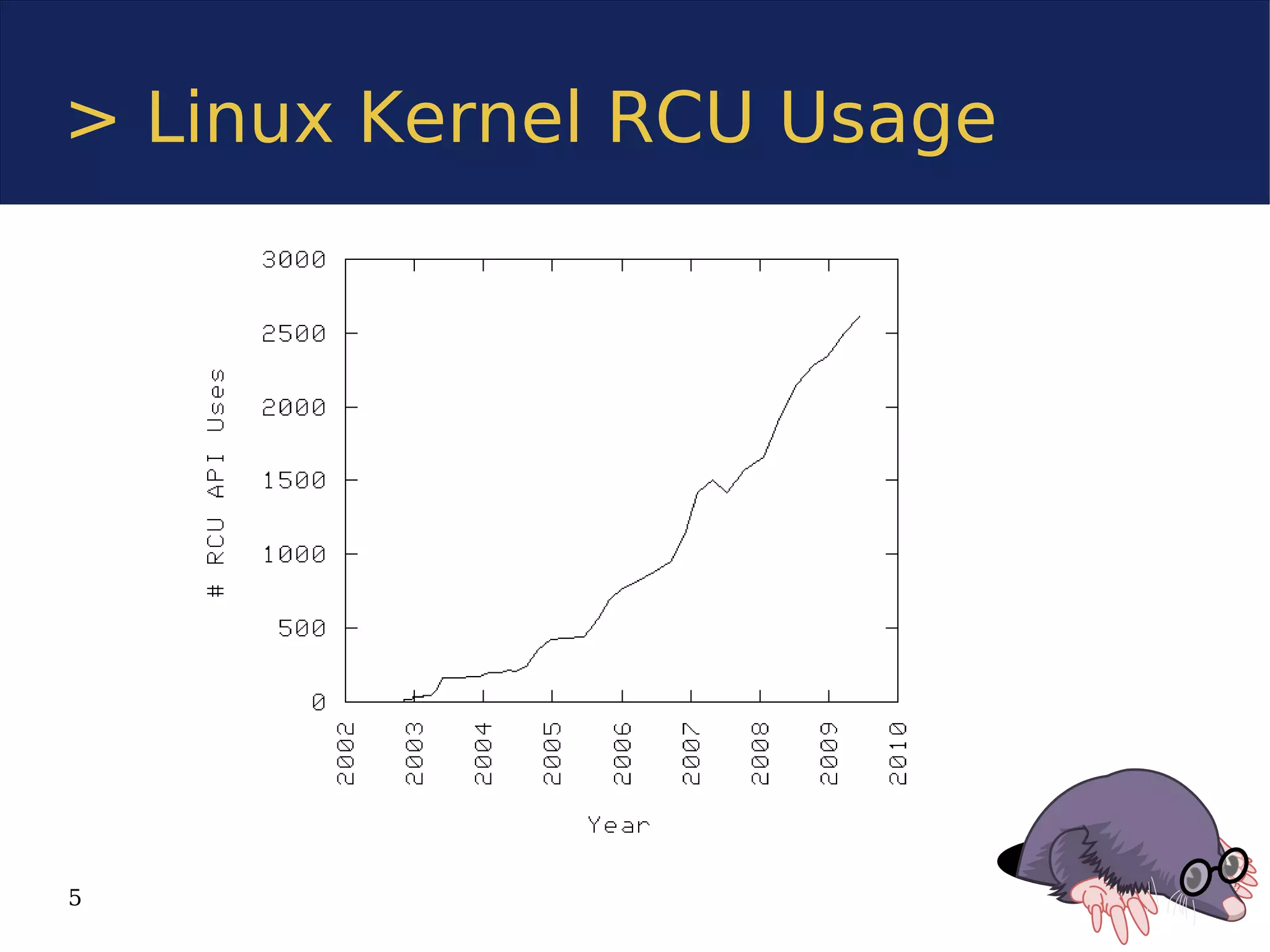
> Linux Kernel RCU Usage


5
> RCU Overview
●   Relativistic programming
    –   Updates seen in different orders by CPUs
    –   Tolerates conflicts
●   Linear scalability
●   Wait-free read-side
●   Efficient updates
    –   Only a single pointer exchange needs
        exclusive access

6
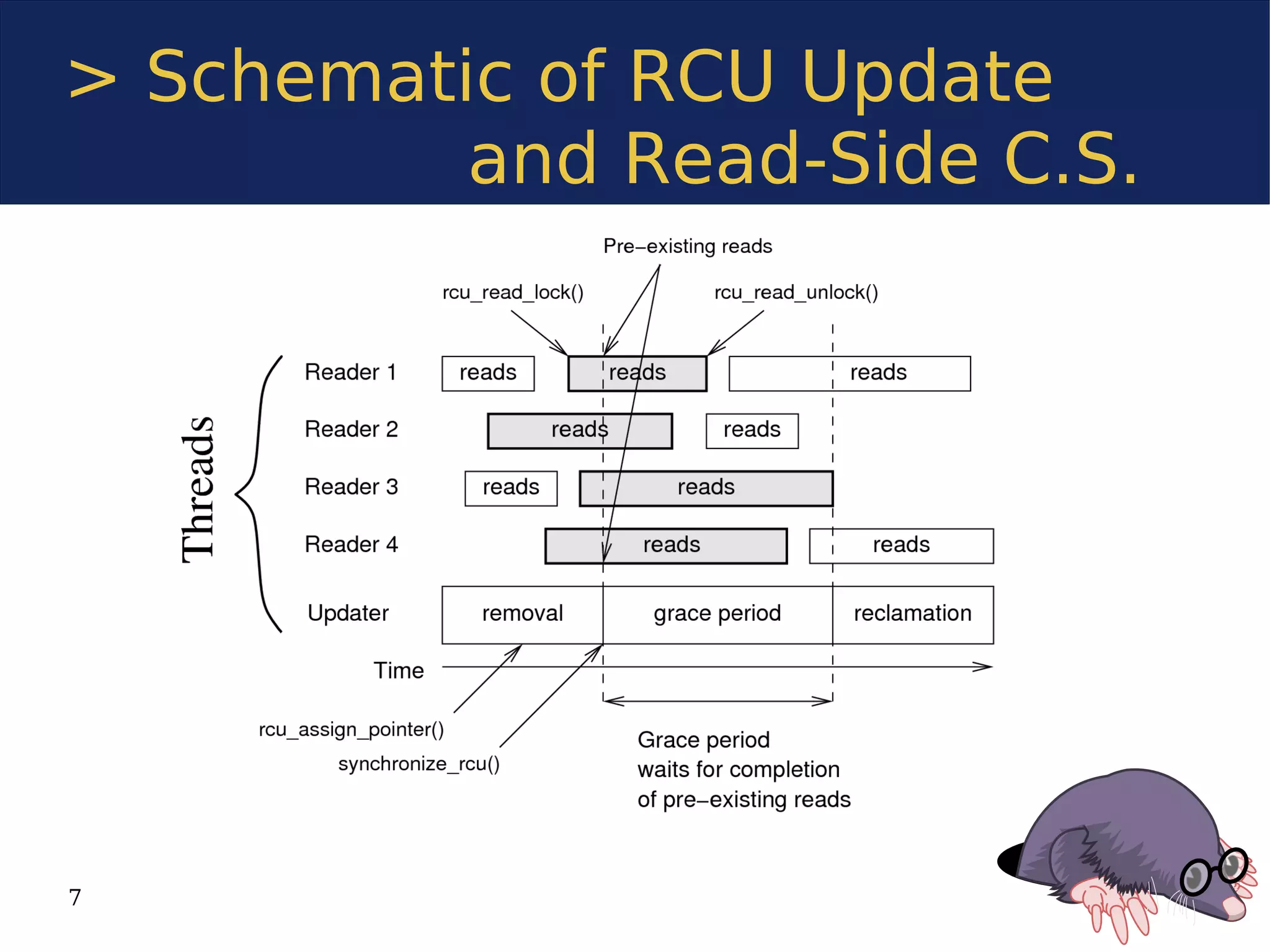
> Schematic of RCU Update
          and Read-Side C.S.


7
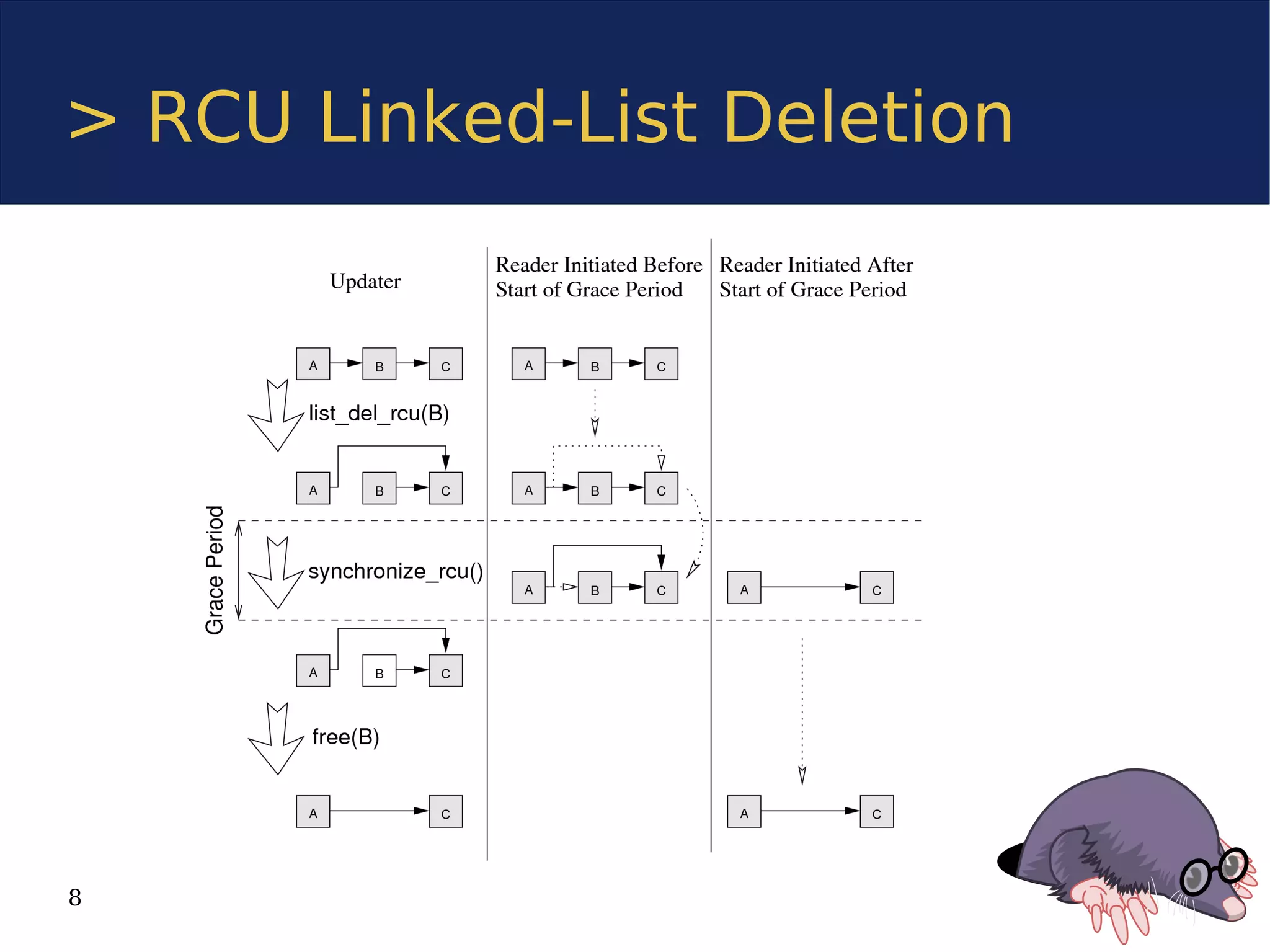
> RCU Linked-List Deletion


8
> Kernel vs Userspace RCU
●   Quiescent state
    –   Kernel threads
         ●   Wait for kernel pre-existing RCU read-side C.S. to
             complete
    –   User threads
         ●   Wait for process pre-existing RCU read-side C.S. to
             complete


9
> Userspace RCU Library
●    QSBR
     –   liburcu-qsbr.so
●    Generic RCU
     –   liburcu-mb.so
●    Signal-based RCU
     –   liburcu.so
●    call_rcu()
     –   liburcu-defer.so

10
> QSBR
●    Detection of quiescent state:
     –   Each reader thread calls
         rcu_quiescent_state() periodically.
●    Require application modification
●    Read-side with very low overhead


11
> Generic RCU
●    Detection of quiescent state:
     –   rcu_read_lock()/rcu_read_unlock() mark the
         beginning/end of the critical sections
     –   Counts nesting level
●    Suitable for library use
●    Higher read-side overhead than QSBR
     due to added memory barriers


12
> Signal-based RCU
●    Same quiescent state detection as
     Generic RCU
●    Suitable for library use, but reserves a
     signal
●    Read-side close to QSBR performance
     –   Remove memory barriers from
         rcu_read_lock()/rcu_read_unlock().
     –   Replaced by memory barriers in signal
         handler, executed at each update-side
         memory barrier.
13
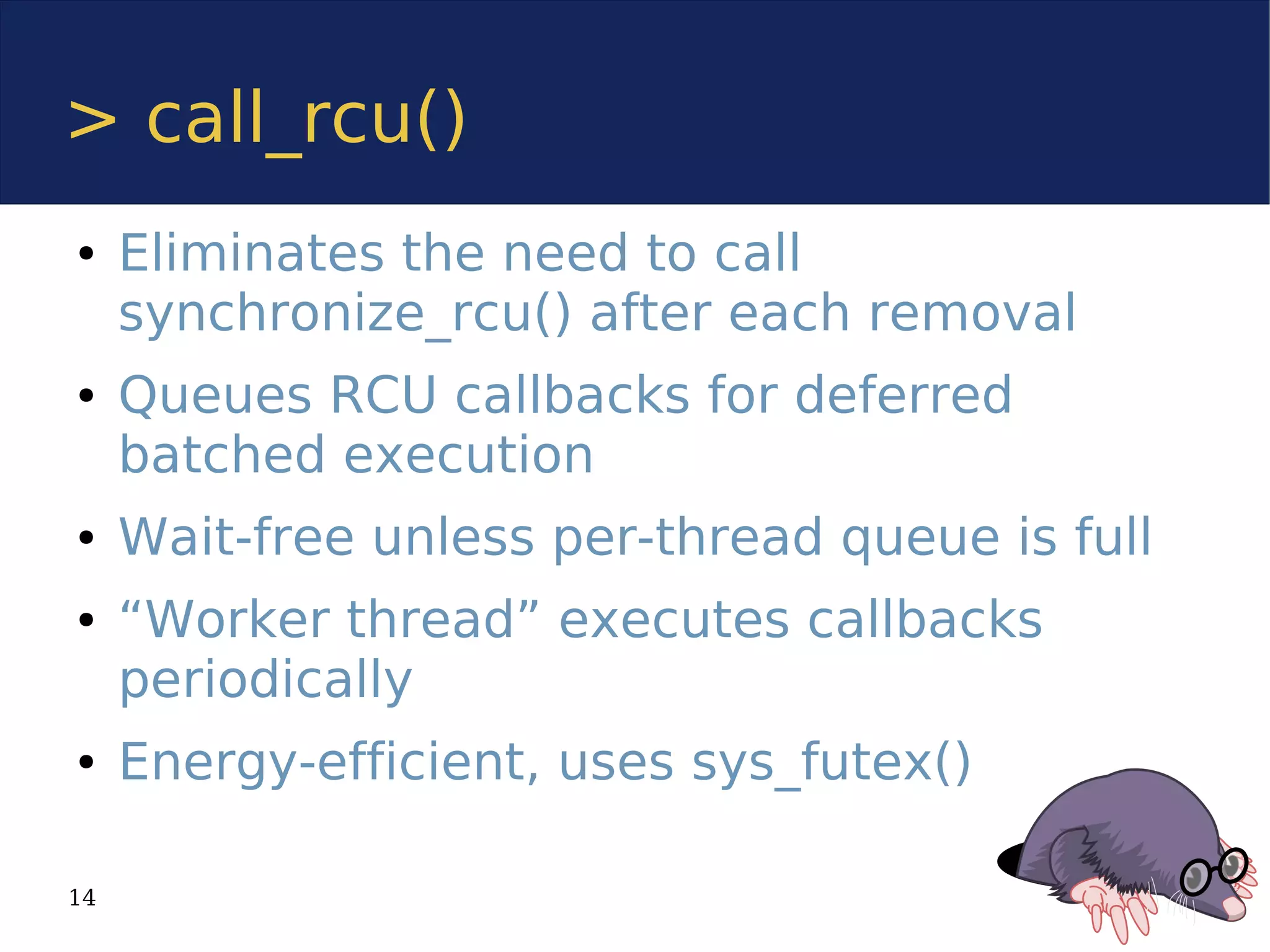
> call_rcu()
●    Eliminates the need to call
     synchronize_rcu() after each removal
●    Queues RCU callbacks for deferred
     batched execution
●    Wait-free unless per-thread queue is full
●    “Worker thread” executes callbacks
     periodically
●    Energy-efficient, uses sys_futex()

14
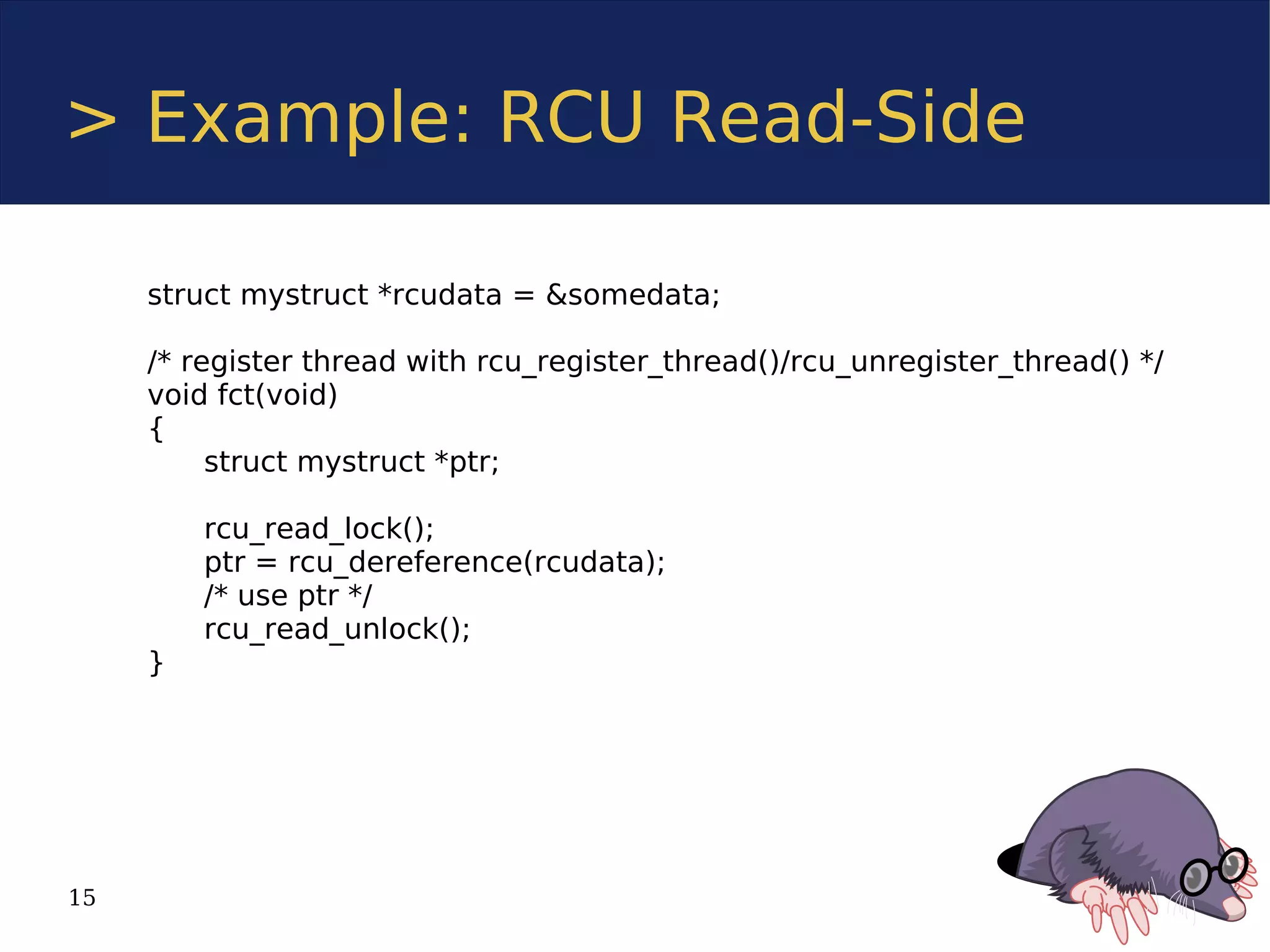
> Example: RCU Read-Side

     struct mystruct *rcudata = &somedata;

     /* register thread with rcu_register_thread()/rcu_unregister_thread() */
     void fct(void)
     {
          struct mystruct *ptr;

         rcu_read_lock();
         ptr = rcu_dereference(rcudata);
         /* use ptr */
         rcu_read_unlock();
     }


15
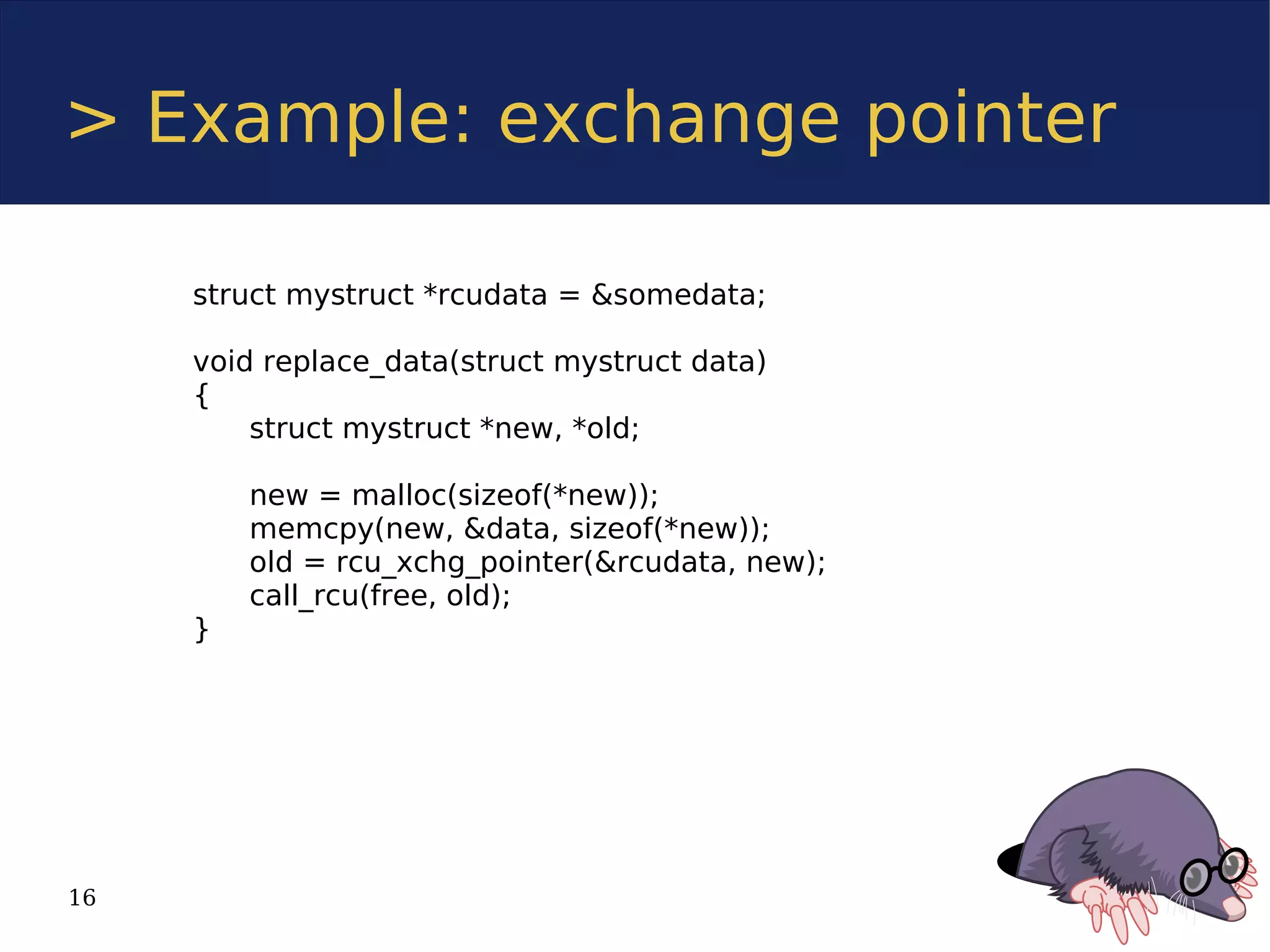
> Example: exchange pointer

     struct mystruct *rcudata = &somedata;

     void replace_data(struct mystruct data)
     {
         struct mystruct *new, *old;

         new = malloc(sizeof(*new));
         memcpy(new, &data, sizeof(*new));
         old = rcu_xchg_pointer(&rcudata, new);
         call_rcu(free, old);
     }


16
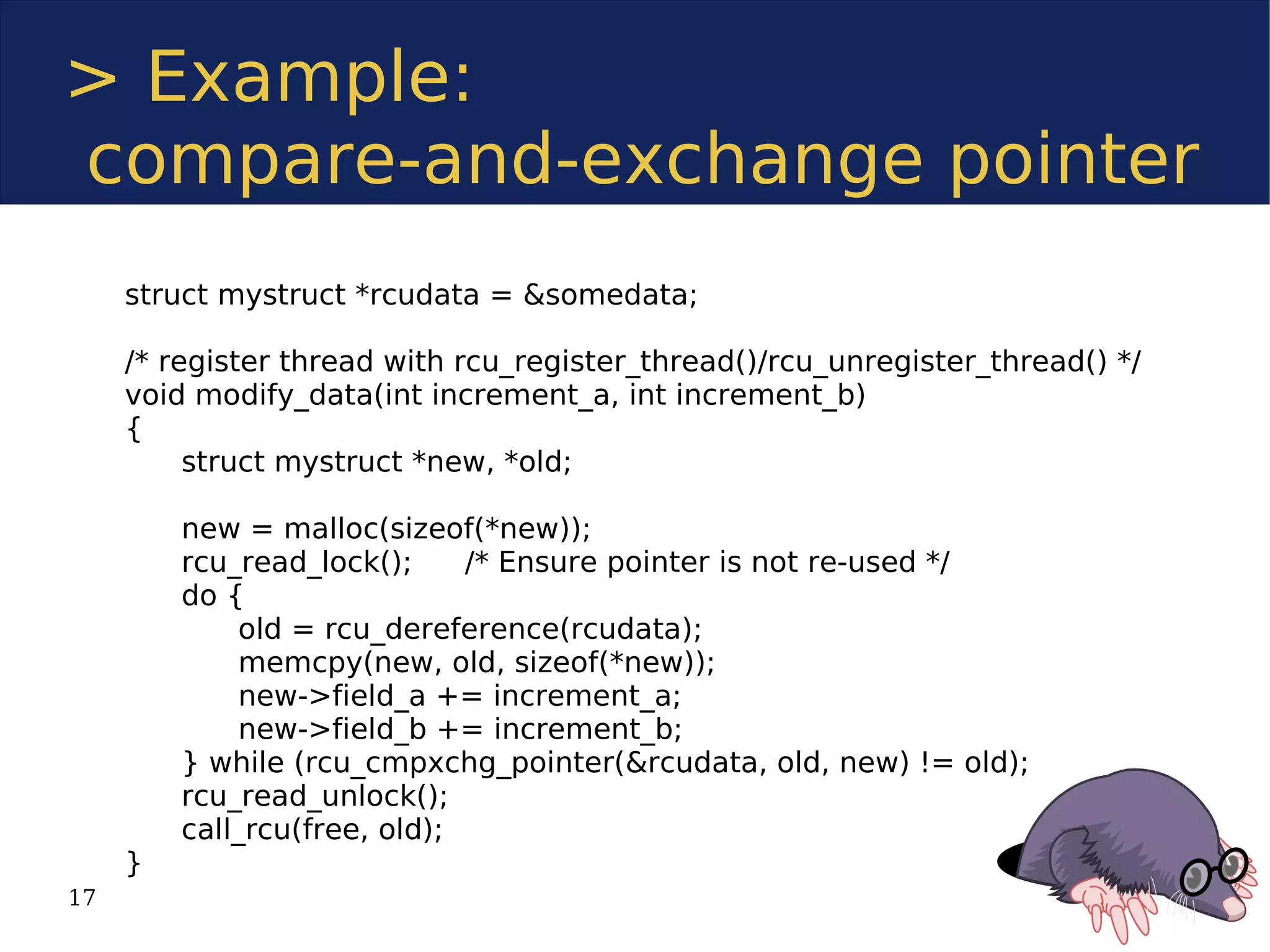
> Example:
compare-and-exchange pointer
     struct mystruct *rcudata = &somedata;

     /* register thread with rcu_register_thread()/rcu_unregister_thread() */
     void modify_data(int increment_a, int increment_b)
     {
          struct mystruct *new, *old;

         new = malloc(sizeof(*new));
         rcu_read_lock();     /* Ensure pointer is not re-used */
         do {
              old = rcu_dereference(rcudata);
              memcpy(new, old, sizeof(*new));
              new->field_a += increment_a;
              new->field_b += increment_b;
         } while (rcu_cmpxchg_pointer(&rcudata, old, new) != old);
         rcu_read_unlock();
         call_rcu(free, old);
     }
17
> Benchmarks
●    Read-side Scalability
●    Read-side C.S. length impact
●    Update Overhead


18
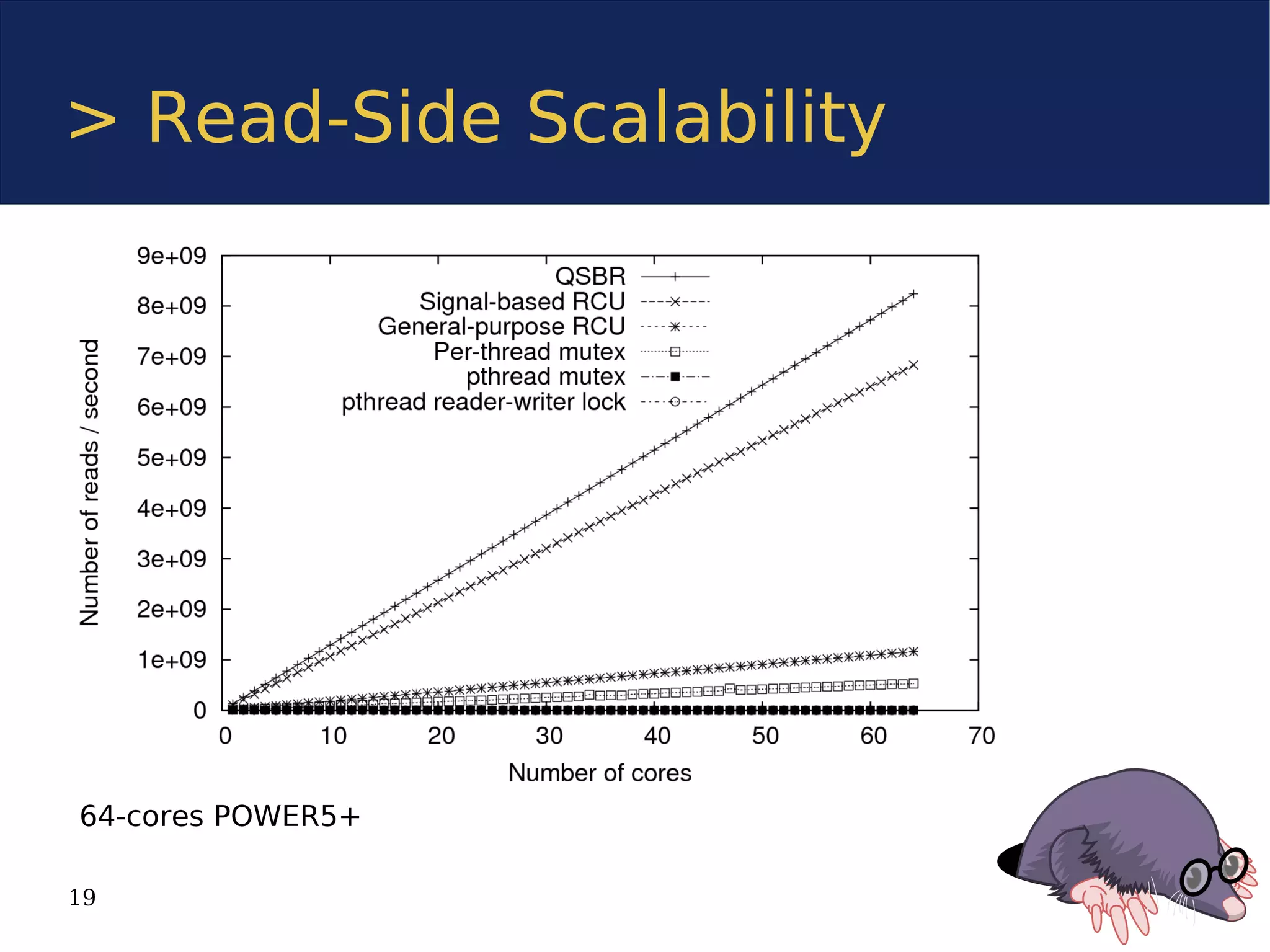
> Read-Side Scalability


64-cores POWER5+

19
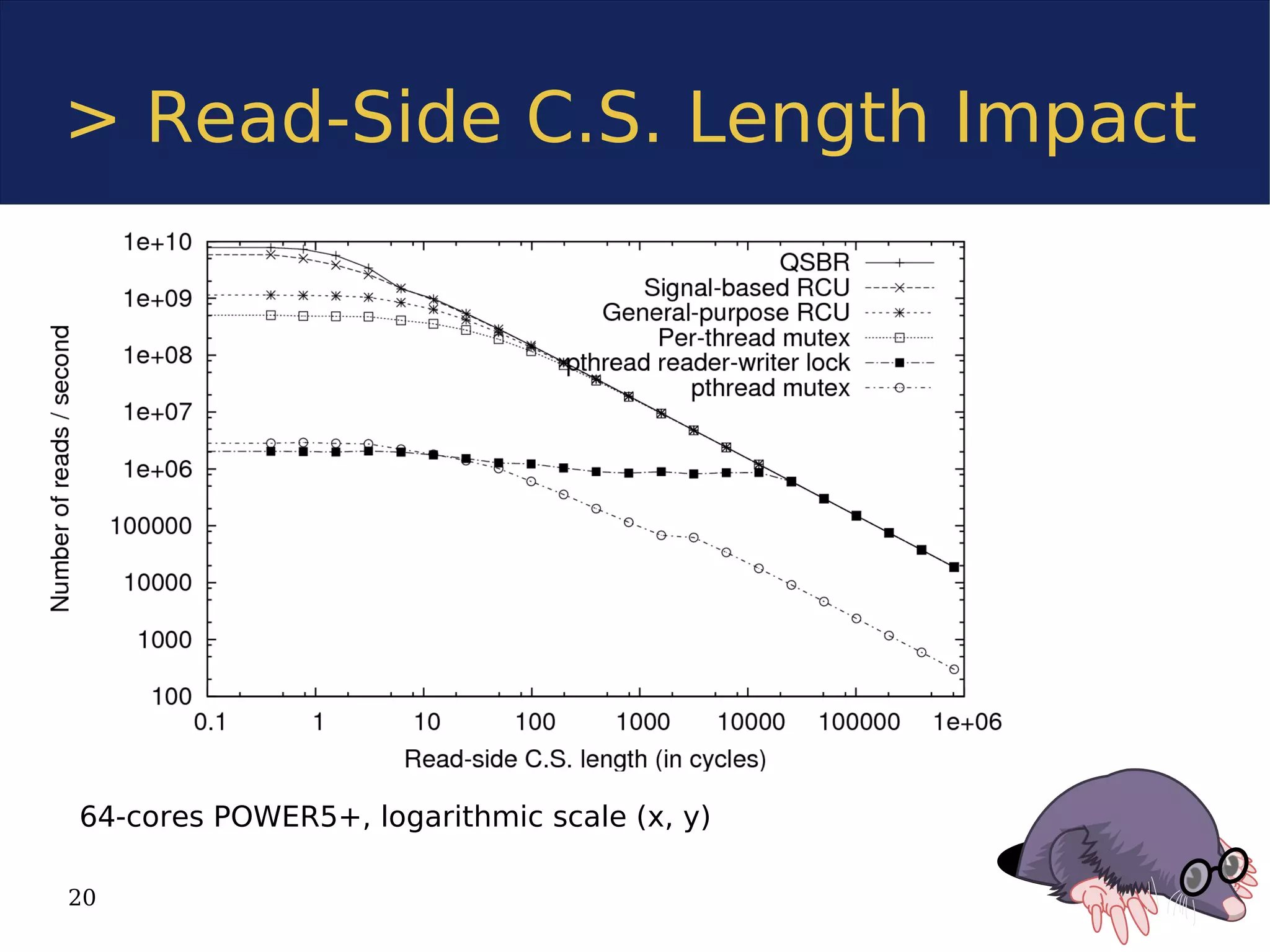
> Read-Side C.S. Length Impact


64-cores POWER5+, logarithmic scale (x, y)

20
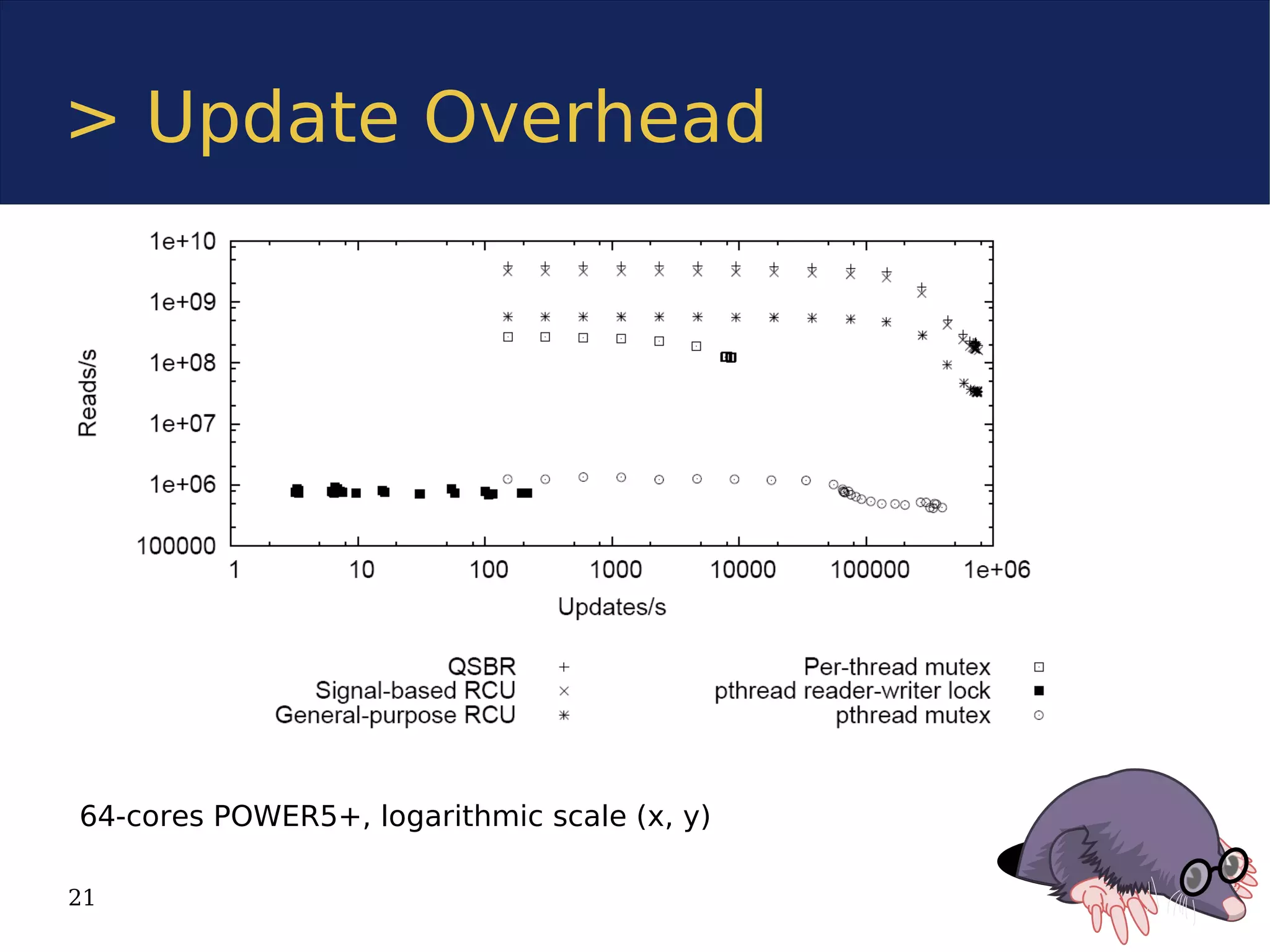
> Update Overhead


64-cores POWER5+, logarithmic scale (x, y)

21
> RCU-Friendly Applications
●    Multithreaded applications with read-
     often shared data
     –   Cache
          ●   Name servers
          ●   Proxy
          ●   Web servers with static pages
     –   Configuration
          ●   Low synchronization overhead
          ●   Dynamically modified without restart


22
> RCU-Friendly Applications
●    Libraries supporting multithreaded
     applications
     –   Tracing library, e.g. lib UST (LTTng port for
         userspace tracing)
          ●   http://git.dorsal.polymtl.ca/?p=ust.git


23
> RCU-Friendly Applications
●    Libraries supporting multithreaded
     applications (cont.)
     –   Typing/data structure support
          ●   Typing system
               –   Creation of a class is a rare event
               –   Reading class structure happens at object
                   creation/destruction (_very_ often)
               –   Applies to gobject
                     ● Used by: gtk/gdk/glib/gstreamer...


          ●   Efficient hash tables
          ●   Glib “quarks”

24
> RCU-Friendly Applications
●    Routing tables in userspace
●    Userspace network stacks
●    Userspace signal-handling
     –   Signal-safe read-side
     –   Could implement an inter-thread signal
         multiplexer
●    Your own ?


25
> Info / Download / Contact
●    Mathieu Desnoyers
     –   Computer and Software Engineering Dpt.,
         École Polytechnique de Montréal
●    Web site:
     –   http://www.lttng.org/urcu
●    Git tree
     –   git://lttng.org/userspace-rcu.git
●    Email
     –   mathieu.desnoyers@polymtl.ca
26

Userspace RCU library : what linear multiprocessor scalability means for your application

  • 1.
    Userspace RCU Library: What Linear Multiprocessor Scalability Means for Your Application Linux Plumbers Conference 2009 Mathieu Desnoyers École Polytechnique de Montréal
  • 2.
    > Mathieu Desnoyers ● Author/maintainer of : – LTTV (Linux Trace Toolkit Viewer) ● 2003-... – LTTng (Linux Trace Toolkit Next Generation) ● 2005-... – Immediate Values ● 2007... – Tracepoints ● 2008-... – Userspace RCU Library 2 ● 2009-...
  • 3.
    > Contributions by ● Paul E. McKenney – IBM Linux Technology Center ● Alan Stern – Rowland Institute, Harvard University ● Jonathan Walpole – Computer Science Department, Portland State University ● Michel Dagenais – Computer and Software Engineering Dpt., 3 École Polytechnique de Montréal
  • 4.
    > Summary ● RCU Overview ● Kernel vs Userspace RCU ● Userspace RCU Library ● Benchmarks ● RCU-Friendly Applications 4
  • 5.
    > Linux KernelRCU Usage 5
  • 6.
    > RCU Overview ● Relativistic programming – Updates seen in different orders by CPUs – Tolerates conflicts ● Linear scalability ● Wait-free read-side ● Efficient updates – Only a single pointer exchange needs exclusive access 6
  • 7.
    > Schematic ofRCU Update and Read-Side C.S. 7
  • 8.
  • 9.
    > Kernel vsUserspace RCU ● Quiescent state – Kernel threads ● Wait for kernel pre-existing RCU read-side C.S. to complete – User threads ● Wait for process pre-existing RCU read-side C.S. to complete 9
  • 10.
    > Userspace RCULibrary ● QSBR – liburcu-qsbr.so ● Generic RCU – liburcu-mb.so ● Signal-based RCU – liburcu.so ● call_rcu() – liburcu-defer.so 10
  • 11.
    > QSBR ● Detection of quiescent state: – Each reader thread calls rcu_quiescent_state() periodically. ● Require application modification ● Read-side with very low overhead 11
  • 12.
    > Generic RCU ● Detection of quiescent state: – rcu_read_lock()/rcu_read_unlock() mark the beginning/end of the critical sections – Counts nesting level ● Suitable for library use ● Higher read-side overhead than QSBR due to added memory barriers 12
  • 13.
    > Signal-based RCU ● Same quiescent state detection as Generic RCU ● Suitable for library use, but reserves a signal ● Read-side close to QSBR performance – Remove memory barriers from rcu_read_lock()/rcu_read_unlock(). – Replaced by memory barriers in signal handler, executed at each update-side memory barrier. 13
  • 14.
    > call_rcu() ● Eliminates the need to call synchronize_rcu() after each removal ● Queues RCU callbacks for deferred batched execution ● Wait-free unless per-thread queue is full ● “Worker thread” executes callbacks periodically ● Energy-efficient, uses sys_futex() 14
  • 15.
    > Example: RCURead-Side struct mystruct *rcudata = &somedata; /* register thread with rcu_register_thread()/rcu_unregister_thread() */ void fct(void) { struct mystruct *ptr; rcu_read_lock(); ptr = rcu_dereference(rcudata); /* use ptr */ rcu_read_unlock(); } 15
  • 16.
    > Example: exchangepointer struct mystruct *rcudata = &somedata; void replace_data(struct mystruct data) { struct mystruct *new, *old; new = malloc(sizeof(*new)); memcpy(new, &data, sizeof(*new)); old = rcu_xchg_pointer(&rcudata, new); call_rcu(free, old); } 16
  • 17.
    > Example: compare-and-exchange pointer struct mystruct *rcudata = &somedata; /* register thread with rcu_register_thread()/rcu_unregister_thread() */ void modify_data(int increment_a, int increment_b) { struct mystruct *new, *old; new = malloc(sizeof(*new)); rcu_read_lock(); /* Ensure pointer is not re-used */ do { old = rcu_dereference(rcudata); memcpy(new, old, sizeof(*new)); new->field_a += increment_a; new->field_b += increment_b; } while (rcu_cmpxchg_pointer(&rcudata, old, new) != old); rcu_read_unlock(); call_rcu(free, old); } 17
  • 18.
    > Benchmarks ● Read-side Scalability ● Read-side C.S. length impact ● Update Overhead 18
  • 19.
  • 20.
    > Read-Side C.S.Length Impact 64-cores POWER5+, logarithmic scale (x, y) 20
  • 21.
    > Update Overhead 64-coresPOWER5+, logarithmic scale (x, y) 21
  • 22.
    > RCU-Friendly Applications ● Multithreaded applications with read- often shared data – Cache ● Name servers ● Proxy ● Web servers with static pages – Configuration ● Low synchronization overhead ● Dynamically modified without restart 22
  • 23.
    > RCU-Friendly Applications ● Libraries supporting multithreaded applications – Tracing library, e.g. lib UST (LTTng port for userspace tracing) ● http://git.dorsal.polymtl.ca/?p=ust.git 23
  • 24.
    > RCU-Friendly Applications ● Libraries supporting multithreaded applications (cont.) – Typing/data structure support ● Typing system – Creation of a class is a rare event – Reading class structure happens at object creation/destruction (_very_ often) – Applies to gobject ● Used by: gtk/gdk/glib/gstreamer... ● Efficient hash tables ● Glib “quarks” 24
  • 25.
    > RCU-Friendly Applications ● Routing tables in userspace ● Userspace network stacks ● Userspace signal-handling – Signal-safe read-side – Could implement an inter-thread signal multiplexer ● Your own ? 25
  • 26.
    > Info /Download / Contact ● Mathieu Desnoyers – Computer and Software Engineering Dpt., École Polytechnique de Montréal ● Web site: – http://www.lttng.org/urcu ● Git tree – git://lttng.org/userspace-rcu.git ● Email – mathieu.desnoyers@polymtl.ca 26