The Simple Past TenseThe Simple Past Tense
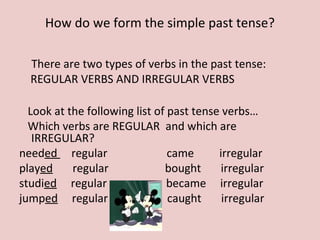
There are two types of verbs in the past tense:
REGULAR VERBS AND IRREGULAR VERBS
Look at the following list of past tense verbs…
Which verbs are REGULAR and which are
IRREGULAR?
needed regular came irregular
played regular bought irregular
studied regular became irregular
jumped regular caught irregular
How do we form the simple past tense?
Regular verbs are verbs that…
end with –ed.
Simple Form Past Form
• play played
• jump jumped
• bury buried
• study studied
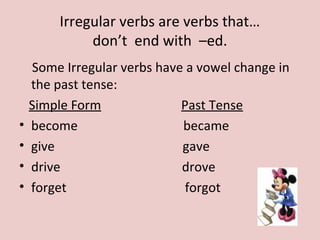
Irregular verbs are verbs that…
don’t end with –ed.
Some Irregular verbs have a vowel change in
the past tense:
Simple Form Past Tense
• become became
• give gave
• drive drove
• forget forgot
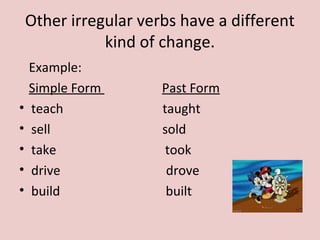
Other irregular verbs have a different
kind of change.
Example:
Simple Form Past Form
• teach taught
• sell sold
• take took
• drive drove
• build built
And some Irregular Verbs don’t change at
all…
Example:
Simple Form Past
• hit hit
• put put
• set set
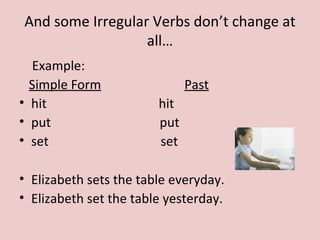
• Elizabeth sets the table everyday.
• Elizabeth set the table yesterday.
For Regular Verbs, simply use the –ed form of
the verb in a positive sentence.
Example:
Yesterday, mom worked at the office until eight
o’clock.
Melissa lived and studied in Piura when she was a
child.
Be careful with spelling changes!
For Irregular Verbs use the correct past
tense form in positive sentences.
Unfortunately, these forms must be memorized!
Last week, I sent you a present for your birthday.
The girl gave a speech in English.
She did a great job!
For negative sentences use…
Did not or didn’t + verb
simple form
I went to the party yesterday.
Andrea didn’t go to the party yesterday
because she was sick.
Exception = Verb to be !
The verb “to be” is special.
Never use did not or didn’t with the verb “to
be.”
Instead, just use:
Was or were + not
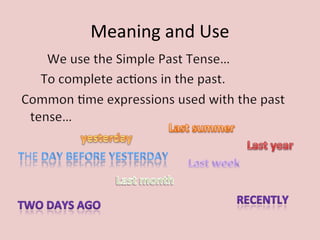
Meaning and Use
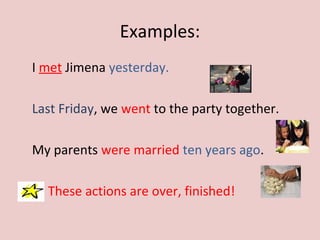
Examples:
I met Jimena yesterday.
Last Friday, we went to the party together.
My parents were married ten years ago.
These actions are over, finished!
The –ed ending has:
Three different sounds
t – d - id
Some regular verbs end with a “t” sound.
Example:
walked, laughed, washed, jumped, and
talked.
Pronunciation of Regular Verbs…
Some regular verbs end with
“d” sound.
Example:
planned, played, learned,
loved, and answered.
Other regular verbs end with an “id”
sound.
Example:
Simple form Past form
• invite invited
• wait waited
• decide decided
• need needed
Practice
• Now make a list of which –ed verbs have a “t”
sound, which have a “d” sound and which
have an “id” sound.
• With practice you can start to learn and
memorize correct pronunciation.
Irregular verbsppt

Irregular verbsppt

  • 1.
    The Simple PastTenseThe Simple Past Tense
  • 2.
    There are twotypes of verbs in the past tense: REGULAR VERBS AND IRREGULAR VERBS Look at the following list of past tense verbs… Which verbs are REGULAR and which are IRREGULAR? needed regular came irregular played regular bought irregular studied regular became irregular jumped regular caught irregular How do we form the simple past tense?
  • 3.
    Regular verbs areverbs that… end with –ed. Simple Form Past Form • play played • jump jumped • bury buried • study studied
  • 4.
    Irregular verbs areverbs that… don’t end with –ed. Some Irregular verbs have a vowel change in the past tense: Simple Form Past Tense • become became • give gave • drive drove • forget forgot
  • 5.
    Other irregular verbshave a different kind of change. Example: Simple Form Past Form • teach taught • sell sold • take took • drive drove • build built
  • 6.
    And some IrregularVerbs don’t change at all… Example: Simple Form Past • hit hit • put put • set set • Elizabeth sets the table everyday. • Elizabeth set the table yesterday.
  • 7.
    For Regular Verbs,simply use the –ed form of the verb in a positive sentence. Example: Yesterday, mom worked at the office until eight o’clock. Melissa lived and studied in Piura when she was a child. Be careful with spelling changes!
  • 8.
    For Irregular Verbsuse the correct past tense form in positive sentences. Unfortunately, these forms must be memorized! Last week, I sent you a present for your birthday. The girl gave a speech in English. She did a great job!
  • 9.
    For negative sentencesuse… Did not or didn’t + verb simple form I went to the party yesterday. Andrea didn’t go to the party yesterday because she was sick.
  • 10.
    Exception = Verbto be ! The verb “to be” is special. Never use did not or didn’t with the verb “to be.” Instead, just use: Was or were + not
  • 11.
  • 12.
    Examples: I met Jimenayesterday. Last Friday, we went to the party together. My parents were married ten years ago. These actions are over, finished!
  • 13.
    The –ed endinghas: Three different sounds t – d - id Some regular verbs end with a “t” sound. Example: walked, laughed, washed, jumped, and talked. Pronunciation of Regular Verbs…
  • 14.
    Some regular verbsend with “d” sound. Example: planned, played, learned, loved, and answered.
  • 15.
    Other regular verbsend with an “id” sound. Example: Simple form Past form • invite invited • wait waited • decide decided • need needed
  • 16.
    Practice • Now makea list of which –ed verbs have a “t” sound, which have a “d” sound and which have an “id” sound. • With practice you can start to learn and memorize correct pronunciation.