The Future for ICT
The Future for ICT "I think there is a world market for maybe five computers."  --Thomas Watson, chairman of IBM, 1943   "Computers in the future may weigh no more than 1.5 tons."  --Popular Mechanics, forecasting the relentless march of science, 1949  "There is no reason anyone would want a computer in their home."  --Ken Olson, president, chairman and founder of Digital Equipment Corp., 1977  "640K ought to be enough for anybody."  -- Bill Gates, 1981
The Future for ICT The Future School: Every student and teacher will carry a "personal communicator". All will have access to the Internet and other networks. School work will use this new tool as an information source and a communication system. Projects will be researched, prepared, delivered and evaluated using this tool. Computer studies as we know it will change.
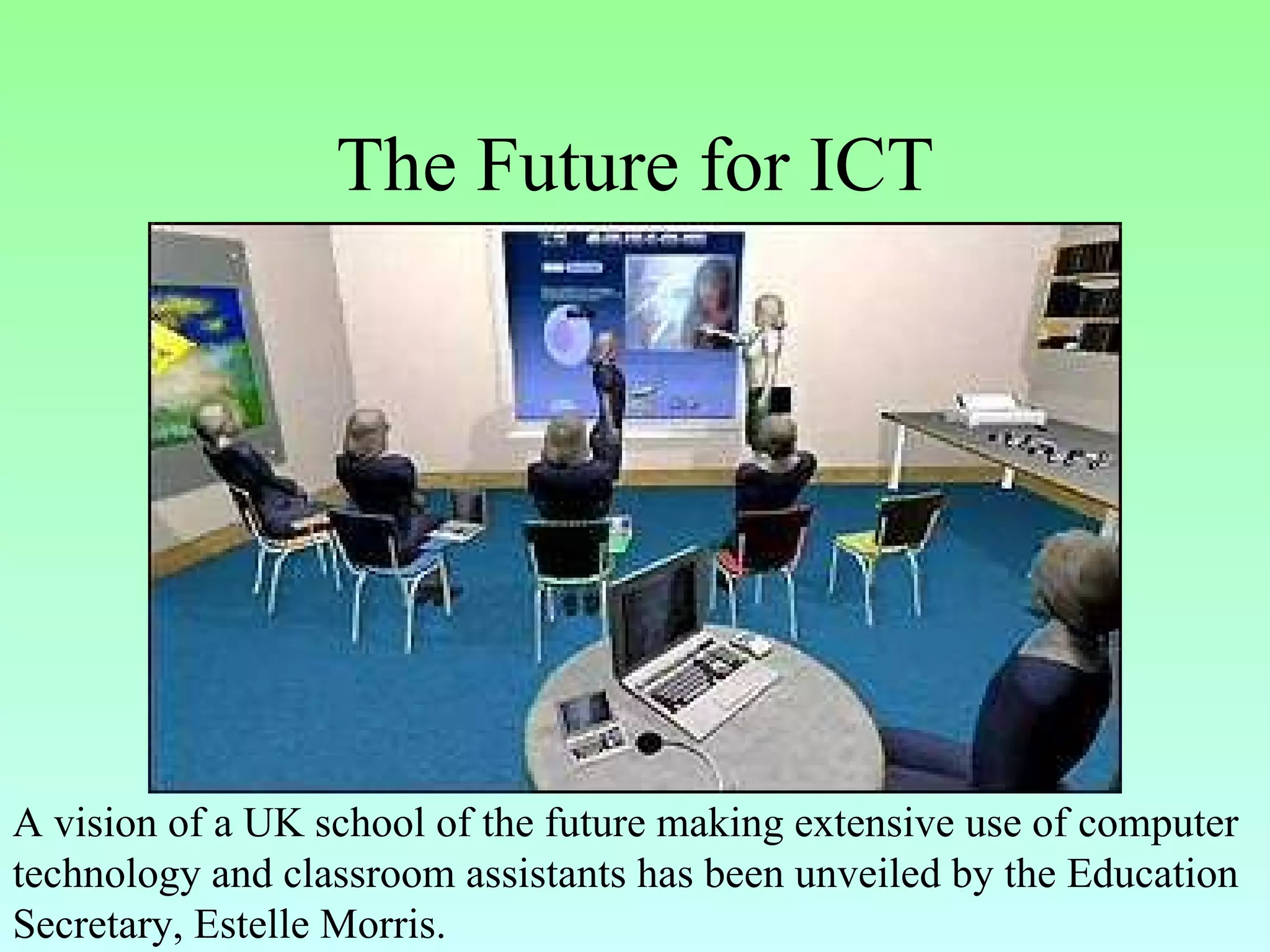
The Future for ICT A vision of a UK school of the future making extensive use of computer technology and classroom assistants has been unveiled by the Education Secretary, Estelle Morris.
The Future for ICT In the classroom perhaps teachers will be working with small groups of teachers, moving between classrooms and open learning areas.  They will be helping students to make sense of information, to support their work on a problem or in producing a presentation of some form (multimedia or single media), which will demonstrate their understanding.
The Future for ICT Students will be working in their preferred way - one that matches their own learning style and which they have been developing with teacher support.  Teachers will work in shifts being available for calls from students in the evenings on the Internet by text, voice or video.  Schools may become community-style centres operating seven days a week, 24 hours a day.
The Future for ICT Perhaps the curriculum will also have changed, matching the demands of society and preparing students for the life and work place skills they will need to function in the 21st century.  Assessment structures will have been revised and group assessment and multimedia based assessment will have replaced the traditional pencil and paper methods of the previous century.
The Future for ICT
The Future for ICT Four Glimpses into the Future: 1. You pull into the dry cleaners on your way to work and check e-mail from your tiny personal computing device as you drop off your shirts.  2. Your e-mail is automatically sorted, with the most urgent messages determined by eight factors, including how quickly you've responded to each sender in the past and your body language as you did so.
The Future for ICT 3. You check in with the office via your earrings, which contain microphones and speakers wirelessly connecting you to a cell phone. Or maybe your earrings  are  the cell phone, and all commands are voice driven.  4. As you settle into your cubicle, a sensor on your employee badge communicates with the office computers, projectors and printers, instantly configuring a network that lets co-workers electronically interact with you.
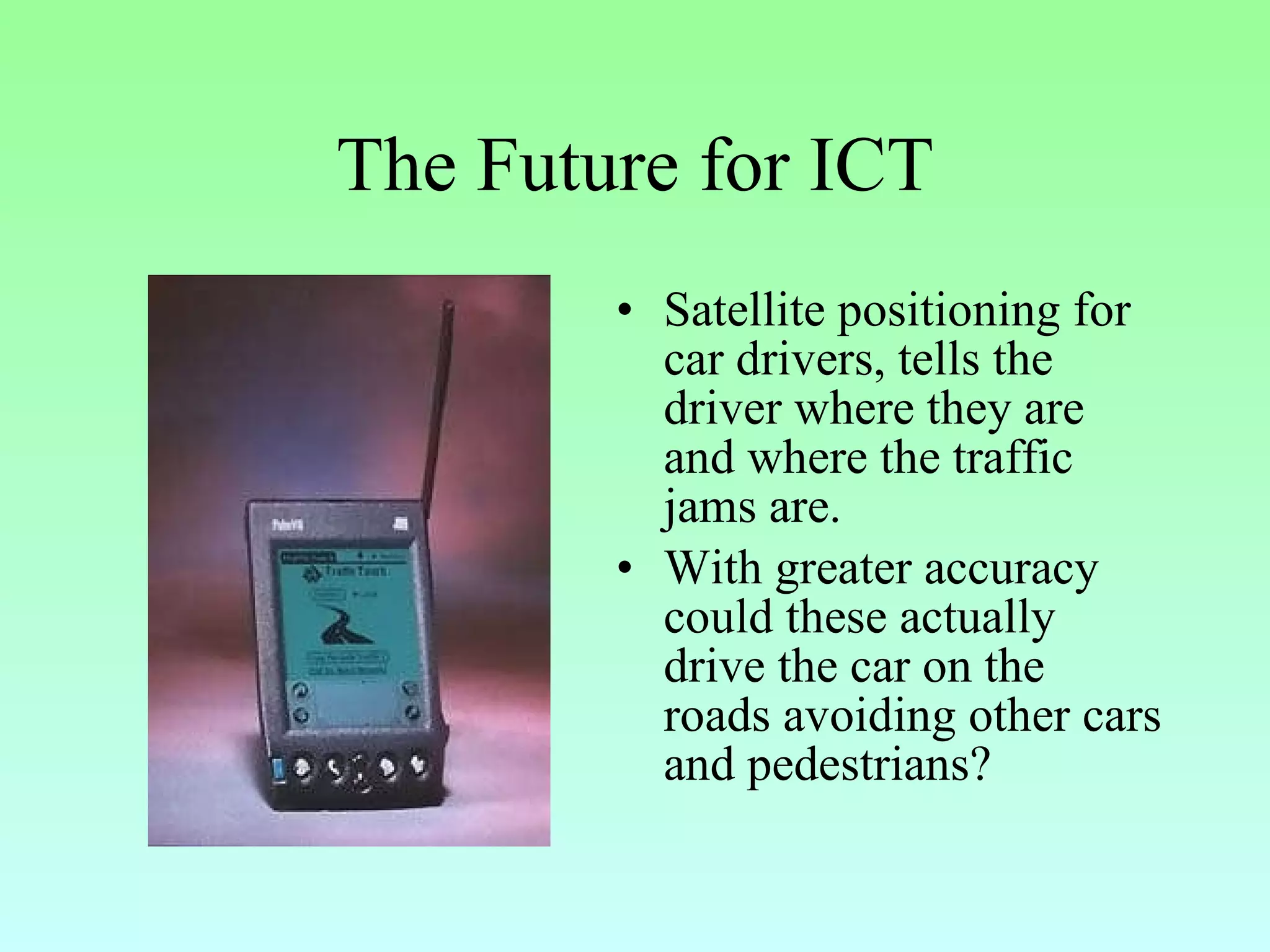
The Future for ICT Satellite positioning for car drivers, tells the driver where they are and where the traffic jams are. With greater accuracy could these actually drive the car on the roads avoiding other cars and pedestrians?
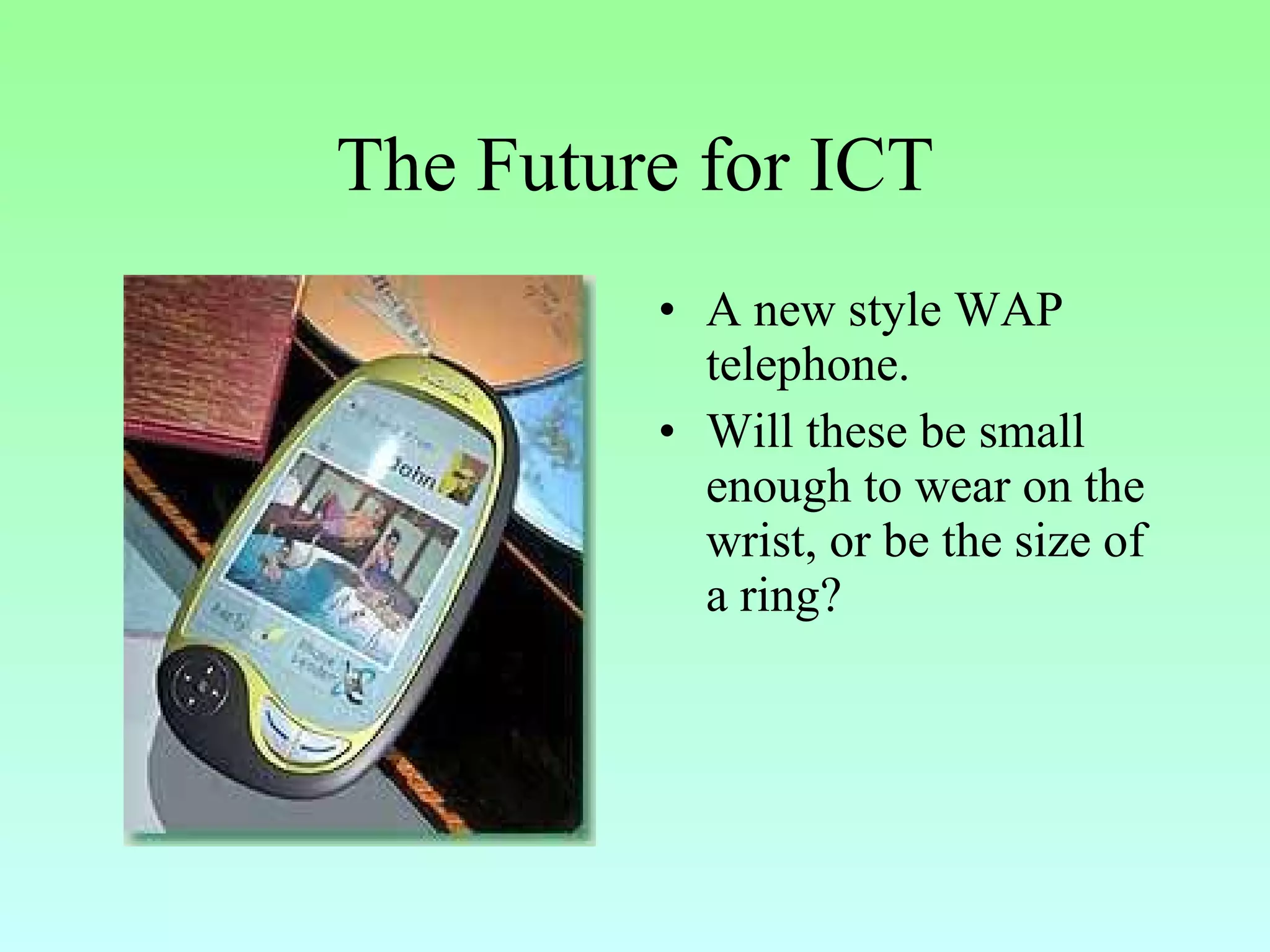
The Future for ICT A new style WAP telephone. Will these be small enough to wear on the wrist, or be the size of a ring?
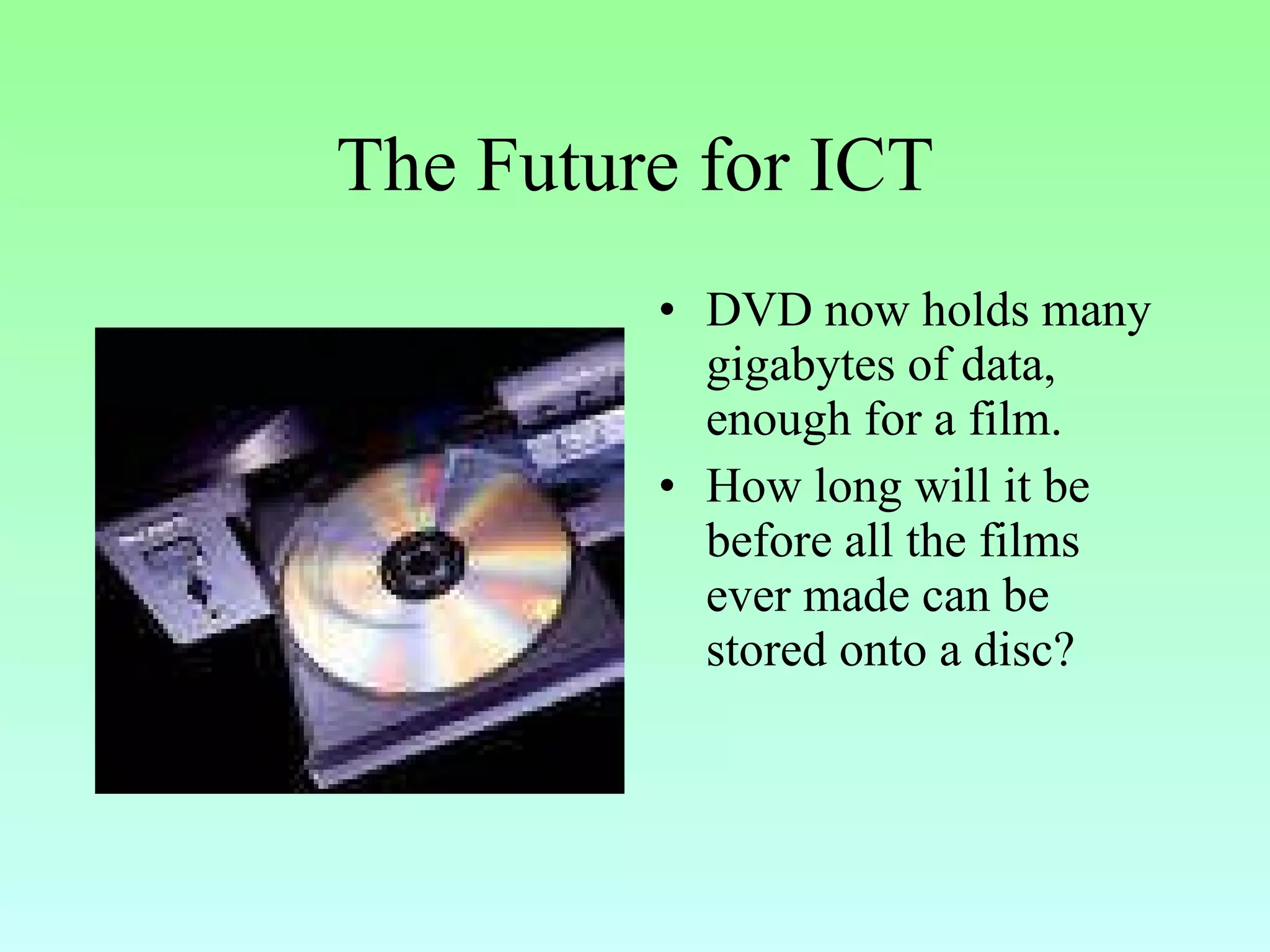
The Future for ICT DVD now holds many gigabytes of data, enough for a film.  How long will it be before all the films ever made can be stored onto a disc?
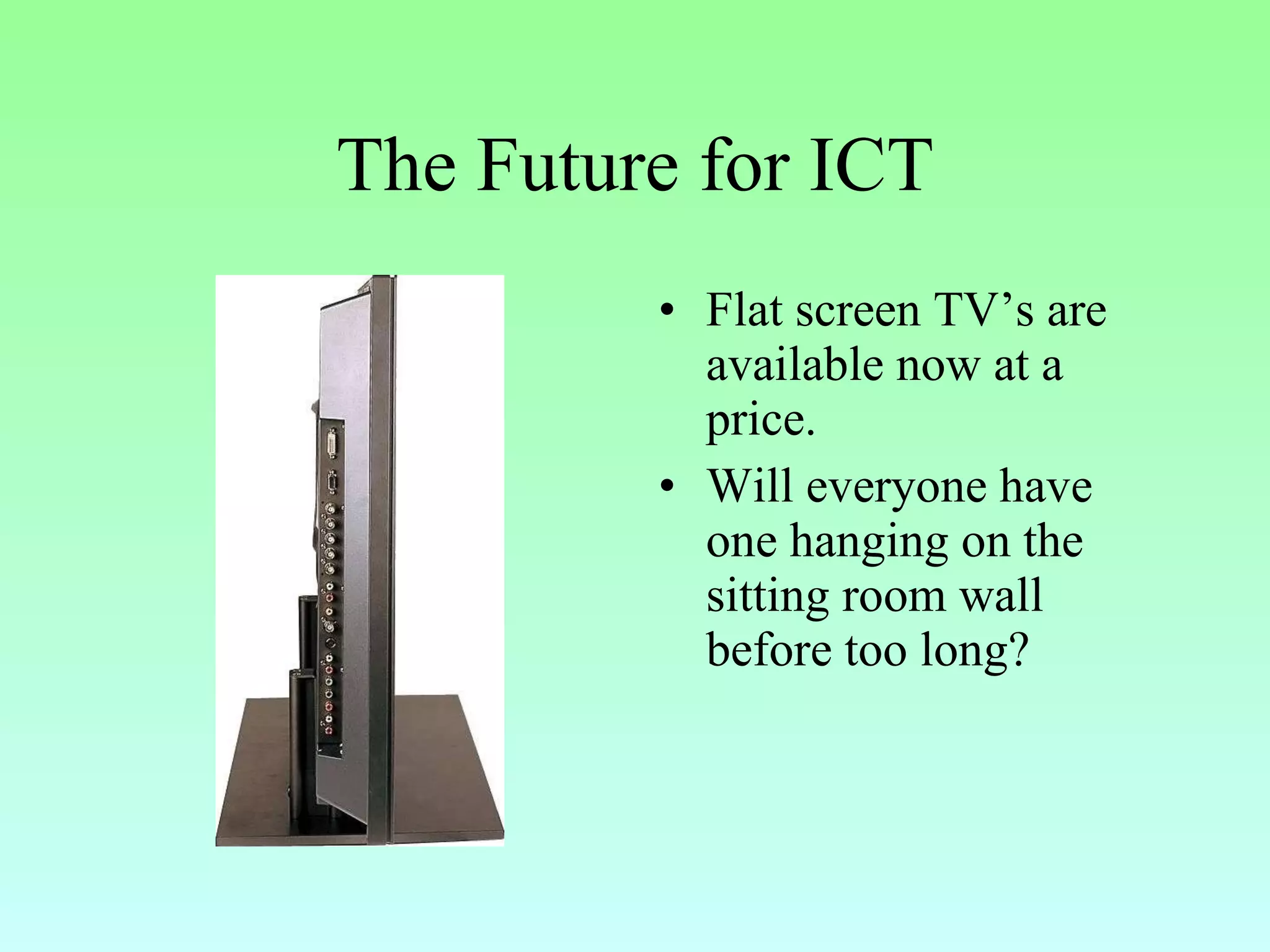
The Future for ICT Flat screen TV’s are available now at a price. Will everyone have one hanging on the sitting room wall before too long?
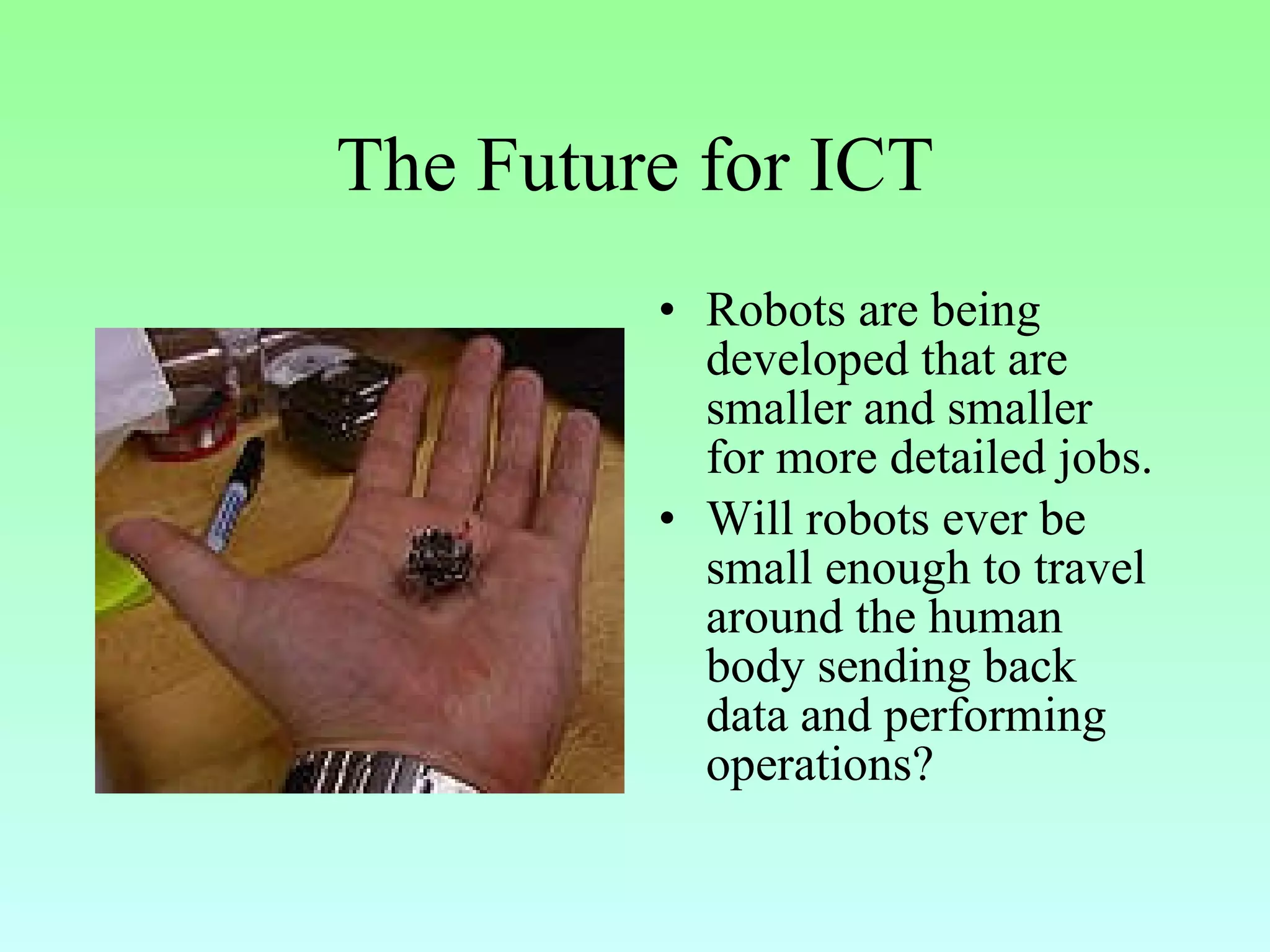
The Future for ICT Robots are being developed that are smaller and smaller for more detailed jobs. Will robots ever be small enough to travel around the human body sending back data and performing operations?
The Future for ICT The Future Lifestyle: Everybody will carry a small personal computer but it will   be called a "personal communicator”. This will combine the computer as we know it with a cellular-telephone. Each unit will have telephone, fax, e-mail (text / voice / video), browser and general computer facilities. Everyone will have a personal source of information, able to access easily encyclopaedias, telephone directories, train timetables and other similar information databases anywhere in the world.
The Future for ICT It will also have TV/Radio, personal stereo, calculator,and link easily to Internet, to their bank's computer and to a desk-top computer in their own homes using infra red wireless technology.   It will also carry Global Satellite Positioning facilities from cellular telephone network. Disk storage will not be necessary for these portable units as they will be able to record data on remote hardware.
The Future for ICT Individuals will be able to control home security, home telephone messages and the like from their portable computer. Setting the video at home to record a TV program would be easy … except that the video recorder and even the television broadcast system will probably have changed also. Already being developed is a home refrigerator that uses bar codes to keep stock of it contents, supplying you with recipes for what you have and telephoning your supplier when stock runs low.
The Future for ICT Ultimately manufacturers will aim for full portability and so miniaturisation will be a goal. Use of voice recognition will render key-boards unnecessary except perhaps in a miniature emergency format.  Similarly it is likely that these units will carry an onboard digital camera. This will be used for communication, photo-copying, faxing as well as still and video camera work. The "Personal Communicator" will then be both a still camera and a video camera.
www.ICT-Teacher.com

Year10 The Future For Ict

  • 1.
  • 2.
    The Future forICT "I think there is a world market for maybe five computers." --Thomas Watson, chairman of IBM, 1943 "Computers in the future may weigh no more than 1.5 tons." --Popular Mechanics, forecasting the relentless march of science, 1949 "There is no reason anyone would want a computer in their home." --Ken Olson, president, chairman and founder of Digital Equipment Corp., 1977 "640K ought to be enough for anybody." -- Bill Gates, 1981
  • 3.
    The Future forICT The Future School: Every student and teacher will carry a "personal communicator". All will have access to the Internet and other networks. School work will use this new tool as an information source and a communication system. Projects will be researched, prepared, delivered and evaluated using this tool. Computer studies as we know it will change.
  • 4.
    The Future forICT A vision of a UK school of the future making extensive use of computer technology and classroom assistants has been unveiled by the Education Secretary, Estelle Morris.
  • 5.
    The Future forICT In the classroom perhaps teachers will be working with small groups of teachers, moving between classrooms and open learning areas. They will be helping students to make sense of information, to support their work on a problem or in producing a presentation of some form (multimedia or single media), which will demonstrate their understanding.
  • 6.
    The Future forICT Students will be working in their preferred way - one that matches their own learning style and which they have been developing with teacher support. Teachers will work in shifts being available for calls from students in the evenings on the Internet by text, voice or video. Schools may become community-style centres operating seven days a week, 24 hours a day.
  • 7.
    The Future forICT Perhaps the curriculum will also have changed, matching the demands of society and preparing students for the life and work place skills they will need to function in the 21st century. Assessment structures will have been revised and group assessment and multimedia based assessment will have replaced the traditional pencil and paper methods of the previous century.
  • 8.
  • 9.
    The Future forICT Four Glimpses into the Future: 1. You pull into the dry cleaners on your way to work and check e-mail from your tiny personal computing device as you drop off your shirts. 2. Your e-mail is automatically sorted, with the most urgent messages determined by eight factors, including how quickly you've responded to each sender in the past and your body language as you did so.
  • 10.
    The Future forICT 3. You check in with the office via your earrings, which contain microphones and speakers wirelessly connecting you to a cell phone. Or maybe your earrings are the cell phone, and all commands are voice driven. 4. As you settle into your cubicle, a sensor on your employee badge communicates with the office computers, projectors and printers, instantly configuring a network that lets co-workers electronically interact with you.
  • 11.
    The Future forICT Satellite positioning for car drivers, tells the driver where they are and where the traffic jams are. With greater accuracy could these actually drive the car on the roads avoiding other cars and pedestrians?
  • 12.
    The Future forICT A new style WAP telephone. Will these be small enough to wear on the wrist, or be the size of a ring?
  • 13.
    The Future forICT DVD now holds many gigabytes of data, enough for a film. How long will it be before all the films ever made can be stored onto a disc?
  • 14.
    The Future forICT Flat screen TV’s are available now at a price. Will everyone have one hanging on the sitting room wall before too long?
  • 15.
    The Future forICT Robots are being developed that are smaller and smaller for more detailed jobs. Will robots ever be small enough to travel around the human body sending back data and performing operations?
  • 16.
    The Future forICT The Future Lifestyle: Everybody will carry a small personal computer but it will be called a "personal communicator”. This will combine the computer as we know it with a cellular-telephone. Each unit will have telephone, fax, e-mail (text / voice / video), browser and general computer facilities. Everyone will have a personal source of information, able to access easily encyclopaedias, telephone directories, train timetables and other similar information databases anywhere in the world.
  • 17.
    The Future forICT It will also have TV/Radio, personal stereo, calculator,and link easily to Internet, to their bank's computer and to a desk-top computer in their own homes using infra red wireless technology. It will also carry Global Satellite Positioning facilities from cellular telephone network. Disk storage will not be necessary for these portable units as they will be able to record data on remote hardware.
  • 18.
    The Future forICT Individuals will be able to control home security, home telephone messages and the like from their portable computer. Setting the video at home to record a TV program would be easy … except that the video recorder and even the television broadcast system will probably have changed also. Already being developed is a home refrigerator that uses bar codes to keep stock of it contents, supplying you with recipes for what you have and telephoning your supplier when stock runs low.
  • 19.
    The Future forICT Ultimately manufacturers will aim for full portability and so miniaturisation will be a goal. Use of voice recognition will render key-boards unnecessary except perhaps in a miniature emergency format. Similarly it is likely that these units will carry an onboard digital camera. This will be used for communication, photo-copying, faxing as well as still and video camera work. The "Personal Communicator" will then be both a still camera and a video camera.
  • 20.