Impact of Information and
Communication Technology
LESSON 3
Learning Goals/
Objectives
At the end of the lesson, the students will be able to
understand the following:
§ Impact of Information and Communications
Technology in:
§ Education
§ Employment
§ Business
§ Health Sector
§ E-Commerce/Online Shopping
§ Communication
§ Banking Sector
§ Multimedia
§ Entertainment
Introduction
§ Over the last decade, Information and
Communication Technology or ICT has come to
play a significant role in society. Our society has
become more accustomed to having the benefits of
ICT, which has changed the way people live and
interact with one another.
§ People have incorporated ICT into their everyday
lives, such as using cell phones to make calls,
withdrawing cash out of the ATM, or using the
computer to browse the internet. Not only has ICT
made an impact on people’s personal lives, but it
has also made an impact on how businesses
operate, revolutionizing the business industry.
Introduction
§ ICT has also led to the enhancement of education.
Since education and the business industry are
connected to the economy, ICT has become a
major factor in the growing global economy.
However, some questions have emerged on how
these effects can be measured and why we should
expose these effects to the public.
§ With ICT being such a big contributor to society
through businesses, education, and the global
economy, it is important for the public to measure
and observe both the positive and negative
impacts of ICT so that they can best prepare for the
future.
Whatis
Informationand
Communication
Technology?
§ According to Entrepreneur.com, information
technology “encompasses all forms of technology
used to create, store, exchange and utilize
information in its various forms including business
data, conversations, still images, motion pictures
and multimedia presentations.”
§ In layman’s terms, information technology is
considered to be any type of data exchanged
between devices.
Example of
information
technology
§ Computer, which gives the user the capability to
store information, communicate, and transfer data
through the internet.
§ Invention of the smart phone, which has recently
become more of a influence in our society,
especially in relation to businesses.
Information and
communication
technology (ICT)
in Education
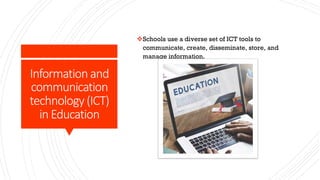
vSchools use a diverse set of ICT tools to
communicate, create, disseminate, store, and
manage information.
Information and
communication
technology (ICT)
in Education
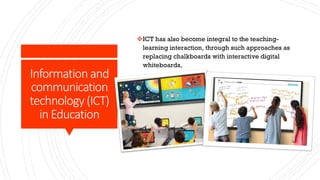
vICT has also become integral to the teaching-
learning interaction, through such approaches as
replacing chalkboards with interactive digital
whiteboards,
Information and
communication
technology (ICT)
in Education
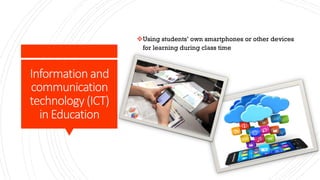
vUsing students’ own smartphones or other devices
for learning during class time
Information and
communication
technology (ICT)
in Education
v“flipped classroom” model where students watch
lectures at home on the computer and use
classroom time for more interactive exercises.
Information and
communication
technology (ICT)
in Education
§ Information and Communications Technology
(ICT) can impact student learning when teachers
are digitally literate and understand how to
integrate it into curriculum.
Information and
communication
technology (ICT)
in Education
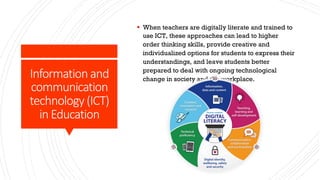
§ When teachers are digitally literate and trained to
use ICT, these approaches can lead to higher
order thinking skills, provide creative and
individualized options for students to express their
understandings, and leave students better
prepared to deal with ongoing technological
change in society and the workplace.
Some common
educational
applications of
ICT
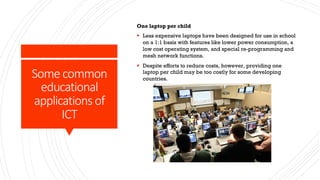
One laptop per child
§ Less expensive laptops have been designed for use in school
on a 1:1 basis with features like lower power consumption, a
low cost operating system, and special re-programming and
mesh network functions.
§ Despite efforts to reduce costs, however, providing one
laptop per child may be too costly for some developing
countries.
Some common
educational
applications of
ICT
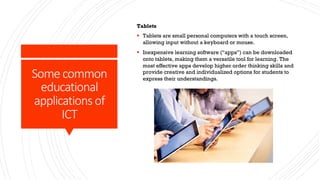
Tablets
§ Tablets are small personal computers with a touch screen,
allowing input without a keyboard or mouse.
§ Inexpensive learning software (“apps”) can be downloaded
onto tablets, making them a versatile tool for learning. The
most effective apps develop higher order thinking skills and
provide creative and individualized options for students to
express their understandings.
Some common
educational
applications of
ICT
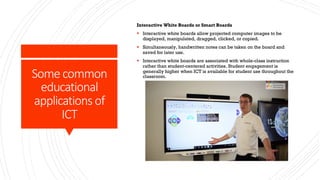
Interactive White Boards or Smart Boards
§ Interactive white boards allow projected computer images to be
displayed, manipulated, dragged, clicked, or copied.
§ Simultaneously, handwritten notes can be taken on the board and
saved for later use.
§ Interactive white boards are associated with whole-class instruction
rather than student-centered activities. Student engagement is
generally higher when ICT is available for student use throughout the
classroom.
Some common
educational
applications of
ICT
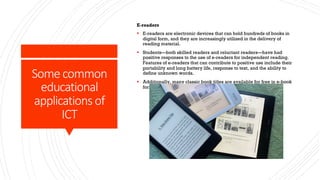
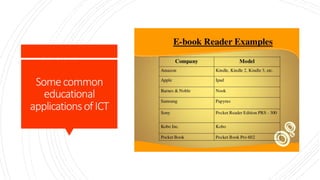
E-readers
§ E-readers are electronic devices that can hold hundreds of books in
digital form, and they are increasingly utilized in the delivery of
reading material.
§ Students—both skilled readers and reluctant readers—have had
positive responses to the use of e-readers for independent reading.
Features of e-readers that can contribute to positive use include their
portability and long battery life, response to text, and the ability to
define unknown words.
§ Additionally, many classic book titles are available for free in e-book
form.
Somecommon
educational
applicationsofICT
Some common
educational
applications of
ICT:
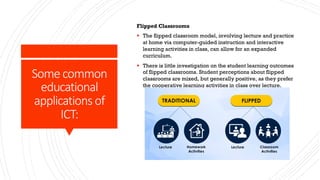
Flipped Classrooms
§ The flipped classroom model, involving lecture and practice
at home via computer-guided instruction and interactive
learning activities in class, can allow for an expanded
curriculum.
§ There is little investigation on the student learning outcomes
of flipped classrooms. Student perceptions about flipped
classrooms are mixed, but generally positive, as they prefer
the cooperative learning activities in class over lecture.
The Impact of
ICT on
Education
§ ICT has been aiding education by transforming the way
students learn and access information. Instructors have also
encountered similar positive effects, which have allowed
education to grow vastly.
§ ICT has given students the ability to access and search
information instantaneously with a click of a button through
the internet. Before the internet, students would have to do
research at the library by looking through hard copied books
for the information needed.
§ Another recent impact of the development of ICT is visible in
universities, where the deployment of online courses has
replaced face to face classroom experience to some degree.
Students are now able to log on to a web conference with the
instructor who covers the class material. If a student misses
his or her class session he or she can watch a recording of the
lecture. Class material, homework assignments and quizzes
can also all be done through the internet. These new features
have given students the luxury of being able learn and do
their work at their own convenience. The above examples
are just some of the many ways ICT has helped education
develop over the years. Overtime, ICT will continue to play
an active role in education to bring positive outcomes to our
society.
Effects of ICT on
Employment
The introduction of computers at the workplace has
resulted in Creation of new jobs, Replacement of
computer illiterate workers and Displacement of jobs
Job Creation
ICT has introduced new employment opportunities that
never existed before. The new job titles are computer
operators, programmers, network administrators, ICT
science etc.
Job Replacement
The workers that are computer illiterate are replaced
with those who are computer literate
Job Displacement
Here the workers do not lose their jobs instead they are
moved to another place or department
The Impact of ICT
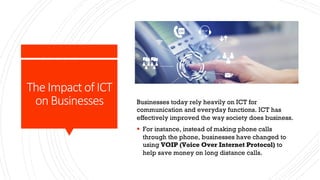
on Businesses Businesses today rely heavily on ICT for
communication and everyday functions. ICT has
effectively improved the way society does business.
§ For instance, instead of making phone calls
through the phone, businesses have changed to
using VOIP (Voice Over Internet Protocol) to
help save money on long distance calls.
The Impact of ICT
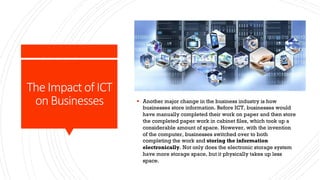
on Businesses § Another major change in the business industry is how
businesses store information. Before ICT, businesses would
have manually completed their work on paper and then store
the completed paper work in cabinet files, which took up a
considerable amount of space. However, with the invention
of the computer, businesses switched over to both
completing the work and storing the information
electronically. Not only does the electronic storage system
have more storage space, but it physically takes up less
space.
The Impact of ICT
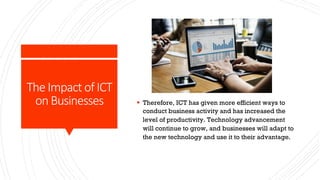
on Businesses § Therefore, ICT has given more efficient ways to
conduct business activity and has increased the
level of productivity. Technology advancement
will continue to grow, and businesses will adapt to
the new technology and use it to their advantage.
WhyBusinesses
ShouldbeAware
oftheEffectsof
ICT
Since the ICT industry is constantly coming up with new
technology that may or may not benefit businesses, it
would be important for businesses and their employees
to know the effects of these new technologies.
ü By allowing employees to understand the effects of
ICT, companies can best prepare their employees for
the changes that must take place in order for the
business to continue run smoothly.
ü Bringing awareness to the public will also help the
company as a whole to plan for future business
decisions that involve implementing information
technology. Even though businesses can make
preparations for these effects, they cannot completely
account for all the changes. Preparation for these
changes will help businesses adapt faster to the full
effects of ICT so that they can take advantage of the
new technology as soon as possible.
Health Sector
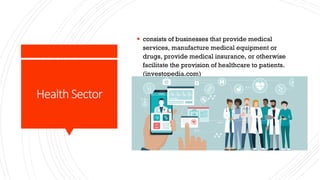
§ consists of businesses that provide medical
services, manufacture medical equipment or
drugs, provide medical insurance, or otherwise
facilitate the provision of healthcare to patients.
(investopedia.com)
Impact of ICT in
Health Sector
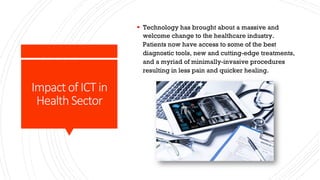
§ Technology has brought about a massive and
welcome change to the healthcare industry.
Patients now have access to some of the best
diagnostic tools, new and cutting-edge treatments,
and a myriad of minimally-invasive procedures
resulting in less pain and quicker healing.
Impact of
Technology to
Health Sector
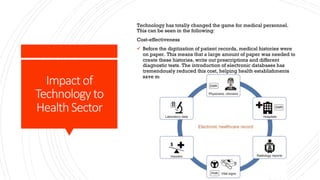
Technology has totally changed the game for medical personnel.
This can be seen in the following:
Cost-effectiveness
ü Before the digitization of patient records, medical histories were
on paper. This means that a large amount of paper was needed to
create these histories, write out prescriptions and different
diagnostic tests. The introduction of electronic databases has
tremendously reduced this cost, helping health establishments
save money.
Impact of
Technology to
Health Sector
Time-effectiveness
ü Writing a patient history takes a considerable amount of time.
This is uncomfortable especially in hospitals that experience
a high flow of patients. With the intervention of various
databases that have the diseases sorted according to
appropriate coding systems, it is now faster to work with a
computer and more patients get attended to per time.
Statistical effectiveness
ü Due to the creation of new medical technology that employs
the use of cloud data (huge amounts of information used for
analytic work) to compile patient histories in specific settings,
studies are easier. Epidemiological studies are carried out
periodically to determine the general health conditions of the
population. This includes determining morbidity and
mortality rates, incidence rates of various illnesses, etc. With
the help of this cloud data, it is easier to obtain needed
information for comparison or case studies. This leads to
conclusions and action plans based on concrete evidence,
and improves community healthcare in the long run.
Impact of
Technology to
Health Sector
Widespread access to patients
ü Gone are the days when a gravely sick patient had to
wait for hours due to his remote location. Now,
doctors can connect with patients who are miles away
and prescribe treatments. This is not only time
effective for sick people, but also cost-effective for the
doctors. This is because they don’t have to travel all
the way to see the specific patients. Also, remote
areas can now be easily accessed and healthcare
coverage becomes more effective.
Increased life expectancy
ü All the above-mentioned benefits work together to
achieve one common goal – improving the life
expectancy of the general population. Improved
diagnostic, treatment and remote access innovations
tackle primary and secondary illnesses. Improved
statistical and epidemiological study applications
tackle prophylaxis and prognosis. Each of these
aspects is interconnected such that the population has
an improved chance of living healthier lives.
E-Commerce and
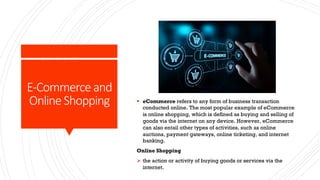
Online Shopping § eCommerce refers to any form of business transaction
conducted online. The most popular example of eCommerce
is online shopping, which is defined as buying and selling of
goods via the internet on any device. However, eCommerce
can also entail other types of activities, such as online
auctions, payment gateways, online ticketing, and internet
banking.
Online Shopping
Ø the action or activity of buying goods or services via the
internet.
E-Commerce and
Online Shopping
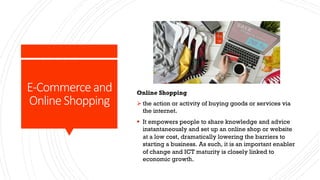
Online Shopping
Ø the action or activity of buying goods or services via
the internet.
§ It empowers people to share knowledge and advice
instantaneously and set up an online shop or website
at a low cost, dramatically lowering the barriers to
starting a business. As such, it is an important enabler
of change and ICT maturity is closely linked to
economic growth.
Impact of ICT in
an Online
Shopping
Technology has changed the way people shop and
the way that shops and retailers operate. The range
of products available online continues to grow and
people are increasingly more confident buying
online.
The rise of online stores has created a range of new
jobs for people who build, design and run the
websites. Shopping online has its advantages but it
has its disadvantages too.
Advantages of
shopping online
§ It’s convenient - it can be done at home, during a
lunch break or even on the move using a
smartphone
§ There’s greater variety - there are more shops
online than on any high street or shopping center.
§ It's easier to compare prices and find the best deal
online.
§ It’s often cheaper - increased competition between
retailers brings down prices.
§ It’s accessible – those with a disability that limits
their mobility can choose to have goods delivered.
§ There’s no need to travel and you don’t have to
queue.
Disadvantages
of shopping
online
§ You might be uncomfortable entering your credit
card details online.
§ You cannot physically inspect goods before you
buy.
§ Goods might get damaged during transport.
§ Goods might not arrive on time, or at all.
§ You might not be happy with retailers storing
information about you, eg your buying habits.
Communication
§ It is a giving, receiving or exchanging ideas,
information, signals or messages through appropriate
media, enabling individuals or groups to persuade, to
seek information, to give information or to express
emotions. This broad definition includes body-
language, skills of speaking and writing.
Impact of ICT in
Communication
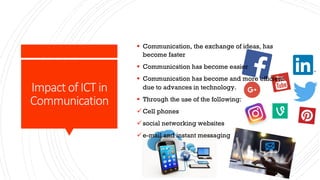
§ Communication, the exchange of ideas, has
become faster
§ Communication has become easier
§ Communication has become and more efficient
due to advances in technology.
§ Through the use of the following:
üCell phones
üsocial networking websites
üe-mail and instant messaging
Banking Sector § is an industry and a section of the economy
devoted to the holding of financial assets for others
and investing those financial assets as a leveraged
way to create more wealth.
Use of ICT in
Banking Sector
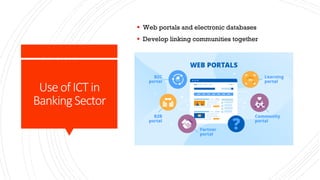
§ Web portals and electronic databases
§ Develop linking communities together
Use of ICT in
Banking Sector
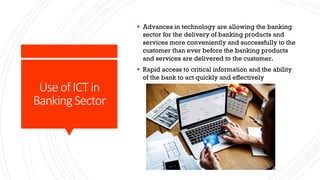
§ Advances in technology are allowing the banking
sector for the delivery of banking products and
services more conveniently and successfully to the
customer than ever before the banking products
and services are delivered to the customer.
§ Rapid access to critical information and the ability
of the bank to act quickly and effectively
Use of ICT in
Banking Sector
§ The bank gains a dynamic competitive advantage
due to the use of ICT and by having an accountable
customer service environment, direct marketing,
and new rationalized business processes.
§ ICT has increased the level of competition between
the banks and forced them to integrate the new
technologies to compete and satisfy their
customers.
Importance of
ICT in Banking
§ ICT has made the banking sector more innovative
and competitive because of the advancements of
information and communications technologies.
§ With the use of ICT in banking, it allows banking
sector to fulfill the needs of customers by
strengthening their internal control systems.
§ Extensive use of ATMs, Internet banking, mobile
banking, smart cards, 24/7 services, plus the
ability to offer a wide verity of products and
services have enabled the banks to improve their
service that is provided by the banking sectors to
customers.
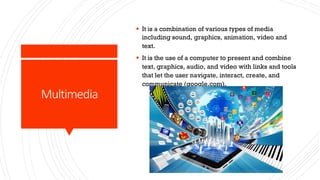
Multimedia
§ It is a combination of various types of media
including sound, graphics, animation, video and
text.
§ It is the use of a computer to present and combine
text, graphics, audio, and video with links and tools
that let the user navigate, interact, create, and
communicate (google.com).
Where to use
Multimedia
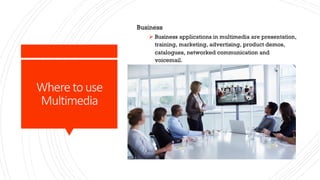
Business
Ø Business applications in multimedia are presentation,
training, marketing, advertising, product demos,
catalogues, networked communication and
voicemail.
Where to use
Multimedia
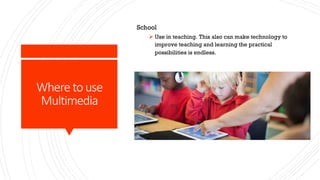
School
Ø Use in teaching. This also can make technology to
improve teaching and learning the practical
possibilities is endless.
Where to use
Multimedia
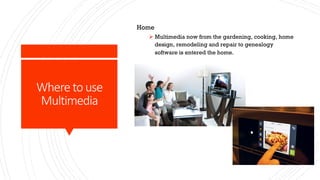
Home
Ø Multimedia now from the gardening, cooking, home
design, remodeling and repair to genealogy
software is entered the home.
Where to use
Multimedia
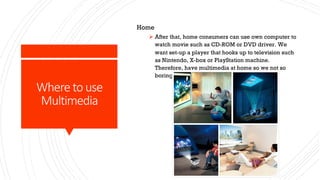
Home
Ø After that, home consumers can use own computer to
watch movie such as CD-ROM or DVD driver. We
want set-up a player that hooks up to television such
as Nintendo, X-box or PlayStation machine.
Therefore, have multimedia at home so we not so
boring at home.
Where to use
Multimedia
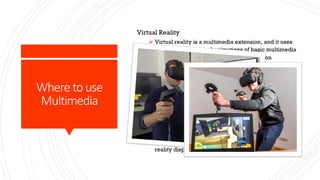
Virtual Reality
Ø Virtual reality is a multimedia extension, and it uses
imagery, sounds, and animations of basic multimedia
elements. Because it requires from a person
stringing is navigation feedback, maybe virtual
reality is an interactive multimedia in its fullest
extension. It is often used to describe a wide variety
of applications commonly associated with immersive,
highly visual and 3D environments. Simulation
environment can be similar to the real world, for
example is in the pilot or combat training, simulation
or it can be significantly different from the reality as
in virtual reality games. This definition will be
somewhat ahead of romantic attention. Then the
people tend to agree with wearing a suit virtual
reality display and data.
Where to use
Multimedia
Public Places
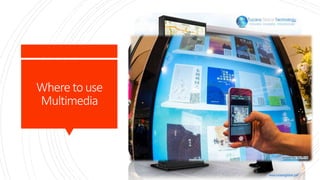
Ø In the public places have hotels, train station,
shopping malls, museums, libraries and grocery
stores. We make the multimedia in public places is
for the people provide 24 hours a day also can use
the multimedia in them life. In this is piped to
wireless devices such as cell phones and PDS. The
wireless is at anywhere and anytime because that
can give the people at any moment also can online to
research any things. This make easier to people,
then they don’t want go back home just can online.
That can save time and also can make the life more
enrich.
Impact of ICT in
Multimedia
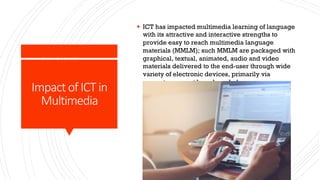
§ ICT has impacted multimedia learning of language
with its attractive and interactive strengths to
provide easy to reach multimedia language
materials (MMLM); such MMLM are packaged with
graphical, textual, animated, audio and video
materials delivered to the end-user through wide
variety of electronic devices, primarily via
computers, smart boards and phones.
Entertainment
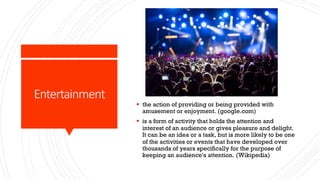
§ the action of providing or being provided with
amusement or enjoyment. (google.com)
§ is a form of activity that holds the attention and
interest of an audience or gives pleasure and delight.
It can be an idea or a task, but is more likely to be one
of the activities or events that have developed over
thousands of years specifically for the purpose of
keeping an audience's attention. (Wikipedia)
Impact of ICT in
Entertainment
Industry
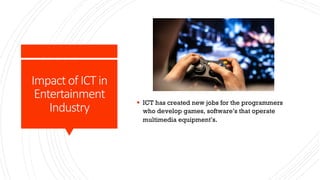
§ ICT has created new jobs for the programmers
who develop games, software’s that operate
multimedia equipment’s.
Impact of ICT in
Entertainment
Industry
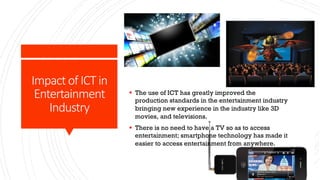
§ The use of ICT has greatly improved the
production standards in the entertainment industry
bringing new experience in the industry like 3D
movies, and televisions.
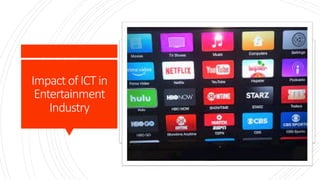
§ There is no need to have a TV so as to access
entertainment; smartphone technology has made it
easier to access entertainment from anywhere.
Impact of ICT in
Entertainment
Industry
§ The internet has made the entertainment materials
more readily accessible. There is no need to go to
a movie or a music store to buy the movies since
you can and download(video on demand). For
example the iPod comes with huge internal
memory to store music and one can access more
and
§ This has increased revenue and profits for the
entertainment industry due to Internet that has
enabled to reach new markets readily accessible
from any corner of the globe.
References:
§ https://sites.google.com/site/finalenglishpaper302/
main
§ https://learningportal.iiep.unesco.org/en/issue-briefs/
improve-learning/curriculum-and-materials/
information-and-communication-technology-ict
§ https://www.bbc.co.uk/bitesize/guides/zbxbkqt/
revision/3
§ https://medium.com/@mabdulbasit01/what-is-ict-how-
ict-has-transformed-in-banking-world-2813b7b7d383
§ https://slejournal.springeropen.com/articles/10.1186/
s40561-020-00134-7#:~:text=Moreover%2C%20ICT%20
has%20impacted%20multimedia,wide%20variety%20of
%20electronic%20devices
References:
§ https://madhavuniversity.edu.in/role-of-
multimedia-in-information-technology.html
§ https://www.academia.edu/5066850/
IMPACT_OF_ICT_IN_EDUCATION_ENTERTAINME
NT_DEVELOPMENT_GOVERNANCE_POLITICS_A
ND_INDUSTRY
§ https://www.itbriefcase.net/the-impact-of-
information-technology-on-medicine
§ https://www.oberlo.com/ecommerce-wiki/
ecommerce

Information and Communication Technology Sample PPT

  • 1.
    Impact of Informationand Communication Technology LESSON 3
  • 2.
    Learning Goals/ Objectives At theend of the lesson, the students will be able to understand the following: § Impact of Information and Communications Technology in: § Education § Employment § Business § Health Sector § E-Commerce/Online Shopping § Communication § Banking Sector § Multimedia § Entertainment
  • 3.
    Introduction § Over thelast decade, Information and Communication Technology or ICT has come to play a significant role in society. Our society has become more accustomed to having the benefits of ICT, which has changed the way people live and interact with one another. § People have incorporated ICT into their everyday lives, such as using cell phones to make calls, withdrawing cash out of the ATM, or using the computer to browse the internet. Not only has ICT made an impact on people’s personal lives, but it has also made an impact on how businesses operate, revolutionizing the business industry.
  • 4.
    Introduction § ICT hasalso led to the enhancement of education. Since education and the business industry are connected to the economy, ICT has become a major factor in the growing global economy. However, some questions have emerged on how these effects can be measured and why we should expose these effects to the public. § With ICT being such a big contributor to society through businesses, education, and the global economy, it is important for the public to measure and observe both the positive and negative impacts of ICT so that they can best prepare for the future.
  • 5.
    Whatis Informationand Communication Technology? § According toEntrepreneur.com, information technology “encompasses all forms of technology used to create, store, exchange and utilize information in its various forms including business data, conversations, still images, motion pictures and multimedia presentations.” § In layman’s terms, information technology is considered to be any type of data exchanged between devices.
  • 6.
    Example of information technology § Computer,which gives the user the capability to store information, communicate, and transfer data through the internet. § Invention of the smart phone, which has recently become more of a influence in our society, especially in relation to businesses.
  • 7.
    Information and communication technology (ICT) inEducation vSchools use a diverse set of ICT tools to communicate, create, disseminate, store, and manage information.
  • 8.
    Information and communication technology (ICT) inEducation vICT has also become integral to the teaching- learning interaction, through such approaches as replacing chalkboards with interactive digital whiteboards,
  • 9.
    Information and communication technology (ICT) inEducation vUsing students’ own smartphones or other devices for learning during class time
  • 10.
    Information and communication technology (ICT) inEducation v“flipped classroom” model where students watch lectures at home on the computer and use classroom time for more interactive exercises.
  • 11.
    Information and communication technology (ICT) inEducation § Information and Communications Technology (ICT) can impact student learning when teachers are digitally literate and understand how to integrate it into curriculum.
  • 12.
    Information and communication technology (ICT) inEducation § When teachers are digitally literate and trained to use ICT, these approaches can lead to higher order thinking skills, provide creative and individualized options for students to express their understandings, and leave students better prepared to deal with ongoing technological change in society and the workplace.
  • 13.
    Some common educational applications of ICT Onelaptop per child § Less expensive laptops have been designed for use in school on a 1:1 basis with features like lower power consumption, a low cost operating system, and special re-programming and mesh network functions. § Despite efforts to reduce costs, however, providing one laptop per child may be too costly for some developing countries.
  • 14.
    Some common educational applications of ICT Tablets §Tablets are small personal computers with a touch screen, allowing input without a keyboard or mouse. § Inexpensive learning software (“apps”) can be downloaded onto tablets, making them a versatile tool for learning. The most effective apps develop higher order thinking skills and provide creative and individualized options for students to express their understandings.
  • 15.
    Some common educational applications of ICT InteractiveWhite Boards or Smart Boards § Interactive white boards allow projected computer images to be displayed, manipulated, dragged, clicked, or copied. § Simultaneously, handwritten notes can be taken on the board and saved for later use. § Interactive white boards are associated with whole-class instruction rather than student-centered activities. Student engagement is generally higher when ICT is available for student use throughout the classroom.
  • 16.
    Some common educational applications of ICT E-readers §E-readers are electronic devices that can hold hundreds of books in digital form, and they are increasingly utilized in the delivery of reading material. § Students—both skilled readers and reluctant readers—have had positive responses to the use of e-readers for independent reading. Features of e-readers that can contribute to positive use include their portability and long battery life, response to text, and the ability to define unknown words. § Additionally, many classic book titles are available for free in e-book form.
  • 17.
  • 18.
    Some common educational applications of ICT: FlippedClassrooms § The flipped classroom model, involving lecture and practice at home via computer-guided instruction and interactive learning activities in class, can allow for an expanded curriculum. § There is little investigation on the student learning outcomes of flipped classrooms. Student perceptions about flipped classrooms are mixed, but generally positive, as they prefer the cooperative learning activities in class over lecture.
  • 19.
    The Impact of ICTon Education § ICT has been aiding education by transforming the way students learn and access information. Instructors have also encountered similar positive effects, which have allowed education to grow vastly. § ICT has given students the ability to access and search information instantaneously with a click of a button through the internet. Before the internet, students would have to do research at the library by looking through hard copied books for the information needed. § Another recent impact of the development of ICT is visible in universities, where the deployment of online courses has replaced face to face classroom experience to some degree. Students are now able to log on to a web conference with the instructor who covers the class material. If a student misses his or her class session he or she can watch a recording of the lecture. Class material, homework assignments and quizzes can also all be done through the internet. These new features have given students the luxury of being able learn and do their work at their own convenience. The above examples are just some of the many ways ICT has helped education develop over the years. Overtime, ICT will continue to play an active role in education to bring positive outcomes to our society.
  • 20.
    Effects of ICTon Employment The introduction of computers at the workplace has resulted in Creation of new jobs, Replacement of computer illiterate workers and Displacement of jobs Job Creation ICT has introduced new employment opportunities that never existed before. The new job titles are computer operators, programmers, network administrators, ICT science etc. Job Replacement The workers that are computer illiterate are replaced with those who are computer literate Job Displacement Here the workers do not lose their jobs instead they are moved to another place or department
  • 21.
    The Impact ofICT on Businesses Businesses today rely heavily on ICT for communication and everyday functions. ICT has effectively improved the way society does business. § For instance, instead of making phone calls through the phone, businesses have changed to using VOIP (Voice Over Internet Protocol) to help save money on long distance calls.
  • 22.
    The Impact ofICT on Businesses § Another major change in the business industry is how businesses store information. Before ICT, businesses would have manually completed their work on paper and then store the completed paper work in cabinet files, which took up a considerable amount of space. However, with the invention of the computer, businesses switched over to both completing the work and storing the information electronically. Not only does the electronic storage system have more storage space, but it physically takes up less space.
  • 23.
    The Impact ofICT on Businesses § Therefore, ICT has given more efficient ways to conduct business activity and has increased the level of productivity. Technology advancement will continue to grow, and businesses will adapt to the new technology and use it to their advantage.
  • 24.
    WhyBusinesses ShouldbeAware oftheEffectsof ICT Since the ICTindustry is constantly coming up with new technology that may or may not benefit businesses, it would be important for businesses and their employees to know the effects of these new technologies. ü By allowing employees to understand the effects of ICT, companies can best prepare their employees for the changes that must take place in order for the business to continue run smoothly. ü Bringing awareness to the public will also help the company as a whole to plan for future business decisions that involve implementing information technology. Even though businesses can make preparations for these effects, they cannot completely account for all the changes. Preparation for these changes will help businesses adapt faster to the full effects of ICT so that they can take advantage of the new technology as soon as possible.
  • 25.
    Health Sector § consistsof businesses that provide medical services, manufacture medical equipment or drugs, provide medical insurance, or otherwise facilitate the provision of healthcare to patients. (investopedia.com)
  • 26.
    Impact of ICTin Health Sector § Technology has brought about a massive and welcome change to the healthcare industry. Patients now have access to some of the best diagnostic tools, new and cutting-edge treatments, and a myriad of minimally-invasive procedures resulting in less pain and quicker healing.
  • 27.
    Impact of Technology to HealthSector Technology has totally changed the game for medical personnel. This can be seen in the following: Cost-effectiveness ü Before the digitization of patient records, medical histories were on paper. This means that a large amount of paper was needed to create these histories, write out prescriptions and different diagnostic tests. The introduction of electronic databases has tremendously reduced this cost, helping health establishments save money.
  • 28.
    Impact of Technology to HealthSector Time-effectiveness ü Writing a patient history takes a considerable amount of time. This is uncomfortable especially in hospitals that experience a high flow of patients. With the intervention of various databases that have the diseases sorted according to appropriate coding systems, it is now faster to work with a computer and more patients get attended to per time. Statistical effectiveness ü Due to the creation of new medical technology that employs the use of cloud data (huge amounts of information used for analytic work) to compile patient histories in specific settings, studies are easier. Epidemiological studies are carried out periodically to determine the general health conditions of the population. This includes determining morbidity and mortality rates, incidence rates of various illnesses, etc. With the help of this cloud data, it is easier to obtain needed information for comparison or case studies. This leads to conclusions and action plans based on concrete evidence, and improves community healthcare in the long run.
  • 29.
    Impact of Technology to HealthSector Widespread access to patients ü Gone are the days when a gravely sick patient had to wait for hours due to his remote location. Now, doctors can connect with patients who are miles away and prescribe treatments. This is not only time effective for sick people, but also cost-effective for the doctors. This is because they don’t have to travel all the way to see the specific patients. Also, remote areas can now be easily accessed and healthcare coverage becomes more effective. Increased life expectancy ü All the above-mentioned benefits work together to achieve one common goal – improving the life expectancy of the general population. Improved diagnostic, treatment and remote access innovations tackle primary and secondary illnesses. Improved statistical and epidemiological study applications tackle prophylaxis and prognosis. Each of these aspects is interconnected such that the population has an improved chance of living healthier lives.

  • 30.
    E-Commerce and Online Shopping§ eCommerce refers to any form of business transaction conducted online. The most popular example of eCommerce is online shopping, which is defined as buying and selling of goods via the internet on any device. However, eCommerce can also entail other types of activities, such as online auctions, payment gateways, online ticketing, and internet banking. Online Shopping Ø the action or activity of buying goods or services via the internet.
  • 31.
    E-Commerce and Online Shopping OnlineShopping Ø the action or activity of buying goods or services via the internet. § It empowers people to share knowledge and advice instantaneously and set up an online shop or website at a low cost, dramatically lowering the barriers to starting a business. As such, it is an important enabler of change and ICT maturity is closely linked to economic growth.
  • 32.
    Impact of ICTin an Online Shopping Technology has changed the way people shop and the way that shops and retailers operate. The range of products available online continues to grow and people are increasingly more confident buying online. The rise of online stores has created a range of new jobs for people who build, design and run the websites. Shopping online has its advantages but it has its disadvantages too.
  • 33.
    Advantages of shopping online §It’s convenient - it can be done at home, during a lunch break or even on the move using a smartphone § There’s greater variety - there are more shops online than on any high street or shopping center. § It's easier to compare prices and find the best deal online. § It’s often cheaper - increased competition between retailers brings down prices. § It’s accessible – those with a disability that limits their mobility can choose to have goods delivered. § There’s no need to travel and you don’t have to queue.
  • 34.
    Disadvantages of shopping online § Youmight be uncomfortable entering your credit card details online. § You cannot physically inspect goods before you buy. § Goods might get damaged during transport. § Goods might not arrive on time, or at all. § You might not be happy with retailers storing information about you, eg your buying habits.
  • 35.
    Communication § It isa giving, receiving or exchanging ideas, information, signals or messages through appropriate media, enabling individuals or groups to persuade, to seek information, to give information or to express emotions. This broad definition includes body- language, skills of speaking and writing.
  • 36.
    Impact of ICTin Communication § Communication, the exchange of ideas, has become faster § Communication has become easier § Communication has become and more efficient due to advances in technology. § Through the use of the following: üCell phones üsocial networking websites üe-mail and instant messaging
  • 37.
    Banking Sector §is an industry and a section of the economy devoted to the holding of financial assets for others and investing those financial assets as a leveraged way to create more wealth.
  • 38.
    Use of ICTin Banking Sector § Web portals and electronic databases § Develop linking communities together
  • 39.
    Use of ICTin Banking Sector § Advances in technology are allowing the banking sector for the delivery of banking products and services more conveniently and successfully to the customer than ever before the banking products and services are delivered to the customer. § Rapid access to critical information and the ability of the bank to act quickly and effectively
  • 40.
    Use of ICTin Banking Sector § The bank gains a dynamic competitive advantage due to the use of ICT and by having an accountable customer service environment, direct marketing, and new rationalized business processes. § ICT has increased the level of competition between the banks and forced them to integrate the new technologies to compete and satisfy their customers.
  • 41.
    Importance of ICT inBanking § ICT has made the banking sector more innovative and competitive because of the advancements of information and communications technologies. § With the use of ICT in banking, it allows banking sector to fulfill the needs of customers by strengthening their internal control systems. § Extensive use of ATMs, Internet banking, mobile banking, smart cards, 24/7 services, plus the ability to offer a wide verity of products and services have enabled the banks to improve their service that is provided by the banking sectors to customers.
  • 42.
    Multimedia § It isa combination of various types of media including sound, graphics, animation, video and text. § It is the use of a computer to present and combine text, graphics, audio, and video with links and tools that let the user navigate, interact, create, and communicate (google.com).
  • 43.
    Where to use Multimedia Business ØBusiness applications in multimedia are presentation, training, marketing, advertising, product demos, catalogues, networked communication and voicemail.
  • 44.
    Where to use Multimedia School ØUse in teaching. This also can make technology to improve teaching and learning the practical possibilities is endless.
  • 45.
    Where to use Multimedia Home ØMultimedia now from the gardening, cooking, home design, remodeling and repair to genealogy software is entered the home.
  • 46.
    Where to use Multimedia Home ØAfter that, home consumers can use own computer to watch movie such as CD-ROM or DVD driver. We want set-up a player that hooks up to television such as Nintendo, X-box or PlayStation machine. Therefore, have multimedia at home so we not so boring at home.
  • 47.
    Where to use Multimedia VirtualReality Ø Virtual reality is a multimedia extension, and it uses imagery, sounds, and animations of basic multimedia elements. Because it requires from a person stringing is navigation feedback, maybe virtual reality is an interactive multimedia in its fullest extension. It is often used to describe a wide variety of applications commonly associated with immersive, highly visual and 3D environments. Simulation environment can be similar to the real world, for example is in the pilot or combat training, simulation or it can be significantly different from the reality as in virtual reality games. This definition will be somewhat ahead of romantic attention. Then the people tend to agree with wearing a suit virtual reality display and data.
  • 48.
    Where to use Multimedia PublicPlaces Ø In the public places have hotels, train station, shopping malls, museums, libraries and grocery stores. We make the multimedia in public places is for the people provide 24 hours a day also can use the multimedia in them life. In this is piped to wireless devices such as cell phones and PDS. The wireless is at anywhere and anytime because that can give the people at any moment also can online to research any things. This make easier to people, then they don’t want go back home just can online. That can save time and also can make the life more enrich.
  • 49.
    Impact of ICTin Multimedia § ICT has impacted multimedia learning of language with its attractive and interactive strengths to provide easy to reach multimedia language materials (MMLM); such MMLM are packaged with graphical, textual, animated, audio and video materials delivered to the end-user through wide variety of electronic devices, primarily via computers, smart boards and phones.
  • 50.
    Entertainment § the actionof providing or being provided with amusement or enjoyment. (google.com) § is a form of activity that holds the attention and interest of an audience or gives pleasure and delight. It can be an idea or a task, but is more likely to be one of the activities or events that have developed over thousands of years specifically for the purpose of keeping an audience's attention. (Wikipedia)
  • 51.
    Impact of ICTin Entertainment Industry § ICT has created new jobs for the programmers who develop games, software’s that operate multimedia equipment’s.
  • 52.
    Impact of ICTin Entertainment Industry § The use of ICT has greatly improved the production standards in the entertainment industry bringing new experience in the industry like 3D movies, and televisions. § There is no need to have a TV so as to access entertainment; smartphone technology has made it easier to access entertainment from anywhere.
  • 53.
    Impact of ICTin Entertainment Industry § The internet has made the entertainment materials more readily accessible. There is no need to go to a movie or a music store to buy the movies since you can and download(video on demand). For example the iPod comes with huge internal memory to store music and one can access more and § This has increased revenue and profits for the entertainment industry due to Internet that has enabled to reach new markets readily accessible from any corner of the globe.
  • 54.
    References: § https://sites.google.com/site/finalenglishpaper302/ main § https://learningportal.iiep.unesco.org/en/issue-briefs/ improve-learning/curriculum-and-materials/ information-and-communication-technology-ict §https://www.bbc.co.uk/bitesize/guides/zbxbkqt/ revision/3 § https://medium.com/@mabdulbasit01/what-is-ict-how- ict-has-transformed-in-banking-world-2813b7b7d383 § https://slejournal.springeropen.com/articles/10.1186/ s40561-020-00134-7#:~:text=Moreover%2C%20ICT%20 has%20impacted%20multimedia,wide%20variety%20of %20electronic%20devices
  • 55.