Welcome to Year 10!
What you need to know right from
the first lesson!
The Course…
The English course comprises two
qualifications: English Language
English Literature
You will have 4 lessons of English per
cycle and it is most likely you will the
the same teacher throughout the 2 year
course.
The Course…
This year the course differs from previous
ones due to a change in syllabus, so you will
sit the Literature exam in November 2010 and
the Language exam in May 2011.
Details of these courses are in the handout
‘Welcome to Year 10’: please read through
this now and ask your teacher if you have any
questions.
The modules of study…
An introductory inquiry unit
Study of Romeo and Juliet
Study of wider reading novel
Creative writing
How to read with insight (Section B)
Poetry Carousel
Introduction to exam texts: ‘A View from
the Bridge’ and ‘Balzac and the Little
Chinese Seamstress’
Exams and Coursework
As you read in the handout, you will
complete 2 exams and a number of
coursework pieces which test your
reading, writing, speaking and listening
skills.
These will be done throughout this year
and the next, and all written work MUST
be submitted through turnitin.com.
Please set up your turnitin account now.
File system
We expect that you will file your English
‘notes’ in your computer in a logical
manner within a range of folders:
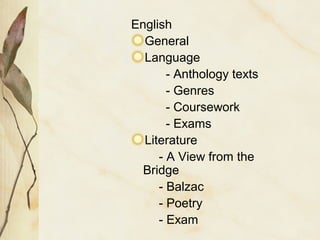
English
General
Language
- Anthology texts
- Genres
- Coursework
- Exams
Literature
- A View from the
Bridge
- Balzac
- Poetry
- Exam
Please save your ‘Welcome to year 10’
doc into the ‘General’ folder.
In the same folder, set up a sub-folder
called ‘Year 10 Inquiry into Language
and Literature’
Now we are ready to start…
Now on to more exciting
things…
The first unit you will undertake this year is
‘Language and Literature: how we express
ourselves through the spoken and written
word’.
The purpose of the unit is to consider why we
study language and literature at school, and
our personal connection with language and
literature.
The Unit…
We will start by asking you to complete a
series of activities (in stations) that relate to
language and literature.
Then you will need to consider an inquiry,
related to language and literature, that you
are interested in. You may choose to work
individually or in small groups.
You will spend a number of lessons
researching your inquiry, with the aim of
showing your findings through the creation
of a product, or a performance that will be
shared with your peers.
You will be guided through each step of
the process:
- engaging
- investigating
- connecting
First things first…
Think about all of the ways we choose to
communicate and express ourselves.
In groups, create a visual map/ mind map on
the whiteboards.
Once done, try to rate which you think are the
most effective.
Share with the class.
Please open your student reflection journal and
respond to the following questions:
How would you define the terms ‘language’,
‘literature’ and ‘express’? Discuss in small
groups/ the class once done.
What are your experiences of language and
literature, to this point in your life?
Station work
Your teacher will now introduce the stations
you can choose from.
You need to complete ___(fill in considering
the time available) this lesson and do 1 for
homework. Next lesson you will also have
station work to do.
GOOD LUCK!!!
Year 10 introduction copy

Year 10 introduction copy

  • 1.
    Welcome to Year10! What you need to know right from the first lesson!
  • 2.
    The Course… The Englishcourse comprises two qualifications: English Language English Literature You will have 4 lessons of English per cycle and it is most likely you will the the same teacher throughout the 2 year course.
  • 3.
    The Course… This yearthe course differs from previous ones due to a change in syllabus, so you will sit the Literature exam in November 2010 and the Language exam in May 2011. Details of these courses are in the handout ‘Welcome to Year 10’: please read through this now and ask your teacher if you have any questions.
  • 4.
    The modules ofstudy… An introductory inquiry unit Study of Romeo and Juliet Study of wider reading novel Creative writing How to read with insight (Section B) Poetry Carousel Introduction to exam texts: ‘A View from the Bridge’ and ‘Balzac and the Little Chinese Seamstress’
  • 5.
    Exams and Coursework Asyou read in the handout, you will complete 2 exams and a number of coursework pieces which test your reading, writing, speaking and listening skills. These will be done throughout this year and the next, and all written work MUST be submitted through turnitin.com. Please set up your turnitin account now.
  • 6.
    File system We expectthat you will file your English ‘notes’ in your computer in a logical manner within a range of folders:
  • 7.
    English General Language - Anthology texts -Genres - Coursework - Exams Literature - A View from the Bridge - Balzac - Poetry - Exam
  • 8.
    Please save your‘Welcome to year 10’ doc into the ‘General’ folder. In the same folder, set up a sub-folder called ‘Year 10 Inquiry into Language and Literature’ Now we are ready to start…
  • 9.
    Now on tomore exciting things… The first unit you will undertake this year is ‘Language and Literature: how we express ourselves through the spoken and written word’. The purpose of the unit is to consider why we study language and literature at school, and our personal connection with language and literature.
  • 10.
    The Unit… We willstart by asking you to complete a series of activities (in stations) that relate to language and literature. Then you will need to consider an inquiry, related to language and literature, that you are interested in. You may choose to work individually or in small groups.
  • 11.
    You will spenda number of lessons researching your inquiry, with the aim of showing your findings through the creation of a product, or a performance that will be shared with your peers. You will be guided through each step of the process: - engaging - investigating - connecting
  • 12.
    First things first… Thinkabout all of the ways we choose to communicate and express ourselves. In groups, create a visual map/ mind map on the whiteboards. Once done, try to rate which you think are the most effective. Share with the class.
  • 13.
    Please open yourstudent reflection journal and respond to the following questions: How would you define the terms ‘language’, ‘literature’ and ‘express’? Discuss in small groups/ the class once done. What are your experiences of language and literature, to this point in your life?
  • 14.
    Station work Your teacherwill now introduce the stations you can choose from. You need to complete ___(fill in considering the time available) this lesson and do 1 for homework. Next lesson you will also have station work to do. GOOD LUCK!!!