- 1 -
Year 7 Program – Semester 1, 2014 – Teaching Document
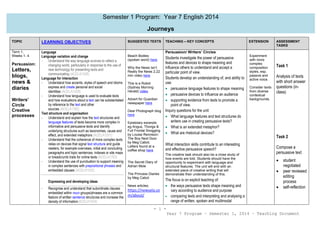
Semester 1 Program: Year 7 English 2014
Journeys
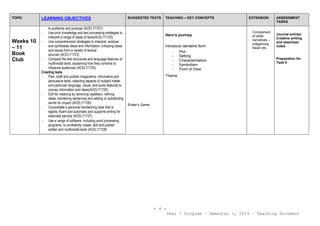
TOPIC LEARNING OBJECTIVES SUGGESTED TEXTS TEACHING – KEY CONCEPTS EXTENSION ASSESSMENT
TASKS
Term 1,
Weeks 1- 4
Persuasion:
Letters,
blogs,
news &
diaries
Writers’
Circle
Creative
processes
Language
Language variation and change
- Understand the way language evolves to reflect a
changing world, particularly in response to the use of
new technology for presenting texts and
communicating (ACELA1528)
Language for interaction
- Understand how accents, styles of speech and idioms
express and create personal and social
identities (ACELA1529)
- Understand how language is used to evaluate texts
and how evaluations about a text can be substantiated
by reference to the text and other
sources (ACELA1782)
Text structure and organisation
- Understand and explain how the text structures and
language features of texts become more complex in
informative and persuasive texts and identify
underlying structures such as taxonomies, cause and
effect, and extended metaphors (ACELA1531)
- Understand that the coherence of more complex texts
relies on devices that signal text structure and guide
readers, for example overviews, initial and concluding
paragraphs and topic sentences, indexes or site maps
or breadcrumb trails for online texts (ACELA1763)
- Understand the use of punctuation to support meaning
in complex sentences with prepositional phrases and
embedded clauses (ACELA1532)
Expressing and developing ideas
- Recognise and understand that subordinate clauses
embedded within noun groups/phrases are a common
feature of written sentence structures and increase the
density of information(ACELA1534)
Beach Bodies
(spoken word) here
Why the News Isn’t
Really the News 2.22
min video here
This is a Robot
(Sydney Morning
Herald) video
Advert for Guardian
newspaper here
Dear Photograph blog
here
Epistolary excerpts
eg Angus, Thongs &
Full Frontal Snogging
by Louise Rennison;
The Boy Next Door
by Meg Cabot;
Letters found at a
coffee shop here
The Secret Diary of
Adrian Mole
The Princess Diaries
by Meg Cabot
News articles:
https://newsela.co
m/about/
Persuasion/ Writers’ Circles
Students investigate the power of persuasive
features and devices to shape meaning and
influence others to understand and accept a
particular point of view.
Students develop an understanding of, and ability to
use:
 persuasive language features to shape meaning
 persuasive devices to influence an audience
 supporting evidence from texts to promote a
point of view.
Inquiry questions for the unit:
 What language features and text structures do
writers use in creating persuasive texts?
 What is an extended metaphor?
 What are rhetorical devices?
What interaction skills contribute to an interesting
and effective persuasive speech?
The creative task should also be a close study of
how events are told. Students should have the
opportunity to experiment with language and
structural features. The unit will end with an
extended piece of creative writing that will
demonstrate their understanding of this.
The focus is on explicit teaching of:
 the ways persuasive texts shape meaning and
vary according to audience and purpose
 comparing texts and interpreting and analysing a
range of written, spoken and multimodal
Experiment
with more
complex
composition
styles, esp.
passive and
active voice.
Consider texts
from diverse
contextual
backgrounds.
Task 1
Analysis of texts
with short answer
questions (in-
class)
Task 2
Compose a
persuasive text
 student
negotiated
 peer reviewed
editing
process
 self-reflection
- 2 -
Year 7 Program – Semester 1, 2014 – Teaching Document
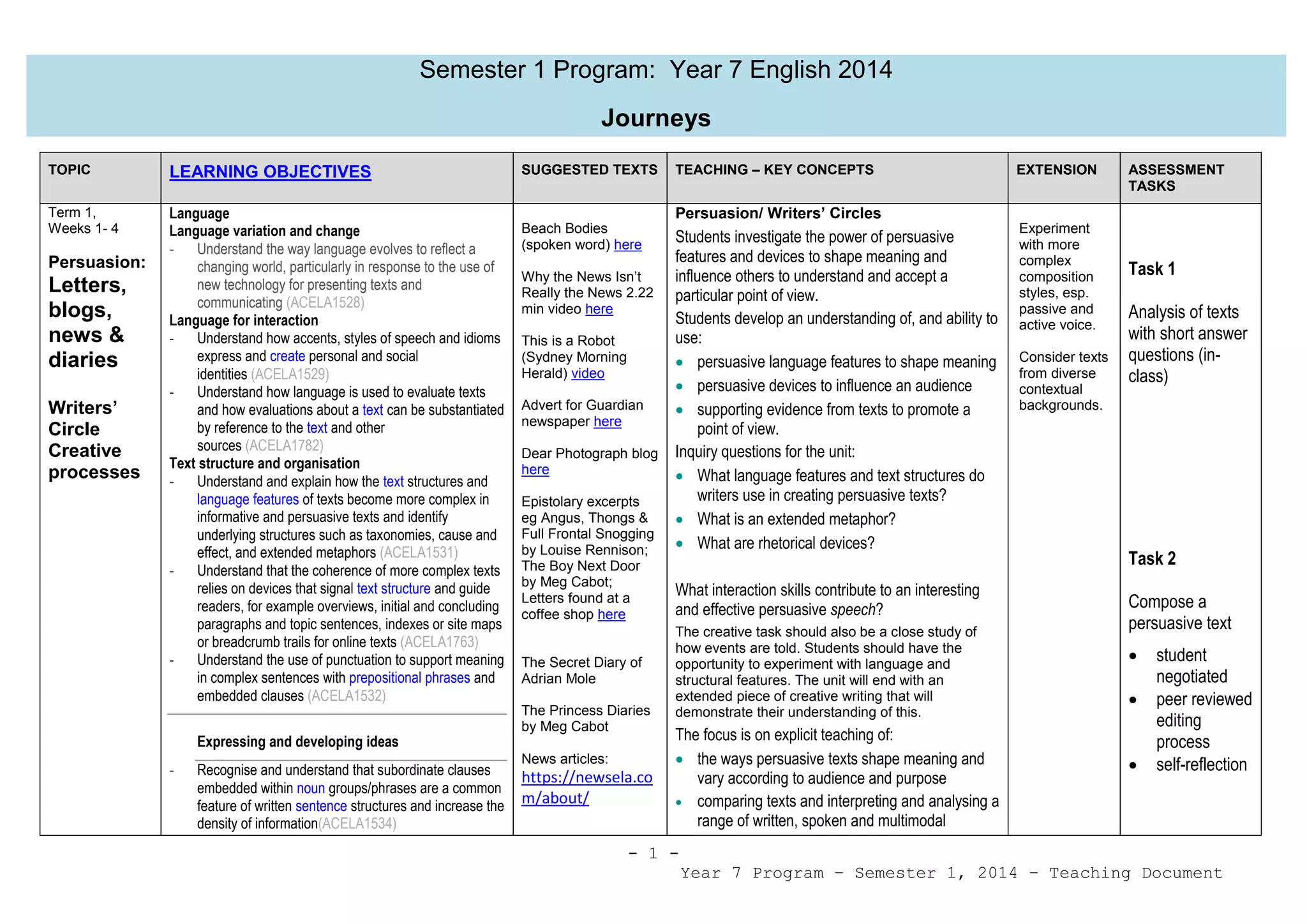
TOPIC LEARNING OBJECTIVES SUGGESTED TEXTS TEACHING – KEY CONCEPTS EXTENSION ASSESSMENT
TASKS
- Understand how modality is achieved through
discriminating choices in modal verbs, adverbs,
adjectives and nouns (ACELA1536)
- Analyse how point of view is generated in visual texts
by means of choices, for example gaze, angle and
social distance (ACELA1764)
- Investigate vocabulary typical of extended and more
academic texts and the role of abstract nouns,
classification, description and generalisation in
building specialised knowledge through
language(ACELA1537)
- Understand how to use spelling rules and word
origins, for example Greek and Latin roots, base
words, suffixes, prefixes, spelling patterns and
generalisations to learn new words and how to spell
them (ACELA1539)
Literature
Literature and context
1. Identify and explore ideas and viewpoints about
events, issues and characters represented in
texts drawn from different historical, social and
cultural contexts (ACELT1619)
Responding to literature
1. Reflect on ideas and opinions about characters,
settings and events in literary texts, identifying
areas of agreement and difference with others
and justifying a point of view (ACELT1620)
2. Compare the ways that language and images are
used to create character, and to influence
emotions and opinions in different types of
texts(ACELT1621)
3. Discuss aspects of texts, for example their
aesthetic and social value, using relevant and
appropriate metalanguage (ACELT1803)
Examining literature
1. Recognise and analyse the ways that
characterisation, events and settings are
combined in narratives, and discuss the
http://www.dogon
ews.com/
http://tweentribun
e.com/
http://kids.national
geographic.com/ki
ds/stories/
http://www.ourlittl
eearth.com/
http://teachingkids
news.com/
http://news.discov
ery.com/
http://htekidsnews
.com/
persuasive texts, figurative and rhetorical
language and devices, using evidence from
texts to support a persuasive speech.
Literacy sub strand: Interpreting, analysing,
evaluating
- Analyse and explain the ways text
structures and language features shape
meaning and vary according to audience
and purpose.
- Use prior knowledge and text processing
strategies to interpret a range of types of
texts.
- Use comprehension strategies to interpret,
analyse and synthesise ideas and
information, critiquing ideas and issues
from a variety of textual sources.
- Compare the text structures and language
features of multimodal texts, explaining
how they combine to influence audiences.
- 3 -
Year 7 Program – Semester 1, 2014 – Teaching Document
TOPIC LEARNING OBJECTIVES SUGGESTED TEXTS TEACHING – KEY CONCEPTS EXTENSION ASSESSMENT
TASKS
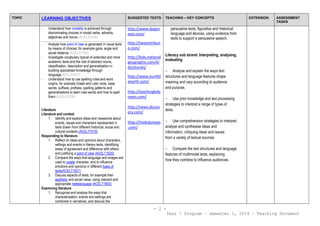
Weeks 5
– 8
Comics/
Graphic
tales
purposes and appeal of different
approaches (ACELT1622)
2. Understand, interpret and discuss how language
is compressed to produce a dramatic effect in
film or drama, and to create layers of meaning in
poetry, for example haiku, tankas, couplets, free
verse and verse novels (ACELT1623)
Creating literature
1. Create literary texts that adapt stylistic features
encountered in other texts, for example, narrative
viewpoint, structure of stanzas, contrast and
juxtaposition (ACELT1625)
2. Experiment with text structures and language
features and their effects in creating literary texts,
for example, using rhythm, sound effects,
monologue, layout, navigation and
colour(ACELT1805)
Literacy
Texts in context
- Analyse and explain the effect of technological
innovations on texts, particularly media
texts(ACELY1765)
Interacting with others
- Identify and discuss main ideas, concepts and points
of view in spoken texts to evaluate qualities, for
example the strength of an argument or the lyrical
power of a poetic rendition (ACELY1719)
- Use interaction skills when discussing and presenting
ideas and information, selecting body
language, voice qualities and other elements, (for
example music and sound) to add interest and
meaning (ACELY1804)
- Plan, rehearse and deliver presentations, selecting
and sequencing appropriate content and multimodal
elements to promote a point of view or enable a new
way of seeing (ACELY1720)
Interpreting, analysing, evaluating
- Analyse and explain the ways text structures and
language features shape meaning and vary according
For Teachers: Scott
McLeod’s
Understanding
Comics (TED talks
video)
For Students: Buzz
Feed – This Is Why
We Love Comics
Digital comic
museum:
http://digitalcomic
museum.com/
Once Upon A Time
The Superheroes
(10 minutes)
Comics/ graphic tales
Forms – layout conventions. Where do they
come from? What is their purpose? etc.
Consideration of analysis techniques – scaffold
how to identify devices, consider their use and
explain the effect they might have on an
audience
Practise inferential reading and justification of
text interpretations
Revise paragraph structure
Outline design strategies for Task 4.
Reading
through
Context
Comics as a
record of
national
identity
Comparison to
other cultures
Task 3
Comic
investigation
Task 4
Comic production/
folio
Checklists to be
provided for Cyber
Café; modelling and
review to refine
processes. Notions
of best work to be
reinforced.
- 4 -
Year 7 Program – Semester 1, 2014 – Teaching Document
TOPIC LEARNING OBJECTIVES SUGGESTED TEXTS TEACHING – KEY CONCEPTS EXTENSION ASSESSMENT
TASKS
Weeks 10
– 11
Book
Club
to audience and purpose (ACELY1721)
- Use prior knowledge and text processing strategies to
interpret a range of types of texts(ACELY1722)
- Use comprehension strategies to interpret, analyse
and synthesise ideas and information, critiquing ideas
and issues from a variety of textual
sources (ACELY1723)
- Compare the text structures and language features of
multimodal texts, explaining how they combine to
influence audiences (ACELY1724)
Creating texts
- Plan, draft and publish imaginative, informative and
persuasive texts, selecting aspects of subject matter
and particular language, visual, and audio features to
convey information and ideas(ACELY1725)
- Edit for meaning by removing repetition, refining
ideas, reordering sentences and adding or substituting
words for impact (ACELY1726)
- Consolidate a personal handwriting style that is
legible, fluent and automatic and supports writing for
extended periods (ACELY1727)
- Use a range of software, including word processing
programs, to confidently create, edit and publish
written and multimodal texts (ACELY1728)
Ender’s Game
Hero’s journey
Introduce narrative form
- Plot
- Setting
- Characterisation
- Symbolism
- Point of View
Theme
Comparison
of other
narratives –
indigenous,
Asian etc.
Journal entries:
Creative writing
and sketches/
notes
Preparation for
Task 5
- 5 -
Year 7 Program – Semester 1, 2014 – Teaching Document
TOPIC LEARNING OBJECTIVES SUGGESTED TEXTS TEACHING – KEY CONCEPTS EXTENSION ASSESSMENT
TASKS
Term 2,
Weeks – 1-4
Travel
brochure/
Advertising
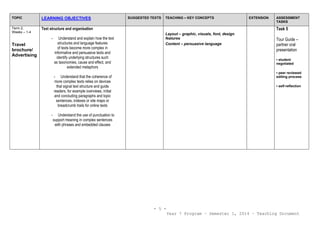
Text structure and organisation
- Understand and explain how the text
structures and language features
of texts become more complex in
informative and persuasive texts and
identify underlying structures such
as taxonomies, cause and effect, and
extended metaphors
- Understand that the coherence of
more complex texts relies on devices
that signal text structure and guide
readers, for example overviews, initial
and concluding paragraphs and topic
sentences, indexes or site maps or
breadcrumb trails for online texts
- Understand the use of punctuation to
support meaning in complex sentences
with phrases and embedded clauses
Layout – graphic, visuals, font, design
features
Content – persuasive language
Task 5
Tour Guide –
partner oral
presentation
• student
negotiated
• peer reviewed
editing process
• self-reflection
- 6 -
Year 7 Program – Semester 1, 2014 – Teaching Document
TOPIC FOCUS OF THREAD WITHIN SUB-
STRAND
SUGGESTED TEXTS TEACHING – KEY CONCEPTS EXTENSION ASSESSMENT
TASKS
Weeks 5-8
Journey - Film Study
Texts in context
- Analyse and explain the effect of technological
innovations on texts,particularly media texts
Interacting with others
- Identify and discuss main ideas, concepts and
points of view in spoken texts to evaluate
qualities, for example the strength of an
argument or the lyrical power of a poetic
rendition
- Use interaction skills when discussing and
presenting ideas and information, selecting body
language, voice qualities and other elements,
(for example music and sound) to add interest
and meaning
- Plan, rehearse and deliver presentations,
selecting and sequencing appropriate content
and multimodal elements to promote a point of
view or enable a new way of seeing
Spirited Away
Bend It Like Beckham
Galaxy Quest
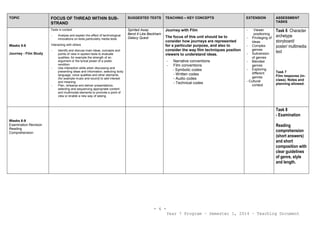
Journey with Film
The focus of this unit should be to
consider how journeys are represented
for a particular purpose, and also to
consider the way film techniques position
viewers to understand ideas.
- Narrative conventions
- Film conventions
- Symbolic codes
- Written codes
- Audio codes
- Technical codes
- Viewer
positioning
- Privileging of
ideas
- Complex
genres
- Subversion
of genres
- Blended
genres
- Exploring
different
genres
- Cultural
context
Task 6 Character
archetype
storyboard/
poster/ multimedia
text
Task 7
Film response (in-
class). Notes and
planning allowed.
Weeks 8-9
Examination Revision
Reading
Comprehension
. Task 8
- Examination
Reading
comprehension
(short answers)
and short
composition with
clear guidelines
of genre, style
and length.
- 7 -
Year 7 Program – Semester 1, 2014 – Teaching Document
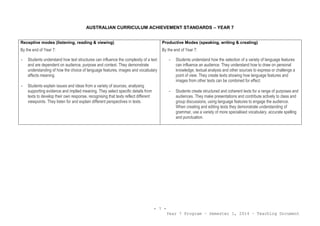
AUSTRALIAN CURRICULUM ACHIEVEMENT STANDARDS – YEAR 7
Receptive modes (listening, reading & viewing)
By the end of Year 7:
- Students understand how text structures can influence the complexity of a text
and are dependent on audience, purpose and context. They demonstrate
understanding of how the choice of language features, images and vocabulary
affects meaning.
- Students explain issues and ideas from a variety of sources, analysing
supporting evidence and implied meaning. They select specific details from
texts to develop their own response, recognising that texts reflect different
viewpoints. They listen for and explain different perspectives in texts.
Productive Modes (speaking, writing & creating)
By the end of Year 7:
- Students understand how the selection of a variety of language features
can influence an audience. They understand how to draw on personal
knowledge, textual analysis and other sources to express or challenge a
point of view. They create texts showing how language features and
images from other texts can be combined for effect.
- Students create structured and coherent texts for a range of purposes and
audiences. They make presentations and contribute actively to class and
group discussions, using language features to engage the audience.
When creating and editing texts they demonstrate understanding of
grammar, use a variety of more specialised vocabulary, accurate spelling
and punctuation.

Year 7 Sememster 1 Teaching Outline

  • 1.
    - 1 - Year7 Program – Semester 1, 2014 – Teaching Document Semester 1 Program: Year 7 English 2014 Journeys TOPIC LEARNING OBJECTIVES SUGGESTED TEXTS TEACHING – KEY CONCEPTS EXTENSION ASSESSMENT TASKS Term 1, Weeks 1- 4 Persuasion: Letters, blogs, news & diaries Writers’ Circle Creative processes Language Language variation and change - Understand the way language evolves to reflect a changing world, particularly in response to the use of new technology for presenting texts and communicating (ACELA1528) Language for interaction - Understand how accents, styles of speech and idioms express and create personal and social identities (ACELA1529) - Understand how language is used to evaluate texts and how evaluations about a text can be substantiated by reference to the text and other sources (ACELA1782) Text structure and organisation - Understand and explain how the text structures and language features of texts become more complex in informative and persuasive texts and identify underlying structures such as taxonomies, cause and effect, and extended metaphors (ACELA1531) - Understand that the coherence of more complex texts relies on devices that signal text structure and guide readers, for example overviews, initial and concluding paragraphs and topic sentences, indexes or site maps or breadcrumb trails for online texts (ACELA1763) - Understand the use of punctuation to support meaning in complex sentences with prepositional phrases and embedded clauses (ACELA1532) Expressing and developing ideas - Recognise and understand that subordinate clauses embedded within noun groups/phrases are a common feature of written sentence structures and increase the density of information(ACELA1534) Beach Bodies (spoken word) here Why the News Isn’t Really the News 2.22 min video here This is a Robot (Sydney Morning Herald) video Advert for Guardian newspaper here Dear Photograph blog here Epistolary excerpts eg Angus, Thongs & Full Frontal Snogging by Louise Rennison; The Boy Next Door by Meg Cabot; Letters found at a coffee shop here The Secret Diary of Adrian Mole The Princess Diaries by Meg Cabot News articles: https://newsela.co m/about/ Persuasion/ Writers’ Circles Students investigate the power of persuasive features and devices to shape meaning and influence others to understand and accept a particular point of view. Students develop an understanding of, and ability to use:  persuasive language features to shape meaning  persuasive devices to influence an audience  supporting evidence from texts to promote a point of view. Inquiry questions for the unit:  What language features and text structures do writers use in creating persuasive texts?  What is an extended metaphor?  What are rhetorical devices? What interaction skills contribute to an interesting and effective persuasive speech? The creative task should also be a close study of how events are told. Students should have the opportunity to experiment with language and structural features. The unit will end with an extended piece of creative writing that will demonstrate their understanding of this. The focus is on explicit teaching of:  the ways persuasive texts shape meaning and vary according to audience and purpose  comparing texts and interpreting and analysing a range of written, spoken and multimodal Experiment with more complex composition styles, esp. passive and active voice. Consider texts from diverse contextual backgrounds. Task 1 Analysis of texts with short answer questions (in- class) Task 2 Compose a persuasive text  student negotiated  peer reviewed editing process  self-reflection
  • 2.
    - 2 - Year7 Program – Semester 1, 2014 – Teaching Document TOPIC LEARNING OBJECTIVES SUGGESTED TEXTS TEACHING – KEY CONCEPTS EXTENSION ASSESSMENT TASKS - Understand how modality is achieved through discriminating choices in modal verbs, adverbs, adjectives and nouns (ACELA1536) - Analyse how point of view is generated in visual texts by means of choices, for example gaze, angle and social distance (ACELA1764) - Investigate vocabulary typical of extended and more academic texts and the role of abstract nouns, classification, description and generalisation in building specialised knowledge through language(ACELA1537) - Understand how to use spelling rules and word origins, for example Greek and Latin roots, base words, suffixes, prefixes, spelling patterns and generalisations to learn new words and how to spell them (ACELA1539) Literature Literature and context 1. Identify and explore ideas and viewpoints about events, issues and characters represented in texts drawn from different historical, social and cultural contexts (ACELT1619) Responding to literature 1. Reflect on ideas and opinions about characters, settings and events in literary texts, identifying areas of agreement and difference with others and justifying a point of view (ACELT1620) 2. Compare the ways that language and images are used to create character, and to influence emotions and opinions in different types of texts(ACELT1621) 3. Discuss aspects of texts, for example their aesthetic and social value, using relevant and appropriate metalanguage (ACELT1803) Examining literature 1. Recognise and analyse the ways that characterisation, events and settings are combined in narratives, and discuss the http://www.dogon ews.com/ http://tweentribun e.com/ http://kids.national geographic.com/ki ds/stories/ http://www.ourlittl eearth.com/ http://teachingkids news.com/ http://news.discov ery.com/ http://htekidsnews .com/ persuasive texts, figurative and rhetorical language and devices, using evidence from texts to support a persuasive speech. Literacy sub strand: Interpreting, analysing, evaluating - Analyse and explain the ways text structures and language features shape meaning and vary according to audience and purpose. - Use prior knowledge and text processing strategies to interpret a range of types of texts. - Use comprehension strategies to interpret, analyse and synthesise ideas and information, critiquing ideas and issues from a variety of textual sources. - Compare the text structures and language features of multimodal texts, explaining how they combine to influence audiences.
  • 3.
    - 3 - Year7 Program – Semester 1, 2014 – Teaching Document TOPIC LEARNING OBJECTIVES SUGGESTED TEXTS TEACHING – KEY CONCEPTS EXTENSION ASSESSMENT TASKS Weeks 5 – 8 Comics/ Graphic tales purposes and appeal of different approaches (ACELT1622) 2. Understand, interpret and discuss how language is compressed to produce a dramatic effect in film or drama, and to create layers of meaning in poetry, for example haiku, tankas, couplets, free verse and verse novels (ACELT1623) Creating literature 1. Create literary texts that adapt stylistic features encountered in other texts, for example, narrative viewpoint, structure of stanzas, contrast and juxtaposition (ACELT1625) 2. Experiment with text structures and language features and their effects in creating literary texts, for example, using rhythm, sound effects, monologue, layout, navigation and colour(ACELT1805) Literacy Texts in context - Analyse and explain the effect of technological innovations on texts, particularly media texts(ACELY1765) Interacting with others - Identify and discuss main ideas, concepts and points of view in spoken texts to evaluate qualities, for example the strength of an argument or the lyrical power of a poetic rendition (ACELY1719) - Use interaction skills when discussing and presenting ideas and information, selecting body language, voice qualities and other elements, (for example music and sound) to add interest and meaning (ACELY1804) - Plan, rehearse and deliver presentations, selecting and sequencing appropriate content and multimodal elements to promote a point of view or enable a new way of seeing (ACELY1720) Interpreting, analysing, evaluating - Analyse and explain the ways text structures and language features shape meaning and vary according For Teachers: Scott McLeod’s Understanding Comics (TED talks video) For Students: Buzz Feed – This Is Why We Love Comics Digital comic museum: http://digitalcomic museum.com/ Once Upon A Time The Superheroes (10 minutes) Comics/ graphic tales Forms – layout conventions. Where do they come from? What is their purpose? etc. Consideration of analysis techniques – scaffold how to identify devices, consider their use and explain the effect they might have on an audience Practise inferential reading and justification of text interpretations Revise paragraph structure Outline design strategies for Task 4. Reading through Context Comics as a record of national identity Comparison to other cultures Task 3 Comic investigation Task 4 Comic production/ folio Checklists to be provided for Cyber Café; modelling and review to refine processes. Notions of best work to be reinforced.
  • 4.
    - 4 - Year7 Program – Semester 1, 2014 – Teaching Document TOPIC LEARNING OBJECTIVES SUGGESTED TEXTS TEACHING – KEY CONCEPTS EXTENSION ASSESSMENT TASKS Weeks 10 – 11 Book Club to audience and purpose (ACELY1721) - Use prior knowledge and text processing strategies to interpret a range of types of texts(ACELY1722) - Use comprehension strategies to interpret, analyse and synthesise ideas and information, critiquing ideas and issues from a variety of textual sources (ACELY1723) - Compare the text structures and language features of multimodal texts, explaining how they combine to influence audiences (ACELY1724) Creating texts - Plan, draft and publish imaginative, informative and persuasive texts, selecting aspects of subject matter and particular language, visual, and audio features to convey information and ideas(ACELY1725) - Edit for meaning by removing repetition, refining ideas, reordering sentences and adding or substituting words for impact (ACELY1726) - Consolidate a personal handwriting style that is legible, fluent and automatic and supports writing for extended periods (ACELY1727) - Use a range of software, including word processing programs, to confidently create, edit and publish written and multimodal texts (ACELY1728) Ender’s Game Hero’s journey Introduce narrative form - Plot - Setting - Characterisation - Symbolism - Point of View Theme Comparison of other narratives – indigenous, Asian etc. Journal entries: Creative writing and sketches/ notes Preparation for Task 5
  • 5.
    - 5 - Year7 Program – Semester 1, 2014 – Teaching Document TOPIC LEARNING OBJECTIVES SUGGESTED TEXTS TEACHING – KEY CONCEPTS EXTENSION ASSESSMENT TASKS Term 2, Weeks – 1-4 Travel brochure/ Advertising Text structure and organisation - Understand and explain how the text structures and language features of texts become more complex in informative and persuasive texts and identify underlying structures such as taxonomies, cause and effect, and extended metaphors - Understand that the coherence of more complex texts relies on devices that signal text structure and guide readers, for example overviews, initial and concluding paragraphs and topic sentences, indexes or site maps or breadcrumb trails for online texts - Understand the use of punctuation to support meaning in complex sentences with phrases and embedded clauses Layout – graphic, visuals, font, design features Content – persuasive language Task 5 Tour Guide – partner oral presentation • student negotiated • peer reviewed editing process • self-reflection
  • 6.
    - 6 - Year7 Program – Semester 1, 2014 – Teaching Document TOPIC FOCUS OF THREAD WITHIN SUB- STRAND SUGGESTED TEXTS TEACHING – KEY CONCEPTS EXTENSION ASSESSMENT TASKS Weeks 5-8 Journey - Film Study Texts in context - Analyse and explain the effect of technological innovations on texts,particularly media texts Interacting with others - Identify and discuss main ideas, concepts and points of view in spoken texts to evaluate qualities, for example the strength of an argument or the lyrical power of a poetic rendition - Use interaction skills when discussing and presenting ideas and information, selecting body language, voice qualities and other elements, (for example music and sound) to add interest and meaning - Plan, rehearse and deliver presentations, selecting and sequencing appropriate content and multimodal elements to promote a point of view or enable a new way of seeing Spirited Away Bend It Like Beckham Galaxy Quest Journey with Film The focus of this unit should be to consider how journeys are represented for a particular purpose, and also to consider the way film techniques position viewers to understand ideas. - Narrative conventions - Film conventions - Symbolic codes - Written codes - Audio codes - Technical codes - Viewer positioning - Privileging of ideas - Complex genres - Subversion of genres - Blended genres - Exploring different genres - Cultural context Task 6 Character archetype storyboard/ poster/ multimedia text Task 7 Film response (in- class). Notes and planning allowed. Weeks 8-9 Examination Revision Reading Comprehension . Task 8 - Examination Reading comprehension (short answers) and short composition with clear guidelines of genre, style and length.
  • 7.
    - 7 - Year7 Program – Semester 1, 2014 – Teaching Document AUSTRALIAN CURRICULUM ACHIEVEMENT STANDARDS – YEAR 7 Receptive modes (listening, reading & viewing) By the end of Year 7: - Students understand how text structures can influence the complexity of a text and are dependent on audience, purpose and context. They demonstrate understanding of how the choice of language features, images and vocabulary affects meaning. - Students explain issues and ideas from a variety of sources, analysing supporting evidence and implied meaning. They select specific details from texts to develop their own response, recognising that texts reflect different viewpoints. They listen for and explain different perspectives in texts. Productive Modes (speaking, writing & creating) By the end of Year 7: - Students understand how the selection of a variety of language features can influence an audience. They understand how to draw on personal knowledge, textual analysis and other sources to express or challenge a point of view. They create texts showing how language features and images from other texts can be combined for effect. - Students create structured and coherent texts for a range of purposes and audiences. They make presentations and contribute actively to class and group discussions, using language features to engage the audience. When creating and editing texts they demonstrate understanding of grammar, use a variety of more specialised vocabulary, accurate spelling and punctuation.