The Right to Education Realizing the Potential of Digital Tools in Education Esther Wojcicki Chair, Creative Commons A2K4 Yale Law School February 12, 2010
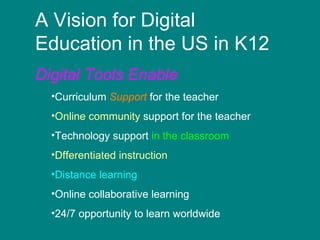
A Vision for Digital Education in the US in K12 Digital Tools Enable Curriculum  Support  for the teacher Online community  support for the teacher Technology support  in the classroom Dfferentiated instruction Distance learning Online collaborative learning 24/7 opportunity to learn worldwide
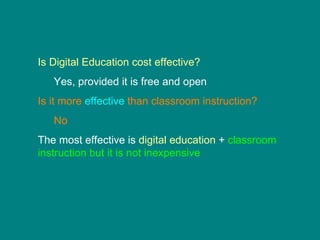
Is Digital Education cost effective? Yes, provided it is free and open Is it more  effective  than classroom instruction? No The most effective is  digital education  +  classroom instruction but it is not inexpensive
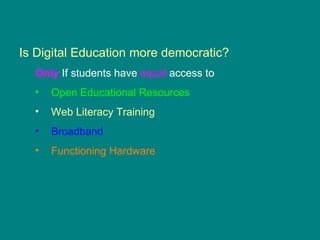
Is Digital Education more democratic? Only  If students have  equal  access to  Open Educational Resources Web Literacy Training Broadband  Functioning Hardware
Five Chief Barriers To Broadband Adoption Nationwide & Worldwide Affordability  Hardware Digital technology literacy levels Lack of awareness of relevance and utility of online content & OER Inability to use existing technology Linguistic barriers Accreditation
ADDITIONAL CHALLENGES OF  Open Education Resources (OER) OER is not a known name Materials hard to find (metadata problem) Uneven quality  Not tied to state or national standards
Copyright would be a major barrier to digital education if CREATIVE COMMONS licenses were not available. Copyright is not as big an issue as Legal barriers Technological barriers Linguistic barriers Cultural barriers
Additional road blocks to digital education in U.S. U.S.  telecommunications policy   Children’s Internet Protection Act  (CIPA) Children’s Online Privacy and Protection Act  (COPPA) Family Educational Rights and Privacy Act (FERPA)
Many schools  BLOCK  student access to the Internet
CENSORSHIP  “ All schools that accept  eRate money  (and I don’t know how many there are)  filter ,  because they are required to in the eRate regulations” Karen Cator, Director for Office of Educational Technology
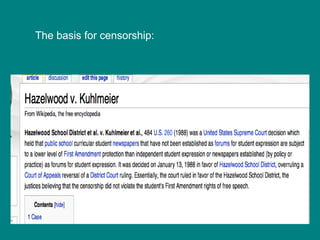
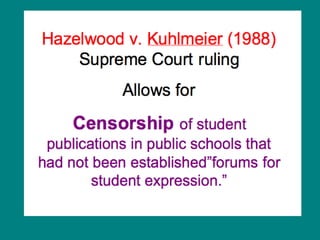
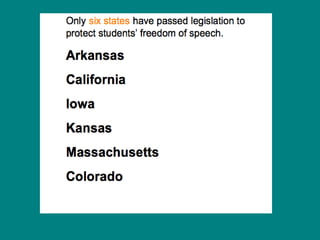
The basis for censorship:
 
 
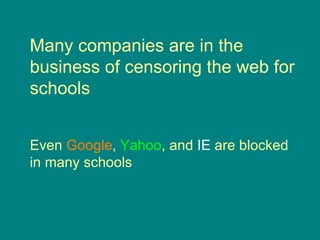
Many companies are in the business of censoring the web for schools Even  Google ,  Yahoo , and  IE  are blocked in many schools
ANOTHER MAJOR PROBLEM: CONFUSION ABOUT DEFINITION OF OPEN
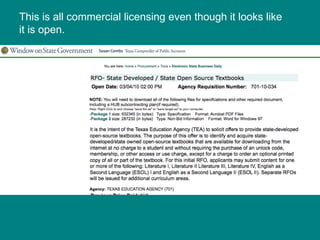
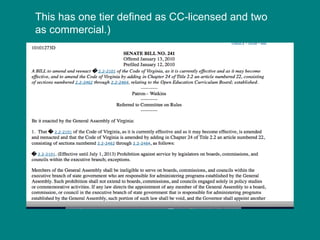
This is all commercial licensing even though it looks like it is open.
This has one tier defined as CC-licensed and two as commercial.)
PEOPLE CONFUSE   OPEN WITH  FREE
CREATIVE COMMONS  LICENSING HELPS BUT DOES NOT SOLVE ALL THE PROBLEMS
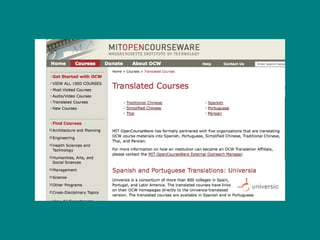
CC helps eliminate Linguistic barriers - by allowing translation
CC Licenses Improve Technical Access By  Allowing reformatting and repackaging,  OER can be made available to those with only  low bandwidth  or small screen access, even if OER was originally developed for high-bandwidth rich-UI users
CC helps Cultural barriers By allowing adaptation, OER can be repurposed and made culturally appropriate, even when originally developed for a specific cultural setting
CC is tackling legal interoperability issues  for OER
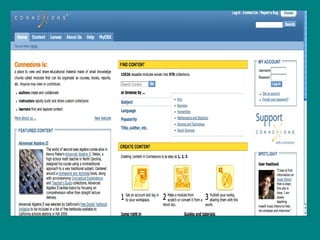
CC  is working on interoperable OER metadata   Essential  for discovery of resources .
A FEW EXAMPLES OF LICENSE USAGE


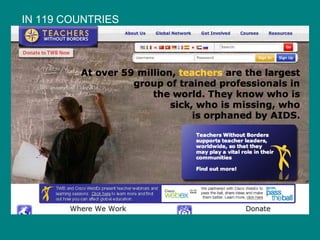
IN 119 COUNTRIES
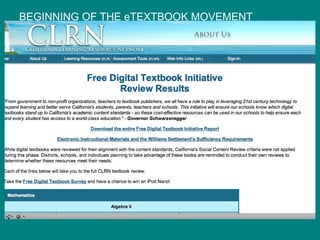
BEGINNING OF THE eTEXTBOOK MOVEMENT
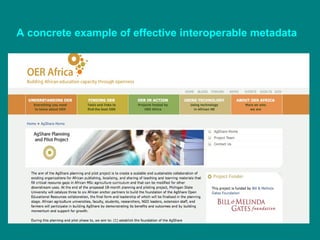
A concrete example of effective interoperable metadata
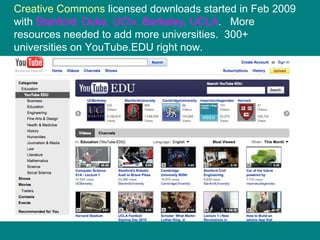
Creative Commons  licensed downloads started in Feb 2009 with  Stanford, Duke, UCtv, Berkeley, UCLA .  More resources needed to add more universities.  300+ universities on YouTube.EDU right now.
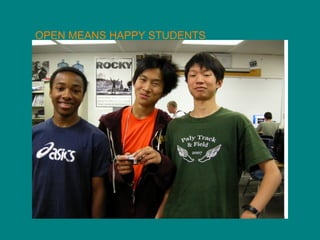
OPEN MEANS HAPPY STUDENTS
Your  IDEAS  welcome to help move  OER  and  CC  forward [email_address]

Yale A2 K4

  • 1.
    The Right toEducation Realizing the Potential of Digital Tools in Education Esther Wojcicki Chair, Creative Commons A2K4 Yale Law School February 12, 2010
  • 2.
    A Vision forDigital Education in the US in K12 Digital Tools Enable Curriculum Support for the teacher Online community support for the teacher Technology support in the classroom Dfferentiated instruction Distance learning Online collaborative learning 24/7 opportunity to learn worldwide
  • 3.
    Is Digital Educationcost effective? Yes, provided it is free and open Is it more effective than classroom instruction? No The most effective is digital education + classroom instruction but it is not inexpensive
  • 4.
    Is Digital Educationmore democratic? Only If students have equal access to Open Educational Resources Web Literacy Training Broadband Functioning Hardware
  • 5.
    Five Chief BarriersTo Broadband Adoption Nationwide & Worldwide Affordability Hardware Digital technology literacy levels Lack of awareness of relevance and utility of online content & OER Inability to use existing technology Linguistic barriers Accreditation
  • 6.
    ADDITIONAL CHALLENGES OF Open Education Resources (OER) OER is not a known name Materials hard to find (metadata problem) Uneven quality Not tied to state or national standards
  • 7.
    Copyright would bea major barrier to digital education if CREATIVE COMMONS licenses were not available. Copyright is not as big an issue as Legal barriers Technological barriers Linguistic barriers Cultural barriers
  • 8.
    Additional road blocksto digital education in U.S. U.S. telecommunications policy Children’s Internet Protection Act (CIPA) Children’s Online Privacy and Protection Act (COPPA) Family Educational Rights and Privacy Act (FERPA)
  • 9.
    Many schools BLOCK student access to the Internet
  • 10.
    CENSORSHIP “All schools that accept eRate money (and I don’t know how many there are) filter , because they are required to in the eRate regulations” Karen Cator, Director for Office of Educational Technology
  • 11.
    The basis forcensorship:
  • 12.
  • 13.
  • 14.
    Many companies arein the business of censoring the web for schools Even Google , Yahoo , and IE are blocked in many schools
  • 15.
    ANOTHER MAJOR PROBLEM:CONFUSION ABOUT DEFINITION OF OPEN
  • 16.
    This is allcommercial licensing even though it looks like it is open.
  • 17.
    This has onetier defined as CC-licensed and two as commercial.)
  • 18.
    PEOPLE CONFUSE OPEN WITH FREE
  • 19.
    CREATIVE COMMONS LICENSING HELPS BUT DOES NOT SOLVE ALL THE PROBLEMS
  • 20.
    CC helps eliminateLinguistic barriers - by allowing translation
  • 21.
    CC Licenses ImproveTechnical Access By Allowing reformatting and repackaging, OER can be made available to those with only low bandwidth or small screen access, even if OER was originally developed for high-bandwidth rich-UI users
  • 22.
    CC helps Culturalbarriers By allowing adaptation, OER can be repurposed and made culturally appropriate, even when originally developed for a specific cultural setting
  • 23.
    CC is tacklinglegal interoperability issues for OER
  • 24.
    CC isworking on interoperable OER metadata Essential for discovery of resources .
  • 25.
    A FEW EXAMPLESOF LICENSE USAGE
  • 26.
  • 27.
  • 28.
  • 29.
  • 30.
    BEGINNING OF THEeTEXTBOOK MOVEMENT
  • 31.
    A concrete exampleof effective interoperable metadata
  • 32.
    Creative Commons licensed downloads started in Feb 2009 with Stanford, Duke, UCtv, Berkeley, UCLA . More resources needed to add more universities. 300+ universities on YouTube.EDU right now.
  • 33.
  • 34.
    Your IDEAS welcome to help move OER and CC forward [email_address]