Solutions to Digital InequalityBy David Weddle
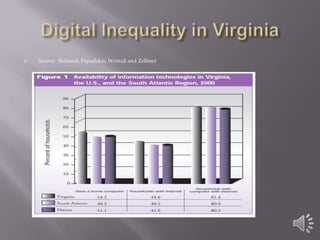
Digital Inequality in VirginiaSource:  Bohland, Papadakis, Worrall and Zellmer
From Digital Divide to Digital InequalityDigital Divide = The divide between those with access to new technologies and those without itDefined by the US Department of Commerce’s National Telecommunications and Information Administration (NTIA)DiMaggio and Hargittai proposed the concept of digital inequality Inequality among the internet users in the extent to which they are able to reap benefits from their use of technology.New definition goes beyond differences in access
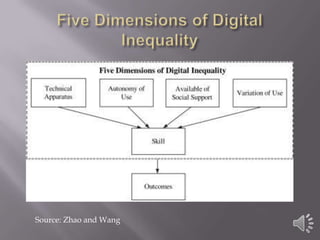
Five Dimensions of Digital InequalitySource: Zhao and Wang
Dimensions of Digital InequalityTechnical Apparatus --  Does the student have a computer?Autonomy of Use– How do students access the internet at different locations (School, library, etc.)Availability of Social Support– Attitude toward internet use of superiors or teachersVariation of Use– The main activities for leisure or study goals when using the internetSkill– Capabilities of the student in using the internetPhoto Source: http://healthpsych.psy.vanderbilt.edu
Why is Digital Inequality Important?Internet access expands access to education, jobs and better healthProvides a place for political discussion and provides citizens with direct access to governmentEducational attainment is strongly associate d with rates of internet useIn 2001, 65% of employed people 16 years of age or older were internet users, compared to 37% of those who were not working (DiMaggio and Hargittai)Krueger reported that workers who use computers on the job earned 10 to 15 % more than their otherwise similar peers (DiMaggio and Hargittai)Freeman reports that use of the internet is associated with higher wages (DiMaggio and Hargittai)Photo Source: http://baloo-baloosnon-policalcartoonblog.blogspot.com
$50 Million to Address Digital Inequalities Photo Source: www.learnhowtomakemoneyfas.net
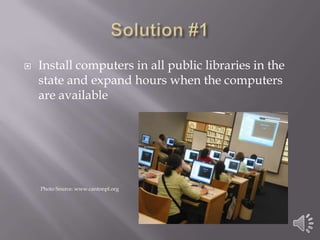
Solution #1Install computers in all public libraries in the state and expand hours when the computers are availablePhoto Source: www.cantonpl.org
Solution #2Expand staffing and other resources so that public schools can be open to the public after normal school hours, on weekends, and during the summer monthsPhoto Source: www.woodsideonthemove.org
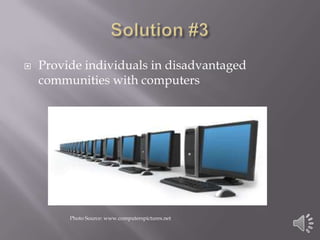
Solution #3Provide individuals in disadvantaged communities with computersPhoto Source: www.computerspictures.net
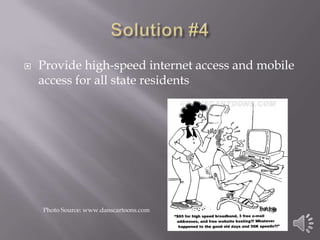
Solution #4Provide high-speed internet access and mobile access for all state residentsPhoto Source: www.danscartoons.com
Solution #5Subsidize  internet service providers to provide low-cost internet to all state residents
Solution #6Provide information literacy courses to enhance computer skills and enable knowledgeable use of digital technologies
Solution #7Develop free online educational content, giving first priority to content most relevant to lower socio-economic groups before content that is relevant to the rest of the public
Best OPTIONS…Photo Source: www.natreview.com
Solution #1Public internet access plays an important role in narrowing the digital gap (Hong & Huang)An important institution for facilitating information access and bridging the digital divide (Bertot)People with low-income levels are more likely to use the internet in libraries (DiMaggio)
Solution #2Properly trained staff can help with computer literacyChildren are comfortable within the school environmentLead children toward using the computer for educational purposes Other benefits such as keeping children involved and out of trouble
Solution #6Provide students with tools necessary to use the computer efficientlyTeachers and trained staff members help to reinforce children’s learning
Not So Fast My Friend…Photo Source: www.natreview.com
Solution #3, #4 and #5Simply having a computer doesn’t mean children know how to use itWhat is the computer being used for?  Malamud and Cristian Pop-Eleches found that children who won vouchers for personal computers had lower grades in mathClotfelter, Ladd and Vigdor found that providing universal access to home computers and high-speed internet access would broaden math and achievement gaps
Solution #7Access is still a problem!
Additional Solutions	Install computers and trained staff promoting computer literacy in community centers and public housingRequire technology centers in developments that receive public financing Use a combination of solutions 1 and 2 to introduce technology and provide the necessary staffing to reinforce learning
THE ENDPhoto Source: www.samplepresentation.wordpress.com
ReferencesBertot, J.C., McClure; C.R. Jaeger, P.T. and Ryan, J. Public libraries and the internet 2006, Study results and findings, retrieved September 27 at www.ii.fsu.edu/projectFiles/plinternet/2006/2006plinternet.pdfBohland, James; Papadakis, Maria; Worrall, Richard and Zellmer, David.  The digital dominion’s digital divide.  Spring 2001Clotfelter, Charles T.; Ladd, Helen F. and Vigdor,Jacob L.  Scaling the digital divide: Home computer technology and student achievementDiMaggio, Paul; Hargittai, Eszter; Celeste, Coral and Shafer, Steven.  From unequal access to differentiated use:  A literature review and agenda for research in digital inequalityMalamud, Ofer and Pop-Eleches, Cristian.  Home computer use and the development of capital.  January 2010.Zhao, Ling; Lu, Yaobin; Huang, Wayne and Wang, Qiuhong.  Internet inequality: The relationship between high school students’ internet use in different locations and their internet self-efficacy.  Computers and Education, Volume 55, Issue, December 2010, Pages 1405-1423.

Solutions to digital inequality david weddle

  • 1.
    Solutions to DigitalInequalityBy David Weddle
  • 2.
    Digital Inequality inVirginiaSource: Bohland, Papadakis, Worrall and Zellmer
  • 3.
    From Digital Divideto Digital InequalityDigital Divide = The divide between those with access to new technologies and those without itDefined by the US Department of Commerce’s National Telecommunications and Information Administration (NTIA)DiMaggio and Hargittai proposed the concept of digital inequality Inequality among the internet users in the extent to which they are able to reap benefits from their use of technology.New definition goes beyond differences in access
  • 4.
    Five Dimensions ofDigital InequalitySource: Zhao and Wang
  • 5.
    Dimensions of DigitalInequalityTechnical Apparatus -- Does the student have a computer?Autonomy of Use– How do students access the internet at different locations (School, library, etc.)Availability of Social Support– Attitude toward internet use of superiors or teachersVariation of Use– The main activities for leisure or study goals when using the internetSkill– Capabilities of the student in using the internetPhoto Source: http://healthpsych.psy.vanderbilt.edu
  • 6.
    Why is DigitalInequality Important?Internet access expands access to education, jobs and better healthProvides a place for political discussion and provides citizens with direct access to governmentEducational attainment is strongly associate d with rates of internet useIn 2001, 65% of employed people 16 years of age or older were internet users, compared to 37% of those who were not working (DiMaggio and Hargittai)Krueger reported that workers who use computers on the job earned 10 to 15 % more than their otherwise similar peers (DiMaggio and Hargittai)Freeman reports that use of the internet is associated with higher wages (DiMaggio and Hargittai)Photo Source: http://baloo-baloosnon-policalcartoonblog.blogspot.com
  • 7.
    $50 Million toAddress Digital Inequalities Photo Source: www.learnhowtomakemoneyfas.net
  • 8.
    Solution #1Install computersin all public libraries in the state and expand hours when the computers are availablePhoto Source: www.cantonpl.org
  • 9.
    Solution #2Expand staffingand other resources so that public schools can be open to the public after normal school hours, on weekends, and during the summer monthsPhoto Source: www.woodsideonthemove.org
  • 10.
    Solution #3Provide individualsin disadvantaged communities with computersPhoto Source: www.computerspictures.net
  • 11.
    Solution #4Provide high-speedinternet access and mobile access for all state residentsPhoto Source: www.danscartoons.com
  • 12.
    Solution #5Subsidize internet service providers to provide low-cost internet to all state residents
  • 13.
    Solution #6Provide informationliteracy courses to enhance computer skills and enable knowledgeable use of digital technologies
  • 14.
    Solution #7Develop freeonline educational content, giving first priority to content most relevant to lower socio-economic groups before content that is relevant to the rest of the public
  • 15.
  • 16.
    Solution #1Public internetaccess plays an important role in narrowing the digital gap (Hong & Huang)An important institution for facilitating information access and bridging the digital divide (Bertot)People with low-income levels are more likely to use the internet in libraries (DiMaggio)
  • 17.
    Solution #2Properly trainedstaff can help with computer literacyChildren are comfortable within the school environmentLead children toward using the computer for educational purposes Other benefits such as keeping children involved and out of trouble
  • 18.
    Solution #6Provide studentswith tools necessary to use the computer efficientlyTeachers and trained staff members help to reinforce children’s learning
  • 19.
    Not So FastMy Friend…Photo Source: www.natreview.com
  • 20.
    Solution #3, #4and #5Simply having a computer doesn’t mean children know how to use itWhat is the computer being used for? Malamud and Cristian Pop-Eleches found that children who won vouchers for personal computers had lower grades in mathClotfelter, Ladd and Vigdor found that providing universal access to home computers and high-speed internet access would broaden math and achievement gaps
  • 21.
    Solution #7Access isstill a problem!
  • 22.
    Additional Solutions Install computersand trained staff promoting computer literacy in community centers and public housingRequire technology centers in developments that receive public financing Use a combination of solutions 1 and 2 to introduce technology and provide the necessary staffing to reinforce learning
  • 23.
    THE ENDPhoto Source:www.samplepresentation.wordpress.com
  • 24.
    ReferencesBertot, J.C., McClure;C.R. Jaeger, P.T. and Ryan, J. Public libraries and the internet 2006, Study results and findings, retrieved September 27 at www.ii.fsu.edu/projectFiles/plinternet/2006/2006plinternet.pdfBohland, James; Papadakis, Maria; Worrall, Richard and Zellmer, David. The digital dominion’s digital divide. Spring 2001Clotfelter, Charles T.; Ladd, Helen F. and Vigdor,Jacob L. Scaling the digital divide: Home computer technology and student achievementDiMaggio, Paul; Hargittai, Eszter; Celeste, Coral and Shafer, Steven. From unequal access to differentiated use: A literature review and agenda for research in digital inequalityMalamud, Ofer and Pop-Eleches, Cristian. Home computer use and the development of capital. January 2010.Zhao, Ling; Lu, Yaobin; Huang, Wayne and Wang, Qiuhong. Internet inequality: The relationship between high school students’ internet use in different locations and their internet self-efficacy. Computers and Education, Volume 55, Issue, December 2010, Pages 1405-1423.