1420 Taughannock Blvd. Ithaca NY 14850
(607) 273-6260 | www.priweb.org/naturecenter
Restoring Balance to the Forest Ecosystem
Vanessa Wikel
A.S. Environmental Studies, 14’ Tompkins Cortland Community College
B.S. Environmental Science & Sustainability (in progress, 16’) Cornell University
Cayuga Nature Center is a non-profit public venue of the Paleontological Research Institution
(PRI) and a proud member of Ithaca’s Discovery Trail. Our nature center is a place for the
community to come and enjoy 100 acres of land overlooking Cayuga Lake. In bringing the
community together it is our goal to promote awareness of the natural world through
education, increasing appreciation and a sense of responsibility for the natural world.
Cayuga Nature Center Offers:
• Admission to the nature center lodge varies seasonally with March 21st-December 19th being
open daily from 9am-5pm (regular hours) & December 21st-March 20th Thursday-Sunday
10am-4pm with Monday-Wednesday CLOSED (winter hours). (see lobby for pricing)
• Climb the TreeTops in a six-story observational house and enjoy the sites of Denison Falls
• Visit the exhibits around the center which showcase life in the Cayuga Basin, past and
present, as well as discover the background on Our Changing Climate.
• As you explore the grounds you’ll become familiar with the many indoor and outdoor
animal residents we have, as well as the Butterfly Garden (summer only).
• Lastly, enjoy a nice hike spanning miles of trails along gorges and streams cozied within a
diverse biotic community.
We are stewards of the Earth and as Aldo Leopold has wisely said:
“The last word in ignorance is the man who says of an animal or plant: "What good is it?" If
the land mechanism as a whole is good, then every part is good, whether we understand it
or not. If the biota, in the course of aeons, has built something we like but do not
understand, then who but a fool would discard seemingly useless parts? To keep every cog
and wheel is the first precaution of intelligent tinkering.”
~~Aldo Leopold, A Sand County Almanac, and Sketches Here and There, 1948 (University of Montana Aldo
Leopold Wilderness Research Institute, 2015)
1
Silviculture is very simply the practice of
controlling the establishment, growth, health and
community structure of a forested ecosystem. This
practice is conducted in forestry and often used to
manage invasive plants as it is a more sustainable
practice relying on manual tending to the forest
community. Some recommendations for managing
invasive plants often involve toxic chemicals or
controlled burning. Here at the Cayuga Nature
Center these are not options because we want to
preserve the integrity of this forest in a way that is
beneficial in the short and long term.
Silviculture beings with a site assessment, which
we have already done for you to identify the most
problematic areas. Canopy density, (how light
shines through the canopy, soil type and texture,
climate), and the overall biota of the forested
community will all effect the intensity and
frequency at which invasive flora can dominate
native flora.
Non-native flora are problematic because they
have few, if any, natural competitors. Over time if
invasive plants are not managed a vegetation
shift—(e.g. a shift in the floral community over a
period of time) can occur. This can increase the
spread of various plant diseases as well as
introduce new pests. This can be prevented by
simply manually tending to the forest so the native
flora can gradually re-established.
The next few pages will show you how to ID these
plants, how to remove them, and most importantly
will offer general safety tips which come from
those who have personal experience managing
these plants.
Thank you for coming on board! Any help is greatly
appreciated in restoring balance to this gorgeous
forested ecosystem!
Figure 1. Multiflora rose growth pattern
Figure 2. Wild grapevine growth pattern
Figure 3. Swallow-wort growth pattern
2
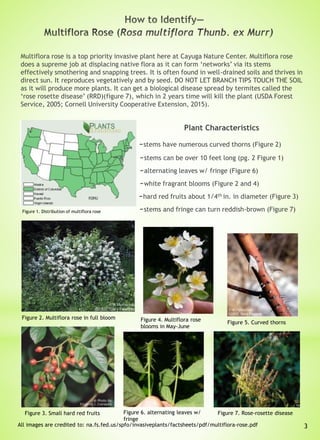
Multiflora rose is a top priority invasive plant here at Cayuga Nature Center. Multiflora rose
does a supreme job at displacing native flora as it can form ‘networks’ via its stems
effectively smothering and snapping trees. It is often found in well-drained soils and thrives in
direct sun. It reproduces vegetatively and by seed. DO NOT LET BRANCH TIPS TOUCH THE SOIL
as it will produce more plants. It can get a biological disease spread by termites called the
‘rose rosette disease’ (RRD)(figure 7), which in 2 years time will kill the plant (USDA Forest
Service, 2005; Cornell University Cooperative Extension, 2015).
Plant Characteristics
~stems have numerous curved thorns (Figure 2)
~stems can be over 10 feet long (pg. 2 Figure 1)
~alternating leaves w/ fringe (Figure 6)
~white fragrant blooms (Figure 2 and 4)
~hard red fruits about 1/4th in. in diameter (Figure 3)
~stems and fringe can turn reddish-brown (Figure 7)Figure 1. Distribution of multiflora rose
Figure 4. Multiflora rose
blooms in May-June
Figure 2. Multiflora rose in full bloom
Figure 5. Curved thorns
Figure 3. Small hard red fruits Figure 6. alternating leaves w/
fringe
Figure 7. Rose-rosette disease
3All images are credited to: na.fs.fed.us/spfo/invasiveplants/factsheets/pdf/multiflora-rose.pdf
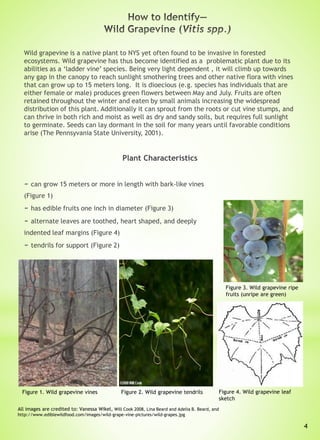
Wild grapevine is a native plant to NYS yet often found to be invasive in forested
ecosystems. Wild grapevine has thus become identified as a problematic plant due to its
abilities as a ‘ladder vine’ species. Being very light dependent , it will climb up towards
any gap in the canopy to reach sunlight smothering trees and other native flora with vines
that can grow up to 15 meters long. It is dioecious (e.g. species has individuals that are
either female or male) produces green flowers between May and July. Fruits are often
retained throughout the winter and eaten by small animals increasing the widespread
distribution of this plant. Additionally it can sprout from the roots or cut vine stumps, and
can thrive in both rich and moist as well as dry and sandy soils, but requires full sunlight
to germinate. Seeds can lay dormant in the soil for many years until favorable conditions
arise (The Pennsyvania State University, 2001).
Plant Characteristics
~ can grow 15 meters or more in length with bark-like vines
(Figure 1)
~ has edible fruits one inch in diameter (Figure 3)
~ alternate leaves are toothed, heart shaped, and deeply
indented leaf margins (Figure 4)
~ tendrils for support (Figure 2)
4
All images are credited to: Vanessa Wikel, Will Cook 2008, Lina Beard and Adelia B. Beard, and
http://www.ediblewildfood.com/images/wild-grape-vine-pictures/wild-grapes.jpg
Figure 1. Wild grapevine vines Figure 2. Wild grapevine tendrils
Figure 3. Wild grapevine ripe
fruits (unripe are green)
Figure 4. Wild grapevine leaf
sketch
Swallow-wort is rather prolific and tends to grow anywhere a gap in the canopy has
formed. It has been seen covering multiflora rose in direct competition. Depending upon
the growth stage of both plants, they may in fact co-habitat (e.g. “share” resources) until
one outgrows the other. This will likely be the swallow-wort as it grows fast and spreads
easily by seed due to its feathery filaments (Figure 2), which can easily ride the wind and
spread via wildlife. These seeds can also stay viable for 3-5 years in soils with an increase
in stem number (Figure 3) supported by the intricate, yet shallow, weblike rooting
system. Swallow-wort produces 5-petaled flowers, stems with downy hairs, filamented
seed pods, and opposite oriented leaves. Pale swallow-wort is the most abundant at the
Cayuga Nature Center and the most problematic as it can crowd out native flora
impacting the ecosystem as whole due to the haemolytic glycosides this plant produces
which are toxic to animals. Furthermore it encourages the growth of a soil fungi that
deters the growth of all other plants but the swallow-wort.
For small populations, hand-digging the roots is possible. For larger populations, mowing
and spraying herbicides are ideal to manage the seed pods before they open and release
the seeds to the wind. Burning and composting are not advisable due to the toxic
chemicals it produces. (Ramanujan, Krishna, 2014).
Plant Characteristics
~ 1-2m in height (Figure 3)
~ Opposite leaves that are shiny and
Narrowly oval or heart-shaped w/
Sharp tips (Figure 2 and 3)
~ Filamented seed pod (Figure 2)
~ 5-petaled flowers either dark
Purple (black) or pink (pale) (Figure 1)
5
Figure 3. Swallow-wort growth formation
Figure 1. black (left) and pale (right) swallow-wort flowers
Figure 2. seed pod with seeds and filaments for wind born
transportation
All images are credited to: Larissa Smith; http://news.cornell.edu/stories/2014/04/invasive-vines-swallow-new-yorks-
natural-areas
Garlic mustard is a biennial plant fully maturing in the second year when the short rosette
(Figure 3) forms into a tall stalk with flowers and later dies in June (Figure 4). It is commonly
found in disturbed woodlots and forest edges with the competitive capacity to invade forest
understories making this a hardy invasive plant. On average garlic mustard produces 22 four-side
seed pods with as many as 28 seeds per pod all of which can easily disperse via wind, humans or
wild life (Figure 1). In the first year identifying this plant is difficult so taking note of a garlic
odor is key should the plant be crushed. The basal leaves are dark-green, round toothed and
kidney shaped when immature in the first year later developing into alternating stem leaves with
more triangular in shape 1 to 5 cm long. This is the stage when the plant’s odor is less noticeable
and the plant forms a long stalk with flowers, four small white petals per bloom arranged in a
symmetric pattern. After seeding the plant will become bare and tendril like(Figure 3) (Cornell
University Cooperative Extension, 2015).
Plant Characteristics
~ Garlic odor when immature if crushed ~ 4-petaled white flowers (Figure 1)
~ Flower pods with four sides housing approx. 28 seeds per all in a cluster (Figure 1)
~ A kidney shaped rosette in the 1st year (Figure 3) with a stalk developing in the 2nd year (Figure
4) ~ leaves are scalloped (Figure 5)
6
All images are credited to: Paul Rischmiller, Wendy Hollender, Thomas J. Elpel and
https://rivertoncommunity.files.wordpress.com/2014/03/garlic-mustard-sketch.jpg
Figure 3. 1st year kidney shaped
leaves in a rosette
Figure 4. 2nd year plant with multiple
4ft high stems
Figure 5. Garlic mustard leaves
Figure 2. End of its life cycle
Figure 1. Mustard physiology
While this plant is native , it is a very fast-growing perennial woody vine that can do
severe damage if not tended to. Thriving in partial shade to full sun and preferring acidic
soil while also tolerating a wide range of soils and pH, including salty soils, this plant is
very wide spread throughout the southern, midwestern and eastern half of the United
States. Virginia Creeper is often confused with eastern poison ivy which has three
compound leaves with three leaflets, whereas Virginia creeper has five compound
serrated leaves with five leaflets growing 2-6 inches long (Figure 1 and 2). The leaflets
are red when they first emerge and then turn green as they mature only to turn back to
bright red to maroon in the fall (Figure 1 and 2). The flowers are rather tiny and
inconspicuous forming small clusters during the spring, followed by fruit 4-6 mm diameter
with two to three seeds per. This plant is most easily identified for its leaf structure and
viney growth form. The Virginia creeper flowers from June to August, matures from
August to October, and drops its fruits from September to February. Seed dispersal is
primarily by animals and germination takes place within the first or second spring after
dispersal. This plant has often been used as an ornamental which would explain why it is
so common. A typical Virginia creeper can climb to a height of over 60 ft if not manually
tended, all the while out competing other flora (USDA -NRCS, 2015).
Plant Characteristics
~ The most notable physical characteristic are the coloration and arrangement of the five
compound leaves with five leaflets (Figure 1 and 2)
7
All images are credited to: Robert H. Mohlenbrock @ USDA NRCS PLANTS
http://plants.usda.gov/plantguide/pdf/pg_paqu2.pdf and Hirts: Vines and Coverground
http://ecx.images-amazon.com/images/I/517c6kFMr%2BL._SX450_.jpg
Figure 1. Compound serrated eaves with 5 leaflets Figure 2. Leaves in the fall turn bright red-maroon
Dame’s Rocket grows best in partial sun with moist to
semi-dry conditions and fertile loamy soil more on the
alkaline side. Commonly found in forests, moist meadows,
and in semi-open moderately disturbed areas. Not an
overly problematic plant at CNC, but if flowering take care
to remove it completely as any residues left upon the soil
can produce ripened seed pods. Dame’s Rocket is spread
via seed and produces mature seeds which ripen over the
summer. Seed pods are 2-5 inches long and slightly hairy.
Dame’s Rocket produces its basal rosette in its 1st year
(Figure 2) and flowering stems in the 2nd and later years
(USDA Forest Service, 2005).
Plant Characteristics
~ 4-petaled flower; characteristic of the mustard family
with showy clusters of purple to white flowers (Figure 4
and 6)
~ Lance like alternating leaves—smaller up the stem;
covered in fine hairs with wide spaced ‘teeth’ up to
6 inches long (Figure 5)
~ Seeds with pods (Figure 7)
Note: Not to be confused with
5-petaled Phlox. They look very
similar but note the number of
petals per flower.
8
Figure 1. Distribution of Dame’s Rocket
Figure 2. Rosette in fall—1st year
Figure 3. Rosette in in spring with last
year's dead flower stems
All images are credited to: C.D. Bebeau and
http://na.fs.fed.us/spfo/invasiveplants/factsheets/pdf/dames-rocket.pdf
Figure 4. White-lavender 4 petal flowers
(can also be a vibrant purple (Figure 5)
Figure 6. Mature Dame’s Rocket
Figure 5. sharply toothed leaves
Figure 7. Seed pod and seeds
Wild parsnip produces furanocoumarin in its sap which if touched will cause photosensitive
chemical burns on the skin remaining sensitive to the sun for up to 8 hrs. after exposure(Figure
1). It typically grows up to 4-5ft. tall and survives in a wide range of habitats from dry soils to
wet meadows, however it does best in alkaline calcium rich moist soils. It is ideally found in
disturbed soils where native vegetation hasn’t become established. This plant undergoes a two
year process in which the 1st year (Figure 4) it forms rosettes and grows vegetatively, where in
the 2nd year (Figure 6) it will form an aerial shoot and flower. Seedlings emerge from Feb-April
and mature in July remaining viable for up to 4 years in the soil despite having a high mortality
rate. After seeding the plant will die. Note: there is a look alike Golden Alexander (Zizia aurea)
but it differs in appearance in that the leaves of the Golden Alexander are smooth and fine finely
serrated, and the clusters are very loose (Cornell University Cooperative Extension, 2015).
Plant Characteristics
~ yellow flowers in a loose umbel (Figure 7) ~ hallow stem; except at nodes (Figure 2)
~ round to oval flat seeds ribbed with narrow wings about 1 ½-3 inches long (Figure 3)
~ lower leaves have stems, upper do not; leaves are broad compound up to six inches
long and grow in pairs (Figure 5)
9
Figure 1. Photo sensitive rash from
Wild Parsnip
All images are credited to: http://nyis.info/index.php?action=invasive_detail&id=61
Figure 4. Wild Parsnip in 1st year of growth
Figure 6. Wild Parsnip in 2nd year of
growth
Figure 2. Wild Parsnip stem
Figure 5. Wild Parsnip leaves
Figure 3. Wild Parsnip seeds
Figure 7. Wild Parsnip umbel
WARNING: Do
not handle!!!
Poison ivy is easily confused with Poison oak, however they have several characteristics
and are both equally as irritating to have come into contact with. They are trailing vines
with aerial rootlets and 3-parted leaves, asymmetric leaves which can over time
development into a ‘ladder vine’ (Figure 6), ground cover, or shrub plant depending upon
competition in the local habitat (Figure 7). Both plants cause irritation with urushiol oil,
however poison oak has more rounded leaves and points with a less smooth leaf surface
that tends to be “lumpy” between the veins. Plants grow in young woodlands with less
dense canopy, thickets, edges of paths, sand dunes, walls (such as climbing urban
environments) and roadways. EVEN AFTER DEAD the poison remains active for hours to
days and reaction can be delayed! In general do not use any power tools to manually
remove, as the urushiol oil can enter the lungs if made air born, this includes not burning
the plant. If fully removing put in a heavy duty plastic garbage bag to be thrown out with
regular trash. (NYS Depart of Transportation, 2015; NYC Department of Health, n.d.).
Note: all pictures show poison ivy with its distinct leaf forms. Be aware poison oak is not
common at the Cayuga Nature Center.
Plant Characteristics
~3-part asymmetrical leaves (Figure 1) ~smooth leaf surface for poison ivy, “lumpy” for
poison oak ~has varying leaf forms (Figure 5 and 7) ~has green and white berries (Figure
7) ~in fall note the coloration and leaf pattern since leaves fall off (Figure 4)
10
Figure 1. Poison ivy in
spring
Figure 2. Poison ivy in summer
Figure 6. Poison ivy vine
after winter is still potent
Figure 3. Poison ivy in Fall
Figure 7. Poison ivy various
leaf forms
Figure 5. Poison ivy notched
leaves
All images are credited to: https://www.dot.ny.gov/dangerous-plants/poison-ivy
and http://www.nyc.gov/html/doh/downloads/pdf/eode/poison-ivy-fact-sheet.pdf
Figure 4. Poison ivy in Fall
1. Get caretaker/groundskeeper’s number! If you spot a downed tree, or have another
such emergency call him immediately. Less immediate concerns you can email.
2. Always have enough water and food when out on the trails. If you do not feel well
(you know your body best), please take a rest (as becoming over heated is rather easy
when physically active).
3. Always wear long sleeves, pants, gloves and preferably tall boots you can tuck your
pants into. Dealing with multiflora rose can result in pretty nasty scratches if not
carefully removed, and ticks are more frequently found in knee high or taller grasses.
4. That being said, please bring sunblock and BUG SPRAY that protects against ticks, and
mosquitoes, but a bug spray that ‘does it all’ would be preferred. I recommend
spraying your clothes and all entry points to create a “ring of fire” effect. I haven’t
found a tick on me doing it that way. CHECK FOR TICKS DAILY!
5. Know how to ID wild parsnip and poison ivy! Wild parsnip is not commonly found in
the forest and is up in the fields and out front in the gardens mostly but is spreading
so please be careful. Poison ivy vines also aren’t very prolific, but is found throughout
the ground layer of the canopy in plenty.
6. As a rule of thumb: the green bypass pruners are for live plants only and the red
anvil pruners are for dead plants only. Also carry a mini handsaw on you if dealing
with wild grapevine and ask for proper instruction if you are at all unsure how to use
these tools. Other tools are available upon request. Ask the caretaker for them and
how to use them if instruction is needed.
7. Be very mindful of the uneven ground on the trails and the bridges (as they may be
slippery).
8. If you have back problems like I do please work carefully, stretch often, and if
needed, ask for another project to work on to give yourself a rest. There is always
something to do around here! 
11
Figure 1. Piled swallow-wort for removal
Note:
1. The most problematic patches of invasive plants have already been located for you.
Please use the trail maps and note the legend which is there to help you decide what
‘mini-project’ you want to tackle. Additional land marks will be notated and
numbered on the maps to aid in navigation.
2. In general dealing with the white, purple, and orange trails are more simple as the
trail blazes are very apparent and the plants are more easy to spot. If you manage to
work at all on the most problematic of the trials, the red trail, more experience in
spotting these plants would be useful as the trail can become convoluted and using
the map will become more difficult.
Assessment Process
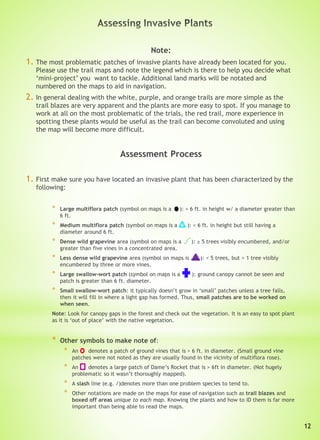
1. First make sure you have located an invasive plant that has been characterized by the
following:
* Large multiflora patch (symbol on maps is a ): > 6 ft. in height w/ a diameter greater than
6 ft.
* Medium multiflora patch (symbol on maps is a ): < 6 ft. in height but still having a
diameter around 6 ft.
* Dense wild grapevine area (symbol on maps is a ): ≥ 5 trees visibly encumbered, and/or
greater than five vines in a concentrated area.
* Less dense wild grapevine area (symbol on maps is a ): < 5 trees, but > 1 tree visibly
encumbered by three or more vines.
* Large swallow-wort patch (symbol on maps is a ): ground canopy cannot be seen and
patch is greater than 6 ft. diameter.
* Small swallow-wort patch: it typically doesn’t grow in ‘small’ patches unless a tree falls,
then it will fill in where a light gap has formed. Thus, small patches are to be worked on
when seen.
Note: Look for canopy gaps in the forest and check out the vegetation. It is an easy to spot plant
as it is ‘out of place’ with the native vegetation.
* Other symbols to make note of:
* An denotes a patch of ground vines that is > 6 ft. in diameter. (Small ground vine
patches were not noted as they are usually found in the vicinity of multiflora rose).
* An denotes a large patch of Dame’s Rocket that is > 6ft in diameter. (Not hugely
problematic so it wasn’t thoroughly mapped).
* A slash line (e.g. /)denotes more than one problem species to tend to.
* Other notations are made on the maps for ease of navigation such as trail blazes and
boxed off areas unique to each map. Knowing the plants and how to ID them is far more
important than being able to read the maps.
12
2. Things to keep in mind for each plant type:
* Multiflora rose: always work towards the rooting base and thin out as much as
possible before yanking on the stems as you may tear down native vegetation hidden
under the thorny network. Always wear gloves, long sleeves and pants. It is also
advised to tuck your pants into your shoes/boots shoes. This plant leaves nasty
lacerations if you get snagged by the thorns. Place chopped down multiflora rose in
discrete piles off trail .We want to desiccate this plant, and then dig up the rooting
base to prevent future growth. Pick up stray seeds, fruits and flowers you find to
prevent further spread and place with chopped piles to dry out. Note: this includes
tackling plants infected with RRD. It is harmless to humans.
* Wild grapevine: wild grapevine typically requires sawing through the vines. Look up
as often times wild grapevine is found smothering trees, and also in direct
competition with multiflora rose and other viney species, which also will climb trees
(as well as other viney plants). Be aware when you saw through vines that they tend
to keep trees “together” from natural or invasive plant damages so falling branches
is typical when tugging away vines. Fully removing the vines from the upper canopy
is not necessary, as once cut, they will wither and die releasing the tree from
competition.
* Swallow-wort: swallow-wort forms very dense patches with shallow fibrous roots and
are easy to grab at the base and rip up. Take special care to keep all seeds and
flowers in a concentrated pile and cover with a tarp so the pile can be relocated to
an area where the caretaker can mow over the seeds and flowers to prevent further
spread. You will also find swallow-wort directly competing with multiflora rose.
* Wild Mustard: found sporadically, but can be problematic. It can also be ripped up
by grabbing at the base. No special removal is needed. Just rip and move along to
more problematic species.
* Dame’s Rocket: not overly problematic, but if you happen to spot some while
working on other species feel free to rip it up by the base as it has a shallow root
system. If its flowering however make sure to completely bag and remove this plant
otherwise the seedpods will ripen. It is recommended to still remove it to diminish
the seed bank.
* Wild parsnip: DO NOT TOUCH! LEAVE BE! If found inform the caretaker. This is
typically not found in the forest as it needs a lot of sunlight. Control method is to
remove prior to its second year when it seeds and with extreme caution. Mowing
equipment can be used during the 1st year only otherwise seedlings will spread
prolifically. Chemical control after desiccation via “bagging it” has been used
successfully here at CNC.
* Poison ivy: just chop the vine (and later rinse and wipe the oil off the tools), do not
handle it, and leave it be. Do not touch or try to remove completely. We just want
to prevent further smothering of the tree host. Remember, vines are ‘furry’ and
yellow-brown. They are very distinct from wild grapevine, but still, wear gloves. Do
not touch tools or gloves after handling it as the oils from the vine remain ‘active’
for a time if you have to hold it in place to saw through. “Gently” saw through the
vines so as to prevent any lung or skin irritation due to the urushiol oils. Remember
the oil is in all parts of the plant!
Note: you can use a cord to tie vines in place to the tree when sawing through them so you can
minimize handling them directly. In general keep in mind that sometime complete removal of wild
grapvine may not always be necessary as it may be an aid in keeping multiflora rose and virginia
creeper at nay. Ask yourself, would chopping all of it down increase the proliferation of a more
problematic species? In MOST cases here at the nature center the answer is no.
13
This informative booklet was made possible by Cornell funding and faculty in the hiring
process, a crazy invasive plant loving intern (Vanessa J. Wikel), and all of the lovely staff
at Cayuga Nature Center.
It is my hope to again acquire an internship to work here at Cayuga Nature Center next
summer to continue this work in progress. Ideally I wanted to use a highly accurate global
positioning system (GPS), Google Earth if necessary, and spatial analysis software (Arc
Geographic Information System is preferred as I have taken two classes on it and
consider myself knowledgeable enough to build a base map with appropriate layers).
Essentially as the forest is restored it would be interesting to map the precise locations of
every problem location. While it is rather easy to spot most of these species from afar
this does not give us a sense of the actual area each species has taken over in relation to
the total area of the forest, nor the areas requiring more aggressive removal techniques.
With a accurate GPS and Arc GIS the actual area could be mapped using remote-sensing
techniques (e.g. walking the perimeter of each invasive plant ‘patch’ that has been
identified as being the most problematic to control). Ecological modeling could further be
used to project the rate of spread and the rate of natural or disease related deaths.
Ecological modeling is not yet in my bank of knowledge but maybe one day someone can
complete the work I’ve begun.
In my research I’ve found the most recommended ‘solution’ for tending to these invasive
plants is often controlled burning or chemical application, both of which can have several
adverse effects solving one problem but creating many more in the process. Manually
tending to the forest is typically the ‘last resort’ as it is time consuming and requires
devoted and relatively fit individuals who don’t mind getting their hands dirty. The
beauty of this approach is that beneficial flora are not harmed in the process as much as
possible so they can eventually spread into areas that were once taken over by invasive
plants. Even if all native plants in the vicinity are not immediately beneficial they are still
easier to control due to the natural competitive process between other native flora. It is
because of these reasons and many more that the classic approach through silviculture
will be the primary method for controlling the spread of invasive plants here at Cayuga
Nature Center.
A passionate spirit, open mind and eyes are all that are needed to continue the positive
impact to the forests of NYS and beyond.
Thanks to all who have contributed, past and present!
Vanessa J. Wikel
14
Cornell University Cooperative Extension. New York Invasive Species Information. Garlic
Mustard (Alliaria petiolata). Site updated in 2015. Web. Accessed on August 6th
from: http://www.nyis.info/index.php?action=invasive_detail&id=25
Cornell University Cooperative Extension. New York Invasive Species Information.
Multiflora Rose (Rosa multiflora Thunb. ex Murr). Site updated in 2015. Web.
Accessed on July 2nd, 2015 from: nyis.info/index.php?action=invasive_detail&id=33
Cornell University Cooperative Extension. New York Invasive Species Information. Wild
Parsnip (Pastinaca sativa). Site updated in 2015. Web. Accessed on July 7th, 2015
from: http://nyis.info/index.php?action=invasive_detail&id=61
National Park Service. Map Symbols and Patterns for NPS Maps. Web. Accessed on July
28th, 2015 from: http://www.nps.gov/hfc/carto/map-symbols.cfm
NYC Health Department. Poison Ivy Fact Sheet. N.d. Web. Accessed on July 14, 2015
from: http://www.nyc.gov/html/doh/downloads/pdf/eode/poison-ivy-fact-
sheet.pdf
NYS Department of Transportation. Poison Ivy (Rhus radicans) and Poison Oak
(Toxicodendron diverslobum). Last updated 2015. Web. Accessed on July 14th, 2015
from: https://www.dot.ny.gov/dangerous-plants/poison-ivy
PennState College of Agricultural Sciences School of Forest Resource. Fact Sheet: Invasive
Weeds Wild Grape. 2001. Web. Accessed on July 14th from:
http://extension.psu.edu/natural-resources/forests/private/tools-
resources/publications/invasive-plants-and-insects/wild
grape/extension_publication_file
Ramanujan, Krishna . Cornell University. Cornell Chronicle. Invasive vines swallow up New
York’s natural areas. April 23rd, 2014. Web. Accessed on July 21st from:
http://news.cornell.edu/stories/2014/04/invasive-vines-swallow-new-yorks-
natural-areas
United States Department of Agriculture Natural Resources Conservation Service. Virginia
Creeper Parthenocissus quinquefolia (L.) Planch. Last modified Aug. 6th, 2015. Web.
Accessed on Aug. 6th, 2015 from:
http://plants.usda.gov/plantguide/pdf/pg_paqu2.pdf
University of Montana Aldo Leopold Wilderness Research Institute. Last updated June 23,
2015. Web. Accessed on June 23, 2015 from:
http://leopold.wilderness.net/aboutus/aldo.htm
USDA Forest Service. Forest Invasive Plants Resource Center. Dame’s Rocket (Hesperis
matronalis). Feb. 6, 2005. Web. Accessed on July 9nd, 2015 from:
http://na.fs.fed.us/spfo/invasiveplants/factsheets/pdf/dames-rocket.pdf
USDA Forest Service. Forest Invasive Plants Resource Center. Multiflora rose (Rosa
multiflora Thunb. ex Murr). Feb. 6, 2005. Web. Accessed on July 2nd, 2015 from:
na.fs.fed.us/spfo/invasiveplants/factsheets/pdf/multiflora-rose.pdf
15
16
All images are property of volunteers and workers of Cayuga Nature Center unless
otherwise noted with a link to the owner and cited on this page.
Cornell University Cooperative Extension. New York Invasive Species Information. Multiflora
Rose (Rosa multiflora Thunb. ex Murr). Site updated in 2015. Web. Accessed on July
2nd, 2015 from: nyis.info/index.php?action=invasive_detail&id=33
Cornell University Cooperative Extension. New York Invasive Species Information. Wild
Parsnip (Pastinaca sativa). Site updated in 2015. Web. Accessed on July 7th, 2015
from: http://nyis.info/index.php?action=invasive_detail&id=61
Edible Wild Foods. Wild grapvine (Vitis spp.). 2011-2015. Web. Accessed on july 21st from:
http://www.ediblewildfood.com/images/wild-grape-vine-pictures/wild-grapes.jpg
Larissa Smith and Jeromy Biazzo/USDA. 2014. Web. Accessed on July 21st from:
http://news.cornell.edu/stories/2014/04/invasive-vines-swallow-new-yorks-natural-
areas
NYC Health Department. Poison Ivy Fact Sheet. N.d. Web. Accessed on July 14, 2015 from:
http://www.nyc.gov/html/doh/downloads/pdf/eode/poison-ivy-fact-sheet.pdf
NYS Department of Transportation. Poison Ivy (Rhus radicans) and Poison Oak
(Toxicodendron diverslobum). Last updated 2015. Web. Accessed on July 14th, 2015
from: https://www.dot.ny.gov/dangerous-plants/poison-ivy
USDA Forest Service. Forest Invasive Plants Resource Center. Multiflora rose (Rosa
multiflora Thunb. ex Murr). Feb. 6, 2005. Web. Accessed on July 2nd, 2015 from:
na.fs.fed.us/spfo/invasiveplants/factsheets/pdf/multiflora-rose.pdf
USDA Forest Service. Forest Invasive Plants Resource Center. Dame’s Rocket (Hesperis
matronalis). Feb. 6, 2005. Web. Accessed on July 9nd, 2015 from:
http://na.fs.fed.us/spfo/invasiveplants/factsheets/pdf/dames-rocket.pdf
Robert H. Mohlenbrock @ USDA NRCS PLANTS n.d. Web. Accessed on Aug. 6th, 20150 from:
http://plants.usda.gov/plantguide/pdf/pg_paqu2.pdf
Will Cook 2008. Web. Accessed on July 21st from:
http://www.carolinanature.com/trees/viro.html
Hirts: Vines and Coverground. n.d. Web. Accessed on Aug. 6th, 20150 from:
http://ecx.images-amazon.com/images/I/517c6kFMr%2BL._SX450_.jpg
Paul Rischmiller. 2015/ Web. Accessed on August 6th, 2015 from:
http://adkinvasives.com/species_of_concern/garlic-mustard/
Project Gutenberg EBook of Mother Nature's Toy-Shop, by Lina Beard and Adelia B. Beard.
Fig.78 - The drinking cup was made of a leaf like this. Page 68. Fig. 87 Blossoms of
the Phlox. Page 76. Web. Accessed on Aug 13th , 2015 from:
http://www.gutenberg.org/files/44440/44440-h/44440-h.htm#Page_71
American Museum of Natural History. Tips to Identify Poison Ivy. Web. Accessed on Aug.
13th, 2015 from: http://www.amnh.org/explore/curriculum-collections/biodiversity-
counts/plant-identification/tips-to-identify-poison-ivy
Riverton stake Holder Committee. Web. Accessed on August 13th, 2015 from:
https://rivertoncommunity.files.wordpress.com/2014/03/garlic-mustard-sketch.jpg
Wendy Hollender. Web. Accessed on August 13th 2015 from: http://bit.ly/1Auh44Q
Thomas J. Elpel's Web Portal. Web. Accessed on August 13th 2015 from:
http://www.wildflowers-and-
weeds.com/Plant_Families/Brassicaceae_pics/Brassicaceae.jpg
G.D. Bebeau. Web. Accessed on August 13th, 2015 from:http://www.friendsofthewildflow
ergarden.org/generaljpegs/Seasons/spring/damesrocketleafh.jpg

Guide to Assessing Invasive Plants

  • 1.
    1420 Taughannock Blvd.Ithaca NY 14850 (607) 273-6260 | www.priweb.org/naturecenter Restoring Balance to the Forest Ecosystem Vanessa Wikel A.S. Environmental Studies, 14’ Tompkins Cortland Community College B.S. Environmental Science & Sustainability (in progress, 16’) Cornell University
  • 2.
    Cayuga Nature Centeris a non-profit public venue of the Paleontological Research Institution (PRI) and a proud member of Ithaca’s Discovery Trail. Our nature center is a place for the community to come and enjoy 100 acres of land overlooking Cayuga Lake. In bringing the community together it is our goal to promote awareness of the natural world through education, increasing appreciation and a sense of responsibility for the natural world. Cayuga Nature Center Offers: • Admission to the nature center lodge varies seasonally with March 21st-December 19th being open daily from 9am-5pm (regular hours) & December 21st-March 20th Thursday-Sunday 10am-4pm with Monday-Wednesday CLOSED (winter hours). (see lobby for pricing) • Climb the TreeTops in a six-story observational house and enjoy the sites of Denison Falls • Visit the exhibits around the center which showcase life in the Cayuga Basin, past and present, as well as discover the background on Our Changing Climate. • As you explore the grounds you’ll become familiar with the many indoor and outdoor animal residents we have, as well as the Butterfly Garden (summer only). • Lastly, enjoy a nice hike spanning miles of trails along gorges and streams cozied within a diverse biotic community. We are stewards of the Earth and as Aldo Leopold has wisely said: “The last word in ignorance is the man who says of an animal or plant: "What good is it?" If the land mechanism as a whole is good, then every part is good, whether we understand it or not. If the biota, in the course of aeons, has built something we like but do not understand, then who but a fool would discard seemingly useless parts? To keep every cog and wheel is the first precaution of intelligent tinkering.” ~~Aldo Leopold, A Sand County Almanac, and Sketches Here and There, 1948 (University of Montana Aldo Leopold Wilderness Research Institute, 2015) 1
  • 3.
    Silviculture is verysimply the practice of controlling the establishment, growth, health and community structure of a forested ecosystem. This practice is conducted in forestry and often used to manage invasive plants as it is a more sustainable practice relying on manual tending to the forest community. Some recommendations for managing invasive plants often involve toxic chemicals or controlled burning. Here at the Cayuga Nature Center these are not options because we want to preserve the integrity of this forest in a way that is beneficial in the short and long term. Silviculture beings with a site assessment, which we have already done for you to identify the most problematic areas. Canopy density, (how light shines through the canopy, soil type and texture, climate), and the overall biota of the forested community will all effect the intensity and frequency at which invasive flora can dominate native flora. Non-native flora are problematic because they have few, if any, natural competitors. Over time if invasive plants are not managed a vegetation shift—(e.g. a shift in the floral community over a period of time) can occur. This can increase the spread of various plant diseases as well as introduce new pests. This can be prevented by simply manually tending to the forest so the native flora can gradually re-established. The next few pages will show you how to ID these plants, how to remove them, and most importantly will offer general safety tips which come from those who have personal experience managing these plants. Thank you for coming on board! Any help is greatly appreciated in restoring balance to this gorgeous forested ecosystem! Figure 1. Multiflora rose growth pattern Figure 2. Wild grapevine growth pattern Figure 3. Swallow-wort growth pattern 2
  • 4.
    Multiflora rose isa top priority invasive plant here at Cayuga Nature Center. Multiflora rose does a supreme job at displacing native flora as it can form ‘networks’ via its stems effectively smothering and snapping trees. It is often found in well-drained soils and thrives in direct sun. It reproduces vegetatively and by seed. DO NOT LET BRANCH TIPS TOUCH THE SOIL as it will produce more plants. It can get a biological disease spread by termites called the ‘rose rosette disease’ (RRD)(figure 7), which in 2 years time will kill the plant (USDA Forest Service, 2005; Cornell University Cooperative Extension, 2015). Plant Characteristics ~stems have numerous curved thorns (Figure 2) ~stems can be over 10 feet long (pg. 2 Figure 1) ~alternating leaves w/ fringe (Figure 6) ~white fragrant blooms (Figure 2 and 4) ~hard red fruits about 1/4th in. in diameter (Figure 3) ~stems and fringe can turn reddish-brown (Figure 7)Figure 1. Distribution of multiflora rose Figure 4. Multiflora rose blooms in May-June Figure 2. Multiflora rose in full bloom Figure 5. Curved thorns Figure 3. Small hard red fruits Figure 6. alternating leaves w/ fringe Figure 7. Rose-rosette disease 3All images are credited to: na.fs.fed.us/spfo/invasiveplants/factsheets/pdf/multiflora-rose.pdf
  • 5.
    Wild grapevine isa native plant to NYS yet often found to be invasive in forested ecosystems. Wild grapevine has thus become identified as a problematic plant due to its abilities as a ‘ladder vine’ species. Being very light dependent , it will climb up towards any gap in the canopy to reach sunlight smothering trees and other native flora with vines that can grow up to 15 meters long. It is dioecious (e.g. species has individuals that are either female or male) produces green flowers between May and July. Fruits are often retained throughout the winter and eaten by small animals increasing the widespread distribution of this plant. Additionally it can sprout from the roots or cut vine stumps, and can thrive in both rich and moist as well as dry and sandy soils, but requires full sunlight to germinate. Seeds can lay dormant in the soil for many years until favorable conditions arise (The Pennsyvania State University, 2001). Plant Characteristics ~ can grow 15 meters or more in length with bark-like vines (Figure 1) ~ has edible fruits one inch in diameter (Figure 3) ~ alternate leaves are toothed, heart shaped, and deeply indented leaf margins (Figure 4) ~ tendrils for support (Figure 2) 4 All images are credited to: Vanessa Wikel, Will Cook 2008, Lina Beard and Adelia B. Beard, and http://www.ediblewildfood.com/images/wild-grape-vine-pictures/wild-grapes.jpg Figure 1. Wild grapevine vines Figure 2. Wild grapevine tendrils Figure 3. Wild grapevine ripe fruits (unripe are green) Figure 4. Wild grapevine leaf sketch
  • 6.
    Swallow-wort is ratherprolific and tends to grow anywhere a gap in the canopy has formed. It has been seen covering multiflora rose in direct competition. Depending upon the growth stage of both plants, they may in fact co-habitat (e.g. “share” resources) until one outgrows the other. This will likely be the swallow-wort as it grows fast and spreads easily by seed due to its feathery filaments (Figure 2), which can easily ride the wind and spread via wildlife. These seeds can also stay viable for 3-5 years in soils with an increase in stem number (Figure 3) supported by the intricate, yet shallow, weblike rooting system. Swallow-wort produces 5-petaled flowers, stems with downy hairs, filamented seed pods, and opposite oriented leaves. Pale swallow-wort is the most abundant at the Cayuga Nature Center and the most problematic as it can crowd out native flora impacting the ecosystem as whole due to the haemolytic glycosides this plant produces which are toxic to animals. Furthermore it encourages the growth of a soil fungi that deters the growth of all other plants but the swallow-wort. For small populations, hand-digging the roots is possible. For larger populations, mowing and spraying herbicides are ideal to manage the seed pods before they open and release the seeds to the wind. Burning and composting are not advisable due to the toxic chemicals it produces. (Ramanujan, Krishna, 2014). Plant Characteristics ~ 1-2m in height (Figure 3) ~ Opposite leaves that are shiny and Narrowly oval or heart-shaped w/ Sharp tips (Figure 2 and 3) ~ Filamented seed pod (Figure 2) ~ 5-petaled flowers either dark Purple (black) or pink (pale) (Figure 1) 5 Figure 3. Swallow-wort growth formation Figure 1. black (left) and pale (right) swallow-wort flowers Figure 2. seed pod with seeds and filaments for wind born transportation All images are credited to: Larissa Smith; http://news.cornell.edu/stories/2014/04/invasive-vines-swallow-new-yorks- natural-areas
  • 7.
    Garlic mustard isa biennial plant fully maturing in the second year when the short rosette (Figure 3) forms into a tall stalk with flowers and later dies in June (Figure 4). It is commonly found in disturbed woodlots and forest edges with the competitive capacity to invade forest understories making this a hardy invasive plant. On average garlic mustard produces 22 four-side seed pods with as many as 28 seeds per pod all of which can easily disperse via wind, humans or wild life (Figure 1). In the first year identifying this plant is difficult so taking note of a garlic odor is key should the plant be crushed. The basal leaves are dark-green, round toothed and kidney shaped when immature in the first year later developing into alternating stem leaves with more triangular in shape 1 to 5 cm long. This is the stage when the plant’s odor is less noticeable and the plant forms a long stalk with flowers, four small white petals per bloom arranged in a symmetric pattern. After seeding the plant will become bare and tendril like(Figure 3) (Cornell University Cooperative Extension, 2015). Plant Characteristics ~ Garlic odor when immature if crushed ~ 4-petaled white flowers (Figure 1) ~ Flower pods with four sides housing approx. 28 seeds per all in a cluster (Figure 1) ~ A kidney shaped rosette in the 1st year (Figure 3) with a stalk developing in the 2nd year (Figure 4) ~ leaves are scalloped (Figure 5) 6 All images are credited to: Paul Rischmiller, Wendy Hollender, Thomas J. Elpel and https://rivertoncommunity.files.wordpress.com/2014/03/garlic-mustard-sketch.jpg Figure 3. 1st year kidney shaped leaves in a rosette Figure 4. 2nd year plant with multiple 4ft high stems Figure 5. Garlic mustard leaves Figure 2. End of its life cycle Figure 1. Mustard physiology
  • 8.
    While this plantis native , it is a very fast-growing perennial woody vine that can do severe damage if not tended to. Thriving in partial shade to full sun and preferring acidic soil while also tolerating a wide range of soils and pH, including salty soils, this plant is very wide spread throughout the southern, midwestern and eastern half of the United States. Virginia Creeper is often confused with eastern poison ivy which has three compound leaves with three leaflets, whereas Virginia creeper has five compound serrated leaves with five leaflets growing 2-6 inches long (Figure 1 and 2). The leaflets are red when they first emerge and then turn green as they mature only to turn back to bright red to maroon in the fall (Figure 1 and 2). The flowers are rather tiny and inconspicuous forming small clusters during the spring, followed by fruit 4-6 mm diameter with two to three seeds per. This plant is most easily identified for its leaf structure and viney growth form. The Virginia creeper flowers from June to August, matures from August to October, and drops its fruits from September to February. Seed dispersal is primarily by animals and germination takes place within the first or second spring after dispersal. This plant has often been used as an ornamental which would explain why it is so common. A typical Virginia creeper can climb to a height of over 60 ft if not manually tended, all the while out competing other flora (USDA -NRCS, 2015). Plant Characteristics ~ The most notable physical characteristic are the coloration and arrangement of the five compound leaves with five leaflets (Figure 1 and 2) 7 All images are credited to: Robert H. Mohlenbrock @ USDA NRCS PLANTS http://plants.usda.gov/plantguide/pdf/pg_paqu2.pdf and Hirts: Vines and Coverground http://ecx.images-amazon.com/images/I/517c6kFMr%2BL._SX450_.jpg Figure 1. Compound serrated eaves with 5 leaflets Figure 2. Leaves in the fall turn bright red-maroon
  • 9.
    Dame’s Rocket growsbest in partial sun with moist to semi-dry conditions and fertile loamy soil more on the alkaline side. Commonly found in forests, moist meadows, and in semi-open moderately disturbed areas. Not an overly problematic plant at CNC, but if flowering take care to remove it completely as any residues left upon the soil can produce ripened seed pods. Dame’s Rocket is spread via seed and produces mature seeds which ripen over the summer. Seed pods are 2-5 inches long and slightly hairy. Dame’s Rocket produces its basal rosette in its 1st year (Figure 2) and flowering stems in the 2nd and later years (USDA Forest Service, 2005). Plant Characteristics ~ 4-petaled flower; characteristic of the mustard family with showy clusters of purple to white flowers (Figure 4 and 6) ~ Lance like alternating leaves—smaller up the stem; covered in fine hairs with wide spaced ‘teeth’ up to 6 inches long (Figure 5) ~ Seeds with pods (Figure 7) Note: Not to be confused with 5-petaled Phlox. They look very similar but note the number of petals per flower. 8 Figure 1. Distribution of Dame’s Rocket Figure 2. Rosette in fall—1st year Figure 3. Rosette in in spring with last year's dead flower stems All images are credited to: C.D. Bebeau and http://na.fs.fed.us/spfo/invasiveplants/factsheets/pdf/dames-rocket.pdf Figure 4. White-lavender 4 petal flowers (can also be a vibrant purple (Figure 5) Figure 6. Mature Dame’s Rocket Figure 5. sharply toothed leaves Figure 7. Seed pod and seeds
  • 10.
    Wild parsnip producesfuranocoumarin in its sap which if touched will cause photosensitive chemical burns on the skin remaining sensitive to the sun for up to 8 hrs. after exposure(Figure 1). It typically grows up to 4-5ft. tall and survives in a wide range of habitats from dry soils to wet meadows, however it does best in alkaline calcium rich moist soils. It is ideally found in disturbed soils where native vegetation hasn’t become established. This plant undergoes a two year process in which the 1st year (Figure 4) it forms rosettes and grows vegetatively, where in the 2nd year (Figure 6) it will form an aerial shoot and flower. Seedlings emerge from Feb-April and mature in July remaining viable for up to 4 years in the soil despite having a high mortality rate. After seeding the plant will die. Note: there is a look alike Golden Alexander (Zizia aurea) but it differs in appearance in that the leaves of the Golden Alexander are smooth and fine finely serrated, and the clusters are very loose (Cornell University Cooperative Extension, 2015). Plant Characteristics ~ yellow flowers in a loose umbel (Figure 7) ~ hallow stem; except at nodes (Figure 2) ~ round to oval flat seeds ribbed with narrow wings about 1 ½-3 inches long (Figure 3) ~ lower leaves have stems, upper do not; leaves are broad compound up to six inches long and grow in pairs (Figure 5) 9 Figure 1. Photo sensitive rash from Wild Parsnip All images are credited to: http://nyis.info/index.php?action=invasive_detail&id=61 Figure 4. Wild Parsnip in 1st year of growth Figure 6. Wild Parsnip in 2nd year of growth Figure 2. Wild Parsnip stem Figure 5. Wild Parsnip leaves Figure 3. Wild Parsnip seeds Figure 7. Wild Parsnip umbel WARNING: Do not handle!!!
  • 11.
    Poison ivy iseasily confused with Poison oak, however they have several characteristics and are both equally as irritating to have come into contact with. They are trailing vines with aerial rootlets and 3-parted leaves, asymmetric leaves which can over time development into a ‘ladder vine’ (Figure 6), ground cover, or shrub plant depending upon competition in the local habitat (Figure 7). Both plants cause irritation with urushiol oil, however poison oak has more rounded leaves and points with a less smooth leaf surface that tends to be “lumpy” between the veins. Plants grow in young woodlands with less dense canopy, thickets, edges of paths, sand dunes, walls (such as climbing urban environments) and roadways. EVEN AFTER DEAD the poison remains active for hours to days and reaction can be delayed! In general do not use any power tools to manually remove, as the urushiol oil can enter the lungs if made air born, this includes not burning the plant. If fully removing put in a heavy duty plastic garbage bag to be thrown out with regular trash. (NYS Depart of Transportation, 2015; NYC Department of Health, n.d.). Note: all pictures show poison ivy with its distinct leaf forms. Be aware poison oak is not common at the Cayuga Nature Center. Plant Characteristics ~3-part asymmetrical leaves (Figure 1) ~smooth leaf surface for poison ivy, “lumpy” for poison oak ~has varying leaf forms (Figure 5 and 7) ~has green and white berries (Figure 7) ~in fall note the coloration and leaf pattern since leaves fall off (Figure 4) 10 Figure 1. Poison ivy in spring Figure 2. Poison ivy in summer Figure 6. Poison ivy vine after winter is still potent Figure 3. Poison ivy in Fall Figure 7. Poison ivy various leaf forms Figure 5. Poison ivy notched leaves All images are credited to: https://www.dot.ny.gov/dangerous-plants/poison-ivy and http://www.nyc.gov/html/doh/downloads/pdf/eode/poison-ivy-fact-sheet.pdf Figure 4. Poison ivy in Fall
  • 12.
    1. Get caretaker/groundskeeper’snumber! If you spot a downed tree, or have another such emergency call him immediately. Less immediate concerns you can email. 2. Always have enough water and food when out on the trails. If you do not feel well (you know your body best), please take a rest (as becoming over heated is rather easy when physically active). 3. Always wear long sleeves, pants, gloves and preferably tall boots you can tuck your pants into. Dealing with multiflora rose can result in pretty nasty scratches if not carefully removed, and ticks are more frequently found in knee high or taller grasses. 4. That being said, please bring sunblock and BUG SPRAY that protects against ticks, and mosquitoes, but a bug spray that ‘does it all’ would be preferred. I recommend spraying your clothes and all entry points to create a “ring of fire” effect. I haven’t found a tick on me doing it that way. CHECK FOR TICKS DAILY! 5. Know how to ID wild parsnip and poison ivy! Wild parsnip is not commonly found in the forest and is up in the fields and out front in the gardens mostly but is spreading so please be careful. Poison ivy vines also aren’t very prolific, but is found throughout the ground layer of the canopy in plenty. 6. As a rule of thumb: the green bypass pruners are for live plants only and the red anvil pruners are for dead plants only. Also carry a mini handsaw on you if dealing with wild grapevine and ask for proper instruction if you are at all unsure how to use these tools. Other tools are available upon request. Ask the caretaker for them and how to use them if instruction is needed. 7. Be very mindful of the uneven ground on the trails and the bridges (as they may be slippery). 8. If you have back problems like I do please work carefully, stretch often, and if needed, ask for another project to work on to give yourself a rest. There is always something to do around here!  11 Figure 1. Piled swallow-wort for removal
  • 13.
    Note: 1. The mostproblematic patches of invasive plants have already been located for you. Please use the trail maps and note the legend which is there to help you decide what ‘mini-project’ you want to tackle. Additional land marks will be notated and numbered on the maps to aid in navigation. 2. In general dealing with the white, purple, and orange trails are more simple as the trail blazes are very apparent and the plants are more easy to spot. If you manage to work at all on the most problematic of the trials, the red trail, more experience in spotting these plants would be useful as the trail can become convoluted and using the map will become more difficult. Assessment Process 1. First make sure you have located an invasive plant that has been characterized by the following: * Large multiflora patch (symbol on maps is a ): > 6 ft. in height w/ a diameter greater than 6 ft. * Medium multiflora patch (symbol on maps is a ): < 6 ft. in height but still having a diameter around 6 ft. * Dense wild grapevine area (symbol on maps is a ): ≥ 5 trees visibly encumbered, and/or greater than five vines in a concentrated area. * Less dense wild grapevine area (symbol on maps is a ): < 5 trees, but > 1 tree visibly encumbered by three or more vines. * Large swallow-wort patch (symbol on maps is a ): ground canopy cannot be seen and patch is greater than 6 ft. diameter. * Small swallow-wort patch: it typically doesn’t grow in ‘small’ patches unless a tree falls, then it will fill in where a light gap has formed. Thus, small patches are to be worked on when seen. Note: Look for canopy gaps in the forest and check out the vegetation. It is an easy to spot plant as it is ‘out of place’ with the native vegetation. * Other symbols to make note of: * An denotes a patch of ground vines that is > 6 ft. in diameter. (Small ground vine patches were not noted as they are usually found in the vicinity of multiflora rose). * An denotes a large patch of Dame’s Rocket that is > 6ft in diameter. (Not hugely problematic so it wasn’t thoroughly mapped). * A slash line (e.g. /)denotes more than one problem species to tend to. * Other notations are made on the maps for ease of navigation such as trail blazes and boxed off areas unique to each map. Knowing the plants and how to ID them is far more important than being able to read the maps. 12
  • 14.
    2. Things tokeep in mind for each plant type: * Multiflora rose: always work towards the rooting base and thin out as much as possible before yanking on the stems as you may tear down native vegetation hidden under the thorny network. Always wear gloves, long sleeves and pants. It is also advised to tuck your pants into your shoes/boots shoes. This plant leaves nasty lacerations if you get snagged by the thorns. Place chopped down multiflora rose in discrete piles off trail .We want to desiccate this plant, and then dig up the rooting base to prevent future growth. Pick up stray seeds, fruits and flowers you find to prevent further spread and place with chopped piles to dry out. Note: this includes tackling plants infected with RRD. It is harmless to humans. * Wild grapevine: wild grapevine typically requires sawing through the vines. Look up as often times wild grapevine is found smothering trees, and also in direct competition with multiflora rose and other viney species, which also will climb trees (as well as other viney plants). Be aware when you saw through vines that they tend to keep trees “together” from natural or invasive plant damages so falling branches is typical when tugging away vines. Fully removing the vines from the upper canopy is not necessary, as once cut, they will wither and die releasing the tree from competition. * Swallow-wort: swallow-wort forms very dense patches with shallow fibrous roots and are easy to grab at the base and rip up. Take special care to keep all seeds and flowers in a concentrated pile and cover with a tarp so the pile can be relocated to an area where the caretaker can mow over the seeds and flowers to prevent further spread. You will also find swallow-wort directly competing with multiflora rose. * Wild Mustard: found sporadically, but can be problematic. It can also be ripped up by grabbing at the base. No special removal is needed. Just rip and move along to more problematic species. * Dame’s Rocket: not overly problematic, but if you happen to spot some while working on other species feel free to rip it up by the base as it has a shallow root system. If its flowering however make sure to completely bag and remove this plant otherwise the seedpods will ripen. It is recommended to still remove it to diminish the seed bank. * Wild parsnip: DO NOT TOUCH! LEAVE BE! If found inform the caretaker. This is typically not found in the forest as it needs a lot of sunlight. Control method is to remove prior to its second year when it seeds and with extreme caution. Mowing equipment can be used during the 1st year only otherwise seedlings will spread prolifically. Chemical control after desiccation via “bagging it” has been used successfully here at CNC. * Poison ivy: just chop the vine (and later rinse and wipe the oil off the tools), do not handle it, and leave it be. Do not touch or try to remove completely. We just want to prevent further smothering of the tree host. Remember, vines are ‘furry’ and yellow-brown. They are very distinct from wild grapevine, but still, wear gloves. Do not touch tools or gloves after handling it as the oils from the vine remain ‘active’ for a time if you have to hold it in place to saw through. “Gently” saw through the vines so as to prevent any lung or skin irritation due to the urushiol oils. Remember the oil is in all parts of the plant! Note: you can use a cord to tie vines in place to the tree when sawing through them so you can minimize handling them directly. In general keep in mind that sometime complete removal of wild grapvine may not always be necessary as it may be an aid in keeping multiflora rose and virginia creeper at nay. Ask yourself, would chopping all of it down increase the proliferation of a more problematic species? In MOST cases here at the nature center the answer is no. 13
  • 15.
    This informative bookletwas made possible by Cornell funding and faculty in the hiring process, a crazy invasive plant loving intern (Vanessa J. Wikel), and all of the lovely staff at Cayuga Nature Center. It is my hope to again acquire an internship to work here at Cayuga Nature Center next summer to continue this work in progress. Ideally I wanted to use a highly accurate global positioning system (GPS), Google Earth if necessary, and spatial analysis software (Arc Geographic Information System is preferred as I have taken two classes on it and consider myself knowledgeable enough to build a base map with appropriate layers). Essentially as the forest is restored it would be interesting to map the precise locations of every problem location. While it is rather easy to spot most of these species from afar this does not give us a sense of the actual area each species has taken over in relation to the total area of the forest, nor the areas requiring more aggressive removal techniques. With a accurate GPS and Arc GIS the actual area could be mapped using remote-sensing techniques (e.g. walking the perimeter of each invasive plant ‘patch’ that has been identified as being the most problematic to control). Ecological modeling could further be used to project the rate of spread and the rate of natural or disease related deaths. Ecological modeling is not yet in my bank of knowledge but maybe one day someone can complete the work I’ve begun. In my research I’ve found the most recommended ‘solution’ for tending to these invasive plants is often controlled burning or chemical application, both of which can have several adverse effects solving one problem but creating many more in the process. Manually tending to the forest is typically the ‘last resort’ as it is time consuming and requires devoted and relatively fit individuals who don’t mind getting their hands dirty. The beauty of this approach is that beneficial flora are not harmed in the process as much as possible so they can eventually spread into areas that were once taken over by invasive plants. Even if all native plants in the vicinity are not immediately beneficial they are still easier to control due to the natural competitive process between other native flora. It is because of these reasons and many more that the classic approach through silviculture will be the primary method for controlling the spread of invasive plants here at Cayuga Nature Center. A passionate spirit, open mind and eyes are all that are needed to continue the positive impact to the forests of NYS and beyond. Thanks to all who have contributed, past and present! Vanessa J. Wikel 14
  • 16.
    Cornell University CooperativeExtension. New York Invasive Species Information. Garlic Mustard (Alliaria petiolata). Site updated in 2015. Web. Accessed on August 6th from: http://www.nyis.info/index.php?action=invasive_detail&id=25 Cornell University Cooperative Extension. New York Invasive Species Information. Multiflora Rose (Rosa multiflora Thunb. ex Murr). Site updated in 2015. Web. Accessed on July 2nd, 2015 from: nyis.info/index.php?action=invasive_detail&id=33 Cornell University Cooperative Extension. New York Invasive Species Information. Wild Parsnip (Pastinaca sativa). Site updated in 2015. Web. Accessed on July 7th, 2015 from: http://nyis.info/index.php?action=invasive_detail&id=61 National Park Service. Map Symbols and Patterns for NPS Maps. Web. Accessed on July 28th, 2015 from: http://www.nps.gov/hfc/carto/map-symbols.cfm NYC Health Department. Poison Ivy Fact Sheet. N.d. Web. Accessed on July 14, 2015 from: http://www.nyc.gov/html/doh/downloads/pdf/eode/poison-ivy-fact- sheet.pdf NYS Department of Transportation. Poison Ivy (Rhus radicans) and Poison Oak (Toxicodendron diverslobum). Last updated 2015. Web. Accessed on July 14th, 2015 from: https://www.dot.ny.gov/dangerous-plants/poison-ivy PennState College of Agricultural Sciences School of Forest Resource. Fact Sheet: Invasive Weeds Wild Grape. 2001. Web. Accessed on July 14th from: http://extension.psu.edu/natural-resources/forests/private/tools- resources/publications/invasive-plants-and-insects/wild grape/extension_publication_file Ramanujan, Krishna . Cornell University. Cornell Chronicle. Invasive vines swallow up New York’s natural areas. April 23rd, 2014. Web. Accessed on July 21st from: http://news.cornell.edu/stories/2014/04/invasive-vines-swallow-new-yorks- natural-areas United States Department of Agriculture Natural Resources Conservation Service. Virginia Creeper Parthenocissus quinquefolia (L.) Planch. Last modified Aug. 6th, 2015. Web. Accessed on Aug. 6th, 2015 from: http://plants.usda.gov/plantguide/pdf/pg_paqu2.pdf University of Montana Aldo Leopold Wilderness Research Institute. Last updated June 23, 2015. Web. Accessed on June 23, 2015 from: http://leopold.wilderness.net/aboutus/aldo.htm USDA Forest Service. Forest Invasive Plants Resource Center. Dame’s Rocket (Hesperis matronalis). Feb. 6, 2005. Web. Accessed on July 9nd, 2015 from: http://na.fs.fed.us/spfo/invasiveplants/factsheets/pdf/dames-rocket.pdf USDA Forest Service. Forest Invasive Plants Resource Center. Multiflora rose (Rosa multiflora Thunb. ex Murr). Feb. 6, 2005. Web. Accessed on July 2nd, 2015 from: na.fs.fed.us/spfo/invasiveplants/factsheets/pdf/multiflora-rose.pdf 15
  • 17.
    16 All images areproperty of volunteers and workers of Cayuga Nature Center unless otherwise noted with a link to the owner and cited on this page. Cornell University Cooperative Extension. New York Invasive Species Information. Multiflora Rose (Rosa multiflora Thunb. ex Murr). Site updated in 2015. Web. Accessed on July 2nd, 2015 from: nyis.info/index.php?action=invasive_detail&id=33 Cornell University Cooperative Extension. New York Invasive Species Information. Wild Parsnip (Pastinaca sativa). Site updated in 2015. Web. Accessed on July 7th, 2015 from: http://nyis.info/index.php?action=invasive_detail&id=61 Edible Wild Foods. Wild grapvine (Vitis spp.). 2011-2015. Web. Accessed on july 21st from: http://www.ediblewildfood.com/images/wild-grape-vine-pictures/wild-grapes.jpg Larissa Smith and Jeromy Biazzo/USDA. 2014. Web. Accessed on July 21st from: http://news.cornell.edu/stories/2014/04/invasive-vines-swallow-new-yorks-natural- areas NYC Health Department. Poison Ivy Fact Sheet. N.d. Web. Accessed on July 14, 2015 from: http://www.nyc.gov/html/doh/downloads/pdf/eode/poison-ivy-fact-sheet.pdf NYS Department of Transportation. Poison Ivy (Rhus radicans) and Poison Oak (Toxicodendron diverslobum). Last updated 2015. Web. Accessed on July 14th, 2015 from: https://www.dot.ny.gov/dangerous-plants/poison-ivy USDA Forest Service. Forest Invasive Plants Resource Center. Multiflora rose (Rosa multiflora Thunb. ex Murr). Feb. 6, 2005. Web. Accessed on July 2nd, 2015 from: na.fs.fed.us/spfo/invasiveplants/factsheets/pdf/multiflora-rose.pdf USDA Forest Service. Forest Invasive Plants Resource Center. Dame’s Rocket (Hesperis matronalis). Feb. 6, 2005. Web. Accessed on July 9nd, 2015 from: http://na.fs.fed.us/spfo/invasiveplants/factsheets/pdf/dames-rocket.pdf Robert H. Mohlenbrock @ USDA NRCS PLANTS n.d. Web. Accessed on Aug. 6th, 20150 from: http://plants.usda.gov/plantguide/pdf/pg_paqu2.pdf Will Cook 2008. Web. Accessed on July 21st from: http://www.carolinanature.com/trees/viro.html Hirts: Vines and Coverground. n.d. Web. Accessed on Aug. 6th, 20150 from: http://ecx.images-amazon.com/images/I/517c6kFMr%2BL._SX450_.jpg Paul Rischmiller. 2015/ Web. Accessed on August 6th, 2015 from: http://adkinvasives.com/species_of_concern/garlic-mustard/ Project Gutenberg EBook of Mother Nature's Toy-Shop, by Lina Beard and Adelia B. Beard. Fig.78 - The drinking cup was made of a leaf like this. Page 68. Fig. 87 Blossoms of the Phlox. Page 76. Web. Accessed on Aug 13th , 2015 from: http://www.gutenberg.org/files/44440/44440-h/44440-h.htm#Page_71 American Museum of Natural History. Tips to Identify Poison Ivy. Web. Accessed on Aug. 13th, 2015 from: http://www.amnh.org/explore/curriculum-collections/biodiversity- counts/plant-identification/tips-to-identify-poison-ivy Riverton stake Holder Committee. Web. Accessed on August 13th, 2015 from: https://rivertoncommunity.files.wordpress.com/2014/03/garlic-mustard-sketch.jpg Wendy Hollender. Web. Accessed on August 13th 2015 from: http://bit.ly/1Auh44Q Thomas J. Elpel's Web Portal. Web. Accessed on August 13th 2015 from: http://www.wildflowers-and- weeds.com/Plant_Families/Brassicaceae_pics/Brassicaceae.jpg G.D. Bebeau. Web. Accessed on August 13th, 2015 from:http://www.friendsofthewildflow ergarden.org/generaljpegs/Seasons/spring/damesrocketleafh.jpg