Bird Control in Scotland
What You Need to Know
John Barclay, General Manager
Excel Environmental Services
http://www.excelenvironmental.co.uk
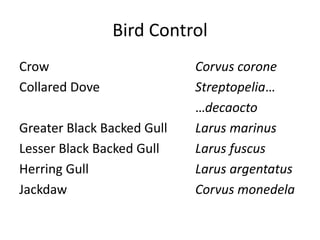
Bird Control
Crow Corvus corone
Collared Dove Streptopelia…
…decaocto
Greater Black Backed Gull Larus marinus
Lesser Black Backed Gull Larus fuscus
Herring Gull Larus argentatus
Jackdaw Corvus monedela
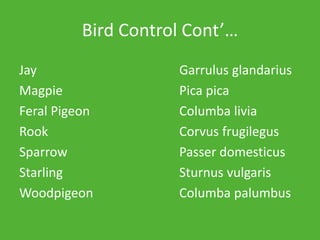
Bird Control Cont’…
Jay Garrulus glandarius
Magpie Pica pica
Feral Pigeon Columba livia
Rook Corvus frugilegus
Sparrow Passer domesticus
Starling Sturnus vulgaris
Woodpigeon Columba palumbus
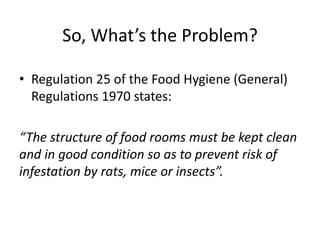
So, What’s the Problem?
• Regulation 25 of the Food Hygiene (General)
Regulations 1970 states:
“The structure of food rooms must be kept clean
and in good condition so as to prevent risk of
infestation by rats, mice or insects”.
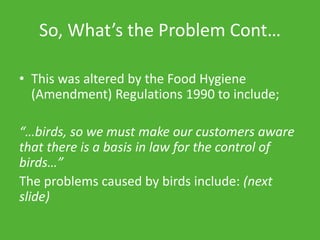
So, What’s the Problem Cont…
• This was altered by the Food Hygiene
(Amendment) Regulations 1990 to include;
“…birds, so we must make our customers aware
that there is a basis in law for the control of
birds…”
The problems caused by birds include: (next
slide)
Bird Control Problems
1. Disease;
Birds can transmit food poisoning organisms,
including Salmonella. They can also pass on
Ornithosis , a flu related virus and Psittacosis
which caused a pneumonic-like illness. Pigeon
breeders may some times contract “Pigeon
Fanciers Lung” which is a respiratory disease.
Extra Reading on Disease
Salmonella
http://www.hpa.org.uk/Topics/InfectiousDiseases/I
nfectionsAZ/Salmonella
Psittacosis
http://www.hpa.org.uk/Topics/InfectiousDiseases/I
nfectionsAZ/Psittacosis/GeneralInformation/psiCon
trolofPsittacosis
Bird Fancier Lung
http://en.wikipedia.org/wiki/Bird_fancier%27s_lun
g
Bird Control Problems
2. Insect Infestations;
In addition to bacteria and viruses, a large
number of insect and mite species live in bird
fouling and nesting material, as well as on the
live and dead birds themselves.
These include; (next slide).
Bluebottles
Greenbottles
Larder Beetle
Varied Carpet Beetle
Fur Beetle
Australian Spider Beetle
Golden Spider Beetle
Brown House Moth
White Shouldered House Moth
Biscuit Beetle
Flour Mite
Poultry Red Mite
Various Lice
Bird Control Problems
3. Building Damage;
Birds and bird droppings not only look unsightly,
but bird droppings contain an acid which attacks
stone and can cause serious defacement of a
building. Birds nests will often block gutters,
leading to costly flooding.
Bird Control Problems
4. Contamination of Food;
As well as spreading disease, the presence of
birds inside a food factory can lead to physical
contamination with droppings and feathers.
Sparrows are particular indoor pests and can
cause spoilage by consuming products.
Bird Control Problems
5. Danger of Falling;
Wet bird fouling is extremely slippery and may
result in a fall. This is particularly hazardous on
steps and fire escapes.
6. Nuisance;
The noise and smell produced by birds can be
very disturbing and unpleasant. The very
presence of birds invokes fear in some people.
Main Urban Species
There are four main urban pests which are often
called upon to control;
Feral Pigeon Columbia livia
House Sparrow Passer domesticus
Starlings Sturnus vulgaris
Gull Larus spp
Gulls
Gulls are medium to large-sized birds, often in
flocks associated with coastal areas, sometimes
feeding inland on tips, particularly in winter
when our native bird’s populations are swollen
by immigrants from the continent and
elsewhere.
Gulls: Food & Habits
During the 20th Century, gull numbers
have increased rapidly. In inland
localities, especially outside the
breeding season, gulls often roost in
many thousands on large bodies of
water such as reservoirs or flooded
gravel pits.
Gulls: Food & Habits
All species, when inland, depend on
domestic refuse for food, although
Black-headed and common gulls also
feed on agricultural land.
Gulls: Food & Habits
Over the past twenty years or so, Herring
Gulls – and in some cases lesser Black-
Backed Gulls – have taken to breeding
on buildings in coastal towns and inland,
including private houses, hotels and
large warehouses.
Gulls: Food & Habits
Complaints about gulls are increasing as
damage is done to roof fabric by pecking
and the corrosive action of droppings.
Gulls also cause damage by fouling
buildings and washing lines. Their nests
block gutters and downpipes and they also
damage plants. Gulls may also attack
people.
Gulls: Food & Habits
The calling of birds on rooftop territories
squabbling over food in the early morning
is also a particular source of disturbance –
this behaviour is not confined to the
breeding season.
Gulls: Food & Habits
Gulls feed at refuse tips and have been
implicated in the transmission of
Salmonella. Their roosting on and pollution
of reservoirs also cause concern.
Control of Gulls
• Some proofing and deterrent methods such as spring
wire, gels and netting can be quite effective against gulls
• However, the most efficient and long term measure of
control is a long-term method designed to reduce a
troublesome colony.
• This involves either spiking the eggs in a nursery at
regular intervals, so that the adults continue to incubate
the eggs, or by completely removing all eggs, young, and
nesting material.
• Particular care should be taken with this method as adult
gulls may attack the technicians carrying out the work.
Repellents & Scaring Devices
These have little effect against breeding birds.
However, some success has been achieved with the
display of spreadeagled corpses of shot gulls and
broadcasts of distress calls.
Scaring devices have little effect in the noisy and
rapidly changing environment of tips, unless
someone is there all day to operate the scaring
devices. Some sites have specially constructed
moveable net to exclude gulls from rubbish tips.
Shooting
Noisy rooftop gulls can be shot with a
silenced .22 rifle in the early morning when
this is feasible.
Herring gulls take up territories from early
March and shooting should take place as
soon as possible after this time, and before
mid-May. This will prevent hatched broods
from being left to starve in the nest.
Stupefying Baits
The use of stupefying baits outdoors in
populated areas presents many problems,
but a few licensed operations have been
carried out against nesting and other gulls.
And…
• Proofing
Roosting ledges can be proofed with spring wire
systems.
• Trapping
Not effective against Gulls.
Get in touch
Excel Environmental Services
Professional Bird Control Services
0141 889 2999 or
http://www.excelenvironmental.co.uk

Bird Control: Know the Facts

  • 1.
    Bird Control inScotland What You Need to Know John Barclay, General Manager Excel Environmental Services http://www.excelenvironmental.co.uk
  • 2.
    Bird Control Crow Corvuscorone Collared Dove Streptopelia… …decaocto Greater Black Backed Gull Larus marinus Lesser Black Backed Gull Larus fuscus Herring Gull Larus argentatus Jackdaw Corvus monedela
  • 3.
    Bird Control Cont’… JayGarrulus glandarius Magpie Pica pica Feral Pigeon Columba livia Rook Corvus frugilegus Sparrow Passer domesticus Starling Sturnus vulgaris Woodpigeon Columba palumbus
  • 4.
    So, What’s theProblem? • Regulation 25 of the Food Hygiene (General) Regulations 1970 states: “The structure of food rooms must be kept clean and in good condition so as to prevent risk of infestation by rats, mice or insects”.
  • 5.
    So, What’s theProblem Cont… • This was altered by the Food Hygiene (Amendment) Regulations 1990 to include; “…birds, so we must make our customers aware that there is a basis in law for the control of birds…” The problems caused by birds include: (next slide)
  • 6.
    Bird Control Problems 1.Disease; Birds can transmit food poisoning organisms, including Salmonella. They can also pass on Ornithosis , a flu related virus and Psittacosis which caused a pneumonic-like illness. Pigeon breeders may some times contract “Pigeon Fanciers Lung” which is a respiratory disease.
  • 7.
    Extra Reading onDisease Salmonella http://www.hpa.org.uk/Topics/InfectiousDiseases/I nfectionsAZ/Salmonella Psittacosis http://www.hpa.org.uk/Topics/InfectiousDiseases/I nfectionsAZ/Psittacosis/GeneralInformation/psiCon trolofPsittacosis Bird Fancier Lung http://en.wikipedia.org/wiki/Bird_fancier%27s_lun g
  • 8.
    Bird Control Problems 2.Insect Infestations; In addition to bacteria and viruses, a large number of insect and mite species live in bird fouling and nesting material, as well as on the live and dead birds themselves. These include; (next slide).
  • 9.
    Bluebottles Greenbottles Larder Beetle Varied CarpetBeetle Fur Beetle Australian Spider Beetle Golden Spider Beetle Brown House Moth White Shouldered House Moth Biscuit Beetle Flour Mite Poultry Red Mite Various Lice
  • 10.
    Bird Control Problems 3.Building Damage; Birds and bird droppings not only look unsightly, but bird droppings contain an acid which attacks stone and can cause serious defacement of a building. Birds nests will often block gutters, leading to costly flooding.
  • 11.
    Bird Control Problems 4.Contamination of Food; As well as spreading disease, the presence of birds inside a food factory can lead to physical contamination with droppings and feathers. Sparrows are particular indoor pests and can cause spoilage by consuming products.
  • 12.
    Bird Control Problems 5.Danger of Falling; Wet bird fouling is extremely slippery and may result in a fall. This is particularly hazardous on steps and fire escapes. 6. Nuisance; The noise and smell produced by birds can be very disturbing and unpleasant. The very presence of birds invokes fear in some people.
  • 13.
    Main Urban Species Thereare four main urban pests which are often called upon to control; Feral Pigeon Columbia livia House Sparrow Passer domesticus Starlings Sturnus vulgaris Gull Larus spp
  • 14.
    Gulls Gulls are mediumto large-sized birds, often in flocks associated with coastal areas, sometimes feeding inland on tips, particularly in winter when our native bird’s populations are swollen by immigrants from the continent and elsewhere.
  • 15.
    Gulls: Food &Habits During the 20th Century, gull numbers have increased rapidly. In inland localities, especially outside the breeding season, gulls often roost in many thousands on large bodies of water such as reservoirs or flooded gravel pits.
  • 16.
    Gulls: Food &Habits All species, when inland, depend on domestic refuse for food, although Black-headed and common gulls also feed on agricultural land.
  • 17.
    Gulls: Food &Habits Over the past twenty years or so, Herring Gulls – and in some cases lesser Black- Backed Gulls – have taken to breeding on buildings in coastal towns and inland, including private houses, hotels and large warehouses.
  • 18.
    Gulls: Food &Habits Complaints about gulls are increasing as damage is done to roof fabric by pecking and the corrosive action of droppings. Gulls also cause damage by fouling buildings and washing lines. Their nests block gutters and downpipes and they also damage plants. Gulls may also attack people.
  • 19.
    Gulls: Food &Habits The calling of birds on rooftop territories squabbling over food in the early morning is also a particular source of disturbance – this behaviour is not confined to the breeding season.
  • 20.
    Gulls: Food &Habits Gulls feed at refuse tips and have been implicated in the transmission of Salmonella. Their roosting on and pollution of reservoirs also cause concern.
  • 21.
    Control of Gulls •Some proofing and deterrent methods such as spring wire, gels and netting can be quite effective against gulls • However, the most efficient and long term measure of control is a long-term method designed to reduce a troublesome colony. • This involves either spiking the eggs in a nursery at regular intervals, so that the adults continue to incubate the eggs, or by completely removing all eggs, young, and nesting material. • Particular care should be taken with this method as adult gulls may attack the technicians carrying out the work.
  • 22.
    Repellents & ScaringDevices These have little effect against breeding birds. However, some success has been achieved with the display of spreadeagled corpses of shot gulls and broadcasts of distress calls. Scaring devices have little effect in the noisy and rapidly changing environment of tips, unless someone is there all day to operate the scaring devices. Some sites have specially constructed moveable net to exclude gulls from rubbish tips.
  • 23.
    Shooting Noisy rooftop gullscan be shot with a silenced .22 rifle in the early morning when this is feasible. Herring gulls take up territories from early March and shooting should take place as soon as possible after this time, and before mid-May. This will prevent hatched broods from being left to starve in the nest.
  • 24.
    Stupefying Baits The useof stupefying baits outdoors in populated areas presents many problems, but a few licensed operations have been carried out against nesting and other gulls.
  • 25.
    And… • Proofing Roosting ledgescan be proofed with spring wire systems. • Trapping Not effective against Gulls.
  • 26.
    Get in touch ExcelEnvironmental Services Professional Bird Control Services 0141 889 2999 or http://www.excelenvironmental.co.uk