Veggie Bytes 2011 
A Patriotic Potato Patch 
On January 14th, 90 second graders of Valverda Elementary, located near Livonia, 
La., planted a Patriotic Potato Patch in their school garden. LSU AgCenter Horticulture 
agents Miles Brashier, Steve Borel and Mark Carriere assisted the young gardeners. The 
varieties planted included: 
Mountain Rose, a red skin potato with a pink to red center 
Purple Viking, a purple/ blue skin potato with a white interior 
Kennebec, a white skin, white flesh potato 
Purple Majesty, a purple skin and purple flesh potato 
Sixty 5th grade students planted Red La Soda, a red skin potato with white flesh in 
the garden. The following week, sixty 4th graders planted red and white onions. The on-ion 
varieties they chose to plant were White Bermuda, Southern Red, Texas Granex, 
1015, Contessa, Candy and Red Candy Apple. 
Valverda Elementary has a garden area that is approximately 7000 sq ft. The stu-dent’s 
plant in long garden beds that are 4 ft wide by 60 ft long. Prior to planting, the 
agents tilled the soil and fertilized the beds with 13-13-13. Students planted the potato 
pieces skin side down on 9 inch centers. 
Not only were the students planting their Patriotic Garden, they were also harvesting 
a few fall vegetables. Other vegetables grown were beets, shallots (red and white), broc-coli 
and cabbage. Throughout the school year, a total of 450 students and 22 teachers 
participated in the Valverda Elementary School Garden. 
Although Miles, Steve, and Mark are garden pros and have been planting potatoes 
with school gardeners for several years, this is their first Patriotic Potato Patch. They 
will create this same themed garden at Rosenwald Elementary, Rougon Elementary and 
False River Academy. The idea for the Patriotic Potato Patch stemmed from the Victory 
Gardens grown during WWII when vegetables were grown during the war to help sup-port 
the families of the men at war. Sometimes vegetables were grown for the soldiers. 
This garden is a nice tribute to our soldiers and to our country. Additionally, it teaches 
students where food comes from, that vegetables come in all sizes and colors, and that a 
little hard work pays off. continued on Page 5 
February—April 
Volume 2, Issue 1 
A Patriotic Potato 
Patch 
1 
What’s Growing 2 
A Closer Look 3 
Classroom to the 
Garden 
4 
INSIDE THIS ISSUE 
E-mail: kkfontenot@agcenter.lsu.edu 
We’re on the Web www.lsuagcenter.com 
Growing Gardens! 
Kathryn “KiKi” Fontenot 
155 Julian C. Miller Hall 
Baton Rouge, LA 70803
What’s Growing! 
Gardening tips 
Start gearing up for your spring 
vegetable garden now so that you can 
harvest produce before school lets out 
for the summer. Typically in Louisiana, 
spring vegetable crops are not planted 
outdoors before the last frost date. 
South Louisiana gardeners can plant 
around March 15th, North Louisiana 
gardeners should wait until April 1st. 
However, if you want to harvest a few 
ripe tomatoes, peppers, etc before 
school lets out you’ll need to start 
transplants indoors. To grow trans-plants, 
plant seeds into containers in a 
sterile soil “germinating mix” indoors 
(in a sunny window). Do not move 
these transplants or seedlings into the 
garden until they have developed their 
first true leaves and after the last 
chance of frost. See the planting guide 
for vegetables that can be planted now. 
Vegetables to plant in February 
In the garden direct seed: beets, turnips, mustard, parsley, rad-ishes, 
lettuce, snap beans and Irish potatoes. 
In the garden plant transplants of: broccoli, cauliflower, cabbage, 
and lettuce. 
In the classroom: start transplants of tomatoes, peppers, and egg-plant. 
Vegetables to Plant in March 
In the garden direct seed: snap beans, Swiss chard, radish, lettuce, 
collard greens, mustards, and turnips. 
In the garden plant transplants of: tomatoes, peppers and egg-plants. 
In the classroom: start cucumber transplants, plant after last frost. 
Vegetables to plant in April 
In the garden direct seed: snap beans, butter beans, radish, col-lards, 
and cucumbers. 
In the garden transplant: sweet potato slips, tomatoes, peppers, 
and eggplant. 
If you have a year-round school program or summer classes that will 
care for and work in the garden you can also plant the following 
vegetables. Sweet corn can be directly seeded into the garden in 
LATE February. Plant cantaloupes, squash, cucumbers, and water-melons 
well after danger of frost is over this is usually after March 
15th in south Louisiana and closer to April 1 in North Louisiana. 
Okra, Southern peas (field peas), peanuts, pumpkins, winter squash, 
summer squash, and sweet corn can be direct seeded into the garden 
in April. These vegetables are not generally recommended for 
school gardens that will not be tended by students during the 
summer. Students should be allowed to harvest everything they 
plant. 
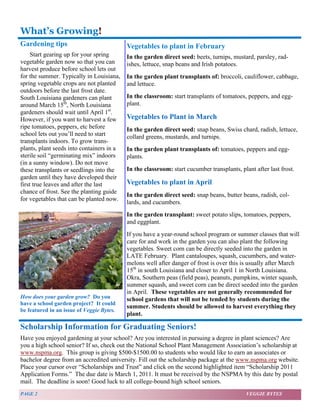
How does your garden grow? Do you 
have a school garden project? It could 
be featured in an issue of Veggie Bytes. 
Scholarship Information for Graduating Seniors! 
Have you enjoyed gardening at your school? Are you interested in pursuing a degree in plant sciences? Are 
you a high school senior? If so, check out the National School Plant Management Association’s scholarship at 
www.nspma.org. This group is giving $500-$1500.00 to students who would like to earn an associates or 
bachelor degree from an accredited university. Fill out the scholarship package at the www.nspma.org website. 
Place your cursor over “Scholarships and Trust” and click on the second highlighted item “Scholarship 2011 
Application Forms.” The due date is March 1, 2011. It must be received by the NSPMA by this date by postal 
mail. The deadline is soon! Good luck to all college-bound high school seniors. 
PAGE 2 VEGGIE BYTES
A Closer Look 
Many school gardeners planted strawberries in 
their gardens in September and October. Your ber-ries 
should have increased in size and have grown 
multiple crowns since they’ve been planted. Hope-fully 
you have harvested a couple of berries by now. 
As the temperature rises, you will be harvesting 
more and more. Aside from watering, fertilizing and 
covering your strawberry plants from freezing tem-peratures, 
have you really looked at your plants? 
Find a few hand lenses or microscopes and start 
observing. Under the hand lens or microscope, ob-serve 
a leaf. Do you notice anything that you had 
not seen before? You should see tiny hairs on both 
sides of the leaf. Plants have hair but we don’t call it 
hair. The scientific term for plant hair is 
“pubescence”. Pubescence has a function. Some sci-entists 
think that plants have evolved pubescence as 
a result of living in stressful environments. There 
are many possible functions of pubescence. Pubes-cence 
is thought to slow down air movement around 
stomata (small holes in a leaf’s surface that allow 
transpiration to occur). On windy days, the pubes-cence 
protects the stomata from the direct wind and 
thus slows down transpiration. If too much transpi-ration 
occurs a plant will wilt. Pubescence may also 
act as a blanket as help protect the plant from freez-ing 
temperatures. Because pubescent plants have a 
fuzzy feel, many herbivores don’t like the way they 
taste. Individual pubescence on the leaf surface 
shades the leave. This is important in extremely hot 
and sunny environments like deserts. Can you imag-ine 
why your strawberry plants have pubescence? 
Now look closely at the underside of the leaf. 
Focus on the midrib or vein. Did you see anything 
moving? Look closely! If you have been covering 
your strawberries for freeze protection, you might 
have encouraged mites to come to your plants. Some 
mites are beneficial and some are pests. Look care-fully 
at the mites. If they have two dark spots on 
their body, spray horticulture oil or use a liquid dish 
detergent mixed with water to suds up your plants. 
Both soapy water and horticulture oil will smoother 
the mites. Mites will slow down strawberry growth 
so watch carefully for them. 
Do you have any berries on your plants? Look 
closely at the berries. See the seeds? Strawberries 
are unique because unlike other fruits and vegetables, 
strawberries contain their seeds on the outside of their 
flesh. Did you know each berry has approximately 200 
seeds? Go ahead count them! 
Here is a neat strawberry fact. The little brown seed 
-like structures that get stuck in our teeth when you eat 
strawberries really aren’t seeds at all. I know I just re-ferred 
to them as seeds but they are really achenes or 
nuts! Yes Nuts! Inside each nut is a tiny seed. The red 
flesh that we think of as the fruit is different than most 
fruits too. It is accessory tissue. Most fruit that we eat is 
ovarian tissue. Technically a strawberry really isn’t a 
fruit even though we say it is! 
Wait! You are not finished observing yet. Look 
closely at the flower while you have your hand lenses 
and microscopes out. .Do you notice anything? A 
strawberry plant has a perfect flower. Perfect meaning 
that the flower has both male (stamen [anther and fila-ment]) 
and female (stigma, style, and ovary) parts. This 
one flower can successfully pollinate itself. Look at the 
diagram of the flower below. 
Does the drawing match the flower on your strawberry plant? 
Can you locate the male and female parts of the flower on your 
strawberry plants? 
Try this easy strawberry shortcake recipe with your 
students! 
Prep Time: 15 minutes Total Time: 15 minutes 
Yield: 6 servings 
Ingredients: 
1 pre-baked loaf of pound cake or 1 angel food cake 
3 cups strawberries, hulled and sliced 
1 cup heavy cream 
3 Tbsp. powdered sugar 
1 tsp. vanilla 
Or ready-made whip cream 
Preparation: 
Use a potato masher to mash half of the strawberries in a 
bowl. Stir in the sliced strawberries and chill. Beat the cream 
with powdered sugar and vanilla until it from soft peaks. 
Slice the pound cake. Place one slice of cake on a plate and 
cover with the strawberry mixture and a dollop of cream. 
Serve immediately. 
PAGE 3 VEGGIE BYTES
Connecting the Classroom to the Garden 
Lafayette Master Gardeners, Norman and Glenda Ballivierro shared some neat school garden activities 
at the 2011 Louisiana State Horticulture Society (LSHS) meeting. These activities are wonderful ways to con-nect 
the garden to the classroom! The first activity can be used in an art or science class! As Lafayette Master 
Gardeners, their design is named and fashioned for ULL. Decorate your “baby” using your school colors. The 
second activity is perfect for geography or history classes. 
Seed propagation is 
often taught in the 
classroom. Typical ac-tivities 
include planting 
seeds figuring germina-tion 
percentages, meas-uring 
growth, but why 
not make it into an art 
activity. Follow the in-structions 
below to cre-ate 
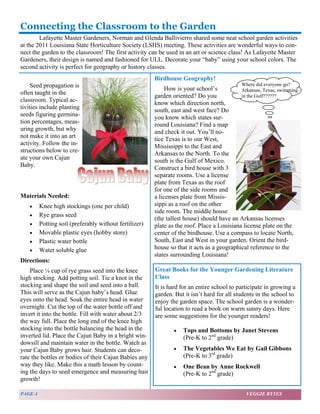
your own Cajun 
Baby. 
Materials Needed: 
• Knee high stockings (one per child) 
• Rye grass seed 
• Potting soil (preferably without fertilizer) 
• Movable plastic eyes (hobby store) 
• Plastic water bottle 
• Water soluble glue 
Directions: 
Place ¼ cup of rye grass seed into the knee 
high stocking. Add potting soil. Tie a knot in the 
stocking and shape the soil and seed into a ball. 
This will serve as the Cajun baby’s head. Glue 
eyes onto the head. Soak the entire head in water 
overnight. Cut the top of the water bottle off and 
invert it into the bottle. Fill with water about 2/3 
the way full. Place the long end of the knee high 
stocking into the bottle balancing the head in the 
inverted lid. Place the Cajun Baby in a bright win-dowsill 
and maintain water in the bottle. Watch as 
your Cajun Baby grows hair. Students can deco-rate 
the bottles or bodies of their Cajun Babies any 
way they like. Make this a math lesson by count-ing 
the days to seed emergence and measuring hair 
growth! 
Birdhouse Geography! 
How is your school’s 
garden oriented? Do you 
know which direction north, 
south, east and west face? Do 
you know which states sur-round 
Louisiana? Find a map 
and check it out. You’ll no-tice 
Texas is to our West, 
Mississippi to the East and 
Arkansas to the North. To the 
south is the Gulf of Mexico. 
Construct a bird house with 3 
separate rooms. Use a license 
plate from Texas as the roof 
for one of the side rooms and 
a licenses plate from Missis-sippi 
as a roof on the other 
Where did everyone go? 
Arkansas, Texas, swimming 
in the Gulf?????? 
side room. The middle house 
(the tallest house) should have an Arkansas licenses 
plate as the roof. Place a Louisiana license plate on the 
center of the birdhouse. Use a compass to locate North, 
South, East and West in your garden. Orient the bird-house 
so that it acts as a geographical reference to the 
states surrounding Louisiana! 
Great Books for the Younger Gardening Literature 
Class 
It is hard for an entire school to participate in growing a 
garden. But it isn’t hard for all students in the school to 
enjoy the garden space. The school garden is a wonder-ful 
location to read a book on warm sunny days. Here 
are some suggestions for the younger readers! 
• Tops and Bottoms by Janet Stevens 
(Pre-K to 2nd grade) 
• The Vegetables We Eat by Gail Gibbons 
(Pre-K to 3rd grade) 
• One Bean by Anne Rockwell 
(Pre-K to 2nd grade) 
PAGE 4 VEGGIE BYTES
A Patriotic Potato Patch. Continued from Page 1. 
A Patriotic Potato Patch 
The two varieties of potatoes most commonly grown 
in Louisiana are Red LaSoda and Kennebec. You can 
easily find these red and white potatoes at your local 
hardware store or nursery. Purple potatoes will need to be 
ordered online. Potatoes are cut in quarters or halves with 
at least one eye on each piece. Plant pieces about 4 inches 
deep into the soil. As the plants start growing, throw dirt 
up around the base of the plant. This is especially impor-tant 
as the potatoes start forming. You do not want the 
potatoes exposed to sunlight. Potatoes will be ready to 
harvest when half of the vegetative matter turns yellow or 
brown. This generally occurs 90-110 days after planting. 
If you think heavy rains will occur right before harvest… 
harvest the potatoes early! They are very susceptible to 
rot. Small potatoes are better than no potatoes! 
Speaking of Patriotic Gardens if you are in 4H and 
plan to attend 4H summer camp, check out the new Vic-tory 
Garden Track. You’ll learn all about gardening by 
participating in fun pollination relay races, making ter-rariums, 
eating like an insect, and composting with live 
worms! Carly Gillett is the summer track leader. She is a 
Horticulture master’s degree student at LSU and is very 
fun to hang out with. Join her this summer at 4H camp in 
the Victory Garden track! It’s a yummy idea. 
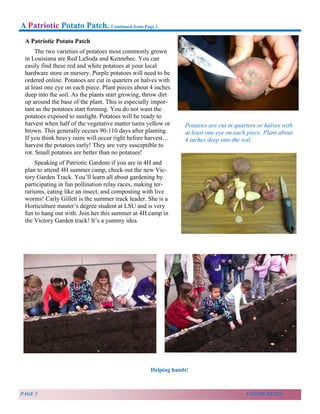
Potatoes are cut in quarters or halves with 
at least one eye on each piece. Plant about 
4 inches deep into the soil. 
Helping hands! 
PAGE 5 VEGGIE BYTES

Feb 2011 Louisiana School Gardening News

  • 1.
    Veggie Bytes 2011 A Patriotic Potato Patch On January 14th, 90 second graders of Valverda Elementary, located near Livonia, La., planted a Patriotic Potato Patch in their school garden. LSU AgCenter Horticulture agents Miles Brashier, Steve Borel and Mark Carriere assisted the young gardeners. The varieties planted included: Mountain Rose, a red skin potato with a pink to red center Purple Viking, a purple/ blue skin potato with a white interior Kennebec, a white skin, white flesh potato Purple Majesty, a purple skin and purple flesh potato Sixty 5th grade students planted Red La Soda, a red skin potato with white flesh in the garden. The following week, sixty 4th graders planted red and white onions. The on-ion varieties they chose to plant were White Bermuda, Southern Red, Texas Granex, 1015, Contessa, Candy and Red Candy Apple. Valverda Elementary has a garden area that is approximately 7000 sq ft. The stu-dent’s plant in long garden beds that are 4 ft wide by 60 ft long. Prior to planting, the agents tilled the soil and fertilized the beds with 13-13-13. Students planted the potato pieces skin side down on 9 inch centers. Not only were the students planting their Patriotic Garden, they were also harvesting a few fall vegetables. Other vegetables grown were beets, shallots (red and white), broc-coli and cabbage. Throughout the school year, a total of 450 students and 22 teachers participated in the Valverda Elementary School Garden. Although Miles, Steve, and Mark are garden pros and have been planting potatoes with school gardeners for several years, this is their first Patriotic Potato Patch. They will create this same themed garden at Rosenwald Elementary, Rougon Elementary and False River Academy. The idea for the Patriotic Potato Patch stemmed from the Victory Gardens grown during WWII when vegetables were grown during the war to help sup-port the families of the men at war. Sometimes vegetables were grown for the soldiers. This garden is a nice tribute to our soldiers and to our country. Additionally, it teaches students where food comes from, that vegetables come in all sizes and colors, and that a little hard work pays off. continued on Page 5 February—April Volume 2, Issue 1 A Patriotic Potato Patch 1 What’s Growing 2 A Closer Look 3 Classroom to the Garden 4 INSIDE THIS ISSUE E-mail: kkfontenot@agcenter.lsu.edu We’re on the Web www.lsuagcenter.com Growing Gardens! Kathryn “KiKi” Fontenot 155 Julian C. Miller Hall Baton Rouge, LA 70803
  • 2.
    What’s Growing! Gardeningtips Start gearing up for your spring vegetable garden now so that you can harvest produce before school lets out for the summer. Typically in Louisiana, spring vegetable crops are not planted outdoors before the last frost date. South Louisiana gardeners can plant around March 15th, North Louisiana gardeners should wait until April 1st. However, if you want to harvest a few ripe tomatoes, peppers, etc before school lets out you’ll need to start transplants indoors. To grow trans-plants, plant seeds into containers in a sterile soil “germinating mix” indoors (in a sunny window). Do not move these transplants or seedlings into the garden until they have developed their first true leaves and after the last chance of frost. See the planting guide for vegetables that can be planted now. Vegetables to plant in February In the garden direct seed: beets, turnips, mustard, parsley, rad-ishes, lettuce, snap beans and Irish potatoes. In the garden plant transplants of: broccoli, cauliflower, cabbage, and lettuce. In the classroom: start transplants of tomatoes, peppers, and egg-plant. Vegetables to Plant in March In the garden direct seed: snap beans, Swiss chard, radish, lettuce, collard greens, mustards, and turnips. In the garden plant transplants of: tomatoes, peppers and egg-plants. In the classroom: start cucumber transplants, plant after last frost. Vegetables to plant in April In the garden direct seed: snap beans, butter beans, radish, col-lards, and cucumbers. In the garden transplant: sweet potato slips, tomatoes, peppers, and eggplant. If you have a year-round school program or summer classes that will care for and work in the garden you can also plant the following vegetables. Sweet corn can be directly seeded into the garden in LATE February. Plant cantaloupes, squash, cucumbers, and water-melons well after danger of frost is over this is usually after March 15th in south Louisiana and closer to April 1 in North Louisiana. Okra, Southern peas (field peas), peanuts, pumpkins, winter squash, summer squash, and sweet corn can be direct seeded into the garden in April. These vegetables are not generally recommended for school gardens that will not be tended by students during the summer. Students should be allowed to harvest everything they plant. How does your garden grow? Do you have a school garden project? It could be featured in an issue of Veggie Bytes. Scholarship Information for Graduating Seniors! Have you enjoyed gardening at your school? Are you interested in pursuing a degree in plant sciences? Are you a high school senior? If so, check out the National School Plant Management Association’s scholarship at www.nspma.org. This group is giving $500-$1500.00 to students who would like to earn an associates or bachelor degree from an accredited university. Fill out the scholarship package at the www.nspma.org website. Place your cursor over “Scholarships and Trust” and click on the second highlighted item “Scholarship 2011 Application Forms.” The due date is March 1, 2011. It must be received by the NSPMA by this date by postal mail. The deadline is soon! Good luck to all college-bound high school seniors. PAGE 2 VEGGIE BYTES
  • 3.
    A Closer Look Many school gardeners planted strawberries in their gardens in September and October. Your ber-ries should have increased in size and have grown multiple crowns since they’ve been planted. Hope-fully you have harvested a couple of berries by now. As the temperature rises, you will be harvesting more and more. Aside from watering, fertilizing and covering your strawberry plants from freezing tem-peratures, have you really looked at your plants? Find a few hand lenses or microscopes and start observing. Under the hand lens or microscope, ob-serve a leaf. Do you notice anything that you had not seen before? You should see tiny hairs on both sides of the leaf. Plants have hair but we don’t call it hair. The scientific term for plant hair is “pubescence”. Pubescence has a function. Some sci-entists think that plants have evolved pubescence as a result of living in stressful environments. There are many possible functions of pubescence. Pubes-cence is thought to slow down air movement around stomata (small holes in a leaf’s surface that allow transpiration to occur). On windy days, the pubes-cence protects the stomata from the direct wind and thus slows down transpiration. If too much transpi-ration occurs a plant will wilt. Pubescence may also act as a blanket as help protect the plant from freez-ing temperatures. Because pubescent plants have a fuzzy feel, many herbivores don’t like the way they taste. Individual pubescence on the leaf surface shades the leave. This is important in extremely hot and sunny environments like deserts. Can you imag-ine why your strawberry plants have pubescence? Now look closely at the underside of the leaf. Focus on the midrib or vein. Did you see anything moving? Look closely! If you have been covering your strawberries for freeze protection, you might have encouraged mites to come to your plants. Some mites are beneficial and some are pests. Look care-fully at the mites. If they have two dark spots on their body, spray horticulture oil or use a liquid dish detergent mixed with water to suds up your plants. Both soapy water and horticulture oil will smoother the mites. Mites will slow down strawberry growth so watch carefully for them. Do you have any berries on your plants? Look closely at the berries. See the seeds? Strawberries are unique because unlike other fruits and vegetables, strawberries contain their seeds on the outside of their flesh. Did you know each berry has approximately 200 seeds? Go ahead count them! Here is a neat strawberry fact. The little brown seed -like structures that get stuck in our teeth when you eat strawberries really aren’t seeds at all. I know I just re-ferred to them as seeds but they are really achenes or nuts! Yes Nuts! Inside each nut is a tiny seed. The red flesh that we think of as the fruit is different than most fruits too. It is accessory tissue. Most fruit that we eat is ovarian tissue. Technically a strawberry really isn’t a fruit even though we say it is! Wait! You are not finished observing yet. Look closely at the flower while you have your hand lenses and microscopes out. .Do you notice anything? A strawberry plant has a perfect flower. Perfect meaning that the flower has both male (stamen [anther and fila-ment]) and female (stigma, style, and ovary) parts. This one flower can successfully pollinate itself. Look at the diagram of the flower below. Does the drawing match the flower on your strawberry plant? Can you locate the male and female parts of the flower on your strawberry plants? Try this easy strawberry shortcake recipe with your students! Prep Time: 15 minutes Total Time: 15 minutes Yield: 6 servings Ingredients: 1 pre-baked loaf of pound cake or 1 angel food cake 3 cups strawberries, hulled and sliced 1 cup heavy cream 3 Tbsp. powdered sugar 1 tsp. vanilla Or ready-made whip cream Preparation: Use a potato masher to mash half of the strawberries in a bowl. Stir in the sliced strawberries and chill. Beat the cream with powdered sugar and vanilla until it from soft peaks. Slice the pound cake. Place one slice of cake on a plate and cover with the strawberry mixture and a dollop of cream. Serve immediately. PAGE 3 VEGGIE BYTES
  • 4.
    Connecting the Classroomto the Garden Lafayette Master Gardeners, Norman and Glenda Ballivierro shared some neat school garden activities at the 2011 Louisiana State Horticulture Society (LSHS) meeting. These activities are wonderful ways to con-nect the garden to the classroom! The first activity can be used in an art or science class! As Lafayette Master Gardeners, their design is named and fashioned for ULL. Decorate your “baby” using your school colors. The second activity is perfect for geography or history classes. Seed propagation is often taught in the classroom. Typical ac-tivities include planting seeds figuring germina-tion percentages, meas-uring growth, but why not make it into an art activity. Follow the in-structions below to cre-ate your own Cajun Baby. Materials Needed: • Knee high stockings (one per child) • Rye grass seed • Potting soil (preferably without fertilizer) • Movable plastic eyes (hobby store) • Plastic water bottle • Water soluble glue Directions: Place ¼ cup of rye grass seed into the knee high stocking. Add potting soil. Tie a knot in the stocking and shape the soil and seed into a ball. This will serve as the Cajun baby’s head. Glue eyes onto the head. Soak the entire head in water overnight. Cut the top of the water bottle off and invert it into the bottle. Fill with water about 2/3 the way full. Place the long end of the knee high stocking into the bottle balancing the head in the inverted lid. Place the Cajun Baby in a bright win-dowsill and maintain water in the bottle. Watch as your Cajun Baby grows hair. Students can deco-rate the bottles or bodies of their Cajun Babies any way they like. Make this a math lesson by count-ing the days to seed emergence and measuring hair growth! Birdhouse Geography! How is your school’s garden oriented? Do you know which direction north, south, east and west face? Do you know which states sur-round Louisiana? Find a map and check it out. You’ll no-tice Texas is to our West, Mississippi to the East and Arkansas to the North. To the south is the Gulf of Mexico. Construct a bird house with 3 separate rooms. Use a license plate from Texas as the roof for one of the side rooms and a licenses plate from Missis-sippi as a roof on the other Where did everyone go? Arkansas, Texas, swimming in the Gulf?????? side room. The middle house (the tallest house) should have an Arkansas licenses plate as the roof. Place a Louisiana license plate on the center of the birdhouse. Use a compass to locate North, South, East and West in your garden. Orient the bird-house so that it acts as a geographical reference to the states surrounding Louisiana! Great Books for the Younger Gardening Literature Class It is hard for an entire school to participate in growing a garden. But it isn’t hard for all students in the school to enjoy the garden space. The school garden is a wonder-ful location to read a book on warm sunny days. Here are some suggestions for the younger readers! • Tops and Bottoms by Janet Stevens (Pre-K to 2nd grade) • The Vegetables We Eat by Gail Gibbons (Pre-K to 3rd grade) • One Bean by Anne Rockwell (Pre-K to 2nd grade) PAGE 4 VEGGIE BYTES
  • 5.
    A Patriotic PotatoPatch. Continued from Page 1. A Patriotic Potato Patch The two varieties of potatoes most commonly grown in Louisiana are Red LaSoda and Kennebec. You can easily find these red and white potatoes at your local hardware store or nursery. Purple potatoes will need to be ordered online. Potatoes are cut in quarters or halves with at least one eye on each piece. Plant pieces about 4 inches deep into the soil. As the plants start growing, throw dirt up around the base of the plant. This is especially impor-tant as the potatoes start forming. You do not want the potatoes exposed to sunlight. Potatoes will be ready to harvest when half of the vegetative matter turns yellow or brown. This generally occurs 90-110 days after planting. If you think heavy rains will occur right before harvest… harvest the potatoes early! They are very susceptible to rot. Small potatoes are better than no potatoes! Speaking of Patriotic Gardens if you are in 4H and plan to attend 4H summer camp, check out the new Vic-tory Garden Track. You’ll learn all about gardening by participating in fun pollination relay races, making ter-rariums, eating like an insect, and composting with live worms! Carly Gillett is the summer track leader. She is a Horticulture master’s degree student at LSU and is very fun to hang out with. Join her this summer at 4H camp in the Victory Garden track! It’s a yummy idea. Potatoes are cut in quarters or halves with at least one eye on each piece. Plant about 4 inches deep into the soil. Helping hands! PAGE 5 VEGGIE BYTES