SCALES 
Integrated Pest Management for Home Gardeners and Landscape Professionals 
Scale insects can be serious pests on 
trees, shrubs, and other perennials. 
The impact of infestations depends 
on the scale species, the plant species 
and cultivar, environmental factors, 
and natural enemies. Populations of 
some scales can increase dramatically 
within a few months, such as when 
honeydew-seeking ants or dusty 
conditions interfere with scale natural 
enemies. Plants are not harmed by a 
few scales, and even high populations 
of certain species apparently do not 
damage plants. Soft scales and some 
other species excrete honeydew, a sweet, 
sticky liquid produced by insects that 
ingest large quantities of plant sap. 
Sticky honeydew and the blackish sooty 
mold growing on honeydew can bother 
people even when scale populations are 
not harming plants. 
IDENTIFICATION 
Scales are unusual looking and many 
people do not at first recognize them as 
insects. Adult female scales and most 
immatures (nymphs) are immobile, 
wingless, and lack a separate head 
or other recognizable body parts. 
Immature scales and adult females 
have a characteristic round or oval 
to elongate and flattened or humped 
appearance. Immature males are often a 
different color and shape than females, 
especially in later nymphal stages 
(instars). Adult male scales are tiny, 
delicate insects with one pair of wings. 
Adult males are rarely seen, do not feed, 
and live only a few hours. 
Scales insert a tiny strawlike mouthpart 
into plants and suck fluids. Scales can 
occur on bark, fruit, or leaves. Armored 
scales and soft scales are the most 
common groups (families). Common 
species of scales and their tree and 
shrub hosts are listed in Tables 1–3. 
Excellent color keys for scale insects 
in California are available from the 
California Department of Food and 
Agriculture; see References for titles. 
It is important to correctly distinguish 
the scale family to which your pest 
species belongs. For example, a popular 
systemic insecticide (imidacloprid, 
discussed below) controls European 
elm scale and most soft scales but 
does not control armored scales or 
cottony cushion scale. Imidacloprid 
can dramatically increase cottony 
cushion scale populations because it is 
very toxic to one of its natural enemies, 
the vedalia beetle, Rodolia cardinalis. 
This important cottony cushion scale 
predator is poisoned by feeding on 
scales that have ingested the insecticide. 
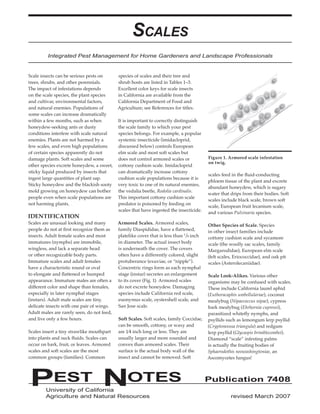
Armored Scales. Armored scales, 
family Diaspididae, have a flattened, 
platelike cover that is less than 1/8 inch 
in diameter. The actual insect body 
is underneath the cover. The covers 
often have a differently colored, slight 
protuberance (exuviae, or “nipple”). 
Concentric rings form as each nymphal 
stage (instar) secretes an enlargement 
to its cover (Fig. 1). Armored scales 
do not excrete honeydew. Damaging 
species include California red scale, 
euonymus scale, oystershell scale, and 
San Jose scale. 
Soft Scales. Soft scales, family Coccidae, 
can be smooth, cottony, or waxy and 
are 1⁄4 inch long or less. They are 
usually larger and more rounded and 
convex than armored scales. Their 
surface is the actual body wall of the 
insect and cannot be removed. Soft 
Figure 1. Armored scale infestation 
on twig. 
scales feed in the fluid-conducting 
phloem tissue of the plant and excrete 
abundant honeydew, which is sugary 
water that drips from their bodies. Soft 
scales include black scale, brown soft 
scale, European fruit lecanium scale, 
and various Pulvinaria species. 
Other Species of Scale. Species 
in other insect families include 
cottony cushion scale and sycamore 
scale (the woolly sac scales, family 
Margarodidae), European elm scale 
(felt scales, Eriococcidae), and oak pit 
scales (Asterolecaniidae). 
Scale Look-Alikes. Various other 
organisms may be confused with scales. 
These include California laurel aphid 
(Euthoracaphis umbellulariae), coconut 
mealybug (Nipaecoccus nipae), cypress 
bark mealybug (Ehrhornia cupressi), 
parasitized whitefly nymphs, and 
psyllids such as lemongum lerp psyllid 
(Cryptoneossa triangula) and redgum 
lerp psyllid (Glycaspis brimblecombei). 
Diamond “scale” infesting palms 
is actually the fruiting bodies of 
Sphaerodothis neowashingtoniae, an 
Ascomycetes fungus! 
PEST NOTES Publication 7408 
University of California 
Agriculture and Natural Resources 
revised March 2007
March 2007 Scales 
◆ 2 of 8 ◆ 
LIFE CYCLE 
Females of many scale species 
reproduce without mating (there are 
no males). At maturity, adult females 
produce eggs that are usually hidden 
under her body or cover. Eggs hatch 
into tiny crawlers (mobile first-instar 
nymphs), which are yellow to orangish 
in most species. Crawlers walk over 
the plant surface, are blown by wind 
to other plants, or can be inadvertently 
moved by people or birds. They settle 
down and begin feeding within a day 
or two after emergence. 
Settled nymphs may spend their entire 
life in the same spot without moving 
as they mature into adults. Nymphs 
of other species can move slowly 
but rarely do, such as when species 
that feed on deciduous hosts move 
from foliage to bark in the fall before 
leaves drop. For species with multiple 
generations, all scale life stages may 
be present throughout the year in 
areas with mild winters. Life cycles 
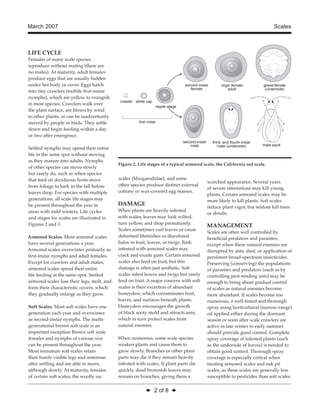
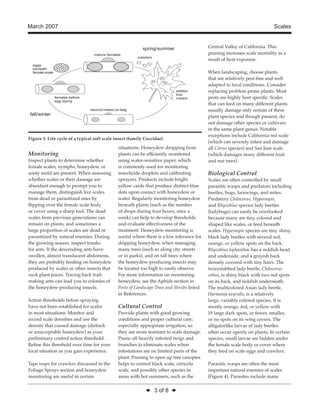
and stages for scales are illustrated in 
Figures 2 and 3. 
Armored Scales. Most armored scales 
have several generations a year. 
Armored scales overwinter primarily as 
first-instar nymphs and adult females. 
Except for crawlers and adult males, 
armored scales spend their entire 
life feeding at the same spot. Settled 
armored scales lose their legs, molt, and 
form their characteristic covers, which 
they gradually enlarge as they grow. 
Soft Scales. Most soft scales have one 
generation each year and overwinter 
as second-instar nymphs. The multi-generational 
brown soft scale is an 
important exception Brown soft scale 
females and nymphs of various size 
can be present throughout the year. 
Most immature soft scales retain 
their barely visible legs and antennae 
after settling and are able to move, 
although slowly. At maturity, females 
of certain soft scales, the woolly sac 
scales (Margarodidae), and some 
other species produce distinct external 
cottony or wax-covered egg masses. 
DAMAGE 
When plants are heavily infested 
with scales, leaves may look wilted, 
turn yellow, and drop prematurely. 
Scales sometimes curl leaves or cause 
deformed blemishes or discolored 
halos in fruit, leaves, or twigs. Bark 
infested with armored scales may 
crack and exude gum. Certain armored 
scales also feed on fruit, but this 
damage is often just aesthetic. Soft 
scales infest leaves and twigs but rarely 
feed on fruit. A major concern with soft 
scales is their excretion of abundant 
honeydew, which contaminates fruit, 
leaves, and surfaces beneath plants. 
Honeydew encourages the growth 
of black sooty mold and attracts ants, 
which in turn protect scales from 
natural enemies. 
When numerous, some scale species 
weaken plants and cause them to 
grow slowly. Branches or other plant 
parts may die if they remain heavily 
infested with scales. If plant parts die 
quickly, dead brownish leaves may 
remain on branches, giving them a 
scorched appearance. Several years 
of severe infestations may kill young 
plants. Certain armored scales may be 
more likely to kill plants. Soft scales 
reduce plant vigor, but seldom kill trees 
or shrubs. 
MANAGEMENT 
Scales are often well controlled by 
beneficial predators and parasites, 
except when these natural enemies are 
disrupted by ants, dust, or application of 
persistent broad-spectrum insecticides. 
Preserving (conserving) the populations 
of parasites and predators (such as by 
controlling pest-tending ants) may be 
enough to bring about gradual control 
of scales as natural enemies become 
more abundant. If scales become too 
numerous, a well-timed and thorough 
spray using horticultural (narrow-range) 
oil applied either during the dormant 
season or soon after scale crawlers are 
active in late winter to early summer 
should provide good control. Complete 
spray coverage of infested plants (such 
as the underside of leaves) is needed to 
obtain good control. Thorough spray 
coverage is especially critical when 
treating armored scales and oak pit 
scales, as these scales are generally less 
susceptible to pesticides than soft scales. 
crawler white cap 
nipple stage 
second-instar 
female 
second-instar 
male 
virgin female 
adult 
third- and fourth-instar 
male (underside) 
gravid female 
(underside) 
male adult 
first instar 
Figure 2. Life stages of a typical armored scale, the California red scale.
March 2007 Scales 
crawlers 
◆ 3 of 8 ◆ 
mature females 
second instars on twig 
females before 
egg laying 
eggs 
beneath 
female scale 
Monitoring 
Inspect plants to determine whether 
female scales, nymphs, honeydew, or 
sooty mold are present. When assessing 
whether scales or their damage are 
abundant enough to prompt you to 
manage them, distinguish live scales 
from dead or parasitized ones by 
flipping over the female scale body 
or cover using a sharp tool. The dead 
scales from previous generations can 
remain on plants, and sometimes a 
large proportion of scales are dead or 
parasitized by natural enemies. During 
the growing season, inspect trunks 
for ants. If the descending ants have 
swollen, almost translucent abdomens, 
they are probably feeding on honeydew 
produced by scales or other insects that 
suck plant juices. Tracing back trail-making 
ants can lead you to colonies of 
the honeydew-producing insects. 
Action thresholds before spraying 
have not been established for scales 
in most situations. Monitor and 
record scale densities and use the 
density that caused damage (dieback 
or unacceptable honeydew) as your 
preliminary control action threshold. 
Refine this threshold over time for your 
local situation as you gain experience. 
Tape traps for crawlers discussed in the 
Foliage Sprays section and honeydew 
monitoring are useful in certain 
situations. Honeydew dropping from 
plants can be efficiently monitored 
using water-sensitive paper, which 
is commonly used for monitoring 
insecticide droplets and calibrating 
sprayers. Products include bright 
yellow cards that produce distinct blue 
dots upon contact with honeydew or 
water. Regularly monitoring honeydew 
beneath plants (such as the number 
of drops during four hours, once a 
week) can help to develop thresholds 
and evaluate effectiveness of the 
treatment. Honeydew monitoring is 
useful where there is a low tolerance for 
dripping honeydew, when managing 
many trees (such as along city streets 
or in parks), and on tall trees where 
the honeydew-producing insects may 
be located too high to easily observe. 
For more information on monitoring 
honeydew, see the Aphids section in 
Pests of Landscape Trees and Shrubs listed 
in References. 
Cultural Control 
Provide plants with good growing 
conditions and proper cultural care; 
especially appropriate irrigation, so 
they are more resistant to scale damage. 
Prune off heavily infested twigs and 
branches to eliminate scales when 
infestations are on limited parts of the 
plant. Pruning to open up tree canopies 
helps to control black scale, citricola 
scale, and possibly other species in 
areas with hot summers, such as the 
Central Valley of California. This 
pruning increases scale mortality as a 
result of heat exposure. 
When landscaping, choose plants 
that are relatively pest-free and well 
adapted to local conditions. Consider 
replacing problem prone plants. Most 
pests are highly host specific. Scales 
that can feed on many different plants 
usually damage only certain of these 
plant species and though present, do 
not damage other species or cultivars 
in the same plant genus. Notable 
exceptions include California red scale 
(which can severely infest and damage 
all Citrus species) and San Jose scale 
(which damages many different fruit 
and nut trees). 
Biological Control 
Scales are often controlled by small 
parasitic wasps and predators including 
beetles, bugs, lacewings, and mites. 
Predatory Chilocorus, Hyperaspis, 
and Rhyzobius species lady beetles 
(ladybugs) can easily be overlooked 
because many are tiny, colored and 
shaped like scales, or feed beneath 
scales. Hyperaspis species are tiny, shiny, 
black lady beetles with several red, 
orange, or yellow spots on the back. 
Rhyzobius lophanthae has a reddish head 
and underside, and a grayish back 
densely covered with tiny hairs. The 
twicestabbed lady beetle, Chilocorus 
orbus, is shiny black with two red spots 
on its back, and reddish underneath. 
The multicolored Asian lady beetle, 
Harmonia axyridis, is a relatively 
large, variably colored species. It is 
mostly orange, red, or yellow with 
19 large dark spots, or fewer, smaller, 
or no spots on its wing covers. The 
alligatorlike larvae of lady beetles 
often occur openly on plants. In certain 
species, small larvae are hidden under 
the female scale body or cover where 
they feed on scale eggs and crawlers. 
Parasitic wasps are often the most 
important natural enemies of scales 
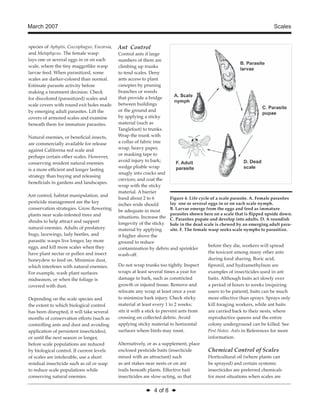
(Figure 4). Parasites include many 
Figure 3. Life cycle of a typical soft scale insect (family Coccidae). 
settled 
first 
instars 
fall/winter 
spring/summer
March 2007 Scales 
Figure 4. Life cycle of a scale parasite. A. Female parasites 
lay one or several eggs in or on each scale nymph. 
B. Larvae emerge from the eggs and feed as immature 
parasites shown here on a scale that is flipped upside down. 
C. Parasites pupate and develop into adults. D. A roundish 
hole in the dead scale is chewed by an emerging adult para-site. 
◆ 4 of 8 ◆ 
species of Aphytis, Coccophagus, Encarsia, 
and Metaphycus. The female wasp 
lays one or several eggs in or on each 
scale, where the tiny maggotlike wasp 
larvae feed. When parasitized, some 
scales are darker-colored than normal. 
Estimate parasite activity before 
making a treatment decision. Check 
for discolored (parasitized) scales and 
scale covers with round exit holes made 
by emerging adult parasites. Lift the 
covers of armored scales and examine 
beneath them for immature parasites. 
Natural enemies, or beneficial insects, 
are commercially available for release 
against California red scale and 
perhaps certain other scales. However, 
conserving resident natural enemies 
is a more efficient and longer lasting 
strategy than buying and releasing 
beneficials in gardens and landscapes. 
Ant control, habitat manipulation, and 
pesticide management are the key 
conservation strategies. Grow flowering 
plants near scale-infested trees and 
shrubs to help attract and support 
natural enemies. Adults of predatory 
bugs, lacewings, lady beetles, and 
parasitic wasps live longer, lay more 
eggs, and kill more scales when they 
have plant nectar or pollen and insect 
honeydew to feed on. Minimize dust, 
which interferes with natural enemies. 
For example, wash plant surfaces 
midseason, or when the foliage is 
covered with dust. 
Depending on the scale species and 
the extent to which biological control 
has been disrupted, it will take several 
months of conservation efforts (such as 
controlling ants and dust and avoiding 
application of persistent insecticides), 
or until the next season or longer, 
before scale populations are reduced 
by biological control. If current levels 
of scales are intolerable, use a short 
residual insecticide such as oil or soap 
to reduce scale populations while 
conserving natural enemies. 
Ant Control 
Control ants if large 
numbers of them are 
climbing up trunks 
to tend scales. Deny 
ants access to plant 
canopies by pruning 
branches or weeds 
that provide a bridge 
between buildings 
or the ground and 
by applying a sticky 
material (such as 
Tanglefoot) to trunks. 
Wrap the trunk with 
a collar of fabric tree 
wrap, heavy paper, 
or masking tape to 
avoid injury to bark; 
wedge pliable wrap 
snugly into cracks and 
crevices; and coat the 
wrap with the sticky 
material. A barrier 
band about 2 to 6 
inches wide should 
be adequate in most 
situations. Increase the 
longevity of the sticky 
material by applying 
it higher above the 
ground to reduce 
contamination by debris and sprinkler 
wash-off. 
F. The female wasp seeks scale nymphs to parasitize. 
before they die, workers will spread 
the toxicant among many other ants 
during food sharing. Boric acid, 
fipronil, and hydramethylnon are 
examples of insecticides used in ant 
baits. Although baits act slowly over 
a period of hours to weeks (requiring 
users to be patient), baits can be much 
more effective than sprays. Sprays only 
kill foraging workers, while ant baits 
are carried back to their nests, where 
reproductive queens and the entire 
colony underground can be killed. See 
Pest Notes: Ants in References for more 
information. 
Chemical Control of Scales 
Horticultural oil (where plants can 
be sprayed) and certain systemic 
insecticides are preferred chemicals 
for most situations when scales are 
Do not wrap trunks too tightly. Inspect 
wraps at least several times a year for 
damage to bark, such as constricted 
growth or injured tissue. Remove and 
relocate any wrap at least once a year 
to minimize bark injury. Check sticky 
material at least every 1 to 2 weeks; 
stir it with a stick to prevent ants from 
crossing on collected debris. Avoid 
applying sticky material to horizontal 
surfaces where birds may roost. 
Alternatively, or as a supplement, place 
enclosed pesticide baits (insecticide 
mixed with an attractant) such 
as ant stakes near nests or on ant 
trails beneath plants. Effective bait 
insecticides are slow-acting, so that
March 2007 Scales 
◆ 5 of 8 ◆ 
numerous enough to cause damage. 
Dormant Season Sprays. Dormant 
season application of a narrow-range 
or horticultural oil is effective against 
most scale pests on deciduous woody 
plants. A good time to apply oil is when 
no rain or fog is expected within a day. 
On leafless host plants, application 
can be made any time when weather 
is suitable during dormancy to control 
lecanium scales, San Jose scale, walnut 
scale, and many other species. For oak 
pit and sycamore scales, spray during 
the delayed-dormant period, which is 
after the buds swell but before buds 
open. Do not spray oystershell or olive 
scales during the dormant season 
because susceptible stages of these 
pests are not present during winter. 
Oil Use and Precautions. Horticultural 
oils are specially refined petroleum 
products, often called narrow-range, 
superior, or supreme oils. Some 
botanical (plant-derived) oils are also 
available. Thoroughly spraying plants 
at the proper time with oil alone 
usually provides adequate control. One 
study of sycamore scale found that 
organophosphates (e.g., malathion) or 
organophosphates combined with oil 
were no more effective than a thorough 
spray of oil or insecticidal soap alone, 
if properly timed during the delayed-dormant 
period. Another study of 
citricola scale on hackberry found 
spraying oil on foliage once during late 
spring after most crawlers emerged 
was as effective as using a systemic 
organophosphate (acephate). 
Avoid products called dormant oil or 
dormant oil emulsions. These are more 
likely to injure plants. Do not apply oil 
when it is foggy, freezing (under 32°F), 
hot (over 90°F), or rainy, or within a day 
of when these conditions are expected. 
If leaves are present, to avoid oil injury, 
be sure only to apply to well watered 
plants. Do not apply horticultural oil to 
deciduous trees within 30 days before or 
after application of captan, sulfur, or certain 
other fungicides to avoid damage to trees. 
TABLE 1. Some Common Armored Scales (Diaspididae), Their Impact in California, and the Principal Hosts. 
Common Name (Scientific Name) Susceptible Hosts and Impact Hosts Usually Not Damaged 
California red scale (Aonidiella aurantii) citrus highly susceptible in Central 
Valley; biologically controlled in 
Southern California 
acacia, boxwood, eugenia, euonymus, grape, 
magnolia, mulberry, olive, palm, podocarpus, 
privet, rose 
cycad scale (Furchadaspis zamiae) cycads (sago palm) severely infested bird-of-paradise 
euonymus scale (Unaspis euonymi) Euonymus japonica highly 
susceptible 
Euonymus kiautschovica (=E. sieboldiana) 
tolerant, E. alata unaffected 
greedy scale (Hemiberlesia rapax) generally not damaging acacia, bay, boxwood, ceanothus, cactus, fruit 
trees, holly, ivy, laurel, magnolia, manzanita, palm, 
pepper tree, pittosporum, pyracantha, redbud, 
strawberry tree, willow 
latania scale (Hemiberlesia lataniae) generally not damaging, except on 
kiwifruit 
acacia, avocado, Cedrus, English ivy, euonymus, 
Fatsia, fuchsia, gladiolus, grevillea, Kentia, 
philodendron, rose, Rubus, Salix, yucca 
minute cypress scale (Carulaspis minima) Cupressus sempervirens highly 
susceptible 
arborvitae, cypress, juniper 
obscure scale (Melanaspis obscura) biologically controlled chestnut, oaks, pecan 
oleander scale (Aspidiotus nerii) generally not damaging acacia, aucuba, bay, boxwood, cactus, holly, ivy, 
laurel, magnolia, manzanita, maple, mulberry, 
oleander, olive, palm, pepper tree, redbud, sago 
palm or cycad, Taxus (yew), yucca 
olive scale (Parlatoria oleae) biologically controlled olive 
oystershell scale (Lepidosaphes ulmi) poplars and willows especially 
susceptible 
alder, aspen, box elder, boxwood, ceanothus, 
cottonwood, most deciduous fruit and nuts, holly, 
maple, sycamore 
purple scale (Lepidosaphes beckii) biologically controlled citrus 
San Jose scale (Quadraspidiotus 
nut and stone fruit trees can be 
perniciosus) 
highly susceptible 
acacia, aspen, citrus, cottonwood, most maple, 
mulberry, poplar, pyracantha, rose, strawberry 
tree, willow 
walnut scale (Quadraspidiotus juglansregiae) biologically controlled walnut 
“Biologically controlled” species are usually not damaging, but can become pests if their natural enemies are disrupted by ants, dust, or 
application of persistant broad-spectrum insecticides.
March 2007 Scales 
◆ 6 of 8 ◆ 
Foliage Sprays. Horticultural oil is 
effective in spring or summer on 
deciduous plants when sprayed soon 
after most crawlers have emerged. Late 
spring and summer are also the times 
to spray avocado, citrus, and many 
other broadleaf evergreens. Foliage-season 
application requires more spray 
volume on deciduous plants than a 
dormant treatment because leaves 
as well as bark must be thoroughly 
covered. Spring or summer sprays 
should thoroughly cover plant parts 
where most scales occur (typically 
twigs and the underside of leaves) 
and be well timed to occur when most 
scales are crawlers or young nymphs, 
the most susceptible stages. 
To effectively time a spray of leafy 
plants, use traps made of double-sided 
sticky tape to determine when crawlers 
are hatching. Before crawlers begin 
to emerge in spring, tightly encircle 
several infested twigs or branches 
with transparent tape that is sticky 
on both sides (this tape is available 
at stationery stores). Change the 
tapes approximately once a week and 
examine the tapes with a hand lens 
to identify the crawlers. Once scale 
eggs begin hatching, scale crawlers 
get stuck on the tapes and appear as 
yellow or orange specks. Spray after 
crawler production has peaked and 
the number trapped each week has 
definitely declined, which is soon after 
most crawlers have settled. For more 
information on sticky tape monitoring, 
consult Pests of Landscape Trees and 
Shrubs, listed in References. 
In addition to narrow-range oil, 
insecticidal soap or a mixture of oil 
and soap can be sprayed. Carbamate 
insecticides (carbaryl or Sevin), 
organophosphates (e.g., malathion), 
and pyrethroids (e.g., bifenthrin 
and cyfluthrin) are other contact 
insecticides registered for scale control. 
However, these more persistent 
insecticides cause greater disruption 
of biological control than oil or soap 
because persistent residues continue to 
kill or intoxicate beneficial insects and 
mites migrating in after the application. 
It is also best to avoid the more 
persistent sprays because of problems 
from their runoff into urban surface 
water and contaminating municipal 
wastewater. 
Systemic Insecticides. Systemic 
insecticides are absorbed and moved 
within plants. If the plant is infested 
with a scale species susceptible to 
systemic insecticide, systemics are 
particularly useful where it is not 
practical to spray because plants are 
large or spray may drift to unintended 
areas. Depending on the product, 
systemic insecticide may be applied 
by spraying foliage, injection or 
implantation into trunk vascular tissue, 
or applying on or into soil beneath 
trees and shrubs, where the insecticide 
is absorbed by roots. 
A soil application of the systemic 
insecticide imidacloprid can provide 
season-long control of soft scales 
and certain other species such as 
European elm scale. Imidacloprid is 
not effective on armored scales and 
certain other species such as cottony 
cushion scale. Imidacloprid is available 
to both homeowners (Bayer Advanced 
Garden Tree & Shrub Insect Control) 
and professional applicators (Merit and 
others). Imidacloprid can be effective 
when applied to soil during late winter 
to early spring or before rainfall or 
irrigation are expected to facilitate root 
Figure 5. When applying systemic pesticides to trees, make an application to soil whenever possible as directed on product 
labels instead of injecting or implanting trunks with pesticides. Injecting or implanting trunks injures trees and can introduce 
or facilitate entry of plant pathogens.
March 2007 Scales 
TABLE 2. Some Common Soft Scales (Coccidae), Their Impact in California, and the Principal Hosts. 
Common Name (Scientific Name) Susceptible Hosts and Impact Hosts Usually Not Damaged 
black scale (Saissetia oleae) sometimes annoyingly abundant 
away from the coast and if ant-tended 
◆ 7 of 8 ◆ 
aspen, bay, citrus, cottonwood, coyote bush, holly, 
maple, mayten, oleander, olive, palm, pear, pepper 
tree, pistachio, poplar, privet, stone fruit, strawberry 
tree, walnut 
brown soft scale (Coccus hesperidum) annoyingly abundant if ant-tended aspen, avocado, citrus, cottonwood, holly, manzanita, 
palm, poplar, stone fruit, strawberry tree, willow 
calico scale (Eulecanium cerasorum) liquidambar sometimes damaged box elder, maple, stone fruit, walnut 
citricola scale (Coccus 
pseudomagnoliarum) 
citrus and hackberry sometimes 
damaged in Central Valley; 
biologically controlled in Southern 
California 
elm, pomegranate, walnut 
European fruit lecanium, also called 
brown apricot scale (Parthenolecanium 
corni) 
annoying abundant sometimes alder, almond, aspen, cottonwood, elm, grape, pear, 
pistachio, poplar, stone fruit, toyon, walnut 
frosted scale (Parthenolecanium 
pruinosum) 
walnut sometimes damaged ash, birch, elm, laurel, locust, pistachio, rose, 
sycamore 
green shield scale (Pulvinaria psidii) all plants with this scale are 
quarantined, under eradication or 
regulatory control 
aralia, begonia, camellia, croton, eugenia, gardenia, 
hibiscus, laurel fig or Indian laurel (Ficus retusa), 
pepper tree, pittosporum, plumeria, Schefflera 
irregular pine scale (Toumeyella pinicola) Monterey pine infested, mostly in 
Bay Area 
other pines 
Kuno scale (Eulecanium kunoense) stone fruit sometimes damaged, 
especially plum 
cotoneaster, pyracantha, rose, walnut 
tuliptree scale (Toumeyella liriodendri) deciduous magnolias and tuliptree 
(yellow poplar) highly susceptible 
gardenia, linden 
wax scales, including barnacle and 
Chinese wax scales (Ceroplastes spp.) 
annoyingly abundant sometimes 
on Escallonia, gardenia, Geijera 
parviflora, and mayten 
California bay laurel, citrus, coyote bush, holly, 
Mahonia, pepper tree 
TABLE 3. Some Common Scales in Other Families, Their Importance in California, and the Principal Hosts. 
Common Name (Scientific Name) Susceptible Hosts and Impact Hosts Usually Not Damaged 
cottony cushion scale1 (Icerya purchasi, family 
Margarodidae) 
Cocculus laurifolius highly 
susceptible, biologically controlled 
on other hosts 
citrus, nandina, pittosporum2 
European elm scale (Gossyparia spuria, Eriococcidae) American and Chinese elms 
especially susceptible 
other elms 
oak pit scales3 (Asterolecanium spp., Asterolecaniidae) Quercus lobata, Q. douglasii, and 
Q. rober highly susceptible 
other oaks 
sycamore scale4 (Stomacoccus platani, family 
Margarodidae) 
London plane and sycamore 
susceptible 
— 
1 See Pest Notes: Cottony Cushion Scale, UC ANR Publication 7410 
2 Cottony cushion scale can harm “Hosts Usually Not Damaged” if natural enemies are disrupted, such as by application of certain 
persistent insecticides. 
3 See Pest Notes: Oak Pit Scales, UC ANR Publication 7470 
4 See Pest Notes: Sycamore Scale, UC ANR Publication 7409
March 2007 Scales 
WARNING ON THE USE OF CHEMICALS 
Pesticides are poisonous. Always read and carefully follow all precautions and safety recommendations 
given on the container label. Store all chemicals in the original labeled containers in a locked cabinet or shed, 
away from food or feeds, and out of the reach of children, unauthorized persons, pets, and livestock. 
Pesticides applied in your home and landscape can move and contaminate creeks, lakes, and rivers. 
Confine chemicals to the property being treated. Avoid drift onto neighboring properties, especially gardens 
containing fruits or vegetables ready to be picked. 
Do not place containers containing pesticide in the trash or pour pesticides down sink or toilet. Either use 
the pesticide according to the label or take unwanted pesticides to a Household Hazardous Waste Collection 
site. Contact your county agricultural commissioner for additional information on safe container disposal and 
for the location of the Household Hazardous Waste Collection site nearest you. Dispose of empty containers 
by following label directions. Never reuse or burn the containers or dispose of them in such a manner that 
they may contaminate water supplies or natural waterways. 
The University of California prohibits discrimination or harassment of any person on the basis of race, 
color, national origin, religion, sex, gender identity, pregnancy (including childbirth, and medical condi-tions 
related to pregnancy or childbirth), physical or mental disability, medical condition (cancer-related 
or genetic characteristics), ancestry, marital status, age, sexual orientation, citizenship, or status as a 
covered veteran (covered veterans are special disabled veterans, recently separated veterans, Vietnam 
era veterans, or any other veterans who served on active duty during a war or in a campaign or expedi-tion 
for which a campaign badge has been authorized) in any of its programs or activities. University 
policy is intended to be consistent with the provisions of applicable State and Federal laws. Inquiries 
regarding the University’s nondiscrimination policies may be directed to the Affirmative Action/Staff 
Personnel Services Director, University of California, Agriculture and Natural Resources, 300 Lakeside 
Drive, 6th Floor, Oakland, CA 94612-3550, (510) 987-0096. 
◆ 8 of 8 ◆ 
For more information contact the University 
of California Cooperative Extension in your county. 
See your telephone directory for addresses and 
phone numbers. 
AUTHORS: S. H. Dreistadt, UC Statewide IPM 
Program, Davis; J. G. Morse, Entomology, UC Riv-erside; 
P. A. Phillips, UC Statewide IPM Program, 
Ventura Co.; R. E. Rice, Entomology, emeritus, 
Kearney Agricultural Center, Parlier 
TECHNICAL EDITOR: M. L. Flint 
COORDINATION & PRODUCTION: P. N. Galin 
ILLUSTRATIONS: Fig. 1: V. Winemiller; Fig. 2: D. 
Kidd; Fig. 3: S. H. Dreistadt; Fig. 4: adapted from 
H. J. Quayle. 1938. Insects of Citrus and other 
Subtropical Fruits. Ithaca, NY: Comstock; Fig. 5: 
adapted from S. H., Dreistadt, J. K. Clark, and 
M. L. Flint. 2004. Pests of Landscape Trees and 
Shrubs: An Integrated Pest Management Guide. 
UC Statewide IPM Program. Oakland: Univ. Calif. 
Agric. Nat. Res. Publ. 3359 
Produced by IPM Education & Publications, 
UC Statewide IPM Program, University of 
California, Davis, CA 95616-8620 
This Pest Note is available on the 
World Wide Web (www.ipm.ucdavis.edu) 
This publication has been anonymously peer 
reviewed for technical accuracy by University of Cali-fornia 
scientists and other qualified professionals. This 
review process was managed by the ANR Associate 
Editor for Pest Management. 
To simplify information, trade names of products 
have been used. No endorsement of named products 
is intended, nor is criticism implied of similar products 
that are not mentioned. 
This material is partially based upon work supported by 
the Extension Service, U.S. Department of Agriculture, 
under special project Section 3(d), Integrated Pest 
Management. 
trunks (Figure 5). It is difficult to place 
insecticide into trunks at the proper 
depth. Also, unsterilized injection tools 
contacting internal parts of multiple 
plants may mechanically spread certain 
plant pathogens, including bacteria 
(e.g., slime flux or wetwood), fungi 
(e.g., vascular wilt pathogens), and 
viruses. The physical act of penetrating 
trunks during injections injures plants. 
Especially avoid methods that cause 
large wounds, which may lead to wood 
decay. Do not inject or implant trunks 
more than once a year. 
REFERENCES 
Dreistadt, S. H., J. K. Clark, and M. L. 
Flint. 2004. Pests of Landscape Trees and 
Shrubs: An Integrated Pest Management 
Guide, UC Statewide IPM Program. 
Oakland: Univ. Calif. Agric. Nat. Res. 
Publ. 3359. 
Flint, M. L. 1998. Pests of the Garden 
and Small Farm: A Grower’s Guide to 
Using Less Pesticide. UC Statewide IPM 
Program. Oakland: Univ. Calif. Agric. 
Nat. Res. Publ. 3332. 
Flint, M. L., and S. H. Dreistadt. 1998. 
Natural Enemies Handbook: The Illustrated 
Guide to Biological Pest Control. UC 
Statewide IPM Program. Oakland: 
Univ. Calif. Agric. Nat. Res. Publ. 3386. 
Geisel, P., and E. Perry. 2004. Pest 
Notes: Oak Pit Scales. UC Statewide IPM 
Program. Oakland: Univ. Calif. Agric. 
Nat. Res. Publ. 7470. Also available 
online at www.ipm.ucdavis.edu. 
Gill, R. J. 1982. Color-Photo and Host Keys 
to the Armored Scales of California. Scale 
and Whitefly Key #5. Sacramento: Calif. 
Dept. Food Agric. 
Gill, R. J. 1982. Color-Photo and Host Keys 
to the Soft Scales of California. Scale and 
Whitefly Key #4. Sacramento: Calif. 
Dept. Food & Agric. 
Gill, R. J. 1988-1997. The Scale Insects of 
California Parts 1–3. Sacramento: Calif. 
Dept. Food & Agric. 
Grafton-Cardwell, E. E. 2003. Pest 
Notes: Cottony Cushion Scale. UC 
Statewide IPM Program. Oakland: Univ. 
Calif. Agric. Nat. Res. Publ. 7410. Also 
available online at www.ipm 
.ucdavis.edu 
Klotz, J., and M. Rust. 2005. Pest Notes: 
Ants. UC Statewide IPM Program. 
Oakland: Univ. Calif. Div. Agric. Nat. 
Res. Publ. 7411. Also available online at 
www.ipm.ucdavis.edu 
UC Statewide IPM Project. 2000. Pest 
Notes: Sycamore Scale. Oakland: Univ. 
Calif. Agric. Nat. Res. Publ. 7409. Also 
available online at www.ipm.ucdavis 
.edu ❖ 
absorption of the insecticide. Summer 
application to stressed, heavily infested 
trees is less likely to be effective and is 
not recommended. 
Certain other systemic insecticides are 
also available, but only to professional 
applicators. For example, dinotefuran 
(Safari) is a neonicotinoid (in the same 
chemical group as imidacloprid) that 
can be sprayed onto foliage or applied 
onto soil or through certain irrigation 
systems, especially to control cycad 
scale and soft scales. 
Injecting Trunks. When using systemics, 
consider making a soil application 
whenever possible instead of spraying 
foliage or injecting or implanting

Scales Integrated Pest Management

  • 1.
    SCALES Integrated PestManagement for Home Gardeners and Landscape Professionals Scale insects can be serious pests on trees, shrubs, and other perennials. The impact of infestations depends on the scale species, the plant species and cultivar, environmental factors, and natural enemies. Populations of some scales can increase dramatically within a few months, such as when honeydew-seeking ants or dusty conditions interfere with scale natural enemies. Plants are not harmed by a few scales, and even high populations of certain species apparently do not damage plants. Soft scales and some other species excrete honeydew, a sweet, sticky liquid produced by insects that ingest large quantities of plant sap. Sticky honeydew and the blackish sooty mold growing on honeydew can bother people even when scale populations are not harming plants. IDENTIFICATION Scales are unusual looking and many people do not at first recognize them as insects. Adult female scales and most immatures (nymphs) are immobile, wingless, and lack a separate head or other recognizable body parts. Immature scales and adult females have a characteristic round or oval to elongate and flattened or humped appearance. Immature males are often a different color and shape than females, especially in later nymphal stages (instars). Adult male scales are tiny, delicate insects with one pair of wings. Adult males are rarely seen, do not feed, and live only a few hours. Scales insert a tiny strawlike mouthpart into plants and suck fluids. Scales can occur on bark, fruit, or leaves. Armored scales and soft scales are the most common groups (families). Common species of scales and their tree and shrub hosts are listed in Tables 1–3. Excellent color keys for scale insects in California are available from the California Department of Food and Agriculture; see References for titles. It is important to correctly distinguish the scale family to which your pest species belongs. For example, a popular systemic insecticide (imidacloprid, discussed below) controls European elm scale and most soft scales but does not control armored scales or cottony cushion scale. Imidacloprid can dramatically increase cottony cushion scale populations because it is very toxic to one of its natural enemies, the vedalia beetle, Rodolia cardinalis. This important cottony cushion scale predator is poisoned by feeding on scales that have ingested the insecticide. Armored Scales. Armored scales, family Diaspididae, have a flattened, platelike cover that is less than 1/8 inch in diameter. The actual insect body is underneath the cover. The covers often have a differently colored, slight protuberance (exuviae, or “nipple”). Concentric rings form as each nymphal stage (instar) secretes an enlargement to its cover (Fig. 1). Armored scales do not excrete honeydew. Damaging species include California red scale, euonymus scale, oystershell scale, and San Jose scale. Soft Scales. Soft scales, family Coccidae, can be smooth, cottony, or waxy and are 1⁄4 inch long or less. They are usually larger and more rounded and convex than armored scales. Their surface is the actual body wall of the insect and cannot be removed. Soft Figure 1. Armored scale infestation on twig. scales feed in the fluid-conducting phloem tissue of the plant and excrete abundant honeydew, which is sugary water that drips from their bodies. Soft scales include black scale, brown soft scale, European fruit lecanium scale, and various Pulvinaria species. Other Species of Scale. Species in other insect families include cottony cushion scale and sycamore scale (the woolly sac scales, family Margarodidae), European elm scale (felt scales, Eriococcidae), and oak pit scales (Asterolecaniidae). Scale Look-Alikes. Various other organisms may be confused with scales. These include California laurel aphid (Euthoracaphis umbellulariae), coconut mealybug (Nipaecoccus nipae), cypress bark mealybug (Ehrhornia cupressi), parasitized whitefly nymphs, and psyllids such as lemongum lerp psyllid (Cryptoneossa triangula) and redgum lerp psyllid (Glycaspis brimblecombei). Diamond “scale” infesting palms is actually the fruiting bodies of Sphaerodothis neowashingtoniae, an Ascomycetes fungus! PEST NOTES Publication 7408 University of California Agriculture and Natural Resources revised March 2007
  • 2.
    March 2007 Scales ◆ 2 of 8 ◆ LIFE CYCLE Females of many scale species reproduce without mating (there are no males). At maturity, adult females produce eggs that are usually hidden under her body or cover. Eggs hatch into tiny crawlers (mobile first-instar nymphs), which are yellow to orangish in most species. Crawlers walk over the plant surface, are blown by wind to other plants, or can be inadvertently moved by people or birds. They settle down and begin feeding within a day or two after emergence. Settled nymphs may spend their entire life in the same spot without moving as they mature into adults. Nymphs of other species can move slowly but rarely do, such as when species that feed on deciduous hosts move from foliage to bark in the fall before leaves drop. For species with multiple generations, all scale life stages may be present throughout the year in areas with mild winters. Life cycles and stages for scales are illustrated in Figures 2 and 3. Armored Scales. Most armored scales have several generations a year. Armored scales overwinter primarily as first-instar nymphs and adult females. Except for crawlers and adult males, armored scales spend their entire life feeding at the same spot. Settled armored scales lose their legs, molt, and form their characteristic covers, which they gradually enlarge as they grow. Soft Scales. Most soft scales have one generation each year and overwinter as second-instar nymphs. The multi-generational brown soft scale is an important exception Brown soft scale females and nymphs of various size can be present throughout the year. Most immature soft scales retain their barely visible legs and antennae after settling and are able to move, although slowly. At maturity, females of certain soft scales, the woolly sac scales (Margarodidae), and some other species produce distinct external cottony or wax-covered egg masses. DAMAGE When plants are heavily infested with scales, leaves may look wilted, turn yellow, and drop prematurely. Scales sometimes curl leaves or cause deformed blemishes or discolored halos in fruit, leaves, or twigs. Bark infested with armored scales may crack and exude gum. Certain armored scales also feed on fruit, but this damage is often just aesthetic. Soft scales infest leaves and twigs but rarely feed on fruit. A major concern with soft scales is their excretion of abundant honeydew, which contaminates fruit, leaves, and surfaces beneath plants. Honeydew encourages the growth of black sooty mold and attracts ants, which in turn protect scales from natural enemies. When numerous, some scale species weaken plants and cause them to grow slowly. Branches or other plant parts may die if they remain heavily infested with scales. If plant parts die quickly, dead brownish leaves may remain on branches, giving them a scorched appearance. Several years of severe infestations may kill young plants. Certain armored scales may be more likely to kill plants. Soft scales reduce plant vigor, but seldom kill trees or shrubs. MANAGEMENT Scales are often well controlled by beneficial predators and parasites, except when these natural enemies are disrupted by ants, dust, or application of persistent broad-spectrum insecticides. Preserving (conserving) the populations of parasites and predators (such as by controlling pest-tending ants) may be enough to bring about gradual control of scales as natural enemies become more abundant. If scales become too numerous, a well-timed and thorough spray using horticultural (narrow-range) oil applied either during the dormant season or soon after scale crawlers are active in late winter to early summer should provide good control. Complete spray coverage of infested plants (such as the underside of leaves) is needed to obtain good control. Thorough spray coverage is especially critical when treating armored scales and oak pit scales, as these scales are generally less susceptible to pesticides than soft scales. crawler white cap nipple stage second-instar female second-instar male virgin female adult third- and fourth-instar male (underside) gravid female (underside) male adult first instar Figure 2. Life stages of a typical armored scale, the California red scale.
  • 3.
    March 2007 Scales crawlers ◆ 3 of 8 ◆ mature females second instars on twig females before egg laying eggs beneath female scale Monitoring Inspect plants to determine whether female scales, nymphs, honeydew, or sooty mold are present. When assessing whether scales or their damage are abundant enough to prompt you to manage them, distinguish live scales from dead or parasitized ones by flipping over the female scale body or cover using a sharp tool. The dead scales from previous generations can remain on plants, and sometimes a large proportion of scales are dead or parasitized by natural enemies. During the growing season, inspect trunks for ants. If the descending ants have swollen, almost translucent abdomens, they are probably feeding on honeydew produced by scales or other insects that suck plant juices. Tracing back trail-making ants can lead you to colonies of the honeydew-producing insects. Action thresholds before spraying have not been established for scales in most situations. Monitor and record scale densities and use the density that caused damage (dieback or unacceptable honeydew) as your preliminary control action threshold. Refine this threshold over time for your local situation as you gain experience. Tape traps for crawlers discussed in the Foliage Sprays section and honeydew monitoring are useful in certain situations. Honeydew dropping from plants can be efficiently monitored using water-sensitive paper, which is commonly used for monitoring insecticide droplets and calibrating sprayers. Products include bright yellow cards that produce distinct blue dots upon contact with honeydew or water. Regularly monitoring honeydew beneath plants (such as the number of drops during four hours, once a week) can help to develop thresholds and evaluate effectiveness of the treatment. Honeydew monitoring is useful where there is a low tolerance for dripping honeydew, when managing many trees (such as along city streets or in parks), and on tall trees where the honeydew-producing insects may be located too high to easily observe. For more information on monitoring honeydew, see the Aphids section in Pests of Landscape Trees and Shrubs listed in References. Cultural Control Provide plants with good growing conditions and proper cultural care; especially appropriate irrigation, so they are more resistant to scale damage. Prune off heavily infested twigs and branches to eliminate scales when infestations are on limited parts of the plant. Pruning to open up tree canopies helps to control black scale, citricola scale, and possibly other species in areas with hot summers, such as the Central Valley of California. This pruning increases scale mortality as a result of heat exposure. When landscaping, choose plants that are relatively pest-free and well adapted to local conditions. Consider replacing problem prone plants. Most pests are highly host specific. Scales that can feed on many different plants usually damage only certain of these plant species and though present, do not damage other species or cultivars in the same plant genus. Notable exceptions include California red scale (which can severely infest and damage all Citrus species) and San Jose scale (which damages many different fruit and nut trees). Biological Control Scales are often controlled by small parasitic wasps and predators including beetles, bugs, lacewings, and mites. Predatory Chilocorus, Hyperaspis, and Rhyzobius species lady beetles (ladybugs) can easily be overlooked because many are tiny, colored and shaped like scales, or feed beneath scales. Hyperaspis species are tiny, shiny, black lady beetles with several red, orange, or yellow spots on the back. Rhyzobius lophanthae has a reddish head and underside, and a grayish back densely covered with tiny hairs. The twicestabbed lady beetle, Chilocorus orbus, is shiny black with two red spots on its back, and reddish underneath. The multicolored Asian lady beetle, Harmonia axyridis, is a relatively large, variably colored species. It is mostly orange, red, or yellow with 19 large dark spots, or fewer, smaller, or no spots on its wing covers. The alligatorlike larvae of lady beetles often occur openly on plants. In certain species, small larvae are hidden under the female scale body or cover where they feed on scale eggs and crawlers. Parasitic wasps are often the most important natural enemies of scales (Figure 4). Parasites include many Figure 3. Life cycle of a typical soft scale insect (family Coccidae). settled first instars fall/winter spring/summer
  • 4.
    March 2007 Scales Figure 4. Life cycle of a scale parasite. A. Female parasites lay one or several eggs in or on each scale nymph. B. Larvae emerge from the eggs and feed as immature parasites shown here on a scale that is flipped upside down. C. Parasites pupate and develop into adults. D. A roundish hole in the dead scale is chewed by an emerging adult para-site. ◆ 4 of 8 ◆ species of Aphytis, Coccophagus, Encarsia, and Metaphycus. The female wasp lays one or several eggs in or on each scale, where the tiny maggotlike wasp larvae feed. When parasitized, some scales are darker-colored than normal. Estimate parasite activity before making a treatment decision. Check for discolored (parasitized) scales and scale covers with round exit holes made by emerging adult parasites. Lift the covers of armored scales and examine beneath them for immature parasites. Natural enemies, or beneficial insects, are commercially available for release against California red scale and perhaps certain other scales. However, conserving resident natural enemies is a more efficient and longer lasting strategy than buying and releasing beneficials in gardens and landscapes. Ant control, habitat manipulation, and pesticide management are the key conservation strategies. Grow flowering plants near scale-infested trees and shrubs to help attract and support natural enemies. Adults of predatory bugs, lacewings, lady beetles, and parasitic wasps live longer, lay more eggs, and kill more scales when they have plant nectar or pollen and insect honeydew to feed on. Minimize dust, which interferes with natural enemies. For example, wash plant surfaces midseason, or when the foliage is covered with dust. Depending on the scale species and the extent to which biological control has been disrupted, it will take several months of conservation efforts (such as controlling ants and dust and avoiding application of persistent insecticides), or until the next season or longer, before scale populations are reduced by biological control. If current levels of scales are intolerable, use a short residual insecticide such as oil or soap to reduce scale populations while conserving natural enemies. Ant Control Control ants if large numbers of them are climbing up trunks to tend scales. Deny ants access to plant canopies by pruning branches or weeds that provide a bridge between buildings or the ground and by applying a sticky material (such as Tanglefoot) to trunks. Wrap the trunk with a collar of fabric tree wrap, heavy paper, or masking tape to avoid injury to bark; wedge pliable wrap snugly into cracks and crevices; and coat the wrap with the sticky material. A barrier band about 2 to 6 inches wide should be adequate in most situations. Increase the longevity of the sticky material by applying it higher above the ground to reduce contamination by debris and sprinkler wash-off. F. The female wasp seeks scale nymphs to parasitize. before they die, workers will spread the toxicant among many other ants during food sharing. Boric acid, fipronil, and hydramethylnon are examples of insecticides used in ant baits. Although baits act slowly over a period of hours to weeks (requiring users to be patient), baits can be much more effective than sprays. Sprays only kill foraging workers, while ant baits are carried back to their nests, where reproductive queens and the entire colony underground can be killed. See Pest Notes: Ants in References for more information. Chemical Control of Scales Horticultural oil (where plants can be sprayed) and certain systemic insecticides are preferred chemicals for most situations when scales are Do not wrap trunks too tightly. Inspect wraps at least several times a year for damage to bark, such as constricted growth or injured tissue. Remove and relocate any wrap at least once a year to minimize bark injury. Check sticky material at least every 1 to 2 weeks; stir it with a stick to prevent ants from crossing on collected debris. Avoid applying sticky material to horizontal surfaces where birds may roost. Alternatively, or as a supplement, place enclosed pesticide baits (insecticide mixed with an attractant) such as ant stakes near nests or on ant trails beneath plants. Effective bait insecticides are slow-acting, so that
  • 5.
    March 2007 Scales ◆ 5 of 8 ◆ numerous enough to cause damage. Dormant Season Sprays. Dormant season application of a narrow-range or horticultural oil is effective against most scale pests on deciduous woody plants. A good time to apply oil is when no rain or fog is expected within a day. On leafless host plants, application can be made any time when weather is suitable during dormancy to control lecanium scales, San Jose scale, walnut scale, and many other species. For oak pit and sycamore scales, spray during the delayed-dormant period, which is after the buds swell but before buds open. Do not spray oystershell or olive scales during the dormant season because susceptible stages of these pests are not present during winter. Oil Use and Precautions. Horticultural oils are specially refined petroleum products, often called narrow-range, superior, or supreme oils. Some botanical (plant-derived) oils are also available. Thoroughly spraying plants at the proper time with oil alone usually provides adequate control. One study of sycamore scale found that organophosphates (e.g., malathion) or organophosphates combined with oil were no more effective than a thorough spray of oil or insecticidal soap alone, if properly timed during the delayed-dormant period. Another study of citricola scale on hackberry found spraying oil on foliage once during late spring after most crawlers emerged was as effective as using a systemic organophosphate (acephate). Avoid products called dormant oil or dormant oil emulsions. These are more likely to injure plants. Do not apply oil when it is foggy, freezing (under 32°F), hot (over 90°F), or rainy, or within a day of when these conditions are expected. If leaves are present, to avoid oil injury, be sure only to apply to well watered plants. Do not apply horticultural oil to deciduous trees within 30 days before or after application of captan, sulfur, or certain other fungicides to avoid damage to trees. TABLE 1. Some Common Armored Scales (Diaspididae), Their Impact in California, and the Principal Hosts. Common Name (Scientific Name) Susceptible Hosts and Impact Hosts Usually Not Damaged California red scale (Aonidiella aurantii) citrus highly susceptible in Central Valley; biologically controlled in Southern California acacia, boxwood, eugenia, euonymus, grape, magnolia, mulberry, olive, palm, podocarpus, privet, rose cycad scale (Furchadaspis zamiae) cycads (sago palm) severely infested bird-of-paradise euonymus scale (Unaspis euonymi) Euonymus japonica highly susceptible Euonymus kiautschovica (=E. sieboldiana) tolerant, E. alata unaffected greedy scale (Hemiberlesia rapax) generally not damaging acacia, bay, boxwood, ceanothus, cactus, fruit trees, holly, ivy, laurel, magnolia, manzanita, palm, pepper tree, pittosporum, pyracantha, redbud, strawberry tree, willow latania scale (Hemiberlesia lataniae) generally not damaging, except on kiwifruit acacia, avocado, Cedrus, English ivy, euonymus, Fatsia, fuchsia, gladiolus, grevillea, Kentia, philodendron, rose, Rubus, Salix, yucca minute cypress scale (Carulaspis minima) Cupressus sempervirens highly susceptible arborvitae, cypress, juniper obscure scale (Melanaspis obscura) biologically controlled chestnut, oaks, pecan oleander scale (Aspidiotus nerii) generally not damaging acacia, aucuba, bay, boxwood, cactus, holly, ivy, laurel, magnolia, manzanita, maple, mulberry, oleander, olive, palm, pepper tree, redbud, sago palm or cycad, Taxus (yew), yucca olive scale (Parlatoria oleae) biologically controlled olive oystershell scale (Lepidosaphes ulmi) poplars and willows especially susceptible alder, aspen, box elder, boxwood, ceanothus, cottonwood, most deciduous fruit and nuts, holly, maple, sycamore purple scale (Lepidosaphes beckii) biologically controlled citrus San Jose scale (Quadraspidiotus nut and stone fruit trees can be perniciosus) highly susceptible acacia, aspen, citrus, cottonwood, most maple, mulberry, poplar, pyracantha, rose, strawberry tree, willow walnut scale (Quadraspidiotus juglansregiae) biologically controlled walnut “Biologically controlled” species are usually not damaging, but can become pests if their natural enemies are disrupted by ants, dust, or application of persistant broad-spectrum insecticides.
  • 6.
    March 2007 Scales ◆ 6 of 8 ◆ Foliage Sprays. Horticultural oil is effective in spring or summer on deciduous plants when sprayed soon after most crawlers have emerged. Late spring and summer are also the times to spray avocado, citrus, and many other broadleaf evergreens. Foliage-season application requires more spray volume on deciduous plants than a dormant treatment because leaves as well as bark must be thoroughly covered. Spring or summer sprays should thoroughly cover plant parts where most scales occur (typically twigs and the underside of leaves) and be well timed to occur when most scales are crawlers or young nymphs, the most susceptible stages. To effectively time a spray of leafy plants, use traps made of double-sided sticky tape to determine when crawlers are hatching. Before crawlers begin to emerge in spring, tightly encircle several infested twigs or branches with transparent tape that is sticky on both sides (this tape is available at stationery stores). Change the tapes approximately once a week and examine the tapes with a hand lens to identify the crawlers. Once scale eggs begin hatching, scale crawlers get stuck on the tapes and appear as yellow or orange specks. Spray after crawler production has peaked and the number trapped each week has definitely declined, which is soon after most crawlers have settled. For more information on sticky tape monitoring, consult Pests of Landscape Trees and Shrubs, listed in References. In addition to narrow-range oil, insecticidal soap or a mixture of oil and soap can be sprayed. Carbamate insecticides (carbaryl or Sevin), organophosphates (e.g., malathion), and pyrethroids (e.g., bifenthrin and cyfluthrin) are other contact insecticides registered for scale control. However, these more persistent insecticides cause greater disruption of biological control than oil or soap because persistent residues continue to kill or intoxicate beneficial insects and mites migrating in after the application. It is also best to avoid the more persistent sprays because of problems from their runoff into urban surface water and contaminating municipal wastewater. Systemic Insecticides. Systemic insecticides are absorbed and moved within plants. If the plant is infested with a scale species susceptible to systemic insecticide, systemics are particularly useful where it is not practical to spray because plants are large or spray may drift to unintended areas. Depending on the product, systemic insecticide may be applied by spraying foliage, injection or implantation into trunk vascular tissue, or applying on or into soil beneath trees and shrubs, where the insecticide is absorbed by roots. A soil application of the systemic insecticide imidacloprid can provide season-long control of soft scales and certain other species such as European elm scale. Imidacloprid is not effective on armored scales and certain other species such as cottony cushion scale. Imidacloprid is available to both homeowners (Bayer Advanced Garden Tree & Shrub Insect Control) and professional applicators (Merit and others). Imidacloprid can be effective when applied to soil during late winter to early spring or before rainfall or irrigation are expected to facilitate root Figure 5. When applying systemic pesticides to trees, make an application to soil whenever possible as directed on product labels instead of injecting or implanting trunks with pesticides. Injecting or implanting trunks injures trees and can introduce or facilitate entry of plant pathogens.
  • 7.
    March 2007 Scales TABLE 2. Some Common Soft Scales (Coccidae), Their Impact in California, and the Principal Hosts. Common Name (Scientific Name) Susceptible Hosts and Impact Hosts Usually Not Damaged black scale (Saissetia oleae) sometimes annoyingly abundant away from the coast and if ant-tended ◆ 7 of 8 ◆ aspen, bay, citrus, cottonwood, coyote bush, holly, maple, mayten, oleander, olive, palm, pear, pepper tree, pistachio, poplar, privet, stone fruit, strawberry tree, walnut brown soft scale (Coccus hesperidum) annoyingly abundant if ant-tended aspen, avocado, citrus, cottonwood, holly, manzanita, palm, poplar, stone fruit, strawberry tree, willow calico scale (Eulecanium cerasorum) liquidambar sometimes damaged box elder, maple, stone fruit, walnut citricola scale (Coccus pseudomagnoliarum) citrus and hackberry sometimes damaged in Central Valley; biologically controlled in Southern California elm, pomegranate, walnut European fruit lecanium, also called brown apricot scale (Parthenolecanium corni) annoying abundant sometimes alder, almond, aspen, cottonwood, elm, grape, pear, pistachio, poplar, stone fruit, toyon, walnut frosted scale (Parthenolecanium pruinosum) walnut sometimes damaged ash, birch, elm, laurel, locust, pistachio, rose, sycamore green shield scale (Pulvinaria psidii) all plants with this scale are quarantined, under eradication or regulatory control aralia, begonia, camellia, croton, eugenia, gardenia, hibiscus, laurel fig or Indian laurel (Ficus retusa), pepper tree, pittosporum, plumeria, Schefflera irregular pine scale (Toumeyella pinicola) Monterey pine infested, mostly in Bay Area other pines Kuno scale (Eulecanium kunoense) stone fruit sometimes damaged, especially plum cotoneaster, pyracantha, rose, walnut tuliptree scale (Toumeyella liriodendri) deciduous magnolias and tuliptree (yellow poplar) highly susceptible gardenia, linden wax scales, including barnacle and Chinese wax scales (Ceroplastes spp.) annoyingly abundant sometimes on Escallonia, gardenia, Geijera parviflora, and mayten California bay laurel, citrus, coyote bush, holly, Mahonia, pepper tree TABLE 3. Some Common Scales in Other Families, Their Importance in California, and the Principal Hosts. Common Name (Scientific Name) Susceptible Hosts and Impact Hosts Usually Not Damaged cottony cushion scale1 (Icerya purchasi, family Margarodidae) Cocculus laurifolius highly susceptible, biologically controlled on other hosts citrus, nandina, pittosporum2 European elm scale (Gossyparia spuria, Eriococcidae) American and Chinese elms especially susceptible other elms oak pit scales3 (Asterolecanium spp., Asterolecaniidae) Quercus lobata, Q. douglasii, and Q. rober highly susceptible other oaks sycamore scale4 (Stomacoccus platani, family Margarodidae) London plane and sycamore susceptible — 1 See Pest Notes: Cottony Cushion Scale, UC ANR Publication 7410 2 Cottony cushion scale can harm “Hosts Usually Not Damaged” if natural enemies are disrupted, such as by application of certain persistent insecticides. 3 See Pest Notes: Oak Pit Scales, UC ANR Publication 7470 4 See Pest Notes: Sycamore Scale, UC ANR Publication 7409
  • 8.
    March 2007 Scales WARNING ON THE USE OF CHEMICALS Pesticides are poisonous. Always read and carefully follow all precautions and safety recommendations given on the container label. Store all chemicals in the original labeled containers in a locked cabinet or shed, away from food or feeds, and out of the reach of children, unauthorized persons, pets, and livestock. Pesticides applied in your home and landscape can move and contaminate creeks, lakes, and rivers. Confine chemicals to the property being treated. Avoid drift onto neighboring properties, especially gardens containing fruits or vegetables ready to be picked. Do not place containers containing pesticide in the trash or pour pesticides down sink or toilet. Either use the pesticide according to the label or take unwanted pesticides to a Household Hazardous Waste Collection site. Contact your county agricultural commissioner for additional information on safe container disposal and for the location of the Household Hazardous Waste Collection site nearest you. Dispose of empty containers by following label directions. Never reuse or burn the containers or dispose of them in such a manner that they may contaminate water supplies or natural waterways. The University of California prohibits discrimination or harassment of any person on the basis of race, color, national origin, religion, sex, gender identity, pregnancy (including childbirth, and medical condi-tions related to pregnancy or childbirth), physical or mental disability, medical condition (cancer-related or genetic characteristics), ancestry, marital status, age, sexual orientation, citizenship, or status as a covered veteran (covered veterans are special disabled veterans, recently separated veterans, Vietnam era veterans, or any other veterans who served on active duty during a war or in a campaign or expedi-tion for which a campaign badge has been authorized) in any of its programs or activities. University policy is intended to be consistent with the provisions of applicable State and Federal laws. Inquiries regarding the University’s nondiscrimination policies may be directed to the Affirmative Action/Staff Personnel Services Director, University of California, Agriculture and Natural Resources, 300 Lakeside Drive, 6th Floor, Oakland, CA 94612-3550, (510) 987-0096. ◆ 8 of 8 ◆ For more information contact the University of California Cooperative Extension in your county. See your telephone directory for addresses and phone numbers. AUTHORS: S. H. Dreistadt, UC Statewide IPM Program, Davis; J. G. Morse, Entomology, UC Riv-erside; P. A. Phillips, UC Statewide IPM Program, Ventura Co.; R. E. Rice, Entomology, emeritus, Kearney Agricultural Center, Parlier TECHNICAL EDITOR: M. L. Flint COORDINATION & PRODUCTION: P. N. Galin ILLUSTRATIONS: Fig. 1: V. Winemiller; Fig. 2: D. Kidd; Fig. 3: S. H. Dreistadt; Fig. 4: adapted from H. J. Quayle. 1938. Insects of Citrus and other Subtropical Fruits. Ithaca, NY: Comstock; Fig. 5: adapted from S. H., Dreistadt, J. K. Clark, and M. L. Flint. 2004. Pests of Landscape Trees and Shrubs: An Integrated Pest Management Guide. UC Statewide IPM Program. Oakland: Univ. Calif. Agric. Nat. Res. Publ. 3359 Produced by IPM Education & Publications, UC Statewide IPM Program, University of California, Davis, CA 95616-8620 This Pest Note is available on the World Wide Web (www.ipm.ucdavis.edu) This publication has been anonymously peer reviewed for technical accuracy by University of Cali-fornia scientists and other qualified professionals. This review process was managed by the ANR Associate Editor for Pest Management. To simplify information, trade names of products have been used. No endorsement of named products is intended, nor is criticism implied of similar products that are not mentioned. This material is partially based upon work supported by the Extension Service, U.S. Department of Agriculture, under special project Section 3(d), Integrated Pest Management. trunks (Figure 5). It is difficult to place insecticide into trunks at the proper depth. Also, unsterilized injection tools contacting internal parts of multiple plants may mechanically spread certain plant pathogens, including bacteria (e.g., slime flux or wetwood), fungi (e.g., vascular wilt pathogens), and viruses. The physical act of penetrating trunks during injections injures plants. Especially avoid methods that cause large wounds, which may lead to wood decay. Do not inject or implant trunks more than once a year. REFERENCES Dreistadt, S. H., J. K. Clark, and M. L. Flint. 2004. Pests of Landscape Trees and Shrubs: An Integrated Pest Management Guide, UC Statewide IPM Program. Oakland: Univ. Calif. Agric. Nat. Res. Publ. 3359. Flint, M. L. 1998. Pests of the Garden and Small Farm: A Grower’s Guide to Using Less Pesticide. UC Statewide IPM Program. Oakland: Univ. Calif. Agric. Nat. Res. Publ. 3332. Flint, M. L., and S. H. Dreistadt. 1998. Natural Enemies Handbook: The Illustrated Guide to Biological Pest Control. UC Statewide IPM Program. Oakland: Univ. Calif. Agric. Nat. Res. Publ. 3386. Geisel, P., and E. Perry. 2004. Pest Notes: Oak Pit Scales. UC Statewide IPM Program. Oakland: Univ. Calif. Agric. Nat. Res. Publ. 7470. Also available online at www.ipm.ucdavis.edu. Gill, R. J. 1982. Color-Photo and Host Keys to the Armored Scales of California. Scale and Whitefly Key #5. Sacramento: Calif. Dept. Food Agric. Gill, R. J. 1982. Color-Photo and Host Keys to the Soft Scales of California. Scale and Whitefly Key #4. Sacramento: Calif. Dept. Food & Agric. Gill, R. J. 1988-1997. The Scale Insects of California Parts 1–3. Sacramento: Calif. Dept. Food & Agric. Grafton-Cardwell, E. E. 2003. Pest Notes: Cottony Cushion Scale. UC Statewide IPM Program. Oakland: Univ. Calif. Agric. Nat. Res. Publ. 7410. Also available online at www.ipm .ucdavis.edu Klotz, J., and M. Rust. 2005. Pest Notes: Ants. UC Statewide IPM Program. Oakland: Univ. Calif. Div. Agric. Nat. Res. Publ. 7411. Also available online at www.ipm.ucdavis.edu UC Statewide IPM Project. 2000. Pest Notes: Sycamore Scale. Oakland: Univ. Calif. Agric. Nat. Res. Publ. 7409. Also available online at www.ipm.ucdavis .edu ❖ absorption of the insecticide. Summer application to stressed, heavily infested trees is less likely to be effective and is not recommended. Certain other systemic insecticides are also available, but only to professional applicators. For example, dinotefuran (Safari) is a neonicotinoid (in the same chemical group as imidacloprid) that can be sprayed onto foliage or applied onto soil or through certain irrigation systems, especially to control cycad scale and soft scales. Injecting Trunks. When using systemics, consider making a soil application whenever possible instead of spraying foliage or injecting or implanting