Steve Anderson +  Erik Loyer Alliance for Networking Visual Culture University of Southern California
Institute for Multimedia Literacy School of Cinematic Arts
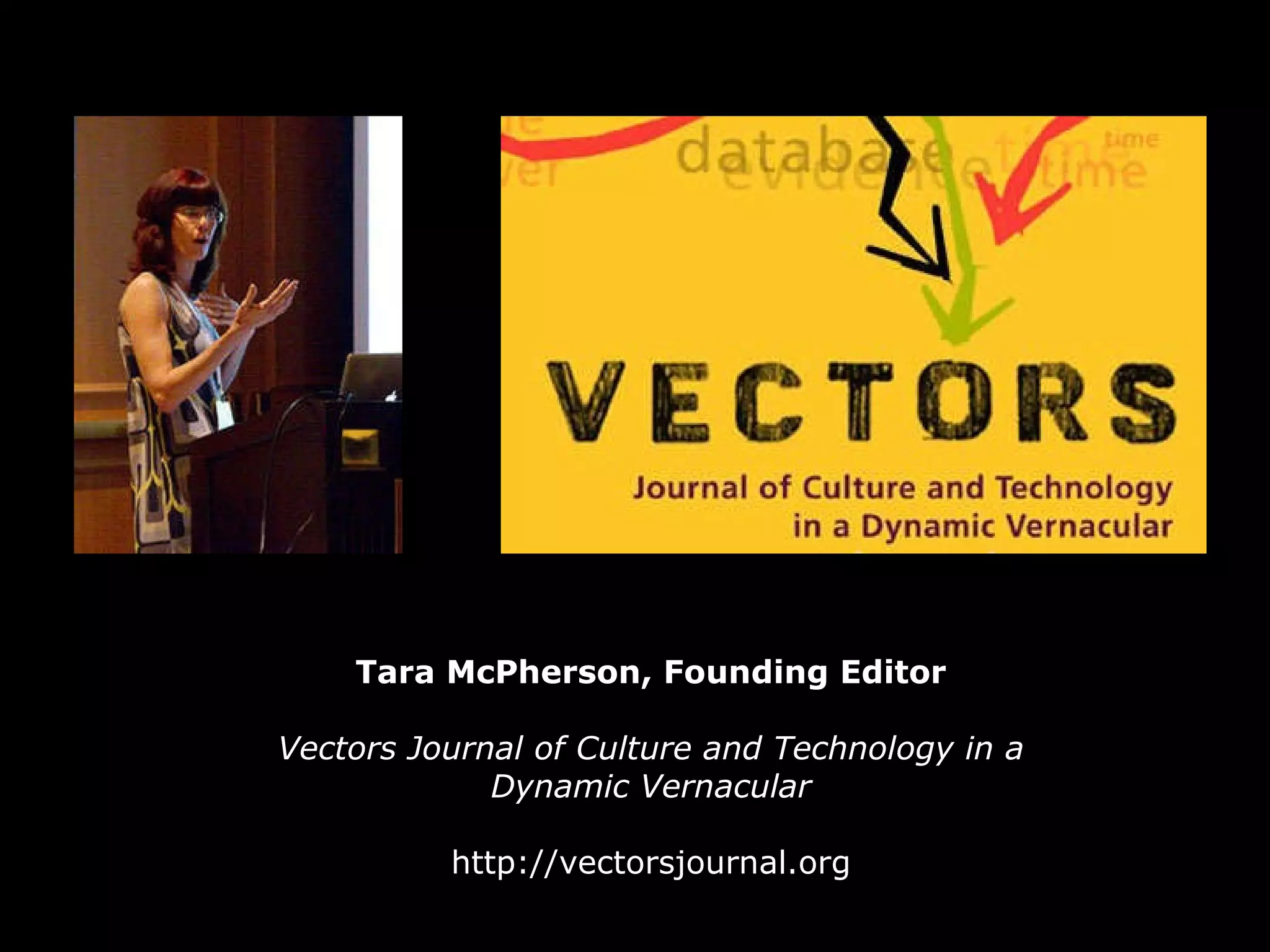
Tara McPherson, Founding Editor Vectors Journal of Culture and Technology in a Dynamic Vernacular http://vectorsjournal.org
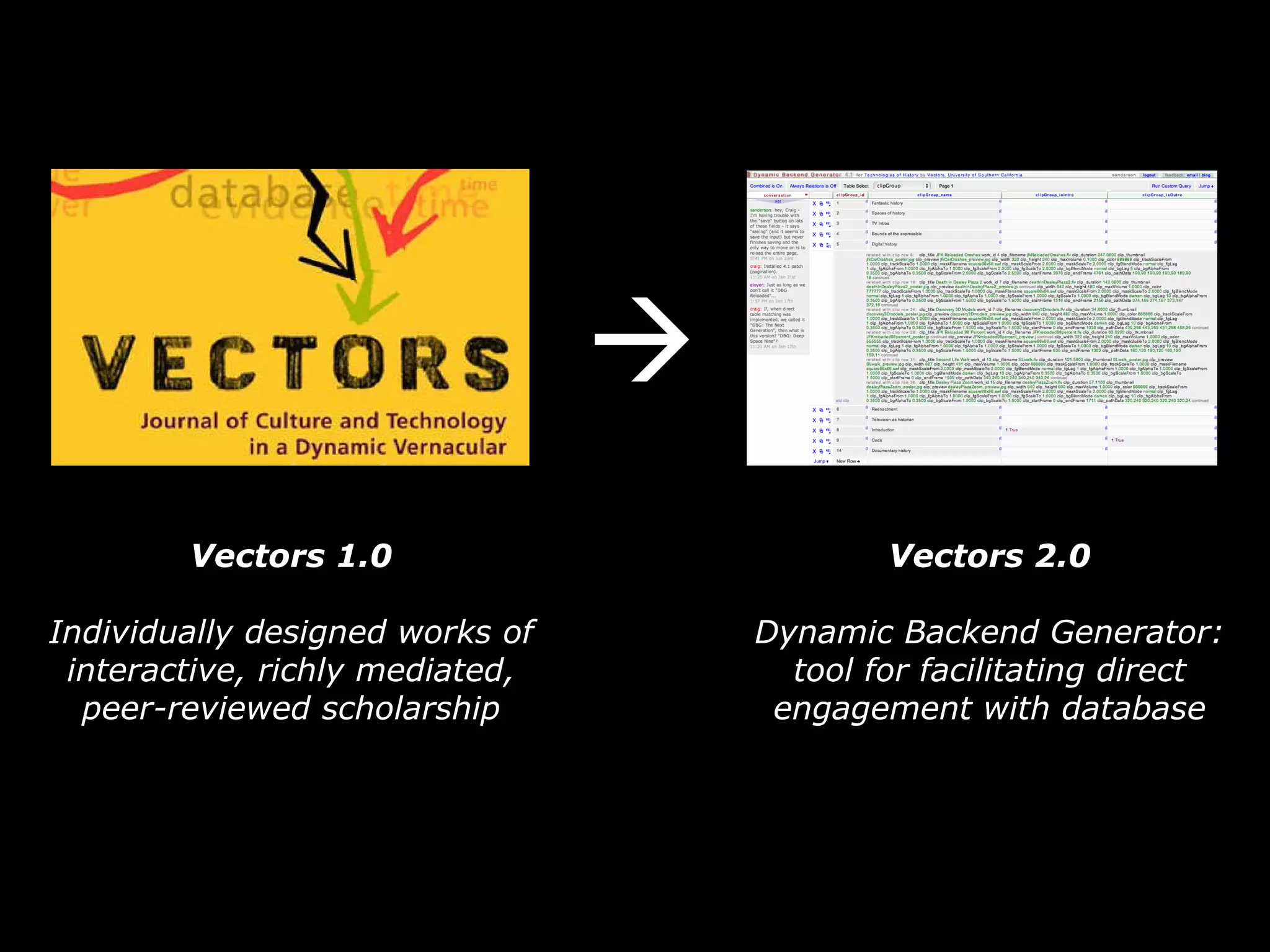
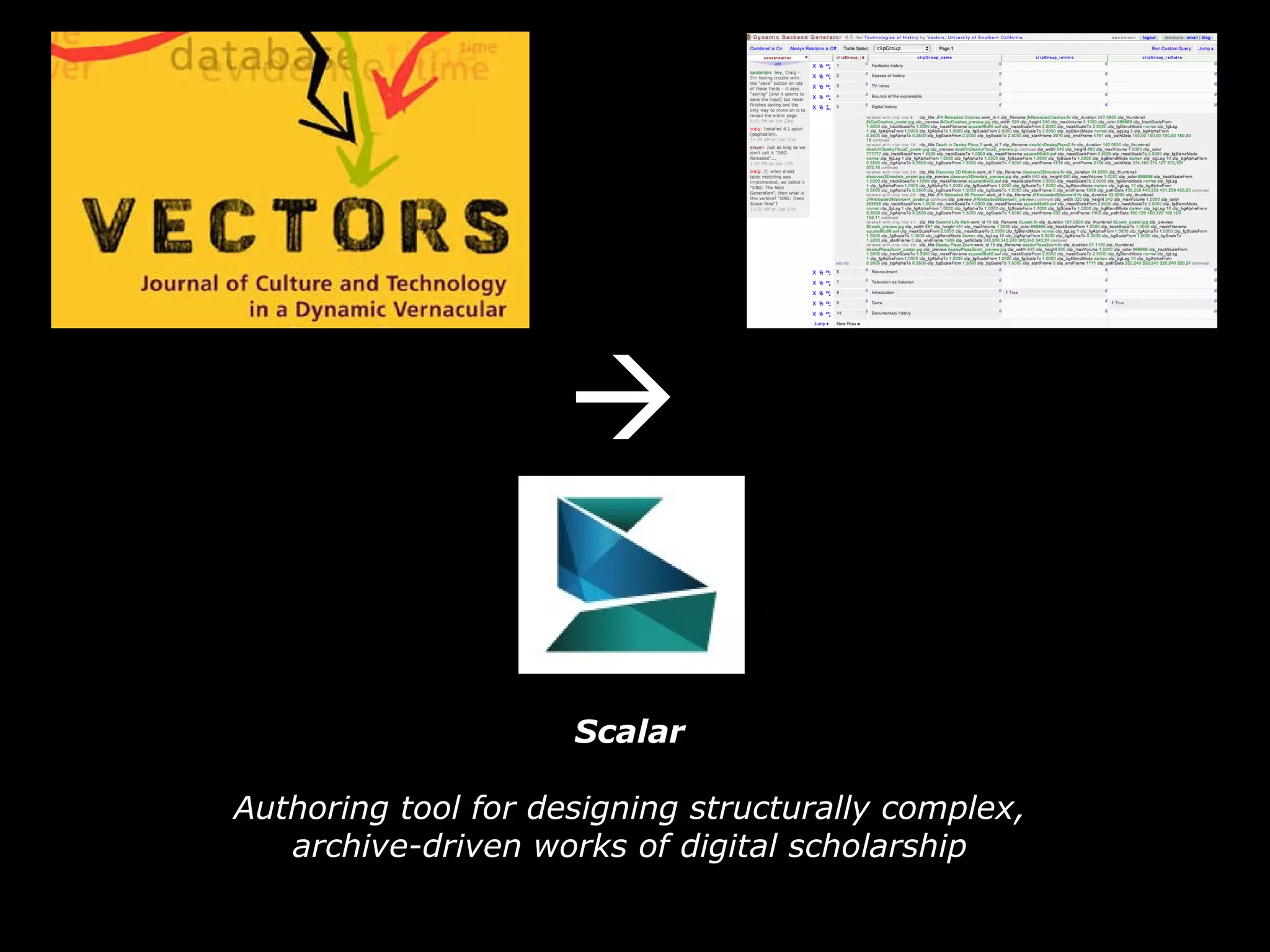
Vectors 1.0 Individually designed works of interactive, richly mediated, peer-reviewed scholarship  Vectors 2.0 Dynamic Backend Generator: tool for facilitating direct engagement with database
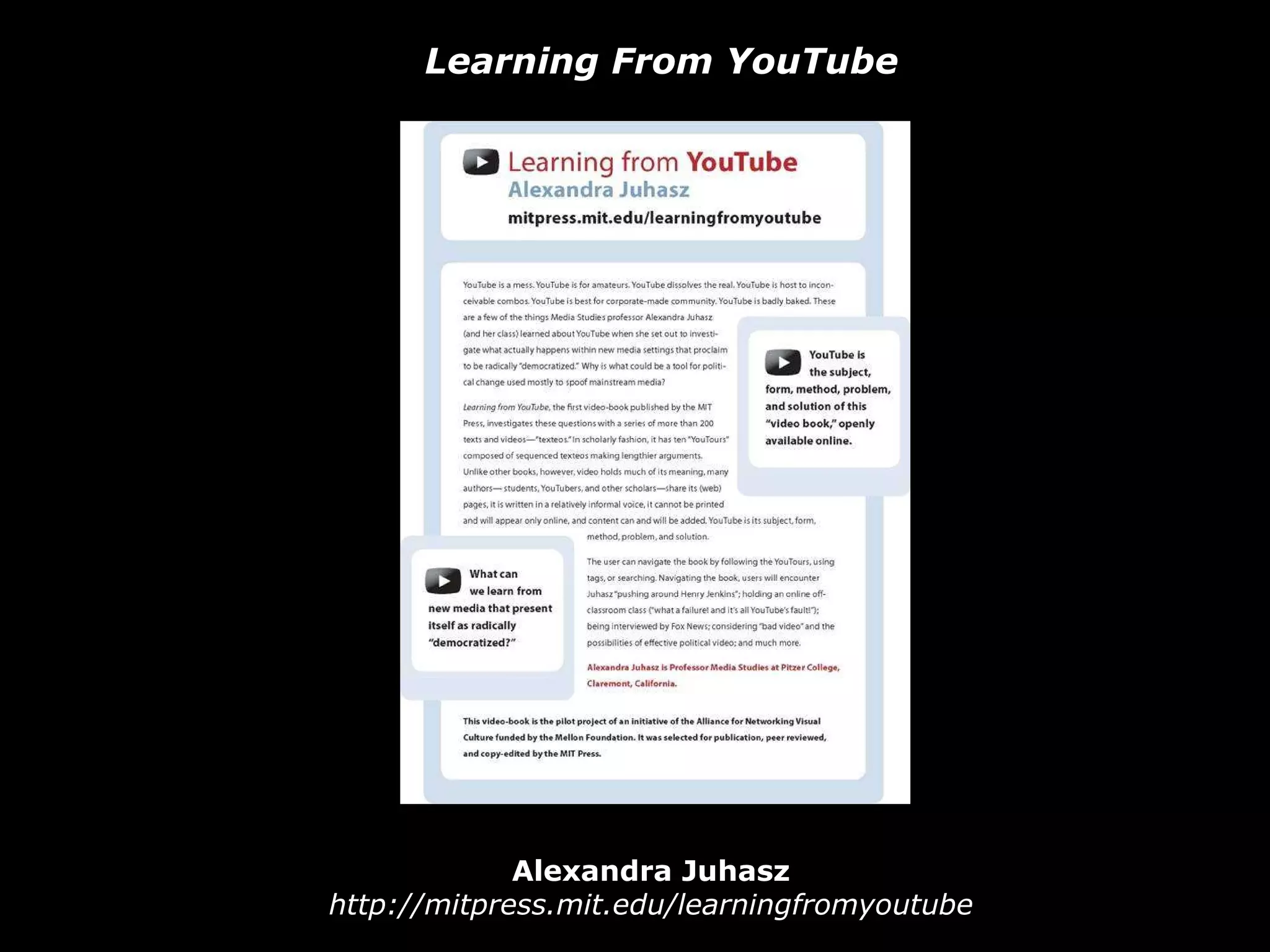
Learning from YouTube Alexandra Juhasz http://mitpress.mit.edu/learningfromyoutube Learning From YouTube
 Scalar Authoring tool for designing structurally complex, archive-driven works of digital scholarship
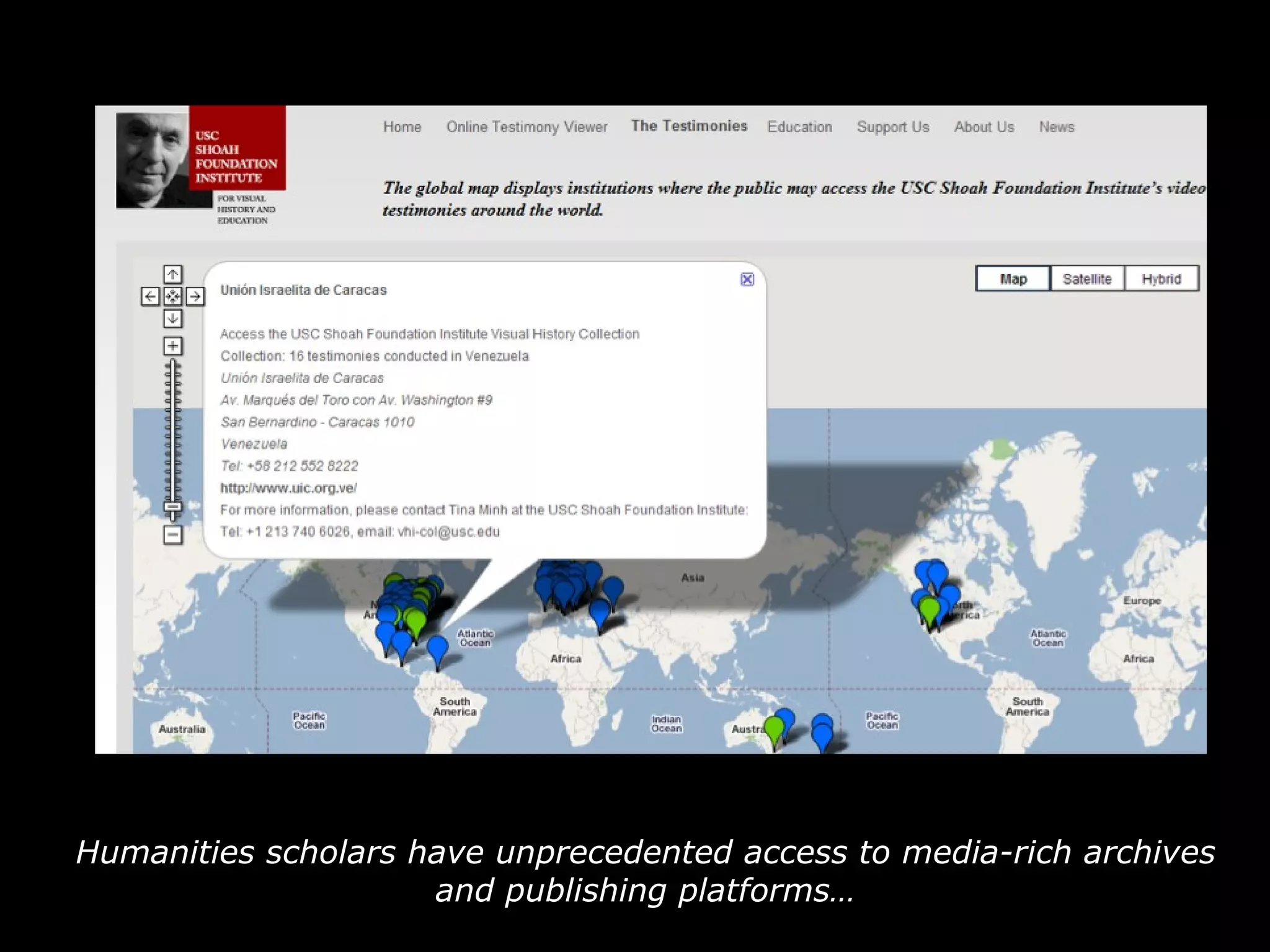
Humanities scholars have unprecedented access to media-rich archives and publishing platforms…
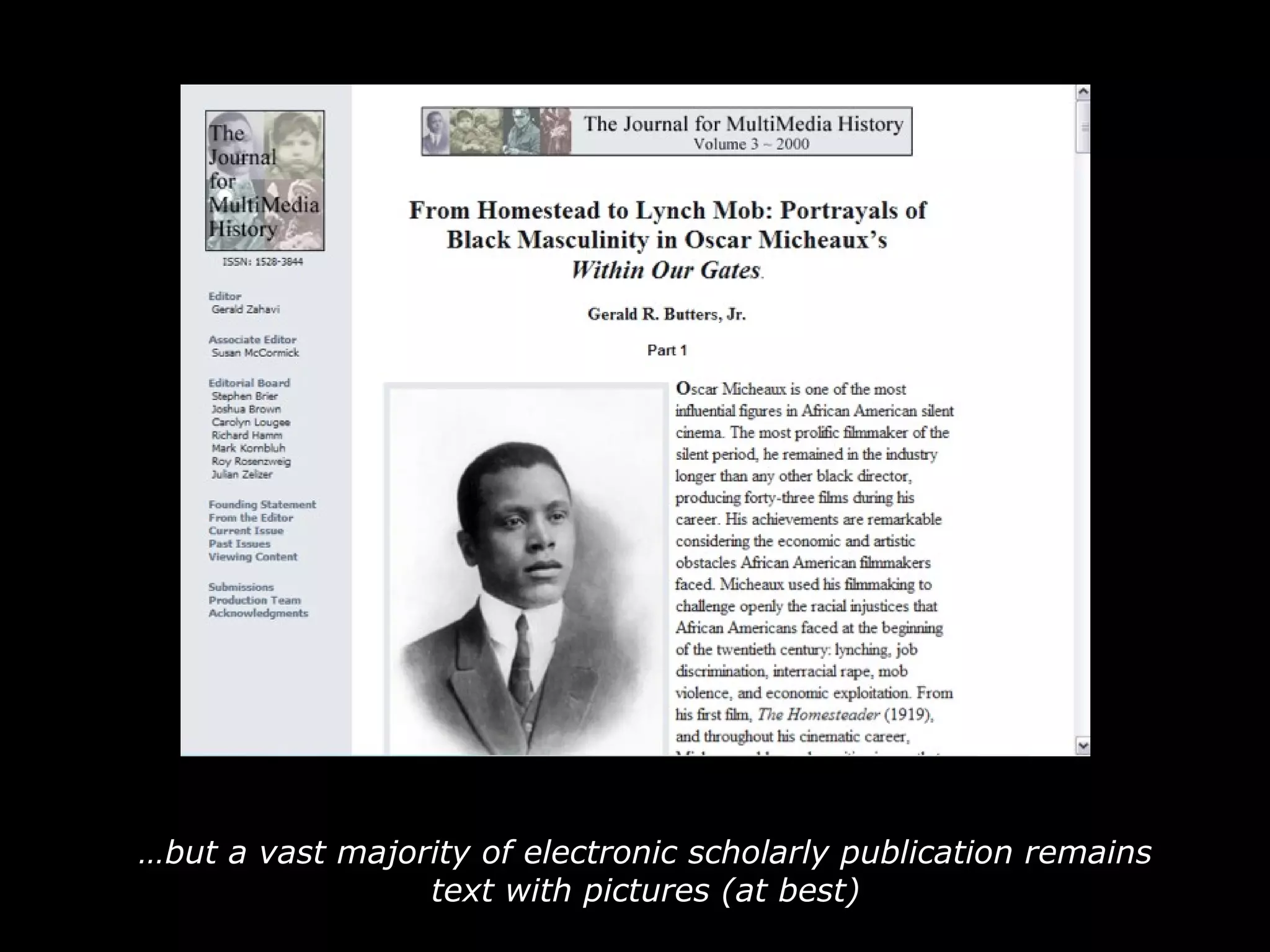
… but a vast majority of electronic scholarly publication remains text with pictures (at best)
If humanists are interested in creating in their work with digital technologies - the subjective, inflected, and annotated processes central to humanistic inquiry - they must be committed to designing the digital systems and tools for their future work. -Johanna Drucker   Chronicle of Higher Education  (2009)
Alliance for Networking Visual Culture Drawing on the insights of five years of publishing  Vectors  to define priorities for emerging modes of scholarship Relational thinking Emergent genres of multimodal scholarship Process as much as product  Rethinking digital tools Support from: Mellon Foundation National Endowment for the Humanities USC Institute for Multimedia Literacy
Alliance for Networking Visual Culture University Presses MIT Press Duke University Press University of California Press Archive partners Shoah Foundation Hemispheric Institute Internet Archive Critical Commons
http://scalar.usc.edu

XSEAD presentation Scalar 1/19/12

  • 1.
    Steve Anderson + Erik Loyer Alliance for Networking Visual Culture University of Southern California
  • 2.
    Institute for MultimediaLiteracy School of Cinematic Arts
  • 3.
    Tara McPherson, FoundingEditor Vectors Journal of Culture and Technology in a Dynamic Vernacular http://vectorsjournal.org
  • 4.
    Vectors 1.0 Individuallydesigned works of interactive, richly mediated, peer-reviewed scholarship  Vectors 2.0 Dynamic Backend Generator: tool for facilitating direct engagement with database
  • 5.
    Learning from YouTubeAlexandra Juhasz http://mitpress.mit.edu/learningfromyoutube Learning From YouTube
  • 6.
     Scalar Authoringtool for designing structurally complex, archive-driven works of digital scholarship
  • 7.
    Humanities scholars haveunprecedented access to media-rich archives and publishing platforms…
  • 8.
    … but avast majority of electronic scholarly publication remains text with pictures (at best)
  • 9.
    If humanists areinterested in creating in their work with digital technologies - the subjective, inflected, and annotated processes central to humanistic inquiry - they must be committed to designing the digital systems and tools for their future work. -Johanna Drucker Chronicle of Higher Education (2009)
  • 10.
    Alliance for NetworkingVisual Culture Drawing on the insights of five years of publishing Vectors to define priorities for emerging modes of scholarship Relational thinking Emergent genres of multimodal scholarship Process as much as product Rethinking digital tools Support from: Mellon Foundation National Endowment for the Humanities USC Institute for Multimedia Literacy
  • 11.
    Alliance for NetworkingVisual Culture University Presses MIT Press Duke University Press University of California Press Archive partners Shoah Foundation Hemispheric Institute Internet Archive Critical Commons
  • 12.

Editor's Notes

  • #4 Structuring absence #2 = Tara McPherson; Founding Editor of Vectors, PI on Alliance for Networking Visual Culture, an initiative funded by the Mellon Foundation that is meant to scale the experiments of Vectors to a much wider audience and model new scholarly workflows.
  • #5 Vectors – published 5-6 issues over the course of as many years; each with around 8 interactive, heavily designed media-rich works of humanities and social science scholarship Committed to the benefit of engaging the computational potentials of emerging modes of scholarship; built a tool that we internally called the DBG; which facilitated having our scholars work directly in their database; not programming but not handing the project off to our design and programming team either; the work of the journal became increasingly an intervention in scholarly practice; Also mining the scholars we worked with for insights into what kind of tools and authoring platforms they really needed and were able to use.
  • #6 http://scalar.usc.edu/anvc/kuhn/index http://ijlm.net/knowinganddoing/10.1162/IJLM_a_00057
  • #10 Humanists must plan their digital future April 3, 2009 Blind Spots By JOHANNA DRUCKER we currently face “a criti- cal juncture” with regard to faculty interest in crafting digital tools , and calls on scholars to take seriously the task of imagining the future of digital scholarship